anaheim-gazette 1914-02-19
Scanned page
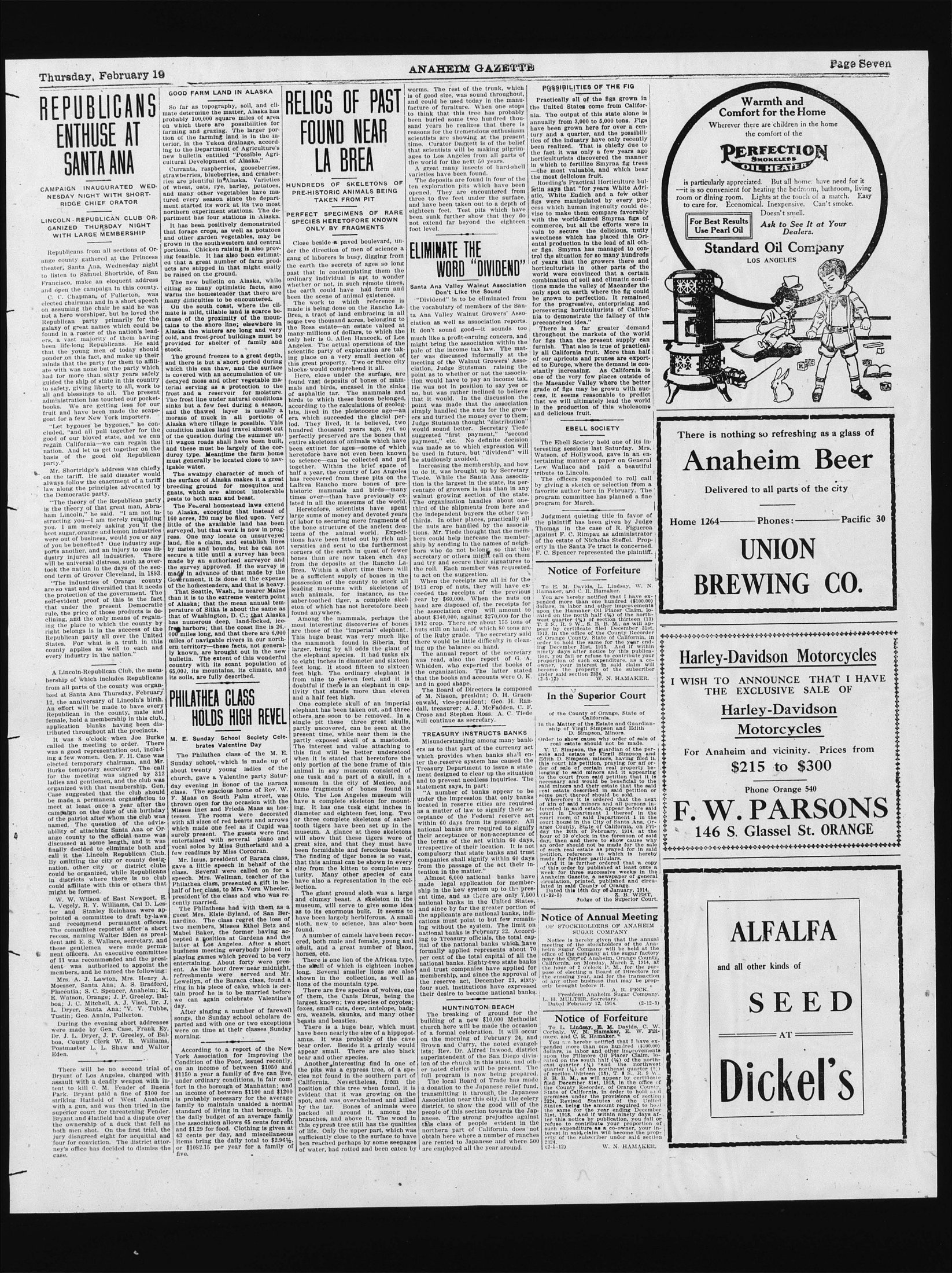
Searchable text
REPUBLICANS ENTHUSE AT SANTA ANA
CAMPAIGN INAUGURATED WEDNESDAY NIGHT WITH SHORT-RIDGE CHIEF ORATOR
LINCOLN·REPUBLICAN CLUB ORGANIZED THURSDAY NIGHT WITH LARGE MEMBERSHIP
Republicans from all sections of Orange county gathered at the Princess theater, Santa Ana, Wednesday night to listen to Samuel Shortride, of San Francisco, make an eloquent address and open the campaign in this county.
C. C. Chapman, of Fullerton, was elected chairman and in a short speech on assuming the chair he said he was not a hero worshiper, but he loved the Republican party primarily for the galaxy of great names which could be found in a roster of the nation's leaders, a vast majority of them having been life-long Republicans. He said that the young men of today should ponder on this fact, and make up their minds that the party for them to affiliate with was none but the party which had for more than sixty years safely guided the ship of state in this country to safety, giving liberty to all, work to all and blessings to all. The present administration has touched our pocketbooks. We are getting less for our fruit and have been made the scapegoat for a few New York importers.
"Let bygones be bygones," he concluded, "and all pull together for the good of our bloved state, and we can regain California—we can regain the nation. And let us get together on the basis of the good old Republican party."
Mr. Shortridge's address was chiefly
GOOD FARM LAND IN ALASKA
So far as topography, soil, and climate determine the matter, Alaska has probably 100,000 square miles of area on which there are possibilities for farming and grazing. The larger portion of the farming land is in the interior, in the Yukon drainage, according to the Department of Agriculture's new bulletin entitled "Possible Agricultural Development of Alaska."
Currants, raspberries, gooseberries, strawberries, blueberries, and cranberries are plentiful in Alaska. Varieties of wheat, oats, rye, barley, potatoes, and many other vegetables have matured every season since the department started its work at its two most northern experiment stations. The department has four stations in Alaska.
It has been positively demonstrated that forage crops, as well as potatoes and other garden vegetables, may be grown in the southwestern and central portions. Chicken raising is also proving feasible. It has also been estimated that a great number of farm products are shipped in that might easily be raised on the ground.
The new bulletin on Alaska, while citing so many optimistic facts, also warns the homesteader that there are many difficulties to be encountered.
On the south coast, where the climate is mild, tillable land is scarce because of the proximity of the mountains to the shore line; elsewhere in Alaska the winters are long and very cold, and frost-proof buildings must be provided for shelter of family and stock.
The ground freezes to a great depth, and there is but a short period during which this can thaw, and the surface is covered with an accumulation of undecayed moss and other vegetable material serving as a protection to the frost and a reservoir for moisture. The frost line under natural conditions sinks but a few feet during a season, and the thawed layer is usually a morass of mudk in all portions of Alaska where tillage is possible. This condition makes land travel almost out of the question during the summer until wagon roads shall have been built, and these must be largely of the corduroy type. Meantime the farm home must generally be located close to navigable water.
The swampy character of much of
had for more than sixty years safely guided the ship of state in this country to safety, giving liberty to all, work to all and blessings to all. The present administration has touched our pocketbooks. We are getting less for our fruit and have been made the scapegoat for a few New York importers.
"Let bygones be bygones," he concluded, "and all pull together for the good of our bloved state, and we can regain California—we can regain the nation. And let us get together on the basis of the good old Republican party."
Mr. Shortridge's address was chiefly on the tariff. He said disaster would always follow the enactment of a tariff law along the principles advocated by the Democratic party.
"The theory of the Republican party is the theory of that great man, Abraham Lincoln," he said. "I am not instructing you—I am merely reminding you. I am merely asking you if the beet sugar, orange and lemon industries were out of business, would you or any of you be benefited? One industry supports another, and an injury to one industry injures all industries. There will be universal distress, such as overtook the nation in the days of the second term of Grover Cleveland, in 1893.
"The industries of Orange county are so vast and diversified that it needs the protection of the government. The self-evident proof of this is the fact that under the present Democratic rule, the price of those products is declining, and the only means of regaining the place to which the county by right belongs is in the success of the Republican party all over the United States. For what is a truth in this county applies as well to each and every industry in the nation."
A Lincoln-Republican Club, the membership of which includes Republicans from all parts of the county was organized at Santa Ana Thursday, February 12, the anniversary of Lincoln's birth. An effort will be made to have every Republican in the county, male and female, hold a membership in this club, application blanks having been distributed throughout all the precincts.
It was 8 o'clock when Joe Burke called the meeting to order. There was a good representation out, including a few women. Gen. F. H. Case was elected temporary chairman, and Mr. Burke temporary secretary. The call for the meeting was signed by 312 ladies and gentlemen, and the club was organized with that membership. Gen. Case suggested that the club should be made a permanent organization to meet at least once a year after the campaign on the date of the birthday of the patriot after whom the club was named. The question of the advisability of attaching Santa Ana or Orange county to the official name was discussed at some length, and it was finally decided to eliminate both and call it the Lincoln Republican Club.
By omitting the city or county designation, other city or district clubs could be organized, while Republicans in districts where there is no club could affiliate with this or others that might be formed.
PHILATHEA CLASS HOLDS HIGH REVEL
M. E. Sunday School Society Celebrates Valentine Day
The Philathea class of the M. E. Sunday school, which is made up of about twenty young ladies of the church, gave a Valentine party Saturday evening in honor of the Baraca class. The spacious home of Rev. W. F. Maas on South Palm street, was thrown open for the occasion with the Misses Inez and Frieda Maas as hostesses. The rooms were decorated with all sizes of red hearts and arrows which made one feel as if Cupid was surely present. The guests were first entertained with several piano and vocal solos by Miss Sutherland and a few readings by Miss Corcoran.
Mr. Imus, president of Baraca class, gave a little speech in behalf of the class. Several were called on for a speech. Mrs. Wellman, teacher of the Philathea class, presented a gift in behalf of her class, to Mrs. Vern Wheeler, president of the class and who was covered with an accumulation of decayed moss and other vegetable serving as a protection to the frost and a reservoir for moisture. The frost line under natural conditions sinks but a few feet during a season, and the thawed layer is usually a morass of mudk in all portions of Alaska where tillage is possible. This condition makes land travel almost out of the question during the summer until wagon roads shall have been built, and these must be largely of the corduroy type. Meantime the farm home must generally be located close to navigable water.
The swampy character of much of the surface of Alaska makes it a great breeding ground for mosquitoes and gnats, which are almost intolerable pests to both man and beast.
The Federal homestead laws extend to Alaska, excepting that instead of 160 acres, 320 may be filed upon. Very little of the available land has been surveyed, but that work is now in progress. One may locate on unsurveyed land, file a claim, and establish lines by metes and bounds, but he can not secure a title until a survey has been made by an authorized surveyor and the survey approved. If the survey is made in advance of that made by the Government, it is done at the expense of the homesteaders, and that is heavy.
That Seattle, Wash., is nearer Maine than it is to the extreme western point of Alaska; that the mean annual temperature of Sitka is about the same as that of Washington, D.C.; that Alaska has numerous deep, land-locked, ice-free harbors; that the coast line is 26,000 miles long, and that there are 6,000 miles of navigable rivers in our northern territory—these facts, not generally known, are brought out in the new bulletin. The extent of this wonderful country with its scant population of 65,000, its mountains, its climate, and its soils, are fully described.
Among the mammals most interesting dissect are those of the "imu." This huge beast was the mammoth found larger, being by all the elephant species to eight inches in diagonal feet long. It stood feet high. The ordinance from nine to eleven doubtful if there is any activity that stands rare and a half feet high.
One complete skull elephant has been taken others are soon to be single pit these partly uncovered, can present time, while they partly exposed skull The interest and view this find will be when it is stated that only portion of the lion animal in any muscled one tusk and a parrot museum in the city some fragments of Ohio. The Los Angeles have a complete sking It has one tusk diameter and eighteen or three complete teeth tigers have been museum. A glance will show that their great size, and that been formidable and The finding of tiger that this animal can size from the kitterture Many other have also a represen-
be made a permanent organization to meet at least once a year after the campaign on the date of the birthday of the patriot after whom the club was named. The question of the advisability of attaching Santa Ana or Orange county to the official name was discussed at some length, and it was finally decided to eliminate both and call it the Lincoln Republican Club. By omitting the city or county designation, other city or district clubs could be organized, while Republicans in districts where there is no club could affiliate with this or others that might be formed.
W. W. Wilson of East Newport, E. L. Vegely, R. Y. Williams, Cal D. Lester and Stanley Reinhaus were appointed a committee to draft by-laws and recommend permanent officers. The committee reported after a short recess, naming Walter Eden as president and E. S. Wallace, secretary, and these gentlemen were made permanent officers. An executive committee of 11 was recommended and the president was authorized to appoint the members, and he named the following:
Mrs. A. J. Lawton, Mrs. Henry A. Moesser, Santa Ana; A. S. Bradford, Placentia; S. C. Spencer, Anaheim; K. E. Watson, Orange; J. P. Greeley, Balboa; J. C. Mitchell, A. J. Visel, Dr. J. L. Dryer, Santa Ana; V. V. Tubbs, Tustin; Geo. Annin, Fullerton.
During the evening short addresses were made by Gen. Case, Frank Ey, Dr. J. L. Dryer, J. P. Greeley, of Balboa, County Clerk W. B. Williams, Postmaster L. L. Shaw and Walter Eden.
There will be no second trial of Bryant of Los Angeles, charged with assault with a deadly weapon with intent to kill C. M. Fender of Buena Park. Bryant paid a fine of $100 for striking Hatfield of West Anaheim with a gun, and was then tried in the superior court for threatening Fender. Bryant and Hatfield had a dispute over the ownership of a duck that fell as both men shot. On the first trial, the jury disagreed eight for acquittal and four for conviction. The district attorney's office has decided to dismiss the case.
According to a report of the New York Association for Improving the Condition of the Poor, issued recently, on an income of between $1050 and $1150 a year a family of five can live, under ordinary conditions, in fair comfort in the borough of Manhattan; and an income of between $1100 and $1200 is probably necessary for the average family to maintain unaided a normal standard of living in that borough. In the daily budget of an average family the association allows 65 cents for rent and $1.29 for food. Clothing is given at 43 cents per day, and miscellaneous items bring the daily total to $2.96½, or $1082.15 per year for a family of five.
Mr. Imus, president of Baraca class, gave a little speech in behalf of the class. Several were called on for a speech. Mrs. Wellman, teacher of the Philathea class, presented a gift in behalf of her class, to Mrs. Vern Wheeler, president of the class and who was recently married.
The Philatheas had with them as a guest Mrs. Elsie Byland, of San Bernardino. The class regret the loss of two members, Misses Ethel Betz and Mabel Baker, the former having accepted a position at Gardena and the latter at Los Angeles. After a short business meeting everybody joined in playing games which proved to be very entertaining. About forty were present. As the hour drew near midnight, refreshments were served and Mr. Lewellyn, of the Baraca class, found a ring in his piece of cake, which is certain proof he is to be married before we can again celebrate Valentine's day.
After singing a number of farewell songs, the Sunday school scholars departed and with one or two exceptions were on time at their classes Sunday morning.
Another interest the pits was a cypcles not found in California. Never position of this tree evident that it was spot, and was over by the tar. Bone packed all around branches, and about this cypress tree set of life. Only the up sufficiently close to ben reached perhaps of water, had rotten
RELICS OF PAST FOUND NEAR LA BREA
HUNDREDS OF SKELETONS OF PRE-HISTORIC ANIMALS BEING TAKEN FROM PIT
PERFECT SPECIMENS OF RARE SPECIES HERETOFORE KNOWN ONLY BY FRAGMENTS
Close beside a paved boulevard, under the direction of men of science a gang of laborers is busy, digging from the earth the secrets of ages so long past that in contemplating them the ordinary individual is apt to wonder whether or not, in such remote times, the earth could have had form and been the scene of animal existence.
The work to which reference is made is being done on the Rancho La Brea, a tract of land embracing in all some two thousand acres, belonging to the Ross estate—an estate valued at many millions of dollars, to which the only heir is G. Allen Hancock, of Los Angeles. The actual operations of the scientific party of exploration are taking place on a very small section of this great property. Two or three city blocks would comprehend it all.
Here, close under the surface, are found vast deposits of bones of mammals and birds, encased in the sinks of asphaltic tar. The mammals and birds to which these bones belonged, according to the calculations of geologists, lived in the pleistocene age—an era which succeeded the glacial period. They lived, it is believed, two hundred thousand years ago, yet so perfectly preserved are the bones that entire skeletons of animals which have been extinct for ages—some of which heretofore have not even been known to science—can be collected and put together. Within the brief space of half a year, the county of Los Angeles worms. The rest of the trunk, which is of good size, was sound throughout, and could be used today in the manufacture of furniture. When one stops to think that this tree has probably been buried some two hundred thousand years he realizes that there is reasons for the tremendous enthusiasm scientists are showing at the present time. Curator Daggett is of the belief that scientists will be making pilgrimages to Los Angeles from all parts of the world for the next 50 years.
A great many insects of hard-shell varieties have been found.
The deposits are found in four of the ten exploration pits which have been opened. They are encountered from three to five feet under the surface, and have been taken out to a depth of eighteen feet. Test pits which have been sunk further show that they do not extend far beyond the eighteen foot level.
ELIMINATE THE WORD "DIVIDEND"
Santa Ana Valley Walnut Association Don't Like the Sound
"Dividend" is to be eliminated from the vocabulary of members of the Santa Ana Valley Walnut Growers' Association as well as association reports. It don't sound good—it sounds too much like a profit-earning concern, and might bring the association within the pale of the income tax law. The matter was discussed informally at the meeting of the Walnut Growers' Association, Judge Stutsman raising the point as to whether or not the association would have to pay an income tax. He was not in position to say yes or no, but was rather inclined to believe that it would. In the discussion the point was made that the association simply handled the nuts for the growers and turned the money over to them. Judge Stutsman thought "distribution" would sound better. Secretary Tiede suggested "first payment," "second payment," etc. No definite decision was made as to which expression will be used in future, but "dividend" will be studiously avoided.
Increasing the membership, and how to do it, was brought up by Secretary POSSIBILITIES OF THE FIG
Practically all of the figs grown in the United States come from California. The output of this state alone is annually from 3,000 to 5,000 tons. Figs have been grown here for over a century and a quarter, and the possibilities of the industry have only recently been realized. That is chiefly due to the fact it was only a few years ago horticulturists discovered the manner in which fertilize Smyrna fig trees—the most valuable, and which bear the most delicious fruit.
Roeding's Practical Horticulture bulletin says that "for years White Adriatic, White Endich and a few other figs were manipulated by every process which human ingenuity could devise to make them compare favorably with the world-famed Smyrna figs of commerce, but all the efforts were in vain to secure the delicious, nutty sweetness which has placed this Oriental production in the lead of all other figs. Smyrna has managed to control the situation for so many hundreds of years that the growers there and horticulturists in other parts of the world were convinced that a certain combination of soil and climatic conditions made the valley of Maeander the only spot on earth where the fig could be grown to perfection. It remained for the progressive, enterprising and persevering horticulturists of California to demonstrate the fallacy of this preconceived idea."
There is a far greater demand throughout the markets of the world for figs than the present supply can furnish. That also is true of practically all California fruit. More than half of our apricots and prunes are exported to Europe, where the demand is constantly increasing. As California is one of the very few places outside of the Maeander Valley where the better grade of figs may be grown with success, it seems reasonable to predict that we will ultimately lead the world in the production of this wholesome and delicious fruit.
EBELL SOCIETY
The Ebell Society held one of its interesting sessions last Saturday. Mrs. Watson, of Hollywood, gave in an entertaining manner a paper on General Lew Wallace and paid a beautiful tribute to Lincoln.
Here, close under the surface, are found vast deposits of bones of mammals and birds, encased in the sinks of asphaltic tar. The mammals and birds to which these bones belonged, according to the calculations of geologists, lived in the pleistocene age—an era which succeeded the glacial period. They lived, it is believed, two hundred thousand years ago, yet so perfectly preserved are the bones that entire skeletons of animals which have been extinct for ages—some of which heretofore have not even been known to science—can be collected and put together. Within the brief space of half a year, the county of Los Angeles has recovered from these pits on the LaBrea Rancho more bones of prehistoric mammals and birds—many times over—than have previously existed in all the museums of the world.
Heretofore, scientists have spent large sums of money and devoted years of labor to securing mere fragments of the bone structure of the ancient denizens of the animal world. Expeditions have been fitted out by rich universities and sent to the furthermost corners of the earth in quest of fewer bones than are now taken each day from the deposits at the Rancho LaBrea. Within a short time there will be a sufficient supply of bones in the possession of the county to stock all leading museums with skeletons of such animals, for instance, as the saber-toothed tiger, a complete skeleton of which has not heretofore been found anywhere.
Among the mammals, perhaps the most interesting discoveries of bones are those of the "imperial" elephant. This huge beast was very much like the mammoth found in Siberia, but larger, being by all odds the giant of the elephant species. It had tusks six to eight inches in diameter and sixteen feet long. It stood fifteen to sixteen feet high. The ordinary elephant is from nine to eleven feet, and it is doubtful if there is an elephant in captivity that stands more than eleven and a half feet high.
One complete skull of an imperial elephant has been taken out, and three others are soon to be removed. In a single pit these three great skulls, partly uncovered, can be seen at the present time, while near them is the partly exposed skull of a mastodon. The interest and value attaching to this find will be better understood when it is stated that heretofore the only portion of the bone frame of this animal in any museum consisted of one tusk and a part of a skull, in a museum in the city of Mexico, and some fragments of bones found in Ohio. The Los Angeles museum will have a complete skeleton for mounting. It has one tusk eight inches in diameter and eighteen feet long. Two or three complete skeletons of saber-toothtigers have been set up in the museum. A glance at these skeletons will show that these tigers were of great size, and that they must have been formidable and ferocious beasts. The finding of tiger bones is so vast, that this animal can be shown in every size from the kitten to complete maturity. Many other species of cats have also a representation in the collection.
The giant ground sloth was a large and clumsy beast. A skeleton in the point as to whether or not the association would have to pay an income tax. He was not in position to say yes or no, but was rather inclined to believe that it would. In the discussion the point was made that the association simply handled the nuts for the growers and turned the money over to them. Judge Stutsman thought "distribution" would sound better. Secretary Tiede suggested "first payment," "second payment," etc. No definite decision was made as to which expression will be used in future, but "dividend" will be studiously avoided.
Increasing the membership, and how to do it, was brought up by Secretary Tiede. While the Santa Ana association is the largest in the state, its percentage of growers is less than in any walnut growing section of the state. The organization handles about one-third of the shipments from here and the independent buyers other two-thirds. In other places, practically all nuts are handled by the associations. Mr. Tiede thought that the members could help increase the membership by sending in the names of neighbors who do not belong so that the secretary or others might call on them and try and secure their signatures to the roll. Each member was requested to act on the suggestion.
When the receipts are all in for the 1913 crop of nuts, they will have exceeded the receipts of the previous year by $60,000. When the nuts on hand are disposed of, the receipts for the association crop will amount to about $340,000, against $270,000 for the 1912 crop. There are about 155 tons of nuts still on hand, of which 80 tons are of the Ruby grade. The secretary said there would be little difficulty in cleaning up the balance on hand.
The annual report of the secretary was read, also the report of G. A. Whidden, who experted the books of the organization. The latter stated that the books and accounts were O. K. and in good shape.
The Board of Directors is composed of M. Nisson, president; O. H. Gruenewald, vice-president; Geo. H. Randall, treasurer; A. J. McFadden, C. F. Crose and Stephen Ross. A. C. Tiede will continue as secretary.
TREASURY INSTRUCTS BANKS
Misunderstanding among many bankers as to that part of the currency act which provides when banks shall enter the reserve system has caused the Treasury Department to issue a statement designed to clear up the situation and to prevent needless inquiries. The statement says, in part:
"A number of banks appear to be under the impression that only banks located in reserve cities are required as a matter of law to signify their acceptance of the Federal reserve act within 60 days from its passage. All national banks are required to signify their acceptance or non-acceptance of the terms of the act within 60 days, irrespective of their location. It is not compulsory that state banks and trust companies shall signify within 60 days from the passage of the act their intention in the matter."
Almost 6,000 national banks have made legal application for membership in the new system up to the present time, and as there are only 7,500 one of the very few places outside of the Maeander Valley where the better grade of figs may be grown with success, it seems reasonable to predict that we will ultimately lead the world in the production of this wholesome and delicious fruit.
EBELL SOCIETY
The Ebell Society held one of its interesting sessions last Saturday. Mrs. Watson, of Hollywood, gave in an entertaining manner a paper on General Lew Wallace and paid a beautiful tribute to Lincoln.
The officers responded to roll call by giving a sketch or selection from a favorite author born in February. The program committee has planned a fine program for March.
Judgment quieting title in favor of the plaintiff has been given by Judge Thomas in the case of R. Figueroa against F. C. Rimpau as administrator of the estate of Nicholas Steffel. Property in the Santa Fe tract is concerned. F. C. Spencer represented the plaintiff.
Notice of Forfeiture
To E. M. Davids, L. Lindsay, W. N. Hamaker, and C. R. Hamaker.
You are hereby notified that I have expended more than one hundred ($100.00) dollars, in labor and other improvements upon the Hamaker Oil Placer Claim, located on the north half (½) of the northwest quarter (¼) of section thirteen (13). T. 3 S., R. 9 W., S. B. B.M., as will appear by certificate filed December 31st, 1913, in the office of the County Recorder of Orange County, State of California, in order to hold same for the year ending December 31st, 1913. And if within ninety days after notice by this publication you fail or refuse to contribute your proportion of such expenditure, as a coowner, your interest in said claim will become the property of the subscriber under said section 2324.
W. N. HAMAKER.
In the Superior Court
of the County of Orange, State of California.
In the Matter of the Estate and Guardianship of Virgil Simpson and Edith D. Simpson, Minors.
Order to show cause why order of sale real estate should not be made.
V. U. Simpson, the guardian of persons and estate of Virgil Simpson and Edith D. Simpson, minors, having filed in this court his petition, praying for an order of sale certain real property belonging to said minors and it appearing to the court from said petition that it is necessary and would be beneficial to the said minors and their estate that said real estate described in said petition or some part thereof should be sold.
Wherefore it is ordered that next of kin of sald minors and all persons interested in said estate, appear before said court in Department 1 thereof in the court room of said Department 1 in the court house in the City of Santa Ana, Orange County, State of California, on Friday the 20th of February, 1914, at hour 10 o'clock in the forenoon of said day, then and there to show cause why an order should not be made for the sale of such real estate as prayed for in said petition, reference to which is hereby made for further particulars.
And it is further ordered that a copy of this order by published at least once a week for three successive weeks in The Anaheim Gazette, a newspaper of general circulation, printed and circulated in said County of Orange.
Dated this 16th day of January, 1914.
(1-22-5)
have a complete skeleton for mounting. It has one tusk eight inches in diameter and eighteen feet long. Two or three complete skeletons of saber-tooth tigers have been set up in the museum. A glance at these skeletons will show that these tigers were of great size, and that they must have been formidable and ferocious beasts. The finding of tiger bones is so vast, that this animal can be shown in every size from the kitten to complete maturity. Many other species of cats have also a representation in the collection.
The giant ground sloth was a large and clumsy beast. A skeleton in the museum, will serve to give some idea as to its enormous bulk. It seems to have been largely herbiferous. A small sloth, new to science, has also been found.
A number of camels have been recovered, both male and female, young and adult, and a great number of blison, horses, etc.
There is one lion of the African type, the skull of which is eighteen inches long. Several smaller lions are also shown in the collection, as well as lions of the mountain type.
There are five species of wolves, one of them, the Canis Dirus, being the largest known; two species of coyotes; foxes, small cats, deer, antelope, badgers, weazels, skunks, and many other beasts and beasties.
There is a huge bear, which must have been nearly the size of a hippopotamus. It was probably of the cave bear order. Beside it a grizzly would appear small. There are also black bear and other species.
Another interesting find in one of the pits was a cypress tree, of a species not found in the southern part of California. Nevertheless, from the position of this tree when found, it is evident that it was growing on the spot, and was overwhelmed and killed by the tar. Bones of animals were packed all around it, among the branches, and above it. The wood in this cypress tree still has the qualities of life. Only the upper part, which was sufficiently close to the surface to have been reached perhaps by some seepages of water, had rotted and been eaten by
HUNTINGTON BEACH
The breaking of ground for the building of a new $10,000 Methodist church here will be made the occasion of a formal celebration. It will occur on the morning of February 24, and Brown and Curry, the noted evangelists; Rev. Dr. Alfred Inwood, district superintendent of the San Diego division of the church in this state, and other noted clerics will be present. The full program is now being prepared.
The local Board of Trade has made a donation to the Japanese relief fund, transmitting it through the Japanese Association near this city, in the celery district, to show the good will of the people of this section towards the Japanese. The strong prejudice against this class of people evident in the northern part of California does not obtain here where a number of ranches are rented to Japanese and where 500 are employed all the year around.
Wherefore it is ordered that the next of kin of said minors and all persons interested in said estate, appear before said court in Department 1 thereof in the court room of said Department 1 in the court house in the City of Santa Ana, Orange County, State of California, on Friday the 20th of February, 1914, at the hour of 10 o'clock in the forenoon of said day, then there to show cause why an order should not be made for the sale of such real estate as prayed for in said petition, reference to which is hereby made for further particulars.
And it is further ordered that a copy of this order by published at least once a week for three successive weeks in the Anaheim Gazette, a newspaper of general circulation, printed, published and circulated in said County of Orange.
Dated this 16th day of January, 1914.
(1-22-5)
Z. B. WEST,
Judge of the Superior Court.
Notice of Annual Meeting
OF STOCKHOLDERS OF ANAHEIM
SUGAR COMPANY
Notice is hereby given that the annual meeting of the stockholders of the Anaheim Sugar Company will be held at the office of the company at the sugar factory near the City of Anaheim, Orange County, California, on Monday, March 2, 1914, at the hour of 2 o'clock P.M., for the purpose of electing a Board of Directors for the ensuing year, and for the transaction of any other business that may be properly brought before it.
A. R. PECK,
President Anaheim Sugar Company.
L. H. MULTER, Secretary.
Dated February 12, 1914.
Notice of Forfeiture
To L. Lindsay, E. M. Davids, C. W. Corbaly, W. N. Hamaker, E. W. Fillmore, and C. R. Hamaker.
You are hereby notified that I have expended more than one hundred ($100.00) dollars in labor and other improvements upon the Fillmore Oil Placer Claim, located on the south half (½) of the northeast quarter (¼) and the northwest quarter (¼) of the northeast quarter (¼) of section thirteen (18), T. S., R. 9 W., S. B. B. M., as will appear by certificate filed December 31st, 1918, in the office of the County Recorder, of Orange County, State of California, in order to hold said premises under the provisions of section 2324, Revised Statutes of the United States, being the amount required to hold the same for the year ending December 31st, 1918.
And if within ninety days after this notice by publication you fail or refuse to contribute your proportion of such expenditure as a co-owner, your interest in said claim will become the property of the subscriber under said section 2324.
(2-5-12)
W. N. HAMAKER.
Warmth and Comfort for the Home
Wherever there are children in the home
the comfort of the
PERFECTION
SMOKELESS
OIL HEATER
is particularly appreciated. But all homes have need for it
—it is so convenient for heating the bedroom, bathroom, living
room or dining room. Lights at the touch of a match. Easy
to care for. Economical. Inexpensive. Can't smoke.
Doesn't smell.
For Best Results
Use Pearl Oil
Ask to See It at Your Dealers.
Standard Oil Company
LOS ANGELES
There is nothing so refreshing as a glass of
Anaheim Beer
There is nothing so refreshing as a glass of
Anaheim Beer
Delivered to all parts of the city
Home 1264——Phones:——Pacific 30
UNION
BREWING CO.
Harley-Davidson Motorcycles
I WISH TO ANNOUNCE THAT I HAVE
THE EXCLUSIVE SALE OF
Harley-Davidson
Motorcycles
For Anaheim and vicinity. Prices from
$215 to $300
Phone Orange 540
F. W. PARSONS
146 S. Glassel St. ORANGE
F. W. PARSONS
146 S. Glassel St. ORANGE
ALFALFA
and all other kinds of
SEED
AT
Dickel's