anaheim-gazette 1914-02-12
Scanned page
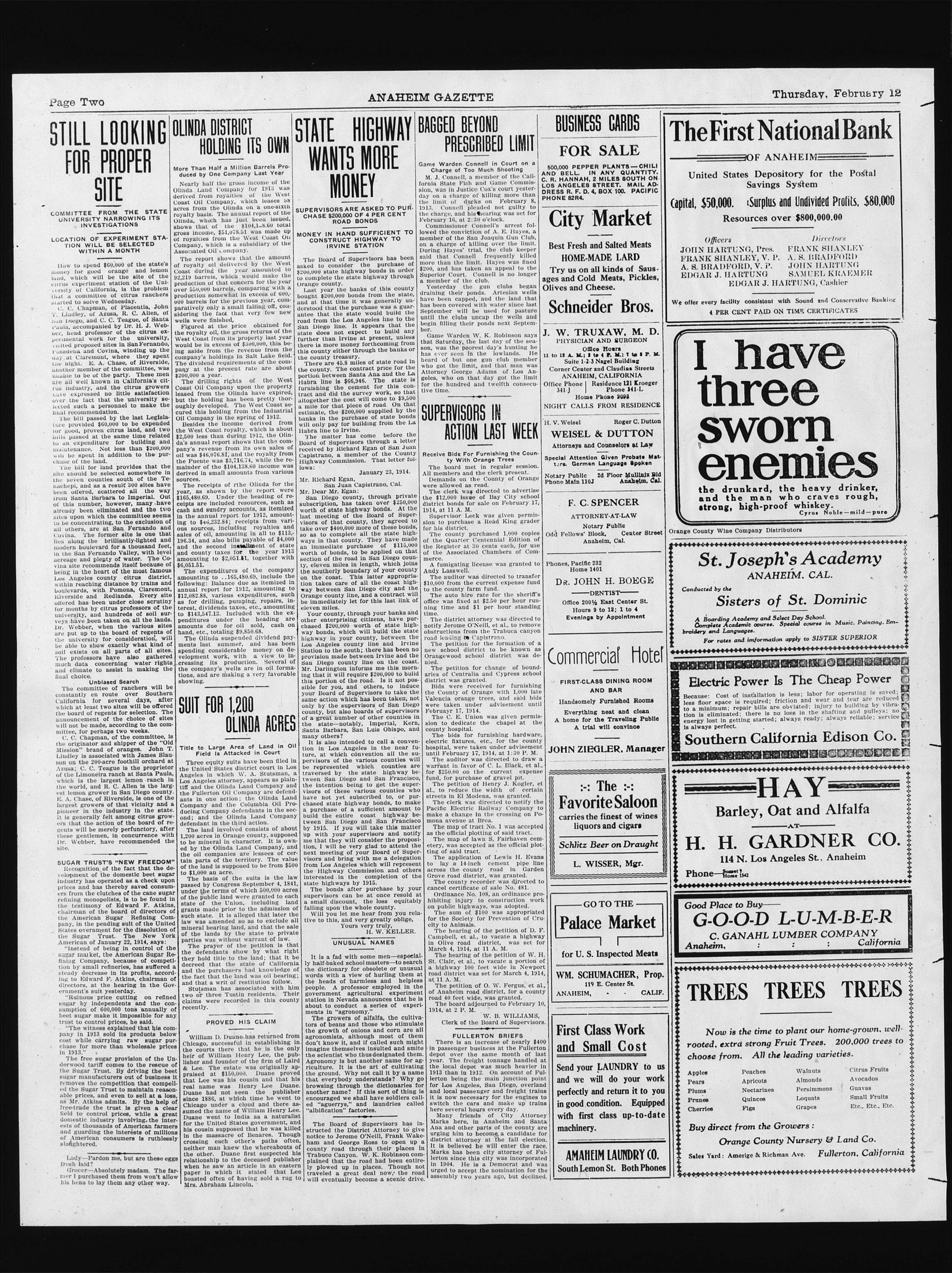
Searchable text
STILL LOOKING FOR PROPER SITE
COMMITTEE FROM THE STATE UNIVERSITY NARROWING ITS INVESTIGATIONS
LOCATION OF EXPERIMENT STATION WILL BE SELECTED WITHIN A MONTH
How to spend $60,000 of the state's money for good orange and lemon land, which will be the site of the citrus experiment station of the University of California, is the problem that a committee of citrus ranchers started to solve Wednesday.
C. C. Chapman, of Placentia, John T. Lindley, of Azusa, R. C. Allen, of San Diego, and C. C. Teague, of Santa Paula, accompanied by Dr. H. J. Webber, head professor of the citrus experimental work for the university, visited proposed sites in San Fernando, Pasadena and Covina, winding up the day at Claremont, where they spent the night. E. A. Chase, of Riverside, another member of the committee, was unable to be of the party. These men are all well known in California's citrus industry, and the citrus growers have expressed no little satisfaction over the fact that the university selected such a personnel to make the final recommendation.
The bill passed by the last Legislature provided $60,000 to be expended for good, proven citrus land, and two bills passed at the same time related to an expenditure for building and maintenance. Not less than $200,000 will be spent in addition to the purchase of the land.
The bill for land provides that the site should be selected somewhere in Olinda District holding its own more than half a Million Barrels Produced by One Company Last Year
Nearly half the gross income of the Olinda Land Company for 1913 was derived from royalties of the West Coast Oil Company, which leases 58 acres from the Olinda on a one-sixth royalty basis. The annual report of the Olinda, which has just been issued, shows that of the $104,158.60 total gross income, $51,078.51 was made up of royalties from the West Coast Oil Company, which is a subsidiary of the Associated Oil Company.
The report shows that the amount of royalty oil delivered by the West Coast during the year amounted to 92,219 barrels, which would make the production of that concern for the year over 550,000 barrels, comparing with a production somewhat in excess of 600,000 barrels for the previous year, comparatively only a small falling off, considering the fact that very few new wells were finished.
Figured at the price obtained for the royalty oil, the gross returns of the West Coast from its property last year would be in excess of $300,000, this being aside from the revenue from the company's holdings in Salt Lake field. The dividend requirements of the company at the present rate are about $200,000 a year.
The drilling rights of the West Coast Oil Company upon the property leased from the Olinda have expired, but the holding has been pretty thoroughly developed. The West Coast secured this holding from the Industrial Oil Company in the spring of 1912.
Besides the income derived from the West Coast royalty, which is about $2,500 less than during 1912, the Olinda's annual report shows that the company's revenue from its own sales of oil was $46,076.81, and the royalty from the Puente was $3,716.74, while the remainder of the $104,138.60 income was derived in small amounts from various
The bill passed by the last Legislature provided $60,000 to be expended for good, proven citrus land, and two bills passed at the same time related to an expenditure for building and maintenance. Not less than $200,000 will be spent in addition to the purchase of the land.
The bill for land provides that the site should be selected somewhere in the seven counties south of the Tenachepi, and as a result 300 sites have been offered, scattered all the way from Santa Barbara to Imperial. Out of this number, however, many have already been eliminated and the two sites upon which the committee seems to be concentrating, to the exclusion of all others, are at San Fernando and Covina. The former site is one that lies along the brilliantly-lighted and modern boulevard for a thousand feet, in the San Fernando Valley, with level acreage and plenty of water. The Covina site recommends itself because of being in the heart of the most famous Los Angeles county citrus district, within reaching distance by trains and boulevards, with Pomona, Claremont, Riverside and Redlands. Every site offered has been under close scrutiny for months by citrus professors of the university, and hundreds of soil surveys have been taken on all the lands. Dr. Webber, when the various sites are put up to the board of regents of the university for consideration, will be able to show exactly what kind of soil exists on all parts of all sites. The professors have also gathered much data concerning water rights and climate to assist in making the final choice.
Unbiased Search
The committee of ranchers will be constantly en route over Southern California for several days, after which at least two sites will be offered the board of regents for selection. The announcement of the choice of sites will not be made, according to the committee, for perhaps two weeks.
C. C. Chapman, of the committee, is the originator and shipper of the "Old Mission" brand of oranges. John T. Lindley is associated with James Slauson on the 200-acre foothill orchard at Azusa; C. C. Teague is the proprietor of the Limoneira ranch at Santa Paula, which is the largest lemon ranch in the world, and R. C. Allen is the largest lemon grower in San Diego county. E. A. Chase, of Riverside, is one of the largest growers of that vicinity and a pioneer in the industry in the state. It is generally felt among citrus growers that the action of the board of regents will be merely perfunctory, after these gentlemen, in concurrence with Dr. Webber, have recommended the site.
SUGAR TRUST'S "NEW FREEDOM"
Recognition of the fact that the development of the domestic beet sugar industry has operated as a check upon prices and has thereby saved consumers from the clutches of the cane sugar refining monopolists is to be found in
The drilling rights of the West Coast Oil Company upon the property leased from the Olinda have expired, but the holding has been pretty thoroughly developed. The West Coast secured this holding from the Industrial Oil Company in the spring of 1912.
Besides the income derived from the West Coast royalty, which is about $2,500 less than during 1912, the Olinda's annual report shows that the company's revenue from its own sales of oil was $46,076.81, and the royalty from the Puente was $3,716.74, while the remainder of the $104,138.60 income was derived in small amounts from various sources.
The receipts of rthe Olinda for the year, as shown by the report were $165,480.69. Under the heading of receipts are included resources, such as cash and sundry accounts, as itemized in the annual report for 1912, amounting to $46,232.84; receipts from various sources, including royalties and sales of oil, amounting in all to $113,-196.34, and also bills payable for $4,000 and the second installment of state and county taxes for the year 1913 amounting to $2,051.51, together with $6,051.51.
The expenditures of the company amounting to ...165,480.69, include the following: Balance due as itemized in annual report for 1912, amounting to $12,082.88, various expenditures, such as for drilling, pumping, repairs, interest, dividends taxes, etc., amounting to $143,547.13. Included with the expenditures under the heading are amounts due for oil sold, cash on hand, etc., totaling $9,850.68.
The Olinda suspended dividend payments last summer, and has been spending considerable money on development work, with a view to increasing its production. Several of the company's wells are in oil formations, and are making a very favorable showing.
SUIT FOR 1,200 OLINDA ACRES
Title to Large Area of Land in Oil Field Is Attacked in Court
Three equity suits have been filed in United States district court in Los Angeles in which W. A. Stutsman, a Los Angeles attorney, appears as plaintiff and the Olinda Land Company and the Fullerton Oil Company are defendants in one action; the Olinda Land Company and the Columbia Oil Producing Company defendants in the second; and the Olinda Land Company defendant in the third action.
The land involved consists of about 1,200 acres in Orange county, supposed to be mineral in character. It is owned by the Olinda Land Company, and the oil companies are lessees of certain parts of the territory. The value of the land is supposed to be from $500 to $1,000 an acre.
The basis of the suits is the law passed by Congress September 4, 1841, under the terms of which 500,000 acres of public land were granted to each portion between San Habra line is $66,547 furnishing the center tract and did she altogether cost a mile for that piece estimate, the $200,banks in the purchaser will only pay for her Habra line to Irving.
The matter has Board of Supervisors received by Richard Capistrano,a men Highway Commission allows:
Mr. Richard Egan,
San Juan C.
Mr. Dear Mr. Egan,
San Diego county subscription,has worth of state high last meeting of visorsof that coul take over $400,000 so as to complete ways in that country an immediate purge worth of bonds,tothe section ofthe roady,eleven miles inthe southerly bound onthe coast.The tion takes care oufway between San Orange county linebe immediately let eleven miles.
Your county,the other enterprising chased $200,000 way bondswhich highwayin yourLos Angeles countStationtothe southeast provisionmadebeSan DiegocountMr.Darlingtoninthat itwillrequisitionthisportionofthe sibleforyou,andyourBoardofSupremeactionwhichonlybythesupercountbutalsoboleofa great numberthestate—notablySantaBarbara,Somanyothers?
It is also intentioninLosAnglureatwhichcopervisorsoftheberepresentedtraversedbythetweenSanDiegotheintentionbelowvisorsofthethesegentlementhatwillintentionbefromLosAnglestheHighwayCointerestedinthestatehighwaysbeneitherSugarTRUST'S"NEWFREEDOM"
SUGAR TRUST'S "NEW FREEDOM"
Recognition of the fact that the development of the domestic beet sugar industry has operated as a check upon prices and has thereby saved consumers from the clutches of the cane sugar refining monopolists, is to be found in the testimony of Edward F. Atkins, chairman of the board of directors of the American Sugar Refining Company, in the pending suit of the United States government for the dissolution of the Sugar Trust. The New York American of January 22, 1914, says:
"Instead of being in control of the sugar market, the American Sugar Refining Company, because of competition by small refineries, has suffered a steady decrease in its profits, according to Edward F. Atkins, chairman of directors, at the hearing in the Government's suit yesterday.
"Ruinous price cutting on refined sugar by independents and the consumption of 600,000 tons annually of beet sugar make it impossible for any trust to control prices, he said.
"The witness explained that his company in 1913 sold its products below cost while carrying raw sugar purchase for more than wholesale prices in 1913."
The free sugar provision of the Underwood tariff comes to the rescue of the Sugar Trust. By driving the beet sugar manufacturers out of business it removes the competition that compelled the Sugar Trust to maintain reasonable prices, and even to sell at a loss, as Mr. Atkins admits. By the help of free-trade the trust is given a clear field to control prices, while a great domestic industry involving, the interests of thousands of American farmers and guarding the interests of millions of American consumers is ruthlessly slaughtered.
Lady—Pardon me, but are these eggs fresh laid?
Grocer—Absolutely madam. The farmer I purchased them from won't allow his hens to lay them any other way.
The land involved consists of about 1,200 acres in Orange county, supposed to be mineral in character. It is owned by the Olinda Land Company, and the oil companies are lessees of certain parts of the territory. The value of the land is supposed to be from $500 to $1,000 an acre.
The basis of the suits is the law passed by Congress September 4, 1841, under the terms of which 500,000 acres of the public land were granted to each state of the Union, including land grants made prior to the admission of such state. It is alleged that later the law was amended so as to exclude all mineral bearing land, and that the sale of the lands by the state to private parties was without warrant of law.
The prayer of the petition is that the defendants show by what right they hold title to the land; that it be decreed that the state of California and the purchasers had knowledge of the fact that the land was oil bearing; and that a writ of restitution follow.
Stutsman has associated with him two or three Tustin residents. Their claims were recorded in this county recently.
PROVED HIS CLAIM
William D. Duane has returned from Chicago, successful in establishing in the courts there that he is the only heir of William Henry Lee, the publisher and founder of the firm of Laird & Lee. The estate was originally appraised at $150,000. Duane proved that Lee was his cousin and that his real name was Henry Lee Duane. Duane had not seen the publisher since 1886, at which time he went to Chicago under a cloud and there assumed the name of William Henry Lee. Duane went to India as a naturalist for the United States government, and his cousin supposed that he was killed in the massacre of Benares. Though crossing each other's paths often, neither man knew the whereabouts of the other. Duane first suspected his relationship to the deceased publisher when he saw an article in an eastern paper in which it stated that Lee boasted often of having sold a rug to Mrs. Abraham Lincoln.
STATE HIGHWAY WANTS MORE MONEY
SUPERVISORS ARE ASKED TO PURCHASE $200,000 OF 4 PER CENT ROAD BONDS
MONEY IN HAND SUFFICIENT TO CONSTRUCT HIGHWAY TO IRVINE STATION
The Board of Supervisors has been asked to consider the purchase of $200,000 state highway bonds in order to complete the state highway through Orange county.
Last year the banks of this county bought $200,000 bonds from the state, and at that time it was generally understood that the purchase was a guarantee that the state would build the road from the Los Angeles line to the San Diego line. It appears that the state does not expect to build any further than Irvine at present, unless there is more money forthcoming from this county either through the banks or the county treasury.
There are 45.8 miles of state road in the county. The contract price for the portion between Santa Ana and the La Habra line is $66,946. The state is furnishing the cement for this contract and did the survey work, so that altogether the cost will come to $9,500 a mile for that piece of road. On that estimate, the $200,000 supplied by the banks in the purchase of state bonds will only pay for building from the La Habra line to Irvine.
The matter has come before the Board of Supervisors through a letter received by Richard Egan of San Juan Capistrano, a member of the County Highway Commission. That letter follows:
January 23, 1914.
BAGGED BEYOND PRESCRIBED LIMIT
Game Warden Connell in Court on a Charge of Too Much Shooting
M. J. Connell, a member of the California State Fish and Game Commission, was in Justice Cox's court yesterday on a charge of killing more than the limit of ducks on February 8, 1913. Connell pleaded not guilty to the charge, and his hearing was set for February 16, at 2:30 o'clock.
Commissioner Connell's arrest followed the conviction of A. E. Hayes, a member of the San Joaquin Gun Club, on a charge of killing over the limit. During Hayes' trial, the club keeper said that Connell frequently killed more than the limit. Hayes was fined $200, and has taken an appeal to the Superior Court. Connell is no longer a member of the club.
Yesterday the gun clubs began draining their ponds. Artesian wells have been capped, and the land that has been covered with water since last September will be used for pasture until the clubs uncap the wells and begin filling their ponds next September.
Game Warden W. K. Robinson says that Saturday, the last day of the season, was the poorest day's hunting he has ever seen in the lowlands. He heard of but one gun club member who got the limit, and that man was Attorney George Adams of Los Angeles, who on that day got the limit for the hundred and twelfth consecutive time.
SUPERVISORS IN ACTION LAST WEEK
Receive Bids For Furnishing the County With Orange Trees
The board met in regular session. All members and the clerk present.
BUSINESS CARDS
FOR SALE
500,000 PEPPER PLANTS—CHILI AND BELL. IN ANY QUANTITY. C. R. HANNAH, 2 MILES SOUTH ON LOS ANGELES STREET. MAIL ADDRESS R. F. D. 4, BOX 100. PACIFIC PHONE 82R4.
City Market
Best Fresh and Salted Meats HOME-MADE LARD
Try us on all kinds of Sausages and Cold Meats, Pickles, Olives and Cheese.
Schneider Bros.
J. W. TRUXAW, M. D.
PHYSICIAN AND SURGEON
Office Hours
11 to 12 A.M.; 3 to 4 P.M.: 7 to 8 P.M.
Suite 1-2-3 Nagel Building
Corner Center and Claudina Streets
ANAHEIM, CALIFORNIA
Office Phone | Residence 121 Kroeger
341-J
Home Phone 2093
NIGHT CALLS FROM RESIDENCE
H. V. Weisel Roger C. Dutton
WEISEL & DUTTON
Attorneys and Counselors at Law
Special Attention Given Probate Matters. German Language Spoken
SUPERVISORS IN ACTION LAST WEEK
Receive Bids For Furnishing the County With Orange Trees
The board met in regular session. All members and the clerk present.
Demands on the County of Orange were allowed as read.
The clerk was directed to advertise the $12,000 issue of Bay City school district bonds for sale on February 17, 1914, at 11 A.M.
Supervisor Leck was given permission to purchase a Read King grader for his district.
The county purchased 1,000 copies of the Quarter Centennial Edition of the Register at 30 cents each, for use of the Associated Chambers of Commerce.
A fumigating license was granted to Andy Lasswell.
The auditor was directed to transfer $10,000 from the current expense fund to the county farm fund.
The auto hire rate for the sheriff's office was fixed at $2.50 per hour running time and $1 per hour standing time.
The district attorney was directed to notify Jerome O'Neill, et al., to remove obstructions from the Trabuca canyon road leading to Capistrano.
The petition for the formation of a new school district to be known as Orangewood school district was denied.
The petition for change of boundaries of Centralia and Cypress school district was granted.
Bids were received for furnishing the County of Orange with 1,000 late Valencia orange trees, and said bids were taken under advisement until February 17, 1914.
The C. E. Union was given permission to dedicate the chapel at the county hospital.
The bids for furnishing hardware, electric fixtures, etc., for the county hospital, were taken under advisement until February 17, 1914, at 1:30 P. M.
The auditor was directed to draw a warrant in favor of C. L. Black, et al., for $250.00 on the current expense fund, for purchase of gravel pit.
The petition of Henry J. Kogler, et al., to reduce the width of certain streets in El Modena, was granted.
The clerk was directed to notify the Pacific Electric Railway Company to make a change in the crossing on Pomona avenue at Brea.
The map of tract No. 1 was accepted as the official plotting of said tract.
The map of lawn S. Fairhaven cemetery, was accepted as the official plotting of said tract.
The application of Lewis H. Evans to lay a 14-inch cement pipe line across the county road in Garden Grove road district, was granted.
The county recorder was directed to cancel certificate of sale No. 481.
Ordinance No. 108, an ordinance prohibiting injury to construction work between Santa Ana and La Habra line is $66,946. The state is furnishing the cement for this contract and did the survey work, so that altogether the cost will come to $9,500 a mile for that piece of road. On that estimate, the $200,000 supplied by the banks in the purchase of state bonds will only pay for building from the La Habra line to Irvine.
The matter has come before the Board of Supervisors through a letter received by Richard Egan of San Juan Capistrano, a member of the County Highway Commission. That letter follows:
January 23, 1914.
Mr. Richard Egan,
San Juan Capistrano, Cal.
Mr. Dear Mr. Egan:
San Diego county, through private subscription, has taken over $250,000 worth of state highway bonds. At the last meeting of the Board of Supervisors of that county, they agreed to take over $400,000 more of these bonds, so as to complete all the state highways in that county. They have made an immediate purchase of $115,000 worth of bonds, to be applied on that section of the road in San Diego county, eleven miles in length, which joins the southerly boundary of your county on the coast. This latter appropriation takes care of all the coast highway between San Diego city and the Orange county line, and a contract will be immediately let for this last link of eleven miles.
Your county, through your banks and other enterprising citizens, have purchased $200,000 worth of state highway bonds, which will build the state highway in your county, between the Los Angeles county line and Irvine Station to the south; there has been no provision made between Irvine and the San Diego county line on the coast.
Mr. Darlington informs me this morning that it will require $200,000 to build this portion of the road. Is it not possible for you, and others, to induce your Board of Supervisors to take the same action which has been taken, not only by the supervisors of San Diego county, but also boards of supervisors of a great number of other counties in the state—notably, Imperial, Kern, Santa Barbara, San Luis Obispo, and many others?
It is also intended to call a convention in Los Angeles in the near future, at which convention all the supervisors of the various counties will be represented which counties are traversed by the state highway between San Diego and San Francisco, the intention being to get the supervisors of these various counties who have not yet subscribed to, or purchased state highway bonds, to make a purchase of a sufficient amount to build the entire coast highway between San Diego and San Francisco by 1915. If you will take this matter up with your supervisors and notify me that they will consider the proposition, I will be very glad to attend the next meeting of your Board of Supervisors and bring with me a delegation from Los Angeles which will represent the Highway Commission and others interested in the completion of the state highways by 1915.
The bonds after purchase by your supervisors can be at once resold at
UNUSUAL NAMES
It is a fad with some men—especially half-baked school masters—to search the dictionary for obsolete or unusual words with a view of hurling them at the heads of harmless and helpless people. A professor employed in the government agricultural experiment station in Nevada announces that he is about to conduct a series of experiments in "agronomy."
The growers of alfalfa, the cultivators of beans and those who stimulate the growth of onions and corn are all agronomists, although most of them don't know it, and if called such might imagine themselves insulted and smite the scientist who thus designated them. Agronomy is but another name for agriculture. It is the art of cultivating the ground. Why not call it by a name that everybody understands? Why go browsing through the dictionaries for another name? If this sort of thing is encouraged we shall have soldiers called "aguerrys," and laundries called "albification" factories.
The Board of Supervisors has instructed the District Attorney to give notice to Jerome O'Neill, Frank Wakeham and George Ross to open up a county road through their places in Trabuco Canyon. W. K. Robinson complained that the road had been entirely plowed up in places. Though not traveled a great deal now; the road will eventually become a scenic drive.
The clerk was directed to notify the Pacific Electric Railway Company to make a change in the crossing on Pomona avenue at Brea.
The map of tract No. 1 was accepted as the official plotting of said tract.
The map of lawn S. Fairhaven cemetery, was accepted as the official plotting of said tract.
The application of Lewis H. Evans to lay a 14-inch cement pipe line across the county road in Garden Grove road district, was granted.
The county recorder was directed to cancel certificate of sale No. 481.
Ordinance No. 108, an ordinance prohibiting injury to construction work on public highways, was adopted.
The sum of $100 was appropriated for the Society for Prevention of Cruelty to Animals.
The hearing of the petition of D. F. Campbell, et al., to vacate a highway in Olive road district, was set for March 4, 1914, at 11 A.M.
The hearing of the petition of W. H. St. Clair, et al., to vacate a portion of a highway 100 feet wide in Newport road district was set for March 4, 1914, at 11 A.M.
The petition of O. W. Fergus, et al., of Anaheim road district, for a county road 40 feet wide, was granted.
The board adjourned to February 10, 1914, at 2 P.M.
W. B. WILLIAMS,
Clerk of the Board of Supervisors.
FULLERTON BRIEF'S
There is an increase of nearly $400 in passenger business at the Fullerton depot over the same month of last year. The freight tonnage handled at the local depot was much heavier in 1913 than in 1912. On account of Fullerton being the main junction point for Los Angeles, San Diego, overland and local passenger and freight trains it is now necessary for the engines to switch the cars and make up trains here several hours every day.
Many friends of City Attorney Marks here, in Anaheim and Santa Ana and other parts of the county are urging him to become a candidate for district attorney at the fall election. It is believed he will enter the race. Marks has been city attorney of Fullerton since this city was incorporated in 1904. He is a Democrat and was urged to accept the nomination for the assembly two years ago, but declined.
Thursday, February 12
The First National Bank
OF ANAHEIM
United States Depository for the Postal Savings System
Capital, $50,000. Surplus and Undivided Profits, $80,000
Resources over $800,000.00
Officers
JOHN HARTUNG, Pres.
FRANK SHANLEY
FRANK SHANLEY, V. P.
A. S. BRADFORD
A. S. BRADFORD, V. P.
JOHN HARTUNG
EDGAR J. HARTUNG
SAMUEL KRAEMER
EDGAR J. HARTUNG, Cashier
We offer every facility consistent with Sound and Conservative Banking
4 PER CENT PAID ON TIME CERTIFICATES
I have three sworn enemies
CALIFORNIA
Residence 121 Kroeger
Phone 341-L
Phone 2092
FROM RESIDENCE
Roger C. Dutton
& DUTTON
Counselors at Law
Given Probate MatLanguage Spoken
2d Floor Mullinix Bld
Anaheim, Cal.
PENCER
NEY-AT-LAW
Bury Public
Center Street
Anaheim, Cal.
82
01
N H. BOEGE
ENTIST
East Center St.
to 12; 1 to 4
by Appointment
pecial Hotel
SS DINING ROOM
ND BAR
Furnished Rooms
neat and clean
the Traveling Public
will convince
GILER. Manager
The :::
ite Saloon
the finest of wines
s and cigars
deer on Draught
ISSER, Mgr.
three sworn enemies
the drunkard, the heavy drinker,
and the man who craves rough,
strong, high-proof whiskey.
Cyrus Noble—mild—pure
Orange County Wine Company Distributors
St. Joseph’s Academy
ANAHEIM, CAL.
Conducted by the
Sisters of St. Dominic
A Boarding Academy and Select Day School.
Complete Academic course. Special course in Music, Painting, Embroidery and Languages.
For rates and information apply to SISTER SUPERIOR
Electric Power Is The Cheap Power
Because: Cost of installation is less; labor for operating is saved;
less floor space is required; friction and wear and tear are reduced
to a minimum; repair bills are obviated; injury to building by vibration is eliminated; there is no loss in the shafting and pulleys; no
energy lost in getting started; always ready; always reliable; service
is always perfect.
Southern California Edison Co.
HAY
Barley, Oat and Alfalfa
AT
H. H. GARDNER CO.
114 N. Los Angeles St., Anaheim
Phone—Sunset 9
Home 1542
Barley, Oat and Alfalfa
AT
H. H. GARDNER CO.
114 N. Los Angeles St., Anaheim
Phone—Sunset 9 Home 1542
Good Place to Buy—
G-O-O-D L-U-M-B-E-R
C. GANAHL LUMBER COMPANY
Anaheim, : : : California
TREES TREES TREES
Now is the time to plant our home-grown, well-rooted, extra strong Fruit Trees. 200,000 trees to choose from. All the leading varieties.
Apples Peaches Walnuts Citrus Fruits
Pears Apricots Almonds Avocados
Plums Nectarines Persimmons Guavas
Prunes Quinces Loquats Small Fruits
Cherries Figs Grapes Etc., Etc., Etc.
Buy direct from the Growers:
Orange County Nursery & Land Co.
Sales Yard: Amerige & Richman Ave. Fullerton, California