anaheim-gazette 1914-02-05
Scanned page
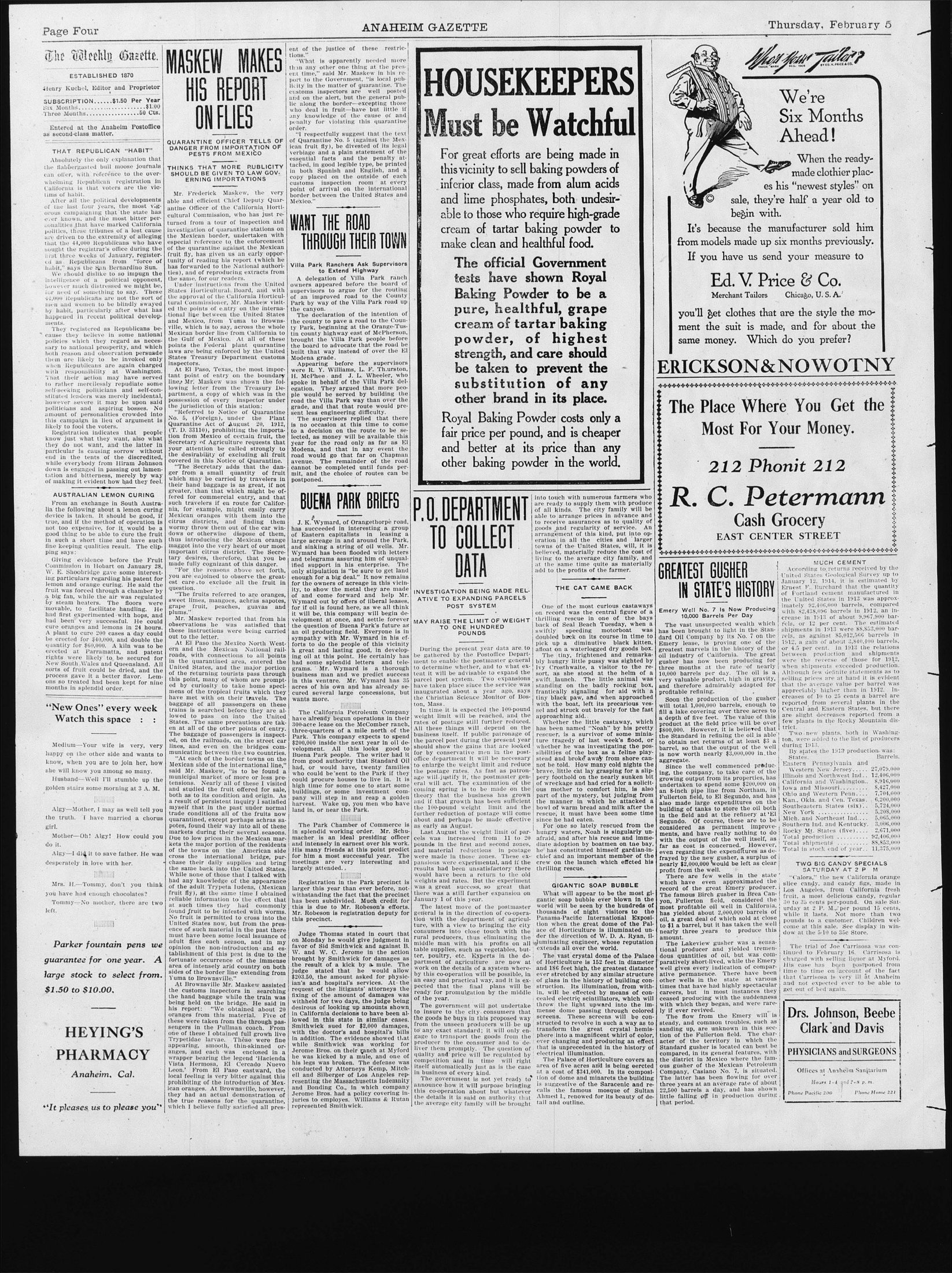
Searchable text
THE WEEKLY GAZETTE.
ESTABLISHED 1870
Henry Kuchel, Editor and Proprietor
SUBSCRIPTION.....$1.50 Per Year
Six Months.....$1.00
Three Months.....$50 Cts.
Entered at the Anaheim Postoffice as second-class matter.
THAT REPUBLICAN "HABIT"
Absolutely the only explanation that the flabbergasted bull moose journals can offer, with reference to the overwhelming Republican registration in California is that voters are the victims of habit.
After all the political developments of the last four years, the most vigorous campaigning that the state has ever known, and the most bitter personalities that have marked California politics, these tribunes of a lost cause are driven to the extremity of alleging that the 44,000 Republicans who have sought the registrar's office during the first three weeks of January, registered as Republicans from "force of habit," says the San Bernardino Sun.
We should dislike to so impugn the intelligence of a political opponent, however much distressed we might be, for need of something to say. These 44,000 Republicans are not the sort of men and women to be blindly swayed by habit, particularly after what has happened in recent political developments.
They registered as Republicans because they believe in some national policies which they regard as necessary to national prosperity, and which both reason and observation persuade them are likely to be invoked only when Republicans are again charged with responsibility at Washington. That their action may have served to rather mercilessly repudiate some self-seeking politicians and self-constituted leaders was merely incidental, however severe it may be upon said politicians and aspiring bosses. No amount of personalities crowded into this campaign in lieu of argument is likely to fool the voters.
Registration indicates that people know just what they want, also what they do not want, and the latter in particular is causing sorrow without end in the tents of the discredited, while everybody from Hiram Johnson down is engaged in passing out lamenetion and bitterness merely by war.
MASKEW MAKES HIS REPORT ON FLIES
QUARANTINE OFFICER TELLS OF DANGER FROM IMPORTATION OF PESTS FROM MEXICO
THINKS THAT MORE PUBLICITY SHOULD BE GIVEN TO LAW GOVERNING IMPORTATIONS
Mr. Frederick Maskew, the very able and efficient Chief Deputy Quarantine Officer of the California Horticultural Commission, who has just returned from a tour of inspection and investigation of quarantine stations on the Mexican border, undertaken with especial reference to the enforcement of the quarantine against the Mexican fruit fly, has given us an early opportunity of reading his report (which he has forwarded to the National authorities), and of reproducing extracts from the same, for our readers.
Under instructions from the United States Horticultural Board, and with the approval of the California Horticultural Commissioner, Mr. Maskew visited the points of entry on the international line between the United States and Mexico, from Yuma to Brownsville, which is to say, across the whole Mexican border line from California to the Gulf of Mexico. At all of these points the Federal plant quarantine laws are being enforced by the United States Treasury Department customs inspectors.
At El Paso, Texas, the most important point of entry on the boundary line, Mr. Maskew was shown the following letter from the Treasury Department, a copy of which was in the possession of every inspector under the jurisdiction of this station:
"Referred to Notice of Quarantine No. 5, (Foreign), under the Plant Quarantine Act of August 20, 1912, (T. D. 33110), prohibiting the importation from Mexico of certain fruit, the Secretary of Agriculture requests that your attention be called strongly to the desirability of excluding all fruit covered in this Notice of Quarantine.
"The Secretary adds that the danger from a small quantity of fruit ent of the justice offenses."
“What is apparent than any other one time,” said Mr. McPhee, port to the Governor'splicity in the matter of customs inspectors and on the alert, but lie along the border—who deal in fruit—any knowledge of the penalty for violating order.
"I respectfully suggest of Quarantine No. 5 (American fruit fly), be divulgeage and a plain essential facts and tached, in good legibility in both Spanish and copy placed on the customs inspection point of arrival on the border between the U.S., Mexico.”
VANT THE ROAD THROUGH THE VILLA PARK Ranchers to Extend H
A delegation of V owners appeared before supervisors to argue of an improved road Park by way of the V canyon.
The declaration of the county to pave a city Park, beginning at tin county highway east brought the Villa Park board to advocate built that way instead Modena grade.
Appearing before were R. Y. Williams, H. McPhee and J. spoke in behalf of the eagation. They argue ple would be served road the Villa Park w grade, and that that sent less engineering.
The supervisors re is no occasion at tha to a decision on tha lected, as money will year for the road o Modena, and that in road would go that avenue. The remain cannot be completed mit, and the choice
That their action may have served to rather mercilessly repudiate some self-seeking politicians and self-constituted leaders was merely incidental, however severe it may be upon said politicians and aspiring bosses. No amount of personalities crowded into this campaign in lieu of argument is likely to fool the voters.
Registration indicates that people know just what they want, also what they do not want, and the latter in particular is causing sorrow without end in the tents of the discredited, while everybody from Hiram Johnson down is engaged in passing out lamentation and bitterness, merely by way of making it evident how bad they feel.
AUSTRALIAN LEMON CURING
From an exchange in South Australia the following about a lemon curing device is taken. It should be good, if true, and if the method of operation is not too expensive, for it would be a good thing to be able to cure the fruit in such a short time and have such fine keeping qualities result. The clipping says:
Giving evidence before the Fruit Commission in Hobart on January 28, W. E. Shoobridge gave some interesting particulars regarding his patent for lemon and orange curing. He said the fruit was forced through a chamber by a big fan, while the air was regulated by steam heaters. The floors were movable, to facilitate handling. He had first experimented with hops, and had been very successful. He could cure oranges and lemons in 24 hours. A plant to cure 200 cases a day could be erected for $40,000, and double the quantity for $60,000. A kiln was to be erected at Parramatta, and patent rights were likely to be secured for New South Wales and Queensland. All sorts of fruit could be dried, and the process gave it a better flavor. Lemons so treated had been kept for nine months in splendid order.
“New Ones” every week Watch this space :
Medium—Your wife is very, very happy on the other side and wants to know, when you are to join her, how she will know you among so many.
Husband—Well I’ll stumble up the golden stairs some morning at 3 A.M.
Algy—Mother, I may as well tell you the truth. I have married a chorus girl.
Mother—Oh! Algy! How could you do it.
Algy—I did it to save father. He was desperately in love with her.
Mrs. H.—Tommy, don’t you think you have had enough chocolates?
Mr. Maskew was shown the following letter from the Treasury Department, a copy of which was in the possession of every inspector under the jurisdiction of this station:
“Referred to Notice of Quarantine No. 5, (Foreign), under the Plant Quarantine Act of August 20, 1912, (T. D. 33110), prohibiting the importation from Mexico of certain fruit, the Secretary of Agriculture requests that your attention be called strongly to the desirability of excluding all fruit covered in this Notice of Quarantine.
“The Secretary adds that the danger from a small quantity of fruit which may be carried by travelers in their hand baggage is as great, if not greater than that which might be offered for commercial entry, and that such travelers if en route for California, for example, might easily carry Mexican oranges with them into the citrus districts, and finding them wormy throw them out of the car windows or otherwise dispose of them, thus introducing the Mexican orange maggot into the very heart of our most important citrus district. The Secretary desires, therefore, that you be made fully cognizant of this danger.
“For the reasons above set forth, you are enjoined to observe the greatest care to exclude all the fruit in question.
“The fruits referred to are oranges, sweet limes, mangoes, achras sapotes, grape fruit, peaches, guavas and plums.”
Mr. Maskew reported that from his observations he was satisfied that these instructions were being carried out to the letter.
At El Paso the Mexico North Western and the Mexican National railroads, with connections to all points in the quarantined area, entered the United States, and the major portion of the returning tourists pass through this point, many of whom are prompted by curiosity to take home specimens of the tropical fruits which they have met with on their travels. The baggage of all passengers on these trains is searched before they are allowed to pass on into the United States. The same precautions are taken at all of the other points of entry. The baggage of passengers is inspected, on the railroads, on the street car lines, and even on the bridges communicating between the two countries.
“At each of the border towns on the Mexican side of the international line,” said Mr. Maskew, “is to be found a municipal market of more or less pretensions. Nearly all of these I visited and studied the fruit offered for sale, both as to its condition and origin. As a result of persistent inquiry I satisfied myself that in the past under normal trade conditions all of the fruits now quarantined, except perhaps achras sapotes, found their way into all of these markets during their several seasons. Due to low prices in the Mexican markets the major portion of the residents of the towns on the American side cross the international bridge, purchase their daily supplies and bring the same back into the United States. While none of those that I talked with had any knowledge of the appearance of the adult Trypeta ludens, (Mexican fruit fly), at the same time I obtained reliable information to the effect that
H. McPhee and J. Spoke in behalf of this eagement. They argue people would be served road the Villa Park w grade, and that that sent less engineering.
The supervisors report no occasion at this to a decision on the lected, as money will year for the road of Modena, and that in road would go that avenue. The remain cannot be completed mit, and the choice postponed.
BUENA PARK
J. K. Wymard, of O has succeeded in initiation Eastern capitalist large acreage in and sinking a string Wymard has been floated telegrams assuring support in his only stipulation is “be enough for a big deal for the owners of acrity, to show me met of and come forward Wymard out by offers for if oil is found here it will be, this company development at once, and the question of Buenan oil producing field sympathy with Mr. V forts to do the people a great and lasting oil at this point had some splendid programs. Mr. Wymard business man and woman in this venture. Mr acres of his own and cured several large wants more.
The California Pele have already begun on 300-acre lease on three-quarters of a park. This company has $200,000 inside the new development. All this Buena Park people from good authority had, or would have who could be sent to could procure houses high time for some buildings, or some pany will step in an harvest. Wake up, y land in, or near the H.
The Park Chamber in splendid working macher is an ideal and intensely in earn His many friends at for him a most succ meetings are very largely attended.
Registration in the larger this year than withstanding the fact
Algy—Mother, I may as well tell you the truth. I have married a chorus girl.
Mother—Oh! Algy! How could you do it.
Algy—I did it to save father. He was desperately in love with her.
Mrs. H.—Tommy, don't you think you have had enough chocolates?
Tommy—No mother, there are two left.
Parker fountain pens we guarantee for one year. A large stock to select from. $1.50 to $10.00.
HEYING'S PHARMACY
Anaheim, Cal.
"It pleases us to please you"
At Brownsville Mr. Maskew assisted the customs inspectors in searching the hand baggage while the train was being held on the bridge. He said in his report: "We obtained about 20 oranges from this material. Five of these were taken from the through passengers in the Pullman coach. From one of these I obtained full grown live Trypetidae larvae. These were fine appearing, smooth, thin-skinned oranges, and each was enclosed in a wrapper bearing the legend 'Hacienda Vista Hermosa, El Cercado Nuevo Leon.' From El Paso eastward, the local feeling is very bitter against this prohibiting of the introduction of Mexican oranges. At Brownsville, however, they had an actual demonstration of the true reasons for the quarantine, which I believe fully satisfied all pres-
a result of persistent inquiry I satisfied myself that in the past under normal trade conditions all of the fruits now quarantined, except perhaps achras sapotes, found their way into all of these markets during their several seasons.
Due to low prices in the Mexican markets the major portion of the residents of the towns on the American side cross the international bridge, purchase their daily supplies and bring the same back into the United States.
While none of those that I talked with had any knowledge of the appearance of the adult Trypetela ludens, (Mexican fruit fly), at the same time I obtained reliable information to the effect that at such times they had commonly found fruit to be infested with worms. No fruit is permitted to cross into the United States now, but from the presence of such material in the past there must have been some local issuance of adult flies each season, and in my opinion the non-introduction and establishment of this pest is due to the fortunate occurrence of the immense area of intensely arid country on both sides of the border line extending from Yuma to Brownsville."
At Smithwick Mr. Maskew assisted the customs inspectors in searching the hand baggage while the train was being held on the bridge. He said in his report: "We obtained about 20 oranges from this material. Five of these were taken from the through passengers in the Pullman coach. From one of these I obtained full grown live Trypetidae larvae. These were fine appearing, smooth, thin-skinned oranges, and each was enclosed in a wrapper bearing the legend 'Hacienda Vista Hermosa, El Cercado Nuevo Leon.' From El Paso eastward, the local feeling is very bitter against this prohibiting of the introduction of Mexican oranges. At Smithwick, however, they had an actual demonstration of the true reasons for the quarantine, which I believe fully satisfied all pres-
ENT OF THE JUSTICE OF THESE RESTRICTIONS."
"What is apparently needed more than any other one thing at the present time," said Mr. Maskew in his report to the Government, "is local publicity in the matter of quarantine. The customs inspectors are well posted and on the alert, but the general public along the border—excepting those who deal in fruit—have but little if any knowledge of the cause of and penalty for violating this quarantine order.
"I respectfully suggest that the text of Quarantine No. 5 (against the Mexican fruit fly), be divested of its legal verbiage and a plain statement of the essential facts and the penalty attached, in good legible type, be printed in both Spanish and English, and a copy placed on the outside of each customs inspection room at every point of arrival on the international border between the United States and Mexico."
WANT THE ROAD THROUGH THEIR TOWN
Villa Park Ranchers Ask Supervisors to Extend Highway
A delegation of Villa Park ranch owners appeared before the board of supervisors to argue for the routing of an improved road to the County Park by way of the Villa Park road up the canyon.
The declaration of the intention of the county to pave a road to the County Park, beginning at the Orange-Tustin county highway east of McPherson, brought the Villa Park people before the board to advocate that the road be built that way instead of over the El Modena grade.
Appearing before the supervisors were R. Y. Williams, L. F. Thurston, H. McPhee and J. L. Wheeler, who spoke in behalf of the Villa Park delegation. They argued that more people would be served by building the road the Villa Park way than over the grade, and that that route would present less engineering difficulty.
The supervisors replied that there is no occasion at this time to come to a decision on the route to be selected, as money will be available this year for the road only as far as El Modena, and that in any event the road would go that far on Chapman avenue. The remainder of the road cannot be completed until funds permit, and the choice of routes can be
HOUSEKEEPERS Must be Watchful
For great efforts are being made in this vicinity to sell baking powders of inferior class, made from alum acids and lime phosphates, both undesirable to those who require high-grade cream of tartar baking powder to make clean and healthful food.
The official Government tests have shown Royal Baking Powder to be a pure, healthful, grape cream of tartar baking powder, of highest strength, and care should be taken to prevent the substitution of any other brand in its place.
Royal Baking Powder costs only a fair price per pound, and is cheaper and better at its price than any other baking powder in the world.
BUENA PARK BRIEFS
J. K. Wymard, of Orangethorpe road, has succeeded in interesting a group of Eastern capitalists in leasing a large acreage in and around the Park, and sinking a string of oil wells. Mr. Wymard has been flooded with letters and telegrams assuring him of unqualified support in his enterprise. The only stipulation is "be sure to get land enough for a big deal." It now remains for the owners of acreage in this vicinity, to show the metal they are made of and come forward and help Mr. Wymard out by offers of liberal leases, for if oil is found here, as we all think it will be, this company will begin development at once, and settle forever the question of Buena Park's future as an oil producing field. Everyone is in sympathy with Mr. Wymard in his efforts to do the people of this vicinity a great and lasting good, in developing oil at this point. He certainly has had some splendid letters and telegrams. Mr. Wymard is a thorough business man and we predict success in this venture. Mr. Wymard has 35 acres of his own and has already secured several large concessions, but wants more.
The California Petroleum Company have already begun operations in their 300-acre lease on the McComber ranch, three-quarters of a mile north of the Park. This company expects to spend $200,000 inside the next year in oil development. All this looks good to Buena Park people. The writer had it from good authority that Standard Oil had, or would have, twenty families who could be sent to the Park if they could procure houses to live in. It is high time for some one to start some buildings, or some investment company will step in and reap a golden harvest. Wake up, you men who have land in, or near the Park.
The Park Chamber of Commerce is in splendid working order. Mr. Schumacher is an ideal presiding officer and intensely in earnest over his work. His many friends at this point predict for him a most successful year. The meetings are very interesting and largely attended.
Registration in the Park precinct is larger this year than ever before, notwithstanding the fact that the precinct substitution of any other brand in its place.
Royal Baking Powder costs only a fair price per pound, and is cheaper and better at its price than any other baking powder in the world.
P.O. DEPARTMENT TO COLLECT DATA
INVESTIGATION BEING MADE RELATIVE TO EXPANDING PARCELS POST SYSTEM
MAY RAISE THE LIMIT OF WEIGHT TO ONE HUNDRED POUNDS
During the present year data are to be gathered by the Postoffice Department to enable the postmaster general to determine whether, and to what extent it will be advisable to expand the parcel post system. Two expansions have taken place since the service was inaugurated about a year ago, says the Christian Science Monitor of Boston, Mass.
In time it is expected the 100-pound weight limit will be reached, and the rates of postage still further reduced. All these things will depend on the business itself. If public patronage of the parcel post during the present year should show the gains that are looked for by conservative men in the post-office department it will be necessary to enlarge the weight limit and reduce the postage rates. As fast as patronage will justify it, the postmaster general will act. The examination of the coming spring is to be made on the theory that the business has grown and if that growth has been sufficient the 100-pound weight limit and the further reduction of postage will come about and perhaps be made effective as early as August.
Last August the weight limit of parcels was increased from 11 to 20 pounds in the first and second zones, and material reductions in postage were made in those zones. These expansions were experimental, and if the results had been unsatisfactory there would have been a return to the old weights and rates. But the experiment was a great success, so great that there was a still further expansion on January 1 of this year.
THE CAT CAME BACK
One of the most curious castaways on record was the central figure of a thrilling rescue in one of the bays back of Seal Beach Tuesday, when a swiftly speeding motorboat was doubled back on its course in time to pick up a diminutive black kitten, afloat on a waterlogged dry goods box.
The tiny, frightened and remarkably hungry little pussy was sighted by Ivy Crosthwaite, a visitor to the resort, as she stood at the helm of a swift launch. The little animal was standing on the badly rocking box, frantically signaling for aid with a tiny black paw, and when approached with the boat, left its precarious vessel and struck out bravely for the fast approaching aid.
Whether the little castaway, which has been named "Noah" by his pretty rescuer, is a survivor of some miniature tragedy of last week's flood, or whether he was investigating the possibilities of the box as a feline playstead and broke away from shore cannot be told. How many cold nights the brave, little cat lay grasping for a slippery foothold on the nearly sunken bit of wreckage and had cried for a solicitous mother to comfort him, is also part of the mystery, but judging from the manner in which he attacked a bowl of warm bread and milk after the rescue, it must have been some time since he had eaten.
For one so lately rescued from the hungry waters, Noah is singularly unafraid, and after his rescue and immediate adoption by boatmen on the bay, he has constituted himself gardian-in-chief and an important member of the crew on the launch which effected his thrilling rescue.
GIGANTIC SOAP BUBBLE
What will appear to be the most gigantic soap bubble ever blown in
The Park Chamber of Commerce is in splendid working order. Mr. Schumacher is an ideal presiding officer and intensely in earnest over his work. His many friends at this point predict for him a most successful year. The meetings are very interesting and largely attended.
Registration in the Park precinct is larger this year than ever before, notwithstanding the fact that the precinct has been subdivided. Much credit for this is due to Mr. Robeson's efforts. Mr. Robeson is registration deputy for this precinct.
Judge Thomas stated in court that on Monday he would give judgment in favor of Sid Smithwick and against B. W. and W. C. Jerome in the action brought by Smithwick for damages as the result of a kick by a mule. The judge stated that he would allow $203.50, the amount asked for physician's and hospital's services. At the request of the litigants' attorneys the fixing of the amount of damages was withheld for two days, the judge being desirous of looking up amounts shown in California decisions to have been allowed in this state in similar cases. Smithwick sued for $2,000 damages, with the doctor's and hospital's bills in addition. The evidence showed that while Smithwick was working for Jerome Bros. on their ranch at Myford he was kicked by a mule, and one of his legs was broken. The defense was conducted by Attorneys Kemp, Mitchell and Silberger of Los Angeles representing the Massachusetts Indemnity and Bonding Co., in which company Jerome Bros. had a policy covering injuries to employes. Williams & Rutan represented Smithwick.
Last August the weight limit of parcels was increased from 11 to 20 pounds in the first and second zones, and material reductions in postage were made in those zones. These expansions were experimental, and if the results had been unsatisfactory there would have been a return to the old weights and rates. But the experiment was a great success, so great that there was a still further expansion on January 1 of this year.
The latest move of the postmaster general is in the direction of co-operation with the department of agriculture, with a view to bringing the city consumers into close touch with the rural producers, thus eliminating the middle man with his profits on all table supplies, such as vegetables, butter, poultry, etc. Experts in the department of agriculture are now at work on the details of a system whereby this co-operation will be possible, in an easy and practical way, and it is expected that the final plans will be ready for promulgation by the middle of the year.
The government will not undertake to insure to the city consumers that the goods he buys in this proposed way from the unseen producers will be up to any exact standard; it will only engage to transport the goods from the producer to the consumer and to deliver them promptly. The question of quality and price will be regulated by competition and in time will right itself automatically just as is the case in business of every kind.
The government is not yet ready to announce how it will purpose bringing this co-operation about but whatever the details it is said on authority that the average city family will be brought
GIGANTIC SOAP BUBBLE
What will appear to be the most gigantic soap bubble ever blown in the world will be seen by the hundreds of thousands of night visitors to the Panama-Pacific International Exposition when the great dome of the Palace of Horticulture is illuminated under the direction of W. D. A. Ryan, illuminating engineer, whose reputation extends all over the world.
The vast crystal dome of the Palace of Horticulture is 152 feet in diameter and 186 feet high, the greatest distance ever stretched by any similar structure of glass in the history of building construction. Its illumination, from within, will be effected by means of concealed electric scintillators, which will throw the light upward into the immense dome passing through colored screens. These screens will be constructed to revolve in such a way as to transform the great crystal hemisphere into a magnificent whirl of color, ever changing and producing an effect that is unprecedented in the history of electrical illumination.
The Palace of Horticulture covers an area of five acres and is being erected at a cost of $341,000. In its composition of dome and minarets the building is suggestive of the Saracenic and recalls the famous mosque of Sultan Ahmed I., renowed for its beauty of detail and outline.
Thursday, February 5
What Your Tailor?
TRADE MARK REG. 1905 BY ED. V. PRICE & CO.
We're Six Months Ahead!
When the ready-made clothier places his "newest styles" on sale, they're half a year old to begin with.
It's because the manufacturer sold him from models made up six months previously.
If you have us send your measure to
Ed. V. Price & Co.
Merchant Tailors Chicago, U.S.A.
you'll get clothes that are the style the moment the suit is made, and for about the same money. Which do you prefer?
ERICKSON&NOWOTNY
The Place Where You Get the Most For Your Money.
212 Phonit 212
The Place Where You Get the Most For Your Money.
212 Phonit 212
R. C. Petermann
Cash Grocery
EAST CENTER STREET
GREATEST GUSHER IN STATE'S HISTORY
Emery Well No. 7 Is Now Producing 10,000 Barrels Per Day
The vast unsuspected wealth which has been brought to light in the Standard Oil Company by its No. 7 on the Emery lease, is proving one of the greatest marvels in the history of the oil industry of California. The great gusher has now been producing for three months at the rate of nearly 10,000 barrels per day. The oil is a very valuable product, high in gravity, and therefore admirably adapted for profitable refining.
Soon the production of the gusher will total 1,000,000 barrels, enough to fill a lake covering over three acres to a depth of five feet. The value of this product at the field price will be over $800,000. However, it is believed that the Standard in refining the oil is able to obtain net returns of at least $3 a barrel, so that the output of the well is now worth nearly $3,000,000 in the aggregate.
Since the well commenced producing, the company, to take care of the growing output from its properties, has undertaken to spend some $200,000 on an 8-inch pipe line from Northam, in Fullerton field, to El Segundo, and has also made large expenditures on the building of tanks to store the oil both in the field and at the refinery at El Segundo. Of course, these are to be considered as permanent improvements, and have really nothing to do with the output of the well itself, as far as cost is concerned. However, even regarding the expenditures as defrayed by the new gusher, a surplus of nearly $2,000,000 would be left as clear profit from the well.
There are few wells in the state which have even approximated the record of the great Emery producer. The famous Birch gusher in Brea Canal should consider the
MUCH CEMENT
According to returns received by the United States Geological Survey up to January 12, 1914, it is estimated by Ernest F. Burchard that the quantity of Portland cement manufactured in the United States in 1913 was approximately 92,406,000 barrels, compared with 82,438,096 barrels in 1912, an increase in 1913 of about 9,967,900 barrels, or 12 per cent. The estimated shipments in 1913 were 88,853,000 barrels, as against 85,012,566 barrels in 1912, a gain of about 3,840,400 barrels, or 4.5 per cent. In 1913 the relations between production and shipments were the reverse of those for 1912 when shipments exceeded production. Although few definite statements as to selling prices are at hand it is evident that the average value per barrel was appreciably higher than in 1912. Increases of 10 to 25 cents a barrel are reported from several plants in the Central and Eastern States, but there are slight decreases reported from a few plants in the Rocky Mountain district.
Two new plants, both in Washington, were added to the list of producers during 1913.
By states the 1913 production was:
States. Barrels.
Eastern Pennsylvania and
Western New Jersey... 27,079,000
Illinois and Northwest Ind... 12,406,000
California and Washington... 8,916,000
Iowa and Missouri... 8,427,000
Ohio and Western Penn... 7,704,000
Kan., Okla. and Cen. Texas... 6,200,000
Southeastern States (six)... 5,724,000
New York... 5,208,000
Mich. and Northeast Ind... 5,065,000
Southern Ind. and Kentucky... 3,006,000
Rocky Mt. States (five)... 2,671,000
Total production... 92,406,000
Total shipments... 88,853,000
Total in stock end of year... 11,375,000
TWO BIG CANDY SPECIALS
SATURDAY AT 2 P.M.
"Calora," the new California orange slice candy, and candy figs, made in Los Angeles, from California fresh fruit, a most delicious candy, regular
TWO BIG CANDY SPECIALS
SATURDAY AT 2 P M
"Calora," the new California orange slice candy, and candy figs, made in Los Angeles, from California fresh fruit, a most delicious candy, regular 30 to 35 cents per pound. On sale Saturday at 2 P. M., per pound 15 cents, while it lasts. Not more than two pounds to a customer. Children welcome at this sale. See display in window at the 5-10 to 35c Store.
The trial of Joe Carrisosa was continued to February 16. Carrisosa is charged with selling liquor at Myford. His case has been postponed from time to time on account of the fact that Carrisosa is very ill at Anaheim and not expected ever to be able to get out of bed again.
Drs. Johnson, Beebe Clark and Davis
PHYSICIANS and SURGEONS
Offices at Anaheim Sanitarium
Hours 1-4 and 7-8 p.m.
Phone Pacific 200 Phone Home 221