anaheim-gazette 1914-01-29
Scanned page
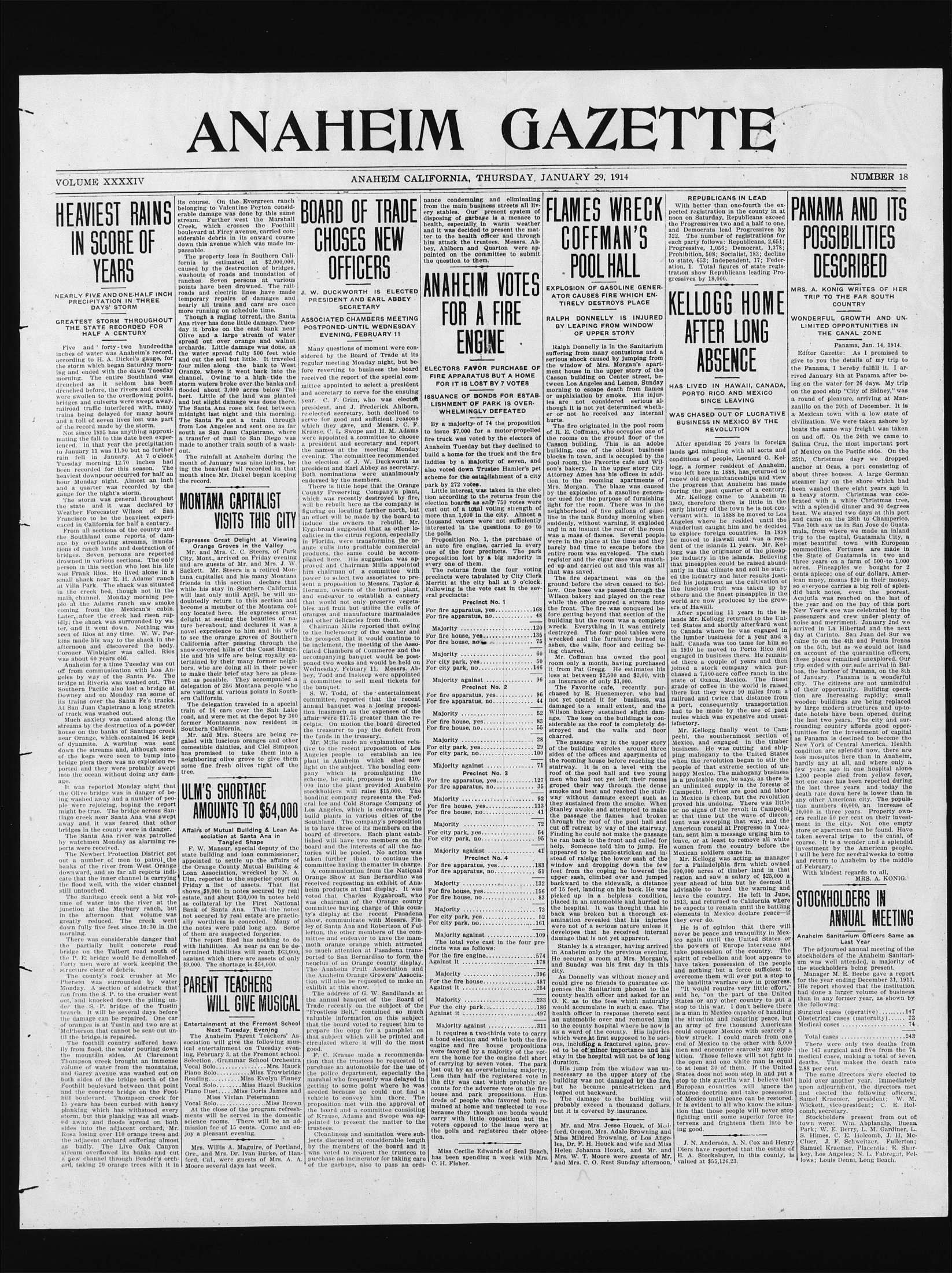
Searchable text
HEAVIEST RAINS IN SCORE OF YEARS
NEARLY FIVE AND ONE-HALF INCH PRECIPITATION IN THREE DAYS' STORM
GREATEST STORM THROUGHOUT THE STATE RECORDED FOR HALF A CENTURY
Five and forty-two hundredths inches of water was Anaheim's record, according to H. A. Dickel's gauge, for the storm which began Saturday morning and ended with the dawn Tuesday morning. The entire Southland was drenched as it seldom has been drenched before, the rivers and creeks were swollen to the overflowing point, bridges and culverts were swept away, railroad traffic interfered with, many trains being delayed for many hours and a toll of seven lives lost was part of the record made by the storm.
Not since 1895 has anything approximating the fall to this date been experienced. In that year the precipitation to January 11 was 11.90 but no further rain fell in January. At 7 o'clock Tuesday morning 12.70 inches had been recorded for this season. The heaviest downpour occurred for half an its course. On the Evergreen ranch belonging to Valentine Peyton considerable damage was done by this same stream. Further west the Marshall Creek, which crosses the Foothill boulevard at Firey avenue, carried considerable debris in its onward course down this avenue which was made impassable.
The property loss in Southern California is estimated at $2,000,000, caused by the destruction of bridges, washouts of roads and inundation of ranches. Seven persons at various points have been drowned. The railroads and electric lines have made temporary repairs of damages and nearly all trains and cars are once more running on schedule time.
Though a raging torrent, the Santa Ana river has done little damage. Tuesday it broke on the east bank near Olive and a large stream of water spread out over orange and walnut orchards. Little damage was done, as the water spread fully 500 feet wide and cut the soil but little. It traveled four miles along the bank to West Orange, where it went back into the channel. Owing to a high tide the storm waters broke over the banks and flooded about 3,000 acres below Talbert. Little of the land was planted and but slight damage was done there. The Santa Ana rose six feet between midnight last night and this morning. The Santa Fe got a train through from Los Angeles and sent one as far south as San Juan Capistrano, where a transfer of mail to San Diego was made to another train south of a washout.
The rainfall at Anaheim during the month of January was nine inches, being the heaviest fall recorded in that month since Mr. Dickel began keeping
The entire Southland was drenched as it seldom has been drenched before, the rivers and creeks were swollen to the overflowing point, bridges and culverts were swept away, railroad traffic interfered with, many trains being delayed for many hours and a toll of seven lives lost was part of the record made by the storm.
Not since 1895 has anything approximating the fall to this date been experienced. In that year the precipitation to January 11 was 11.90 but no further rain fell in January. At 7 o'clock Tuesday morning 12.70 inches had been recorded for this season. The heaviest downpour occurred for half an hour Monday night. Almost an inch and a quarter was recorded by the gauge for the night's storm.
The storm was general throughout the state and it was declared by Weather Forecaster Wilson of San Francisco to be the heaviest experienced in California for half a century.
From all sections of the county and the Southland came reports of damage by overflowing streams, inundations of ranch lands and destruction of bridges. Seven persons are reported drowned in various sections. The only person in this section who lost his life was Frank Rios. He lived alone in a small shack near E. H. Adams' ranch at Villa Park. The shack was situated in the creek bed, though not in the main channel. Monday morning people at the Adams ranch saw smoke coming from the Mexican's cabin. Later, after the creek had risen rapidly, the shack was surrounded by water, and it went down. Nothing was seen of Rios at any time. W. W. Perkins made his way to the shack in the afternoon and discovered the body. Coroner Winbigler was called. Rios was about 60 years old.
Anaheim for a time Tuesday was cut off from communication with Los Angeles by way of the Santa Fe. The bridge at Riveria was washed out. The Southern Pacific also lost a bridge at Downey and on Monday ran some of its trains over the Santa Fe's tracks. At San Juan Capistrano a long stretch of track was washed out.
Much anxiety was caused along the streams by the destruction of a powder house on the banks of Santiago creek near Orange, which contained 16 kegs of dynamite. A warning was sent down the streams and, although some of the kegs were seen to bump into bridge piers there was no explosion reported and they were probably swept into the ocean without doing any damage.
It was reported Monday night that the Olive bridge was in danger of being washed away and a number of people were rejoicing, hoping the report might be true. The bridge across Santiago creek near Santa Ana was swept away and it was feared that other bridges in the county were in danger.
The Santa Ana river was patrolled by watchmen Monday as alarming reports were received.
The Newbert Protection District got out a number of men to patrol the banks of the river from West Orange downward, and so far all reports indicate that the inner channel is carrying the flood well, with the wider channel still untouched.
The Sanitago creek sent a big vol-
MONTANA CAPITALIST VISITS THIS CITY
Expresses Great Delight at Viewing Orange Groves in the Valley
Mr. and Mrs. C. C. Steers, of Park City, Mont., arrived on Friday evening and are guests of Mr. and Mrs. J. W. Sackett. Mr. Steers is a retired Montana capitalist and his many Montana friends in this section declare that while his stay in Southern California will last only until April, he will doubtedly return to this section and become a member of the Montana colony located here. He expresses great delight at seeing the beauties of nature hereabout, and declares it was a novel expreience to him and his wife to see the orange groves of Southern California after passing through the snow-covered hills of the Coast Range. He and his wife are being royally entertained by their many former neighbors, who are doing all in their power to make their brief stay here as pleasant as possible. They accompanied a delegation of 256 Montana people who are visiting at various points in Southern California.
The delegation traveled in a special train of 16 cars over the Salt Lake road, and were met at the depot by 300 former Montanans now resident in Southern California.
Mr. and Mrs. Steers are being regaled with luscious oranges and other comestible dainties, and Clel Simpson has promised to take them into a neighboring olive grove to give them some fine fresh olives right off the tree.
ULM'S SHORTAGE AMOUNTS TO $54,000
Affairs of Mutual Building & Loan Association at Santa Ana in Tangled Shape
F. W. Mansur, special deputy of the state building and loan commissioner, appointed to settle up the affairs of the Orange County Mutual Building & Loan Association, wrecked by N. A. Ulm, reported to the superior court on Friday a list of assets. That list shows $9,000 in notes secured by real estate, and about $30,000 in notes held
received the report mittee appointed to and secretary to six year. C. F. Grim president, and J. R.e-elected secretary serve for good aid which they gave, Krause, C. L. Swore were appointed as a president and the names at the evening. The committee elected the president and Earl Both nominations endorsed by the m
There is little County Preserving which was recent will be rebuilt here figuring on location an effort will be made induce the owner Eygabroad suggest calities in the citrus in Florida, were range culls into products, the same plished here. His proved and Chair him chairman of power to select them sent a proposition Herman, owners and endeavor to that would not obles and fruit but oranges and maniand other delicacies.
Chairman Mills to the inclementry the prospect that be inclement, they ciated Chambers accompanying banponed two weeks Wednesday, Febu bey, Todd and Ina a committee to the banquet.
S. W. Todd, o committee, report annual banquet vition inasmuch as affair were $17,75 ceipts. On motion the treasurer to othe funds in the o Mr. Mills made tive to the recent Angeles people plant in Anahein light on the subject pany which is scheme, he said, 000 into the pla stockholders will bonding company eral ice and Cold Los Angeles, wh build plants in Southland.The is to have three b board of director lished will have b board and the intories will be po taken further t committee having
A communica Orange Show att received requesti heim products ad voted that Cha
ING washed away and a number of people were rejoicing, hoping the report might be true. The bridge across Santiago creek near Santa Ana was swept away and it was feared that other bridges in the county were in danger.
The Santa Ana river was patrolled by watchmen Monday as alarming reports were received.
The Newbert Protection District got out a number of men to patrol the banks of the river from West Orange downward, and so far all reports indicate that the inner channel is carrying the flood well, with the wider channel still untouched.
The Sanitago creek sent a big volume of water into the river at the junction at the Maybury ranch, but in the afternoon that volume was greatly reduced. The creek went down fully five feet since 10:30 in the morning.
There was considerable danger that the partially built concrete road bridge on the Talbert road south of the P. E. bridge would be demolished. Forty men were at work keeping the structure clear of debris.
The county's rock crusher at McPherson was surrounded by water Monday. A section of sidetrack that ran from the S. P. to the crusher went out, and knocked down the piling under the S. P. bridge of the Tustin branch. It will be several days before the damage can be repaired. One car of oranges is at Tustin and two are at McPherson that cannot be sent out until the bridge is repaired.
The foothill country suffered heavily from flood, the water pouring down the mountain sides. At Claremont Thompson creek brought an immense volume of water from the mountains, and Garey avenue was washed out on both sides of the bridge north of the Foothill boulevard between that point and the concrete bridge on the Foothill boulevard. Thompson creek for 15 years has been curbed with heavy planking which has withstood every storm, but this planking was all washed away and floods spread on both sides into the adjacent orchard, Mr. Rosa losing over 110 orange trees and the adjacent orchard suffering almost as badly. The Live Oak Canyon stream overflowed its banks and cut a new channel through Bender's orchard, taking 20 orange trees with it in
AMOUNTS TO $54,000
Affairs of Mutual Building & Loan Association at Santa Ana in Tangled Shape
F. W. Mansur, special deputy of the state building and loan commissioner, appointed to settle up the affairs of the Orange County Mutual Building & Loan Association, wrecked by N. A. Ulm, reported to the superior court on Friday a list of assets. That list shows $9,000 in notes secured by real estate, and about $30,000 in notes held as collateral by the First National Bank of Santa Ana. That the notes not secured by real estate are practically worthless is conceded. Many of the notes were paid long ago. Some of them are suspected forgeries.
The report filed has nothing to do with liabilities. As near as can be determined liabilities will reach $63,000, against which there are assets of only $9,000. The shortage is $54,000.
PARENT TEACHERS WILL GIVE MUSICAL
Entertainment at the Fremont School Next Tuesday Evening
The Anaheim Parent Teachers' Association will give the following musical entertainment on Tuesday evening, February 3, at the Fremont school. Selection...Grammar School Orchestra Vocal Solo...Mrs. Hauck Piano Solo...Miss Trowbridge Reading...Miss Evelyn Finney Vocal Solo...Miss Hazel Buckins Piano Duet...Miss Doris James and Miss Vivian Petermann Vocal Solo...Miss Brown
At the close of the program refreshments will be served in the domestic science rooms. There will be an admission fee of 15 cents. Come and enjoy a pleasant evening.
Mrs. Willis A. Maguire, of Portland, Ore., and Mrs. Dr. Ivan Burke, of Hanford, Cal., were guests of Mrs. A. A. Moore several days last week.
A communication Orange Show at received request heim products at voted that Chad was chairman of committee having city's display at the show, communicate ley of Santa Ana lerton, the other mittee and endear moth orange or so much attention ported to San Beneclus of an O The Anaheim F for the Anaheim Oration will also be exhibit at this s
The address othe annual ban Trade recently "Frostless Belt," valuable informt that the board w prepare the copy subject wh circulated where good.
F. C. Krause tion that the tr purchase an authe police depa marshal who fre getting to some needed because vehicle to conv proposition meet the board and a of Krause, Adan pointed to pres trustees.
Cleanliness ar objects discussed by the member was voted to r purchase an inc of the garbage
ANAHEIM GAZETE
ANAHEIM CALIFORNIA, THURSDAY, JANUARY 29, 1914
BOARD OF TRADE CHOSES NEW OFFICERS
J. W. DUCKWORTH IS ELECTED PRESIDENT AND EARL ABBEY SECRETARY
ASSOCIATED CHAMBERS MEETING POSTPONED UNTIL WEDNESDAY EVENING, FEBRUARY 11
Many questions of moment were considered by the Board of Trade at its regular meeting Monday night, but before reverting to business the board received the report of the special committee appointed to select a president and secretary to serve for the ensuing year. C. F. Grim, who was elected president, and J. Frederick Ahlborn, re-elected secretary, both declined to serve for good and sufficient reasons which they gave, and Messrs. C. F. Krause, C. L. Swope and H. M. Adams were appointed a committee to choose a president and secretary and report the names at the meeting Monday evening. The committee recommended the election of J. W. Duckworth as president and Earl Abbey as secretary. Both nominations were unanimously
nance condemning and eliminating from the main business streets all livery stables. Our present system of disposing of garbage is a menace to health, especially in warm weather and it was decided to present the matter to the health officer and through him attack the trustees. Messrs. Abbey, Ahlborn and Quarton were appointed on the committee to submit the question to them.
ANAHEIM VOTES FOR A FIRE ENGINE
ELECTORS FAVOR PURCHASE OF FIRE APPARATUS BUT A HOME FOR IT IS LOST BY 7 VOTES
ISSUANCE OF BONDS FOR ESTABLISHMENT OF PARK IS OVER-WHELMINGLY DEFEATED
By a majority of 74 the proposition to issue $7,000 for a motor-propelled fire truck was voted by the electors of Anaheim Tuesday but they declined to build a home for the truck and the fire laddies by a majority of seven, and also voted down Trustee Hamler's pet FLAMES WRECK COFFMAN'S POOL HALL
EXPLOSION OF GASOLINE GENERATOR CAUSES FIRE WHICH ENTIRELY DESTROYS PLACE
RALPH DONNELLY IS INJURED BY LEAPING FROM WINDOW OF UPPER STORY
Ralph Donnelly is in the Sanitarium suffering from many contusions and a serious shock caused by jumping from the window of Mrs. Morgan's apartment house in the upper story of the Casson building on Center street, between Los Angeles and Lemon, Sunday morning to escape death from flames or asphyxiation by smoke. His injuries are not considered serious although it is not yet determined whether or not he received any internal hurts.
The fire originated in the pool room of R. E. Coffman, who occupies one of the rooms on the ground floor of the Casson building. This is an adobe building, one of the oldest business blocks in town, and is occupied by the pool room, the Favorite cafe and Wilson's bakery. In the upper story City Attorney Ames has his offices in addi-
received the report of the special committee appointed to select a president and secretary to serve for the ensuing year. C. F. Grim, who was elected president, and J. Frederick Ahlborn, re-elected secretary, both declined to serve for good and sufficient reasons which they gave, and Messrs. C. F. Krause, C. L. Swope and H. M. Adams were appointed a committee to choose a president and secretary and report the names at the meeting Monday evening. The committee recommended the election of J. W. Duckworth as president and Earl Abbey as secretary. Both nominations were unanimously endorsed by the members.
There is little hope that the Orange County Preserving Company's plant, which was recently destroyed by fire, will be rebuilt here as the company is figuring on locating far north, but an effort will be made by the board to induce the owners to rebuild. Mr. Eygabroad suggested that as other localities in the citrus regions, especially in Florida, were transforming the orange culls into profitable commercial products, the same could be accomplished here. His suggestion was approved and Chairman Mills appointed him chairman of a committee with power to select two associates to present a proposition to Messrs. Taylor & Herman, owners of the burned plant, and endeavor to establish a cannery that would not only preserve vegetables and fruit but utilize the culls of oranges and manufacture marmalades and other delicacies from them.
Chairman Mills reported that owing to the inclementity of the weather and the prospect that it would continue to be inclement, the meeting of the Associated Chambers of Commerce and the accompanying banquet would be postponed two weeks and would be held on Wednesday, February 11. Messrs. Abbey, Todd and Inskeep were appointed a committee to sell meal tickets for the banquet.
S. W. Todd, of the entertainment committee, reported that the recent annual banquet was a losing proposition inasmuch as the expenses of the affair were $17.75 greater than the receipts. On motion the board directed the treasurer to pay the deficit from the funds in the treasury.
Mr. Mills made an explanation relative to the recent proposition of Los Angeles people to establish an ice plant in Anaheim which shed new light on the subject. The bonding company which is promulgating the scheme, he said, proposes to put $10,000 into the plant provided Anaheim stockholders will raise $15,000. The bonding company represents the Federal Ice and Cold Storage Company of Los Angeles, which is endeavoring to build plants in various cities of the Southland. The company's proposition is to have three of its members on the board of directors. Each plant established will have two members on the board and the interests of all the factories will be pooled. No action was taken further than to continue the committee having the matter in charge.
A communication from the National Orange Show at San Bernardino was received requesting an exhibit of Anaheim products at that display. It was voted that Charles Eygabroaf, who
FIRE APPARATUS BUT A HOME FOR IT IS LOST BY 7 VOTES
ISSUANCE OF BONDS FOR ESTABLISHMENT OF PARK IS OVER-WHELMINGLY DEFEATED
By a majority of 74 the proposition to issue $7,000 for a motor-propelled fire truck was voted by the electors of Anaheim Tuesday but they declined to build a home for the truck and the fire laddies by a majority of seven, and also voted down Trustee Hamler's pet scheme for the establishment of a city park by 272 votes.
Little interest was taken in the election according to the returns from the election boards as only 750 votes were cast out of a total voting strength of more than 1,600 in the city. Almost a thousand voters were not sufficiently interested in the questions to go to the polls.
Proposition No. 1, the purchase of an auto fire engine, carried in every one of the four precincts. The park proposition lost by a big majority in every one of them.
The returns from the four voting precincts were tabulated by City Clerk Merritt at the city hall at 9 o'clock. Following is the vote cast in the several precincts:
Precinct No. 1
For fire apparatus, yes...168
For fire apparatus, no...48
Majority...120
For fire house, yes...135
For fire house, no...75
Majority...60
For city park, yes...50
For city park, no...146
Majority against...96
Precinct No. 2
For fire apparatus, yes...96
For fire apparatus, no...44
Majority...52
For fire house, yes...83
For fire house, no...55
Majority...28
For city park, yes...29
For city park, no...100
Majority against...71
Precinct No. 3
For fire apparatus, yes...127
For fire apparatus, no...35
Majority...92
For fire house, yes...113
For fire house, no...41
Majority...72
For city park, yes...54
For city park, no...95
Majority against...41
Precinct No. 4
For fire apparatus, yes...183
For fire apparatus, no...51
Majority...132
For fire house, yes...156
For fire house, no...83
Casson building on Center street, between Los Angeles and Lemon, Sunday morning to escape death from flames or asphixiation by smoke. His injuries are not considered serious although it is not yet determined whether or not he received any internal hurts.
The fire originated in the pool room of R. E. Coffman, who occupies one of the rooms on the ground floor of Casson building. This is an adobe building, one of the oldest business blocks in town, and is occupied by the pool room, the Favorite cafe and Wilson's bakery. In the upper story City Attorney Ames has his offices in addition to the rooming apartments of Mrs. Morgan. The blaze was caused by the explosion of a gasoline generator used for the purpose of furnishing light for the room. There was in the neighborhood of five gallons of gasoline in the tank Sunday morning when suddenly, without warning, it exploded and in an instant the rear of the room was a mass of flames. Several people were in the place at the time and they barely had time to escape before the entire room was enveloped. The cash register and the cigar case was snatched up and carried out and this was all that was saved.
The fire department was on the ground before the siren ceased to below. One hose was passed through the Wilson bakery and played on the rear while the other poured a stream into the front. The fire was conquered before getting beyond that section of the building but the room was a complete wreck. Everything in it was entirely destroyed. The four pool tables were wrecked and the furniture burned to ashes, the walls, floor and ceiling being charred.
Mr. Coffman has owned the pool room only a month, having purchased it from Pat Gregg. He estimates his loss at between $2,500 and $3,000, with an insurance of only $1,000.
The Favorite cafe, recently purchased by E. Huenemeyer, who had not yet opened it for business, was damaged to a small extent, and the Wilson bakery sustained slight damage. The loss on the buildings is considerable as the roof is completely destroyed and the walls and floor charred.
The passage way in the upper story of the building circles around three sides of the offices and apartments of the rooming house before reaching the stairway. It is on a level with the roof of the pool hall and two young men who had not yet left their rooms grouped their way through the dense smoke and heat and reached the stairway without damage except such as they sustained from the smoke. When Stanley awoke and attempted to make the passage she flames had broken through the roof of the pool hall and cut off retreat by way of the stairway. Finding he could not make the passage he ran back to the front and called for help. Someone told him to jump. He appeared to be panic-stricken and instead of raising the lower sash of the window and dropping down the few feet from the coping he lowered the upper sash, climbed over and jumped backward to the sidewalk, a distance of 15 feet, landing on his back. He was picked up in a helpless condition,
---
bonding company represents the Federal Ice and Cold Storage Company of Los Angeles, which is endeavoring to build plants in various cities of the Southland. The company's proposition is to have three of its members on the board of directors. Each plant established will have two members on the board and the interests of all the factories will be pooled. No action was taken further than to continue the committee having the matter in charge.
A communication from the National Orange Show at San Bernardino was received requesting an exhibit of Anaheim products at that display. It was voted that Charles Eygabroaf, who was chairman of the Orange county committee having charge of this county's display at the recent Pasadena show, communicate with Messrs. Finley of Santa Ana and Robertson of Fullerton, the other members of the committee and endeavor to have the mammoth orange which attracted so much attention at Pasadena transported to San Bernardino to form the neuclus of an Orange county display. The Anaheim Fruit Association and the Anaheim Orange Growers' Association will also be requested to make an exhibit at this show.
The address of G. W. Sandilands at the annual banquet of the Board of Trade recently on the subject of the "Frostless Belt," contained so much valuable information on this subject that the board voted to request him to prepare the copy for a pamphlet on that subject which will be printed and circulated where it will do the most good.
F. C. Krause made a recommendation that the trustees be requested to purchase an automobile for the use of the police department, especially the marshal who frequently was delayed in getting to some point where he was needed because he could not find a vehicle to convey him there. The proposition met with the approval of the board and a committee consisting of Krause, Adams and Swope was appointed to present the matter to the trustees.
Cleanliness and sanitation were subjects discussed at considerable length by the members of the board and it was voted to request the trustees to purchase an incinerator for taking care of the garbage, also to pass an ordinance.
Miss Cecille Edwards of Seal Beach, has been spending a week with Mrs. C. H. Fisher.
Precinct No. 4
For fire apparatus, yes...183
For fire apparatus, no...51
Majority...132
For fire house, yes...156
For fire house, no...83
Majority...73
For city park, yes...52
For city park, no...161
Majority against...109
The total vote cast in the four precincts was as follows:
For the fire engine...574
Against it...178
Majority...396
For the fire house...487
Against it...254
Majority...233
For the city park...186
Against it...497
Majority against...311
It requires a two-thirds vote to carry a bond election and while both the fire engine and fire house propositions were favored by a majority of the voters the home for the engine fell short of carrying by seven votes. The park lost out by an overwhelming majority. Less than half the registered vote in the city was cast which probably accounts for the adverse vote on the fire house and park propositions. Hundreds of people who favored both remained at home and neglected to vote because they though one bonds would carry with little opposition but the voters opposed to the issue were at the polls and registered their objection.
Mr. and Mrs. Jesse Houck, of Medford, Oregon, Mrs. Adale Browning and Miss Mildred Browning, of Los Angeles, Dr. F. H. Houck and wife and Miss Helen Johanna Houck, and Mr. and Mrs. W. T. Moore were guests of Mr. and Mrs. C. O. Rust Sunday afternoon.
ZETTE
29, 1914
NUMBER 18
G WRECK
MAN'S
HALL
GASOLINE GENERFIRE WHICH ENSTROYS PLACE
KELLY IS INJURED
FROM WINDOW
PER STORY
y is in the Sanitarium
many contusions and a
used by jumping from
Mrs. Morgan's apartthe upper story of the
on Center street, beses and Lemon, Sunday
pe death from flames
by smoke. His injurconsidered serious alyet determined whethreceived any internal
ated in the pool room
who occupies one of
the ground floor of the.
This is an adobe
of the oldest business
and is occupied by the
Favorite cafe and Wilthe upper story City
has his offices in addi-
REPUBLICANS IN LEAD
With better than one-fourth the expected registration in the county in at
noon on Saturday, Republicans exceed
the Progressives two and a half to one,
and Democrats lead Progressives by
322. The number of registrations for
each party follows: Republicans, 2,651;
Progressive, 1,056; Democrat, 1,378;
Prohibition, 508; Socialist, 183; decline
to state, 653; Independent, 17; Federation, 1. Total figures of state registration show Republicans leading Progressives by 18,000.
KELLOGG HOME
AFTER LONG
ABSENCE
HAS LIVED IN HAWAII, CANADA,
PORTO RICO AND MEXICO
SINCE LEAVING
WAS CHASED OUT OF LUCRATIVE
BUSINESS IN MEXICO BY THE
REVOLUTION
After spending 25 years in foreign
lands and mingling with all sorts and
conditions of people, Leonard G. Kellogg, a former resident of Anaheim,
who left here in 1888, has returned to
PANAMA AND ITS
POSSIBILITIES
DESCRIBED
MRS. A. KONIG WRITES OF HER
TRIP TO THE FAR SOUTH
COUNTRY
WONDERFUL GROWTH AND UNLIMITED OPPORTUNITIES IN
THE CANAL ZONE
Panama, Jan. 14, 1914.
Editor Gazette: As I promised to give to you the details of my trip to the Panama, I hereby fulfill it. I arrived January 8th at Panama after being on the water for 26 days. My trip on the good ship "City of Sidney," was a round of pleasure, arriving at Manzanillo on the 20th of December. It is a Mexican town with a low state of civilization. We were taken ashore by boats the same way freight was taken on and off. On the 24th we came to Salina Cruz, the most important port of Mexico on the Pacific side. On the 25th, Christmas day we dropped anchor at Ocas, a port consisting of about three houses. A large German
HAS LIVED IN HAWAII, CANADA,
PORTO RICO AND MEXICO
SINCE LEAVING
WAS CHASED OUT OF LUCRATIVE
BUSINESS IN MEXICO BY THE
REVOLUTION
After spending 25 years in foreign lands and mingling with all sorts and conditions of people, Leonard G. Kellogg, a former resident of Anaheim, who left here in 1888, has returned to renew old acquaintanceships and view the progress that Anaheim has made during the past quarter of a century.
Mr. Kellogg came to Anaheim in 1869, therefore there is little in the early history of the town he is not conversant with. In 1888 he moved to Los Angeles where he resided until the wanderlust caught him and he decided to explore foreign countries. In 1898 he moved to Hawaii and was a resident of the islands 11 years. Mr. Kellogg was the originator of the pineapple industry in the islands. Believing that pineapples could be raised abundantly in that climate and soil he started the industry and later results justified his judgment as the cultivation of the luscious fruit was taken up by others and the finest pineapples in the world are now produced by the growers of Hawaii.
After spending 11 years in the islands Mr. Kellogg returned to the United States and shortly afterward went to Canada where he was engaged in the lumber business for a year and a half. Canada was too tame for him so in 1910 he moved to Porto Rico and engaged in business there. He remained there a couple of years and then joined a stock company which purchased a 7,500-acre coffee ranch in the state of Oxaca, Mexico. The finest grade of coffee in the world is raised there but they were 90 miles from a railroad and twice that distance from a port, consequently transportation had to be made by the use of pack mules which was expensive and unsatisfactory.
Mr. Kellogg finally went to Campechi, the southernmost section of Mexico, and engaged in the timber business. He was cutting and shipping mahogany to the United States when the revolution began to stir the people of that extreme section of unhappy Mexico. The mahogany business is a profitable one, he says, as there is an unlimited supply in the forests of Campechi. Prices are good and labor in Mexico is cheap, but the revolution proved his undoing. There was little or no signs of the revolt in Campechi at that time but the wave of discontent was sweeping that way, and the American consul at Progresso in Yucatan, sent him a message urging him to leave, or at least to remove all white women from the country before the Mexican soldiers came in.
Mr. Kellogg was acting as manager for a Philadelphia firm which owned 600,000 acres of timber land in that region and saw a salary of $25,000 a year ahead of him but he deemed it advisable to heed the warning and leave the country. He left in June, arrived January 8th at Panama after being on the water for 26 days. My trip on the good ship "City of Sidney," was a round of pleasure, arriving at Manzanillo on the 20th of December. It is a Mexican town with a low state of civilization. We were taken ashore by boats the same way freight was taken on and off. On the 24th we came to Salina Cruz, the most important port of Mexico on the Pacific side. On the 25th, Christmas day we dropped anchor at Ocas, a port consisting of about three houses. A large German steamer lay on the shore which had been washed there eight years ago in a heavy storm. Christmas was celebrated with a white Christmas tree, with a splendid dinner and 90 degrees heat. We stayed two days at this port and came on the 28th to Champerico. The 30th saw us in San Jose de Guatamala, from where we made an inland trip to the capital, Guatamala City, a most beautiful town with European commodities. Fortunes are made in the State of Guatamala in two and three years on a farm of 500- to 1,000 acres. Pineapples we bought for 2 cents apiece; one of our dollars, American money, means $20 in their money, so everyone carries a big roll of splendid bank notes, even the poorest. Acajutla was reached on the last of the year and on the bay of this port New Year's eve was celebrated by the passengers and crew under plenty of noise and merriment. January 2nd we arrived in La Hibertad and the next day at Carinto. San Juan del Sur we came to on the 4th and Punta Irenas on the 5th, but as we could not land on account of the quarantine officers, these places remained unexplored. Our trip ended with our safe arrival in Balboa, the harbor of Panama, on the 8th of January. Panama is a wonderful city. The citizens are not unmindful of their opportunity. Building operation are increasing rapidly; small wooden buildings are being replaced by large modern structures and up-to-date hotels have been opened during the last two years. The city and surrounding country affords good opportunities for the investment of capital as Panama is destined to become the New York of Central America. Health condition are splendid now, there are less mosquitos here than in Anaheim, hardly any at all, and where only a few years ago in one hospital alone 1,200 people died from yellow fever, not one case has been reported during the last three years and today the death rate down here is lower than in any other American city. The population numbers 40,000, an increase of 20,000 in three years. Property owners realize 50 per cent on their investment in the city. Not one empty store or apartment can be found. Have taken several trips to the canal, of course. It is a wonder and a splendid investment by the American people. I will be here for several weeks to come and return to Anaheim by the middle of February.
With kindest regards to all,
MRS. A. KONIG.
STOCKHOLDERS IN ANNUAL MEETING
Anaheim Sanitarium Officers Same as Last Year
The adjourned annual meeting of the stockholders of the Anaheim Sanitarium was well attended, a majority of the stockholders being present.
Manager M. E. Beebe gave a report for the year ending December 31, 1913. His report showed that the institution had done a larger volume of business than in any former year, as shown by the following:
Surgical cases (operative) ... 147
Obstetrical cases (maternity) ... 22
Medical cases ... 74
Total cases ... 243
There were only two deaths from the 147 surgical and five from the 74 medical cases, making a total of seven deaths. This makes the death rate 2.88 per cent.
The same directors were elected to hold over another year. Immediately upon adjournment, the directors met and elected the following officers: Samel Kraemer, president; W. M. Wickett, vice-president; C. E. Holcomb, secretary.
Stockholders present from out of town were: Wm. Abplanalp, Buena Park; W. E. Berry, L. M. Gardiner, L. S. Himes, C. E. Holcomb, J. H. McCluer, J. F. Schweitzer, Fullerton; Samuel Kraemer, Placentia; E. Sharkey, Los Angeles; N. L. Fabregat, Felows; Louis Denni, Long Beach.
Mr. Kellogg was acting as manager for a Philadelphia firm which owned 600,000 acres of timber land in that region and saw a salary of $25,000 a year ahead of him but he deemed it advisable to heed the warning and leave the country. He left in June, 1913, and returned to California where he expects to remain until the battling elements in Mexico declare peace—if they ever do.
He is of opinion that there will never be peace and tranquility in Mexico again until the United States or the powers of Europe intervene and take possession of the country. The spirit of rebellion and loot appears to have taken possession of the people and nothing but a force sufficient to overcome them will ever put a stop to the banditta warfare now in progress.
"It would require very little effort," said he, "on the part of the United States or any other country to put a stop to this war. I don't believe there is a man in Mexico capable of handling the situation and restoring peace, but an army of five thousand Americans could conquer Mexico with scarcely a blow struck. I could march from one end of Mexico to the other with 5,000 men and encounter scarcely any opposition. Those fellows will not fight in the open and one white man is equal to at least 30 of them. If the United States does not soon step in and put a stop to this guerilla war I believe that European countries will ignore the Monroe doctrine and take possession of Mexico until peace can be restored. It is evident to all who know the situation that those people will never stop fighting until some superior force intervenes and frightens them into being good."
J. N. Anderson, A. N. Cox and Henry Diers have reported that the estate of E. A. Stockslager, in this county, is valued at $55,126.23.