anaheim-gazette 1914-01-22
Scanned page
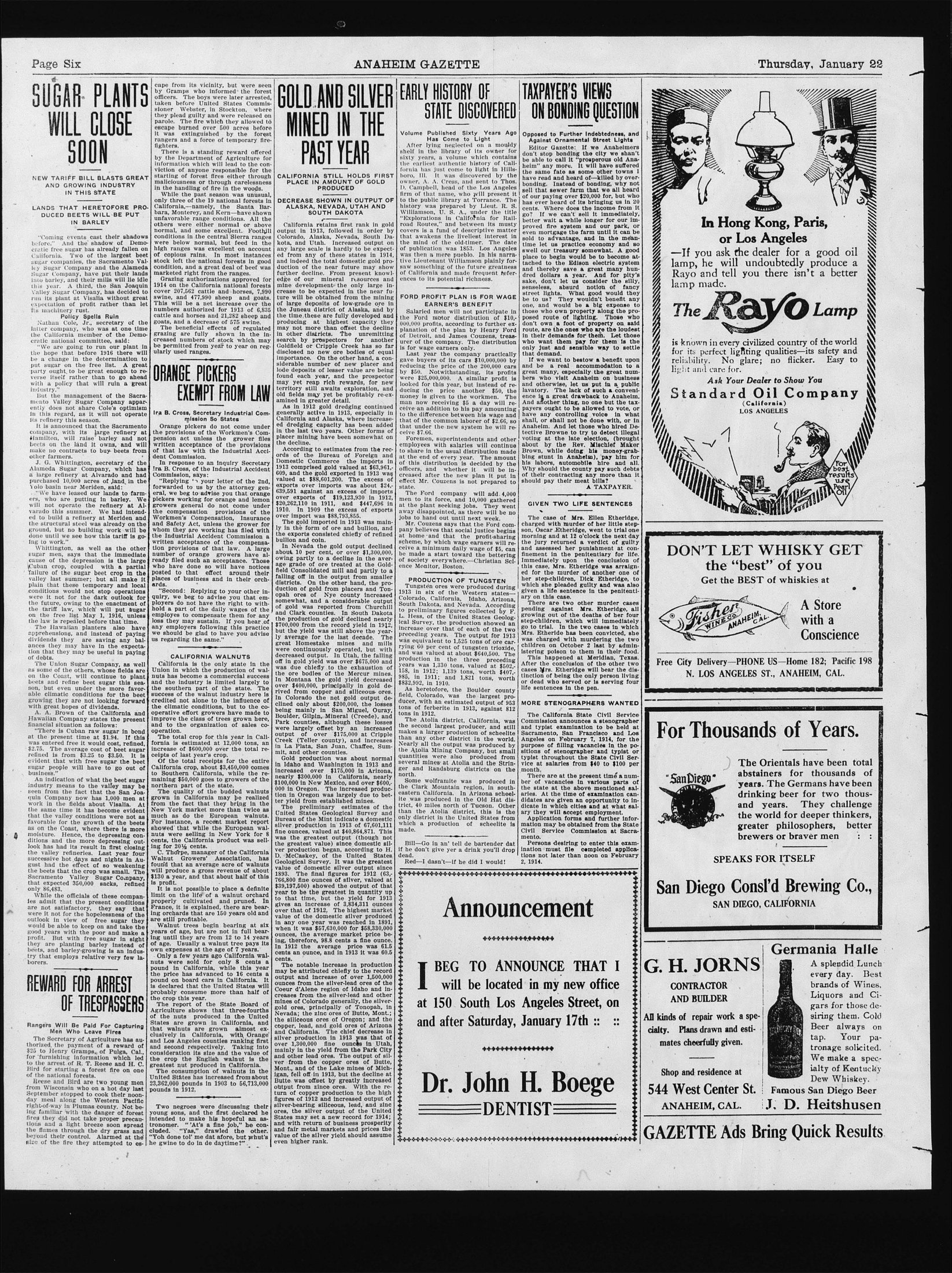
Searchable text
SUGAR PLANTS WILL CLOSE SOON
NEW TARIFF BILL BLASTS GREAT AND GROWING INDUSTRY IN THIS STATE
LANDS THAT HERETOFORE PRODUCED BEETS WILL BE PUT IN BARLEY
"Coming events cast their shadows before." And the shadow of Democratic free sugar has already fallen on California. Two of the largest beet sugar companies, the Sacramento Valley Sugar Company and the Alameda Sugar Company, have put their lands into barley, and their mills will lie idle this year. A third, the San Joaquin Valley Sugar Company, has decided to run its plant at Visalia without great expectation of profit rather than let its machinery rust.
Policy Spells Ruin
Nathan Cole, Jr., secretary of the latter company, who was at one time the California member of the Democratic national committee, said:
"We are going to run our plant in the hope that before 1916 there will be a change in the determination to put sugar on the free list. A great party ought to be great enough to reverse itself rather than to go ahead with a policy that will ruin a great industry."
But the management of the Sacramento Valley Sugar Company apparently does not share Cole's optimism in this regard, as it will not operate its refinery this season.
It is announced that the Sacramento company, with its large refinery at Hamilton, will raise barley and not beets on the land it owns, and will make no contracts to buy beets from other farmers.
J. G. Whittington, secretary of the Alameda Sugar Company, which has a large refinery at Alvarado and had escape from its vicinity, but were seen by Gramps who informed the forest officers. The boys were later arrested, taken before United States Commissioner Webster, in Stockton, where they plead guilty and were released on parole. The fire which they allowed to escape burned over 500 acres before it was extinguished by the forest rangers and a force of temporary firefighters.
There is a standing reward offered by the Department of Agriculture for information which will lead to the conviction of anyone responsible for the starting of forest fires either through maliciousness or through carelessness in the handling of fire in the woods.
While the past season was unusual, only three of the 19 national forests in California—namely, the Santa Barbara, Monterey, and Kern—have shown unfavorable range conditions. All the others were either normal or above normal, and some excellent. Foothill conditions in the central Sierra ranges were below normal, but feed in the high ranges was excellent on account of copious rains. In most instances stock left the national forests in good condition, and a great deal of beef was marketed right from the ranges.
Grazing authorizations approved for 1914 on the California national forests cover 207,562 cattle and horses, 7,990 swine, and 477,990 sheep and goats. This will be a net increase over the numbers authorized for 1913 of 6,835 cattle and horses and 21,282 sheep and goats, and a decrease of 575 swine.
The beneficial effects of regulated grazing are fully shown in the increased numbers of stock which may be permitted from year to year on regularly used ranges.
ORANGE PICKERS EXEMPT FROM LAW
Ira B. Cross, Secretary Industrial Commission So States
Orange pickers do not come under the provisions of the Workmen's Compensation act unless the grower files written acceptance of the provisions of that law with the Industrial Accident Commission.
In response to an Inquiry Secretary Ira B. Cross, of the Industrial Accident Commission says:
California retains first output in 1913, followed by Colorado, Alaska, Nevada, kota, and Utah. Increases any large scale is hardly staged from any of these states and indeed the total domestication of the near future further decline. From pro-edge of our mineral resource development the increase to be expected in future will be obtained from large deposits of low-grade Juneau district of Alaska; the time these are fully developed at highest capacity may not more than offset in other districts. The search by prospectors in Goldfield or Cripple Creek disclosed no new ore body importance. On the other hand siderable number of new lode deposits of lesser value found each year, and that may yet reap rich rewards territory still awaits exploited fields may yet be profiled in greater detail.
As in 1912 gold dredging generally active in 1913, California and Alaska, which ed dredging capacity has in the last two years. Other placer mining have been slowed down.
According to estimates forords of the Bureau of Domestic Commerce the 1913 comprised gold valued 609, and the gold exported
But the management of the Sacramento Valley Sugar Company apparently does not share Cole's optimism in this regard, as it will not operate its refinery this season.
It is announced that the Sacramento company, with its large refinery at Hamilton, will raise barley and not beets on the land it owns, and will make no contracts to buy beets from other farmers.
J. G. Whittington, secretary of the Alameda Sugar Company, which has a large refinery at Alvarado and had purchased 10,000 acres of land in the Yolo basin near Meriden, said:
"We have leased our lands to farmers, who are putting in barley. We will not operate the refinery at Alvarado this summer. We had intended to build a refinery at Meriden and the structural steel was already on the ground, but no building work will be done until we see how this tariff is going to work."
Whittington, as well as the other sugar men, says that the immediate cause of the depression is the large Cuban crop, coupled with a partial failure of the sugar beet crop in the valley last summer; but all make it plain that these temporary and local conditions would not stop operations were it not for the dark outlook for the future, owing to the enactment of the tariff law, which will put sugar on the free list May 1, 1916, unless the law is repealed before that time.
The Hawaiian planters also have apprehensions, and instead of paying dividends they are saving any balances they may have in the expectation that they may be useful in paying debts.
The Union Sugar Company, as well as some of the others, whose fields are on the Coast, will continue to plant beets and refine beet sugar this season, but even under the more favorable climatic conditions for the beet growing they are not looking forward with great hopes of dividends.
A. A. Brown of the California and Hawaiian Company states the present financial situation as follows:
"There is Cuban raw sugar in bond at the present time at $1.94. If this was entered free it would cost, refined, $2.75. The average cost of beet sugar refined is from $3.25 to $3.50. It is evident that with free sugar the beet sugar people will have to go out of business."
An indication of what the beet sugar industry means to the valley may be seen from the fact that the San Joaquin Company now has 1,000 men at work in the fields about Visalia. At the same time it has become evident that the valley conditions were not as favorable for the growth of the beets as on the Coast, where there is more moisture. Hence, the depressing conditions and the more depressing outlook has had its result in first closing the valley refineries. Last year four successive hot days and nights in August had the effect of so weakening the beets that the crop was small. The Sacramento Valley Sugar Company, that expected 350,000 sacks, refined only 86,483.
While the officials of these companies verse itself rather than to go ahead with a policy that will ruin a great industry."
Ira B. Cross, Secretary Industrial Commission So States
Orange pickers do not come under the provisions of the Workmen's Compensation act unless the grower files written acceptance of the provisions of that law with the Industrial Accident Commission.
In response to an inquiry Secretary Ira B. Cross, of the Industrial Accident Commission, says:
"Replying to your letter of the 2nd, forwarded to us by the attorney general, we beg to advise you that orange pickers working for orange and lemon growers general do not come under the compensation provisions of the Workmen's Compensation, Insurance and Safety Act, unless the grower for whom they are working has filed with the Industrial Accident Commission a written acceptance of the compensation provisions of that law. A large number of orange growers have already filed such an acceptance. Those who have done so will have notices posted to that effect around their places of business and in their orchards.
"Second: Replying to your other inquiry, we beg to advise you that employers do not have the right to withhold a part of the daily wages of the employees to compensate them for any loss they may sustain. If you hear of any employers following this practice we should be glad to have you advise us regarding the same."
CALIFORNIA WALNUTS
California is the only state in the Union in which the production of walnuts has become a commercial success and the industry is limited largely to the southern part of the state. The success of the walnut industry here is credited not alone to the influence of the climatic conditions, but to the cooperative effort growers have made to improve the class of trees grown here, and to the organization of sales cooperation.
The total crop for this year in California is estimated at 12,000 tons, an increase of $600,000 over the total receipts of last year's crop.
Of the total receipts for the entire California crop, about $3,450,000 comes to Southern California, while the remaining $50,000 goes to growers of the northern part of the state.
The quality of the budded walnuts grown in California may be realized from the fact that they bring in in New York market more than twice as much as do the European walnuts. For instance, a recent market report showed that while the European walnuts were selling in New York for 8 cents, the California product was selling for 20½ cents.
C. Thorpe, manager of the California Walnut Growers' Association, has found that an average acre of walnuts will produce a gross revenue of about $130 a year, and that about half of this is profit.
It is not possible to place a definite limit on the life of a walnut orchard found each year, and that may yet reap rich rewards territory still awaits exploitation in the last two years. Other placer mining have been studied decline.
According to estimates for orders of the Bureau of Domestic Commerce there was 1913 comprised gold values 609, and the gold exported valued at $88,601,200. The exports over imports was 639,591 against an excess over exports of $19,123,591 $20,262,110 in 1911, and in 1910. In 1909 the excess over import was $88,793,855.
The gold imported in 1913 in form of ore and its exports consisted chiefly bullion and coin.
In Nevada the gold output about 10 per cent, or over owing partly to a decline in age grade of ore treated field Consolidated mill and falling off in the output from districts. On other hand production of gold from place opah ores of Nye county somewhat, and a considerable gold was reported from Clark counties. In South production of gold decreased $700,000 from the record year but the yield was still about average for the last decade great Homestake mines were continuously operated decreased output. In Utah off in gold yield was over was due chiefly to the exeirethe ore bodies of The Mee In Montana the gold yield over $400,000 principally derived from copper and silver In Colorado the net gold clined only about $200,000 being mainly in San Miquel Boulder, Gilpin, Mineral (O Park counties), although it were largely offset by an output of over $175,000 Creek (Teller county), and in La Plata, San Juan, Chico Mit, and other counties.
Gold production was added in Idaho and Washington increased over $175,000 nearly $300,000 in California $100,000 in New Mexico and 400 in Oregon. The increase in Oregon was largely ter yield from established mine.
The preliminary estimate United States Geological Bureau of Mint indicated silver production in 1913 fine ounces, valued at $40,887 was the greatest output since greatest value) since ever production began, according D. McCaskey, of the Uni Geological Survey. It was a value of domestic silver over 1893. The final figures for 766,800 fine ounces of silver $39,197,500) showed the out year to be the greatest in that time but,the vicinity
REWARD FOR ARREST OF TRESPASSERS
Rangers Will Be Paid For Capturing Men Who Leave Fires
The Secretary of Agriculture has authorized the payment of a reward of $25 to Henry Gramps, of Pulga, Cal., for furnishing information which led to the arrest of R. T. Reese and H. C. Bird for starting a forest fire on one of the national forests.
Reese and Bird are two young men from Wisconsin who on a hot day last September stopped to cook their noon-day meal along the Western Pacific right-of-way in Plumas county. Not being familiar with the danger of forest fires they did not take proper precautions and a light breeze soon spread the flames through the dry grass and beyond their control. Alarmed at the size of the fire they attempted to escape from California may be realized from the fact that they bring in the New York market more than twice as much as do the European walnuts. For instance, a recent market report showed that while the European walnuts were selling in New York for 8 cents, the California product was selling for 20½ cents.
C. Thörpe, manager of the California Walnut Growers' Association, has found that an average acre of walnuts will produce a gross revenue of about $130 a year, and that about half of this is profit.
It is not possible to place a definite limit on the life of a walnut orchard properly cultivated and pruned. In France, it is explained, there are bearing orchards that are 150 years old and are still profitable.
Walnut trees begin bearing at six years of age, but are not in full bearing until they are from 12 to 14 years of age. Usually a walnut tree pays its own expenses at the age of 7 years.
Only a few years ago California walnuts were sold for only 8 cents a pound in California, while this year the price has advanced to 16 cents a pound on board cars in California. It is declared that the United States will probably consume more than half of the crop this year.
The report of the State Board of Agriculture shows that three-fourths of the nuts produced in the United States are grown in California, and that walnuts are grown almost exclusively in California, with Orange and Los Angeles counties ranking first and second respectively. Taking into consideration its size and the value of the crop the English walnut is the greatest nut produced in California.
The consumption of walnuts in the United States has increased from about 23,362,000 pounds in 1903 to 56,713,000 pounds in 1912.
Two negroes were discussing their young sons, and the first declared he intended to make his hopeful an astronomer. "At's a fine job," he concluded. "Yas," drawled the other. "Yoh done to' me dat afore, but what's he gwine to do in de daytime?"
GOLD AND SILVER MINED IN THE PAST YEAR
CALIFORNIA STILL HOLDS FIRST PLACE IN AMOUNT OF GOLD PRODUCED
DECREASE SHOWN IN OUTPUT OF ALASKA, NEVADA, UTAH AND SOUTH DAKOTA
California retains first rank in gold output in 1913, followed in order by Colorado, Alaska, Nevada, South Dakota, and Utah. Increased output on any large scale is hardly to be expected from any of these states in 1914, and indeed the total domestic gold production of the near future may show further decline. From present knowledge of our mineral resources and online development the only large increase to be expected in the near future will be obtained from the mining of large deposits of low-grade ore in the Juneau district of Alaska, and by the time these are fully developed and producing at highest capacity they may not more than offset the decline in other districts. The unremitting search by prospectors for another Goldfield or Cripple Creek has so far disclosed no new ore bodies of equal importance. On the other hand, a considerable number of new placer andode deposits of lesser value are being found each year, and the prospector may yet reap rich rewards, for new territory still awaits exploration, and old fields may yet be profitably re-examined in greater detail.
As in 1912 gold dredging continued generally active in 1913, especially in California and Alaska, where increased dredging capacity has been added in the last two years. Other forms of placer mining have been somewhat on the decline.
According to estimates from the records of the Bureau of Foreign and Domestic Commerce the imports in 1913 comprised gold valued at $63,961,009, and the gold exported in 1913 was...
According to estimates from the records of the Bureau of Foreign and Domestic Commerce the imports in 1913 comprised gold valued at $63,961.09, and the gold exported in 1913 was valued at $88,601.200. The excess of exports over imports was about $24,395,591 against an excess of imports over exports of $19,123,930 in 1912, 20,262,110 in 1911, and $447,696 in 1910. In 1909 the excess of exports over import was $88,793,855.
The gold imported in 1913 was mainly in the form of ore and bullion, and the exports consisted chiefly of refined bullion and coin.
In Nevada the gold output declined about 10 per cent, or over $1,300,000,wing partly to a decline in the average grade of ore treated at the Goldfield Consolidated mill and partly to a falling off in the output from smaller districts. On the other hand, the production of gold from placers and Tonpah ores of Nye county increased somewhat, and a considerable output of gold was reported from Churchill and Clark counties. In South Dakota the production of gold declined nearly 700,000 from the record yield in 1912, but the yield was still above the year-average for the last decade. The great Homestake mines and mills were continuously operated, but with decreased output. In Utah, the falling off in gold yield was over $675,000 and was due chiefly to the exhaustion of one ore bodies of the Mercur mines. Montana the gold yield decreased over $400,000, principally in gold devised from copper and siliceous ores. Colorado the net gold output declined only about $200,000, the losses being mainly in San Miguel, Ouray, Boulder, Gilpin, Mineral (Creede), andark counties, although these losses were largely offset by an increased output of over $175,000 at Cripple Creek (Teller county), and increases in La Plata, San Juan, Chaffee, Summit, and other counties.
Gold production was about normal in Idaho and Washington in 1913 and increased over $175,000 in Arizona, nearly $300,000 in California, nearly 100,000 in New Mexico, and over $600.00 in Oregon. The increased production in Oregon was largely due to better yield from established mines.
The preliminary estimates of the United States Geological Survey and bureau of the Mint indicate a domestic silver production in 1913 of 67,601,111 ounces, valued at $40,864,871. This is the greatest output (though not the greatest value) since domestic silver production began, according to H. McCaskey, of the United States Geological Survey. It was the greatest value of domestic silver output since 1893. The final figures for 1912 (63.266,800 fine ounces of silver, valued at 89,197,500) showed the output of thatear to be the greatest in quantity up to that time, but the yield for 1913 were $25,000,000. A similar profit is looked for this year, but instead of reducing the price another $50,the money is given to the workmen. The man now receiving $5 a day will receive-an addition to his pay amounting to the difference between his wage and that of the common laborer of $2.66, so that under the new system he will receive $7.66.
Foremen, superintendents and other employees with salaries will continue to share in the usual distribution made at the end of every year. The amount of this distribution is decided by the officers,and whether it will be increased after the new plan it put in effect Mr. Couzens is not prepared to state.
The Ford company will add 4,000 men to its force,and 10,000 gathered at the plant seeking jobs. They went away disappointed,as there will be no jobs to hand out until next week.
Mr. Couzens says that the Ford company believes that social justice begins at home-and that the profit-sharing scheme,by which wage earners will receive a minimum daily wage of $5,can be made a start toward the bettering of society everywhere.-Christian Science Monitor,Boston.
PRODUCTION OF TUNGSTEN
Tungsten ores were produced during 1913 in six of the Western states—Colorado,California,Idaho,Arizona,South Dakota,and Nevada.According to preliminary figures collected by F.L.Hess.of the United States Geological Survey,the production showed an increase over that of each of the two preceding years.The output for 1913 was equivalent to 1,525 tons of ore carrying 60 per cent of tungsten trioxide,and was valued at about $640,500.The production in the three preceding years was 1,330 tons ,valued at $502.158,在1912;1,139tons ,worth$407.985,在1911;and1,821tons ,worth$832.992,在1910.
As heretofore,the Boulder county field,Colorado,was the largest producer,with an estimated output of 953 tons of ferberite in 1913,against 812 tons in 1912.
The Atolia district,California,was the second largest producer,and still makes a larger production of scheelite than any other district in the world.Nearly all the output was produced by the Atolia Mining Company,bbut small quantities were also produced from several mines at Atolia and the Stringer and Randsburg districts on the north.
Some wolframite was produced in the Clark Mountain region,在southeastern California.In Arizona scheelite was produced in the Old Hat district,40 miles north of Tucson.Other than the Atolia district,this is the only district in the United States from which a production of scheelite is made.
Bill—Go in an' tell de bartender dat if he don't give yer a drink you'll drop dead.
Red—I dasn't—if he did I would!
Announcement
I BEG TO ANNOUNCE THAT I will be located in my new office at 150 South Los Angeles Street, on and after Saturday, January 17th ::
Dr. John H. Boege
DENTIST
In Hong Kong, Paris,
or Los Angeles
—If you ask the dealer for a good oil lamp, he will undoubtedly produce a Rayo and tell you there isn't a better lamp made.
The Rayo Lamp
is known in every civilized country of the world for its perfect lighting qualities—its safety and reliability. No glare; no flicker. Easy to light and care for.
Ask Your Dealer to Show You
Standard Oil Company
(California)
LOS ANGELES
Ask Your Dealer to Show You
Standard Oil Company
(California)
LOS ANGELES
DON'T LET WHISKY GET
the "best" of you
Get the BEST of whiskies at
Fisher WINE CO.
ANAHEIM, CAL.
A Store with a Conscience
Free City Delivery—PHONE US—Home 182; Pacific 198
N. LOS ANGELES ST., ANAHEIM, CAL.
For Thousands of Years.
The Orientals have been total abstainers for thousands of years. The Germans have been drinking beer for two thousand years. They challenge the world for deeper thinkers, greater philosophers, better brewers or braver men : :
SPEAKS FOR ITSELF
San Diego Consl'd Brewing Co.,
and years. They challenge the world for deeper thinkers,
greater philosophers, better brewers or braver men
SPEAKS FOR ITSELF
San Diego Consl’d Brewing Co.,
SAN DIEGO, CALIFORNIA
G. H. JORNS
CONTRACTOR
AND BUILDER
All kinds of repair work a specialty. Plans drawn and estimates cheerfully given.
Shop and residence at
544 West Center St.
ANAHEIM, CAL.
Germania Halle
A splendid Lunch every day. Best brands of Wines, Liquors and Cigars for those desiring them. Cold Beer always on tap. Your patronage solicited. We make a specialty of Kentucky Dew Whiskey.
Famous San Diego Beer
J. D. Heitshusen
GAZETTE Ads Bring Quick Results