anaheim-gazette 1914-01-01
Scanned page
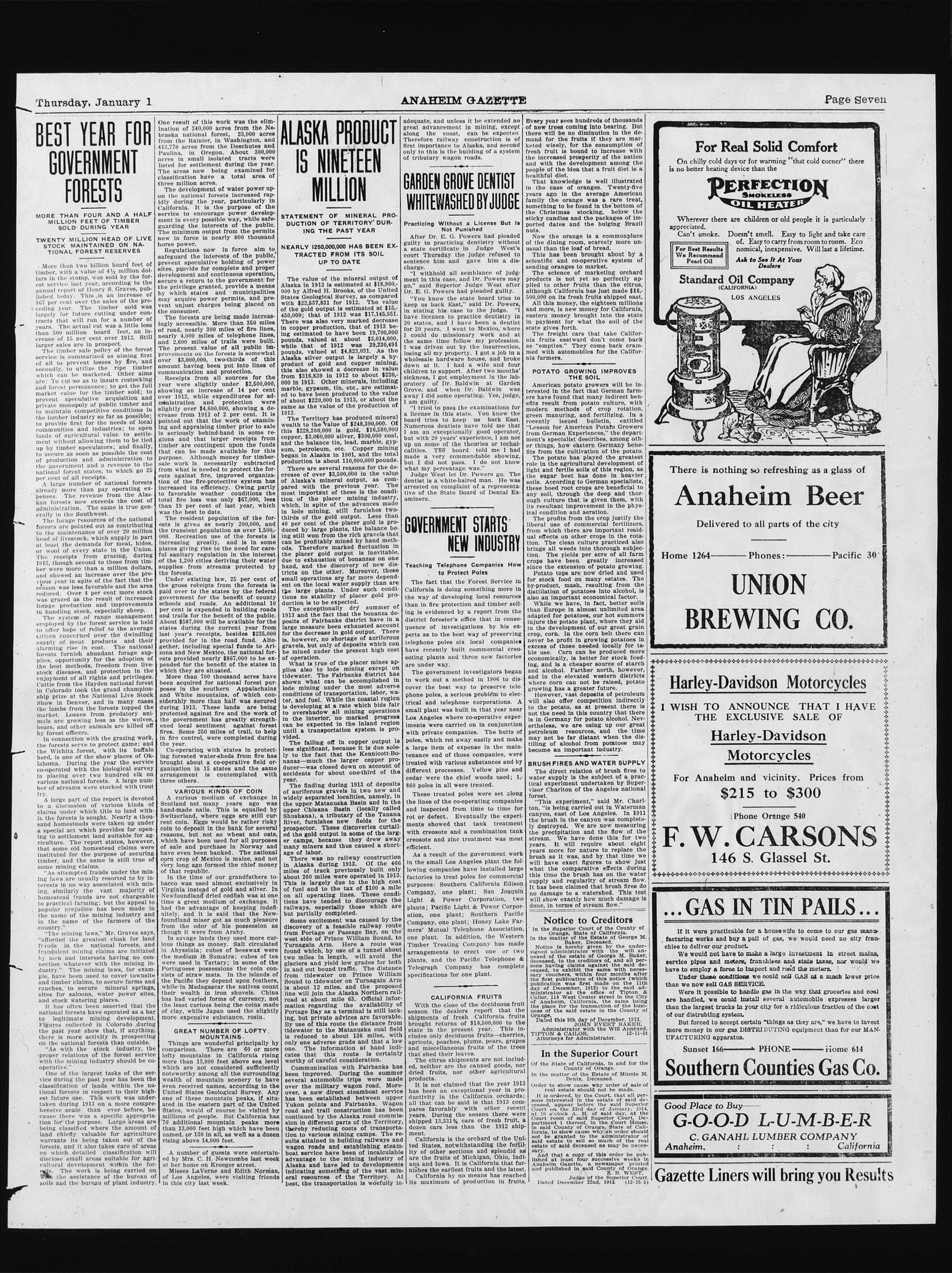
Searchable text
BEST YEAR FOR GOVERNMENT FORESTS
MORE THAN FOUR AND A HALF MILLION FEET OF TIMBER SOLD DURING YEAR
TWENTY MILLION HEAD OF LIVE STOCK MAINTAINED ON NATIONAL FOREST RESERVES
More than two billion board feet of timber, with a value of 4½ million dollars in the stump, was sold by the forest service last year, according to the annual report of Henry S. Graves, published today. This is an increase of 167 per cent over the sales of the preceding year. The timber sold was largely for future cutting under contracts that will run for a number of years. The actual cut was a little less than 500 million board feet, an increase of 15 per cent over 1912. Still larger sales are in prospect.
The timber sale policy of the forest service is summarized as aiming first of all to prevent losses by fire, and secondly, to utilize the ripe timber which can be marketed. Other aims are: To cut so as to insure restocking and forest permanence; to get the full market value for the timber sold; to prevent speculative acquisition and private monopoly of public timber and to maintain competitive conditions in the lumber industry so far as possible; to provide first for the needs of local communities and industries; to open lands of agricultural value to settlement without allowing them to be tied up by timber speculators; and finally, to secure as soon as possible the cost of production and administration to the government and a revenue to the national forest states, to which go 25 One result of this work was the elimination of 340,000 acres from the Nebraska national forest, 23,000 acres from the Rainier, in Washington, and 413,770 acres from the Deschutes and Paulina, in Oregon. About 300,000 acres in small isolated tracts were listed for settlement during the year. The areas now being examined for classification have a total area of three million acres.
The development of water power upon the national forests increased rapidly during the year, particularly in California. It is the purpose of the service to encourage power development in every possible way, while safeguarding the interests of the public. The minimum output from the permits now in force is nearly 800 thousand horse power.
Regulations now in force aim to safeguard the interests of the public, prevent speculative holding of power sites, provide for complete and proper development and continuous operation, secure a return to the government for the privilege granted, provide a means by which states and municipalities may acquire power permits, and prevent unjust charges being placed on the consumer.
The forests are being made increasingly accessible. More than 350 miles of road, nearly 300 miles of fire lines, nearly 4,000 miles of telephone lines, and 2,600 miles of trails were built. The present value of all public improvements on the forests is somewhat over $3,000,000, two-thirds of this amount having been put into lines of communication and protection.
Receipts from all sources for the year were slightly under $2,500,000, showing an increase of 14 per cent over 1912, while expenditures for administration and protection were slightly over $4,600,000, showing a decrease from 1912 of 2 per cent. It is pointed out that the work of examining and appraising timber prior to sale is seriously behind-hand in some regions and that larger receipts from timber are contingent upon the funds that can be made available for this purpose. Although money for timber-sale work is necessarily subtracted from what is needed to protect the forests against fire-improved organiza-
ALASKA PROJECT IS NINETY MILLION
STATEMENT OF MINUTIOUS TERMINATION OF TERRITORY IN THE PAST
NEARLY I250,000,000 HAS TRACTED FROM NEXT UP TO DATES
The value of the mines in Alaska in 1913 is estimated at 000 by Alfred H. Brooks, States Geological Survey with $22,537,831 for 1914 of the gold output is estimated at 450,000; that of 1912 was there was also very much in copper production, though estimated to have bounties valued at $4,822 Alaska silver output is a product of gold and coal this also showed a decrease from $316,839 in 1912 to 000 in 1913. Other minerals marble, gypsum, tin, etc., added to have been produced about $220,000 in 1913 same as the value of the mines.
The Territory has provided wealth to the value of $2 this $228,200,000 is gold copper, $2,060,000 silver, and the balance tin, lead sum, petroleum, etc. C began in Alaska in 1901 production is about 110,000 There are several reasons crease of over $3,500,000
A large number of national forests already more than pay operating expenses. The revenue from the Alaskan forests now exceeds the cost of administration. The same is true generally in the Southwest.
The forage resources of the national forests are pointed out as contributing to the maintenance of over 20 million head of livestock, which supply in part at least the demands for meat, hides, or wool of every state in the Union. The receipts from grazing, during 1913, though second to those from timber were more than a million dollars, and showed an increase over the previous year in spite of the fact that the season was less favorable and the area reduced. Over 4 per cent more stock was grazed as the result of increased forage production and improvements in handling stock, especially sheep.
The system of range management employed by the forest service is held to offer hope of relief to the average citizen concerned over the dwindling supply of meat products and their alarming rise in cost. The national forests furnish abundant forage supplies, opportunity for the adoption of the best methods, freedom from livestock diseases, and protection in the enjoyment of all rights and privileges. Cattle from the Hayden national forest in Colorado took the grand championship prize at the National Live Stock Show in Denver, and in many cases the lambs from the forests topped the market. Losses from predatory animals are growing less as the wolves, bears, and other animals are killed off by forest officers.
In connection with the grazing work, the forests serve to protect game; and the Wichita forest, with its buffalo herd, is one of the show places of Oklahoma. During the year the service co-operated with the biological survey in placing over two hundred elk on various national forests. A large number of streams were stocked with trout fry.
A large part of the report is devoted to a discussion of various kinds of claims under which title to land within the forests is sought. Nearly a thousand homesteads were taken up under a special act which provides for opening to settlement land suitable for agriculture. The report states, however, that some old homestead claims were instituted for the purpose of securing timber, and the same is still true of some mining claims.
"As attempted frauds under the mining laws are usually resorted to by interests in no way associated with mining, similarly the vast majority of homestead frauds are not chargeable
Receipts from all sources for the year were slightly under $2,500,000, showing an increase of 14 per cent over 1912, while expenditures for administration and protection were slightly over $4,600,000, showing a decrease from 1912 of 2 per cent. It is pointed out that the work of examining and appraising timber prior to sale is seriously behind-hand in some regions and that larger receipts from timber are contingent upon the funds that can be made available for this purpose. Although money for timber-sale work is necessarily subtracted from what is needed to protect the forests against fire, improved organization of the fire-protective system has increased its efficiency. Owing partly to favorable weather conditions the total fire loss was only $67,000, less than 19 per cent of last year, which was the best to date.
The resident population of the forests is given as nearly 200,000, and the transient population as over 1,500,000. Recreation use of the forests is increasing greatly, and is in some places giving rise to the need for careful sanitary regulation in the interest of the 1,200 cities deriving their water supplies from streams protected by the forests.
Under existing law, 25 per cent of the gross receipts from the forests is paid over to the states by the federal government for the benefit of county schools and roads. An additional 10 per cent is expended in building roads and trails for the benefit of the public. About $587,000 will be available for the states during the current year from last year's receipts, besides $225,000 provided for in the road fund. Altogether, including special funds to Arizona and New Mexico, the national forests provided nearly $867,000 to be expended for the benefit of the states in which they are situated.
More than 700 thousand acres have been acquired for national forest purposes in the southern Appalachains and White mountains, of which considerably more than half was secured during 1913. These lands are being protected against fire and the work of the government has greatly strengthened local sentiment against forest fires. Some 250 miles of trail, to help in fire control, were completed during the year.
Cooperation with states in protecting forested water-sheds from fire has brought about a co-operative field organization in 15 states and the same arrangement is contemplated with three others.
VARIOUS KINDS OF COIN
A curious medium of exchange in Scotland not many years ago was hand-made nails. This is equalled by Switzerland, where eggs are still current coin. Eggs would be rather risky coin to deposit in the bank for several reasons, but not so wheat and oats, which have been used for all purposes of sale and purchase in Norway and have even been banked. The national corn crop of Mexico is maize, and not very long ago formed the chief money of that republic.
In the time of our grandfathers tobacco was used almost exclusively in Virginia instead of gold and silver. In Newfoundland dried codfish was at one
from $316,839 in 1912 to 000 in 1913. Other mines marble, gypsum, tin, etc. edited to have been produced about $220,000 in 1913 same as the value of the 1912.
The Territory has prosperity to the value of $2 this $228,200,000 is gold copper, $2,060,000 silver, and the balance tin, lead sum, petroleum, etc. O began in Alaska in 1901 production is about 110,000.
There are several reasons crease of over $3,500,000 of Alaska's mineral output pared with the previous most important of these tion of the placer mine which, in spite of the age in lode mining, still fills thirds of the gold output 40 per cent of the place duced by large plants, thining still won from the rich can be profitably mined ods. Therefore marked by the placer gold output due to exhaustion of boa hand, and the discovery tricts on the other. Many small operations are far better on the local water sui large plants. Under tions no stability of production is to be expected.
The exceptionally dry 1913 and the fact that this posits of Fairbanks district large measure been exhalt for the decrease in gold is, however, no shortage gravels, but only of deposits be mined under the pre- operation.
What is true of the plaques also to lode minidewater. The Fairbanks shown what can be acade mining under these conditions of transporter,and fuel. While there is developing at a rate wto overshadow all minin in the interior, no man can be expected in them until a transportation s vided.
The falling off in coess significant because ly to the fact that thie nanaz—much the larger ducer—was closed down accidents for about one year.
The finding during 19of auriferous gravels in widely separated localities upper Matanuska Basin upper Chisana Basin Shushana), a tributary River, furnishes new prospector. These discoedthe gold output in so er camps,because thie many miners and thus a age of labor.
There was no railway in Alaska during 1913 miles of track previous about 260 miles were open This is largely due to fo fuel and to the tax on all operating lines.
A large part of the report is devoted to a discussion of various kinds of claims under which title to land within the forests is sought. Nearly a thousand homesteads were taken up under a special act which provides for opening to settlement land suitable for agriculture. The report states, however, that some old homestead claims were instituted for the purpose of securing timber, and the same is still true of some mining claims.
"As attempted frauds under the mining laws are usually resorted to by interests in no way associated with mining, similarly the vast majority of homestead frauds are not chargeable to practical farming; but the appeal to popular prejudice has been made in the name of the mining industry and in the name of the farmers of the country."
"The mining laws," Mr. Graves says, "afforded the greatest cloak for land frauds in the national forests, and fraudulent mining claims are initiated by men and interests having no connection whatever with the mining industry." The mining laws, for example, have been used to cover townsite and timber claims, to secure farms and ranches, to secure mineral springs, sites for saloons, water power sites, and stock watering places.
It has often been asserted that the national forests have operated as a bar to legitimate mining development. Figures collected in Colorado during the past year show that, if anything, there is more activity in prospecting on the national forests than outside.
"As with the stock industry, the proper relations of the forest service with the mining industry should be cooperative."
One of the largest tasks of the service during the past year has been the classification of lands within the national forests in respect to their highest future use. This work was undertaken during 1913 on a more comprehensive scale than ever before, because there was a specific appropriation for the purpose. Large areas are being classified where the amount of land chiefly valuable for agriculture warrants its being taken out of the forests, and it also takes care of areas on which detailed classification will disclose small areas suitable for agricultural development within the forests. The work is being carried out with the assistance of the bureau of soils and the bureau of plant industry.
A curious medium of exchange in Scotland not many years ago was hand-made nails. This is equalled by Switzerland, where eggs are still current coin. Eggs would be rather risky coin to deposit in the bank for several reasons, but not so wheat and oats, which have been used for all purposes of sale and purchase in Norway and have even been banked. The national corn crop of Mexico is maize, and not very long ago formed the chief money of that republic.
In the time of our grandfathers tobacco was used almost exclusively in Virginia instead of gold and silver. In Newfoundland dried codfish was at one time a great medium of exchange. It had the advantage of keeping indefinitely, and it is said that the Newfoundland miser got as much pleasure from the odor of his possession as though it were from Araby.
In savage lands they used more curious things as money. Salt circulated in Abyssinia; cubes of beeswax were the medium in Sumatra; cubes of tea were used in Tartary; in some of the Portuguese possessions the coin consists of straw mats. In the islands of the Pacific they depend upon feathers, while in Madagascar the natives count their wealth in iron shovels. China has had varied forms of currency, not the least curious being the coins made of clay, while Japan used the slightly more expensive substance, rosin.
GREAT NUMBER OF LOFTY MOUNTAINS
Things are wonderful principally by comparison. There are 60 or more lofty mountains in California rising more than 13,000 feet above sea level which are not considered sufficiently noteworthy among all the surrounding wealth of mountain scenery to have even received names, according to the United States Geological Survey. Any one of these mountain peaks, if situated in the eastern part of the United States, would of course be visited by millions of people. But California has 70 additional mountain peaks more than 13,000 feet high which have been named, or 130 in all, as well as a dozen rising above 14,000 feet.
A number of guests were entertained by Mrs. C. H. Newcombe last week at her home on Kroeger street.
Misses LaVerne and Edith Norman, of Los Angeles, were visiting friends in this city last week.
Widely separated located in upper Chisana Basin (Shushana), a tributary to River, furnishes new prospectors. These discovered the gold output in some camps, because there are many miners and thus a large age of labor.
There was no railway in Alaska during 1913 miles of track previous about 260 miles were open. This is largely due to fuel and to the tax on all operating lines. Tensions have tended to railways, especially those but partially completed.
Some excitement was discovery of a feasible from Portage or Passaic west side of Prince William Turnagain Arm. Here found which, by use of two miles in length, glaciers and yield low in and out bound traffic from tidewater on B Sound to tidewater on W is about 12 miles, and line will join the Alaskan road at about mile 635mation regarding the Portage Bay as a terming, but private advises By use of this route the tidewater to the Matane is reduced to about 1 only one adverse grade one. The information cates that this route worthy of careful consideration.
Communication with been improved. During several automobile trips over the military waggon over, a new direct steep has been established Yukon points and Fair road and trail construc continued by the Alaskan sion in different parts o thereby reducing costs to various mining sults attained in building wagon roads and estates boat service have been advantage to the mines Alaska and have led to indicating something o eral resources of th best, the transportation
ALASKA PRODUCT IS NINETEEN MILLION
STATEMENT OF MINERAL PRODUCTION OF TERRITORY DURING THE PAST YEAR
NEARLY 1250,000,000 HAS BEEN EXTRACTED FROM ITS SOIL UP TO DATE
The value of the mineral output of Alaska in 1913 is estimated at $18,900,000 by Alfred H. Brooks, of the United States Geological Survey, as compared with $22,537,831 for 1912. The value of the gold output is estimated at $15,450,000; that of 1912 was $17,145,951. There was also very marked decrease in copper production, that of 1913 being estimated to have been 19,700,000 pounds, valued at about $3,014,000, while that of 1912 was 29,230,491 pounds, valued at $4,823,031. As the Alaska silver output is largely a byproduct of gold and copper mining, this also showed a decrease in value from $316,839 in 1912 to about $220,000 in 1913. Other minerals, including marble, gypsum, tin, etc., are estimated to have been produced to the value of about $220,000 in 1913, or about the same as the value of the production of 1912.
The Territory has produced mineral wealth to the value of $248,300,000. Of this $228,200,000 is gold, $16,580,000 copper, $2,060,000 silver, $300,000 coal, and the balance tin, lead, marble, gypseum, petroleum, etc. Copper mining began in Alaska in 1901, and the total production is about 110,000,000 pounds.
There are several reasons for the decrease in over $3.500,000 in the value adequate, and unless it be extended no great advancement in mining, except along the coast, can be expected. Therefore railway construction is of first importance to Alaska, and second only to this is the building of a system of tributary wagon roads.
GARDEN GROVE DENTIST WHITEWASHED BY JUDGE
Practicing Without a License But Is Not Punished
After Dr. E. G. Powers had pleaded guilty to practicing dentistry without a state certificate in Judge West's court Thursday the judge refused to sentence him and gave him a discharge.
"I withhold all semblance of judgment in this case," said Dr. Powers may go," said Superior Judge West after Dr. E. G. Powers had pleaded guilty.
"You know the state board tries to keep us back East," said Dr. Powers, in stating his case to the judge. "I have licenses to practice dentistry in 20 states, and I have been a dentist for 20 years. I went to Mexico where I could do missionary work and at the same time follow my profession. I was driven out by the insurrection, losing all my property. I got a job in a wholesale hardware house, and broke down at it. I had a wife and four children to support. After two months' sickness, I got employment in the laboratory of Dr. Baldwin at Garden Grove, and when Dr. Baldwin was away I did some operating. Yes, judge, I am guilty.
"I tried to pass the examinations for a license in this state. You know the board tries to keep us back East. Numerous dentists have told me that I am an exceptionally good operator, but with 20 years' experience, I am not up on some of the theories or technicalities. The board told me I had made a very commendable showing, but I did not pass. I do not know what my percentage was."
Every year sees hundreds of thousands of new trees coming into bearing. But there will be no diminution in the demand for the fruits if they are marketed wisely, for the consumption of fresh fruit is bound to increase with the increased prosperity of the nation and with the development among the people of the idea that a fruit diet is a healthful diet.
That knowledge is well illustrated in the case of oranges. Twenty-five years ago in the average American family the orange was a rare treat, something to be found in the bottom of the Christmas stocking, below the sticky candies and the packages of imported dates and the bulging Brazil nuts.
Now the orange is a commonplace of the dining room, scarcely more unusual than the loaf of bread.
This has been brought about by a scientific and co-operative system of sending oranges to market.
The science of marketing orchard products is not yet so perfectly applied to other fruits than the citrus, although California has just made $18,-500,000 on its fresh fruits shipped east.
All this money, the eighteen millions and more, is new money for California, eastern money brought into the state in payment for what the soil of the state gives forth.
The freight cars that take California fruits eastward don't come back as "empties." They come back crammed with automobiles for the California farmers.
POTATO GROWING IMPROVES THE SOIL
American potato growers will be interested in the fact that German farmers have found that many indirect benefits result from potato culture, with modern methods of crop rotation, green manuring, and fertilizing. In a recently issued bulletin, entitled "Lesson for American Potato Growers from German Experiences," the department's specialist describes among other things how eastern Germany benefits from the cultivation of the potato.
The potato has played the greatest role in the agricultural development of light and fertile soils of this region, as
from $316,839 in 1912 to about $220,000 in 1913. Other minerals, including marble, gypsum, tin, etc., are estimated to have been produced to the value of about $220,000 in 1913, or about the same as the value of the production of 1912.
The Territory has produced mineral wealth to the value of $248,300,000. Of this $228,200,000 is gold, $16,580,000 copper, $2,060,000 silver, $300,000 coal, and the balance tin, lead, marble, gypsum, petroleum, etc. Copper mining began in Alaska in 1901, and the total production is about 110,000,000 pounds.
There are several reasons for the decrease of over $3,500,000 in the value of Alaska's mineral output, as compared with the previous year. The most important of these is the condition of the placer mining industry, which, in spite of the advances made in lode mining, still furnishes two-thirds of the gold output. Less than 40 per cent of the placer gold is produced by large plants, the balance being still won from the rich gravels that can be profitably mined by hand methods. Therefore marked fluctuation in the placer gold output is inevitable due to exhaustion of bonanzas on one hand, and the discovery of new districts on the other. Moreover, these small operations are far more dependent on the local water supply than are the large plants. Under such conditions no stability of placer gold production is to be expected.
The exceptionally dry summer of 1913 and the fact that the bonanza deposits of Fairbanks district have in a large measure been exhausted account for the decrease in gold output. There is, however, no shortage of auriferous gravels, but only of deposits which can be mined under the present high cost of operation.
What is true of the placer mines applies also to lode mining except on tidewater. The Fairbanks district has shown what can be accomplished in lode mining under the most adverse conditions of transportation, labor, water, and fuel. While the coastal region is developing at a rate which bids fair to overshadow all mining operations in the interior, no marked progress can be expected in the inland region until a transportation system is provided.
The falling off in copper output is less significant, because it is due solely to the fact that the Kennicott-Bonanaz—much the larger copper producer—was closed down on account of accidents for about one-third of the year.
The finding during 1913 of deposits of auriferous gravels in two new and widely separated localities, namely, in the upper Matanuska Basin and in the upper Chisana Basin (locally called Shushana), a tributary of the Tannana River, furnishes new fields for the prospector. These discoveries curtailled the gold output in some of the larger camps, because they drew away many miners and thus caused a shortage of labor.
There was no railway construction in Alaska during 1913. Of the 466 miles of track previously built only about 260 miles were operated in 1913. This is largely due to the high cost of fuel and to the tax of $100 a mile on operating lines. These conditions sickness, I got employment in the laboratory of Dr. Baldwin at Garden Grove, and when Dr. Baldwin was away I did some operating. Yes, judge, I am guilty.
"I tried to pass the examinations for a license in this state. You know the board tries to keep us back East. Numerous dentists have told me that I am an exceptionally good operator, but with 20 years' experience, I am not up on some of the theories or technicalities. The board told me I had made a very commendable showing, but I did not pass. I do not know what my percentage was."
Judge West let Dr. Powers go. The dentist is a white-haired man. He was arrested on complaint of a representative of the State Board of Dental Examiners.
GOVERNMENT STARTS NEW INDUSTRY
Teaching Telephone Companies How to Protect Poles
The fact that the Forest Service in California is doing something more in the way of developing local resources than in fire protection and timber selling is evidenced by a report from the district forester's office that in consequence of investigations by his experts as to the best way of preserving telephone poles six local companies have recently built commercial creosoting plants and three new factories are under way.
The government investigators began to work out a method in 1906 to discover the best way to preserve telephone poles, a serious problem to electrical and telephone corporations. A small plant was built in that year near Los Angeles where co-operative experiments were carried on in conjunction with private companies. The butts of poles, which rot away easily and make a large item of expense in the maintenance end of those companies, were treated with various substances and by different processes. Yellow pine and cedar were the chief woods used; 1,860 poles in all were treated.
These treated poles were set along the lines of the co-operating companies and inspected from time to time for rot or defect. Eventually the experiments showed that tank treatment with creosote and a combination tank creosote and zinc treatment was most efficient.
As a result of the government work in the small Los Angeles plant the following companies have installed large factories to treat poles for commercial purposes: Southern California Edison Company, one plant; San Joaquin Light & Power Corporation two
THE SOIL
American potato growers will be interested in the fact that German farmers have found that many indirect benefits result from potato culture, with modern methods of crop rotation, green manuring, and fertilizing. In a recently issued bulletin, entitled "Lesson for American Potato Growers from German Experiences," the department's specialist describes among other things, how eastern Germany benefits from the cultivation of the potato.
The potato has played the greatest role in the agricultural development of light and fertile soils of this region, as the sugar beet has done in heavier soils. According to German specialists, these hoed root crops are beneficial to any soil, through the deep and thorough culture that is given them, with its resultant improvement in the physical condition and aeration.
The profits from the crop justify the liberal use of commercial fertilizers, from which there are important residual effects on other crops in the rotation. The clean culture practiced also brings all weeds into thorough subjection. The yields per acre of all farm crops have been greatly increased since the extension of potato growing.
Potato tops are now dried and used for stock food on many estates. The by-product, mash, resulting from the distillation of potatoes into alcohol, is also an important economical factor.
While we have, in fact, better soils than Europe in almost unlimited area adapted for potatoes, our hot summers injure the potato plant, where they aid in the development of our great grain crop, corn. In the corn belt there can never be profit in growing potatoes in excess of those needed locally for table use. Corn can be produced more economically, is better for stock feeding, and is a cheaper source of starch and alcohol. Farther north, however, and in the elevated western districts where corn cannot be raised, potato growing has a greater future.
However, vast deposits of petroleum will also offer competition indirectly to the potato, as at present there is not the need in this country that there is in Germany for potato alcohol. Nevertheless we are using up our great petroleum resources, and the time may not be far distant when the distilling of alcohol from potatoes may become an important industry.
BRUSH FIRES AND WATER SUPPLY
The direct relation of brush fires to water supply is the subject of a practical experiment undertaken by Supervisor Charlton of the Angeles national forest.
"This experiment," said Mr. Charlton," is being carried out in Waterman canyon, east of Los Angeles. In 1911 the brush in the canyon was completely destroyed. We are now measuring the precipitation and the flow of the stream. We have done this for two years. It will require about eight years more for nature to replace the brush as it was, and by that time we will have exact figures to show just what the comparative effects during this time the brush has on the water supply and regularity of stream flow. It has been claimed that brush fires do no damage to a watershed. This test will show exactly how much damage is
the upper Chisana Basin (locally called Shushana), a tributary of the Tanana River, furnishes new fields for the prospector. These discoveries curtailed the gold output in some of the larger camps, because they drew away many miners and thus caused a shortage of labor.
There was no railway construction in Alaska during 1913. Of the 466 miles of track previously built only about 260 miles were operated in 1913. This is largely due to the high cost of fuel and to the tax of $100 a mile on all operating lines. These conditions have tended to discourage the railways, especially those which are but partially completed.
Some excitement was caused by the discovery of a feasible railway route from Portage or Passage Bay, on the west side of Prince William Sound, to Turnagain Arm. Here a route was found which, by use of a tunnel about two miles in length, will avoid the glaciers and yield low grades for both in and out bound traffic. The distance from tidewater on Prince William Sound to tidewater on Turnagain Arm is about 12 miles, and the proposed line will join the Alaska Northern railroad at about mile 63. Official information regarding the availability of Portage Bay as a terminal is still lacking, but private advices are favorable. By use of this route the distance from tidewater to the Matanuska coal field is reduced to about 136 miles, with only one adverse grade and that a low one. The information at hand indicates that this route is certainly worthy of careful consideration.
Communication with Fairbanks has been improved. During the summer several automobile trips were made over the military wagon road. Moreover, a new direct steamboat service has been established between upper Yukon points and Fairbanks. Wagon road and trail construction has been continued by the Alaska road commission in different parts of the Territory, thereby reducing costs of transportation to various mining camps. The results attained in building railways and wagon roads and establishing steamboat service have been of incalculable advantage to the mining industry of Alaska and have led to developments indicating something of the vast mineral resources of the Territory. At best, the transportation is woefully inefficient in the lines of the co-operating companies and inspected from time to time for rot or defect. Eventually the experiments showed that tank treatment with creosote and a combination tank creosote and zinc treatment was most efficient.
As a result of the government work in the small Los Angeles plant the following companies have installed large factories to treat poles for commercial purposes: Southern California Edison Company, one plant; San Joaquin Light & Power Corporation, two plants; Pacific Light & Power Corporation, one plant; Southern Pacific Company, one plant; Honey Lake Farmers' Mutual Telephone Association, one plant. In addition, the Western Timber Treating Company has made arrangements to erect one or two plants, and the Pacific Telephone & Telegraph Company has complete specifications for one plant.
CALIFORNIA FRUITS
With the close of the deciduous fruit season the dealers report that the shipments of fresh California fruits brought returns of $18,500,000 to the state in the present year. This includes only deciduous fruits—cherries, apricots, peaches, plums, pears, grapes and miscellaneous fruits of the trees that shed their leaves.
The citrus shipments are not included, neither are the canned goods, nor dried fruits, nor other agricultural products.
It is not claimed that the year 1913 has been an exceptional year in productivity in the California orchards; all that can be said is that 1913 compares favorably with other recent years. During the season there were shipped 13,331% cars of fresh fruit, a dozen cars less than the 1912 shipment.
California is the orchard of the United States, notwithstanding the fertility of other sections and splendid as are the fruits of Michigan, Ohio, Indiana and Iowa. It is California that furnishes the earliest fruits and the latest.
California by no means has reached its maximum of production in fruits.
“This experiment,” said Mr. Charlton, “is being carried out in Waterman canyon, east of Los Angeles. In 1911 the brush in the canyon was completely destroyed. We are now measuring the precipitation and the flow of the stream. We have done this for two years. It will require about eight years more for nature to replace the brush as it was, and by that time we will have exact figures to show just what the comparative effects during this time the brush has on the water supply and regularity of stream flow. It has been claimed that brush fires do no damage to a watershed. This test will show exactly how much damage is done, in terms of stream flow.”
Notice to Creditors
In the Superior Court of the County of Orange, State of California.
In the matter of the Estate of George M. Baker, Deceased.
Notice is hereby given by the undersigned administrator with the will annexed of the estate of George M. Baker, deceased, to the creditors of, and all persons having claims against the said deceased, to exhibit the same with necessary vouchers, within four months after the first publication of this notice (which publication was first made on the 11th day of December, 1913) to the said administrator at the office of Tipton & Callor, 118 West Center street in the City of Anaheim, California, the same being the place for the transaction of the business of the said estate in the County of Orange.
Dated this 9th day of December, 1913.
JOHN EVERT BAKER,
Administrator with the Will Annexed.
TIPTON & CAILOR,
Attorneys for Administrator.
In the Superior Court
Of the State of California, in and for the County of Orange.
In the matter of the Estate of Minnie M. Bentz, Deceased.
Order to show cause why order of sale of real estate should not be made.
It is ordered, by the Court, that all persons interested in the estate of said deceased, appear before the said Superior Court on the 23rd day of January, 1914, at 10 o'clock A.M. of said day, at the Court room of said Superior Court. Department I thereof, in the Court House, in said County of Orange, State of California, to show cause why an order should not be granted to the administrator of said estate to sell so much of the real estate of said deceased as may be necessary.
And that a copy of this order be published at least four successive weeks in Anaheim Gazette, a newspaper printed and published in said County of Orange.
Z. B. WEST.
Judge of the Superior Court.
Dated December 22nd, 1913. (12-25-5)
For Real Solid Comfort
On chilly cold days or for warming "that cold corner" there is no better heating device than the
PERFECTION
SMOKELESS
OIL HEATER
Wherever there are children or old people it is particularly appreciated.
Can't smoke. Doesn't smell. Easy to light and take care of. Easy to carry from room to room. Economical, inexpensive. Will last a lifetime.
For Best Results We Recommend Pearl Oil
Ask to See It At Your Dealers
Standard Oil Company
(CALIFORNIA)
LOS ANGELES
There is nothing so refreshing as a glass of
There is nothing so refreshing as a glass of
Anaheim Beer
Delivered to all parts of the city
Home 1264 Phones: Pacific 30
UNION
BREWING CO.
Harley-Davidson Motorcycles
I WISH TO ANNOUNCE THAT I HAVE
THE EXCLUSIVE SALE OF
Harley-Davidson
Motorcycles
For Anaheim and vicinity. Prices from
$215 to $300
Phone Orange 540
F. W. CARSONS
146 S. Glassel St.
F. W. CARSONS
146 S. Glassel St.
...GAS IN TIN PAILS...
If it were practicable for a housewife to come to our gas manufacturing works and buy a pail of gas, we would need no city franchise to deliver our product.
We would not have to make a large investment in street mains, service pipes and meters, franchises and state taxes, nor would we have to employ a force to inspect and read the meters.
Under these conditions we could sell GAS at a much lower price than we now sell GAS SERVICE.
Were it possible to handle gas in the way that groceries and coal are handled, we could install several automobile expresses larger than the largest trucks in your city for a ridiculous fraction of the cost of our distrubting system.
But forced to accept certain "things as they are," we have to invest more money in our gas DISTRIBUTING equipment than for our MANUFACTURING apparatus.
Sunset 166 PHONE Home 614
Southern Counties Gas Co.
Good Place to Buy
G-O-O-D L-U-M-B-E-R
C. GANAHL LUMBER COMPANY
Anaheim California
Gazette Liners will bring you Results