anaheim-gazette 1913-11-27
Scanned page
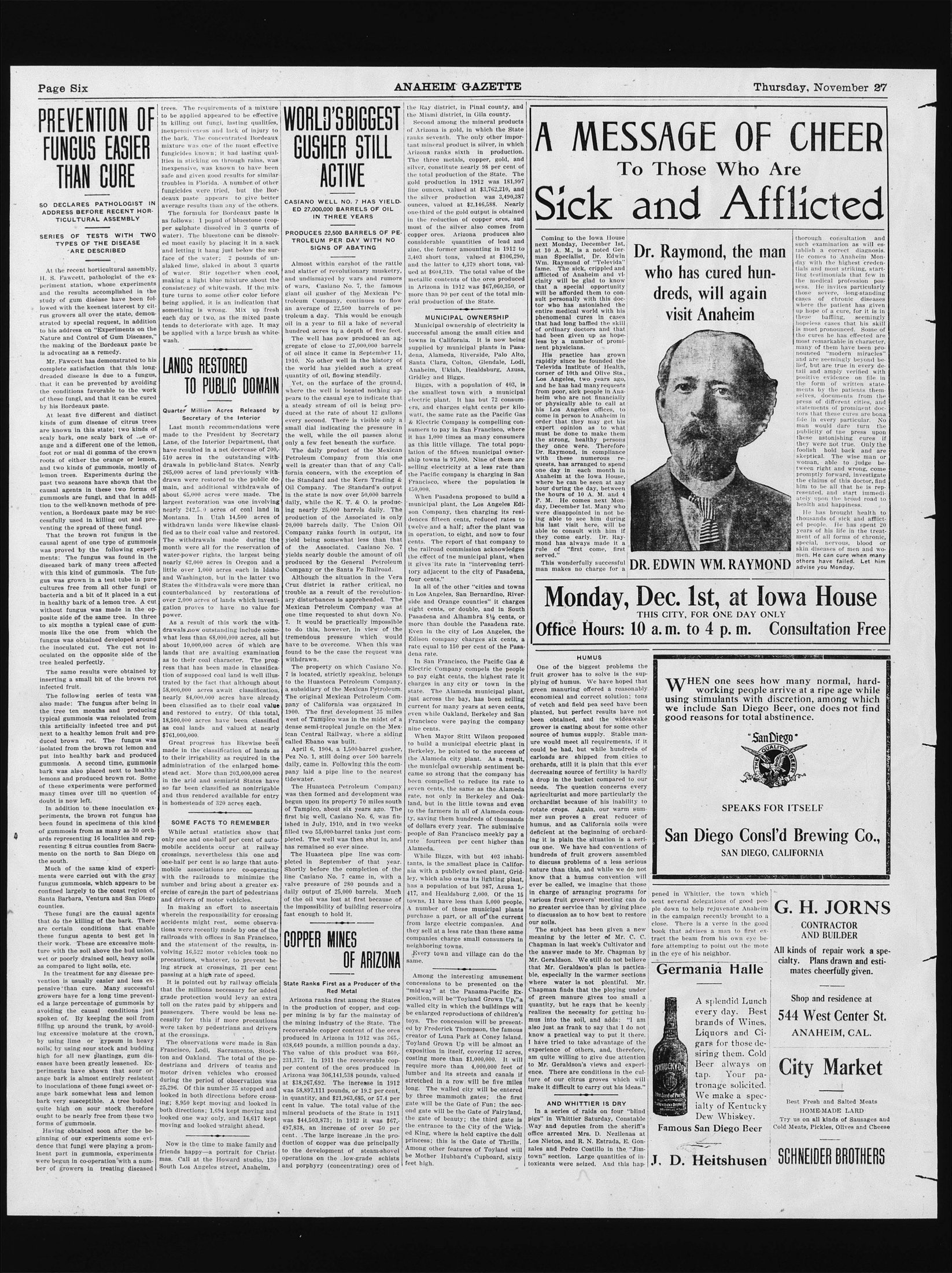
Searchable text
PREVENTION OF FUNGUS EASIER THAN CURE
SO DECLARES PATHOLOGIST IN ADDRESS BEFORE RECENT HORTICULTURAL ASSEMBLY
SERIES OF TESTS WITH TWO TYPES OF THE DISEASE ARE DESCRIBED
At the recent horticultural assembly, H. S. Fawcett, pathologist of the experiment station, whose experiments and the results accomplished in the study of gum disease have been followed with the keenest interest by citrus growers all over the state, demonstrated by special request, in addition to his address on "Experiments on the Nature and Control of Gum Diseases," the making of the Bordeaux paste he is advocating as a remedy.
Mr. Fawcett has demonstrated to his complete satisfaction that this long-dreaded disease is due to a fungus, that it can be prevented by avoiding the conditions favorable to the work of these fungi, and that it can be cured by his Bordeaux paste.
At least five different and distinct kinds of gum disease of citrus trees are known in this state; two kinds of scaly bark, one scaly bark of orange and a different one of the lemon, foot rot or mal di gomma of the crown roots of either the orange or lemon, and two kinds of gummosis, mostly of lemon trees. Experiments during the trees. The requirements of a mixture to be applied appeared to be effective in killing out fungi, lasting qualities, inexpensiveness and lack of injury to the bark. The concentrated Bordeaux mixture was one of the most effective fungicides known; it had lasting qualities in sticking on through rains, was inexpensive, was known to have been safe and given good results for similar troubles in Florida. A number of other fungicides were tried, but the Bordeaux paste appears to give better average results than any of the others.
The formula for Bordeaux paste is as follows: 1 pound of bluestone (copper sulphate dissolved in 3 quarts of water). The bluestone can be dissolved most easily by placing it in a sack and letting it hang just below the surface of the water; 2 pounds of unslaked lime, slaked in about 3 quarts of water. Stir together when cool, making a light blue mixture about the consistency of whitewash. If the mixture turns to some other color before being applied, it is an indication that something is wrong. Mix up fresh each day or two, as the mixed paste tends to deteriorate with age. It may be applied with a large brush as whitewash.
LANDS RESTORED TO PUBLIC DOMAIN
Quarter Million Acres Released by Secretary of the Interior
Last month recommendations were made to the President by Secretary Lane, of the Interior Department, that have resulted in a net decrease of 200,510 acres in the outstanding withdrawals in public-land States. Nearly 265,000 acres of land previously with-
dreaded disease is due to a fungus,
that it can be prevented by avoiding
the conditions favorable to the work
of these fungi, and that it can be cured
by his Bordeaux paste.
At least five different and distinct
kinds of gum disease of citrus trees
are known in this state; two kinds of
scaly bark, one scaly bark of the orange and a different one of the lemon,
foot rot or mal di gomma of the crown
roots of either the orange or lemon,
and two kinds of gummosis, mostly of
lemon trees. Experiments during the
past two seasons have shown that the
causal agents in these two forms of
gummosis are fungi, and that in addition to the well-known methods of prevention, a Bordeaux paste may be successfully used in killing out and preventing the spread of these fungi.
That the brown rot fungus is the
causal agent of one type of gummosis
was proved by the following experiments: The fungus was found in the
diseased bark of many trees affected
with this kind of gummosis. The fungus
was grown in a test tube in pure
cultures free from all other fungi or
bacteria and a bit of it placed in a cut
in healthy bark of a lemon tree. A cut
without fungus was made in the opposite side of the same tree. In three
to six months a typical case of gummosis
like the one from which the
fungus was obtained developed around
the inoculated cut. The cut not inoculated on the opposite side of the
tree healed perfectly.
The same results were obtained by
inserting a small bit of the brown rot
infected fruit.
The following series of tests was
also made: The fungus after being in
the tree ten months and producing
typical gummosis was reisolated from
this artificially infected tree and put
next to a healthy lemon fruit and produced brown rot. The fungus was
isolated from the brown rot lemon and
put into healthy bark and produced
gummosis. A second time, gummosis bark was also placed next to healthy lemons and produced brown rot. Some of these experiments were performed many times over till no question of doubt is now left.
In addition to these inoculation experiments, the brown rot fungus has
been found in specimens of this kind
of gummosis from as many as 30 orchards representing 16 localities and representing 8 citrus counties from Sacramento on the north to San Diego on the south.
Much of the same kind of experiments were carried out with the gray
fungus gummosis, which appears to be confined largely to the coast region of Santa Barbara, Ventura and San Diego.
TO PUBLIC DOMAIN
Quarter Million Acres Released by Secretary of the Interior
Last month recommendations were made to the President by Secretary Lane, of the Interior Department, that have resulted in a net decrease of 200,510 acres in the outstanding withdrawals in public-land States. Nearly 265,000 acres of land previously withdrawn were restored to the public domain, and additional withdrawals of about 65,000 acres were made. The largest restoration was one involving nearly 242,500 acres of coal land in Montana. In Utah 14,500 acres of withdrawn lands were likewise classified as to their coal value and restored. The withdrawals made during the month were all for the reservation of water-power rights, the largest being nearly 62,000 acres in Oregon and a little over 1,000 acres each in Idaho and Washington, but in the latter two States the withdrawals were more than counterbalanced by restorations of over 2,000 acres of lands which investigation proves to have no value for power.
As a result of this work the withdrawals now outstanding include somewhat less than 68,000,000 acres, all but about 10,000,000 acres of which are lands that are awaiting examination as to their coal character. The progress that has been made in classification of supposed coal land is well illustrated by the fact that although about 58,000,000 acres await classification, nearly 84,000,000 acres have already been classified as to their coal value and restored to entry. Of this total, 18,500,000 acres have been classified as coal lands and valued at nearly $761,000,000.
Great progress has likewise been made in the classification of lands as to their irrigability as required in the administration of the enlarged homestead act. More than 203,000,000 acres in the arid and semiarid States have so far been classified as nonirrigable and thus rendered available for entry in homesteads of 320 acres each.
SOME FACTS TO REMEMBER
While actual statistics show that only one and one-half per cent of automobile accidents occur at railway crossings, nevertheless this one and one-half per cent is so large that automobile associations are co-operating with the railroads to minimize the number and bring about a greater exercise of care in the part of pedestrians and drivers of motor vehicles.
Yet, on the surface where the well is located peaks to the casual eye a steady stream of oil produced at the rate of every second. There is small dial indicating that well, while the oil only a few feet beneath it.
The daily product of Petroleum Company well is greater than thafornia concern, with tha-the Standard and the K-Oil Company. The State in the state is now over daily, while the K.T.- ing nearly 25,000 barrels production of the Association 20,000 barrels daily. The Company ranks fourth yield being somewhat low of the Associated.
Although the situation Cruz district is rather trouble as a result of arary disturbances is appl Mexican Petroleum Co-one time requested to o7. It would be practiceto do this, however, it tremendous pressure hawe to be overcome. found to be the case twithdrawn.
The property on whih7 is located, strictly spit to the Huasteca Petrola subsidiary of the Mexi- The original Mexican Pany of California wa- 1900. The first develop west of Tampico was im dense semi-tropical junc- called Ebano was built April 6, 1904, a 1,50o Pez No. 1, still doing o daily, came in. Following pany laid a pipe line tidewater.
The Huasteca Petrola was then formed and begun upon its property of Tampico, about six first big well, Casiano is finished in July, 1910, and filled two 55,000-barrelpleted. The well was tha has remained so ever since.
The Huasteca pipe plupleted in September Shortly before the com-line Casiano No. 7 ca- valve pressure of 280 daily output of 25,000 oil was lost at
In addition to these inoculation experiments, the brown rot fungus has been found in specimens of this kind of gummosis from as many as 30 orchards representing 16 localities and representing 8 citrus counties from Sacramento on the north to San Diego on the south.
Much of the same kind of experiments were carried out with the gray fungus gummosis, which appears to be confined largely to the coast region of Santa Barbara, Ventura and San Diego counties.
These fungi are the causal agents that do the killing of the bark. There are certain conditions that enable these fungus agents to best get in their work. These are excessive moisture with the soil above the bud union, wet or poorly drained soil, heavy soils as compared to light soils, etc.
In the treatment for any disease prevention is usually easier and less expensive than cure. Many successful growers have for a long time prevented a large percentage of gummosis by avoiding the causal conditions just spoken of. By keeping the soil from filling up around the trunk, by avoiding excessive moisture at the crown, by using lime or gypsum in heavy soils; by using sour stock and budding high for all new plantings, gum diseases have been greatly lessened. Experiments have shown that sour orange bark is almost entirely resistant to inoculations of these fungi sweet orange bark somewhat less and lemon bark very susceptible. A tree budded quite high on sour stock therefore ought to be nearly free from these two forms of gummosis.
Having obtained soon after the beginning of our experiments some evidence that fungi were playing a prominent part in gummosis, experiments were begun in co-operation with a number of growers in treating diseased
SOME FACTS TO REMEMBER
While actual statistics show that only one and one-half per cent of automobile accidents occur at railway crossings, nevertheless this one and one-half per cent is so large that automobile associations are co-operating with the railroads to minimize the number and bring about a greater exercise of care in the part of pedestrians and drivers of motor vehicles.
In making an effort to ascertain wherein the responsibility for crossing accidents might rest, some observations were recently made by one of the railroads with offices in San Francisco, and the statement of the results, involving 16,522 motor vehicles took no precautions, whatever, to prevent being struck at crossings, 21 per cent passing at a high rate of speed.
It is pointed out by railway officials that the millions necessary for added grade protection would levy an extra toll on the rates paid by shippers and passengers. There would be less necessity for this if more precautions were taken by pedestrians and drivers at the crossings.
The observations were made in San Francisco, Lodi, Sacramento, Stockton and Oakland. The total of the pedestrians and drivers of teams and motor driven vehicles who crossed during the period of observation was 25,296. Of this number 35 stopped and looked in both directions before crossing; 8,950 kept moving and looked in both directions; 1,694 kept moving and looked one way only, and 14,617 kept moving and looked straight ahead.
Now is the time to make family and friends happy—a portrait for Christmas. Call at the Howard studio, 130 South Los Angeles street, Anaheim.
WORLD'S BIGGEST GUSHER STILL ACTIVE
CASIANO WELL NO. 7 HAS YIELDED 27,000,000 BARRELS OF OIL IN THREE YEARS
PRODUCES 22,500 BARRELS OF PETROLEUM PER DAY WITH NO SIGNS OF ABATING
Almost within earshot of the rattle and slatter of revolutionary musketry, and undismayed by wars and rumors of wars, Casiano No. 7, the famous giant oil gusher of the Mexican Petroleum Company, continues to flow an average of 22,500 barrels of petroleum a day. This would be enough oil in a year to fill a lake of several hundred acres to a depth of five feet.
The well has now produced an aggregate of close to 27,000,000 barrels of oil since it came in September 11, 1910. No other well in the history of the world has yielded such a great quantity of oil, flowing steadily.
Yet, on the surface of the ground, where the well is located nothing appears to the casual eye to indicate that a steady stream of oil is being produced at the rate of about 12 gallons every second. There is visible only a small dial indicating the pressure in the well, while the oil passes along only a few feet beneath the surface.
The daily product of the Mexican Petroleum Company from this one well is greater than that of any California concern, with the exception of the Ray district, in Pinal county, and the Miami district, in Gila county.
Second among the mineral products of Arizona is gold, in which the State ranks seventh. The only other important mineral product is silver, in which Arizona ranks sixth in production. The three metals, copper, gold, and silver, constitute nearly 98 per cent of the total production of the State. The gold production in 1912 was 181,997 fine ounces, valued at $3,762,210, and the silver production was 3,490,387 ounces, valued at $2,146,588. Nearly one-third of the gold output is obtained in the reduction of copper ores, and most of the silver also comes from copper ores. Arizona produces also considerable quantities of lead and zinc, the former amounting in 1912 to 3,403 short tons, valued at $306,290, and the latter to 4,379 short tons, valued at $604,319. The total value of the metallic contents of the ores produced in Arizona in 1912 was $67,060,350, or more than 90 per cent of the total mineral production of the State.
MUNICIPAL OWNERSHIP
Municipal ownership of electricity is successful among the small cities and towns in California. It is now being supplied by municipal plants in Pasadena, Alameda, Riverside, Palo Alto, Santa Clara, Colton, Glendale, Lodi, Anaheim, Ukiah, Healdsburg, Azusa, Gridley and Biggs.
Biggs, with a population of 403, is the smallest town with a municipal electric plant. It has but 72 consumers, and charges eight cents per kilowatt, the same rate as the Pacific Gas & Electric Company is compelling consumers to pay in San Francisco, where it has 1,000 times as many consumers as this little village. The total population of the fifteen municipal ownership towns is 97,000. Nine of them are selling electricity at a less rate than the Pacific company is charging in San Francisco.
Coming to the Iowa House next Monday, December 1st, at 10 A.M., is a noted German Specialist, Dr. Edwin Wm. Raymond of "Televida" fame. The sick, crippled and afflicted of Anaheim and vicinity will be glad to know that a special opportunity will be afforded them to consult personally with this doctor who has astonished the entire medical world with his phenomenal cures in cases that had long baffled the skill of ordinary doctors and that had been given up as hopeless by a number of prominent physicians.
His practice has grown rapidly since he founded the Televida Institute of Health, corner of 10th and Olive Sts., Los Angeles, two years ago, and he has had many requests from poor, sick people in Anaheim who are not financially or physically able to call at his Los Angeles offices, to come in person to Anaheim in order that they may get his expert opinion as to what must be done to make them the strong, healthy persons they once were. Therefore Dr. Raymond, in compliance with these numerous requests, has arranged to spend one day in each month in
Yet, on the surface of the ground, where the well is located nothing appears to the casual eye to indicate that a steady stream of oil is being produced at the rate of about 12 gallons every second. There is visible only a small dial indicating the pressure in the well, while the oil passes along only a few feet beneath the surface.
The daily product of the Mexican Petroleum Company from this one well is greater than that of any California concern, with the exception of the Standard and the Kern Trading & Oil Company. The Standard's output in the state is now over 50,000 barrels daily, while the K. T. & O. is producing nearly 25,000 barrels daily. The production of the Associated is only 20,000 barrels daily. The Union Oil Company ranks fourth in output, its yield being somewhat less than that of the Associated. Casiano No. 7 yields nearly double the amount of oil produced by the General Petroleum Company or the Santa Fe Railroad.
Although the situation in the Vera Cruz district is rather critical, no trouble as a result of the revolutionary disturbances is apprehended. The Mexican Petroleum Company was at one time requested to shut down No. 7. It would be practically impossible to do this, however, in view of the tremendous pressure which would have to be overcome. When this was found to be the case the request was withdrawn.
The property on which Casiano No. 7 is located, strictly speaking, belongs to the Huasteca Petroleum Company, a subsidiary of the Mexican Petroleum Company. The original Mexican Petroleum Company of California was organized in 1900. The first development 35 miles west of Tampico was in the midst of a dense semi-tropical jungle on the Mexican Central Railway, where a siding called Ebano was built.
April 6, 1904, a 1,500-barrel gusher, Pez No. 1, still doing over 500 barrels daily, came in. Following this the company laid a pipe line to the nearest tidewater.
The Huasteca Petroleum Company was then formed and development was begun upon its property 70 miles south of Tampico, about six years ago. The first big well, Casiano No. 6, was finished in July, 1910, and in two weeks filled two 55,000-barrel tanks just completed. The well was then shut in, and has remained so ever since.
The Huasteca pipe line was completed in September of that year. Shortly before the completion of the line Casiano No. 7 came in, with a valve pressure of 280 pounds and a daily output of 25,000 barrels. Much of the oil was lost at first because of
Biggs, with a population of 403, is the smallest town with a municipal electric plant. It has but 72 consumers, and charges eight cents per kilowatt, the same rate as the Pacific Gas & Electric Company is compelling consumers to pay in San Francisco, where it has 1,000 times as many consumers as this little village. The total population of the fifteen municipal ownership towns is 97,000. Nine of them are selling electricity at a less rate than the Pacific company is charging in San Francisco, where the population is 450,000.
When Pasadena proposed to build a municipal plant, the Los Angeles Edison Company, then charging its residences fifteen cents, reduced rates to twelve and a half; after the plant was in operation, to eight, and now to four cents. The report of that company to the railroad commission acknowledges the effect of the municipal plant, when it gives its rate in "intervening territory adjacent to the city of Pasadena, four cents."
In all of the other "cities and towns in Los Angeles, San Bernardino, Riverside and Orange counties" it charges eight cents, or double, and in South Pasadena and Alhambra 8½ cents, or more than double the Pasadena rate. Even in the city of Los Angeles, the Edison company charges six cents, a rate equal to 150 per cent of the Pasadena rate.
In San Francisco, the Pacific Gas & Electric Company compels the people to pay eight cents, the highest rate it charges in any city or town in the state. The Alameda municipal plant, just across the bay, has been selling current for many years at seven cents, even while Oakland, Berkeley and San Francisco were paying the company nine cents.
When Mayor Stitt Wilson proposed to build a municipal electric plant in Berkeley, he pointed to the success of the Alameda city plant. As a result, the municipal ownership sentiment became so strong that the company has been compelled to reduce its rate to seven cents, the same as the Alameda rate, not only in Berkeley and Oakland, but in the little towns and even to the farmers in all of Alameda county, saving them hundreds of thousands of dollars every year. The submissive people of San Francisco meekly pay a rate fourteen per cent higher than Alameda.
While Biggs, with but 403 inhabitants, is the smallest place in California with a publicly owned plant, Gridley, which also owns its lighting plant, has a population of but 987, Azusa 1,-417, and Healdsburg 2,000. Of the 15 corner of 10th and Olive St., Los Angeles, two years ago, and he has had many requests from poor, sick people in Anaheim who are not financially or physically able to call at his Los Angeles offices, to come in person to Anaheim in order that they may get his expert opinion as to what must be done to make them the strong, healthy persons they once were. Therefore Dr. Raymond, in compliance with these numerous requests, has arranged to spend one day in each month in Anaheim at the Iowa House, where he can be seen at any hour during the day, between the hours of 10 A.M. and 4 P.M. He comes next Monday, December 1st. Many who were disappointed in not being able to see him during his last visit here will be able to consult with him if they come early. Dr. Raymond has always made it a rule of "first come, first served."
This wonderfully successful man makes no charge for a
HUMUS
One of the biggest problems the fruit grower has to solve is the supplying of humus. We have hoped that green manuring offered a reasonably economical and correct solution; tons of vetch and field pea seed have been planted, but perfect results have not been obtained, and the wideawake grower is casting about for some other source of humus supply. Stable manure would meet all requirements, if it could be had, but while hundreds of carloads are shipped from cities to orchards, still it is plain that this ever decreasing source of fertility is hardly a drop in the bucket compared to our needs. The question concerns every agriculturist and more particularly the orchardist because of his inability to rotate crops. Again, our warm summer sun proves a great reducer of humus, and as California soils were deficient at the beginning of orcharding it is plain the situation is a serious one. We have had conventions of hundreds of fruit growers assembled to discuss problems of a less serious nature than this, and while we do not know that a humus convention will ever be called, we imagine that those in charge of arranging programs for various fruit growers' meetings can do
begun upon its property 70 miles south of Tampico, about six years ago. The first big well, Casiano No. 6, was finished in July, 1910, and in two weeks filled two 55,000-barrel tanks just completed. The well was then shut in, and has remained so ever since.
The Huasteca pipe line was completed in September of that year. Shortly before the completion of the line Casiano No. 7 came in, with a valve pressure of 280 pounds and a daily output of 25,000 barrels. Much of the oil was lost at first because of the impossibility of building reservoirs fast enough to hold it.
COPPER MINES OF ARIZONA
State Ranks First as a Producer of the Red Metal
Arizona ranks first among the States in the production of copper, and copper mining is by far the mainstay of the mining industry of the State. The recoverable copper content of the ores produced in Arizona in 1912 was 365,-038,649 pounds, a million pounds a day. The value of this product was $60,-231,377. In 1911 the recoverable copper content of the ores produced in Arizona was 306,141,538 pounds, valued at $38,267,692. The increase in 1912 was 58,897,111 pounds, or 19.2 per cent, in quantity, and $21,963,685, or 57.4 per cent in value. The total value of the mineral products of the State in 1911 was $44,503,873; in 1912 it was $67,-497,838, an increase of over 50 per cent. The large increase in the production of copper was due principally to the development of steam-shovel operations on the low-grade schists and porphyry (concentrating) ores of land, but in the little towns and even to the farmers in all of Alameda county, saving them hundreds of thousands of dollars every year. The submissive people of San Francisco meekly pay a rate fourteen per cent higher than Alameda.
While Biggs, with but 403 inhabitants, is the smallest place in California with a publicly owned plant, Gridley, which also owns its lighting plant, has a population of but 987, Azusa 1,-417, and Healdsburg 2,000. Of the 15 towns, 11 have less than 5,000 people. A number of these municipal plants purchase a part, or all of the current from large electric companies. And they sell at a less rate than these same companies charge small consumers in neighboring towns.
Every town and village can do the same.
Among the interesting amusement concessions to be presented on the "midway" at the Panama-Pacific Exposition, will be "Toyland Grown Up," a walled city in which the buildings will be enlarged reproductions of children's toys. The concession will be presented by Frederick Thompson, the famous creator of Luna Park at Coney Island. Toyland Grown Up will be almost an exposition in itself, covering 12 acres, costing more than $1,000,000. It will require more than 4,000,000 feet of lumber and its streets and canals if stretched in a row will be five miles long. The walled city will be entered by three mammoth gates; the first gate will be the Gate of Fun; the second gate will be the Gate of Fairyland, the gate of beauty; the third gate is the entrance to the City of the Wicked King, where is held captive the doll princess; this is the Gate of Thrills. Among other features of Toyland will be Mother Hubbard's Cupboard, sixty feet high.
Orchardist because of his inability to rotate crops. Again, our warm summer sun proves a great reducer of humus, and as California soils were deficient at the beginning of orcharding it is plain the situation is a serious one. We have had conventions of hundreds of fruit growers assembled to discuss problems of a less serious nature than this, and while we do not know that a humus convention will ever be called, we imagine that those in charge of arranging programs for various fruit growers' meeting can do no greater service than by giving place to discussion as to how best to restore our soils.
The subject has been given a new meaning by the letter of Mr. C. C. Chapman in last week's Cultivator and the answer made to Mr. Chapman by Mr. Geraldson. We still do not believe that Mr. Geraldson's plan is pacticable, especially in the warmer sections where water is not plentiful. Mr. Chapman finds that the ploying under of green manure gives too small a quantity, but he says that he keenly realizes the necessity for getting humus into the soil, and adds: "I am also just as frank to say that I do not know a practical way to put it there. I have tried to take advantage of the experience of others, and, therefore, am quite willing to give due attention to Mr. Geraldson's views and experience. There are conditions in the culture of our citrus groves which will make it difficult to carry out his ideas."
AND WHITTIER IS DRY
In a series of raids on four "blind pigs" in Whittier Saturday, Constable Way and deputies from the sheriff's office arrested Mrs. D. Nezilenas at Los Nietos, and R. N. Estrada, E. Gonzales and Pedro Costillo in the "Jim-town" section. Large quantities of intoxicants were seized. And this hap-
THURSDAY, NOVEMBER 27
MESSAGE OF CHEER
To Those Who Are
k and Afflicted
Dr. Raymond, the man who has cured hundreds, will again visit Anaheim
thorough consultation and such examination as will establish a correct diagnosis. He comes to Anaheim Monday with the highest credentials and most striking, startling testimonials that few in the medical profession possess. He invites particularly those severe, long-standing cases of chronic diseases where the patient has given up hope of a cure, for it is in these baffling, seemingly hopeless cases that his skill is most pronounced. Some of the cures he has effected are most remarkable in character, many of them have been pronounced "modern miracles" and are seemingly beyond belief, but are true in every detail and amply verified with positive evidence on file in the form of written statements by the patients themselves, documents from the press of different cities, and statements of prominent doctors that these cures are bona fide in every particular. No man would dare turn the publicity of the press upon these astonishing cures if they were not true. Only the foolish hold back and are skeptical. The wise man or woman, able to judge between right and wrong, come promptly forward investigate
DR. EDWIN WM. RAYMOND
DAY, Dec. 1st, at Iowa House
THIS CITY, FOR ONE DAY ONLY
Hours: 10 a.m. to 4 p.m. Consultation Free
WHEN one sees how many normal, hard-working people arrive at a ripe age while using stimulants with discretion, among which we include San Diego Beer, one does not find good reasons for total abstinence.
"San Diego"
QUALITY BEER
SPEAKS FOR ITSELF
San Diego Consl’d Brewing Co.,
SAN DIEGO, CALIFORNIA
SPEAKS FOR ITSELF
San Diego Consl’d Brewing Co.,
SAN DIEGO, CALIFORNIA
pened in Whittier, the town which sent several delegations of good people down to help rejuvenate Anaheim in the campaign recently brought to a close. There is a verse in the good book that advises a man to first extract the beam from his own eye before attempting to point out the mote in the eye of his neighbor.
G. H. JORNS
CONTRACTOR AND BUILDER
All kinds of repair work a specialty. Plans drawn and estimates cheerfully given.
Shop and residence at 544 West Center St.
ANAHEIM, CAL.
Germania Halle
A splendid Lunch every day. Best brands of Wines, Liquors and Cigars for those desiring them. Cold Beer always on tap. Your patronage solicited. We make a specialty of Kentucky Dew Whiskey.
Famous San Diego Beer
J. D. Heitshusen
City Market
Best Fresh and Salted Meats
HOME-MADE LARD
Try us on all kinds of Sausages and Cold Meats, Pickles, Olives and Cheese
SCHNEIDER BROTHERS