anaheim-gazette 1913-11-13
Scanned page
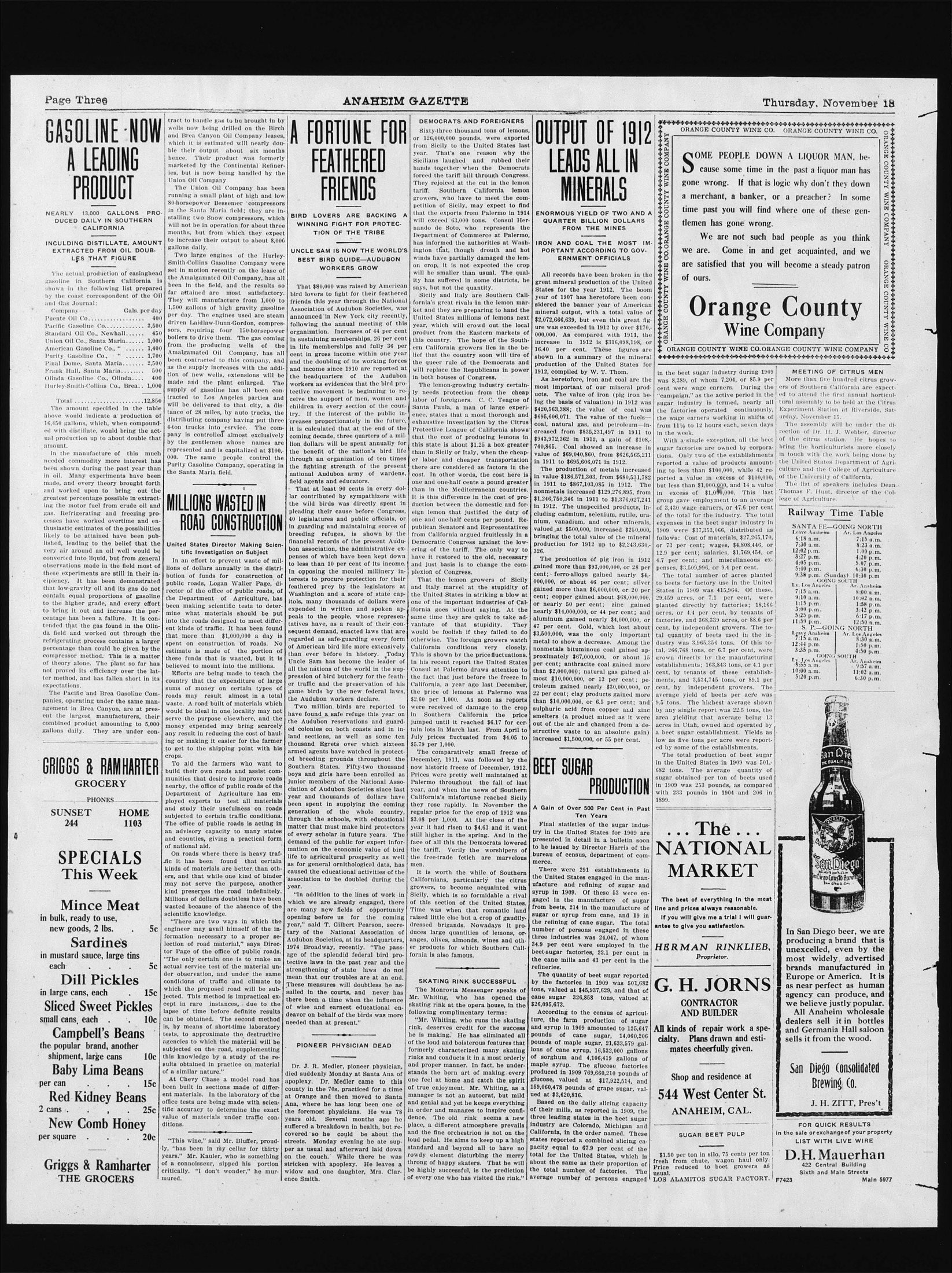
Searchable text
GASOLINE·NOW
A LEADING
PRODUCT
NEARLY 13,000 GALLONS PRODUCED DAILY IN SOUTHERN CALIFORNIA
INCULDING DISTILLATE, AMOUNT EXTRACTED FROM OIL DOUBLES THAT FIGURE
The actual production of casinghead gasoline in Southern California is shown in the following list prepared by the coast correspondent of the Oil and Gas Journal:
Company—Gals. per day
Puente Oil Co... 400
Pacific Gasoline Co... 3,500
Standard Oil Co., Newhall... 450
Union Oil Co., Santa Maria... 1,000
American Gasoline Co., "... 1,400
Purity Gasoline Co., "... 1,700
Pinal Dome, Santa Maria... 2,500
Frank Hall, Santa Maria... 500
Olinda Gasoline Co., Olinda... 400
Hurley-Smith-Collins Co., Brea... 1,000
Total ... 12,850
The amount specified in the table above would indicate a production of 16,450 gallons, which, when compounded with distillate, would bring the actual production up to about double that amount.
In the manufacture of this much needed commodity more interest has been shown during the past year than in oil. Many experiments have been conducted to handle gas to be brought in by wells now being drilled on the Birch and Brea Canyon Oil Company leases, which it is estimated will nearly double their output about six months hence. Their product was formerly marketed by the Continental Refineries, but is now being handled by the Union Oil Company.
The Union Oil Company has been running a small plant of high and low 80-horsepower Bessemer compressors in the Santa Maria field; they are installing two Snow compressors, which will not be in operation for about three months, but from which they expect to increase their output to about 8,000 gallons daily.
Two large engines of the Hurley-Smith-Collins Gasoline Company were set in motion recently on the lease of the Amalgamated Oil Company, has all been in the field, and the results so far attained are most satisfactory. They will manufacture from 1,000 to 1,500 gallons of high gravity gasoline per day. The engines used are steam driven Laidlaw-Dunn-Gordon, compressors, requiring four 150-horsepower boilers to drive them. The gas coming from the producing wells of the Amalgamated Oil Company, has all been contracted to this company, and as the supply increases with the addition of new wells, extensions will be made and the plant enlarged. The supply of gasoline has all been contracted to Los Angeles parties and will be delivered to that city, a distance of 28 miles, by auto trucks, the distributing company having put three 4-ton trucks into eservice. The company is controlled almost exclusively by the gentlemen whose names are represented and is capitalized at $100,-000. The same people control the Purity Gasoline Company, operating in the Santa Maria field.
That $80,000 was raised bird lovers to fight for friends this year through Association of Audubon announced in New York following the annual organization. Increase in sustaining members in life memberships cent in gross income and the doubling of it and income since 1919 the headquarters of workers as evidences of collective movement is receive the support of children in every country. If the interest decreases proportionately it is calculated that a coming decade, three million dollars will be spent the benefit of the new through an organization the fighting strength national Audubon arrives.
The amount specified in the table above would indicate a production of 16,450 gallons, which, when compounded with distillate, would bring the actual production up to about double that amount.
In the manufacture of this much needed commodity more interest has been shown during the past year than in oil. Many experiments have been made, and every theory brought forth and worked upon to bring out the greatest percentage possible in extracting the motor fuel from crude oil and gas. Refrigerating and freezing processes have worked overtime and enthusiastic estimates of the possibilities likely to be attained have been published, leading to the belief that the very air around an oil well would be converted into liquid, but from general observations made in the field most of these experiments are still in their incipiency. It has been demonstrated that low-gravity oil and its gas do not contain equal proportions of gasoline to the higher grade, and every effort to bring it out and increase the percentage has been a failure. It is contended that the gas found in the Olinda field and worked out through the refrigerating process contains a larger percentage than could be given by the compressor method. This is a matter of theory alone. The plant so far has not proved its efficiency over the latter method, and has fallen short in its expectations.
The Pacific and Brea Gasoline Companies, operating under the same management in Brea Canyon, are at present the largest manufacturers, their combined product amounting to 5,000 gallons daily. They are under con-
MILLIONS WASTED IN ROAD CONSTRUCTION
United States Director Making Scientific Investigation on Subject
In an effort to prevent waste of millions of dollars annually in the distribution of funds for construction of public roads, Logan Waller Page, director of the office of public roads, of the Department of Agriculture, has been making scientific tests to determine what materials should be put into the roads designed to meet different kinds of traffic. It has been found that more than $1,000,000 a day is spent on construction of roads. No estimate is made of the portion of these funds that is wasted, but it is believed to mount into the millions.
Efforts are being made to teach the country that the expenditure of large sums of money on certain types of roads may result almost in a total waste. A road built of materials which would be ideal in one locality may not serve the purpose elsewhere, and the money expended may bring scarcely any result in reducing the cost of hauling or making it easier for the farmer to get to the shipping point with his crops.
To aid the farmers who want to build their own roads and assist communities that desire to improve roads nearby, the office of public roads of the Department of Agriculture has employed experts to test all materials and study their usefulness on roads subjected to certain traffic conditions. The office of public roads is acting in an advisory capacity to many states and counties, giving a practical form of national aid.
On roads where there is heavy traffic it has been found that certain kinds of materials are better than others, and that while one kind of binder may not serve the purpose, another kind preserves the road indefinitely. Millions of dollars doubtless have been made and the plant enlarged. The supply of gasoline has all been contracted to Los Angeles parties and will be delivered to that city, a distance of 28 miles, by auto trucks, the distributing company having put three 4-ton trucks into eservice. The company is controlled almost exclusively by the gentlemen whose names are represented and is capitalized at $100,-000. The same people control the Purity Gasoline Company, operating in the Santa Maria field.
That at least 90 percent contributed by sympathy the wild birds was pleading their cause for 40 legislatures and pro-in guarding and main breeding refuges, is financial records of the bon association, the expenses of which have to less than 10 per cent.
In opposing the monsters to procure protected prey by the Washington and a scorpits, many thousands expended in written appeals to the people, relatives have, as a result sequent demand, enacted regarded as safe-guard of American bird life more than ever before in Uncle Sam has become all the nations of the world depression of bird butcherer traffic and the prey game birds by the new Audubon workers.
Two million birds have found a safe refuge at Audubon reservations colonies on both coast land sections, as well thousand Egrets over armed agents have waived breeding grounds Southern States. Fifty boys and girls have been junior members of the ciation of Audubon Society year and thousands o been spent in supply generation of the through the schools, w matter that must make of every scholar in future demand of the public mation on the economic life to agricultural proas as for general ornithology caused the educational association to be dou-
SPECIALS
This Week
Mince Meat
in bulk, ready to use,
new goods, 2 lbs. . 5c
Sardines
in mustard sauce, large tins
each . . . 5c
Dill Pickles
in large cans, each . 15c
Sliced Sweet Pickles
small cans, each . 10c
Campbell’s Beans
the popular brand, another shipment, large cans 10c
Baby Lima Beans
per can . . . 15c
Red Kidney Beans
2 cans . . . 25c
New Comb Honey
per square . . . 20c
Griggs & Ramharter
THE GROCERS
On roads where there is heavy traffic it has been found that certain kinds of materials are better than others, and that while one kind of binder may not serve the purpose, another kind preserves the road indefinitely. Millions of dollars doubtless have been wasted because of the absence of the scientific knowledge.
“There are two ways in which the engineer may avail himself of the information necessary to a proper selection of road material,” says Director Page of the office of public roads.
“The only certain one is to make an actual service test of the material under observation, and under the same conditions of traffic and climate to which the proposed road will be subjected. This method is impractical except in rare instances, due to the lapse of time before definite results can be obtained. The second method is, by means of short-time laboratory tests, to approximate the destructive agencies to which the material will be subjected on the road, supplementing this knowledge by a study of the results obtained in practice on material of a similar nature.”
At Chevy Chase a model road has been built in sections made of different materials. In the laboratory of the office tests are being made with scientific accuracy to determine the exact value of materials under traffic conditions.
“This wine,” said Mr. Bluffer, proudly, “has been in my cellar for thirty years.” Mr. Kauler, who is something of a connoisseur, sipped his portion critically. “I don’t wonder,” he murmured.
Dr. J. R. Medler, pioneered suddenly Monday after apoplexy. Dr. Medler county in the 70s, practiced at Orange and then Ana, where he has long the foremost physician years old. Several men suffered a breakdown in covered so he could streets. Monday even per as usual and afterwaking on the couch. While stricken with apoplexy widow and one daughter Smith.
A FORTUNE FOR FEATHERED FRIENDS
BIRD LOVERS ARE BACKING A WINNING FIGHT FOR PROTECTION OF THE TRIBE
UNCLE SAM IS NOW THE WORLD'S BEST BIRD GUIDE—AUDUBON WORKERS GROW
That $80,000 was raised by American bird lovers to fight for their feathered friends this year through the National Association of Audubon Societies, was announced in New York city recently, following the annual meeting of this organization. Increases of 44 per cent in sustaining memberships, 26 per cent in life memberships and fully 36 per cent in gross income within one year and the doubling of its working forces and income since 1910 are reported at the headquarters of the Audubon workers as evidences that the bird protective movement is beginning to receive the support of men, women and children in every section of the country. If the interest of the public increases proportionately in the future, it is calculated that at the end of the coming decade, three quarters of a million dollars will be spent annually for the benefit of the nation's bird life through an organization of ten times the fighting strength of the present national Audubon army of wardens.
DEMOCRATS AND FOREIGNERS
Sixty-three thousand tons of lemons, or 126,000,000 pounds, were exported from Sicily to the United States last year. That's one reason why the Sicilians laughed and rubbed their hands together when the Democrats forced the tariff bill through Congress. They rejoiced at the cut in the lemon tariff. Southern California lemon growers, who have to meet the competition of Sicily, may expect to find that the exports from Palermo in 1914 will exceed 63,000 tons. Consul Hernando de Soto, who represents the Department of Commerce at Palermo, has informed the authorities at Washington that, though drought and hot winds have partially damaged the lemon crop, it is not expected the crop will be smaller than usual. The quality has suffered in some districts, he says, but not the quantity.
Sicily and Italy are Southern California's great rivals in the lemon market and they are preparing to hand the United States millions of lemons next year, which will crowd out the local product from the Eastern markets of this country. The hope of the Southern California growers lies in the belief that the country soon will tire of the queer rule of the Democrats and will replace the Republicans in power in both houses of Congress.
The lemon-growing industry certainly needs protection from the cheap labor of foreigners. C. C. Teague of Santa Paula, a man of large experience, states that a most thorough and exhaustive investigation by the Citrus Protective League of California shows that the cost of producing lemons in this state is about $1.25 a box greater than in Sicily or Italy, when the cheaper labor and cheaper transportation there are considered as factors in the cost. In other words, the cost here is
OUTPUT OF 1912 LEADS ALL IN MINERALS
ENORMOUS YIELD OF TWO AND A QUARTER BILLION DOLLARS FROM THE MINES
IRON AND COAL THE MOST IMPORTANT ACCORDING TO GOVERNMENT OFFICIALS
All records have been broken in the great mineral production of the United States for the year 1912. The boom year of 1907 has heretofore been considered the banner year of American mineral output, with a total value of $2,072,666,639, but even this great figure was exceeded in 1912 by over $170,000,000. As compared with 1911, the increase in 1912 is $316,098,198, or 16.40 per cent. These figures are shown in a summary of the mineral production of the United States for 1912, compiled by W. T. Thom.
As heretofore, iron and coal are the most important of our mineral products. The value of iron (pig iron being the basis of valuation) in 1912 was $420,563,388; the value of coal was $695,606,071. The value of the fuels—coal, natural gas, and petroleum—increased from $835,231,497 in 1911 to $943,972,362 in 1912, a gain of $108,740,865. Coal showed an increase in value of $69,040,860, from $626,565,211 in 1911 to $695,606,071 in 1912.
The production of metals increased
the headquarters of the Audubon workers as evidences that the bird protective movement is beginning to receive the support of men, women and children in every section of the country. If the interest of the public increases proportionately in the future, it is calculated that at the end of the coming decade, three quarters of a million dollars will be spent annually for the benefit of the nation’s bird life through an organization of ten times the fighting strength of the present national Audubon army of wardens, field agents and educators.
That at least 90 cents in every dollar contributed by sympathizers with the wild birds was directly spent in pleading their cause before Congress, 40 legislatures and public officials, or in guarding and maintaining scores of breeding refuges, is shown by the financial records of the present Audubon association, the administrative expenses of which have been kept down to less than 10 per cent of its income. In opposing the monied millinery interests to procure protection for their feathered prey by the legislators at Washington and a score of state capitals, many thousands of dollars were expended in written and spoken appeals to the people, whose representatives have, as a result of their consequent demand, enacted laws that are regarded as safe-guarding every form of American bird life more extensively than ever before in history. Today Uncle Sam has become the leader of all the nations of the world in the suppression of bird butchery for the feather traffic and the preservation of his game birds by the new federal laws, the Audubon workers declare.
Two million birds are reported to have found a safe refuge this year on the Audubon reservations and guarded colonies on both coasts and in inland sections, as well as some ten thousand Egrets over which sixteen armed agents have watched in protected breeding grounds throughout the Southern States. Fifty-two thousand boys and girls have been enrolled as junior members of the National Association of Audubon Societies since last year and thousands of dollars have been spent in supplying the coming generation of the whole country, through the schools, with educational matter that must make bird protectors of every scholar in future years. The demand of the public for expert information on the economic value of bird life to agricultural prosperity as well as for general ornithological data, has caused the educational activities of the association to be doubled during the year.
"In addition to the lines of work in
The lemon-growing industry certainly needs protection from the cheap labor of foreigners. C. C. Teague of Santa Paula, a man of large experience, states that a most thorough and exhaustive investigation by the Citrus Protective League of California shows that the cost of producing lemons in this state is about $1.25 a box greater than in Sicily or Italy, when the cheaper labor and cheaper transportation there are considered as factors in the cost. In other words, the cost here is one and one-half cents a pound greater than in the Mediterranean countries. It is this difference in the cost of production between the domestic and foreign lemon that justified the duty of one and one-half cents per pound. Republican Senators and Representatives from California argued fruitlessly in a Democratic Congress against the lowering of the tariff. The only way to have it restored to the old, necessary and just basis is to change the complexion of Congress.
That the lemon growers of Sicily and Italy marvel at the stupidity of the United States in striking a blow at one of the important industries of California goes without saying. At the same time they are quick to take advantage of that stupidity. They would be foolish if they failed to do otherwise. The foreign growers watch California conditions very closely. This is shown by the price fluctuations. In his recent report the United States Consul at Palermo draws attention to the fact that just before the freeze in California, a year ago last December, the price of lemons at Palermo was $2.60 per 1,000. As soon as reports were received of damage to the crop in Southern California the price jumped until it reached $6.17 for certain lots in March last. From April to July prices fluctuated from $4.05 to $5.79 per 1,000.
The comparatively small freeze of December, 1911, was followed by the now historic freeze of December, 1912. Prices were pretty well maintained at Palermo throughout the fall of last year, and when the news of Southern California's misfortune reached Sicily they rose rapidly. In November the regular price for the crop of 1912 was $3.08 per 1,000. At the close of the year it had risen to $4.63 and it went still higher in the spring. And in the face of all this the Democrats lowered the tariff. Verily the worshipers of the free-trade fetich are marvelous men.
It is worth the while of Southern Californians, particularly the citrus growers, to become acquainted with Sicily, which is so formidable a rival
As heretofore, iron and coal are the most important of our mineral products. The value of iron (pig iron being the basis of valuation) in 1912 was $420,563,388; the value of coal was $695,606,071. The value of the fuels—coal, natural gas, and petroleum—increased from $835,231,497 in 1911 to $943,972,362 in 1912, a gain of $108,740,865. Coal showed an increase in value of $69,040,860, from $626,565,211 in 1911 to $695,606,071 in 1912.
The production of metals increased in value $186,571,303, from $680,531,782 in 1911 to $867,103,085 in 1912. The nonmetals increased $129,276,895, from $1,246,750,346 in 1911 to $1,376,027,241 in 1912. The unspecified products, including cadmium, selenium, rutile, uranium, vanadium, and other minerals, valued at $500,000, increased $250,000, bringing the total value of the mineral production for 1912 up to $2,243,630,-326.
The production of pig iron in 1912 gained more than $93,000,000, or 28 per cent; ferro-alloys gained nearly $4,.000,000, or about 46 per cent; silver gained more than $6,000,000, or 20 per cent; copper gained about $68,000,000, or nearly 50 per cent; zinc gained nearly $14,000,000, or 44 per cent; and aluminum gained nearly $4,000,000, or 47 per cent. Gold, which lost about $3,500,000, was the only important metal to show a decrease. Among the nonmetals bituminous coal gained approximately $67,000,000, or about 15 per cent; anthracite coal gained more than $2,000,000; natural gas gained almost $10,000,000; or 13 per cent; petroleum gained nearly $30,000,000; or 22 per cent; clay products gained more than $10,000,000; or 6.5 per cent; and sulphuric acid from copper and zinc smelters (a product mined as it were out of the air and changed from a destructive waste to an absolute gain) increased $1,500,000, or 55 per cent.
BEET SUGAR PRODUCTION
A Gain of Over 500 Per Cent in Past Ten Years
Final statistics of the sugar industry in the United States for 1909 are presented in detail in a bulletin soon to be issued by Director Harris of the bureau of census, department of commerce.
There were 291 establishments in the United States engaged in the manufacture and refining of sugar and syrup in 1909. Of these 53 were engaged in manufacturing sugar for both commercial and industrial purposes.
been spent in supplying the coming generation of the whole country, through the schools, with educational matter that must make bird protectors of every scholar in future years. The demand of the public for expert information on the economic value of bird life to agricultural prosperity as well as for general ornithological data, has caused the educational activities of the association to be doubled during the year.
"In addition to the lines of work in which we are already engaged, there are many new fields of opportunity opening before us for the coming year," said T. Gilbert Pearson, secretary of the National Association of Audubon Societies, at its headquarters, 1974 Broadway, recently. "The passage of the splendid federal bird protective laws in the past year and the strengthening of state laws do not mean that our troubles are at an end. These measures will doubtless be sailed in the courts, and never has there been a time when the influence of wise and earnest educational endeavor on behalf of the birds was more needed than at present."
PIONEER PHYSICIAN DEAD
Dr. J. R. Medler, pioneer physician, died suddenly Monday at Santa Ana of apoplexy. Dr. Medler came to this county in the 70s, practiced for a time at Orange and then moved to Santa Ana, where he has long been one of the foremost physicians. He was 78 years old. Several months ago he suffered a breakdown in health, but recovered so he could be about the streets. Monday evening he ate supper as usual and afterward laid down on the couch. While there he was stricken with apoplexy. He leaves a widow and one daughter, Mrs. Clarence Smith.
SKATING RINK SUCCESSFUL
The Monrovia Messenger speaks of Mr. Whiting, who has opened the skating rink at the opera house, in the following complimentary terms:
"Mr. Whiting, who runs the skating rink, deserves credit for the success he is making. He has eliminated all of the loud and boisterous features that formerly characterized many skating rinks and conducts it in a most orderly and proper manner. In fact, he understands the born art of making every one feel at home and catch the spirit of true enjoyment. Mr. Whiting, as a manager is not an autocrat, but mild and genial and yet he keeps everything in order and manages to inspire confidence. The old rink seems a new place, a different atmosphere prevails and the fine orchestrion is not on the loud pedal. He aims to keep up a high standard and beyond all to have no rowdy element disturbing the merry throng of happy skaters. That he will be highly successful, is the prediction of every one who has visited the rink."
A Gain of Over 500 Per Cent in Past Ten Years
Final statistics of the sugar industry in the United States for 1909 are presented in detail in a bulletin soon to be issued by Director Harris of the bureau of census, department of commerce.
There were 291 establishments in the United States engaged in the manufacture and refining of sugar and syrup in 1909. Of these 53 were engaged in the manufacture of sugar from beets, 214 in the manufacture of sugar or syrup from cane, and 19 in the refining of cane sugar. The total number of persons engaged in these three industries was 24,047, of whom 34.9 per cent were employed in the beet-sugar factories, 22.1 per cent in the cane mills and 43 per cent in the refineries.
The quantity of beet sugar reported by the factories in 1909 was 501,682 tons, valued at $45,937,629, and that of cane sugar 326,858 tons, valued at $26,095,673.
According to the census of agriculture, the farm production of sugar and syrup in 1909 amounted to 125,647 pounds of cane sugar, 14,060,206 pounds of maple sugar, 21,633,579 gallons of cane syrup, 16,532,000 gallons of sorghum and 4,106,419 gallons of maple syrup. The glucose factories produced in 1909 769,660,210 pounds of glucose, valued at $17,922,514, and 159,060,478 pounds of grape sugar, valued at $3,620,816.
Based on the daily slicing capacity of their mills, as reported in 1909, the three leading states in the beet sugar industry are Colorado, Michigan and California, in the order named. These states reported a combined slicing capacity equal to 67.9 per cent of the total for the United States, which is about the same as their proportion of the total number of factories. The average number of persons engaged
OF 1912
ALL IN
MERALS
OF TWO AND A
MION DOLLARS
ME MINES
THE MOST IMRDING TO GOVOFFICIALS
been broken in the
ction of the United
1912. The boom
retofore been conyear of American
in a total value of
ten this great fig1912 by over $170,
ded with 1911, the
dals $316,098,198, or
these figures are
very of the mineral
United States for
T. Thom.
and coal are the
our mineral prodiron (pig iron belation) in 1912 was
value of coal was
value of the fuels—
and petroleum—in
31,497 in 1911 to
a gain of $108,
added an increase in
from $626,565,211
71 in 1912.
metals increased
ORANGE COUNTY WINE CO. ORANGE COUNTY WINE CO.
SOME PEOPLE DOWN A LIQUOR MAN, because some time in the past a liquor man has gone wrong. If that is logic why don't they down a merchant, a banker, or a preacher? In some time past you will find where one of these gentlemen has gone wrong.
We are not such bad people as you think we are. Come in and get acquainted, and we are satisfied that you will become a steady patron of ours.
Orange County
Wine Company
ORANGE COUNTY WINE CO. ORANGE COUNTY WINE COMPANY
in the beet sugar industry during 1909 was 8,389, of whom 7,204, or 85.9 per cent were wage earners. During the "campaign," as the active period in the sugar industry is termed, nearly all the factories operated continuously, the wage earners working in shifts of from 11½ to 12 hours each, seven days in the week.
With a single exception, all the beet sugar factories are owned by corporations. Only two of the establishments reported a value of products amounting to less than $100,000, while 42 re-
MEETING OF CITRUS MEN
More than five hundred citrus growers of Southern California are expected to attend the first annual horticultural assembly to be held at the Citrus Experiment Station at Riverside, Saturday, November 15.
The assembly will be under the direction of Dr. H. J. Webber, director of the citrus station. He hopes to bring the horticulturists more closely in touch with the work being done by the United States Department of Agriculture and the College of Agriculture
The total production of beet sugar in the United States in 1909 was 501,682 tons. The average quantity of sugar obtained per ton of beets used in 1909 was 253 pounds, as compared with 233 pounds in 1904 and 206 in 1899.
More than five hundred citrus growers of Southern California are expected to attend the first annual horticultural assembly to be held at the Citrus Experiment Station at Riverside, Saturday, November 15.
The assembly will be under the direction of Dr. H. J. Webber, director of the citrus station. He hopes to bring the horticulturists more closely in touch with the work being done by the United States Department of Agriculture and the College of Agriculture of the University of California.
The list of speakers includes Dean Thomas F. Hunt, director of the College of Agriculture.
The National Market
The best of everything in the meat line and prices always reasonable.
If you will give me a trial I will guarantee to give you satisfaction.
HERMAN RINKLIEB,
Proprietor.
G. H. JORNS
CONTRACTOR AND BUILDER
All kinds of repair work a specialty. Plans drawn and estimates cheerfully given.
Shop and residence at 544 West Center St.
ANAHEIM, CAL.
SUGAR BEET PULP
$1.50 per ton in silo, 75 cents per ton fresh from chute, wagon haul only. Price reduced to beet growers as usual.
LOS ALAMITOS SUGAR FACTORY.
In San Diego beer, we are producing a brand that is unexcelled, even by the most widely advertised brands manufactured in Europe or America. It is as near perfect as human agency can produce, and we believe justly popular.
All Anaheim wholesale dealers sell it in bottles and Germania Hall saloon sells it from the wood.
San Diego Consolidated Brewing Co.
J. H. ZITT, Pres't
FOR QUICK RESULTS
in the sale or exchange of your property
LIST WITH LIVE WIRE
D.H. Mauerhan
422 Central Building
Sixth and Main Streets
F7423
Main 5977