anaheim-gazette 1913-11-13
Scanned page
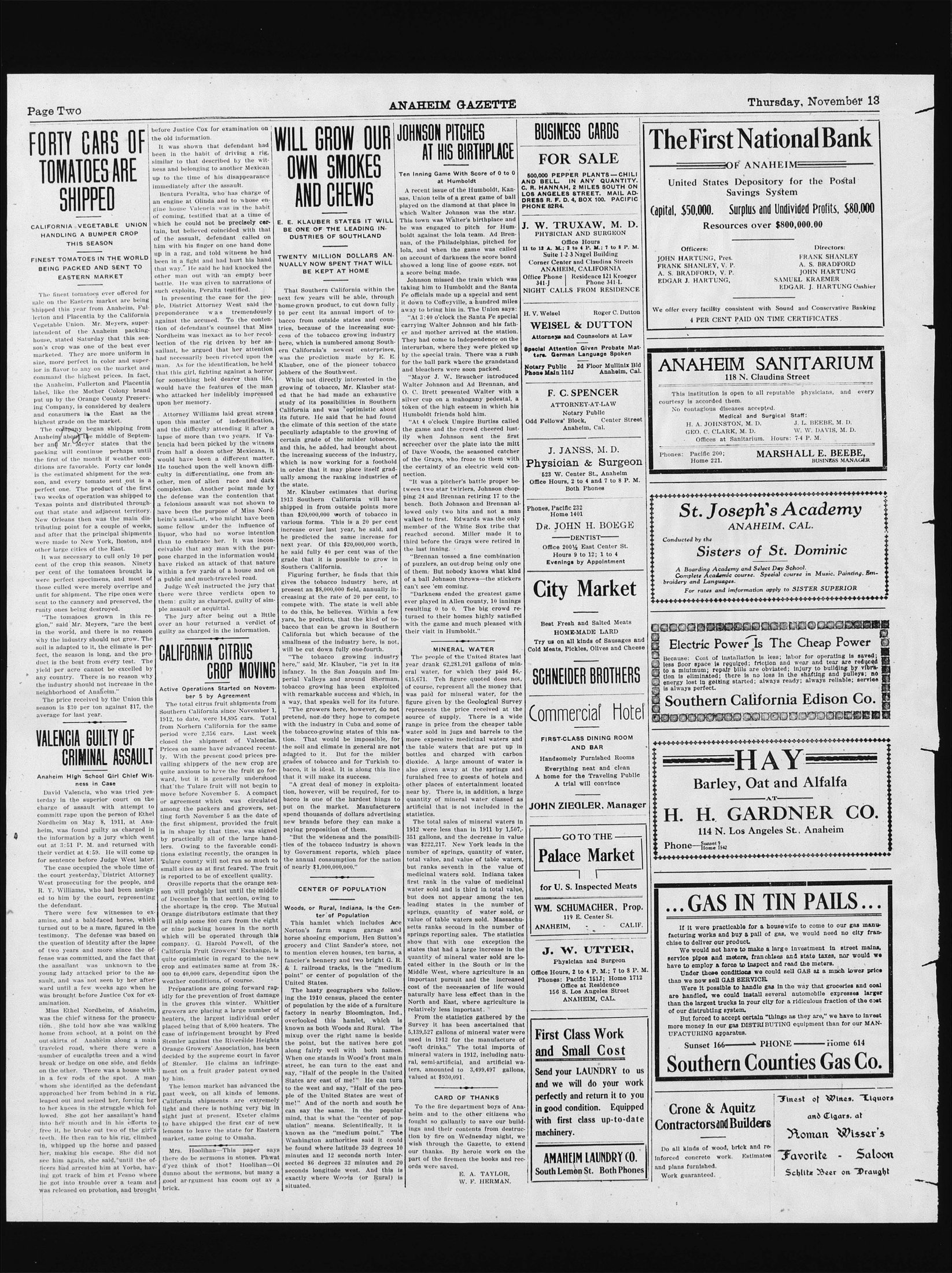
Searchable text
FORTY CARS OF TOMATOES ARE SHIPPED
CALIFORNIA VEGETABLE UNION HANDLING A BUMPER CROP THIS SEASON
FINEST TOMATOES IN THE WORLD BEING PACKED AND SENT TO EASTERN MARKET
The finest tomatoes ever offered for sale on the Eastern market are being shipped this year from Anaheim, Fullerton and Placentia by the California Vegetable Union. Mr. Meyers, superintendent of the Anaheim packinghouse, stated Saturday that this season's crop was one of the best ever marketed. They are more uniform in size, more perfect in color and superior in flavor to any on the market and command the highest prices. In fact, the Anaheim, Fullerton and Placentia label, like the Mother Colony brand put up by the Orange County Preserving Company, is considered by dealers and consumers in the East as the highest grade on the market.
The company began shipping from Anaheim about the middle of September and Mr. Meyer states that the packing will continue perhaps until the first of the month if weather conditions are favorable. Forty car loads is the estimated shipment for the sea-before Justice Cox for examination on the old information.
It was shown that defendant had been in the habit of driving a rig, similar to that described by the witness and belonging to another Mexican up to the time of his disappearance immediately after the assault.
Bentura Peralta, who has charge of an engine at Olinda and to whose engine house Valencia was in the habit of coming, testified that at a time of which he could not be precisely certain, but believed coincided with that of the assault, defendant called on him with his finger on one hand done up in a rag, and told witness he had been in a fight and had hurt his hand that way. He said he had knocked the other man out with an empty beer bottle. He was given to narrations of such exploits, Peralta testified.
In presenting the case for the people, District Attorney West said the preponderance was tremendously against the accused. To the contention of defendant's counsel that Miss Nordheim was inexact as to her recollection of the rig driven by her assailant, he argued that her attention had necessarily been riveted upon the man. As for the identification, he held that this girl, fighting against a horror for something held dearer than life, would have the features of the man who attacked her indelibly impressed upon her memory.
Attorney Williams laid great stress upon this matter of indentification, and the difficulty attending it after a lapse of more than two years. If Valencia had been picked by the witness from half a dozen other Mexicans, it would have been a different matter. He touched upon the well known difficulty in differentiating one from an...
command the highest prices. In fact, the Anaheim, Fullerton and Placentia label, like the Mother Colony brand put up by the Orange County Preserving Company, is considered by dealers and consumers in the East as the highest grade on the market.
The company began shipping from Anaheim about the middle of September and Mr. Meyer states that the packing will continue perhaps until the first of the month if weather conditions are favorable. Forty car loads is the estimated shipment for the season, and every tomato sent out is a perfect one. The product of the first two weeks of operation was shipped to Texas points and distributed throughout that state and adjacent territory. New Orleans then was the main distributing point for a couple of weeks, and after that the principal shipments were made to New York, Boston, and other large cities of the East.
It was necessary to cull only 10 percent of the crop this season. Ninety per cent of the tomatoes brought in were perfect specimens, and most of those culled were merely overripe and unfit for shipment. The ripe ones were sent to the cannery and preserved, the runty ones being destroyed.
"The tomatoes grown in this region," said Mr. Meyers, "are the best in the world, and there is no reason why the industry should not grow. The soil is adapted to it, the climate is perfect, the season is long, and the product is the best from every test. The yield per acre cannot be excelled by any country. There is no reason why the industry should not increase in the neighborhood of Anaheim."
The price received by the Union this season is $30 per ton against $17, the average for last year.
VALENCIA GUILTY OF CRIMINAL ASSAULT
Anaheim High School Girl Chief Witness in Case
David Valencia, who was tried yesterday in the superior court on the charge of assault with attempt to commit rape upon the person of Ethel Nordheim on May 8, 1911, at Anaheim, was found guilty as charged in the information by a jury which went out at 3:51 P. M. and returned with their verdict at 4:59. He will come up for sentence before Judge West later.
The case occupied the whole time of the court yesterday, District Attorney West prosecuting for the people, and R. Y. Williams, who had been assigned to him by the court, representing
Attorney Williams laid great stress upon this matter of indentification, and the difficulty attending it after a lapse of more than two years. If Valencia had been picked by the witness from half a dozen other Mexicans, it would have been a different matter. He touched upon the well known difficulty in differentiating, one from another, men of alien race and dark complexion. Another point made by the defense was the contention that a felonious assault was not shown to have been the purpose of Miss Nordheim's assailant, who might have been some fellow under the influence of liquor, who had no worse intention than to embrace her. It was inconceivable that any man with the purpose charged in the information would have risked an attack of that nature within a few yards of a house and on a public and much-traveled road.
Judge West instructed the jury that there were three verdicts open to them: guilty as charged, guilty of simple assault or acquittal.
The jury after being out a little over an hour returned a verdict of guilty as charged in the information.
CALIFORNIA CITRUS CROP MOVING
Active Operations Started on November 5 by Agreement
The total citrus fruit shipments from Southern California since November 1, 1912, to date, were 14,895 cars. Total from Northern California for the same period were 2,356 cars. Last week closed the shipment of Valencias. Prices on same have advanced recently. With the present good prices prevailing shippers of the new crop are quite anxious to have the fruit go forward, but it is generally understood that 'the Tulare fruit will not begin to move before November 5.' A compact or agreement which was circulated among the packers and growers, setting forth November 5 as the date of the first shipment, provided the fruit is in shape by that time, was signed by practically all of the large handlers. Owing to the favorable conditions existing recently, the oranges in Tulare county will not run so much to small sizes as at first feared. The fruit is reported to be of excellent quality.
Oroville reports that the orange season will probably last until the middle of December in that section, owing to something held dearer than life, would have the features of the man who attacked her indelibly impressed upon her memory.
Mr. Klauber estimates 1913 Southern California shipped in from outside than $20,000,000 worth various forms. This is an increase over last year, he predicted the same next year. Of this $20,000 he said fully 40 per cent grade that it is possible Southern California.
Figuring further, he gives the tobacco industry present an $8,000,000 field creasing at the rate of 2 compete with. The state to do this, he believes. Years, he predicts, that bacco that can be grown California but which has smallness of the industry will be cut down fully or "The tobacco grows here," said Mr. Klauber, infancy. In the San Joaquin Valley and around tobacco growing has been with remarkable success a way, that speaks well.
"The growers here, how pretend, nor do they hold with the industry in Cuba the tobacco-growing station. That would be in the soil and climate in adapted to it. But for grades of tobacco and f bacco, it is ideal. It is that it will make its suc"
"A great deal of motion, however, will be r bacco is one of the hauls put on the market. spend thousands of dollars new brands before they paying proposition of th
"But the wideness and ties of the tobacco industry by Government reports the annual consumption of nearly $1,000,000,000."
terday in the superior court on the charge of assault with attempt to committ rape upon the person of Ethel Nordheim on May 8, 1911, at Anaheim, was found guilty as charged in the information by a jury which went out at 3:51 P.M. and returned with their verdict at 4:59. He will come up for sentence before Judge West later.
The case occupied the whole time of the court yesterday, District Attorney West prosecuting for the people, and R. Y. Williams, who had been assigned to him by the court, representing the defendant.
There were few witnesses to examine, and a bald-faced horse, which turned out to be a mare, figured in the testimony. The defense was based on the question of identity after the lapse of two years and more since the offense was committed, and the fact that the assailant was unknown to the young lady attacked prior to the assault, and was not seen by her afterward until a few weeks ago when he was brought before Justice Cox for examination.
Miss Ethel Nordheim, of Anaheim, was the chief witness for the prosecution. She told how she was walking home from school, at a point on the outskirts of Anaheim along a main traveled road, where there were a number of eucalyptus trees and a wind break or hedge on one side, and fields on the other. There was a house within a few rods of the spot. A man whom she identified as the defendant approached her from behind in a rig, leaped out and seized her, forcing her to her knees in the struggle which followed. She got her assailant's hand into her mouth and in his efforts to free it, he broke out two of the girl's teeth. He then ran to his rig, climbed in, whipped up the horse and passed her, making his escape. She did not see him again, she said, until the officers had arrested him at Yorba, having got track of him at Fesno where he got into trouble over a team and was released on probation, and brought or agreement which was circulated among the packers and growers, setting forth November 5 as the date of the first shipment, provided the fruit is in shape by that time, was signed by practically all of the large handlers. Owing to the favorable conditions existing recently, the oranges in Tulare county will not run so much to small sizes as at first feared. The fruit is reported to be of excellent quality.
Oroville reports that the orange season will probably last until the middle of December in that section, owing to the shortage in the crop. The Mutual Orange distributors estimate that they will ship some 800 cars from the eight or nine packing houses in the north which will be operated through this company. G. Harold Powell, of the California Fruit Growers' Exchange, is quite optimistic in regard to the new crop and estimates same at from 38,-000 to 40,000 cars, depending upon the weather conditions, of course.
Preparations are going forward rapidly for the prevention of frost damage in the groves this winter. Whittier growers are placing a large number of heaters, the largest individual order placed being that of 8,000 heaters. The case of infringement brought by Fred Stemler against the Riverside Heights Orange Growers' Association, has been decided by the supreme court in favor of Stemler. He claims an infringement on a fruit grader patent owned by him.
The lemon market has advanced the past week, on all kinds of lemons. California shipments are extremely light and there is nothing very big in sight just at present. Exeter claims to have shipped the first car of new lemons to leave the state for Eastern market, same going to Omaha.
Mrs. Hoolihan—This paper says there do be sermons in stones. Phwat d'yez think of thot? Hoolihan—Oi dunno about the sermons, but many a good ar-rgument has coom out av a brick.
WILL GROW OUR OWN SMOKES AND CHEWS
E. E. KLAUBER STATES IT WILL BE ONE OF THE LEADING INDUSTRIES OF SOUTHLAND
TWENTY MILLION DOLLARS ANNUALLY NOW SPENT THAT WILL BE KEPT AT HOME
That Southern California within the next few years will be able, through home-grown product, to cut down fully 10 per cent its annual import of tobacco from outside states and countries, because of the increasing success of the tobacco growing industry here, which is numbered among Southern California's newest enterprises, was the prediction made by E. E. Klauber, one of the pioneer tobacco jobbers of the Southwest.
While not directly interested in the growing of tobacco, Mr. Klauber stated that he had made an exhaustive study of its possibilities in Southern California and was optimistic about its future. He said that he had found the climate of this section of the state peculiarly adaptable to the growing of certain grade of the milder tobaccos, and this, he added, had brought about the increasing success of the industry, which is now working for a foothold in order that it may place itself gradually.
JOHNSON PITCHES AT HIS BIRTHPLACE
Ten Inning Game With Score of 0 to 0 at Humboldt
A recent issue of the Humboldt, Kansas, Union tells of a great game of ball played on the diamond at that place in which Walter Johnson was the star. This town was Walter's birthplace and he was engaged to pitch for Humboldt against the Iola team. Ad Brennan, of the Philadelphiaias, pitched for Iola, and when the game was called on account of darkness the score board showed a long line of goose eggs, not a score being made.
Johnson missed the train which was taking him to Humboldt and the Santa Fe officials made up a special and sent it down to Coffeyville, a hundred miles away to bring him in. The Union says:
"At 3:40 o'clock the Santa Fe special carrying Walter Johnson and his father and mother arrived at the station. They had come to Independence on the interurban, where they were picked up by the special train. There was a rush for the ball park where the grandstand and bleachers were soon packed.
"Mayor J. W. Braucher introduced Walter Johnson and Ad Brennan, and O. C. Brett presented Walter with a silver cup on a mahogany pedestal, a token of the high esteem in which his Humboldt friends hold him.
"At 4 o'clock Umpire Burtiss called the game and the crowd cheered lustily when Johnson sent the first screecher over the plate into the mitt of Dave Woods, the seasoned catcher of the Grays, who froze to them with the certainty of an electric weld connection."
While not directly interested in the growing of tobacco, Mr. Klauber stated that he had made an exhaustive study of its possibilities in Southern California and was optimistic about its future. He said that he had found the climate of this section of the state peculiarly adaptable to the growing of certain grade of the milder tobaccos, and this, he added, had brought about the increasing success of the industry, which is now working for a foothold in order that it may place itself gradually among the ranking industries of the state.
Mr. Klauber estimates that during 1913 Southern California will have shipped in from outside points more than $20,000,000 worth of tobacco in various forms. This is a 20 per cent increase over last year, he said, and he predicted the same increase for next year. Of this $20,000,000 worth, he said fully 40 per cent was of the grade that it is possible to grow in Southern California.
Figuring further, he finds that this gives the tobacco industry here, at present an $8,000,000 field, annually increasing at the rate of 20 per cent, to compete with. The state is well able to do this, he believes. Within a few years, he predicts, that the kind of tobacco that can be grown in Southern California but which because of the smallness of the industry here, is not, will be cut down fully one-fourth.
"The tobacco growing industry here," said Mr. Klauber, "is yet in its infancy. In the San Joaquin and Imperial Valleys and around Sherman, tobacco growing has been exploited with remarkable success and which, in a way, that speaks well for its future.
"The growers here, however, do not pretend, nor do they hope to compete with the industry in Cuba and some of the tobacco-growing states of this nation. That would be impossible, for the soil and climate in general are not adapted to it. But for the milder grades of tobacco and for Turkish tobacco, it is ideal. It is along this line that it will make its success.
"A great deal of money in exploitation, however, will be required, for tobacco is one of the hardest hings to put on the market. Manufacturers spend thousands of dollars advertising new brands before they can make a paying proposition of them.
"But the wideness and the possibilities of the tobacco industry is shown by Government reports, which place the annual consumption for the nation of nearly $1,000,000,000."
Mayor J. W. Braucher introduced Walter Johnson and Ad Brennan, and O. C. Brett presented Walter with a silver cup on a mahogany pedestal, a token of the high esteem in which his Humboldt friends hold him.
"At 4 o'clock Umpire Burtiss called the game and the crowd cheered lustily when Johnson sent the first screecher over the plate into the mitt of Dave Woods, the seasoned catcher of the Grays, who froze to them with the certainty of an electric weld connection.
"It was a pitcher's battle proper between two star twirlers, Johnson chopping 24 and Brennan retiring 17 to the bench. Both Johnson and Brennan allowed only two hits and not a man walked to first. Edwards was the only member of the White Sox tribe that reached second. Miller made it to third before the Grays were retired in the last inning.
"Brennan tossed a fine combination of puzzlers, an out-drop being only one of them. But nobody knows what kind of a ball Johnson throws—the stickers can't see 'em coming.
"Darkness ended the greatest game ever played in Allen county, 10 innings resulting 0 to 0. The big crowd returned to their homes highly satisfied with the game and much pleased with their visit in Humboldt."
MINERAL WATER
The people of the United States last year drank 62,281,201 gallons of mineral water, for which they paid $6,-615,671. Teh figure quoted does not, of course, represent all the money that was paid for mineral water, for the figure given by the Geological Survey represents the price received at the source of supply. There is a wide range in price from the cheaper table water sold in jugs and barrels to the more expensive medicinal waters and the table waters that are put up in bottles and charged with carbon dioxide. A large amount of water is also given away at the springs and furnished free to guests of hotels and other places of entertainment located near by. There is, in addition, a large quantity of mineral water classed as artificial that is not included in the statistics.
The total sales of mineral waters in 1912 were less than in 1911 by 1,507,-351 gallons, and the decrease in value was $222,217. New York leads in the number of springs, quantity of water, total value, and value of table waters, but ranks seventh in the value of medicinal waters sold. Indiana takes first rank in the value of medicinal water sold and is third in total value, but does not appear among the ten
bacco is one of the hardest hings to put on the market. Manufacturers spend thousands of dollars advertising new brands before they can make a paying proposition of them.
"But the wideness and the possibilities of the tobacco industry is shown by Government reports, which place the annual consumption for the nation of nearly $1,000,000,000."
CENTER OF POPULATION
Woods, or Rural, Indiana, is the Center of Population
This hamlet which includes Ace Norton's farm wagon garage and horse shoeing emporium, Hen Sutton's grocery and Clint Sander's store, not to mention eleven houses, ten barns, a fancier's hennery and two bright G. R. & I. railroad tracks, is the "medium point" or center of population of the United States.
The hasty geographers who following the 1910 census, placed the center of population by the side of a furniture factory in nearby Bloomington, Ind., overlooked this hamlet, which is known as both Woods and Rural. The mixup over the right name is beside the point, but the natives here got along fairly well with both names. When one stands in Wood's front main street, he can turn to the east and say, "Half of the people in the United States are east of me!" He can turn to the west and say, "Half of the people of the United States are west of me!" And of the north and south he can say the same. In the popular mind, that is what the "center of population" means. Scientifically, it is known as the "medium point." The Washington authorities said it could be found where latitude 39 degrees 10 minutes and 12 seconds north intersected 86 degrees 32 minutes and 20 seconds longitude west. And this is exactly where Woods (or Rural) is situated.
The total sales of mineral waters in 1912 were less than in 1911 by 1,507,-351 gallons, and the decrease in value was $222,217. New York leads in the number of springs, quantity of water, total value, and value of table waters, but ranks seventh in the value of medicinal waters sold. Indiana takes first rank in the value of medicinal water sold and is third in total value, but does not appear among the ten leading states in the number of springs, quantity of water sold, or value of table waters sold. Massachusetts ranks second in the number of springs reporting sales. The statistics show that with one exception the states that had a large increase in the quantity of mineral water sold are located either in the South or in the Middle West, where agriculture is an important pursuit and the increased cost of the necessaries of life would naturally have less effect than in the North and East, where agriculture is relatively less important.
From the statistics gathered by the Survey it has been ascertained that 5,139,527 gallons of mineral water were used in 1912 for the manufacture of "soft drinks." The total imports of mineral waters in 1912, including natural, semi-artificial, and artificial waters, amounted to 3,499,497 gallons, valued at $930,091.
CARD OF THANKS
To the fire department boys of Anaheim and to the other citizens who fought so gallantly to save our buildings and their contents from destruction by fire on Wednesday night, we wish through the Gazette, to extend our thanks. By heroic work on the part of the firemen the books and records were saved.
E. A. TAYLOR,
W. F. HERMAN.
Thursday, November 13
The First National Bank
OF ANAHEIM
United States Depository for the Postal Savings System
Capital, $50,000. Surplus and Undivided Profits, $80,000
Resources over $800,000.00
Officers:
JOHN HARTUNG, Pres.
FRANK SHANLEY
FRANK SHANLEY, V. P.
A. S. BRADFORD
EDGAR J. HARTUNG,
SAMUEL KRAEMER
EDGAR. J. HARTUNG Cashier
We offer every facility consistent with Sound and Conservative Banking
4 PER CENT PAID ON TIME CERTIFICATES.
ANAHEIM SANITARIUM
118 N. Claudina Street
This institution is open to all reputable physicians, and every courtesy is accorded them.
No contagious diseases accepted.
Medical and Surgical Staff:
H. A. JOHNSTON, M. D.
J. L. BEEBE, M. D.
GEO. C. CLARK, M. D.
W. W. DAVIS, M. D.
Offices at Sanitarium. Hours: 7-4 P.M.
Phones: Pacific 200;
Home 221.
MARSHALL E. BEEBE,
BUSINESS MANAGER
118 N. Claudina Street
This institution is open to all reputable physicians, and every courtesy is accorded them.
No contagious diseases accepted.
Medical and Surgical Staff:
H. A. JOHNSTON, M. D. J. L. BEEBE, M. D.
GEO. C. CLARK, M. D. W. W. DAVIS, M. D.
Offices at Sanitarium. Hours: 7-4 P.M.
Phones: Pacific 200; MARSHALL E. BEEBE,
Home 221. BUSINESS MANAGER
St. Joseph’s Academy
ANAHEIM, CAL.
Conducted by the
Sisters of St. Dominic
A Boarding Academy and Select Day School.
Complete Academic course. Special course in Music, Painting, Embroidery and Languages.
For rates and information apply to SISTER SUPERIOR
Electric Power Is The Cheap Power
Because: Cost of installation is less; labor for operating is saved;
less floor space is required; friction and wear and tear are reduced
to a minimum; repair bills are obviated; injury to building by vibration is eliminated; there is no loss in the shafting and pulleys; no energy lost in getting started; always ready; always reliable; service is always perfect.
Southern California Edison Co.
HAY
Barley, Oat and Alfalfa
AT
H. H. GARDNER CO.
114 N. Los Angeles St., Anaheim
Phone—Sunset 9
Home 1542
H. H. GARDNER CO.
114 N. Los Angeles St., Anaheim
Phone—Sunset 9 Home 1542
...GAS IN TIN PAILS...
If it were practicable for a housewife to come to our gas manufacturing works and buy a pail of gas, we would need no city franchise to deliver our product.
We would not have to make a large investment in street mains, service pipes and meters, franchises and state taxes, nor would we have to employ a force to inspect and read the meters.
Under these conditions we could sell GAS at a much lower price than we now sell GAS SERVICE.
Were it possible to handle gas in the way that groceries and coal are handled, we could install several automobile expresses larger than the largest trucks in your city for a ridiculous fraction of the cost of our distributing system.
But forced to accept certain "things as they are," we have to invest more money in our gas DISTRIBUTING equipment than for our MANUFACTURING apparatus.
Sunset 166 PHONE Home 614
Southern Counties Gas Co.
Crone & Aquitz Contractors and Builders
Do all kinds of wood, brick and reinforced concrete work. Estimates and plans furnished.
Work guaranteed.
Finest of Wines. Liquors and Cigars. at Roman Wisser's Favorite - Saloon Schlitz Beer on Draught