anaheim-gazette 1913-11-06
Scanned page
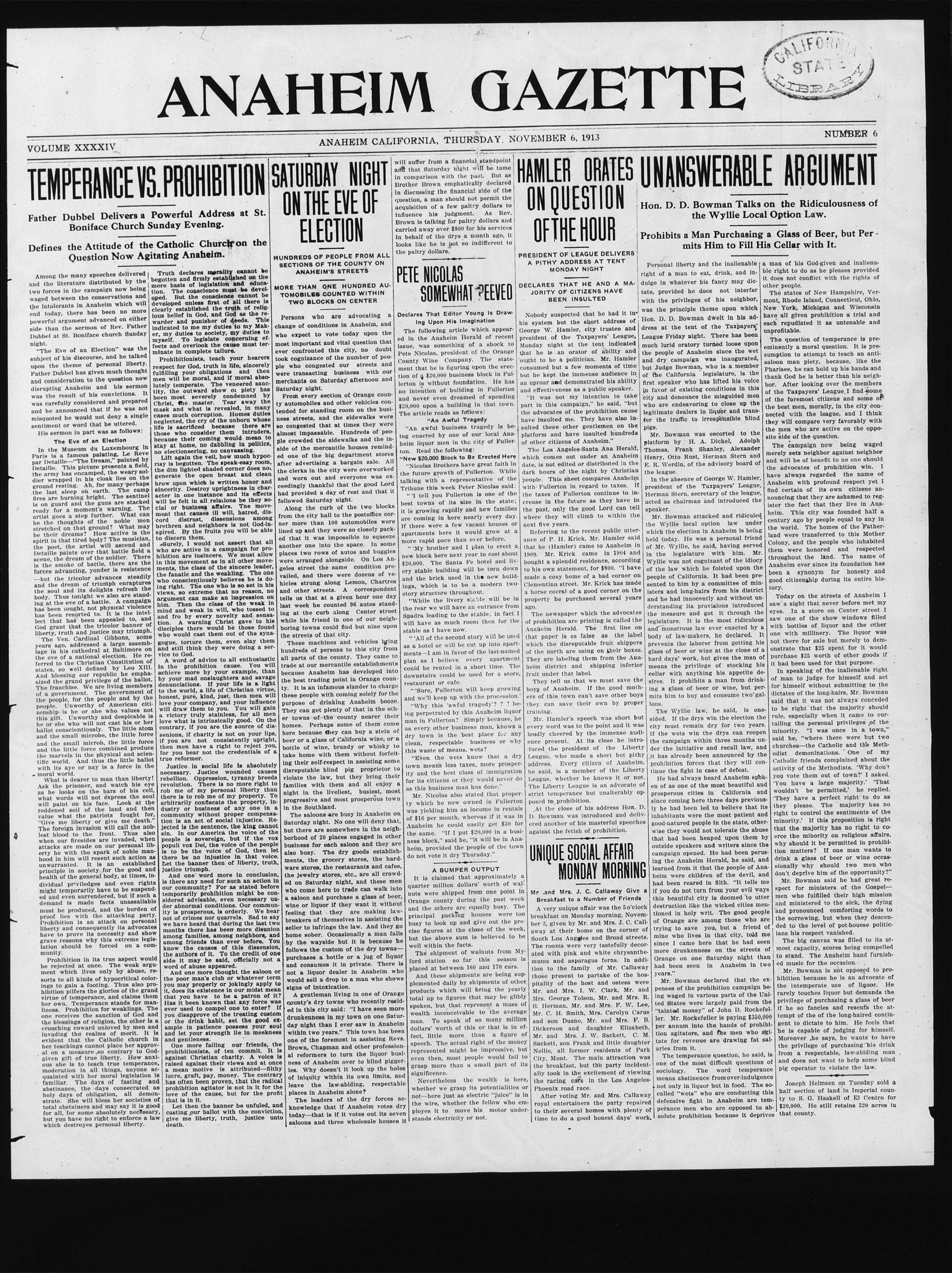
Searchable text
TEMPERANCE VS. PROHIBITION
Father Dubbel Delivers a Powerful Address at St. Boniface Church Sunday Evening.
Defines the Attitude of the Catholic Church on the Question Now Agitating Anaheim.
Among the many speeches delivered and the literature distributed by the two forces in the campaign now being waged between the conservations and the intolerants in Anaheim which will end today, there has been no more powerful argument advanced on either side than the sermon of Rev. Father Dubbel at St. Boniface church Sunday night.
"The Eve of an Election" was the subject of his discourse, and he talked upon the theme of personal liberty. Father Dubbel has given much thought and consideration to the question now disrupting Anaheim and his sermon was the result of his convictions. It was carefully considered and prepared and he announced that if he was not misquoted he would not deny a single sentiment or word that he uttered.
His sermon in part was as follows:
The Eve of an Election
In the Museum du Luxembourg in Paris is a famous painting, Le Reve par Detaille—"The Dream," painted by Detaille. This picture presents a field, the army has encamped, the weary solitary declares morality cannot be begotten and firmly established on the mere basis of legislation and education. The conscience must be developed. But the conscience cannot be developed unless first of all there is clearly established the truth of religious belief in God, and God as the rewarder and punisher of deeds. This indicated to me my duties to my Maker, my duties to society, my duties to myself. To legislate concerning effects and overlook the cause must terminate in complete tailure.
Prohibitionists, teach your hearers respect for God, truth in life, sincerely fulfilling your obligations and then men will be moral, and if moral absolutely temperate. The veneered sanctity, the outward show of piety has been most severely condemned by Christ, the master. Tear away the mask and what is revealed, in many cases much corruption. Homes duties neglected, the cry of the unborn whose life is sacrificed because there are those who consider them intruders, because their coming would mean to stay at home, no dabbling in politics, no electioneering, no canvassing.
Lift again the veil, how much hypocrisy is begotten. The speak-easy room, the dim lighted shaded corner does not enter the open breast and clean
and consideration to the question now disrupting Anaheim and his sermon was the result of his convictions. It was carefully considered and prepared and he announced that if he was not misquoted he would not deny a single sentiment or word that he uttered.
His sermon in part was as follows:
The Eve of an Election
In the Museum du Luxembourg in Paris is a famous painting, Le Reve par Detaille—"The Dream," painted by Detaille. This picture presents a field, the army has encamped, the weary soldier wrapped in his cloak lies on the ground resting. Ah, for many perhaps the last sleep on earth. The camp fires are burning bright. The sentinel is on guard and the guns are stacked ready for a moment's warning. The artist goes a step further. What can be the thoughts of the noble men stretched on that ground? What may be their dreams? How active is the spirit in that tired body? The musician, the poet, the artist will ascend and Detaille paints over that battle field a scene, the dream of the soldier. There is the smoke of battle, there are the forces advancing, yonder is resistance—but the tricolor advances steadily and the dream of triumph enraptures the soul and its delights refresh the body. Thus tonight we also are standing at the eve of a battle. A campaign has been fought, not physical violence has been resorted to. It is the intellect that has been appealed to, and God grant that the tricolor banner of liberty, truth and justice may triumph.
The Ven. Cardinal Gibbons, some years ago, addressed a large assemblage in his cathedral at Baltimore on the eve of a national election. He referred to the Christian Constitution of states, so well defined by Leo XIII. And blessing our republic he emphasized the grand privilege of the ballot. The franchise. We are living members of a government. The government of the people, for the people and by the people. Unworthy of American citizenship is he or she who values not this gift. Unworthy and despicable is he or she who will not cast his or her ballot conscientiously. The little atom and the small microbe, the little force and the small microb, the little force and the little force combined produce the marvels in the physical and scientific world. And thus the little ballot with its aye or nay is a force in the moral world.
What is dearer to man than liberty! Ask the prisoner, and watch his eye as he looks on the bars of his cell, what words will not express the soul will paint on his face. Look at the reddened soil of the land and then value what the patriots fought for, "Give me liberty or give me death." The foreign invasion will call the noblest blood to the front. Thus also when our firesides are invaded, when attacks are made on our personal liberty he with the spark of noble manhood in him will resent such action as unwarranted. It is an established principle in society for the good and health of the general body, at times, individual privileges and even rights might temporarily have to be suspended and even surrendered, but if such a
Lift again the veil, how much hypocrisy is begotten. The speak-easy room, the dim lighted shaded corner does not generate the open breast and clean brow upon which is written honor and sincerity. Destroy uprightness in character in one instance and its effects will be felt in all relations be they social or business affairs. The movement that causes ill will, hatred, discord distrust, dissensions among brethren and neighbors is not God-inspired. By the fruits you will be able to discern them.
Surely, I would not assert that all who are active in a campaign for prohibition are insincere. We must allow in this movement as in all other movements, the class of the sincere leader, the fanatic and the weakling. The one who conscientiously believes he is doing right. The one who is so set in his views, so extreme that no reason, no argument can make an impression on him. Then the class of the weak in mind and weak in will, who tossed to and fro by every novelty and sensation. A warning Christ gave to his disciples there would be those found who would cast them out of the synagogue, torture them, even slay them and still think they were doing a service to God.
A word of advice to all enthusiastic in the prohibition cause. You will achieve more by your example, than by your mad onslaughters and savage denunciations. If your life is a light to the world, a life of Christian virtue, honest, pure, kind, just, then men will love your company, and your influence will draw them to you. You will gain a victory truly stainless, for all men love what is intrinsically good. On the contrary, if you are the source of dissections, if charity is not on your lips, if you are not consistently upright, then men have a right to reject you, for you bear not the credentials of a true reformer.
Justice in social life is absolutely necessary. Justice wounded causes rebellion. Oppression, tyranny breeds revolution. There is no more right to rob me of my personal liberty than there is to rob me of my property. To arbitrarily confiscate the property, industry or business of any one in a community without proper compensation is an act of social injustice. Rejected is the sentence, the king cannot sin. In our America the voice of the people is sovereign, but if the vox populi vox Deli, the voice of the people is to be the voice of God, then let there be no injustice in that voice. Let the banner then of liberty, truth, justice triumph.
And one word more in conclusion, is there any need for such an action in our community? For as stated before temporarily prohibition might be considered advisable even necessary.
From every section of City automobiles and other vehicles for standing room or less streets, and the side so congested that at time almost impassable. Hundreds crowded the sidewalkside of the mercantile house one of the big departures after advertising a bargain;the clerks in the city were and worn out and everyone ceedingly thankful that they had provided a day of respite followed Saturday night.
Along the curb of these from the city hall to the park more than 100 autos lined up and they were so ed that it was impossible another one into the spacious places two rows of autos were arranged alongside. Angeles street the same ovailed, and there were no vehicles strung along Lemont and other streets. A tells us that at a given last week he counted 96 ing at the curb along while his friend in one boring towns could find them on the streets of that city.
These machines and hundreds of persons to all parts of the county trade at our mercantile store because Anaheim has done best trading point in city. It is an infamous slave these people with coming purpose of drinking Amber They can get plenty of their towns of the country homes. Perhaps some here because they can be beer or a glass of California bottle of wine, brandy take home with them waving their self-respect in disreputable blind piggs violate the law, but their families with them and night in the liveliest, progressive and most prudent in Southland.
The saloons are busy Saturday night. No one but there are somewhere borhood of 20 places en business for each saloon also busy. The dry goods, the grocery stores, the restaurant jewelry stores, etc., who come here to trade on Saturday night,
who come here to trade a saloon purchase
what words will not express the will paint on his face. Look at the reddened soil of the land and then value what the patriots fought for,
"Give me liberty or give me death."
The foreign invasion will call the noblest blood to the front. Thus also when our firesides are invaded, when attacks are made on our personal liberty he with the spark of noble manhood in him will resent such action as unwarranted. It is an established principle in society for the good and health of the general body, at times, individual privileges and even rights might temporarily have to be suspended and even surrendered, but if such a demand is made facts unassailable must be produced, and the burden of proof lies with the attacking party. Prohibition is an attack on personal liberty and consequently its advocates have to prove its necessity and show grave reasons why this extreme legislation should be forced on a community.
Prohibition in its true aspect would be rejected at once. The weak argument which lives only by abuse, resorts to all kinds of hypocritical colorings to gain a footing. Thus also prohibition pilfers the glories of the grand virtue of temperance, and claims them her own. Temperance stands for manliness. Prohibition for weaklings. The one receives the sanction of God and the blessings of religion, the other is a crouching coward unloved by men and invading the realms of merit. It is evident that the Catholic church in her teachings cannot place her approval on a measure so contrary to God-given gift of true liberty. How anxious she is to teach true temperance, moderation in all things, anyone acquainted with her moral legislation is familiar. The days of fasting and abstinence, the days consecrated as holy days of obligation, all demonstrate. She will bless her societies of total abstainers and may say it is good for all, for some absolutely necessary, but you have no right to enforce a law which destroyes personal liberty.
And one word more in conclusion, is there any need for such an action in our community? For as stated before temporarily prohibition might be considered advisable, even necessary under abnormal conditions. Our community is prosperous, is orderly. We hear not of crimes nor quarrels. Sad to say we have heard that during the last two months there has been more disunion among families, among neighbors, and among friends than ever before. You know the causes of this dissension, the authors of it. To the credit of one side it may be said, officially not a word of abuse appeared.
And one more thought the saloon or the poor man's club or whatever term you may properly or jokingly apply to it, does its existence in our midst mean that you have to be a patron of it? Has it been known that any force was ever used to compel one to enter? If you disapprove of the treating custom or the drink habit, set the good example in patience possess your soul and let your strength lie in meekness and gentleness.
One more failing our friends, the prohibitionists, of ten commit. It is against Christian charity. A voice is raised against their views and at once a mean motive is attributed—filthy lucre, graft, pay, money. The contrary has often been proven, that the radical prohibition agitator is not in it for the love of the cause, but for the profit that is in it.
Let then the banner be unfuled, and casting our ballot with the conviction, give me liberty, truth, justice unto death.
The saloons are busy Saturday night. No one but there are somewhere borhood of 20 places en business for each saloon also busy. The dry governments, the grocery stores, the restaurants the jewelry stores, etc., ed on Saturday night, who come here to trade a saloon and purchase wine or liquor if they feel that they are breakers of themselves seller to infringe the law home sober. Occasionally by the wayside but it follows the custom of purchases a bottle or and consumes it in prion not a liquor dealer in would sell a drop to a signs of intoxication.
A gentleman living in county's dry towns whied in this city said: "I drunkenness in my town day night than I ever within two years." This one of the foremost in Brown, Chapman and al reformers to turn ness of Anaheim over les. Why doesn't it lose of iniquity within its leave the law-abidien places in Anaheim alone.
The leaders of the knowledge that if An today—that is if it vows saloons and three whi
SATURDAY NIGHT ON THE EVE OF ELECTION
HUNDREDS OF PEOPLE FROM ALL SECTIONS OF THE COUNTY ON ANAHEIM'S STREETS
MORE THAN ONE HUNDRED AUTOMOBILES COUNTED WITHIN TWO BLOCKS ON CENTER
Persons who are advocating a change of conditions in Anaheim, and who expect to vote today upon the most important and vital question that ever confronted this city, no doubt took cognizance of the number of people who congested our streets and were transacting business with our merchants on Saturday afternoon and Saturday night.
From every section of Orange county automobiles and other vehicles extended for standing room on the business streets, and the sidewalks were so congested that at times they were almost impassable. Hundreds of people crowded the sidewalks and the inside of the mercantile houses reminded one of the big department stores after advertising a bargain sale. All the clerks in the city were overworked will suffer from a financial standpoint and that Saturday night will be tame in comparison with the past. But as Brother Brown emphatically declared in discussing the financial side of the question, a man should not permit the acquisition of a few paltry dollars to influence his judgment. As Rev. Brown is talking for paltry dollars and carried away over $800 for his services in behalf of the drys a month ago, it looks like he is not so indifferent to the paltry dollars.
PETE NICOLAS SOMEWHAT PEEVED
Declares That Editor Young Is Drawing Upon His Imagination
The following article which appeared in the Anaheim Herald of recent issue, was something of a shock to Pete Nicolas, president of the Orange County Wine Company. The statement that he is figuring upon the erection of $20,000 business block in Fullerton is without foundation. He has no intention of building in Fullerton and never even dreamed of spending $20,000 upon a building in that town. The article reads as follows:
"An Awful Tragedy
'An awful business tragedy is being enacted by one of our local Anaheim liquor men in the city of Fullerton. Read the following:
'New $20,000 Block to Be Erected Here'
'Nicolas Brothers have great faith in the future growth of Fullerton. While"
HAMLER ORATES ON QUESTION OF THE HOUR
PRESIDENT OF LEAGUE DELIVERS A PITHY ADDRESS AT TENT MONDAY NIGHT
DECLARES THAT HE AND A MAJORITY OF CITIZENS HAVE BEEN INSULTED
Nobody suspected that he had it in his system but the short address of George W. Hamler, city trustee and president of the Taxpayers’ League, Monday night at the tent indicated that he is an orator of ability and ought to be a politician. Mr. Hamler consumed but a few moments of time but he kept the immense audience in an uproar and demonstrated his ability and effectiveness as a public speaker.
"It was not my intention to take part in this campaign," he said, "but the advocates of the prohibition cause have insulted me. They have also insulted these other gentlemen on the platform and have insulted hundreds of other citizens of Anaheim."
The Los Angeles-Santa Ana Herald, which comes out under an Anaheim date, is not edited or distributed in the dark hours of the night by Christian
From every section of Orange county automobiles and other vehicles convened for standing room on the business streets, and the sidewalks were no congested that at times they were almost impassable. Hundreds of people crowded the sidewalks and the inside of the mercantile houses reminded one of the big department stores after advertising a bargain sale. All the clerks in the city were overworked and worn out and everyone was exceedingly thankful that the good Lord had provided a day of rest and that it followed Saturday night.
Along the curb of the two blocks from the city hall to the postoffice corner more than 100 automobiles were lined up and they were so closely packed that it was impossible to squeeze another one into the space. In some places two rows of autos and buggies were arranged alongside. On Los Angeles street the same condition prevailed, and there were dozens of vehicles strung along Lemon, Chartres and other streets. A correspondent tells us that at a given hour one day last week he counted 96 autos standing at the curb along Center street while his friend in one of our neighboring towns could find but nine upon the streets of that city.
These machines and vehicles bring hundreds of persons to this city from all parts of the county. They came to trade at our mercantile establishments because Anaheim has developed into the best trading point in Orange county. It is an infamous slander to charge these people with coming solely for the purpose of drinking Anaheim booze. They can get plenty of that in the other towns of the county nearer their homes. Perhaps some of them come here because they can buy a stein of beer or a glass of California wine, or a bottle of wine, brandy or whisky to take home with them without forfeiting their self-respect in assisting some disreputable blind pig proprietor to violate the law, but they bring their families with them and all enjoy a night in the liveliest, busiest, most progressive and most prosperous town in the Southland.
The saloons are busy in Anaheim on Saturday night. No one will deny that, but there are somewhere in the neighborhood of 20 places engaged in other business for each saloon and they are also busy. The dry goods establishments, the grocery stores, the hardware stores, the restaurants and cafes, the jewelry stores, etc., are all crowded on Saturday night, and these men who come here to trade can walk into a saloon and purchase a glass of beer,ionization of $20,000 business block in Fullerton is without foundation. He has no intention of building in Fullerton and never even dreamed of spending $20,000 upon a building in that town. The article reads as follows:
"An Awful Tragedy
An awful business tragedy is being enacted by one of our local Anaheim liquor men in the city of Fullerton. Read the following:
New $20,000 Block to Be Erected Here
Nicolas Brothers have great faith in the future growth of Fullerton. While talking with a representative of the Tribune this week Peter Nicolas said:
"I tell you Fullerton is one of the best towns of its size in the state; it is growing rapidly and new families are coming in here nearly every day. If there were a few vacant houses or apartments here it would grow at a more rapid pace than ever before.
'My brother and I plan to erect a new block here next year to cost about $20,000. The Santa Fe hotel and livery stable building will be torn down and the brick used in the new buildings, which is to be a modern two-story structure throughout.
While the livery stable will be in the rear we will have an entrance from Spadra leading to the stable; in fact I will have as much room then for the stable as I have now.
'All of the second story will be used as a hotel or will be cut up into apartments—I am in favor of the last-named plan as I believe every apartment could be rented in a short time. The downstairs could be used for a store, restaurant or cafe.
'Sure, Fullerton will keep growing and we'll keep up with the procession.'
Why this 'awful tragedy'? ? ? being perpetrated by this Anaheim liquor man in Fullerton? Simply because, he as every other business man, knows a dry town is the best place for any clean, respectable business or why this waste of means, wets?
Even the wets know that a dry town means less taxes, more prosperity and the best class of immigration for its citizens or they would never do as this business man has done."
Mr. Nicolas also stated that property which he now owned in Fullerton was yielding him an income in rentals of $16 per month, whereas if it was in Anaheim he could easily get $30 for the same. "If I put $20,000 in a business block," said he, "it will be in Anaheim, provided the people of the town do not vote it dry Thursday."
A BUMPER OUTPUT
It is claimed that approximately a quarter million dollars' worth of walnuts were shipped from one point in California during the past week but he kept the immense audience in an uproar and demonstrated his ability and effectiveness as a public speaker.
"It was not my intention to take part in this campaign," he said, "but the advocates of the prohibition cause have insulted me. They have also insulted these other gentlemen on the platform and have insulted hundreds of other citizens of Anaheim."
The Los Angeles-Santa Ana Herald, which comes out under an Anaheim date, is not edited or distributed in the dark hours of the night by Christian people. This sheet compares Anaheim with Fullerton in regard to taxes. If the taxes of Fullerton continue to increase in the future as they have in the past, only the good Lord can tell where they will climb to within the next five years.
Referring to the recent public utterance of P. H. Krick, Mr. Hamler said that he (Hamler) came to Anaheim in 1909. Mr. Krick came in 1904 and bought a splendid residence, according to his own statement, for $800. "I have made a cosy home of a bad corner on Clementina street. Mr. Krick has made a horse corral of a good corner on the property he purchased several years ago.
The newspaper which the advocates of prohibition are printing is called the Anaheim Herald. The first line on that paper is as false as the label which the disreputable fruit shippers of the north are using on their boxes. They are labelling them from the Anaheim district and shipping inferior fruit under that label.
They tell us that we must save the boys of Anaheim. If the good mothers of this town can't save other boys they can save their own by proper training.
Mr. Hamler's speech was short but every word was to the point and it was loudly cheered by the immense audience present. At its close he introduced the president of the Liberty League, who made a short but pithy address. Every citizen of Anaheim, he said, is a member of the Liberty League, whether he knows it or not. The Liberty League is an advocate of strict temperance but unalterably opposed to prohibition.
At the close of his address Hon. D. D. Bowman was introduced and delivered another of his masterful speeches against the fetish of prohibition.
UNIQUE SOCIAL AFFAIR MONDAY MORNING
Mr. and Mrs. J. C. Callaway Give a Breakfast to a Number of Friends
The saloons are busy in Anaheim on Saturday night. No one will deny that, but there are somewhere in the neighborhood of 20 places engaged in other business for each saloon and they are also busy. The dry goods establishments, the grocery stores, the hardware stores, the restaurants and cafes, the jewelry stores, etc., are all crowded on Saturday night, and these men who come here to trade can walk into a saloon and purchase a glass of beer, wine or liquor if they want it without feeling that they are making lawbreakers of themselves in assisting the seller to infringe the law. And they go home sober. Occasionally a man falls by the wayside but it is because he follows the custom of the dry towns—purchases a bottle or a jug of liquor and consumes it in private. There is not a liquor dealer in Anaheim who would sell a drop to a man who shows signs of intoxication.
A gentleman living in one of Orange county's dry towns who recently resided in this city said: "I have seen more drunkenness in my town on one Saturday night than I ever saw in Anaheim within two years." This town has been one of the foremost in assisting Revs. Brown, Chapman and other professional reformers to turn the liquor business of Anaheim over to blind piggeries. Why doesn't it look up the holes of iniquity within its own limits, and leave the law-abiding, respectable places in Anaheim alone?
The leaders of the dry forces acknowledge that if Anaheim votes dry today—that is if it votes out its seven saloons and three wholesale houses it which he now owned in Fullerton was yielding him an income in rentals of $16 per month, whereas if it was in Anaheim he could easily get $30 for the same. "If I put $20,000 in a business block," said he, "it will be in Anaheim, provided the people of the town do not vote it dry Thursday."
A BUMPER OUTPUT
It is claimed that approximately a quarter million dollars' worth of walnuts were shipped from one point in Orange county during the past week and the others are equally busy. The principal packing houses were too busy to look up and give out the precise figures at the close of the week, but the above sum is believed to be well within the facts.
The shipment of walnuts from Myford station so far this season is placed at between 160 and 170 cars.
And these shipments are being supplemented daily by shipments of other products which will bring the yearly total up to figures that may be glibly spoken, but that represent a mass of wealth inconceivable to the average man. To speak of so many million dollars' worth of this or that is in effect, little more than a figure of speech. The actual right of the money represented might be impressive, but even then, most people would fail to grasp more than a small part of its significence.
Nevertheless the wealth is here, whether we grasp its potentialities or not—here just as electric "juice" is in the wire, whether the fellow who employs it to move his motor understands electricity or not.
Mr. and Mrs. J. C. Callaway Give a Breakfast to a Number of Friends
A very unique affair was the 50'clock breakfast on Monday morning, November 3, given by Mr. and Mrs. J. C. Callaway at their home on the corner of South Los Angeles and Broad streets. The rooms were very tastefully decorated with pink and white chrysanthemums and asparagus ferns. In addition to the family of Mr. Callaway those present to partake of the hospitality of the host and ostess were Mr. and Mrs. I. W. Clark, Mr. and Mrs. George Tolson, Mr. and Mrs. R. B. Herman, Mr. and Mrs. F. W. Lee, Mr. C. H. Smith, Mrs. Carolyn Carus and son Duane, Mr. and Mrs. F. B. Dickerson and daughter Elizabeth, Mr. and Mrs. J. W. Sackett, C. M. Sackett, son Frank and little daughter Nellie, all former residents of Park City, Mont. The main attraction was the breakfast, but the party incidentally took in the excitement of viewing the racing cars in the Los Angeles-Phoenix road race.
After voting Mr. and Mrs. Callaway royal entertainers the party repaired to their several homes with plenty of time to do a good honest days' work...
UNANSWERABLE ARGUMENT
Hon. D. D. Bowman Talks on the Ridiculousness of the Wyllie Local Option Law.
Prohibits a Man Purchasing a Glass of Beer, but Permits Him to Fill His Cellar with It.
Personal liberty and the inalienable right of a man to eat, drink, and indulge in whatever his fancy may dictate, provided he does not interfere with the privileges of his neighbor, was the principle theme upon which Hon. D. D. Bowman dwelt in his address at the tent of the Taxpayers' League Friday night. There has been much lurid oratory turned loose upon the people of Anaheim since the wet and dry campaign was inaugurated, but Judge Bowman, who is a member of the California legislature, is the first speaker who has lifted his voice in favor of existing conditions in this city and denounce the misguided men who are endeavoring to close up the legitimate dealers in liquor and transfer the traffic to irresponsible blind pigs.
Mr. Bowman was escorted to the platform by H. A. Dickel, Adolph Thomas, Frank Shanley, Alexander Henry, Otto Rust, Herman Stern and E. R. Werdin, of the advisory board of the league.
a man of his God-given and inalienable right to do as he pleases provided it does not conflict with the rights of other people.
The states of New Hampshire, Vermont, Rhode Island, Connecticut, Ohio, New York, Michigan and Wisconsin have all given prohibition a trial and each repudiated it as untenable and unprofitable.
The question of temperance is preeminently a moral question. It is presumption to attempt to teach an anti-saloon man piety, because, like the Pharisee, he can hold up his hands and thank God he is better than his neighbor. After looking over the members of the Taxpayers' League, I find some of the foremost citizens and some of the best men, morally, in the city connected with the league, and I think they will compare very favorably with the men who are active on the opposite side of the question.
The campaign now being waged merely sets neighbor against neighbor and will be of benefit to no one should the advocates of prohibition win. I have always regarded the name of
Ana Ana Herald,
an Anaheim
distributed in the
city by Christian
Shares Anaheim
to taxes. If
continue to invent they have inthe Lord can tell
to within the
At public utterr. Hamler said
to Anaheim in
1904 and
influence, according
to $800. "I have
bad corner on
Krick has made
corner on the
several years
In the advocates
king is called the
first line on
as the label
fruit shippers
on their boxes.
from the Anazipping inferior
Must save the
good moth-save other boys
down by proper
It was short but
point and it was
immense audiclose he introdied of the Liberty
short but pithy
men of Anaheim,
of the Liberty
knows it or not.
An advocate of
unalterably op-
Address Hon. D.
roduced and deliverable speeches
prohibition.
AL AFFAIR
BY MORNING
Callaway Give a
father of Friends
of the California legislature, is the first speaker who has lifted his voice in favor of existing conditions in this city and denounce the misguided men who are endeavoring to close up the legitimate dealers in liquor and transfer the traffic to irresponsible blind pigs.
Mr. Bowman was escorted to the platform by H. A. Dickel, Adolph Thomas, Frank Shanley, Alexander Henry, Otto Rust, Herman Stern and E. R. Werdin, of the advisory board of the league.
In the absence of George W. Hamler, president of the Taxpayers' League, Herman Stern, secretary of the league, acted as chairman and introduced the speaker.
Mr. Bowman attacked and ridiculed the Wyllie local option law under which the election in Anaheim is being held today. He was a personal friend of Mr. Wyllie, he said, having served in the legislature with him. Mr. Wyllie was not cognizant of the idiocy of the law which he foisted upon the people of California. It had been presented to him by a committee of ministers and long-hairs from his district and he had innocently and without understanding its provisions introduced the measure and got it through the legislature. It is the most ridiculous and monstrous law ever enacted by a body of law-makers, he declared. It prevents the laborer from getting his glass of beer or wine at the close of a hard days' work, but gives the man of means the privilege of stocking his cellar with anything his appetite desires. It prohibits a man from drinking a glass of beer or wine, but permits him to buy and consume two gallons.
The Wyllie law, he said, is one-sided. If the drys win the election the city must remain dry for two years. If the wets win the drys can reopen the campaign within three months under the initiative and recall law, and it has already been announced by the prohibition forces that they will continue the fight in case of defeat.
He had always heard Anaheim spoken of as one of the most beautiful and prosperous cities in California and since coming here three days previously he had been led to believe that its inhabitants were the most patient and good-natured people in the state, otherwise they would not tolerate the abuse that had been heaped upon them by outside speakers and writers since the campaign opened. He had been perusing the Anaheim Herald, he said, and learned from it that the people of Anaheim were children of the devil, and had been reared in filth. "It tells me if you do not turn from your evil ways this beautiful city is doomed to utter thank God he is better than his neighbor. After looking over the members of the Taxpayers' League I find some of the foremost citizens and some of the best men, morally, in the city connected with the league, and I think they will compare very favorably with the men who are active on the opposite side of the question.
The campaign now being waged merely sets neighbor against neighbor and will be of benefit to no one should the advocates of prohibition win. I have always regarded the name of Anaheim with profound respect yet I find certain of its own citizens announcing that they are ashamed to register the fact that they live in Anaheim. This city was founded half a century ago by people equal to any in the world. The homes of the Fatherland were transferred to this Mother Colony, and the people who inhabited them were honored and respected throughout the land. The name of Anaheim ever since its foundation has been a synonym for honesty and good citizenship during its entire history.
Today on the streets of Anaheim I saw a sight that never before met my eyes. In a store on Center street I saw one of the show windows filled with bottles of liquor and the other one with millinery. The liquor was not there for sale but merely to demonstrate that $25 spent for it would purchase $25 worth of other goods if it had been used for that purpose.
In speaking of the inalienable right of man to judge for himself and act for himself without submitting to the dictates of the long-hairs, Mr. Bowman said that it was not always conceded to be right that the majority should rule, especially when it came to curtailing the personal privileges of the minority. "I was once in a town," said he, "where there were but two churches—the Catholic and the Methodist demonstrations." One of my Catholic friends complained about the activity of the Methodists. 'Why don't you vote them out of town?' I asked. 'You have a large majority.' 'That wouldn't be permitted,' he replied. 'They have a perfect right to do as they please. The majority has no right to control the sentiments of the minority.' If this proposition is right that the majority has no right to coerce the minority on religious affairs, why should it be permitted in prohibition matters? If one man wants to drink a glass of beer or wine occasionally why should two men who don't deprive him of the opportunity?'
Mr. Bowman said he had great respect for ministers of the Gospel—men who fulfilled their high mission
since coming here three days previously he had been led to believe that its inhabitants were the most patient and good-natured people in the state, otherwise they would not tolerate the abuse that had been heaped upon them by outside speakers and writers since the campaign opened. He had been perusing the Anaheim Herald, he said, and learned from it that the people of Anaheim were children of the devil, and had been reared in filth. "It tells me if you do not turn from your evil ways this beautiful city is doomed to utter destruction like the wicked cities mentioned in holy writ. The good people of Orange are among those who are trying to save you, but a friend of mine who lives in that city, told me since I came here that he had seen more drunkenness on the streets of Orange on one Saturday night than had been seen in Anaheim in two years."
Mr. Bowman declared that the expenses of the prohibition campaign being waged in various parts of the United States were largely paid from the "tainted money" of John D. Rockefeller. Mr. Rockefeller is paying $350,000 per annum into the hands of prohibition agitators, and the men who agitate for revenue are drawing fat salaries from it.
The temperance question, he said, is one of the most difficult questions of sociology. The word temperance means abstinence from over-indulgence not only in liquor but in food. The so-called "wets" who are conducting this defensive fight in Anaheim are temperance men who are opposed to absolute prohibition because it deprives
They have a perfect right to do as they please. The majority has no right to control the sentiments of the minority.' If this proposition is right that the majority has no right to coerce the minority on religious affairs, why should it be permitted in prohibition matters? If one man wants to drink a glass of beer or wine occasionally why should two men who don't deprive him of the opportunity?"
Mr. Bowman said he had great respect for ministers of the Gospel—men who fulfilled their high mission and ministered to the sick, the dying and pronounced comforting words to the sorrowing, but when they descended to the level of pot-houese politicians his respect vanished.
The big canvas was filled to its utmost capacity, scores being compelled to stand. The Anaheim band furnished music for the occasion.
Mr. Bowman is not opposed to prohibition because he is an advocate of the intemperate use of liquor. He rarely touches liquor but demands the privilege of purchasing a glass of beer if he so fancies and resents the attempt of the of the long-haired contingent to dictate to him. He feels that he is capable of judging for himself. Moreover, he says, he wants to have the privilege of purchasing his drink from a respectable, law-abiding man and does not want to help some blind pig operator to violate the law.
Joseph Helmsen on Tuesday sold a half section of land in Imperial county to S. G. Haskell of El Centro for $20,000. He still retains 320 acres in that county.