anaheim-gazette 1913-10-16
Scanned page
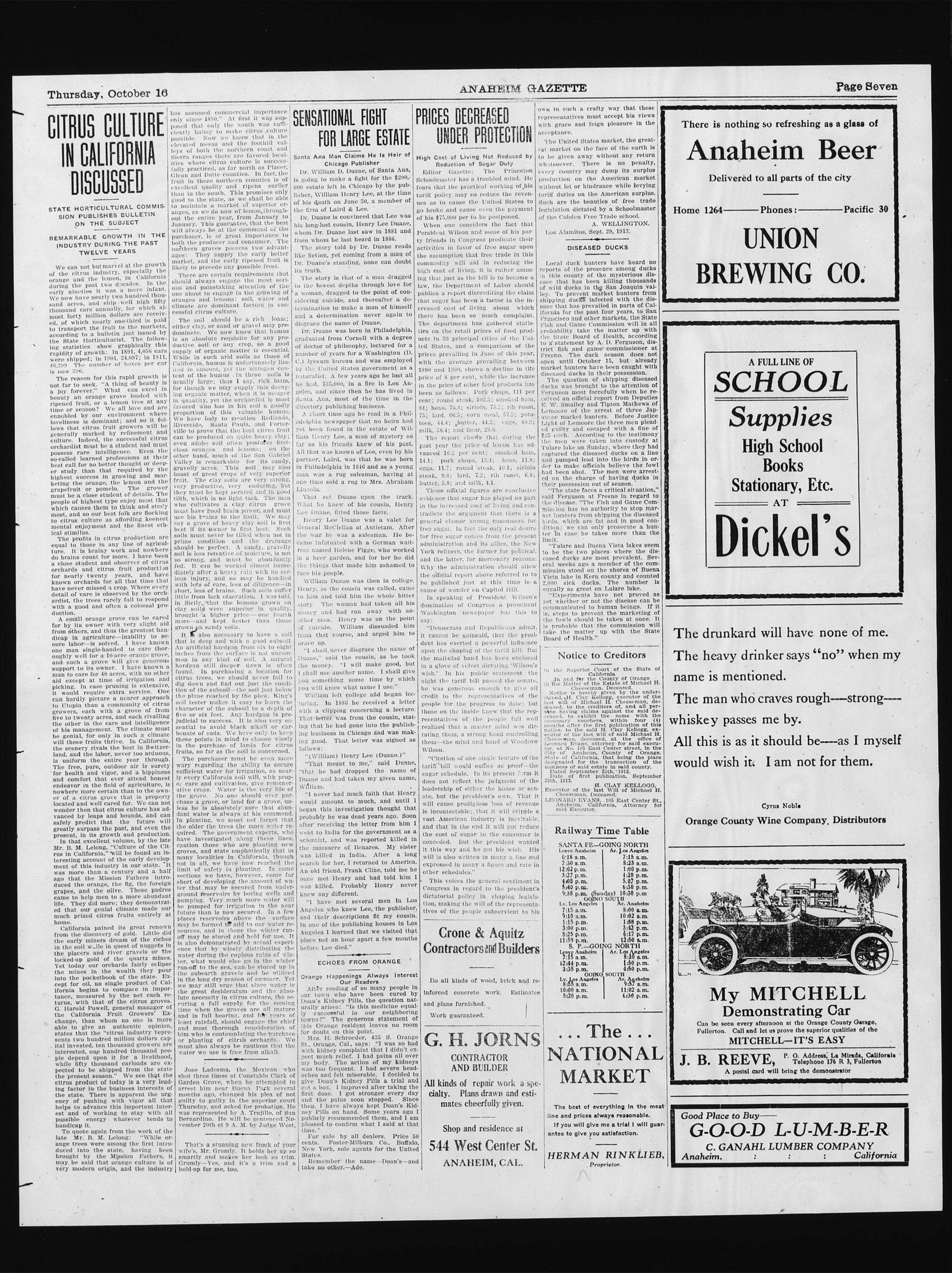
Searchable text
CITRUS CULTURE IN CALIFORNIA DISCUSSED
STATE HORTICULTURAL COMMISSION PUBLISHES BULLETIN ON THE SUBJECT
REMARKABLE GROWTH IN THE INDUSTRY DURING THE PAST TWELVE YEARS
We can not but marvel at the growth of the citrus industry, especially the orange and the lemon, in California during the past two decades. In the early nineties it was a mere infant. We now have nearly two hundred thousand acres, and ship well nigh fifty thousand cars annually, for which almost forty million dollars are received, of which nearly one-third is paid to transport the fruit to the markets, according to a bulletin just issued by the State Horticulturist. The following statistics show graphically this rapidity of growth: In 1891, 4,056 cars were shipped; in 1901, 24,097; in 1911, 46,399. The number of boxes per car is now 396.
The reason for this rapid growth is not far to seek. "A thing of beauty is a joy forever." What can excel in beauty an orange grove loaded with ripened fruit, or a lemon tree at any time or season? We all love and are ennobled by our environment where loveliness is dominant; and so it follows that citrus fruit growers will be generally marked by refinement and culture. Indeed, the successful citrus orchardist must be a student and must possess rare intelligence. Even the so-called learned professions at their best call for no better thought or deeper study than that required by the has assumed commercial importance only since 1880." At first it was supposed that only the south was sufficiently balmy to make citrus culture possible. Now we know that in the elevated mesas and the foothill valleys of both the northern coast and Sierra ranges there are favored localities where citrus culture is successfully practiced, as far north as Placer, Glenn and Butte counties. In fact, the fruit in these northern counties is of excellent quality and ripens earlier than in the south. This promises only good to the state, as we shall be able to maintain a market of superior oranges, as we do now of lemon throughout the entire year, from January to January. This guarantee, that the best will always be at the command of the purchaser, is of great importance to both the producer and consumer. The northern groves possess two advantages: They supply the early better market, and the early ripened fruit is likely to precede any possible frost.
There are certain requirements that should always engage the most serious and painstaking attention of the one about to engage in the growing of oranges and lemons: soil, water and climate are dominant factors in successful citrus culture.
The soil should be a rich loam; either clay, or sand or gravel may predominate. We now know that humus is an absolute requisite for any productive soil or any crop, so a good supply of organic matter is essential. While in such arid soils as those of California, humus is unfortunately limited in amount, yet the nitrogen content of the humus in these soils is usually large; thus I say, rich loam, for though we may supply this decaying organic matter, when it is meager in quantity, yet the orchardist is most favored who has in his soil a goodly proportion of this valuable humus. We have only to mention Redlands, Riverside, Santa Paula, and Forterville to prove that the best citrus fruit can be produced on quite heavy clay; even adobe soil often produces first-class oranges and lemons; on the other hand, much of the San Gabriel Valley is remarkable for its sandy, gravelly acres. This soil may also boast of great crops of very superior...
The reason for this rapid growth is not far to seek. "A thing of beauty is a joy forever." What can excel in beauty an orange grove loaded with ripened fruit, or a lemon tree at any time or season? We all love and are ennobled by our environment where loveliness is dominant; and so it follows that citrus fruit growers will be generally marked by refinement and culture. Indeed, the successful citrus orchardist must be a student and must possess rare intelligence. Even the so-called learned professions at their best call for no better thought or deeper study than that required by the highest success in growing and marketing the orange, the lemon and the grapefruit or pomelo. The grower must be a close student of details. The people of highest type enjoy most that which causes them to think and study most, and so our best folk are flocking to citrus culture as affording keenest mental enjoyment and the finest ethical stimulus.
The profits in citrus production are equal to those in any line of agriculture. It is brainy work and nowhere do brains count for more. I have been a close student and observer of citrus orchards and citrus fruit production for nearly twenty years, and have known orchards for all that time that have never missed a crop. Where every detail of care is observed by the orchardist, the trees rarely fail to respond with a good and often a colossal production.
A small orange grove can be cared for by its owner with very slight aid from others, and thus the greatest handicap in agriculture—inability to secure labor—is solved. I have known one man single-handed to care thoroughly well for a 10-acre orange grove, and such a grove will give generous support to its owner. I have known a man to care for 40 acres, with no other aid except at time of irrigation and picking. In case pruning is extensive, it would require extra service. One can hardly picture a nearer approach to Utopia than a community of citrus growers, each with a grove of five to twenty acres, and each rivalling the other in the care and intelligence of his management. The climate must be genial, for only in such a climate will these fruits thrive. In California, the scenery rivals the best in Switzerland, and the labor, never too arduous, is uniform the entire year through.
The free, pure, outdoor air is surety for health and vigor, and a hippiness and comfort that ever attend honest endeavor in the field of agriculture, is nowhere more certain than to the owner of a citrus grove that is properly located and well cared for. We can not wonder then that citrus culture has advanced by leaps and bounds, and can safely predict that the future will greatly surpass the past, and even the present, in its growth and production.
In that excellent volume, by the late Mr. B. M. Lelong, "Culture of the Citrus in California," will be found an interesting account of the early development of this industry in our state. It was more than a century and a half ago that the Mission Fathers introduced the orange, the fig, the foreign grapes, and the olive. These padres came to help men to a more abundant tent of the humus. In these soils is usually large; thus I say, rich loam, for though we may supply this decaying organic matter, when it is meager in quantity, yet the orchardist is most favored who has in his soil a goodly proportion of this valuable humus. We have only to mention Redlands, Riverside, Santa Paula, and Porterville to prove that the best citrus fruit can be produced on quite heavy clay; even adobe soil often produces first-class oranges and lemons; on the other hand, much of the San Gabriel Valley is remarkable for its sandy, gravelly acres. This soil may also boast of great crops of very superior fruit. The clay soils are very strong, very productive, very enduring, but they must be kept aerated and in good tilth, which is no light task. The man who cultivates a clay citrus grove must have good brain power, and must use his brains to the limit. We may say a grove of heavy clay soil is first best if its owner is first best. Such soils must never be tilled when not in prime condition and the drainage should be perfect. A sandy, gravelly soil is less retentive of moisture, is not so strong, and must be abundantly fed. It can be worked almost immediately after a heavy rain with no serious injury, and so may be handled with less of care, less of diligence—in short, less of brains. Such soils suffer little from lack of aeration. I was told, in Sicily, that the lemons grown on clay soils were superior in quality, brought a higher price—one fourth more—and kept better than those grown on sandy soils.
It is also necessary to have a soil that is deep and with a good subsoil. An artificial hardpan from six to eight inches from the surface is not uncommon in any kind of soil. A natural hardpan still deeper down is often found. In purchasing a location for citrus trees, we should never fail to dig down and find out just the condition of the subsoil—the soil just below the plane reached by the plow. King's soil tester makes it easy to learn the character of the subsoil to a depth of five or six feet. Any hardpan is prejudicial to success. It is also very essential to avoid black alkali or carbonate of soda. We have only to keep these points in mind to choose wisely in the purchase of lands for citrus fruits, so far as the soil is concerned.
The purchaser must be even more wary regarding the ability to secure sufficient water for irrigation, as nearly every California soil will, with proper care and cultivation, give remunerative crops. Water is the very life of the grove. No one should ever purchase a grove, or land for a grove, unless he is absolutely sure that abundant water is always at his command. In planting, we must not forget that the older the trees the more water required. The government experts, who have investigated along these lines, caution those who are planting new groves, and state emphatically that in many localities in California, though not in all, we have now reached the limit of safety in planting. In some sections we have, however, come far short of developing the amount of water that may be secured from underground reservoirs by boring wells and pumping.
Very much more water will tent of the humus. In these soils is usually large; thus I say, rich loam, for though we may supply this decaying organic matter, when it is meager in quantity, yet the orchardist is most favored who has in his soil a goodly proportion of this valuable humus. We have only to mention Redlands, Riverside, Santa Paula, and Porterville to prove that the best citrus fruit can be produced on quite heavy clay; even adobe soil often produces first-class oranges and lemons; on the other hand, much of the San Gabriel Valley is remarkable for its sandy, gravelly acres. This soil may also boast of great crops of very superior fruit. The clay soils are very strong, very productive, very enduring, but they must be kept aerated and in good tilth, which is no light task. The man who cultivates a clay citrus grove must have good brain power, and must use his brains to the limit. We may say a grove of heavy clay soil is first best if its owner is first best. Such soils suffer little from lack of aeration. I was told, in Sicily, that the lemons grown on clay soils were superior in quality, brought a higher price—one fourth more—and kept better than those grown on sandy soils.
It is also necessary to have a soil that is deep and with a good subsoil. An artificial hardpan from six to eight inches from the surface is not uncommon in any kind of soil. A natural hardpan still deeper down is often found. In purchasing a location for citrus trees, we should never fail to dig down and find out just the condition of the subsoil—the soil just below the plane reached by the plow. King's soil tester makes it easy to learn the character of the subsoil to a depth of five or six feet. Any hardpan is prejudicial to success. It is also very essential to avoid black alkali or carbonate of soda. We have only to keep these points in mind to choose wisely in the purchase of lands for citrus fruits, so far as the soil is concerned.
The purchaser must be even more wary regarding the ability to secure sufficient water for irrigation, as nearly every California soil will, with proper care and cultivation, give remunerative crops. Water is the very life of the grove. No one should ever purchase a grove, or land for a grove, unless he is absolutely sure that abundant water is always at his command. In planting, we must not forget that the older the trees the more water required. The government experts, who have investigated along these lines, caution those who are planting new groves, and state emphatically that in many localities in California, though not in all, we have now reached the limit of safety in planting. In some sections we have, however, come far short of developing the amount of water that may be secured from underground reservoirs by boring wells and pumping.
Very much more water will tent of the humus. In these soils is usually large; thus I say, rich loam, for though we may supply this decaying organic matter when it is meager in quantity, yet the orchardist is most favored who has in his soil a goodly proportion of this valuable humus. We have only to mention Redlands, Riverside, Santa Paula, and Porterville to prove that the best citrus fruit can be produced on quite heavy clay; even adobe soil often produces first-class oranges and lemons; on the other hand, much of the San Gabriel Valley is remarkable for its sandy, gravelly acres. This soil may also boast of great crops of very superior fruit. The clay soils are very strong, very productive, very enduring, but they must be kept aerated and in good tilth, which is no light task. The man who cultivates a clay citrus grove must have good brain power, and must use his brains to the limit. We may say a grove of heavy clay soil is first best if its owner is first best. Such soils suffer little from lack of aeration. I was told, in Sicily, that the lemons grown on clay soils were superior in quality, brought a higher price—one fourth more—and kept better than those grown on sandy soils.
It is also necessary to have a soil that is deep and with a good subsoil. An artificial hardpan from six to eight inches from the surface is not uncommon in any kind of soil. A natural hardpan still deeper down is often found. In purchasing a location for citrus trees, we should never fail to dig down and find out just the condition of the subsoil—the soil just below the plane reached by the plow. King's soil tester makes it easy to learn the character of the subsoil to a depth of five or six feet. Any hardpan is prejudicial to success. It is also very essential to avoid black alkali or carbonate of soda. We have only to keep these points in mind to choose wisely in the purchase of lands for citrus fruits,so far as the soil is concerned.
The purchaser must be even more wary regarding the ability to secure sufficient water for irrigation,as nearly every California soil will,with proper care and cultivation,give remunerative crops.Water is the very life of the grove.No one should ever purchase a grove,or land for a grove,unless he is absolutely sure that abundant water is always at his command.In planting,we must not forget that the older the treesthe more water required.The government experts,who have investigated along these lines,caution those who are planting new groves,and state emphaticallythatin many localitiesinCaliforniathoughnotinallwehavenowreachedthelimitofsafetyinplanting.Insomesectionswehavehowever.comfarshortoftdevelopingtheamountofwaterthatmaybesecuredfromundergroundreservoirsbyboringwellsandpumping.Verymuchmorewaterwilltentofthehumus.inthesesoilsisusuallylarge;thusI say,richloam,forshouldatesthebestcitrusfruitcanbeproducedonquiteheavyclay;evenadobesoiloffarmpowermusthavegoodbraintower,andmustusehisbrainstofthelimit.ofsafetyinplanting.Insomesectionswehavehowever.comfarshortoftdevelopingtheamountofwaterthatmaybesecuredfromundergroundreservoirsbyboringwellsandpumping.Verymuchmorewaterwilltentofthehumus.inthesesoilsisusuallylarge;thusI say,richloam,forshouldatesthebestcitrusfruitcanbeproducedonquiteheavyclay;evenadobesoiloffarmpowermusthavegoodbraintower,andmustusehisbrainstofthelimit.ofsafetyinplanting.Insomesectionswehavehowever.comfar短oftdevelopingtheamountofwaterthatmaybesecuredfromundergroundreservoirsbyboringwellsandpumping.Verymuchmorewaterwilltentofthehumus.inthesesoilsisusuallylarge;thusI say,richloam,forshouldatesthebestcitrusfruitcanbeproducedonquiteheavyclay;evenadobesoiloffarmpowermusthavegoodbraintower,andmustusehisbrainstofthelimit.ofsafetyinplanting.Insomesectionswehavehowever.comfar短 oftdevelopingtheamountofwaterthatmaybeSECUREOFTHECITRUSINCALIFORNIA.”
"What he knew of Duane," said he "the money." "I wish I shall use another person named Helene in a beer garden,andthe things that man face his people."
"William Duane was Henry,as he cousinto him and told his story.The woman money had going business in Chicago good." That lee Lincoln.
"That meant too," said he "the money." "I wish I shall use another person named Helene in a beer garden,andthe things that man face his people."
"William Duane was Henry,as he cousinto him和 told his story.The woman money had going business in Chicagoland good." That lee Lincoln.
"That meant too," said he "the money." "I wish I shall use another person named Helene in a beer garden,andthe things that man face his people."
"William Duane was Henry,as he cousinto him和 told his story.The woman money had going business in Chicagoland good." That lee Lincoln.
"That meant too," said he "the money." "I wish I shall use another person named Helene in a beer garden,andthe things that man face his people."
"William Duane was Henry,as he cousinto him和 told his story.The woman money had going business in Chicagoland good." That lee Lincoln.
"That meant too," said he "the money." "I wish I shall use another person named Helene in a beer garden,andthe things that man face his people."
"William Duane was Henry,as he cousinto him和 told his story.The woman money had going business in Chicagoland good." That lee Lincoln.
"That meant too," said he "the money." "I wish I shall use another person named Helene in a beer garden,andthe things that man face his people."
"William Duane was Henry,as he cousinto him和 told his story.The woman money had going business in Chicagoland good." That lee Lincoln.
"That meant too," said he "the money." "I wish I shall use another person named Helene in a beer garden,andthe things that man face his people."
"William Duane was Henry,as he cousinto him和 told his story.The woman money had going business in Chicagoland good." That lee Lincoln.
"That meant too," said he "the money." "I wish I shall use another person named Helene in a beer garden,andthe things that man face his people."
"William Duane was Henry,as he cousinto him和 told his story.The woman money had going business in Chicagoland good." That lee Lincoln.
"That meant too," said he "the money." "I wish I shall use another person named Helene in a beer garden,andthe things that man face his people."
"William Duane was Henry,as he cousinto him和 told his story.The woman money had going business in Chicagoland good." That lee Lincoln.
"That meant too," said he "the money." "I wish I shall use another person named Helene in a beer garden,andthe things that man face his people."
"William Duane was Henry,as he cousinto him和 told his story.The woman money had going business in Chicagoland good." That lee Lincoln.
"That meant too," said he "the money." "I wish I shall use another person named Helene in a beer garden,andthe things that man face his people."
"William Duane was Henry,as he cousinto him和 told his story.The woman money had going business in Chicagoland good." That lee Lincoln.
"That meant too," said he "the money." "I wish I shall use another person named Helene in a beer garden,andthe things that man face his people."
"William Duane was Henry,as he cousinto him和 told his story.The woman money had going business in Chicagoland good." That lee Lincoln.
"That meant too," said he "the money." "I wish I shall use another person named Helene in a beer garden,andthe things that man face his people."
"William Duane was Henry,as he cousinto him和 told his story.The woman money had going business in Chicagoland good." That lee Lincoln.
"That meant too," said he "the money." "I wish I shall use another person named Helene in a beer garden,andthe things that man face his people."
"William Duane was Henry,as he cousinto him和 told his story.The woman money had going business in Chicagoland good." That lee Lincoln.
"That meant too," said he "the money." "I wish I shall use another person named Helene in a beer garden,andthe things that man face his people."
"William Duane was Henry,as he cousinto him和 told his story.The woman money had going business in Chicagoland good." That lee Lincoln.
"That means'to," said he "the money." "I wish I shall use another person named Helene in a beer garden,andthe things that man face his people."
"William Duane was Henry,as he cousinto him和 told his story.The woman money had going business in Chicagoland good." That lee Lincoln.
"That means'to," said he "the money." "I wish I shall use another person named Helene in a beer garden,andthe things that man face his people."
"William Duane was Henry,as he cousinto him和 told his story.The woman money had going business in Chicagoland good." That lee Lincoln.
"That means'to," said he "the money." "I wish I shall use another person named Helene in a beer garden,andthe things that man face his people."
"William Duane was Henry,as he cousinto him和 told his story.The woman money had going business in Chicagoland good." That lee Lincoln.
"That means'to," said he "the money." "I wish I shall use another person named Helene in a beer garden,andthe things that man face his people."
"William Duane was Henry,as he cousinto him和 told his story.The woman money had going business in Chicagoland good." That lee Lincoln.
"That means'to," said he "the money." "I wish I shall use another person named Helene in a beer garden,andthe things that man face his people."
"William Duane was Henry,as he cousinto him和 told his story.The woman money had going business in Chicagoland good." That lee Lincoln.
"That means'to," said he "the money." "I wish I shall use another person named Helene in a beer garden,andthe things that man face his people."
"William Duane was Henry,as he cousinto him和 told his story.The woman money had going business in Chicagoland good." That lee Lincoln.
"That means'to," said he "the money." "I wish I shall use another person named Helene in a beer garden,andthe things that man face his people."
"William Duane was Henry,as he cousinto him和 told his story.The woman money had going business in Chicagoland good." That lee Lincoln.
"That means'to," said he "the money." "I wish I shall use another person named Helene in a beer garden,andthe things that man face his people."
"William Duane was Henry,as he cousinto him和 told his story.The woman money had going business in Chicagoland good." That lee Lincoln.
"That means'to," said he "the money." "I wish I shall use another person named Helene在a啤酒花园中。" That lee Lincoln.
"The short time agoaddudeDuane," said she"The short time agoaddudeDuane," said she"The short time agoaddudeDuane," said she"The short time agoaddudeDuane," said she"The short time agoaddudeDuane," said she"The short time agoaddudeDuane," said she"The short time agoaddudeDuane," said she"The short time agoaddudeDuane," said she"The short time agoaddudeDuane," said she"The short time agoaddudeDuane," said she"The short time agoaddudeDuane," said she"The short time agoaddudeDuane," said she"The short time agoaddudeDuane," said she"The short time agoaddudeDuane," said she"The short time agoaddudeDuane," said she"The short time agoaddudeDuane," said she"The short time agoaddudeDuane," said she"The short time agoaddudeDuane," said she"The short time agoaddudeDuane," said she"The short time agoaddudeDuane," said she"The short time agoaddudeDuane," said she"The short time agoaddudeDuane," said she"The short time agoaddudeDuane," said she"The short time agoaddudeDuane," said she"The short timeagoaddudeDuane,"说she"The short timeagoaddudeDuane,"说she"The short timeagoaddudeDuane,"说she"The short timeagoaddudeDuane,"说she"The short timeagoaddudeDuane,"说she"The short timeagoaddudeDuane,"说she"The short timeagoaddudeDuane,"说she"The short timeagoaddudeDuane,"说she"The short timeagoaddudeDuane,"说she"The shorttimeagoaddudeDuane","说she"The shorttimeagoaddudeDuane","说she"The shorttimeagoaddudeDuane","说she"The shorttimeagoaddudeDuane","说she>The shorttimeagoaddudeDuane","说she>The shorttimeagoaddudeDuane","说she>The短时间agoaddudeDuane","说she>The短时间agoaddudeDuane","说she>The短时间agoaddudeDuanes","说she>The短时间agoaddudeDuanes","说she>The短时间agoaddudeDuanes","说she>The短时间agoaddudeDuanes","说she>The短时间agoaddudeDuanes","说she>The短时间agoaddudeDuanes","说she>The短时间agoaddudeDuanes","说she>The短时间agoaddudeDuanes","说she>The短时间agoадDUANE","说she>The短时间agoадDUANE","说she>The短时间agoадDUANE","说she>The短时间agoадDUANE","说she>The短时间agoадDUANE","说she>The短时间agoадDUANE","说she>The短时间agoадDUANE","说she>The短时间agoадDUANE","说she>The短时间agoадDUANE","说she>The短时间agoадDUANE",
"" "" "" "" "" "" "" "" "" "" "" "" "" "" "" "" "" "" "" "" "" "" "" "" "" "" "" "" "" "" """ """ """ """ """ """ """ """ """ """ """ """ """ """ """ """ """ """ """ """ """ """ """ """ """ """ """ """ """ """ """ """ """ """ """ """ """
</tbody>
</table>
or of a citrus grove that is properly located and well cared for. We can not wonder then that citrus culture has advanced by leaps and bounds, and can safely predict that the future will greatly surpass the past, and even the present, in its growth and production.
In that excellent volume, by the late Mr. B. M. Lelong, "Culture of the Citrus in California," will be found an interesting account of the early development of this industry in our state. It was more than a century and a half ago that the Mission Fathers introduced the orange, the fig, the foreign grapes, and the olive. These padres came to help men to a more abundant life. They did more; they demonstrated that our genial climate made our much prized citrus fruits entirely at home.
California pained its great renown from the discovery of gold. Little did the early miners dream of the riches in the soil while in quest of nuggets in the placers and river gravels or the locked-up gold of the quartz mines. Yet today our orchards fairly eclipse the mines in the wealth they pour into the pocketbook of the state. Except for oil, no single product of California begins to compare in importance, measured by the net cash returns, with that of the citrus groves. G. Harold Powell, general manager of the California Fruit Growers' Exchange, than whom no one is more able to give an authentic opinion, states that the "citrus industry represents two hundred million dollars capital invested, ten thousand growers are interested, one hundred thousand people depend upon it for a livelihood, while fifty thousand carloads are expected to be shipped from the state the present season." We see that the citrus product of today is a very leading factor in the business interests of the state. There is apparent the urgency of pushing with vigor all that helps to advance this important interest and of working to stay with all possible energy whatever tends to handicap it.
To quote again from the work of the late Mr. B. M. Lelong: "While orange trees were among the first introduced into the state, having been brought by the Mission Fathers, it may be said that orange culture is of very modern origin, and the industry chase a grove, or land for a grove, unless he is absolutely sure that abundant water is always at his command. In planting, we must not forget that the older the trees the more water required. The government experts, who have investigated along these lines, caution those who are planting new groves, and state emphatically that in many localities in California, though not in all, we have now reached the limit of safety in planting. In some sections we have, however, come far short of developing the amount of water that may be secured from underground reservoirs by boring wells and pumping. Very much more water will be pumped for irrigation in the near future than is now secured. In a few places reservoirs above the surface may be formed to add to our water resources, and in these the winter run-off may be stored and held for use. It is also demonstrated by actual experience that by wisely distributing the water during the copious rains of winter, what would else go in the winter run-off to the sea, can be stored up in the subearth gravels and be utilized in the long dry season of summer. Yet we may still urge that since water is the great desideratum and the absolute necessity in citrus culture, the securing a full supply, for the coming time when the groves are all mature and in full bearing, and for years of least rainfall, should engage the chief and most thorough consideration of him who is contemplating the purchase or planting of citrus orchards.. We must also always be cautious that the water we use is free from alkali.
Jose Ladesma, the Mexican who shot three times at Constable Clark of Garden Grove, when he attempted to arrest him near Buena Park several months ago, changed his plea of not guilty to guilty in the superior court Thursday, and asked for probation. He was represented by A. Trujillo, of San Bernardino. He will be sentenced November 20th at 9 A.M. by Judge West,
That's a stunning new frock of your wife's, Mr. Grumly. It holds her up so smartly and makes her look so trim. Grumly—Yes, and it's a trim and a hold-up for me, too.
After reading on our town who had Doan's Kidney Pillurally arises: "Is it successfully in towns?" The genius this Orange resident for doubt on this Mrs. H. Schroeer St., Orange, Cal., with kidney compartment much relief my body. The acid was too frequentaches and felt misgive Doan's Kidney got a box. I imprime first dose. I got and the pains so then, I have alwaysney Pills on hand publicly recommend pleased to confirm time."
For sale by alicents. Foster-McNew York, sole aStates.
Remember the take no other.—A
SENSATIONAL FIGHT FOR LARGE ESTATE
Santa Ana Man Claims He Is Heir of Chicago Publisher
Dr. William D. Duane, of Santa Ana, is going to make a fight for the $200,000 estate left in Chicago by the publisher, William Henry Lee, at the time of his death on June 30, a member of the firm of Laird & Lee.
Dr. Duane is convinced that Lee was his long-lost cousin, Henry Lee Duane, whom Dr. Duane last saw in 1881 and from whom he last heard in 1886.
The story told by Dr. Duane reads like fiction, yet coming from a man of Dr. Duane's standing, none can doubt its truth.
The story is that of a man dragged to the lowest depths through love for a woman, dragged to the point of considering suicide, and thereafter a determination to make a man of himself and a determination never again to disgrace the name of Duane.
Dr. Duane was born in Philadelphia, graduated from Cornell with a degree of doctor of philosophy, lectured for a number of years for a Washington (D.C.) lyceum bureau and was employed by the United States government as a naturalist. A few years ago he lost all he had, $35,000, in a fire in Los Angeles, and since then he has lived in Santa Ana, most of the time in the directory publishing business.
A short time ago he read in a Philadelphia newspaper that no heirs had yet been found in the estate of William Henry Lee, a man of mystery so far as his friends knew of his past. All that was known of Lee, even by his partner, Laird, was that he was born in Philadelphia in 1846 and as a young man was a rug salesman having atown in such a crafty way that these representatives must accept his views with grace and feign pleasure in the acceptance.
The United States market, the greatest market on the face of the earth is to be given away without any return whatsoever. There is no penalty, every country may dump its surplus production on the American market without let or hindrance while levying tariff duties on the American surplus. Such are the beauties of free trade legislation dictated by a Schoolmaster of the Cobden Free Trade school.
A. WELLINGTON.
Los Alamitos, Sept. 29, 1913.
DISEASED DUCKS
Local duck hunters have heard no reports of the presence among ducks in this county of the mysterious disease that has been killing thousands of wild ducks in the San Joaquin valley. To prevent market hunters from shipping ducks infected with the disease that has prevailed in parts of California for the past four years, to San Francisco and other markets, the State Fish and Game Commission will in all probability take the matter up with the State Board of Health, according to a statement by A. D. Ferguson, district fish and game commissioner at Fresno. The duck season does not open until October 15, but already market hunters have been caught with diseased ducks in their possession.
The question of shipping diseased ducks was brought to the attention of Ferguson most forcefully when he received an official report from Deputies E. W. Smalley and Tipton Mathews of Lemoreo of the arrest of three Japanese market hunters. Before Justice Light of Lemoreo the three men pleaded guilty and escaped with a fine of $25 each. According to the testimony the men were taken into custody at Tulare lake on Sunday, where they had captured the diseased ducks on a line and pumped lead into the birds in order to make officials believe the fowl had been shot. The men were arrest-
A few years ago he lost all he had, $35,000, in a fire in Los Angeles, and since then he has lived in Santa Ana, most of the time in the directory publishing business.
A short time ago he read in a Philadelphia newspaper that no heirs had yet been found in the estate of William Henry Lee, a man of mystery so far as his friends knew of his past. All that was known of Lee, even by his partner, Laird, was that he was born in Philadelphia in 1846 and as a young man was a rug salesman, having at one time sold a rug to Mrs. Abraham Lincoln.
That set Duane upon the track. What he knew of his cousin, Henry Lee Duane, fitted those facts.
Henry Lee Duane was a valet for General McClellan at Antietam. After the war he was a salesman. He became infatuated with a German waitress named Helene Figge, who worked in a beer garden, and for her did the things that made him ashamed to face his people.
William Duane was then in college. Henry, as the cousin was called, came to him and told him the whole bitter story. The woman had taken all his money and had run away with another man. Henry was on the point of suicide. William dissuaded him from that course, and urged him to brace up.
"I shall never disgrace the name of Duane," said the cousin, as he took the money. "I will make good, but I shall use another name. I shall give you something some time by which you will know what name I use."
William left college and began lecturing. In 1886 he received a letter with a clipping concerning a lecture. That letter was from the cousin, stating that he had gone into the publishing business in Chicago and was making good. That letter was signed as follows:
"(William) Henry Lee (Duane.)"
"That meant to me," said Duane, "that he had dropped the name of Duane and had taken my given name, William."
"I never had much faith that Henry would amount to much, and until I began this investigation thought that probably he was dead years ago. Soon after receiving the letter from him I went to India for the government as a scientist, and was reported killed in the massacre of Benares. My sister was killed in India. After a long search for her, I returned to America. An old friend, Frank Cline, told me once met Henry and had told him I was killed. Probably Henry never knew any different."
The report shows that during the past year the price of bacon has advanced 16.2 per cent; smoked ham, 14.1; pork chops, 13.4; hens, 11.8; eggs, 11.7; round steak, 10.1; sirloin steak, 9.8; lard, 7.2; rib roast, 6.8; butter, 5.8; and milk, 4.1.
These official figures are conclusive evidence that sugar has played no part in the increased cost of living and contradicts the argument that there is a general clamor among consumers for free sugar. In fact the only real desire for free sugar comes from the present administration and its allies, the New York refiners; the former for political and the latter, for mercenary reasons. Why the administration should allow the official report above referred to to be published just at this time is a cause of wonder on Capitol Hill.
In speaking of President Wilson's domination of Congress a prominent Washington newspaper has this to say:
"Democrats and Republicans admit it cannot be gainsaid, that the president has exerted a powerful influence upon the shaping of the tariff bill. But the mail-clad hand has been enclosed in a glove of velvet dictating 'Wilson's wish.' In his public statement the night the tariff bill passed the senate, he was generous enough to give all credit to the representatives of the people for the progress to date; but those on the inside knew that the representatives of the people full well realized that a master mind was dictating them, a strong hand controlling them—the mind and hand of Woodrow Wilson.
"Citation of one single feature of the tariff bill would suffice as proof—the sugar schedule. In its present form it does not reflect the judgment of the leadership of either the house or senate, but the president's own. That it will cause prodigious loss of revenue is incontestable; that it will cripple a vast American industry is inevitable, and that in the end it will not reduce the cost of sugar to the consumer is conceded. But the president wanted it this way and he got his wish. His will is also written in many a line and expressed in many a figure and rate in other schedules."
This voices the general sentiment in Congress in regard to the president's dictatorial policy in shaping legislation in their possession.
The question of shipping diseased ducks was brought to the attention of Ferguson most forcefully when he received an official report from Deputies E. W. Smalley and Tipton Mathews of Lemore of the arrest of three Japanese market hunters. Before Justice Light of Lemore the three men pleaded guilty and escaped with a fine of $25 each. According to the testimony the men were taken into custody at Tulare lake on Sunday, where they had captured the diseased ducks on a line and pumped lead into the birds in order to make officials believe the fowl had been shot. The men were arrested on the charge of having ducks in their possession out of season.
"The state faces a critical situation," said Ferguson at Fresno in regard to the disease. "The Fish and Game Commission has no authority to stop market hunters from shipping the diseased birds, which are fat and in good condition; we can only prosecute a hunter in case he takes more than the limit.
"Tulare and Buena Vista lakes seem to be the two places where the diseased ducks are most prevalent. Several weeks ago a member of the commission stood on the shores of Buena Vista lake in Kern county and counted 2,000 sick ducks. The number is equally as great on Lulare lake.
"Experiments have not proved as yet whether or not the disease can be communicated to human beings. If it is, steps to prevent the marketing of the fowls should be taken at once. It is probable that the commission will take the matter up with the State Board of Health."
would amount to much, and until I began this investigation thought that probably he was dead years ago. Soon after receiving the letter from him I went to India for the government as a scientist, and was reported killed in the massacre of Benares. My sister was killed in India. After a long search for her, I returned to America. An old friend, Frank Cline, told me he once met Henry and had told him I was killed. Probably Henry never knew any different.
"I have met several men in Los Angeles who knew Lee, the publisher, and their descriptions fit my cousin. In one of the publishing houses in Los Angeles I learned that we visited that place not an hour apart a few months before Lee died."
ECHOES FROM ORANGE
Orange Happenings Always Interest Our Readers
After reading of so many people in our town who have been cured by Doan's Kidney Pills, the question naturally arises: "Is this medicine equally successful in our neighboring towns?" The generous statement of this Orange resident leaves no room for doubt on this point.
Mrs. H. Schroeder, 435 S. Orange St., Orange, Cal., says: "I was so bad with kidney complaint that I didn't expect much relief. I had pains all over my body. The action of my kidneys was too frequent. I had severe headaches and felt miserable. I decided to give Doan's Kidney Pills a trial and got a box. I improved after taking the first dose. I got stronger every day and the pains soon stopped. Since then, I have always kept Doan's Kidney Pills on hand. Some years ago I publicly recommended them, and I am pleased to confirm what I said at that time."
For sale by all dealers. Price 50 cents. Foster-Milburn Co., Buffalo, New York, sole agents for the United States.
Remember the name—Doan's—and take no other.—Ade.
Crone & Aquitz Contractors and Builders
Do all kinds of wood, brick and reinforced concrete work. Estimates and plans furnished.
Work guaranteed.
G. H. JORNS
CONTRACTOR AND BUILDER
All kinds of repair work a specialty. Plans drawn and estimates cheerfully given.
Shop and residence at
544 West Center St.
ANAHEIM, CAL.
The National Market
The best of everything in the meat line and prices always reasonable.
If you will give me a trial I will guarantee to give you satisfaction.
HERMAN RINKLIEB,
Proprietor.
There is nothing so refreshing as a glass of
Anaheim Beer
Delivered to all parts of the city
Home 1264——Phones:——Pacific 30
UNION
BREWING CO.
A FULL LINE OF
SCHOOL
Supplies
High School
Books
SCHOOL
Supplies
High School
Books
Stationary, Etc.
AT
Dickel's
The drunkard will have none of me.
The heavy drinker says “no” when my name is mentioned.
The man who craves rough----strong----whiskey passes me by.
All this is as it should be-----as I myself would wish it. I am not for them.
Cyrus Noble
Orange County Wine Company, Distributors
Cyrus Noble
Orange County Wine Company, Distributors
My MITCHELL
Demonstrating Car
Can be seen every afternoon at the Orange County Garage,
Fullerton. Call and let us prove the superior qualities of the
MITCHELL—IT'S EASY
J. B. REEVE,
P. O. Address, La Mirada, California
Telephone 176 R 3, Fullerton
A postal card will bring the demonstrator
Good Place to Buy
G-O-O-D L-U-M-B-E-R
C. GANAHL LUMBER COMPANY
Anaheim, California