anaheim-gazette 1913-10-09
Scanned page
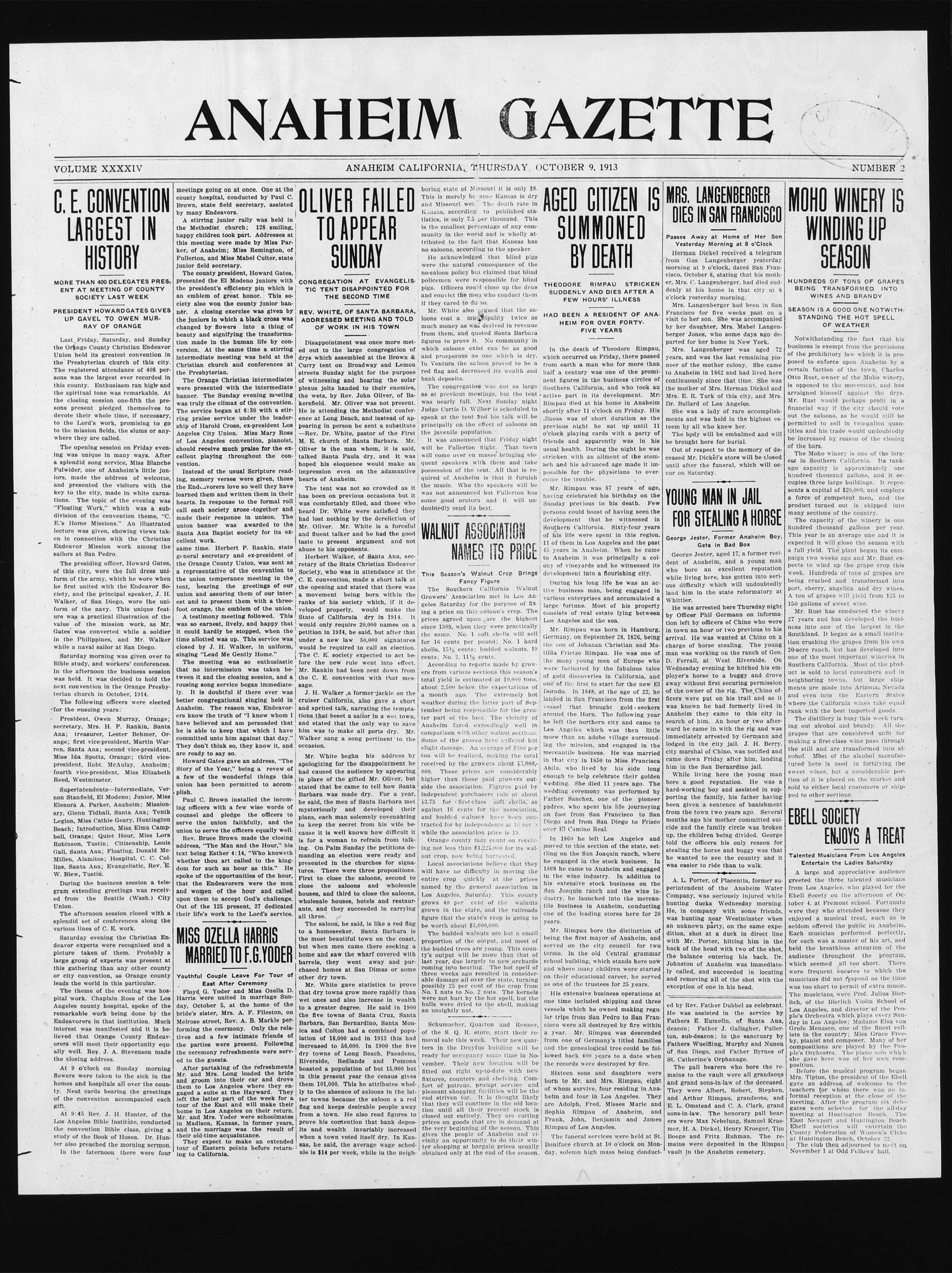
Searchable text
C. E. CONVENTION LARGEST IN HISTORY
MORE THAN 400 DELEGATES PRESENT AT MEETING OF COUNTY SOCIETY LAST WEEK
PRESIDENT HOWARD GATES GIVES UP GAVEL TO OWEN MURRAY OF ORANGE
Last Friday, Saturday, and Sunday the Orange County Christian Endeavor Union held its greatest convention in the Presbyterian church of this city. The registered attendance of 408 persons was the largest ever recorded in this county. Enthusiasm ran high and the spiritual tone was remarkable. At the closing session one-fifth the presons present pledged themselves to devote their whole time, if necessary, to the Lord's work, promising to go to the mission fields, the slums or anywhere they are called.
The opening session on Friday evening was unique in many ways. After a splendid song service, Miss Blanche Fulwider, one of Anaheim's little junior meetings going on at once. One at the county hospital, conducted by Paul C. Brown, state field secretary, assisted by many Endeavors.
A stirring junior rally was held in the Methodist church; 128 smiling, happy children took part. Addresses at this meeting were made by Miss Parker, of Anaheim; Miss Remington, of Fullerton, and Miss Mabel Culter, state junior field secretary.
The county president, Howard Gates, presented the El Modeno juniors with the president's efficiency pin which is an emblem of great honor. This society also won the county junior banner. A closing exercise was given by the juniors in which a black cross was changed by flowers into a thing of beauty and signifying the transformation made in the human life by conversion. At the same time a stirring intermediate meeting was held at the Christian church and conferences at the Presbyterian.
The Orange Christian intermediates were presented with the intermediate banner. The Sunday evening meeting was truly the climax of the convention. The service began at 6:30 with a stirring praise service under the leadership of Harold Cross, ex-president Los Angeles City Union. Miss Mary Ross of Los Angeles convention, pianist, should receive much praise for the excellent playing throughout the convention.
Instead of the usual Scripture read-
sons was the largest ever recorded in this county. Enthusiasm ran high and the spiritual tone was remarkable. At the closing session one-fifth the presons present pledged themselves to devote their whole time, if necessary, to the Lord's work, promising to go to the mission fields, the slums or anywhere they are called.
The opening session on Friday evening was unique in many ways. After a splendid song service, Miss Blanche Fulwider, one of Anaheim's little juniors, made the address of welcome, and presented the visitors with the key to the city, made in white carnations. The topic of the evening was "Floating Work," which was a subdivision of the convention theme, "C. E.'s Home Missions." An illustrated lecture was given, showing views taken in connection with the Christian Endeavor Mission work among the sailors at San Pedro.
The presiding officer, Howard Gates, of this city, wore the full dress uniform of the army, which he wore when he first united with the Endeavor Society, and the principal speaker, J. H. Walker, of San Diego, wore the uniform of the navy. This unique feature was a practical illustration of the value of the mission work, as Mr. Gates was converted while a soldier in the Philippines, and Mr. Walker while a naval sailor at San Diego.
Saturday morning was given over to Bible study, and workers' conferences. In the afternoon the business session was held. It was decided to hold the next convention in the Orange Presbyterian church in October, 1914.
The following officers were elected for the ensuing years:
President, Owen Murray, Orange; secretary, Mrs. H. P. Rankin, Santa Ana; treasurer, Lester Behmer, Orange; first vice-president, Martin Warren, Santa Ana; second vice-president, Miss Ida Spotts, Orange; third vice-president, Robt. McAulay, Anaheim; fourth vice-president, Miss Elizabeth Reed, Westminster.
Superintendent—Intermediate, Vernon Stanfield, El Modeno; Junior, Miss Elenora A. Parker, Anaheim; Missionary, Glenn Tidball, Santa Ana; Tenth Legion, Miss Cathie Geary, Huntington Beach; Introduction, Miss Elma Campbell, Orange; Quiet Hour, Miss Lora Robinson, Tustin; Citizenship, Louis Gall, Santa Ana; Floating, Donald McMillen, Alamitos; Hospital, C. C. Collins, Santa Ana; Evangelistic, Rev. E. W. Blew, Tustin.
During the business session a telegram extending greetings was received from the Seattle (Wash.) City
The Orange Christian intermediates were presented with the intermediate banner. The Sunday evening meeting was truly the climax of the convention. The service began at 6:30 with a stirring praise service under the leadership of Harold Cross, ex-president Los Angeles City Union. Miss Mary Ross of Los Angeles convention, pianoist, should receive much praise for the excellent playing throughout the convention.
Instead of the usual Scripture reading, memory verses were given, those Endevorers love so well they have learned them and written them in their hearts. In response to the formal roll call each society arose together and made their response in unison. The union banner was awarded to the Santa Ana Baptist society for its excellent work.
same time. Herbert P. Rankin, state general secretary and ex-president of the Orange County Union, was sent as a representative of the convention to the union temperance meeting in the tent, bearing the greetings of our union and assuring them of our interest and to present them with a three-foot orange, the emblem of the union.
A testimony meeting followed. This was so earnest, lively, and happy that it could hardly be stopped, when the time allotted was up. This service was closed by J. H. Walker, in uniform, singing "Lead Me Gently Home."
The meeting was so enthusiastic that no intermission was taken between it and the closing session, and a rousing song service began immediately. It is doubtful if there ever was better congregational singing held in Anaheim. The reason was, Endeavors know the truth of "I know whom I have believed and am persuaded that he is able to keep that which I have committed unto him against that day." They don't think so, they know it, and are ready to say so.
Howard Gates gave an address, "The Story of the Year," being a review of a few of the wonderful things this union has been permitted to accomplish.
Paul C. Brown installed the incoming officers with a few wise words of counsel and pledge the officers to serve the union faithfully, and the union to serve the officers equally well.
Rev. Bruce Brown made the closing address, "The Man and the Hour," his text being Esther 4:14, "Who knoweth whether thou art called to the kingdom for such an hour as this." He spoke of the opportunities of the hour, that the Endeavors were the men and women of the hour and called upon them to accept God's challenge.
street Sunday night of witnessing and plexus jolls handed out by Rev. Dr. White,
kersfield. Mr. Olive
He is attending thence at Long Beach pearing in person by Rev. Dr. White,
M. E. church of St.
Oliver is the man talked Santa Pauli hoped his eloquent impression even hearts of Anaheim.
The tent was now has been on previous comfortably fished heard Dr. White had lost nothing by Mr. Oliver. Mr. W
and fluent talker a taste to present abuse to his opposeHerbert Walker,
retary of State Society who was in C. E. convention,
the opening and st
a movement being ranks of his soci
veloped properly,
State of California would only require petition in 1914 he under a new law would be required The C. E. society fore the new rule Mr. Rankin had be
the C. E. convent sage.
J. H. Walker ,a cruiser California,
and sprited talk,n
tions that beset a s
and stated that th
him was to make e
Walker sang a son occasion.
Mr. White began apologizing for these had caused the auu in place of the gift stated that he Barbara was made he said,the men of mysteriously and plans,each man so to keep the secret cause it is well knn is for a woman to ing.On Palm Sun manding an electio presented in the pictures There were First to close thhe close the saloon houses,and third t
During the business session a telegram extending greetings was received from the Seattle (Wash.) City Union.
The afternoon session closed with a splendid set of conferences along the various lines of C. E. work.
Saturday evening the Christian Endeavor experts were recognized and a picture taken of them. Probably a large group of experts was present at this gathering than any other county or city convention, as Orange county leads the world in this particular.
The theme of the evening was hospital work. Chaplain Ross of the Los Angeles county hospital, spoke of the remarkable work being done by the Endeavorers in that institution. Much interest was manifested and it is believed that Orange County Endeavorers will meet their opportunity equally well. Rev. J. A. Stevenson made the closing address.
At 9 o'clock on Sunday morning flowers were taken to the sick in the homes and hospitals all over the county. Neat cards bearing the greetings of the convention accompanied each gift.
At 9:45 Rev. J. H. Hunter, of the Los Angeles Bible Institute, conducted the convention Bible class, giving a study of the Book of Hosea. Dr. Hunter also preached the morning sermon.
In the faternoon there were four Paul C. Brown installed the incoming officers with a few wise words of counsel and pledge the officers to serve the union faithfully, and the union to serve the officers equally well.
Rev. Bruce Brown made the closing address, "The Man and the Hour," his text being Esther 4:14, "Who knoweth whether thou art called to the kingdom for such an hour as this." He spoke of the opportunities of the hour, that the Endeavorers were the men and women of the hour and called upon them to accept God's challenge. Out of the 125 present, 27 dedicated their life's work to the Lord's service.
MISS OZELLA HARRIS MARRIED TO F.G.YODER
Youthful Couple Leave For Tour of East After Ceremony
Floyd G. Yoder and Miss Ozella D. Harris were united in marriage Sunday, October 5, at the home of the bride's sister, Mrs. A. F. Fileston, on Melrose street, Rev. A. B. Markle performing the ceermony. Only the relatives and a few intimate friends of the parties were present. Following the ceremony refreshments were served to the guests.
After partaking of the refreshments Mr. and Mrs. Long loaded the bride and groom into their car and drove them to Los Angeles where they engaged a suite at the Hayward. They left the latter part of the week for a tour of the East and will make their home in Los Angeles on their return. Mr. and Mrs. Yoder were schoolmates in Madison, Kansas, in former years, and the marriage was the result of their old-time acquaintance.
They expect to make an extended tour of Eastern points before returning to California.
Mr. White gave that dry towns grow wet ones and also to a greater degree the five towns of Barbara, San Bernardoica and Colton hadation of 18,000 and increased to 56,000 dry towns of Long Riverside, Redland boasted a population in this present year them 101,000. Thisaly to the absence of ter towns because flag and keeps des from a town. He prove his contentious its and wealth in when a town voted as, he said, the aule is $14 per week
ANAHEIM GAZETE
ANAHEIM CALIFORNIA, THURSDAY, OCTOBER 9, 1913
OLIVER FAILED TO APPEAR SUNDAY
CONGREGATION AT EVANGELISTIC TENT DISAPPOINTED FOR THE SECOND TIME
REV. WHITE, OF SANTA BARBARA, ADDRESSED MEETING AND TOLD OF WORK IN HIS TOWN
Disappointment was once more meted out to the large congregation of drys which assembled at the Brown & Curry tent on Broadway and Lemon streets Sunday night for the purpose of witnessing and hearing the solar plexus jolts handed to their enemies, the wets, by Rev. John Oliver, of Bakersfield. Mr. Oliver was not present. He is attending the Methodist conference at Long Beach, and instead of appearing in person he sent a substitute—Rev. Dr. White, pastor of the First M. E. church of Santa Barbara. Mr. Oliver is the man whom it is said, talked Santa Paula dry, and it was hoped his eloquence would make an impression even on the adamantive boring state of Missouri it is only $8. This is merely because Kansas is dry and Missouri wet. The death rate in Kansas, according to published statistics, is only 7.5 per thousand. This is the smallest percentage of any community in the world and is wholly attributed to the fact that Kansas has no saloons, according to the speaker.
He acknowledged that blind pigs were the natural consequence of the no-saloon policy but claimed that blind policemen were responsible for blind pigs. Officers could close up the dens and convict the men who conduct them if they cared to do so.
Mr. White also argued that the saloons cost a municipality twice as much money as was derived in revenue from them, and quoted Santa Barbara figures to prove it. No community in which saloons exist can be as good and prosperous as one which is dry. In Ventura the saloon proved to be a red flag and decreased its wealth and bank deposits.
The congregation was not as large as at previous meetings, but the tent was nearly full. Next Sunday night Judge Curtis D. Wilber is scheduled to speak at the tent and his talk will be principally on the effect of saloons on the juvenile population.
It was announced that Friday night will be Fullerton night. That town will come over en masse bringing eloquent speakers with them and take possession of the tent. All that is re-
AGED CITIZEN IS SUMMONED BY DEATH
THEODORE RIMPAU STRICKEN SUDDENLY AND DIES AFTER A FEW HOURS' ILLNESS
HAD BEEN A RESIDENT OF ANAHEIM FOR OVER FORTY-FIVE YEARS
In the death of Theodore Rimpau, which occurred on Friday, there passed from earth a man who for more than half a century was one of the prominent figures in the business circles of Southern California, and who took an active part in its development. Mr. Rimpau died at his home in Anaheim shortly after 11 o'clock on Friday. His illness was of short duration as the previous night he sat up until 11 o'clock playing cards with a party of friends and apparently was in his usual health. During the night he was stricken with an ailment of the stomach and his advanced age made it impossible for the physicians to over-
WALNUT ASSOCIATION
NAMES ITS PRICE
This Season's Walnut Crop Brings Fancy Figure
The Southern California Walnut Growers' Association met in Los Angeles Saturday for the purpose of fixing a price on this season's crop. The prices agreed upon are the highest since 1909, when they were practically the same. No. 1 soft shells will sell for 16 cents per pound; No. 1 hard shells, 15½ cents; budded walnuts, 19 cents; No. 2, 11½ cents.
According to reports made by growers from various sections this season's total yield is estimated at 10,000 tons, about 2,500 below the expectations of a month ago. The extremely hot weather during the latter part of September being responsible for the greater part of the loss. The vicinity of Anaheim fared exceedingly well in comparison with other walnut sections. Some of the groves here suffered but slight damage. An average of $300 per ton will be realized, making the total received by the growers about $3,000,000. These prices are considerably higher than those paid growers outside the association. Figures paid by independent purchasers rule at about 13.75 for first-class soft shells, as against 16 cents for the association, and budded walnuts have been contracted for by independents at 16 cents while the association price is 19.
Orange county may count on receiving not less than $1,225,000 for its walnut crop, now being harvested.
Local associations believe that they will have no difficulty in moving the entire crop quickly at the prices named by the general association in Los Angeles, Saturday. This county bank deposits.
The congregation was not as large as at previous meetings, but the tent was nearly full. Next Sunday night Judge Curtis D. Wilber is scheduled to speak at the tent and his talk will be principally on the effect of saloons on the juvenile population.
It was announced that Friday night will be Fullerton night. That town will come over en masse bringing eloquent speakers with them and take possession of the tent. All that is required of Anaheim is that it furnish the music. Who the speakers will be was not announced but Fullerton has some good orators and it will undoubtedly send its best.
Mr. Rimpau was 87 years of age, having celebrated his birthday on the Sunday previous to his death. Few persons could boast of having seen the development that he witnessed in Southern California. Sixty-four years of his life were spent in this region, 11 of them in Los Angeles and the past 45 years in Anaheim. When he came to Anaheim it was principally a colony of vineyards and he witnessed its development into a flourishing city.
During his long life he was an active business man, being engaged in various enterprises and accumulated a large fortune. Most of his property consists of real estate lying between Los Angeles and the sea.
Mr. Rimpau was born in Hamburg, Germany, on September 28, 1826, being the son of Johanan Christian and Matilda Frietze Rimpau. He was one of the many young men of Europe who were fascinated by the fabulous tales of gold discoveries in California, and one of the first to start for the new El Dorado. In 1848, at the age of 22, he landed in San Francisco from the first vessel that brought gold-seekers around the Horn. The following year he left the northern city and came to Los Angeles which was then little more than an adobe village surrounding the mission, and engaged in the mercantile business. He was married in that city in 1850 to Miss Francisca Abila, who lived by his side long enough to help celebrate their golden wedding. She died 11 years ago. The wedding ceremony was performed by Father Sanchez, one of the pioneer padres, who spent his life journeying on foot from San Francisco to San Diego and from San Diego to Frisco over El Camino Real.
In 1860 he left Los Angeles and moved to this section of the state, settling on the San Joaquin ranch, where he engaged in the stock business. In 1868 he came to Anaheim and engaged in the wine industry. In addition to his extensive stock business on the San Joaquin ranch and the wine industry, he launched into the mercan-
he said, the men of Santa Barbara met mysteriously and developed their plans, each man solemnly covenahting to keep the secret from his wife because it is well known how difficult it is for a woman to refrain from talking. On Palm Sunday the petitions demanding an election were ready and presented in the churches for signatures. There were three propositions. First to close the saloons, second to close the saloons and wholesale houses, and third to close the saloons, wholesale houses, hotels and restaurants, and they succeeded in carrying all three.
The saloon, he said, is like a red flag to a homeseeker. Santa Barbara is the most beautiful town on the coast, but when men came there seeking a home and saw the wharf covered with barrels, they went away and purchased homes at San Dimas or some other dry town.
Mr. White gave statistics to prove that dry towns grow more rapidly than wet ones and also increase in wealth to a greater degree. He said in 1900 the five towns of Santa Cruz, Santa Barbara, San Bernardino, Santa Monica and Colton had a combined population of 18,000 and in 1913 this had increased to 56,000. In 1900 the five dry towns of Long Beach, Pasadena, Riverside, Redlands and Pomona boasted a population of but 15,000 but in this present year the census gives them 101,000. This he attributes wholly to the absence of saloons in the latter towns because the saloon s a red flag and keeps desirable people away from a town. He also read figures to prove his contention that bank deposits and wealth invariably increased when a town voted itself dry. In Kansas, he said, the average wage schedule is $14 per week, while in the neigh-
13.75 for first-class soft shells, as against 16 cents for the association, and budded walnuts have been contracted for by independents at 16 cents while the association price is 19.
Orange county may count on receiving not less than $1,225,000 for its walnut crop, now being harvested.
Local associations believe that they will have no difficulty in moving the entire crop quickly at the prices named by the general association in Los Angeles, Saturday. This county grows 40 per cent of the walnuts grown in the state, and the railroads figure that the state's crop is going to be worth about $3,000,000.
The budded walnuts are but a small proportion of the output, and most of the budded trees are young. This county's output will be more than that of last year, due largely to new orchards coming into bearing. The hot spell of three weeks ago resulted in considerable damage all over the state, turning possibly 25 per cent of the crop from No. 1 nuts to No. 2 nuts. The kernels were not hurt by the hot spell, but the hulls were dried to the shell, making an unsightly nut.
Schumacher, Quarton and Renner, of the S. Q. R. store, start their removal sale this week. Their new quarters in the Dreyfus building will be ready for occupancy some time in November. Their new location will be fitted out right up-to-date with new fixtures, counters and shelving. Comfort of patrons, prompt service and pleasant shopping facilities will be the end striven for. It is thought likely that they will continue in the old location until all their present stock is closed out entirely. They are cutting prices on goods that are in demand at the very beginning of the season. This gives the people of Anaheim and vicinity an opportunity to do their winter shopping at bargain prices usually obtained only at the end of the season.
Father Sanchez, one of the pioneer padres, who spent his life journeying on foot from San Francisco to San Diego and from San Diego to Frisco over El Camino Real.
In 1860 he left Los Angeles and moved to this section of the state, settling on the San Joaquin ranch, where he engaged in the stock business. In 1868 he came to Anaheim and engaged in the wine industry. In addition to his extensive stock business on the San Joaquin ranch and the wine industry, he launched into the mercantile business in Anaheim, conducting one of the leading stores here for 20 years.
Mr. Rimpau bore the distinction of being the first mayor of Anaheim, and served on the city council for two terms. In the old Central grammar school building, which stands here now and where many children were started on their educational career, he served as one of the trustees for 25 years.
His extensive business operations at one time included shipping and three vessels which he owned making regular trips from San Pedro to San Francisco were all destroyed by fire within a year. Mr. Rimpau was descended from one of Germany's titled families and the genealogical tree could be followed back 400 years to a date when the records were destroyed by fire.
Sixteen sons and daughters were born to Mr. and Mrs. Rimpau, eight of whom survive, four residing in Anaheim and four in Los Angeles. They are Adolph, Fred, Misses Marie and Sophia Rimpau of Anaheim, and Frank, John, Benjamin and James Rimpau of Los Angeles.
The funeral services were held at St. Boniface church at 10 o'clock on Monday, solemn high mass being conduct-
MIZETTE
1913 NUMBER 2
CITIZEN IS DEMONED DEATH
MPAU STRICKEN AND DIES AFTER A MRS' ILLNESS
RESIDENT OF ANA- OVER FORTY-YEARS
Of Theodore Rimpau, Friday, there passed on who for more than was one of the prominent business circles of California, and who took an its development. Mr. this home in Anaheim clock on Friday. His short duration as the sat up until 11 cards with a party of currently was in his ringing the night he was enailment of the stomached age made it impossible physicians to oversee.
MRS. LANGENBERGER DIES IN SAN FRANCISCO
Passes Away at Home of Her Son Yesterday Morning at 8 o'Clock
Herman Dickel received a telegram from Gus Langenberger yesterday morning at 9 o'clock, dated San Francisco, October 8, stating that his mother, Mrs. C. Langenberger, had died suddenly at his home in that city at 8 o'clock yesterday morning.
Mrs. Langenberger had been in San Francisco for five weeks past on a visit to her son. She was accompanied by her daughter, Mrs. Mabel Langenberger Jones, who some days ago departed for her home in New York.
Mrs. Langenberger was aged 72 years, and was the last remaining pioneer of the mother colony. She came to Anaheim in 1862 and had lived here continuously since that time. She was the mother of Mrs. Herman Dickel and Mrs. E. R. Turk of this city, and Mrs. Dr. Bullard of Los Angeles.
She was a lady of rare accomplishments and was held in the highest esteem by all who knew her.
The body will be embalmed and will be brought here for burial.
Out of respect to the memory of deceased Mr. Dickel's store will be closed until after the funeral, which will occur on Saturday.
MOHO WINERY IS WINDING UP SEASON
HUNDREDS OF TONS OF GRAPES BEING TRANSFORMED INTO WINES AND BRANDY
SEASON IS A GOOD ONE NOT WITHSTANDING THE HOT SPELL OF WEATHER
Notwithstanding the fact that his business is exempt from the provisions of the prohibitory law which it is proposed to enforce upon Anaheim by a certain faction of the town, Charles Otto Rust, owner of the Moho winery, is opposed to the movement, and has arraigned himself against the drys. Mr. Rust would perhaps profit in a financial way if the city should vote out the saloons, as he would still be permitted to sell in two-gallon quantities and his trade would undoubtedly be increased by reason of the closing of the bars.
The Moho winery is one of the largest in Southern California. Its tankage capacity is approximately one hundred thousand gallons, and it
YOUNG MAN IN JAIL FOR STEALING A HORSE
George Jester, Former Anaheim Boy, Gets in Bad Box
George Jester, aged 17, a former resident of Anaheim, and a young man who bore an excellent reputation while living here, has gotten into serious difficulty which will undoubtedly land him in the state reformatory at Whittier.
He was arrested here Thursday night by Officer Phil Germann on information left by officers of Chino who were in town an hour or two previous to his arrival. He was wanted at Chino on a charge of horse stealing. The young man was working on the ranch of Geo. D. Ferrall, at West Riverside. On Wednesday evening he hitched his employer's horse to a buggy and drove away without first securing permission of the owner of the rig. The Chino officers were put on his trail and as it was known he had formerly lived in Anaheim they came to this city in search of him. An hour or two afterward he came in with the rig and was immediately arrested by Germann and lodged in the city jail. J. H. Berry, city marshal of Chino, was notified and came down Friday after him, landing him in the San Bernardino jail.
While living here the young man bore a good reputation. He was a hard-working boy and assisted in supporting the family, his father having been given a sentence of banishment from the town two years ago. Several months ago his mother committed suicide and the family circle was broken up, the children being divided. George told the officers his only reason for stealing the horse and buggy was that he wanted to see the country and it was easier to ride than to walk.
A. L. Porter, of Placentia, former superintendent of the Anaheim Water Company, was seriously injured while Otto Rust, owner of the Moho winery, is opposed to the movement, and has arraigned himself against the drys. Mr. Rust would perhaps profit in a financial way if the city should vote out the saloons, as he would still be permitted to sell in two-gallon quantities and his trade would undoubtedly be increased by reason of the closing of the bars.
The Moho winery is one of the largest in Southern California. Its tankage capacity is approximately one hundred thousand gallons, and it occupies three large buildings. It represents a capital of $20,000, and employs a force of competent men, and the product turned out is shipped into many sections of the country.
The capacity of the winery is one hundred thousand gallons per year. This year is an average one and it is expected it will close the season with a full yield. The plant began its campaign two weeks ago and Mr. Rust expects to wind up the grape crop this week. Hundreds of tons of grapes are being crushed and transformed into port, sherry, angelica and dry wines. A ton of grapes will yield from 125 to 150 gallons of sweet wine.
Mr. Rust has conducted the winery 27 years and has developed the business into one of the largest in the Southland. It began as a small institution crushing the grapes from his own 20-acre ranch, but has developed into one of the most important wineries in Southern California. Most of the product is sold to local consumers and in neighboring towns, but large shipments are made into Arizona, Nevada and even into the Eastern States where the California wines take equal rank with the best imported goods.
The distillery is busy this week turning out alcohol and brandy. All the grapes that are considered unfit for making a first-class wine pass through the still and are transformed into alcohol. Most of the alcohol manufactured here is used in fortifying the sweet wines, but a considerable portion of it is placed on the market and sold to either local customers or shipped to other sections.
EBELL SOCIETY ENJOYS A TREAT
Talented Musicians From Los Angeles Entertain the Ladies Saturday
A large and appreciative audience greeted the three talented musicians from Los Angeles, who played for the Ebell Society on the afternoon of Oc-
A. L. Porter, of Placentia, former superintendent of the Anaheim Water Company, was seriously injured while hunting ducks Wednesday morning. He, in company with some friends, was hunting near Westminster when an unknown party, on the same expedition, shot at a duck in direct line with Mr. Porter, hitting him in the back of the head with two of the shot, the balance entering his back. Dr. Johnston of Anaheim was immediately called, and succeeded in locating and removing all of the shot with the exception of one in his head.
ed by Rev. Father Dubbel as celebrant. He was assisted in the service by Fathers E. Eumelin, of Santa Ana, deacon; Father J. Gallagher, Fullerton, sub-deacon; in the sanctuary by Fathers Wuelfling, Murphy and Nunen of San Diego, and Father Byrnes of St. Catherine's Orphanage.
The pall bearers who bore the remains to the vault were all grandsons and grand sons-in-law of the deceased. They were Albert, Robert, Stephen, and Arthur Rimpau, grandsons, and E. L. Omstead and C. A. Clark, grand sons-in-law. The honorary pall bearers were Max Nebelung, Samuel Kraemer, H. A. Dickel, Henry Kroeger, Tim Boege and Fritz Ruhman. The remains were deposited in the Rimpau vault in the Anaheim cemetery.
EBELL SOCIETY ENJOYS A TREAT
Talented Musicians From Los Angeles Entertain the Ladies Saturday
A large and appreciative audience greeted the three talented musicians from Los Angeles, who played for the Ebell Society on the afternoon of October 4, at Fremont school. Fortunate were they who attended because they enjoyed a musical treat, such as is seldom offered the public in Anaheim. Each musician performed perfectly, for each was a master of his art, and held the breathless attention of the audience throughout the program, which seemed all too short. There were frequent encores to which the musicians did not respond as the time was too short to permit of extra music. The musicians were Prof. Julius Bierlich, of the Bierlich Violin School of Los Angeles, and director of the People's Orchestra which plays every Sunday in Los Angeles; Madame Elsa von Grofe Menasco, one of the finest cellists in the country; Miss Grace Freeby, pianist and composer. Many of her compositions are played by the People's Orchestra. The piano solo which she gave here was of her own composition.
Before the musical program began Mrs. Tipton, the president of the Ebell gave an address of welcome to the teachers for whom there was an informal reception at the close of the meeting. After the program six delegates were selected for the all-day meeting at Huntington Beach. The East Newport and Huntington Beach Ebell societies will entertain the County Federation of Women's Clubs at Huntington Beach, October 22.
The club then adjourned to meet on November 1 at Odd Fellows' hall.