anaheim-gazette 1913-09-18
Scanned page
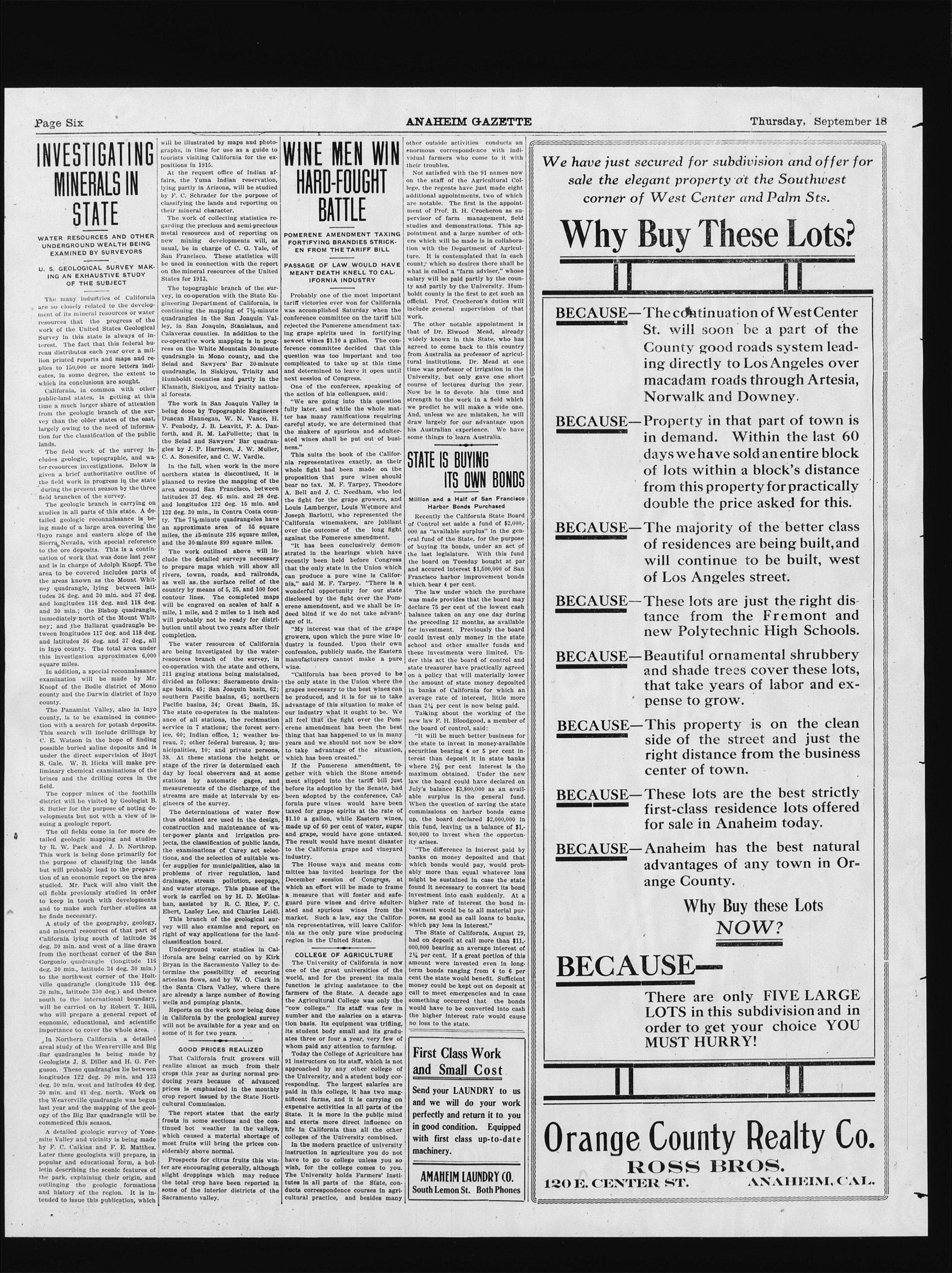
Searchable text
INVESTIGATING MINERALS IN STATE
WATER RESOURCES AND OTHER UNDERGROUND WEALTH BEING EXAMINED BY SURVEYORS
U. S. GEOLOGICAL SURVEY MAKING AN EXHAUSTIVE STUDY OF THE SUBJECT
The many industries of California are so closely related to the development of its mineral resources or water resources that the progress of the work of the United States Geological Survey in this state is always of interest. The fact that this federal bureau distributes each year over a million printed reports and maps and replies to 150,000 or more letters indicates, in some degree, the extent to which its conclusions are sought.
California, in common with other public-land states, is getting at this time a much larger share of attention from the geologic branch of the survey than the older states of the east, largely owing to the need of information for the classification of the public lands.
The field work of the survey includes geologic, topographic, and water-resources investigations. Below is given a brief authoritative outline of will be illustrated by maps and photographs, in time for use as a guide to tourists visiting California for the expositions in 1915.
At the request office of Indian affairs, the Yuma Indian reservation, lying partly in Arizona, will be studied by F. C. Schrader for the purpose of classifying the lands and reporting on their mineral character.
The work of collecting statistics regarding the precious and semi-precious metal resources and of reporting on new mining developments will, as usual, be in charge of C. G. Yale, of San Francisco. These statistics will be used in connection with the report on the mineral resources of the United States for 1913.
The topographic branch of the survey, in co-operation with the State Engineering Department of California, is continuing the mapping of 7½-minute quadrangles in the San Joaquin Valley, in San Joaquin, Stanislaus, and Calaveras counties. In addition to the co-operative work mapping is in progress on the White Mountain 30-minute quadrangle in Mono county, and the Seiad and Sawyers' Bar 30-minute quadrangle, in Siskiyou, Trinity and Humboldt counties and partly in the Klamath, Siskiyou, and Trinity national forests.
The work in San Joaquin Valley is being done by Topographic Engineers Duncan Hannegan, W. N. Vance, H. V. Peabody, J. B. Leavitt, F. A. Danforth, and R. M. LaFollette; that in the Seiad and Sawyers' Bar quadrangles by J. P. Harrison, J. W. Muller, C. A. Sonesifer, and C. W. Vardle.
In the fall, when work in the more northern states is discontinued, it is probably one of the most tariff victories ever won was accomplished Saturday conference committee rejected the Pomerene acting grape spirits used seweet wines $1.10 a gallon conference committee decision was too important complicated to take up and determined to leave next session of Congress.
One of the conferences action of his colleague "We are going into fully later, and while there has many ramifications careful study, we are doing the makers of spuriousated wines shall be pursued."
This suits the booknia representatives ex whole fight had been
California, in common with other public-land states, is getting at this time a much larger share of attention from the geologic branch of the survey than the older states of the east, largely owing to the need of information for the classification of the public lands.
The field work of the survey includes geologic, topographic, and water-resources investigations. Below is given a brief authoritative outline of the field work in progress in the state during the present season by the three field branches of the survey.
The geologic branch is carrying on studies in all parts of this state. A detailed geologic reconnaissance is being made of a large area covering the Inyo range and eastern slope of the Sierra Nevada, with special reference to the ore deposits. This is a continuation of work that was done last year and is in charge of Adolph Knopf. The area to be covered includes parts of the areas known as the Mount Whitney quadrangle, lying between latitudes 36 deg. and 30 min. and 37 deg. and longitudes 118 deg. and 118 deg. and 30 min.; the Bishop quadrangle, immediately north of the Mount Whitney; and the Ballarat quadrangle between longitudes 117 deg. and 118 deg. and latitudes 36 deg. and 37 deg., all in Inyo county. The total area under this investigation approximates 6,000 square miles.
In addition, a special reconnaissance examination will be made by Mr. Knopf of the Bodie district of Mono county and the Darwin district of Inyo county.
The Panamint Valley, also in Inyo county, is to be examined in connection with a search for potash deposits. This search will include drillings by C. E. Watson in the hope of finding possible buried saline deposits and is under the direct supervision of Hoyt S. Gale. W. B. Hicks will make preliminary chemical examinations of the brines and the drilling cores in the field.
The copper mines of the foothills district will be visited by Geologist B. S. Butler for the purpose of noting developments but not with a view of issuing a geologic report.
The oil fields come in for more detailed geologic mapping and studies by R. W. Pack and J. D. Northrop. This work is being done primarily for the purpose of classifying the lands but will probably lead to the preparation of an economic report on the area studied. Mr. Pack will also visit the oil fields previously studied in order to gain insights into development trends.
The work in San Joaquin Valley is being done by Topographic Engineers Duncan Hannegan, W. N. Vance, H. V. Peabody, J. B. Leavitt, F. A. Danforth, and R. M. LaFollette; that in the Seiad and Sawyers' Bar quadrangles by J. P. Harrison, J. W. Muller, C. A. Sonesifer, and C. W. Vardle.
In the fall, when work in the more northern states is discontiued, it is planned to revise the mapping of the area around San Francisco, between latitudes 37 deg. 45 min. and 28 deg. and longitudes 122 deg. 15 min. and 122 deg. 30 min., in Contra Costa county. The 7½-minute quadrangles have an approximate area of 55 square miles, the 15-minute 236 square miles, and the 30-minute 899 square miles.
The work outlined above will include the detailed surveys necessary to prepare maps which will show all rivers, towns, roads, and railroads, as well as the surface relief of the country by means of 5, 25, and 100 foot contour lines. The completed maps will be engraved on scales of half a mile, 1 mile, and 2 miles to 1 inch and will probably not be ready for distribution until about two years after their completion.
The water resources of California are being investigated by the water-resources branch of the survey, in co-operation with the state and others, 211 gaging stations being maintained, divided as follows: Sacramento drainage basin, 45; San Joaquin basin, 62; southern Pacific basins, 45; northern Pacific basins, 34; Great Basin, 25.
The state co-operates in the maintenance of all stations, the reclamation service in 7 stations; the forest service, 60; Indian office, 1; weather bureau, 2; other federal bureaus, 3; municipalities, 10; and private persons, 38. At these stations the height or stage of the river is determined each day by local observers and at some stations by automatic gages, and measurements of the discharge of the streams are made at intervals by engineers of the survey.
The determinations of water flow thus obtained are used in the design, construction and maintenance of water-power plants and irrigation projects, the classification of public lands, the examinations of Carey act selections, and the selection of suitable water supplies for municipalities, also in problems of river regulation, land drainage, stream pollution, seepage, and water storage. This phase of the work is carried on by H. D. McGlasse next session of Congress.
One of the conferences action of his colleague "We are going into fully later, and while there has many ramifications careful study, we are doing the makers of spurious wines shall be pursued."
This suits the book onnia representatives ex whole fight had been proposition that pure bear no tax. M. F. Tait A. Bell and J. C. Neel fight for the grape Louis Lamberger, Louis Joseph Barlotti, who make California winemakers over the outcome of against the Pomerene al
"It has been concluded in the hearing recently been held that the only state in this can produce a pure wine," said M. F. Tarpe wonderful opportunity disclosed by the fight erene amendment, and deed blind if we do not age of it.
"My interest was that growers upon which this dustry is founded. U confession publicly man manufacturers cannot wine.
"California has been only state in the U grapes necessary to them be produced, and it is advantage of this situation our industry what it owes all feel that the fight erene amendment has thing that has happened years and we should not take advantage of which has been created.
If the Pomerene gether with which thenthe ment slipped intothe before its adoption bythe been adopted bythe California pure wines wot taxed for grape spirits $1.10 a gallon, while made up of 60 per cent grape would have The result would have tothe California grape industry.
The House ways am mittee has invited he December session of which an effort will be a measure that will f
district will be visited by Geologist B. S. Butler for the purpose of noting developments but not with a view of issuing a geologic report.
The oil fields come in for more detailed geologic mapping and studies by R. W. Pack and J. D. Northrop. This work is being done primarily for the purpose of classifying the lands but will probably lead to the preparation of an economic report on the area studied. Mr. Pack will also visit the oil fields previously studied in order to keep in touch with developments and to make such further studies as he finds necessary.
A study of the geography, geology, and mineral resources of that part of California lying south of latitude 36 deg. 30 min. and west of a line drawn from the northeast corner of the San Gorgonio quadrangle (longitude 116 deg. 30 min., latitude 34 deg. 30 min.) to the northwest corner of the Holtville quadrangle (longitude 115 deg. 30 min., latitude 330 deg.) and thence south to the international boundary, will be carried on by Robert T. Hill, who will prepare a general report of economic, educational, and scientific importance to cover the whole area.
In Northern California a detailed areal study of the Weaverville and Big Bar quadrangles is being made by Geologists J. S. Diller and H. G. Ferguson. These quadrangles lie between longitudes 122 deg. 30 min. and 123 deg. 30 min. west and latitudes 40 deg. 30 min. and 41 deg. north. Work on the Weaverville quadrangle was begun last year and the mapping of the geology of the Big Bar quadrangle will be commenced this season.
A detailed geologic survey of Yosemite Valley and vicinity is being made by F. C. Calkins and F. E. Matthes. Later these geologists will prepare, in popular and educational form, a bulletin describing the scenic features of the park, explaining their origin, and outlining the geologic formations and history of the region. It is intended to issue this publication, which engineers of the survey.
The determinations of water flow thus obtained are used in the design, construction and maintenance of water-power plants and irrigation projects, the classification of public lands, the examinations of Carey act selections, and the selection of suitable water supplies for municipalities, also in problems of river regulation, land drainage, stream pollution, seepage, and water storage. This phase of the work is carried on by H. D. McGlashan, assisted by R. C. Rice, F. C. Ebert, Lasley Lee, and Charles Leidl.
This branch of the geological survey will also examine and report on right of way applications for the land-classification board.
Underground water studies in California are being carried on by Kirk Bryan in the Sacramento Valley to determine the possibility of securing artesian flows, and by W. O. Clark in the Santa Clara Valley, where there are already a large number of flowing wells and pumping plants.
Reports on the work now being done in California by the geological survey will not be available for a year and on some of it for two years.
GOOD PRICES REALIZED
That California fruit growers will realize almost as much from their crops this year as during normal producing years because of advanced prices is emphasized in the monthly crop report issued by the State Horticultural Commission.
The report states that the early frosts in some sections and the continued hot weather in the valleys, which caused a material shortage of most fruits will bring the prices considerably above normal.
Prospects for citrus fruits this winter are encouraging generally, although slight droppings which may reduce the total crop have been reported in some of the interior districts of the Sacramento valley.
COLLEGE OF AGRICULTURE
The University of California one of the great universities world, and for the profession is giving assistance farmers of the State to the Agricultural College "cow college." Its staff number and the salary-tation basis. Its equipment its student body smallates three or four a year whom paid any attention.
Today the College of 91 instructors on its staff approached by any other University, and a staff responding. The large paid in this college, it sufficient farms, and it expensive activities in State. It is more in tune and exerts more direct life in California than colleges of the University.
In the modern practice instruction in agriculture have to go to college wish, for the college The University holds institutes in all parts of the ducts correspondence cultural practice, and
ANAHEIM GAZETTE
WINE MEN WIN HARD-FOUGHT BATTLE
POMERENE AMENDMENT TAXING FORTIFYING BRANDIES STRICKEN FROM THE TARIFF BILL
PASSAGE OF LAW WOULD HAVE MEANT DEATH KNELL TO CALIFORNIA INDUSTRY
Probably one of the most important tariff victories ever won for California was accomplished Saturday when the conference committee on the tariff bill rejected the Pomerene amendment taxing grape spirits used in fortifying sewet wines $1.10 a gallon. The conference committee decided that this question was too important and too complicated to take up at this time and determined to leave it open until next session of Congress.
One of the conferees, speaking of the action of his colleagues, said:
"We are going into this question fully later, and while the whole matter has many ramifications requiring careful study, we are determined that the makers of spurious and adulterated wines shall be put out of business."
This suits the book of the California representatives exactly, as their whole fight had been made on other outside activities conducts an enormous correspondence with individual farmers who come to it with their troubles.
Not satisfied with the 91 names now on the staff of the Agricultural College, the regents have just made eight additional appointments, two of which are notable. The first is the appointment of Prof. B. H. Crocheron as supervisor of farm management, field studies and demonstrations. This appointment and a large number of others will be made in collaboration with the Department of Agriculture. It is contemplated that in each county which so desires there shall be what is called a "farm adviser," whose salary will be paid partly by the county and partly by the University. Humboldt county is the first to get such an official. Prof. Crocheron's duties will include general supervision of that work.
The other notable appointment is that of Dr. Elwood Mead, already widely known in this State, who has agreed to come back to this country from Australia as professor of agricultural institutions. Dr. Mead at one time was professor of irrigation in the University, but only gave one short course of lectures during the year. Now he is to devote his time and strength to the work in a field which we predict he will make a wide one. And, unless we are mistaken, he will draw largely for our advantage upon his Australian experience. We have some things to learn Australia.
STATE IS BUYING
next session of Congress.
One of the conferees, speaking of the action of his colleagues, said:
"We are going into this question fully later, and while the whole matter has many ramifications requiring careful study, we are determined that the makers of spurious and adulterated wines shall be put out of business."
This suits the book of the California representatives exactly, as their whole fight had been made on the proposition that pure wines should bear no tax. M. F. Tarpey, Theodore A. Bell and J. C. Needham, who led the fight for the grape growers, and Louis Lamberger, Louis Wetmore and Joseph Barlotti, who represented the California winemakers, are jubilant over the outcome of the long fight against the Pomerene amendment.
"It has been conclusively demonstrated in the hearings which have recently been held before Congress that the only state in the Union which can produce a pure wine is California," said M. F. Tarpey. "There is a wonderful opportunity for our state disclosed by the fight over the Pomerene amendment, and we shall be indeed blind if we do not take advantage of it.
"My interest was that of the grape growers, upon which the pure wine industry is founded. Upon their own confession, publicly made, the Eastern manufacturers cannot make a pure wine.
"California has been proved to be the only state in the Union where the grapes necessary to the best wines can be produced, and it is for us to take advantage of this situation to make of our industry what it ought to be. We all feel that the fight over the Pomerene amendment has been the best thing that has happened to us in many years and we should not now be slow to take advantage of the situation, which has been created."
If the Pomerene amendment, together with which the Stone amendment slipped into the tariff bill just before its adoption by the Senate, had been adopted by the conference, California pure wines would have been taxed for grape spirits at the rate of $1.10 a gallon, while Eastern wines, made up of 60 per cent of water, sugar and grape, would have gone untaxed. The result would have meant disaster to the California grape and vineyard industry.
The House ways and means committee has invited hearings for the December session of Congress, at which an effort will be made to frame a measure that will foster and safe-
University, but only gave one short course of lectures during the year. Now he is to devote his time and strength to the work in a field which we predict he will make a wide one. And, unless we are mistaken, he will draw largely for our advantage upon his Australian experience. We have some things to learn Australia.
STATE IS BUYING ITS OWN BONDS
Million and a Half of San Francisco Harbor Bonds Purchased
Recently the California State Board of Control set aside a fund of $2,000,000 as "available surplus" in the general fund of the State, for the purpose of buying its bonds, under an act of the last legislature. With this fund the board on Tuesday bought at par and accured interest $1,500,000 of San Francisco harbor improvement bonds which bear 4 per cent.
The law under which the purchase was made provides that the board may declare 75 per cent of the lowest cash balance taken on any one day during the preceding 12 months, as available for investment. Previously the board could invest only money in the state school and other smaller funds and these investments were limited. Under this act the board of control and state treasurer have practically agreed on a policy that will materially lower the amount of state money deposited in banks of California for which an average rate of interest, little more than 2½ per cent is now being paid.
Talking about the working of the new law F. H. Bloodgood, a member of the board of control, said:
"It will be much better business for the state to invest in money-available securities bearing 4 or 5 per cent interest than deposit it in state banks where 2½ per cent interest is the maximum obtained. Under the new law the board could have declared on July's balance $3,800,000 as an available surplus in the general fund. When the question of saving the state commissions on harbor bonds came up, the board declared $2,000,000 in this fund, leaving us a balance of $1,-800,000 to invest when the opportunity arises.
"The difference in interest paid by banks on money deposited and that which bonds would pay, would probably more than equal whatever loss might be sustained in case the state found it necessary to convert its bond investment into cash suddenly. At a
fornia pure wines would have been taxed for grape spirits at the rate of $1.10 a gallon, while Eastern wines, made up of 60 per cent of water, sugar and grape, would have gone untaxed. The result would have meant disaster to the California grape and vineyard industry.
The House ways and means committee has invited hearings for the December session of Congress, at which an effort will be made to frame a measure that will foster and safeguard pure wines and drive adulterated and spurious wines from the market. Such a law, say the California representatives, will leave California as the only pure wine producing region in the United States.
COLLEGE OF AGRICULTURE
The University of California is now one of the great universities of the world, and for the present its main function is giving assistance to the farmers of the State. A decade ago the Agricultural College was only the "cow college." Its staff was few in number and the salaries on a starvation basis. Its equipment was trifling, its student body small and its graduates three or four a year, very few of whom paid any attention to farming.
Today the College of Agriculture has 91 instructors on its staff, which is not approached by any other college of the University, and a student body corresponding. The largest salaries are paid in this college, it has two magnificent farms, and it is carrying on expensive activities in all parts of the State. It is more in the public mind and exerts more direct influence on life in California than all the other colleges of the University combined.
In the modern practice of university instruction in agriculture you do not have to go to college unless you so wish, for the college comes to you. The University holds Farmers' Institutes in all parts of the State, conducts correspondence courses in agricultural practice, and besides many
When the question of saving the state commissions on harbor bonds came up, the board declared $2,000,000 in this fund, leaving us a balance of $1,-800,000 to invest when the opportunity arises.
"The difference in interest paid by banks on money deposited and that which bonds would pay, would probably more than equal whatever loss might be sustained in case the state found it necessary to convert its bond investment into cash suddenly. At a higher rate of interest the bond investment would be to all material purposes, as good as call loans to banks, which pay less in interest."
The State of California, August 29, had on deposit at call more than $11,-000,000 bearing an average interest of 2¼ per cent. If a great portion of this amount were invested even in long-term bonds ranging from 4 to 6 per cent the state would benefit. Sufficient money could be kept out on deposit at call to meet emergencies and in case something occurred that the bonds would have to be converted into cash the higher interest rate would cause no loss to the state.
First Class Work and Small Cost
Send your LAUNDRY to us and we will do your work perfectly and return it to you in good condition. Equipped with first class up-to-date machinery.
AMAHEIM LAUNDRY CO.
South Lemon St. Both Phones
Thursday, September 18
we just secured for subdivision and offer for
the elegant property at the Southwest
corner of West Center and Palm Sts.
Why Buy These Lots?
USE—The continuation of WestCenter
St. will soon be a part of the
County good roads system leading directly to Los Angeles over
macadam roads through Artesia,
Norwalk and Downey.
USE—Property in that part of town is
in demand. Within the last 60
days we have sold an entire block
of lots within a block's distance
macadam roads through Artesia,
Norwalk and Downey.
USE—Property in that part of town is
in demand. Within the last 60
days we have sold an entire block
of lots within a block's distance
from this property for practically
double the price asked for this.
USE—The majority of the better class
of residences are being built,and
will continue to be built, west
of Los Angeles street.
USE—These lots are just the right distance from the Fremont and
new Polytechnic High Schools.
USE—Beautiful ornamental shrubbery
and shade trees cover these lots,
that take years of labor and expense to grow.
USE—This property is on the clean
side of the street and just the
right distance from the business
center of town.
USE—These lots are the best strictly
first-class residence lots offered
for sale in Anaheim today.
USE—Anaheim has the best natural
advantages of any town in Orange County.
first-class residence lots offered
for sale in Anaheim today.
Anaheim has the best natural
advantages of any town in Orange County.
Why Buy these Lots
NOW?
CAUSE—
There are only FIVE LARGE
LOTS in this subdivision and in
order to get your choice YOU
MUST HURRY!
Orange County Realty Co.
ROSS BROS.
CENTER ST. ANAHEIM, CAL.