anaheim-gazette 1913-09-11
Scanned page
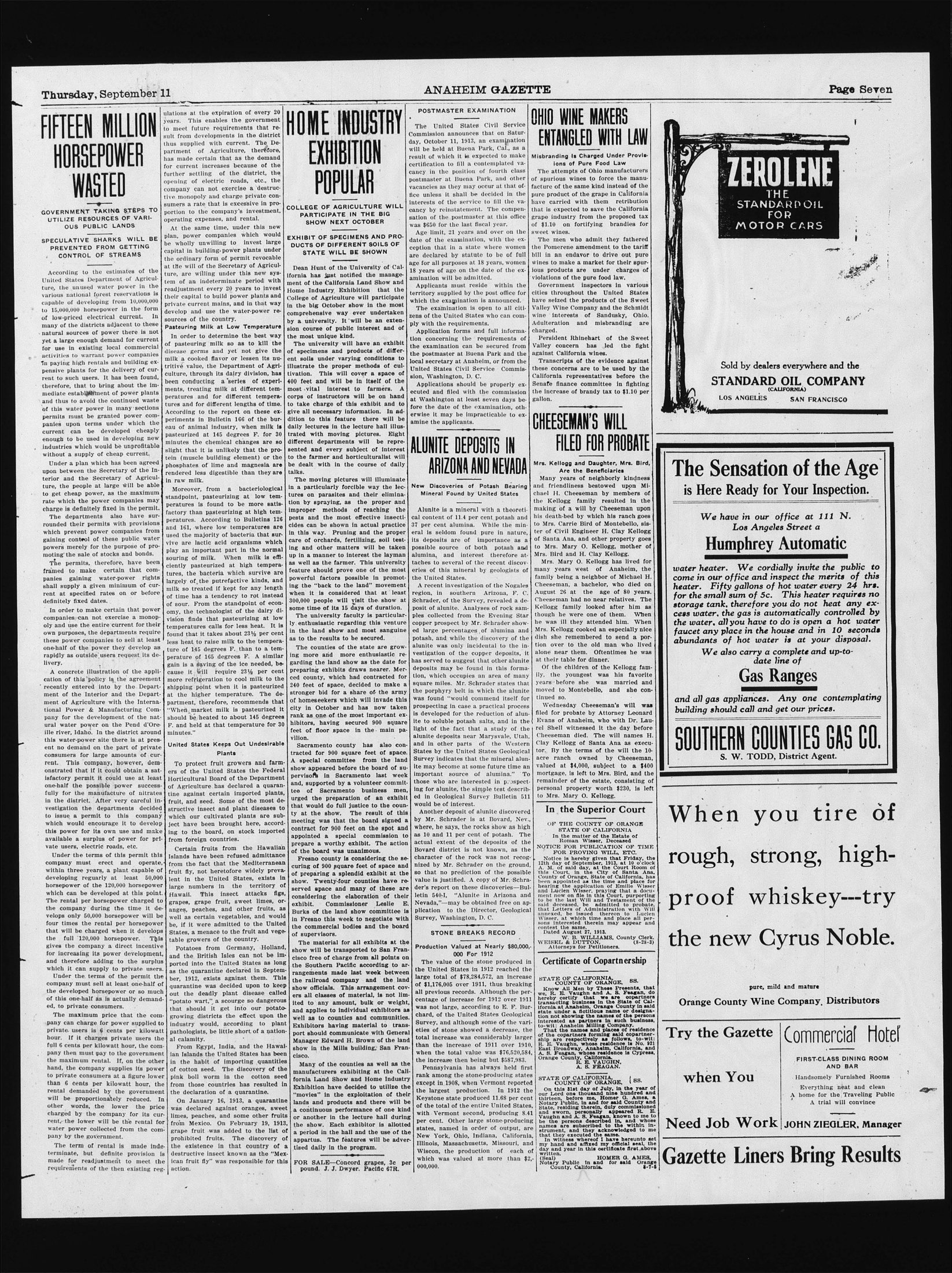
Searchable text
FIFTEEN MILLION HORSEPOWER WASTED
GOVERNMENT TAKING STEPS TO UTILIZE RESOURCES OF VARIOUS PUBLIC LANDS
SPECULATIVE SHARKS WILL BE PREVENTED FROM GETTING CONTROL OF STREAMS
According to the estimates of the United States Department of Agriculture, the unused water power in the various national forest reservations is capable of developing from 10,000,000 to 15,000,000 horsepower in the form of low-priced electrical current. In many of the districts adjacent to these natural sources of power there is not yet a large enough demand for current for use in existing local commercial activities to warrant power companies in paying high rentals and building expensive plants for the delivery of current to such users. It has been found, therefore, that to bring about the immediate establishment of power plants and thus to avoid the continued waste of this water power in many sections permits must be granted power companies upon terms under which the current can be developed cheaply enough to be used in developing new industries which would be unprofitable without a supply of cheap current.
Under a plan which has been agreed upon between the Secretary of the Interior at the expiration of every 20 years. This enables the government to meet future requirements that result from developments in the district thus supplied with current. The Department of Agriculture, therefore, has made certain that as the demand for current increases because of the further settling of the district, the opening of electric roads, etc., the company can not exercise a destructive monopoly and charge private consumers a rate that is excessive in proportion to the company's investment, operating expenses, and rental.
At the same time, under this new plan, power companies which would be wholly unwilling to invest large capital in building-power plants under the ordinary form of permit revocable at the will of the Secretary of Agriculture, are willing under this new system of an indeterminate period with readjustment every 20 years to invest their capital to build power plants and private current mains, and in that way develop and use the water-power resources of the country.
Pasteuring Milk at Low Temperature
In order to determine the best way of pasteuring milk so as to kill the disease germs and yet not give the milk a cooked flavor or lessen its nutritive value, the Department of Agriculture, through its dairy division, has been conducting a series of experiments, treating milk at different temperatures and for different lengths of time. According to the report on these experiments in Bulletin 166 of the bureau of animal industry, when milk is pasteurized at 145 degrees F. for 30 minutes the chemical changes are so slight that it is unlikely that the protein (muscle building element) or the phosphates of lime and magnesia are rendered less digestible than they are.
rent to such users. It has been found, therefore, that to bring about the immediate establishment of power plants and thus to avoid the continued waste of this water power in many sections permits must be granted power companies upon terms under which the current can be developed cheaply enough to be used in developing new industries which would be unprofitable without a supply of cheap current.
Under a plan which has been agreed upon between the Secretary of the Interior and the Secretary of Agriculture, the people at large will be able to get cheap power, as the maximum rate which the power companies may charge is definitely fixed in the permit.
The departments also have surrounded their permits with provisions which prevent power companies from gaining control of these public water powers merely for the purpose of promoting the sale of stocks and bonds.
The permits, therefore, have been framed to make certain that companies gaining water-power rights shall supply a given minimum of current at specified rates on or before definitely fixed dates.
In order to make certain that power companies can not exercise a monopoly and use the entire current for their own purposes, the departments require these power companies to sell at least one-half of the power they develop as rapidly as outside users request its delivery.
A concrete illustration of the application of this policy is the agreement recently entered into by the Department of the Interior and the Department of Agriculture with the International Power & Manufacturing Company for the development of the natural water power on the Pend d'Oreille river, Idaho. In the district around this water-power site there is at present no demand on the part of private consumers for large amounts of current. This company, however, demonstrated that if it could obtain a satisfactory permit it could use at least one-half the possible power successfully for the manufacture of nitrates in the district. After very careful investigation the departments decided to issue a permit to this company which would encourage it to develop this power for its own use and make available a surplus of power for private users, electric roads, etc.
Under the terms of this permit this company must erect and operate, within three years, a plant capable of developing regually at least 50,000 horsepower of the 120,000 horsepower which can be developed at this point.
Moreover, from a bacteriological standpoint, pasteurizing at low temperatures is found to be more satisfactory than pasteurizing at high temperatures. According to Bulletins 126 and 161, where low temperatures are used the majority of bacteria that survive are lactic acid organisms which play an important part in the normal souring of milk. When milk is efficiently pasteurized at high temperatures, the bacteria which survive are largely of the putrefactive kinds, and milk so treated if kept for any length of time has a tendency to rot instead of sour. From the standpoint of economy, the technologist of the dairy division finds that pasteurizing at low temperatures calls for less heat. It is found that it takes about 23½ per cent less heat to raise milk to the temperature of 145 degrees F. than to a temperature of 165 degrees F. A similar gain is a saving of the ice needed, because it will require 23½ per cent more refrigeration to cool milk to the shipping point when it is pasteurized at the higher temperature. The department, therefore, recommends that "When market milk is pasteurized it should be heated to about 145 degrees F. and held at that temperature for 30 minutes."
United States Keeps Out Undesirable Plants
To protect fruit growers and farmers of the United States the Federal Horticultural Board of the Department of Agriculture has declared a quarantine against certain imported plants, fruit, and seed. Some of the most destructive insect and plant diseases to which our cultivated plants are subject have been brought here, according to the board, on stock imported from foreign countries.
Certain fruits from the Hawaiian Islands have been refused admittance from the fact that the Mediterranean fruit fly, not heretofore widely prevalent in the United States, exists in large numbers in the territory of Hawaii. This insect attacks figs, culture through its dairy division, has been conducting a series of experiments, treating milk at different temperatures and for different temperatures and for different lengths of time. According to the report on these experiments in Bulletin 166 of the bureau of animal industry, when milk is pasteurized at 145 degrees F. for 30 minutes the chemical changes are so slight that it is unlikely that the protein (muscle building element) or the phosphates of lime and magnesia are rendered less digestible than they are in raw milk.
Moreover, from a bacteriological standpoint, pasteurizing at low temperatures is found to be more satisfactory than pasteurizing at high temperatures. According to Bulletins 126 and 161, where low temperatures are used the majority of bacteria that survive are lactic acid organisms which play an important part in the normal souring of milk. When milk is efficiently pasteurized at high temperatures, the bacteria which survive are largely of the putrefactive kinds, and milk so treated if kept for any length of time has a tendency to rot instead of sour. From the standpoint of economy, the technologist of the dairy division finds that pasteurizing at low temperatures calls for less heat. It is found that it takes about 23½ per cent less heat to raise milk to the temperature of 145 degrees F. than to a temperature of 165 degrees F. A similar gain is a saving of the ice needed, because it will require 23½ per cent more refrigeration to cool milk to the shipping point when it is pasteurized at the higher temperature. The department, therefore, recommends that "When market milk is pasteurized it should be heated to about 145 degrees F. and held at that temperature for 30 minutes."
The moving pictures in a particularly forcible images on parasites and infection by spraying, as a improper methods on pests and the most cides can be shown in this way. Pruning care of orchards, fertility and other matters up in a manner to interspace as well as the farmer. Feature should prove powerful factors posing the "back to the earth" when it is considered 300,000 people will view some time of its 15 days.
The university faculty enthusiastic regard in the land show and as to the results to be achieved.
The counties of these ing more and more gardening the land show preparing exhibits drawn county, which has 240 feet of space, de stronger bid for a shoof homeseekers which city in October and rank as one of the most exhibitors, having secured feet of floor space in vilion.
Sacramento county tracted for 900 square A special committee show appeared before pervisors in Sacramento and supported by a tree tee of Sacramento urged the preparation that would do full justice at the show. The meeting was that contract for 900 feet appointed a special prepare a worthy exertion of the board was unfulfilled.
Fresno county is covering of 900 square A special committee show. Twenty-four served space and considering the elk
in the district. After very careful investigation the departments decided to issue a permit to this company which would encourage it to develop this power for its own use and make available a surplus of power for private users, electric roads, etc.
Under the terms of this permit this company must erect and operate within three years, a plant capable of developing regularly at least 50,000 horsepower of the 120,000 horsepower which can be developed at this point. The rental per horsepower charged to the company during the time it develops only 50,000 horsepower will be four times the rental per horsepower that will be charged when it develops the full 120,000 horsepower. This gives the company a direct incentive for increasing its power development, and therefore adding to the surplus which it can supply to private users.
Under the terms of the permit the company must sell at least one-half of the developed horsepower or so much of this one-half as is actually demanded, to private consumers.
The maximum price that the company can charge for power supplied to private users is 6 cents per kilowatt hour. If it charges private users the full 6 cents per kilowatt hour, the company then must pay to the government the maximum rental. If, on the other hand, the company supplies its power to private consumers at a figure lower than 6 cents per kilowatt hour, the rental demanded by the government will be proportionately reduced. In other words, the lower the price charged by the company for its current, the lower will be the rental for water power collected from the company by the government.
The term of rental is made indeterminate, but definite provision is made for readjustment to meet the requirements of the then existing reg-
Certain fruits from the Hawaiian Islands have been refused admittance from the fact that the Mediterranean fruit fly, not heretofore widely prevalent in the United States, exists in large numbers in the territory of Hawaii. This insect attacks figs, grapes, grape fruit, sweet limes, oranges, peaches, and other fruits, as well as certain vegetables, and would be, if it were admitted to the United States, a menace to the fruit and vegetable growers of the country.
Potatoes from Germany, Holland, and the British Isles cannot be imported into the United States as long as the quarantine declared in September, 1912, exists against them. This quarantine was decided upon to keep out the deadly plant disease called "potato wart," a scourge so dangerous that should it get into our potato-growing districts the effect upon the industry would, according to plant pathologists, be little short of a national calamity.
From Egypt, India, and the Hawaiian Islands the United States has been in the habit of importing quantities of cotton seed. The discovery of the pink boll worm in the cotton seed from those countries has resulted in the declaration of a quarantine.
On January 16, 1913, a quarantine was declared against oranges, sweet limes, peaches, and some other fruits from Mexico. On February 19, 1913, grape fruit was added to the list of prohibited fruits. The discovery of the existence in that country of a destructive insect known as the "Mexican fruit fly" was responsible for this action.
HOME INDUSTRY EXHIBITION POPULAR
COLLEGE OF AGRICULTURE WILL PARTICIPATE IN THE BIG SHOW NEXT OCTOBER
EXHIBIT OF SPECIMENS AND PRODUCTS OF DIFFERENT SOILS OF STATE WILL BE SHOWN
Dean Hunt of the University of California has just notified the management of the California Land Show and Home Industry Exhibition that the College of Agriculture will participate in the big October show in the most comprehensive way ever undertaken by a university. It will be an extension course of public interest and of the most unique kind.
The university will have an exhibit of specimens and products of different soils under varying conditions to illustrate the proper methods of cultivation. This will cover a space of 400 feet and will be in itself of the most vital interest to farmers. A corps of instructors will be on hand to take charge of this exhibit and to give all necessary information. In addition to this feature there will be daily lectures in the lecture hall illustrated with moving pictures. Eight different departments will be represented and every subject of interest to the farmer and horticulturalist will be dealt with in the course of daily talks.
POSTMASTER EXAMINATION
The United States Civil Service Commission announces that on Saturday, October 11, 1913, an examination will be held at Buena Park, Cal., as a result of which it is expected to make certification to fill a contemplated vacancy in the position of fourth class postmaster at Buena Park, and other vacancies as they may occur at that office unless it shall be decided in the interests of the service to fill the vacancy by reinstatement. The compensation of the postmaster at this office was $650 for the last fiscal year.
Age limit, 21 years and over on the date of the examination, with the exception that in a state where women are declared by statute to be of full age for all purposes at 18 years, women 18 years of age on the date of the examination will be admitted.
Applicants must reside within the territory supplied by the post office for which the examination is announced.
The examination is open to all citizens of the United States who can comply with the requirements.
Application forms and full information concerning the requirements of the examination can be secured from the postmaster at Buena Park and the local secretary at Anaheim, or from the United States Civil Service Commission, Washington, D.C.
Applications should be properly executed and filed with the commission at Washington at least seven days before the date of the examination, otherwise it may be impracticable to examine the applicants.
ALUNITE DEPOSITS IN ARIZONA AND NEVADA
OHIO WINE MAKERS ENTANGLED WITH LAW
Misbranding Is Charged Under Provisions of Pure Food Law
The attempts of Ohio manufacturers of spurious wines to force the manufacture of the same kind instead of the pure product of the grape in California have carried with them retribution that is expected to save the California grape industry from the proposed tax of $1.10 on fortifying brandies for sweet wines.
The men who admit they fathered the Pomerene amendment to the tariff bill in an endavor to drive out pure wines to make a market for their spurious products are under charges of violations of the pure food law.
Government inspectors in various cities throughout the United States have seized the products of the Sweet Valley Wine Company and the Schmidt wine interests of Sandusky, Ohio. Adulteration and misbranding are charged.
Persident Rhinehart of the Sweet Valley concern has led the fight against California wines.
Transcripts of the evidence against these concerns are to be used by the California representatives before the Senate finance committee in fighting the increase of brandy tax to $1.10 per gallon.
CHEESEMAN'S WILL FILED FOR PROBATE
Mrs. Kellogg and Daughter, Mrs. Bird, Are the Beneficiaries
This will cover a space of 400 feet and will be in itself of the most vital interest to farmers. A corps of instructors will be on hand to take charge of this exhibit and to give all necessary information. In addition to this feature there will be daily lectures in the lecture hall illustrated with moving pictures. Eight different departments will be represented and every subject of interest to the farmer and horticulturalist will be dealt with in the course of daily talks.
The moving pictures will illuminate in a particularly forcible way the lectures on parasites and their elimination by spraying, as the proper and improper methods of reaching the pests and the most effective insecticides can be shown in actual practice in this way. Pruning and the proper care of orchards, fertilizing, soil testing and other matters will be taken up in a manner to interest the layman as well as the farmer. This university feature should prove one of the most powerful factors possible in promoting the "back to the land" movement when it is considered that at least 300,000 people will visit the show at some time of its 15 days of duration.
The university faculty is particularly enthusiastic regarding this venture in the land show and most sanguine as to the results to be secured.
The counties of the state are growing more and more enthusiastic regarding the land show as the date for preparing exhibits draws nearer. Merced county, which had contracted for 240 feet of space, decided to make a stronger bid for a share of the army of homeseekers which will invade this city in October and has now taken rank as one of the most important exhibitors, having secured 900 square feet of floor space in the main pavilion.
Sacramento county has also contracted for 900 square feet of space. A special committee from the land show appeared before the board of supervisors in Sacramento last week and, supported by a volunteer committee of Sacramento business men, urged the preparation of an exhibit that would do full justice to the county at the show. The result of this meeting was that the board signed a contract for 900 feet on the spot and appointed a special commission to prepare a worthy exhibit. The action of the board was unanimous.
Fresno county is considering the securing of 900 square feet of space and of preparing a splendid exhibit at the show. Twenty-four counties have reserved space and many of these are considering the elaboration of their applications should be properly executed and filed with the commission at Washington, D.C.
Alunite is a mineral with a theoretical content of 11.4 per cent potash and 37 per cent alumina. While the mineral is seldom found pure in nature, its deposits are of importance as a possible source of both potash and alumina, and interest therefore attaches to several of the recent discoveries of this mineral by geologists of the United States.
A recent investigation of the Nogales region, in southern Arizona, F. C. Schrader, of the Survey, revealed a deposit of alunite. Analyses of rock samples collected from the Evening Star copper prospect by Mr. Schrader showed large percentages of alumina and potash, and while the discovery of the alunite was only incidental to the investigation of the copper deposits, it has served to suggest that other alunite deposits may be found in this formation, which occupies an area of many square miles. Mr. Schrader states that the porphyry belt in which the alunite was found "would commend itself for prospecting in case a practical process is developed for the reduction of alunite to soluble potash salts, and in the light of the fact that a study of the alunite deposits near Marysvale, Utah, and in other parts of the Western States by the United States Geological Survey indicates that the mineral alunite may become at some future time an important source of alumina." To those who are interested in prospecting for alunite, the simple test described in Geological Survey Bulletin 511 would be of interest.
Another deposit of alunite discovered by Mr. Schrader is at Bovard, Nev., where he says, the rocks show as high as 10 and 11 per cent of potash. The actual extent of the deposits of the Bovard district is not known, as the character of the rock was not recognized by Mr. Schrader on the ground, so that no prediction of the possible value is justified. A copy of Mr. Schraeder's report on these discoveries—Bulletin 540-I, "Alunite in Arizona and California representatives before the Senate finance committee in fighting the increase of brandy tax to $1.10 per gallon.
CHEESEMAN'S WILL FILED FOR PROBATE
Mrs. Kellogg and Daughter, Mrs. Bird, Are the Beneficiaries
Many years of neighborly kindness and friendliness bestowed upon Michael H. Cheeseman by members of the Kellogg family resulted in the making of a will by Cheeseman upon his death-bed by which his ranch goes to Mrs. Carrie Bird of Montebello, sister of Civil Engineer H. Clay Kellogg of Santa Ana, and other property goes to Mrs. Mary O. Kellogg, mother of Mrs. Bird and H. Clay Kellogg.
Mrs. Mary O. Kellogg has lived for many years west of Anaheim, the family being a neighbor of Michael H. Cheeseman, a bachelor, who died on August 26 at the age of 80 years. Cheeseman had no near relatives. The Kellogg family looked after him as though he were one of them. When he was ill they attended him. When Mrs. Kellogg cooked an especially nice dish she remembered to send a portion over to the old man who lived alone near them. Oftentimes he was at their table for dinner.
Of the children of the Kellogg family, the youngest was his favorite years before she was married and moved to Montebello, and she continued so.
Wednesday Cheeseman's will was filed for probate by Attorney Leonard Evans of Anaheim, who with Dr. Laurel Shell witnessed it the day before Cheeseman died. The will names H. Clay Kellogg of Santa Ana as executor. By the terms of the will the 10-acre ranch owned by Cheeseman, valued at $4,000, subject to a $400 mortgage, is left to Mrs. Bird, and the remainder of the estate, consisting of personal property worth $230, is left to Mrs. Mary O. Kellogg.
In the Superior Court
OF THE COUNTY OF ORANGE STATE OF CALIFORNIA
In the matter of the Estate of Roman Wisser, Deceased NOTICE FOR PUBLICATION OF TIME FOR PROVING WILL, ETC.
Notice is hereby given that Friday, the 12th day of September, 1913, at 10 o'clock A.M. M. of said day, at the Court Room of this Court, in the City of Santa Ana, County of Orange, State of California, has been appointed as the time and place for hearing the application of Emile Wisser and Lucien Wisser, praying that a document now on file in this Court, purporting
urged the preparation of an exhibit that would do full justice to the county at the show. The result of this meeting was that the board signed a contract for 900 feet on the spot and appointed a special commission to prepare a worthy exhibit. The action of the board was unanimous.
Fresno county is considering the securing of 900 square feet of space and of preparing a splendid exhibit at the show. Twenty-four counties have reserved space and many of these are considering the elaboration of their exhibit. Commissioner Leslie E. Burks of the land show committee is in Fresno this week to negotiate with the commercial bodies and the board of supervisors.
The material for all exhibits at the show will be transported to San Francisco free of charge from all points on the Southern Pacific according to arrangements made last week between the railroad company and the land show officials. This arrangement covers all classes of material, is not limited to any amount, bulk or weight, and applies to individual exhibitors as well as to counties and communities. Exhibitors having material to transport should communicate with General Manager Edward H. Brown of the land show in the Mills building, San Francisco.
Many of the counties as well as the manufacturers exhibiting at the California Land Show and Home Industry Exhibition have decided to utilize the "movies" in the exploitation of their lands and products and there will be a continuous performance of one kind or another in the lecture hall during the show. Each exhibitor is allotted a period in the hall and the use of the appartus. The features will be advertised daily in the program.
FOR SALE—Concord grapes, 3c per pound. J. J. Dwyer. Pacific 67R.
Another deposit of alunite discovered by Mr. Schrader is at Bovard, Nev., where, he says, the rocks show as high as 10 and 11 per cent of potash. The actual extent of the deposits of the Bovard district is not known, as the character of the rock was not recognized by Mr. Schrader on the ground, so that no prediction of the possible value is justified. A copy of Mr. Schrader's report on these discoveries—Bulletin 540-I, "Alunite in Arizona and Nevada,"—may be obtained free on application to the Director, Geological Survey, Washington, D.C.
STONE BREAKS RECORD
Production Valued at Nearly $80,000,000 For 1912
The value of the stone produced in the United States in 1912 reached the large total of $78,284,572, an increase of $1,176,005 over 1911, thus breaking all previous records. Although the percentage of increase for 1912 over 1911 was not large, according to E. F. Burchard, of the United States Geological Survey, and although some of the varieties of stone showed a decrease, the total increase was considerably larger than the increase of 1911 over 1910, when the total value was $76,520,584, the increase then being but $587,983.
Pennsylvania has always held first rank among the stone-producing states except in 1908, when Vermont reported the largest production. In 1912 the Keystone state produced 11.68 per cent of the total of the entire United States, with Vermont second, producing 8.41 per cent. Other large stone-producing states, named in order of output, are New York, Ohio, Indiana, California, Illinois, Massachusetts, Missouri, and Wisconsin, the production of each of which was valued at more than $2,000,000.
In the Superior Court
OF THE COUNTY OF ORANGE
STATE OF CALIFORNIA
In the matter of the Estate of Roman Wisser, Deceased
NOTICE FOR PUBLICATION OF TIME FOR PROVING WILL, ETC.
Notice is hereby given that Friday, the 12th day of September, 1913, at 10 o'clock A.M. of said day, at the Court Room of this Court, in the City of Santa Ana, County of Orange, State of California, has been appointed as the time and place for hearing the application of Emile Wisser and Lucien Wisser, praying that a document now on file in this Court, purporting to be the last Will and Testament of the said deceased, be admitted to probate, that Letters of Administration with Will annexed, be issued thereon to Lucien Wisser, at which time and place all persons interested therein may appear and contest the same.
Dated August 27, 1913.
W. B. WILLIAMS, County Clerk.
WEISEL & DUTTON,
(8-28-3)
Attorneys for Petitioners.
Certificate of Coppartnership
STATE OF CALIFORNIA,
COUNTY OF ORANGE,
SS.
Know All Men by Those Presents, that we, R. E. Vaughn and A. S. Feagan, do hereby certify that we are coppartners transacting business in the State of California at Anaheim, Orange County in said state under a fictitious name or designation not showing the names of the persons interested as partners in such business, to-wit: Anaheim Milling Company.
That the names and places of residence of the coppartners forming said coppartners are respectively as follows, to-wit: R. E. Vaughn, whose residence is No. 921 East Broadway, Anaheim, California, and A. S. Feagan, whose residence is Cypress, Orange County, California.
R. E. VAUGHN,
A. S. FEAGAN.
STATE OF CALIFORNIA,
COUNTY OF ORANGE,
SS.
On this $1st day of July, in the year of our Lord one thousand nine hundred and thirteen before me, Homer G. Ames, a Notary Public, in and for said County and State, residing therein, duly commissioned and sworn personally appeared R. E. Vaughn and A. S. Feagan, known to me to be the persons described in, and whose names are subscribed to the within instrument, and they acknowledged to me that they executed the same.
In witness whereof I have hereunto set my hand and affixed my official seal, the day and year in this certificate first above written.
(Homer G. AMES,
Notary Public in and for said Orange County, California.)
MAKERS
WITH LAW
Under ProvisFood Law
Audio manufacturers
force the manuand instead of the
rape in California
them retribution
ave the California
the proposed tax
ing brandies for
mit they fathered
ment to the tariff
to drive out pure
ket for their spurnder charges of
food law.
actors in various
United States
ucts of the Sweet
y and the Schmidt
Sandusky, Ohio.
nisbranding are
t of the Sweet
led the fight
nes.
evidence against
be used by the
atives before the
mittee in fighting
y tax to $1.10 per
S WILL
R PROBATE
aughter, Mrs. Bird,
eficiaries
ZEROLENE
THE
STANDARD OIL
FOR
MOTOR CARS
Sold by dealers everywhere and the
STANDARD OIL COMPANY
(CALIFORNIA)
LOS ANGELES SAN FRANCISCO
The Sensation of the Age
STANDARD OIL COMPANY
(CALIFORNIA)
LOS ANGELES SAN FRANCISCO
The Sensation of the Age
is Here Ready for Your Inspection.
We have in our office at 111 N.
Los Angeles Street a
Humphrey Automatic
water heater. We cordially invite the public to
come in our office and inspect the merits of this
heater. Fifty gallons of hot water every 24 hrs.
for the small sum of 5c. This heater requires no
storage tank, therefore you do not heat any excess water, the gas is automatically controlled by
the water, all you have to do is open a hot water
faucet any place in the house and in 10 seconds
abundants of hot water is at your disposal.
We also carry a complete and up-todate line of
Gas Ranges
and all gas appliances. Any one contemplating
building should call and get our prices.
SOUTHERN COUNTIES GAS CO.
S. W. TODD, District Agent.
When you tire of
rough, strong, highproof whiskey---try
When you tire of rough, strong, high-proof whiskey---try the new Cyrus Noble.
pure, mild and mature
Orange County Wine Company, Distributors
Try the Gazette when You Need Job Work
Commercial Hotel
FIRST-CLASS DINING ROOM AND BAR
Handsomely Furnished Rooms
Everything neat and clean
A home for the Traveling Public
A trial will convince
JOHN ZIEGLER, Manager
Gazette Liners Bring Results