anaheim-gazette 1913-08-21
Scanned page
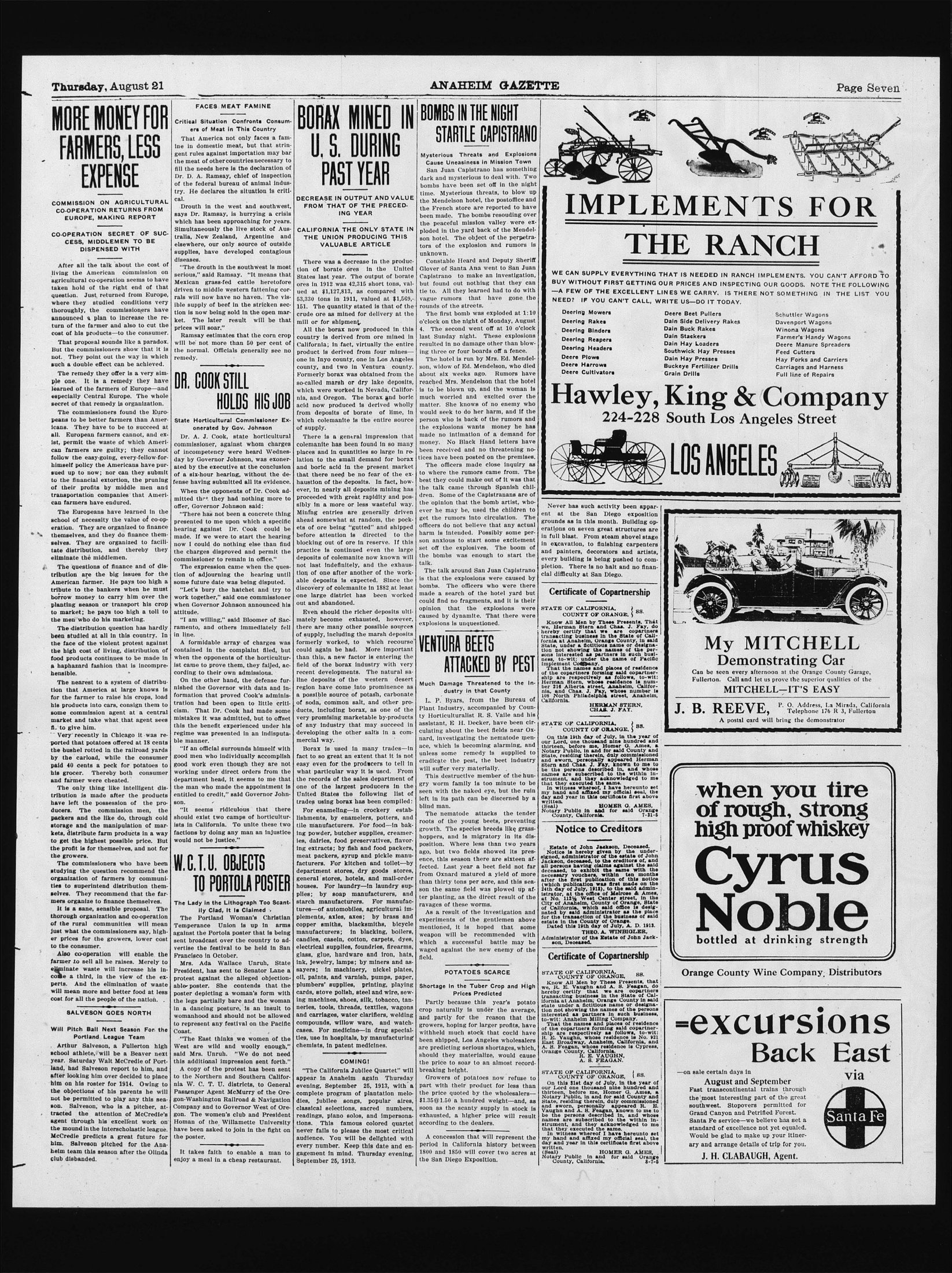
Searchable text
MORE MONEY FOR FARMERS, LESS EXPENSE
COMMISSION ON AGRICULTURAL CO-OPERATION RETURNS FROM EUROPE, MAKING REPORT
CO-OPERATION SECRET OF SUCCESS, MIDDLEMEN TO BE DISPENSED WITH
After all the talk about the cost of living the American commission on agricultural co-operation seems to have taken hold of the right end of that question. Just returned from Europe, where they studied conditions very thoroughly, the commissioners have announced a plan to increase the return of the farmer and also to cut the cost of his products—to the consumer.
That proposal sounds like a paradox. But the commissioners show that it is not. They point out the way in which such a double effect can be achieved.
The remedy they offer is a very simple one. It is a remedy they have learned of the farmers of Europe—and especially Central Europe. The whole secret of that remedy is organization.
The commissioners found the Europeans to be better farmers than Americans. They have to be to succeed at all. European farmers cannot, and exist, permit the waste of which American farmers are guilty; they cannot follow the easy-going, every-fellow-for-himself policy the Americans have pursued up to now; nor can they submit
FACES MEAT FAMINE
Critical Situation Confronts Consumers of Meat in This Country
That America not only faces a famine in domestic meat, but that stringent rules against importation may bar the meat of other countries necessary to fill the needs here is the declaration of Dr. D. A. Ramsay, chief of inspection of the federal bureau of animal industry. He declares the situation is critical.
Drought in the west and southwest, says Dr. Ramsay, is hurrying a crisis which has been approaching for years. Simultaneously the live stock of Australia, New Zealand, Argentine and elsewhere, our only source of outside supplies, have developed contagious diseases.
"The drouth in the southwest is most serious," said Ramsay. "It means that Mexican grass-fed cattle heretofore driven to middle western fattening corals will now have no haven. The visible supply of beef in the stricken section is now being sold in the open market. The later result will be that prices will soar."
Ramsay estimates that the corn crop will be not more than 50 per cent of the normal. Officials generally see no remedy.
DR. COOK STILL HOLDS HIS JOB
State Horticultural Commissioner Exonerated by Gov. Johnson
Dr. A. J. Cook, state horticultural commissioner, against whom charges of incompetency were heard Wednesday by Governor Johnson, was exonerated by the executive at the conclusion of a six-hour hearing without the de-
The remedy they offer is a very simple one. It is a remedy they have learned of the farmers of Europe—and especially Central Europe. The whole secret of that remedy is organization.
The commissioners found the Europeans to be better farmers than Americans. They have to be to succeed at all. European farmers cannot, and exist, permit the waste of which American farmers are guilty; they cannot follow the easy-going, every-fellow-for-himself policy the Americans have pursued up to now; nor can they submit to the financial extortion, the pruning of their profits by middle men and transportation companies that American farmers have endured.
The Europeans have learned in the school of necessity the value of co-operation. They are organized to finance themselves, and they do finance themselves. They are organized to facilitate distribution, and thereby they eliminate the middlemen.
The questions of finance and of distribution are the big issues for the American farmer. He pays too high a tribute to the bankers when he must borrow money to carry him over the planting season or transport his crop to market; he pays too high a toll to the men who do his marketing.
The distribution question has hardly been studied at all in this country. In the face of the violent protest against the high cost of living, distribution of food products continues to be made in a haphazard fashion that is incomprehensible.
The nearest to a system of distribution that America at large knows is for the farmer to raise his crops, load his products into cars, consign them to some commission agent at a central market and take what that agent sees fit to give him.
Very recently in Chicago it was reported that potatoes offered at 18 cents the bushel rotted in the railroad yards by the carload, while the consumer paid 40 cents a peck for potatoes to his grocer. Thereby both consumer and farmer were cheated.
The only thing like intelligent distribution is made after the products have left the possession of the producers. The commission men, the packers and the like do, through cold storage and the manipulation of markets, distribute farm products in a way to get the highest possible price. But the profit is for themselves, and not for the growers.
The commissioners who have been studying the question recommend the organization of farmers by communities to superintend distribution themselves. They recommend that the far-
DR. COOK STILL HOLDS HIS JOB
State Horticultural Commissioner Exonerated by Gov. Johnson
Dr. A. J. Cook, state horticultural commissioner, against whom charges of incompetency were heard Wednesday by Governor Johnson, was exonerated by the executive at the conclusion of a six-hour hearing, without the defense having submitted all its evidence.
When the opponents of Dr. Cook admitted that they had nothing more to offer, Governor Johnson said:
“There has not been a concrete thing presented to me upon which a specific hearing against Dr. Cook could be made. If we were to start the hearing now I could do nothing else than find the charges disproved and permit the commissioner to remain in office.”
The expression came when the question of adjourning the hearing until some future date was being disputed.
“Let's bury the hatchet and try to work together,” said one commissioner when Governor Johnson announced his attitude.
“I am willing,” said Bloomer of Sacramento, and others immediately fell in line.
A formidable array of charges was contained in the complaint filed, but when the opponents of the horticulturist came to prove them, they failed, according to their own admissions.
On the other hand, the defense furnished the Governor with data and information that proved Cook’s administration had been open to little criticism. That Dr. Cook had made some mistakes it was admitted, but to offset this the benefit experienced under his regime was presented in an indisputable manner.
“If an official surrounds himself with good men who individually accomplish good work even though they are not working under direct orders from the department head, it seems to me that the man who made the appointment is entitled to credit,” said Governor Johnson.
“It seems ridiculous that there should exist two camps of horticulturists in California. To unite these two factions by doing any man an injustice would not be justice.”
W.C.T.U. OBJECTS TO PORTOLA POSTER
have left the possession of the producers. The commission men, the packers and the like do, through cold storage and the manipulation of markets, distribute farm products in a way to get the highest possible price. But the profit is for themselves, and not for the growers.
The commissioners who have been studying the question recommend the organization of farmers by communities to superintend distribution themselves. They recommend that the farmers organize to finance themselves.
It is a sane, sensible proposal. The thorough organization and co-operation of the rural communities will mean just what the commissioners say, higher prices for the growers, lower cost to the consumer.
Also co-operation will enable the farmer to sell all he raises. Merely to eliminate waste will increase his income a third, in the view of the experts. And the elimination of waste will mean more and better food at less cost for all the people of the nation.
SALVESON GOES NORTH
Will Pitch Ball Next Season For the Portland League Team
Arthur Salveson, a Fullerton high school athlete, will be a Beaver next year. Saturday Walt McCredie of Portland, had Salveson report to him, and after looking him over decided to place him on his roster for 1914. Owing to the objections of his parents he will not be permitted to play any this season. Salveson, who is a pitcher, attracted the attention of McCredie's agent through his excellent work on the mound in the interscholastic league. McCredie predicts a great future for him. Salveson pitched for the Anaheim team this season after the Olinda club disbanded.
“It seems ridiculous that there should exist two camps of horticulturists in California. To unite these two factions by doing any man an injustice would not be justice.”
W.C.T.U. OBJECTS TO PORTOLA POSTER
The Lady in the Lithograph Too Scantily Clad, It Is Claimed
The Portland Woman’s Christian Temperance Union is up in arms against the Portola poster that is being sent broadcast over the country to advertise the festival to be held in San Francisco in October.
Mrs. Ada Wallace Unruh, State President, has sent to Senator Lane a protest against the alleged objectionable poster. She contends that the poster depicting a woman’s form with the legs partially bare and the woman in a dancing posture, is an insult to womanhood and should not be allowed to represent any festival on the Pacific Coast.
“The East thinks we women of the West are wild and woolly enough,” said Mrs. Unruh. “We do not need this additional impression sent forth.”
A copy of the protest has been sent to the Northern and Southern California W. C. T. U. districts, to General Passenger Agent McMurry of the Oregon-Washington Railroad & Navigation Company and to Governor West of Oregon. The women’s club and President Homan of the Willamette University have been asked to join in the fight on the poster.
It takes faith to enable a man to enjoy a meal in a cheap restaurant.
For enamelling—lithishments, by enamelling tile manufacturers. Using powder, butcheries, dairies, food processing extracts; by fish meat packers, syrup facturers. For kitchen department stores, general stores, hotel houses. For laundries plies; by soap mastarch manufacture; pictures—of automobile plements, axles, ax copper smiths, black manufacturers; in candles, casein, cotton electrical supplies, glass, glue, hardware ink, jewelry, lamps; sayers; in machine oil, paints, and various plumbers’ supplies; cards, stove polish, ing machines, shoes neries, tools, thread and carriages, water compounds, willow cases. For medicine ties, use in hospitals chemists, in patent medicines.
“The California Jumper appear in Anaheim evening, September complete program dies, jubilee song classical selections readings, piano solutions. This famous never falls to please audience. You will every number. Keep engagement in mind. September 25, 1913.”
BORAX MINED IN U.S. DURING PAST YEAR
DECREASE IN OUTPUT AND VALUE FROM THAT OF THE PRECEDING YEAR
CALIFORNIA THE ONLY STATE IN THE UNION PRODUCING THIS VALUABLE ARTICLE
There was a decrease in the production of borate ores in the United States last year. The output of borate ores in 1912 was 42,315 short tons, valued at $1,127,813, as compared with 53,330 tons in 1911, valued at $1,569,-151. The quantity stated is that of the crude ore as mined for delivery at the mill or for shipment.
All the borax now produced in this country is derived from ore mined in California; in fact, virtually the entire product is derived from four mines—one in Inyo county, one in Los Angeles county, and two in Ventura county. Formerly borax was obtained from the so-called marsh or dry lake deposits, which were worked in Nevada, California, and Oregon. The borax and boric acid now produced is derived wholly from deposits of borate of lime, in which colemanite is the entire source of supply.
There is a general impression that colemanite has been found in so many places and in quantities so large in relation to the small demand for borax and boric acid in the present market that there need be no fear of the ex-
Formerly borax was obtained from the so-called marsh or dry lake deposits, which were worked in Nevada, California, and Oregon. The borax and boric acid now produced is derived wholly from deposits of borate of lime, in which colemanite is the entire source of supply.
There is a general impression that colemanite has been found in so many places and in quantities so large in relation to the small demand for borax and boric acid in the present market that there need be no fear of the exhaustion of the deposits. In fact, however, in nearly all deposits mining has proceeded with great rapidity and possibly in a more or less wasteful way. Minfng entries are generally driven ahead somewhat at random, the pockets of ore being "gutted" and shipped before attention is directed to the blocking out of ore in reserve. If this practice is continued even the large deposits of colemanite now known will not last indefinitely, and the exhaustion of one after another of the workable deposits is expected. Since the discovery of colemanite in 1882 at least one large district has been worked out and abandoned.
Even should the richer deposits ultimately become exhausted, however, there are many other possible sources of supply, including the marsh deposits formerly worked, to which recourse could again be had. More important than this, a new factor is entering the field of the borax industry with very recent developments. The natural saline deposits of the western desert region have come into prominence as a possible source of potash, carbonate of soda, common salt, and other products, including borax, as one of the very promising marketable by-products of any industry that may succeed in developing the other salts in a commercial way.
Borax is used in many trades—in fact to so great an extent that it is not easy even for the producers to tell in what particular way it is used. From the records of the sales department of one of the largest producers in the United States the following list of trades using borax has been compiled:
For enamelling—in crockery establishments, by enamelers, potters, and tile manufacturers. For food—in baking powder, butcher supplies, creameries, dairies, food preservatives, flavoring extracts; by fish and food packers, meat packers, syrup and pickle manufacturers. For kitchen and toilet—by department stores, dry goods stores, general stores, hotels, and mail-order houses. For laundry—in laundry supplies; by soap manufacturers, and about six weeks ago. Rumors have reached Mrs. Mendelson that the hotel is to be blown up, and the woman is much worried and excited over the matter. She knows of no enemy who would seek to do her harm, and if the person who is back of the rumors and the explosions wants money he has made no intimation of a demand for money. No Black Hand letters have been received and no threatening notices have been posted on the premises.
The officers made close inquiry as to where the rumors came from. The best they could make out of it was that the talk came through Spanish children. Some of the Capistranans are of the opinion that the bomb artist, who ever he may be, used the children to get the rumors into circulation. The officers do not believe that any actual harm is intended. Possibly some person anxious to start some excitement set off the explosives. The boom of the bombs was enough to start the talk.
The talk around San Juan Capistrano is that the explosions were caused by bombs. The officers who were there made a search of the hotel yard but could find no fragments, and it is their opinion that the explosions were caused by dynamite. That there were explosions is unquestioned.
VENTURA BEETS ATTACKED BY PEST
Much Damage Threatened to the Industry in that County
L. P. Byars, from the Bureau of Plant Industry, accompanied by County Horticulturalist R. S. Valle and his assistant, E H. Decker, have been circulating about the beet fields near Oxnard, investigating the nematode menace, which is becoming alarming, and unless some remedy is supplied to eradicate the pest, the beet industry will suffer very materially.
This destructive member of the hungry worm family is too minute to be seen with the naked eye, but the ruin left in its path can be discerned by a blind man.
The nematode attacks the tender roots of the young beets, preventing growth. The species breeds like grasshoppers, and is migratory in its disposition. Where less than two years ago, but two fields showed its presence, this season there are sixteen affected. Last year a beet field not far from Oxnard matured a yield of more than thirty tons per acre, and this season the same field was plowed up after planting, as the direct result of the
Certificate of Copartnership
STATE OF CALIFORNIA,
COUNTY OF ORANGE,
SS.
Know All Men by These Presents, That we, Herman Stern and Chas. J. Fay, do hereby certify that we are copartners transacting business in the State of California at Anaheim, Orange County, in said State, under a fictitious name or designation not showing the names of the persons interested as partners in such business, to-wit: under the name of Pacific Implement Company.
That the names and places of residence of the copartners forming said copartners are respectively as follows, to-wit: Herman Stern, whose residence is number 216 Alberta street, Anaheim, California, and Chas. J. Fay, whose number is 108 North Philadelphia street, Anaheim, California.
HERMAN STERN,
CHAS. J. FAY.
STATE OF CALIFORNIA,
COUNTY OF ORANGE,
SS.
On this 19th day of July, in the year of our Lord, one thousand nine hundred and thirteen, before me, Homer G. Ames, a Notary Public, in and for said County and State, residing therein, duly commissioned and sworn personally appeared Herman Stern and Chas. J. Fay, known to me to be the persons described in, and whose names are subscribed to the within instrument, and they acknowledged to me that they executed the same.
In witness whereof I have hereunto set my hand and affirmed my official seal, the day and year in this certificate first above written.
(Seal)
HOMER G. AMES,
Notary Public in and for said Orange County, California.
Notice to Creditors
Estate of John Jackson, Deceased.
Notice is hereby given by the undersigned, administrator of the estate of John Jackson, deceased, to the creditors of, and all persons having claims against the said deceased, to exhibit the same with the necessary vouchers, within ten months after the first publication of this notice (which publication was first made on the 24th day of July, 1913), to the said administrator, at the office of Melrose & Ames, at No. 112½ West Center street, in
For enamelling—in crockery establishments, by enamelers, potters, and tile manufacturers. For food—in baking powder, butcher supplies, creameries, dairies, food preservatives, flavoring extracts; by fish and food packers, meat packers, syrup and pickle manufacturers. For kitchen and toilet—by department stores, dry goods stores, general stores, hotels, and mail-order houses. For laundry—in laundry supplies; by soap manufacturers, and starch manufacturers. For manufactures—of automobiles, agricultural implements, axles, axes; by brass and copper smiths, blacksmiths, bicycle manufacturers; in blacking, boilers, candles, casein, cotton, carpets, dyes, electrical supplies, foundries, firearms, glass, glue, hardware and iron, hats, ink, jewelry, lamps; by miners and assayers; in machinery, nickel plates, oil, paints, and varnish, pumps, paper, plumbers' supplies, printing, playing cards, stove polish, steel and wire, sewing machines, shoes, silk, tobacco, tanners, tools, threads, textiles, wagons and carriages, water clarifiers, welding compounds, willow ware, and watchcases. For medicine—in drug specialties, use in hospitals, by manufacturing chemists, in patent medicines.
COMING!
"The California Jubilee Quartet" will appear in Anaheim again Thursday evening, September 25, 1913, with a complete program of plantation melodies, jubilee songs, popular airs, classical selections, sacred numbers, readings, piano solos, and impersonations. This famous colored quartet never falls to please the most critical audience. You will be delighted with every number. Keep this date and engagement in mind. Thursday evening, September 25, 1913.
The nematode attacks the tender roots of the young beets, preventing growth. The species breeds like grasshoppers, and is migratory in its disposition. Where less than two years ago, but two fields showed its presence, this season there are sixteen affected. Last year a beet field not far from Oxnard matured a yield of more than thirty tons per acre, and this season the same field was plowed up after planting, as the direct result of the ravages of these worms.
As a result of the investigation and experiments of the gentlemen above mentioned, it is hoped that some weapon will be recommended with which a successful battle may be waged against the new enemy of the field.
POTATOES SCARCE
Shortage in the Tuber Crop and High Prices Predicted
Partly because this year's potato crop naturally is under the average, and partly for the reason that the growers, hoping for larger profits, have withheld much stock that could have been shipped. Los Angeles wholesalers are predicting serious shortages, which should they materialize, would cause the price to soar to an almost record-breaking height.
Growers of potatoes now refuse to part with their product for less than the price quoted by the wholesalers—$1.35@1.50 a hundred weight—and, as soon as the scanty supply in stock is exhausted, a higher price will result according to the dealers.
A concession that will represent the period in California history between 1800 and 1850 will cover two acres at the San Diego Exposition.
NOTICE TO CREDITORS
Estate of John Jackson, Deceased.
Notice is hereby given by the undersigned, administrator of the estate of John Jackson, deceased, to the creditors of, and all persons having claims against the said deceased, to exhibit the same with the necessary vouchers within ten months after the first publication of this notice (which publication was first made on the 24th day of July, 1913), to the said administrator, at the office of Meirose & Ames,
at No. 112½ West Center street, in the City of Anaheim, County of Orange State of California, which said office is designated by said administrator as the place for the transaction of the business of said estate in the County of Orange.
Dated this 19th day of July, A. D. 1913.
THEO. A. WINBIGLER,
Administrator of the Estate of John Jackson,
Certificate of Copartnership
STATE OF CALIFORNIA,
COUNTY OF ORANGE,
SS.
Know All Men by These Presents,
that we R.E.Vaughn and A.S.Feagan do hereby certify that we are copartners transacting business in the State of California at Anaheim; Orange County in said state under a fictitious name or designation not showing the names of the persons interested as partners in such business,
to-wit: Anaheim Milling Company.
That the names and places of residence of the copartners forming said copartnership are respectively as follows; to-wit:
R.E.Vaughn whose residence is No. 921 East Broadway; Anaheim California; and A.S.Feagan whose residence is Cypress,
Orange County; California.
R.E.Vaughn;
A.S.Feagan.
STATE OF CALIFORNIA,
COUNTY OF ORANGE,
SS.
On this $1st day of July, in the year of our Lord one thousand nine hundred and thirteen before me, Homer G. Ames,
a Notary Public, in and for said County and State, residing therein, duly commissioned and sworn personally appeared R.E.Vaughn and A.S.Feagan known to me to be the persons described in, and whose names are subscribed to the within instrument, and they acknowledged to me that they executed the same.
In witness whereof I have hereunto set my hand and affixed my official seal, the day and year in this certificate first above written.
(Seal)
HOMER G. AMES,
Notary Public in and for said Orange County; California.
8-7-5
IMPLEMENTS FOR
THE RANCH
PLY EVERYTHING THAT IS NEEDED IN RANCH IMPLEMENTS. YOU CAN'T AFFORD TO
FIRST GETTING OUR PRICES AND INSPECTING OUR GOODS. NOTE THE FOLLOWING
THE EXCELLENT LINES WE CARRY. IS THERE NOT SOMETHING IN THE LIST YOU
OU CAN'T CALL, WRITE US—DO IT TODAY.
awers Deere Beet Pullers Schuttler Wagons
kes Dain Side Delivery Rakes Davenport Wagons
aders Dain Buck Rakes Winona Wagons
apers Dain Stackers Farmer's Handy Wagons
eaders Dain Hay Loaders Deere Manure Spreaders
e Southwick Hay Presses Feed Cutters
ows Dain Hay Presses Hay Forks and Carriers
vators Buckeye Fertilizer Drills Carriages and Harness
grain Drills Full line of Repairs
Hwley, King & Company
224-228 South Los Angeles Street
LOS ANGELES
wley, King & Company
224-228 South Los Angeles Street
LOS ANGELES
Coppartnership
ORNIA,
F ORANGE.
These Presents, That and Chas. J. Fay, do we are copartners in the State of Calorange County, in said name or designanames of the perpartners in such busithe name of Pacific
and places of residence
forming said copartnerly as follows, to-wit:
residence is numbet, Anaheim, California
way, whose number is
phia street, Anaheim,
ERMAN STERN,
MAS. J. FAY.
ORNIA,
F ORANGE.
of July, in the year of
and nine hundred and
Homer G. Ames, a
d for said County and
in, duly commissioned
fully appeared Herman
Fay, known to me to
scribed in, and whose
need to the within inacknowledged to me
the same.
I have hereunto set
my official seal, the
certificate first above
HOMER G. AMES,
and for said Orange
la.
Creditors
Jackson, Deceased.
given by the underr of the estate of John
to the creditors of, and
claims against the said
the same with the
within ten months
ication of this notice
was first made on the
(3), to the said admineer of Meirose & Ames,
Center street, in the
My MITCHELL Demonstrating Car
Can be seen every afternoon at the Orange County Garage,
Fullerton. Call and let us prove the superior qualities of the MITCHELL—IT'S EASY
J. B. REEVE,
P. O. Address, La Mirada, California
Telephone 176 R 3, Fullerton
A postal card will bring the demonstrator
when you tire
of rough, strong
high proof whiskey
Cyrus
of rough, strong high proof whiskey
Cyrus Noble
bottled at drinking strength
Orange County Wine Company, Distributors
=excursions
Back East
—on sale certain days in
August and September
Fast transcontinental trains through the most interesting part of the great southwest. Stopovers permitted for Grand Canyon and Petrified Forest.
Santa Fe service—we believe has set a standard of excellence not yet equaled. Would be glad to make up your itinerary and arrange details of trip for you.
J. H. CLABAUGH, Agent.