anaheim-gazette 1913-08-07
Scanned page
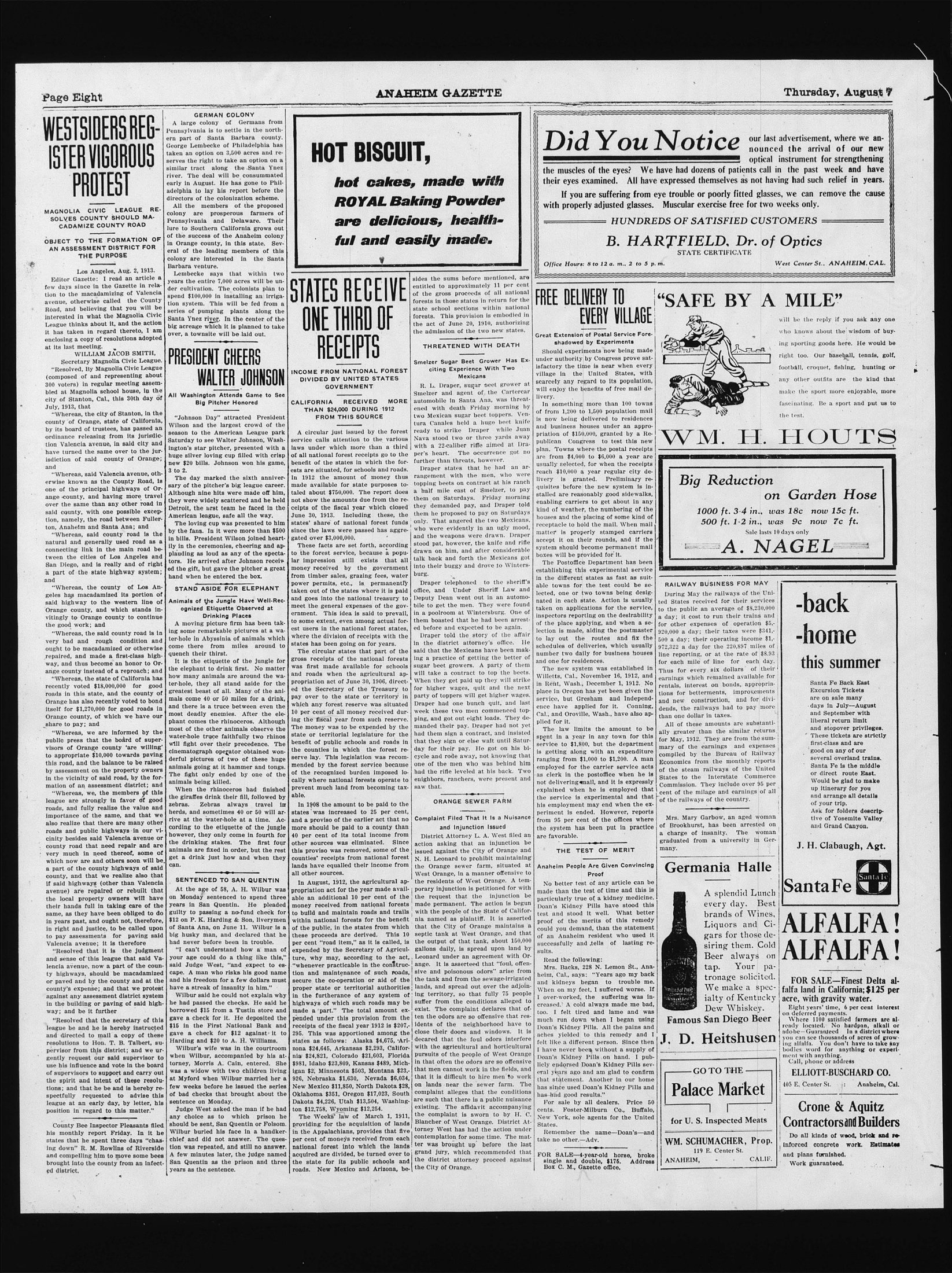
Searchable text
WESTSIDERS REGISTER VIGOROUS PROTEST
MAGNOLIA CIVIC LEAGUE RESOLVES COUNTY SHOULD MACADAMIZE COUNTY ROAD
OBJECT TO THE FORMATION OF AN ASSESSMENT DISTRICT FOR THE PURPOSE
Los Angeles, Aug. 2, 1913.
Editor Gazette: I read an article a few days since in the Gazette in relation to the macadamizing of Valencia avenue, otherwise called the County Road, and believing that you will be interested in what the Magnolia Civic League thinks about it, and the action it has taken in regard thereto, I am enclosing a copy of resolutions adopted at its last meeting.
WILLIAM JACOB SMITH,
Secretary Magnolia Civic League.
"Resolved, By Magnolia Civic League (composed of and representing about 300 voters) in regular meeting assembled at Magnolia school house, in the city of Stanton, Cal., this 30th day of July, 1913, that
"Whereas, the city of Stanton, in the county of Orange, state of California, by its board of trustees, has passed an ordinance releasing from its jurisdiction Valencia avenue, in said city and have turned the same over to the jurisdiction of said county of Orange; and
"Whereas said Valencia avenue, oth-
GERMAN COLONY
A large colony of Germans from Pennsylvania is to settle in the northern part of Santa Barbara county. George Lembecke of Philadelphia has taken an option on 3,500 acres and reserves the right to take an option on a similar tract along the Santa Ynez river. The deal will be consummated early in August. He has gone to Philadelphia to lay his report before the directors of the colonization scheme.
All the members of the proposed colony are prosperous farmers of Pennsylvania and Delaware. Their lure to Southern California grows out of the success of the Anaheim colony in Orange county, in this state. Several of the leading members of this colony are interested in the Santa Barbara venture.
Lembecke says that within two years the entire 7,000 acres will be under cultivation. The colonists plan to spend $100,000 in installing an irrigation system. This will be fed from a series of pumping plants along the Santa Ynez river. In the center of the big acreage which it is planned to take over, a townsite will be laid out.
PRESIDENT CHEERS
WALTER JOHNSON
All Washington Attends Game to See Big Pitcher Honored
"Johnson Day" attracted President Wilson and the largest crowd of the season to the American League park Saturday to see Walter Johnson, Washington's star pitcher, presented with a huge silver loving cup filled with crisp new $20 bills. Johnson won his game, 3 to 2.
WALTER JOHNSON
All Washington Attends Game to See Big Pitcher Honored
"Johnson Day" attracted President Wilson and the largest crowd of the season to the American League park Saturday to see Walter Johnson, Washington's star pitcher, presented with a huge silver loving cup filled with crisp new $20 bills. Johnson won his game, 3 to 2.
The day marked the sixth anniversary of the pitcher's big league career. Although nine hits were made off him, they were widely scattered and he held Detroit, the first team he faced in the American league, safe all the way.
The loving cup was presented to him by the fans. In it were more than $500 in bills. President Wilson joined heartily in the ceremonies, cheering and applauding as loud as any of the spectators. He arrived after Johnson received the gift, but gave the pitcher a great hand when he entered the box.
STAND ASIDE FOR ELEPHANT
Animals of the Jungle Have Well-Recognized Etiquette Observed at Drinking Places
A moving picture firm has been taking some remarkable pictures at a water-hole in Abyssinia of animals which come there from miles around to quench their thirst.
It is the etiquette of the jungle for the elephant to drink first. No matter how many animals are around the water-hole, they all stand aside for the greatest beast of all. Many of the animals come 40 or 50 miles for a drink, and there is a truce between even the most deadly enemies. After the elephant comes the rhinoceros. Although most of the other animals observe the water-hole truce faithfully two rhinos will fight over their precedence. The cinematograph operator obtained wonderful pictures of two of these huge animals going at it hammer and tongs. The fight only ended by one of the animals being killed.
When the rhinoceros had finished the giraffes drink their fill, followed by zebras. Zebras always travel in herds, and sometimes 40 or 50 will arrive at the water-hole at a time. According to the etiquette of the jungle however, they only come in fourth for the drinking stakes. The first four animals are fixed in order, but the rest get a drink just how and when they can.
SENTENCED TO SAN QUENTIN
At the age of 58, A. H. Wilbur was on Monday sentenced to spend three
A circular just issue service calls attention laws under which most of all national forest benefits are situated, for sale. In 1912 the amount made available for sales tailed about $750,000. It does not show the amounts ceipts of the fiscal year June 30, 1913. Includes states' share of nation since the laws were gated over $3,000,000.
These facts are set to the forest service, lar impression still money received by from timber sales, grape power permits, etc., taken out of the state and goes into the nation meet the general government. This idea is to some extent, even best users in the nation where the division of states has been going.
The circular states gross receipts of this was first made available and roads when the propriation act of Jun ed the Secretary of Pay over to the state which any forest res ects 10 per cent of all mo nging the fiscal year fr ee. The money was to be state or territorial lea benefit of public sch othe counties in which serve lay. This legisl mended by the forest of the recognized bu cally where national prevent much land fro able.
In 1908 the amount states was increased and a proviso of the more should be paid 40 per cent of its to other sources was en this proviso was rem county's receipts from lands have equalled all other sources.
In August, 1912, the propriation act for th able an additional 10
league are strongly in favor of good roads, and fully realize the value and importance of the same, and that we also realize that there are many other roads and public highways in our vicinity besides said Valencia avenue or county road that need repair and are very much in need thereof, some of which now are and others soon will be a part of the county highways of said county, and that we realize also that if said highway (other than Valencia avenue) are repaired or rebuilt that the local property owners will have their hands full in taking care of the same, as they have been obliged to do in years past, and ought not, therefore, in right and justice, to be called upon to pay assessments for paving said Valencia avenue; it is therefore
“Resolved that it is the judgment and sense of this league that said Valencia avenue, now a part of the county highways, should be macadamized or paved and by the county and at the county’s expense; and that we protest against any assessment district system in the building or paving of said highway; and be it further
“Resolved that the secretary of this league be and he is hereby instructed and directed to mail a copy of these resolutions to Hon. T. B. Talbert, supervisor from this district; and we urgently request our said supervisor to use his influence and vote in the board of supervisors to support and carry out the spirit and intent of these resolutions; and that he be and is hereby respectfully requested to advise this league at an early day, by letter, his position in regard to this matter.”
County Bee Inspector Pleasants filed his monthly report Friday. In it he states that he spent three days “chasing down” R. M. Rowlins of Riverside and compelling him to move some bees brought into the county from an infected district.
Zebras always travel in herds, and sometimes 40 or 50 will arrive at the water-hole at a time. According to the etiquette of the jungle however, they only come in fourth for the drinking stakes. The first four animals are fixed in order, but the rest get a drink just how and when they can.
SENTENCED TO SAN QUENTIN
At the age of 58, A. H. Wilbur was on Monday sentenced to spend three years in San Quentin. He pleaded guilty to passing a no-fund check for $12 on P. K. Harding & Son, liverymen of Santa Ana, on June 11. Wilbur is a big husky man, and declared that he had never before been in trouble.
“I can’t understand how a man of your age could do a thing like this,” said Judge West, “and expect to escape. A man who risks his good name and his freedom for a few dollars must have a streak of insanity in him.”
Wilbur said he could not explain why he had passed the checks. He said he borrowed $15 from a Tustin store and gave a check for it. He deposited the $15 in the First National Bank and gave a check for $12 against it to Harding and $20 to A. H. Williams.
Wilbur's wife was in the courtroom when Wilbur, accompanied by his attorney, Morris A. Cain, entered. She was a widow with two children living at Myford when Wilbur married her a few weeks before he issued the series of bad checks that brought about the sentence on Monday.
Judge West asked the man if he had any choice as to which prison he should be sent, San Quentin or Folsom. Wilbur buried his face in a handkerchief and did not answer. The question was repeated, and still no answer. A few minutes later, the judge named San Quentin as the prison and three years as the sentence.
In 1908 the amount of states was increased and a proviso of the more should be paid 40 per cent of its total other sources was enforced this proviso was remitted counties’ receipts from lands have equalled all other sources.
In August, 1912, the propriation act for the able an additional 100 money received from to build and maintain within national forests of the public, in the these proceeds are one per cent “road item,” expended by the Secretary, why may, accon “whenever practicable and maintenance secure the co-operation proper state or territory in the furtherance of highways of which she made a part.” The suspended under this proceipts of the fiscal 295. This was apportioned states as follows: Arizona $24,645, Arkansas $24,821, Colorado $981, Idaho $23,809, Kansas $2, Minnesota $926, Nebraska $1,630 New Mexico $11,850 Oklahoma $351 Oregon Dakota $4,226 Utah ton $12,758 Wyoming.
The Weeks' law on providing for the access in the Appalachians, per cent of moneys ripe national forest into acquired are divided, the state for its purroads. New Mexico
HOT BISCUIT,
hot cakes, made with ROYAL Baking Powder are delicious, healthful and easily made.
STATES RECEIVE ONE THIRD OF RECEIPTS
INCOME FROM NATIONAL FOREST DIVIDED BY UNITED STATES GOVERNMENT
CALIFORNIA RECEIVED MORE THAN $24,000 DURING 1912 FROM THIS SOURCE
A circular just issued by the forest service calls attention to the various laws under which more than a third of all national forest receipts go to the benefit of the states in which the forests are situated, for schools and roads.
sides the sums before mentioned, are entitled to approximately 11 per cent of the gross proceeds of all national forests in those states in return for the state school sections within national forests. This provision is embodied in the act of June 20, 1910, authorizing the admission of the two new states.
THREATENED WITH DEATH
Smelzer Sugar Beet Grower Has Exciting Experience With Two Mexicans
R. L. Draper, sugar beet grower at Smelzer and agent of the Cartercar automobile in Santa Ana, was threatened with death Friday morning by two Mexican sugar beet toppers. Ventura Canales held a huge beet knife ready to strike Draper while Juan Nava stood two or three yards away with a 22-caliber rifle aimed at Draper’s heart. The occurrence got no further than threats, however.
Draper states that he had an agreement with the men who were
Did You Not the muscles of the eyes? We have their eyes examined. All have exp If you are suffering from eye tr with properly adjusted glasses. Mu HUNDREDS B. HART Office Hours: 8 to 12 a.m., 2 to 5 p.m.
FREE DELIVERY TO EVERY VILLAGE
Great Extension of Postal Service Foreshadowed by Experiments
Should experiments now being made under authority by Congress prove satisfactory the time is near when every village in the United States, with scarcely any regard to its population, will enjoy the benefits of free mail delivery.
In something more than 100 towns of from 1,200 to 1,500 population mail is now being delivered to residences and business houses under an appropriation of $150,000, granted by a Republican Congress to test this new plan. Towns where the postal receipts are from $4,000 to $6,000 a year are usually selected, for when the receipts reach $10,000 a year regular city de-
A circular just issued by the forest service calls attention to the various laws under which more than a third of all national forest receipts go to the benefit of the states in which the forests are situated, for schools and roads. In 1912 the amount of money thus made available for state purposes totaled about $750,000. The report does not show the amounts due from the receipts of the fiscal year which closed June 30, 1913. Including these, the states' share of national forest funds since the laws were passed has aggregated over $3,000,000.
These facts are set forth, according to the forest service, because a popular impression still exists that all money received by the government from timber sales, grazing fees, water power permits, etc., is permanently taken out of the states where it is paid and goes into the national treasury to meet the general expenses of the government. This idea is said to prevail, to some extent, even among actual forest users in the national forest states, where the division of receipts with the states has been going on for years.
The circular states that part of the gross receipts of the national forests was first made available for schools and roads when the agricultural appropriation act of June 30, 1906, directed the Secretary of the Treasury to pay over to the state or territory in which any forest reserve was situated 10 per cent of all money received during the fiscal year from such reserve. The money was to be expended by the state or territorial legislature for the benefit of public schools and roads in the counties in which the forest reserve lay. This legislation was recommended by the forest service because of the recognized burden imposed locally where national forests operate to prevent much land from becoming taxable.
In 1908 the amount to be paid to the states was increased to 25 per cent, and a proviso of the earlier act that no more should be paid to a county than 40 per cent of its total income from other sources was eliminated. Since this proviso was removed, some of the counties' receipts from national forest lands have equalled their income from all other sources.
In August, 1912, the agricultural appropriation act for the year made available an additional 10 per cent of the Mexicans.
R. L. Draper, sugar beet grower at Smelzer and agent of the Cartercar automobile in Santa Ana, was threatened with death Friday morning by two Mexican sugar beet toppers. Ventura Canales held a hugo beet knife ready to strike Draper while Juan Nava stood two or three yards away with a 22-caliber rifle aimed at Draper's heart. The occurrence got no further than threats, however.
Draper states that he had an arrangement with the men, who were topping beets on contract at his ranch a half mile east of Smelzer, to pay them on Saturdays. Friday morning they demanded pay, and Draper told them he proposed to pay on Saturdays only. That angered the two Mexicans, who were evidently in an ugly mood, and the weapons were drawn. Draper stood pat, however, the knife and rifle drawn on him, and after considerable talk back and forth the Mexicans got into their buggy and drove to Wintersburg.
Draper telephoned to the sheriff's office, and Under Sheriff Law and Deputy Dean went out in an automobile to get the men. They were found in a poolroom at Wintersburg. One of them boasted that he had been arrested before and expected to be again.
Draper told the story of the affair in the district attorney's office. He said that the Mexicans have been making a practice of getting the better of sugar beet growers. A party of them will take a contract to top the beets. When they get paid up they will strike for higher wages, quit and the next party of toppers will get higher wages. Draper had one bunch quit, and last week these two men commenced tipping, and got out eight loads. They demanded their pay. Draper had not yet had them sign a contract, and insisted that they sign or else wait until Saturday for their pay. He got on his bicycle and rode away, not knowing that one of the men who was behind him had the rifle leveled at his back. Two neighbors, ranchers, were present and saw that.
ORANGE SEWER FARM
Complaint Filed That It Is a Nuisance and Injunction Issued
District Attorney L. A. West filed an action asking that an injunction be issued against the City of Orange and N. H. Leonard to prohibit maintaining the Orange sewer farm, situated at West Orange, in a manner offensive to the residents of West Orange. A temporary injunction is petitioned for with the request that the injunction be village in the United States, with scarcely any regard to its population, will enjoy the benefits of free mail delivery.
In something more than 100 towns of from 1,200 to 1,500 population mail is now being delivered to residences and business houses under an appropriation of $150,000, granted by a Republican Congress to test this new plan. Towns where the postal receipts are from $4,000 to $6,000 a year are usually selected, for when the receipts reach $10,000 a year regular city delivery is granted. Preliminary requisites before the new system is installed are reasonably good sidewalks, enabling carriers to get about in any kind of weather, the numbering of the houses and the placing of some kind of receptacle to hold the mail. When mail matter is properly stamped carriers accept it on their rounds, and if the system should become permanent mail boxes will be provided for it.
The Postoffice Department has been establishing this experimental service in the different states as fast as suitable towns for the test could be selected, one or two towns being designated in each state. Action is usually taken on applications for the service, inspectors reporting on the desirability of the place applying, and when a selection is made, aiding the postmaster to lay out the routes and fix the schedules of deliveries, which usually number two daily for business houses and one for residences.
The new system was established in Willetts, Cal., November 16, 1912, and in Rent, Wash., December 1, 1912. No place in Oregon has yet been given the service, but Gresham and Independence have applied for it. Conning, Cal., and Oroville, Wash., have also applied for it.
The law limits the amount to be spent in a year in any town for this service to $1,800, but the department is getting along with an expenditure ranging from $1,000 to $1,200. A man employed for the carrier service acts as clerk in the postoffice when he is not delivering mail, and it is expressly explained when he is employed that the service is experimental and that his employment may end when the experiment is ended. However, reports from 95 per cent of the offices where the system has been put in practice are favorable.
THE TEST OF MERIT
Anaheim People Are Given Convincing Proof
No better test of any article can be made than the test of time and this is particularly true of a kidney medicine.
In 1908 the amount to be paid to the states was increased to 25 per cent, and a proviso of the earlier act that no more should be paid to a county than 40 per cent of its total income from other sources was eliminated. Since this proviso was removed, some of the counties' receipts from national forest lands have equalled their income from all other sources.
In August, 1912, the agricultural appropriation act for the year made available an additional 10 per cent of the money received from national forests to build and maintain roads and trails within national forests for the benefit of the public, in the states from which these proceeds are derived. This 10 per cent "road item," as it is called, is expended by the Secretary of Agriculture, why may, according to the act, "whenever practicable in the construction and maintenance of such roads, secure the co-operation or aid of the proper state or territorial authorities in the furtherance of any system of highways of which such roads may be made a part." The total amount expended under this provision from the receipts of the fiscal year 1912 is $207,295. This was apportioned among the states as follows: Alaska $4,675, Arizona $24,645, Arkansas $2,293, California $24,821, Colorado $21,603, Florida $981, Idaho $23,809, Kansas $489, Michigan $2, Minnesota $503, Montana $23,926, Nebraska $1,630, Nevada $6,034, New Mexico $11,850, North Dakota $28, Oklahoma $351, Oregon $17,023, South Dakota $4,226, Utah $13,504, Washington $12,758, Wyoming $12,254.
The Weeks' law of March 1, 1911, providing for the acquisition of lands in the Appalachians, provides that five per cent of moneys received from each national forest into which the lands acquired are divided, be turned over to the state for its public schools and roads. New Mexico and Arizona, be-
ORANGE SEWER FARM
Complaint Filed That It Is a Nuisance and Injunction Issued
District Attorney L. A. West filed an action asking that an injunction be issued against the City of Orange and N. H. Leonard to prohibit maintaining the Orange sewer farm, situated at West Orange, in a manner offensive to the residents of West Orange. A temporary injunction is petitioned for with the request that the injunction be made permanent. The action is begun with the people of the State of California named as plaintiff. It is asserted that the City of Orange maintains a septic tank at West Orange, and that the output of that tank, about 150,000 gallons daily, is spread upon land by Leonard under an agreement with Orange. It is asserteeed that "foul, offensive and poisonous odors" arise from the tank and from the sewage-irrigated lands, and spread out over the adjoining territory, so that fully 75 people suffer from the conditions alleged to exist. The complaint declares that often the odors are so offensive that residents of the neighborhood have to close their doors and windows. It is decared that the foul odors interfere with the agricultural and horticultural pursuits of the people of West Orange in that often the odors are so offensive that men cannot work in the fields, and that it is difficult to hire men to work on lands near the sewer farm. The complaint alleges that the conditions are such that there is a public nuisance existing. The affidavit accompanying the complaint is sworn to by H. C. Blancher of West Orange. District Attorney West has had the action under contemplation for some time. The matter was brought up before the last grand jury, which recommended that the district attorney proceed against the City of Orange.
No better test of any article can be made than the test of time and this is particularly true of a kidney medicine. Doan's Kidney Pills have stood this test and stood it well. What better proof of the merits of this remedy could you demand, than the statement of an Anaheim resident who used it successfully and tells of lasting results.
Read the following:
Mrs. Backs, 228 N. Lemon St., Anaheim, Cal., says: "Years ago my back and kidneys began to trouble me. When on my feet, I suffered worse. If I over-worked, the suffering was increased.' A cold always made me bad, too. I felt tired and lame and was much run down when I began using Doan's Kidney Pills. All the pains and aches yielded to this remedy and I felt like a different person. Since then I have never been without a supply of Doan's Kidney Pills on hand. I publicly endorsed Doan's Kidney Pills several years ago and am glad to confirm that statement. Another in our home has since used Doan's Kidney Pills and has had good results."
For sale by all dealers. Price 50 cents. Foster-Milburn Co., Buffalo, New York, sole agents for the United States.
Remember the name—Doan's—and take no other.—Adv.
FOR SALE—4-year-old horse, broke single and double,$175. Address Box C. M., Gazette office.
THURSDAY, August 7
You Notice our last advertisement, where we announced the arrival of our new optical instrument for strengthening the eyes? We have had dozens of patients call in the past week and have examined. All have expressed themselves as not having had such relief in years. In suffering from eye trouble or poorly fitted glasses, we can remove the cause and adjusted glasses. Muscular exercise free for two weeks only.
HUNDREDS OF SATISFIED CUSTOMERS
B. HARTFIELD, Dr. of Optics
STATE CERTIFICATE
12 a.m., 2 to 5 p.m.
West Center St., ANAHEIM, CAL.
SAFE BY A MILE
will be the reply if you ask any one who knows about the wisdom of buying sporting goods here. He would be right too. Our baseball, tennis, golf, football, croquet, fishing, hunting or any other outfits are the kind that make the sport more enjoyable, more fascinating. Be a sport and put us to the test.
WM. H. HOUTS
WM. H. HOUTS
Big Reduction on Garden Hose
1000 ft. 3-4 in., was 18c now 15c ft.
500 ft. 1-2 in., was 9c now 7c ft.
Sale lasts 10 days only
A. NAGEL
RAILWAY BUSINESS FOR MAY
During May the railways of the United States received for their services to the public an average of $8,230,000 a day; it cost to run their trains and for other expenses of operation $5,920,000 a day; their taxes were $341,500 a day; their operating income $1,972,322 a day for the 220,897 miles of line reporting, or at the rate of $8.93 for each mile of line for each day.
Thus for every six dollars of their earnings which remained available for rentals, interest on bonds, appropriations for betterments, improvements and new construction, and for dividends, the railways had to pay more than one dollar in taxes.
All of these amounts are substantially greater than the similar returns for May, 1912. They are from the summary of the earnings and expenses compiled by the Bureau of Railway Economics from the monthly reports of the steam railways of the United States to the Interstate Commerce Commission. They include over 95 per cent of the milage and earnings of all of the railways of the country.
Mrs. Mary Garbow, an aged woman of Brookhurst, has been arrested on a charge of insanity. The woman graduated from a university in Germany.
Germania Halle
A splendid Lunch
-back
-home
this summer
Santa Fe Back East Excursion Tickets are on sale many days in July—August and September with liberal return limit and stopover privileges. These tickets are strictly first-class and are good on any of our several overland trains. Santa Fe is the middle or direct route East. Would be glad to make up itinerary for you and arrange all details of your trip.
Ask for folders descriptive of Yosemite Valley and Grand Canyon.
J. H. Clabaugh, Agt.
Santa Fe
Germania Halle
A splendid Lunch every day. Best brands of Wines, Liquors and Cigars for those desiring them. Cold Beer always on tap. Your patronage solicited. We make a specialty of Kentucky Dew Whiskey.
Famous San Diego Beer
J. D. Heitshusen
GO TO THE Palace Market
for U.S. Inspected Meats
WM. SCHUMACHER, Prop.
119 E. Center St.
ANAHEIM, CALIF.
ALFALFA!
ALFALFA!
FOR SALE—Finest Delta alfalfa land in California; $125 per acre, with gravity water.
Eight years' time, 6 per cent interest on deferred payments.
Where 1100 satisfied farmers are already located. No hardpan, alkall or adobe—Guaranteed. In a district where you can see thousands of acres of growing alfalfa. You don't have to take any bodies word for anything or experiment with anything.
Call, phone or address
ELLIOTT-BUSCHARD CO.
405 E. Center St.: Anaheim, Cal.
Crone & Aquitz Contractors and Builders
Do all kinds of wood, brick and reinforced concrete work. Estimates and plans furnished.
Work guaranteed.