anaheim-gazette 1913-07-24
Scanned page
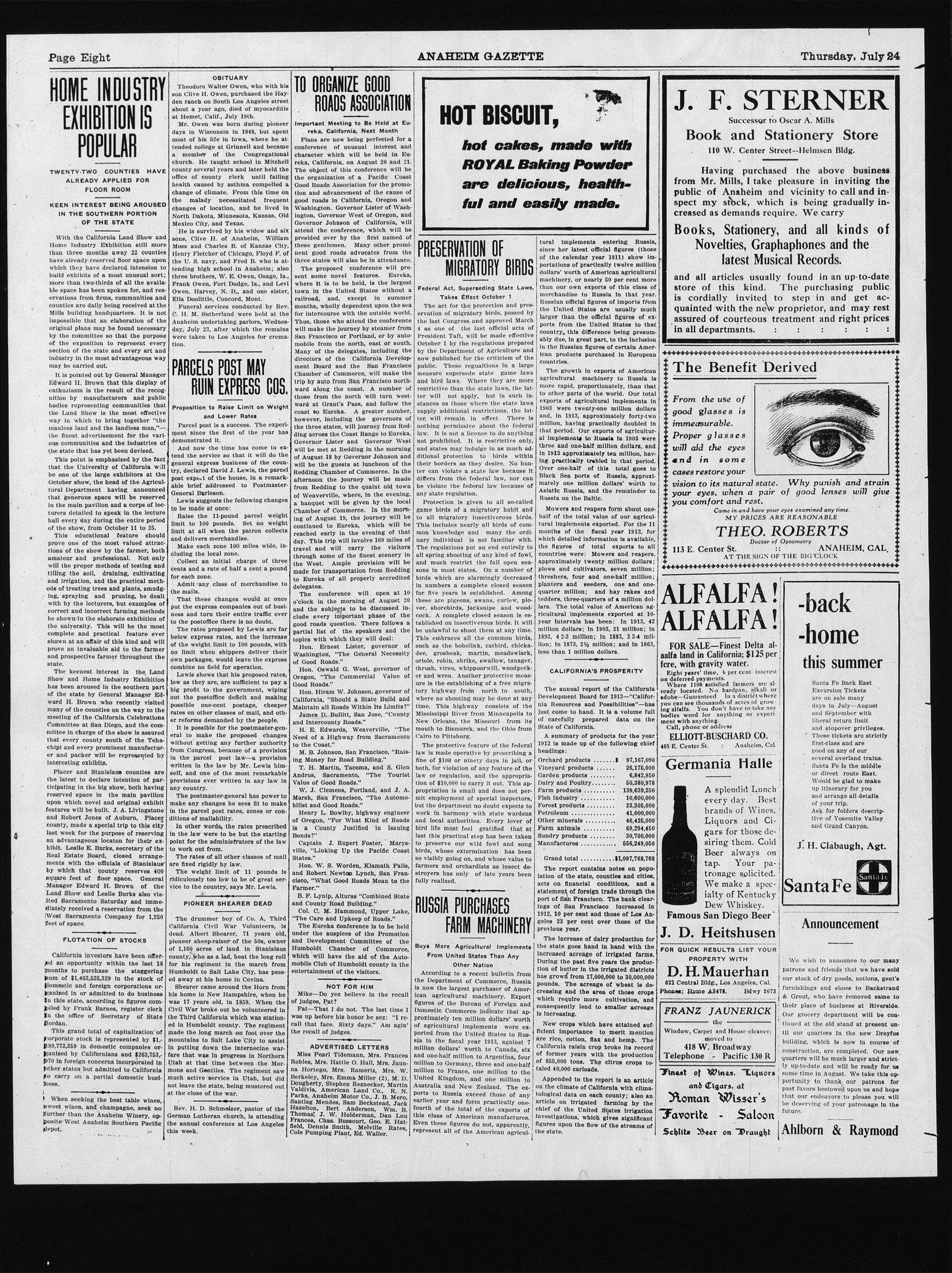
Searchable text
HOME INDUSTRY EXHIBITION IS POPULAR
TWENTY-TWO COUNTIES HAVE ALREADY APPLIED FOR FLOOR ROOM
KEEN INTEREST BEING AROUSED IN THE SOUTHERN PORTION OF THE STATE
With the California Land Show and Home Industry Exhibition still more than three months away 22 counties have already reserved floor space upon which they have declared intension to build exhibits of a most unusual sort; more than two-thirds of all the available space has been spoken for, and reservations from firms, communities and counties are daily being received at the Mills building headquarters. It is not impossible that an elaboration of the original plans may be found necessary by the committee so that the purpose of the exposition to represent every section of the state and every art and industry in the most advantageous way may be carried out.
It is pointed out by General Manager Edward H. Brown that this display of enthusiasm is the result of the recognition by manufacturers and public bodies representing communities that the Land Show is the most effective way in which to bring together "the manless land and the landless man,"—the finest advertisement for the various communities and the industries of the state that has yet been devised.
This point is emphasized by the fact that the University of California will be one of the large exhibitors at the OBITUARY
Theodore Walter Owen, who with his son Clive H. Owen, purchased the Hayden ranch on South Los Angeles street about a year ago, died of myocarditis at Hemet, Calif., July 19th.
Mr. Owen was born during pioneer days in Wisconsin in 1848, but spent most of his life in Iowa, where he attended college at Grinnell and became a member of the Congregational church. He taught school in Mitchell county several years and later held the office of county clerk until failing health caused by asthma compelled a change of climate. From this time on the malady necessitated frequent changes of location, and he lived in North Dakota, Minnesota, Kansas, Old Mexico City, and Texas.
He is survived by his widow and six sons, Clive H. of Anaheim, William Moss and Charles B. of Kansas City, Henry Fletcher of Chicago, Floyd F. of the U.S. navy, and Fred B. who is attending high school in Anaheim; also three brothers, W. E. Owen, Osage, Ia., Frank Owen, Fort Dodge, Ia., and Levi Owen, Harvey, N. D., and one sister, Ella Doolittle, Concord, Mont.
Funeral services conducted by Rev. C. H. M. Sutherland were held at the Anaheim undertaking parlors, Wednesday, July 23, after which the remains were taken to Los Angeles for cremation.
PARCELS POST MAY RUIN EXPRESS COS.
Proposition to Raise Limit on Weight and Lower Rates
Parcel post is a success. The experiment since the first of the year has demonstrated it.
And now the time has come to extend the service so that it will do the general express business of the country, declared David J. Lewis, the parcel
It is pointed out by General Manager Edward H. Brown that this display of enthusiasm is the result of the recognition by manufacturers and public bodies representing communities that the Land Show is the most effective way in which to bring together "the manless land and the landless man,"—the finest advertisement for the various communities and the industries of the state that has yet been devised.
This point is emphasized by the fact that the University of California will be one of the large exhibitors at the October show, the head of the Agricultural Department having announced that generous space will be reserved in the main pavilion and a corps of lecturers detailed to speak in the lecture hall every day during the entire period of the show, from October 11 to 25.
This educational feature should prove one of the most valued attractions of the show by the farmer, both amateur and professional. Not only will the proper methods of testing and tilling the soil, draining, cultivating and irrigation, and the practical methods of treating trees and plants, smudging, spraying and pruning, be dealt with by the lecturers, but examples of correct and incorrect farming methods be shown in the elaborate exhibition of the university. This will be the most complete and practical feature ever shown at an affair of this kind and will prove an invaluable aid to the farmer and prospective farmer throughout the state.
The keenest interest in the Land Show and Home Industry Exhibition has been aroused in the southern part of the state by General Manager Edward H. Brown who recently visited many of the counties on the way to the meeting of the California Celebrations Committee at San Diego, and the committee in charge of the show is assured that every county south of the Tehachipi and every prominent manufacturer and packer will be represented by interesting exhibits.
Placer and Stanislaus counties are the latest to declare intention of participating in the big show, both having reserved space in the main pavilion upon which novel and original exhibit features will be built. J. A. Livingstone and Robert Jones of Auburn, Placer county, made a special trip to this city last week for the purpose of reserving an advantageous location for their exhibit. Leslie E. Burks, secretary of the Real Estate Board, closed arrangements with the officials of Stanislaus by which that county reserves 400 square feet of floor space. General Manager Edward H. Brown of the Land Show and Leslie Burks also visited
Proposition to Raise Limit on Weight and Lower Rates
Parcel post is a success. The experiment since the first of the year has demonstrated it.
And now the time has come to extend the service so that it will do the general express business of the country, declared David J. Lewis, the parcel post expert of the house, in a remarkable brief addressed to Postmaster-General Burleson.
Lewis suggests the following changes to be made at once:
Raise the 11-pound parcel weight limit to 100 pounds. Set no weight limit at all when the patron collects and delivers merchandise.
Make each zone 100 miles wide, including the local zone.
Collect an initial charge of three cents and a rate of half a cent a pound for each zone.
Admit any class of merchandise to the mails.
That these changes would at once put the express companies out of business and turn their entire traffic over to the postoffice there is no doubt.
The rates proposed by Lewis are far below express rates, and the increase of the weight limit to 100 pounds, with no limit when shippers deliver their own packages, would leave the express combine no field for operation.
Lewis shows that his proposed rates, low as they are, are sufficient to pay a big profit to the government, wiping out the postoffice deficit and making possible one-cent postage, cheaper rates on other classes of mail, and other reforms demanded by the people.
It is possible for the postmaster-general to make the proposed changes without getting any further authority from Congress, because of a provision in the parcel post law—a provision written in the law by Mr. Lewis himself, and one of the most remarkable provisions ever written in any law in any country.
The postmaster-general has power to make any changes he sees fit to make in the parcel post rates, zones or conditions of mallability.
In other words, the rates prescribed in the law were to be but the starting point for the administrators of the law to work out from.
The rates of all other classes of mail are fixed rigidly by law.
The weight limit of 11 pounds is ridiculously too low to be of great service to the country, says Mr. Lewis.
upon which novel and original exhibit features will be built. J. A. Livingstone and Robert Jones of Auburn, Placer county, made a special trip to this city last week for the purpose of reserving an advantageous locaton for their exhibit. Leslie E. Burks, secretary of the Real Estate Board, closed arrangements with the officials of Stanislaus by which that county reserves 400 square feet of floor space. General Manager Edward H. Brown of the Land Show and Leslie Burks also visited Sacramento Saturday and immediately received a reservation from the West Sacramento Company for 1,250 feet of space.
FLOTATION OF STOCKS
California investors have been offered an opportunity within the last 18 months to purchase the staggering sum of $1,463,525,329 in the stock of domestic and foreign corporations organized in or admitted to do business in this state, according to figures compiled by Frank Barnes, register clerk in the office of Secretary of State Jordan.
This grand total of capitalization of corporate stock is represented by $1,199,772,359 in domestic companies organized by Californians and $263,753,970 in foreign concerns incorporated in other states but admitted to California to carry on a partial domestic business.
When seeking the best table wines, sweet wines, and champagne, seek no further than the Anaheim Winery, opposite West Anaheim Southern Pacific depot.
PIONEER SHEARER DEAD
The drummer boy of Co. A, Third California Civil War Volunteers, is dead. Albert Shearer, 71 years old, pioneer sheep-raiser of the 50s, owner of 1,160 acres of land in Stanislaus county, who as a lad, beat the long roll for his regiment in the march from Humboldt to Salt Lake City, has passed away at his home in Covina.
Shearer came around the Horn from his home in New Hampshire, when he was 17 years old, in 1859. When the Civil War broke out he volunteered in the Third California which was stationed in Humboldt county. The regiment made the long march on foot over the mountains to Salt Lake City to assist in putting down the internecine warfare that was in progress in Northern Utah at that time between the Mormons and Gentiles. The regiment saw much active service in Utah, but did not leave the state, being mustered out at the close of the war.
Rev. H. D. Schmelzer, pastor of the German Lutheran church, is attending the annual conference at Los Angeles this week.
TO ORGANIZE GOOD ROADS ASSOCIATION
Important Meeting to Be Held at Eureka, California, Next Month
Plans are now being perfected for a conference of unusual interest and character which will be held in Eureka, California, on August 20 and 21. The object of this conference will be the organization of a Pacific Coast Good Roads Association for the promotion and advancement of the cause of good roads in California, Oregon and Washington. Governor Lister of Washington, Governor West of Oregon, and Governor Johnson of California, will attend the conference, which will be presided over by the first named of these gentlemen. Many other prominent good roads advocates from the three states will also be in attendance.
The proposed conference will present some novel features. Eureka, where it is to be held, is the largest town in the United States without a railroad, and, except in summer months, wholly dependent upon the sea for intercourse with the outside world. Thus, those who attend the conference will make the journey by steamer from San Francisco or Portland, or by automobile from the north, east or south. Many of the delegates, including the directors of the California Development Board and the San Francisco Chamber of Commerce, will make the trip by auto from San Francisco northward along the coast. A number of those from the north will turn westward at Grant’s Pass, and follow the coast to Eureka. A greater number, however, including the governors of the three states, will journey from Redding across the Coast Range to Eureka. Governor Lister and Governor West will be met at Redding in the morning of August 18 by Governor Johnson and will be the guests at luncheon of the Redding Chamber of Commerce. In the natural implements entering Russia, since her latest official figures (those of the calendar year 1911) show importations of practically twelve million dollars' worth of American agricultural machinery, or nearly 50 per cent more than our own exports of this class of merchandise to Russia in that year. Russian official figures of imports from the United States are usually much larger than the official figures of exports from the United States to that country; this difference being presumably due, in great part, to the inclusion in the Russian figures of certain American products purchased in European countries.
The growth in exports of American agricultural machinery to Russia is more rapid, proportionately, than that to other parts of the world. Our total exports of agricultural implements in 1903 were twenty-one million dollars and, in 1913, approximately forty-two million, having practically doubled in that period. Our exports of agricultural implements to Russia in 1903 were three and one-half million dollars, and in 1913 approximately ten million, having practically trebled in that period. Over one-half of this total goes to Black Sea ports of Russia.
Chamber of Commerce, will make the trip by auto from San Francisco northward along the coast. A number of those from the north will turn westward at Grant's Pass, and follow the coast to Eureka. A greater number, however, including the governors of the three states, will journey from Redding across the Coast Range to Eureka. Governor Lister and Governor West will be met at Redding in the morning of August 18 by Governor Johnson and will be the guests at luncheon of the Redding Chamber of Commerce. In the afternoon the journey will be made from Redding to the quaint old town of Weaverville, where, in the evening, a banquet will be given by the local Chamber of Commerce. In the morning of August 19, the journey will be continued to Eureka, which will be reached early in the evening of that day. This trip will involve 169 miles of travel and will carry the visitors through some of the finest scenery in the West. Ample provision will be made for transportation from Redding to Eureka of all properly accredited delegates.
The conference will open at 10 o'clock in the morning of August 20 and the subjects to be discussed include every important phase of the good roads question. There follows a partial list of the speakers and the topics with which they will deal:
Hon. Ernest Lister, governor of Washington, "The General Necessity of Good Roads."
Hon. Oswald G. West, governor of Oregon, "The Commercial Value of Good Roads."
Hon. Hiram W. Johnson, governor of California, "Should a State Build and Maintain all Roads Within Its Limits?"
James D. Bullitt, San Jose, "County and Intercounty Roads."
H. E. Edwards, Weaverville, "The Need of a Highway from Sacramento to the Coast."
M. B. Johnson, San Francisco, "Raising Money for Road Building."
T. H. Martin, Tacoma, and S. Glen Andrus, Sacramento, "The Tourist Value of Good Roads."
W. J. Clemens, Portland, and J. A. Marsh, San Francisco, "The Automobilist and Good Roads."
Henry L. Bowlby, highway engineer of Oregon, "For What Kind of Roads is a County Justified in Issuing Bonds?"
Captain J. Rupert Foster, Marysville, "Linking Up the Pacific Coast States."
Hon. W. S. Worden, Klamath Falls, and Robert Newton Lynch, San Francisco, "What Good Roads Mean to the Farmer."
B. F. Lynip, Alturas "Combined State measure superseale state game laws and bird laws. Where they are more restrictive than the state laws, the latter will not apply, but in such instances as those where the state laws supply additional restrictions, the latter will remain in effect. There is nothing permissive about the federal law. It is not a license to do anything not prohibited. It is restrictive only, and states may indulge in as much additional protection to birds within their borders as they desire. No hunter can violate a state law because it differs from the federal law, nor can he violate the federal law because of any state regulation.
Protection is given to all so-called game birds of a migratory habit and to all migratory insectivorous birds. This includes nearly all birds of common knowledge and many the ordinary individual is not familiar with. The regulations put an end entirely to all spring shooting of any kind of fowl, and much restrict the fall open seasons in most states. On a number of birds which are alarmingly decreased in numbers a complete closed season for five years is established. Among these are pigeons, swans, curlew, plover, shorebirds, jacksnipe and woodcock. A complete closed season is established on insectiverous birds. It will be unlawful to shoot them at any time. This embraces all the common birds, such as the bobolink, catbird, chickadee, grosbeak, martin, meadowlark, oriole, robin, shrike, swallow, tanager, thrush, vireo, whippoorwill, woodpecker and wren. Another protective measure is the establishing of a free migratory highway from north to south, where no shooting may be done at any time. This highway consists of the Mississippi River from Minneapolis to New Orleans, the Missouri from its mouth to Bismarck, and the Ohio from Cairo to Pittsburg.
The protective feature of the federal law is made operative by prescribing a fine of $100 or ninety days in jail, or both, for violation of any feature of the law or regulation, and the appropriation of $10,000 to carry it out. This appropriation is small and does not permit employment of special inspectors, but the department no doubt expects to work in harmony with state wardens and local authorities. Every lover of bird life must feel gratified that at last this practical step has been taken to preserve our wild fowl and song birds, whose extermination has been so visibly going on, and whose value to farmers and orchardists as insect destroyers has only of late years been fully realized.
Agricultural machinery to Russia is more rapid, proportionately than that to other parts of the world. Our total exports of agricultural implements in 1903 were twenty-one million dollars and, in 1913, approximately forty-two million having practically doubled in that period. Our exports of agricultural implements to Russia in 1903 were three and one-half million dollars; and in 1913 approximately ten million having practically trebled in that period. Over one-half of this total goes to Black Sea ports of Russia, approximately one million dollars' worth to Asiatic Russia, and the remainder to Russia on the Baltic.
Mowers and reapers form about one-half of the total value of our agricultural implements exported. For the 11 months of the fiscal year 1913, for which detailed information is available, the figures of total exports to all countries were: Mowers and reapers approximately twenty million dollars; plows and cultivators seven million; threshers four and one-half million; planters and seeders one and one-quarter million; and hay rakes and tedders three-quarters of a million dollars. The total value of American agricultural implements exported at 10-year intervals has been: In 1913, 42 million dollars; in 1903, 21 million; in 1893, 42-3 million; in 1883, 3-4 million; in 1873, 2½ million; and in 1863, less than 1 million dollars.
CALIFORNIA'S PROSPERITY
The annual report of the California Development Board for 1913—"California Resources and Possibilities"—has just come to hand. It is a volume full of carefully prepared data on the State of California.
A summary of products for the year 1912 is made up of following chief headings:
Orchard products ... $97,167,090
Vineyard products ... 26,175,000
Garden products ... 6,842,950
Dairy and Poultry ... 50,380,978
Farm products ... 139,639,250
Fish industry ... 10,600,000
Forest products ... 23,305,000
Petroleum ... 41,000,000
Other minerals ... 46,425,000
Farm animals ... 69,294,450
Sundry products ... 30,700,000
Manufactures ... 556,249,050
Grand total ... $1,097,768,768
The report contains notes on population of the state counties and cities acts on financial conditions,and a statement of foreign trade through the port of San Francisco.The bank clear-
Henry L. Bowlby, highway engineer of Oregon, "For What Kind of Roads is a County Justified in Issuing Bonds?"
Captain J. Rupert Foster, Marysville, "Linking Up the Pacific Coast States."
Hon. W. S. Worden, Klamath Falls, and Robert Newton Lynch, San Francisco, "What Good Roads Mean to the Farmer."
B. F. Lynip, Alturas "Combined State and County Road Building."
Col. C. M. Hammond, Upper Lake, "The Care and Upkeep of Roads."
The Eureka conference is to be held under the auspices of the Promotion and Development Committee of the Humboldt Chamber of Commerce, which will have the aid of the Automobile Club of Humboldt county in the entertainment of the visitors.
NOT FOR HIM
Mike—Do yez believe in the recall of judges, Pat?
Pat—That I do not. The last time I was up before his honor he sez: "I recall that face. Sixty days." Am agin' the recall of judges.
ADVERTISED LETTERS
Miss Pearl Tidemann, Mrs. Frances Robles, Mrs. Hattie O. Hall, Mrs. Jaunna Hortego, Mrs. Rameriz, Mrs. W. Berkeley, Mrs. Emma Miller (2), M. D. Dougherty, Stephen Reznecker, Martin Valdivia, American Land Co., R. N. Parks, Anaheim Motor Co., J. B. Mero, Santiago Mendes, Sam Beckstead, Jack Hazelton, Bert Anderson, Wm. B. Thomas; J. W. Holderman, Dan Lou Frances, Chas. Bussourt, Geo. E. Hatfield, Dennis Smith, Melville Rates, Cole Pumping Plant, Ed. Waller.
RUSSIA PURCHASES FARM MACHINERY
Buys More Agricultural Implements From United States Than Any Other Nation
According to a recent bulletin from the Department of Commerce, Russia is now the largest purchaser of American agricultural machinery. Export figures of the Bureau of Foreign and Domestic Commerce indicate that approximately ten million dollars' worth of agricultural implements were exported from the United States to Russia in the fiscal year 1913, against 7 million dollars' worth to Canada, six and one-half million to Argentina, four million to Germany, three and one-half million to France, one million to the United Kingdom, and one million to Australia and New Zealand. The exports to Russia exceed those of any earlier year and form practically one-fourth of the total of the exports of this class of American manufactures. Even these figures do not, apparently, represent all of the American agricul-
Grand total $1,097,768,768
The report contains notes on population of the state, counties and cities, acts on financial conditions, and a statement of foreign trade through the port of San Francisco. The bank clearings of San Francisco increased in 1912, 10 per cent and those of Los Angeles 23 per cent over those of the previous year.
The increase of dairy production for the state goes hand in hand with the increased acreage of irrigated farms. During the past five years the production of butter in the irrigated districts has grown from 17,000,000 to 30,000,000 pounds. The acreage of wheat is decreasing and the area of those crops which require more cultivation, and consequently lend to smaller acreage is increasing.
New crops which have attained sufficient importance to merit mention are rice, cotton, flax and hemp. The California raisin crop broke its record of former years with the production of 855,000 tons. The citrus crops totaled 40,000 carloads.
Appended to the report is an article on the climate of California with climatological data on each county; also an article on irrigated farming by the chief of the United States irrigation investigations, which gives significant figures upon the flow of the streams of the state.
J. F. STERNER
Successor to Oscar A. Mills
Book and Stationery Store
110 W. Center Street--Helmsen Bldg.
Having purchased the above business from Mr. Mills, I take pleasure in inviting the public of Anaheim and vicinity to call and inspect my stock, which is being gradually increased as demands require. We carry
Books, Stationery, and all kinds of Novelties, Graphaphones and the latest Musical Records.
and all articles usually found in an up-to-date store of this kind. The purchasing public is cordially invited to step in and get acquainted with the new proprietor, and may rest assured of courteous treatment and right prices in all departmsnts.
The Benefit Derived
From the use of good glasses is immeasurable.
Proper glasses will aid the eyes and in some cases restore your
From the use of good glasses is immeasurable.
Proper glasses will aid the eyes and in some cases restore your vision to its natural state. Why punish and strain your eyes, when a pair of good lenses will give you comfort and rest.
Come in and have your eyes examined any time.
MY PRICES ARE REASONABLE
THEO. ROBERTS
Doctor of Optometry
113 E. Center St. :: ANAHEIM, CAL.
AT THE SIGN OF THE BIG CLOCK
ALFALFA!
ALFALFA!
FOR SALE—Finest Delta alaalfa land in California; $125 per fcre, with gravity water.
Eight years' time, 6 per cent interest on deferred payments.
Where 1100 satisfied farmers are already located. No hardpan, alkali or adobe—Guaranteed. In a district where you can see thousands of acres of growing alaalfa. You don't have to take any bodies word for anything or experiment with anything.
Call, phone or address
ELLIOTT-BUSCHARD CO.
405 E. Center St. : Anaheim, Cal.
Germania Halle
A splendid Lunch every day. Best brands of Wines, Liquors and Cigars for those desiring them. Cold Beer always on tap. Your patronage solicited. We make a specialty of Kentucky
-back
-home
this summer
Santa Fe Back East Excursion Tickets are on sale many days in July—August and September with liberal return limit and stopover privileges. These tickets are strictly first-class and are good on any of our several overland trains. Santa Fe is the middle or direct route East. Would be glad to make up itinerary for you and arrange all details of your trip.
Ask for folders descriptive of Yosemite Valley and Grand Canyon.
J. H. Clabaugh, Agt.
Santa Fe
Famous San Diego Beer
J. D. Heitshusen
FOR QUICK RESULTS LIST YOUR PROPERTY WITH
D. H. Mauerhan
621 Central Bldg., Los Angeles, Cal.
Phones: Home A3475. Bdwy 2673
FRANZ JAUNERICK
the
Window, Carpet and House cleaner;
moved to
418 W. Broadway
Telephone - Pacific 130 R
Finest of Wines, Liquors
and Cigars, at
Roman Wisser's
Favorite - Saloon
Schlitz Beer on Draught
Announcement
We wish to announce to our many patrons and friends that we have sold our stock of dry goods, notions, gent's furnishings and shoes to Backstrand & Grout, who have removed same to their place of business at Riverside. Our grocery department will be continued at the old stand at present until our quarters in the new Dreyfus building, which is now in course of construction, are completed. Our new quarters will be much larger and strictly up-to-date and will be ready for us some time in August. We take this opportunity to thank our patrons for past favors bestowed upon us and hope that our endeavors to please you will be deserving of your patronage in the future.
Ahlborn & Raymond