anaheim-gazette 1913-07-17
Scanned page
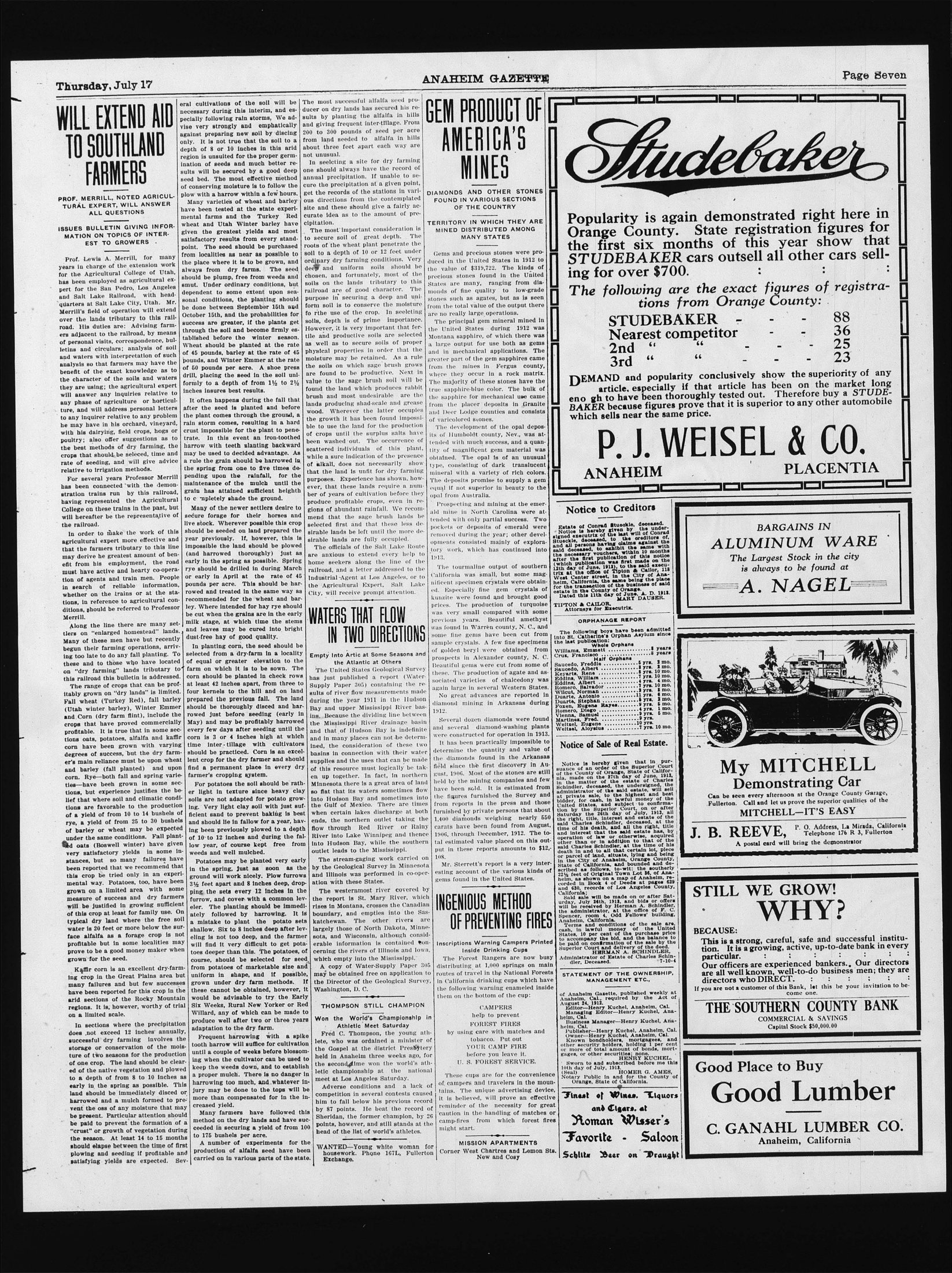
Searchable text
WILL EXTEND AID TO SOUTHLAND FARMERS
PROF. MERRILL, NOTED AGRICULTURAL EXPERT, WILL ANSWER ALL QUESTIONS
ISSUES BULLETIN GIVING INFORMATION ON TOPICS OF INTEREST TO GROWERS
Prof. Lewis A. Merrill, for many years in charge of the extension work for the Agricultural College of Utah, has been employed as agricultural expert for the San Pedro, Los Angeles and Salt Lake Railroad, with headquarters at Salt Lake City, Utah. Mr. Merrill's field of operation will extend over the lands tributary to this railroad. His duties are: Advising farmers adjacent to the railroad, by means of personal visits, correspondence, bulletins and circulars; analysis of soil and waters with interpretation of such analysis so that farmers may have the benefit of the exact knowledge as to the character of the soils and waters they are using; the agricultural expert will answer any inquiries relative to any phase of agriculture or horticulture, and will address personal letters to any inquirer relative to any problem he may have in his orchard, vineyard, with his dairying, field crops, hogs or poultry; also offer suggestions as to the best methods of dry farming, the crops that should be selected, time and rate of seeding, and will give advice relative to irrigation methods.
eral cultivations of the soil will be necessary during this interim, and especially following rain storms. We advise very strongly and emphatically against preparing new soil by discing only. It is not true that the soil to a depth of 8 or 10 inches in this arid region is unsulted for the proper germination of seeds and much better results will be secured by a good deep seed bed. The most effective method of conserving moisture is to follow the plow with a harrow within a few hours.
Many varieties of wheat and barley have been tested at the state experimental farms and the Turkey Red wheat and Utah Winter barley have given the greatest yields and most satisfactory results from every standpoint. The seed should be purchased from localities as near as possible to the place where it is to be grown, and always from dry farms. The seed should be plump, free from weeds and smut. Under ordinary conditions, but dependent on some extent upon seasonal conditions, the planting should be done between September 15th and October 15th, and the probabilities for success are greater, if the plants get through the soil and become firmly established before the winter season. Wheat should be planted at the rate of 45 pounds, barley at the rate of 45 pounds, and Winter Emmer at the rate of 50 pounds per acre. A shoe press drill, placing the seed in the soil uniformly to a depth of from $1\frac{1}{2}$ to $2\frac{1}{2}$ inches insures best results.
It often happens during the fall that after the seed is planted and before the plant comes through the ground, a rain storm comes, resulting in a hard crust impossible for the plant to penetrate. In this event an iron-toothed harrow with teeth slanting backward may be used to decided advantage. As a rule the grain should be harrowed in the spring from one to five times depending upon the rainfall for the most successful ducer on dry land results by planting and giving frequency 200 to 300 pounds from land seeded about three feet not unusual.
In seelcting a one should always annual precipitation cure the precipitate get the records of ous directions from site and these shall curate idea as tocipitation.
The most important to secure soil of roots of the wheat soil to a depth of ordinary dry farm deep and uniform chosen, and fort soils on the land railroad are of purpose in secur form soil is to do rthe use of the soils, depth is o However, it is ve tile and product as well as to s physical property moisture may be the soils on which are found to be value to the say found the land w brush and most lands producing wood. Wherever the growth it hable to use the la of crops until tha been washed out scattered individual while a sure ind of alkali, does that the land is
the character of the soils and waters they are using; the agricultural expert will answer any inquiries relative to any phase of agriculture or horticulture, and will address personal letters to any inquirer relative to any problem he may have in his orchard, vineyard, with his dairying, field crops, hogs or poultry; also offer suggestions as to the best methods of dry farming, the crops that should be selected, time and rate of seeding, and will give advice relative to irrigation methods.
For several years Professor Merrill has been connected with the demonstration trains run by this railroad, having represented the Agricultural College on these trains in the past, but will hereafter be the representative of the railroad.
In order to make the work of this agricultural expert more effective and that the farmers tributary to this line may derive he greatest amount of benefit from his employment, the road must have active and hearty co-operation of agents and train men. People in search of reliable information, whether on the trains or at the stations, in reference to agricultural conditions, should be referred to Professor Merrill.
Along the line there are many settlers on "enlarged homestead" lands. Many of these men have but recently begun their farming operations, arriving too late to do any fall planting. To these and to those who have located on "dry farming" lands tributary to this railroad this bulletin is addressed.
The range of crops that can be profitably grown on "dry lands" is limited. Fall wheat (Turkey Red), fall barley (Utah winter barley), Winter Emmer and Corn (dry farm flint), include the crops that have proved commercially profitable. It is true that in some sections oats, potatoes, alfalfa and kaffir corn have been grown with varying degrees of success, but the dry farmer's main reliance must be upon wheat and barley (fall planted) and upon corn. Rye—both fall and spring varieties—have been grown in some sections, but experience justifies the belief that where soil and climatic conditions are favorable to the production of a yield of from 10 to 14 bushels of rye, a yield of from 25 to 30 bushels of barley or wheat may be expected under the same conditions. Fall planted oats (Boswell winter) have given very satisfactory yields in some instances, but so many failures have been reported that we recommend that this crop be tried only in an experimental way. Potatoes, too, have been grown on a limited area with some measure of success and dry farmers drill, placing the seed in the soil uniformly to a depth of from 1½ to 2½ inches insures best results.
It often happens during the fall that after the seed is planted and before the plant comes through the ground, a rain storm comes, resulting in a hard crust impossible for the plant to penetrate. In this event an iron-toothed harrow with teeth slanting backward may be used to decided advantage. As a rule the grain should be harrowed in the spring from one to five times depending upon the rainfall, for the maintenance of the mulch until the grain has attained sufficient height to completely shade the ground.
Many of the newer settlers desire to secure forage for their horses and live stock. Wherever possible this crop should be seeded on land prepared the year previously. If, however, this is impossible the land should be plowed (and harrowed thoroughly) just as early in the spring as possible. Spring rye should be drilled in during March or early in April at the rate of 45 pounds per acre. This should be harrowed and treated in the same way as recommended for the wheat and barley. Where intended for hay rye should be cut when the grains are in the early milk stage, at which time the stems and leaves may be cured into bright dust-free hay of good quality.
In planting corn, the seed should be selected from a dry-farm in a locality of equal or greater elevation to the farm on which it is to be sown. The corn should be planted in check rows at least 42 inches apart, from three to four kernels to the hill and on land prepared the previous fall. The land should be thoroughly disced and harrowed just before seeding (early in May) and may be profitably harrowed every few days after seeding until the corn is 3 or 4 inches high at which time inter-tillage with cultivators should be practiced. Corn is an excellent crop for the dry farmer and should find a permanent place in every dry farmer's cropping system.
For potatoes the soil should be rather light in texture since heavy clay soils are not adapted for potato growing. Very light clay soil with just sufficient sand to prevent baking is best and should lie in fallow for a year, having been previously plowed to a depth of 10-12 inches and during the fall year, of course kept free from weeds and well mulched.
Potatoes may be planted very early in the spring, just as soon as the ground will work nicely. Plow furrows 3½ feet apart and 8 inches deep, dropping the sets every 12 inches in the furrow and cover with a common levle drill, placing the seed in the soil uniformly to a depth of from 1½ to 2½ inches insures best results.
It often happens during the fall that after the seed is planted and before the plant comes through the ground, a rain storm comes, resulting in a hard crust impossible for the plant to penetrate. In this event an iron-toothed harrow with teeth slanting backward may be used to decided advantage. As a rule the grain should be harrowed in the spring from one to five times depending upon the rainfall, for the maintenance of the mulch until the grain has attained sufficient height to completely shade the ground.
Many of the newer settlers desire to secure forage for their horses and live stock. Wherever possible this crop should be seeded on land prepared the year previously. If, however, this is impossible the land should be plowed (and harrowed thoroughly) just as early in the spring as possible. Spring rye should be drilled in during March or early in April at the rate of 45 pounds per acre. This should be harrowed and treated in the same way as recommended for the wheat and barley. Where intended for hay rye should be cut when the grains are in the early milk stage, at which time the stems and leaves may be cured into bright dust-free hay of good quality.
In planting corn, the seed should be selected from a dry-farm in a locality of equal or greater elevation to the farm on which it is to be sown. The corn should be planted in check rows at least 42 inches apart, from three to four kernels to the hill and on land prepared the previous fall. The land should be thoroughly disced and harrowed just before seeding (early in May) and may be profitably harrowed every few days after seeding until the corn is 3 or 4 inches high at which time inter-tillage with cultivators should be practiced. Corn is an excellent crop for the dry farmer and should find a permanent place in every dry farmer's cropping system.
For potatoes the soil should be rather light in texture since heavy clay soils are not adapted for potato growing. Very light clay soil with just sufficient sand to prevent baking is best and should lie in fallow for a year, having been previously plowed to a depth of 10-12 inches and during the fall year, of course kept free from weeds and well mulched.
Potatoes may be planted very early in the spring, just as soon as the ground will work nicely. Plow furrows 3½ feet apart and 8 inches deep, dropping the sets every 12 inches in the furrow and cover with a common levle drill, placing the seed in the soil uniformly to a depth of from 1½ to 2½ inches insures best results.
It often happens during the fall that after the seed is planted and before the plant comes through the ground, a rain storm comes, resulting in a hard crust impossible for the plant to penetrate. In this event an iron-toothed harrow with teeth slanting backward may be used to decided advantage. As a rule the grain should be harrowed in the spring from one to five times depending upon the rainfall, for the maintenance of the mulch until the grain has attained sufficient height to completely shade the ground.
Many of the newer settlers desire to secure forage for their horses and live stock. Wherever possible this crop should be seeded on land prepared the year previously. If, however, this is impossible the land should be plowed (and harrowed thoroughly) just as early in the spring as possible. Spring rye should be drilled in during March or early in April at the rate of 45 pounds per acre. This should be harrowed and treated in the same way as recommended for the wheat and barley. Where intended for hay rye should be cut when the grains are in the early milk stage, at which time the stems and leaves may be cured into bright dust-free hay of good quality.
In planting corn, the seed should be selected from a dry-farm in a locality of equal or greater elevation to the farm on which it is to be sown. The corn should be planted in check rows at least 42 inches apart, from three to four kernels to the hill and on land prepared the previous fall. The land should be thoroughly disced and harrowed just before seeding (early in May) and may be profitably harrowed every few days after seeding until the corn is 3 or 4 inches high at which time inter-tillage with cultivators should be practiced. Corn is an excellent crop for the dry farmer and should find a permanent place in every dry farmer's cropping system.
For potatoes the soil should be rather light in texture since heavy clay soils are not adapted for potato growing. Very light clay soil with just sufficient sand to prevent baking is best and should lie in fallow for a year, having been previously plowed to a depth of 10-12 inches and during the fall year, of course kept free from weeds and well mulched.
Potatoes may be planted very early in the spring, just as soon as the ground will work nicely. Plow furrows 3½ feet apart and 8 inches deep, dropping the sets every 12 inches in the furrow and cover with a common levle drill, placing the seed in the soil uniformly to a depth of from 1½ to 2½ inches insures best results.
It often happens during the fall that after the seed is planted and before the plant comes through the ground, a rain storm comes, resulting in a hard crust impossible for the plant to penetrate. In this event an iron-toothed harrow with teeth slanting backward may be used to decided advantage. As a rule the grain should be harrowed in the spring from one to five times depending upon the rainfall, for the maintenance of the mulch until the grain has attained sufficient height to completely shade the ground.
Many of the newer settlers desire to secure forage for their horses and live stock. Wherever possible this crop should be seeded on land prepared the year previously. If, however, this is impossible the land should be plowed (and harrowed thoroughly) just as early in the spring as possible. Spring rye should be drilled in during March or early in April at the rate of 45 pounds per acre. This should be harrowed and treated in the same way as recommended for the wheat and barley. Where intended for hay rye should be cut when the grains are in the early milk stage, at which timethe stems and leaves may be cured into bright dust-free hay of good quality.
In planting corn, the seed should be selected from a dry-farm in a locality of equal or greater elevation tothe farm on which it is to be sown. The corn should be planted in check rows at least 42 inches apart, from three to four kernels tothe hill and on land preparedthe previous fall. The land should be thoroughly disced and harrowed just before seeding (early in May) and may be profitably harrowed every few days after seeding untilthe corn is 3 or 4 inches high at which time inter-tillage with cultivatorsshould be practiced. Corn is an excellent crop forthe dry farmer and should find a permanent place in every dry farmer's cropping system.
For potatoesthe soilshouldbe ratherlightintextur sinceheavyclaysoilsarenotadaptedforpotatogrowing.Verylightclaysoilwithjustsufficientsandtopreventbakingisbestandshouldlieinfallowforayear,havingbeenpreviouslyplowedtothedepthof10-12inchesandduringthefallyear,ofcoursekeptfreefromweedsandwellmulched.
Potatoesmaybeplantedveryearlyinthespringjustas soonasthegroundwillworknicely.Plowfurrows3½feetapartand8inchesdeep,droppingthesetsevery12inchesthroughfurrowandcoverwithacommonlevledrillplacingtheseedinthe土壤uniformlytoadepthoffrom1½to2½inchesinsuresbestresults.
It often happens duringthefallthataftertheseedisplantedandbeforetheplantcomesthroughtheground,arainstormcomes,dresultinginahardcrustimpossiblefortheplanttocomethroughtheground,arainstormcomes,dresultinginahardcrustimpossiblefortheplanttocomethroughtheground,arainstormcomes,dresultinginahardcrustimpossiblefortheplanttocomethroughtheground,arainstormcomes,dresultinginahardcrustimpossiblefortheplanttocomethroughtheground,arainstormcomes,dresultinginahardcrustimpossiblefortheplanttocomethroughtheground,arainstormcomes,dresultinginahardcrustimpossiblefortheplanttocomethroughtheground,arainstormcomes,dresultinginahardcrustimpossiblefortheplanttocomethroughtheground,arainstormcomes,dresultinginahardcrustimpossiblefortheplanttocomethroughtheground,arainstormcomes,dresultinginahardcrustimpossiblefortheplanttocomethroughtheground,arainstormcomes,dresultinginahardcrustimpossiblefortheplanttocomethroughtheground,arainstormcomes,dresultinginahardcrustimpossiblefortheplanttocomethroughtheground,arainstormcomes,dresultinginahardcrustimpossiblefortheplanttocomethroughtheground,arainstormcomes,dresultinginahardcrustimpossiblefortheplanttocomethroughtheground,arainstormcomes,dresultinginahardcrustimpossiblefortheplanttocomethroughtheground,arainstormcomes,dresultinginahardcrustimpossiblefortheplanttocomethroughtheground,arainstormcomes,dresultinginahardcrustimpossiblefortheplanttocomethroughtheground,arainstormcomes,dresultinginahardcrustimpossiblefortheplanttocomethroughtheground,arainstormcomes,dresultinginahardcrustimpossiblefortheplanttocomethroughtheground,Arainstormcomes,dresultinginahardcrustimpossiblefortheplanttocomethroughtheground,Arainstormcomes,d.resultinginahardcrustimpossiblefortheplanttocomethroughtheground,Arainstormcomes,d.resultinginahardcrustimpossibleforthe Planttocomethroughtheground,Arainstormcomes,d.resultinginahardcrustimpossibleforthe Planttocomethroughtheground,Arainstormcomes,d.resultinginahardcrustimpossibleforthe Planttocomethroughtheground,Arainstormcomes,d.resultinginahardcrustimpossibleforthe Planttocomethroughtheground,Arainstormcomes,d.resultinginahardcrustimpossibleforthe Planttocomethroughtheground,Arainstormcomes,d.resultinginahardcrustimpossibleforthe Planttocomethroughthroughtheground,Arainstormcomes,d.resultinginahardcrustimpossibleforthe Planttocomethroughthroughtheground,Arainstormcomes,d.resultinginahardcrustimpossibleforthe Planttocomethroughthroughtheground,Arainstormcomes,d.resultinginahardcrustimpossibleforthe Planttocome throughthroughtheground,Arainstormcomes,d.resultinginahardcrustimpossibleforthe Planttocome throughthroughtheground,Arainstormcomes,d.resultinginahardcrustimpossibleforthe Planttocome throughthroughtheground,Arainstormcomes,d.resultinginahardcrustimpossibleforthe Planttocome throughthroughtheground,Arainstormcomes,d.resultinginahardcrustimpossibleforthe Planttocome throughthroughtheground,Arainstormcomes,d.resultinginahardcrustimpossibleforthe Planttocomethroughtheground,Arainstormcomines,d.resultinginhardcrustomposesforprotectigationsofabundancemendmentthattherelatedfirstandsirablelandsbesidefirstandsirablelandsbesidefirstandsirablelandsbesidefirstandsirablelandsbesidefirstandsirablelandsbesidefirstandsirablelandsbesidefirstandsirablelandsbesidefirstandsirablelandsbesidefirstandsirablelandsbesidefirstandsirablelandsbesidefirstandsirablelandsbesidefirstandsirablelandsbesidefirstandsirablelandsbesidefirstandsirablelands beside firstandsirablelandsbeside firstandsirablelandsbeside firstandsirablelandsbeside firstandsirablelandsbeside firstandsirablelandsbeside firstandsirablelandsbeside firstandsirablelandsbeside firstandsirablelandsbeside firstandsirablelandsbeside firstandsirablelandsbeside firstandsirablelandsbeside firstandsirablelands besides firstandsirablelandsbeside firstandsirablelandsbeside firstandsirablelandsbeside firstandsirablelandsbeside firstandsirablelandsbeside firstandsirablelandsbeside firstandsirablelandsbeside firstandsirablelandsbeside firstandsirablelandsbeside firstandsirablelandsbeside firstandsirablelands besides firstandsirablelandsbesides firstandsirablelandsbesides firstandsirablelandsbesides firstandsirablelandsbesides first和secondhandconditionsforestationonlimitedareabutwheatbarleyfallplantationwithlimitedlandscapesforestationonlimitedareabutwheatbarleyfallplantationwithlimitedlandscapesforestationonlimitedareabutwheatbarleyfallplantationwithlimitedlandscapesforestationonlimitedareabutwheatbarleyfallplantationwithlimitedlandscapesforestationonlimitedareabutwheatbarleyfallplantationwithlimitedlandscapesforestationonlimitedareabutwheatbarleyfallplantationwithlimitedlandscapesforestationonlimitedareabutwheatbarleyfallplantationwithlimitedlandscapesforestationonlimitedarea但wheatbarleyfall植物在土壤中生长的条件下进行种植以保持土壤的湿润性和肥力。水稻田中的水培方法包括使用有机肥、微生物肥料和灌溉剂等。水稻田中的水培方法包括使用有机肥、微生物肥料和灌溉剂等。水稻田中的水培方法包括使用有机肥、微生物肥料和灌溉剂等。水稻田中的水培方法包括使用有机肥、微生物肥料和灌溉剂等。水稻田中的水培方法包括使用有机肥、微生物肥料和灌溉剂等。水稻田中的水培方法包括使用有机肥、微生物肥料和灌溉剂等。水稻田中的水培方法包括使用有机肥、微生物肥料和灌溉剂等。水稻田中的水培方法包括使用有机肥、微生物肥料和灌溉剂等。水稻田中的水培方法包括使用有机肥、微生物肥料和灌溉剂等。水稻田中的水培方法包括使用有机肥、微生物肥料和灌溉剂等。水稻田中的水培方法包括使用有机肥、微生物肥料和灌溉剂等。水稻田中的水培方法包括使用有机肥、微生物肥料和灌溉剂等。水稻田中的水培方法包括使用有机肥、微生物肥料和灌溉剂等。水稻田中的水培方法包括使用有机肥、微生物肥料和灌溉剂等。水稻田中的水培方法包括使用有机肥、微生物肥料和灌溉剂等。水稻田中的水培方法包括使用有机肥、微生物肥料和灌溉剂等。水稻田中的水培方法包括使用有机肥、微生物肥料和灌溉剂等。水稻田中的水培方法包括使用有机肥、微生物肥料和灌溉剂等。水稻田中的水培方法包括使用有机肥、微生物肥料和灌溉剂等。水稻田中的水培方法包括使用有机肥、微生物肥料和灌溉剂等。水稻田中的水培方法包括使用有机肥、微生物肥料和灌溉剂等。水稻田中的水培方法包括使用有机肥、微生物肥料和灌溉剂等。水稻田中的水培方法包括使用有机肥、微生物肥料和灌溉剂等。水稻田中的水培方法包括使用有机肥、微生物肥料和灌溉剂等。水稻田中的水培方法包括使用有机肥、微生物肥料和灌溉剂等。水稻田中的水培方法包括使用有机肥、微生物肥料和灌溉剂等。水稻田中的水培方法包括使用有机肥、微生物肥料和灌溉剂等。水稻田中的水培方法包括使用有机肥、微生物肥料和灌溉剂等。水稻田中的水培方法包括使用有机肥、微生物肥料和灌溉剂等。水稻田中的水培方法包括使用有机肥、微生物肥料和灌溉剂等。水稻田中的水培方法包括使用有机肥、微生物肥料和灌溉剂等。水稻田中的水培方法包括使用有机肥、微生物肥料和灌溉剂等。水稻田中的水培方法包括使用有机肥、微生物肥料和灌溉剂等。水稻田中的水培方法包括使用有机肥、微生物肥料和灌溉剂等。水稻田中的水培方法包括使用有机肥、微生物肥料和灌溉剂等。水稻田中的水培方法包括使用有机肥、微生物肥料和灌溉剂等。水稻田中的水培方法包括使用有机肥、微生物肥料和灌溉剂等。水稻田中的水培方法包括使用有机肥、微生物肥料和灌溉剂等。水稻田中的水培方法包括使用有机肥、微生物肥料和灌溉剂等。水稻田中的水培方法包括使用有机肥、微生物肥料和灌溉剂等。水稻田中的水培方法包括使用有机肥、微生物肥料和灌溉剂等。水稻田中的水培方法包括使用有机肥、微生物肥料和灌溉剂等。水稻田中的水培方法包括使用有机肥、微生物肥料和灌溉剂等。水稻田中的水培方法包括使用有机肥、微生物肥料和灌溉剂等。水稻田中的水培方法包括使用有机肥、微生物肥料和灌溉剂等。水稻田中的水培方法包括使用有机肥、微生物肥料和灌溉剂等。水稻田中的水培方法包括使用有机肥、微生物肥料和灌溉剂等。水稻田中的水培方法包括使用有机肥、微生物肥料和灌溉剂等。水稻田中的水培方法包括使用有机肥、微生物肥料和灌溉剂等。水稻田中的水培方法包括使用有机肥、微生物肥料和灌溉剂等。水稻田中的水培方法,包括使用有机肥、微生物肥料和灌溉剂等。水稻田中的水培方法,包括使用有机肥、微生物肥料和灌溉剂等。水稻田中的水培方法,包括使用有机肥、微生物肥料和灌溉剂等。水稻田中的水培方法,包括使用有机肥、微生物肥料和灌溉剂等。水稻田中的水培方法,包括使用有机肥、微生物肥料和灌溉剂等。水稻田中的水培方法,包括使用有机肥、微生物肥料和灌溉剂等。水稻田中的水培方法,包括使用有机肥、微生物肥胖度因土壤pH值而发生变化,土壤pH值的变化会导致作物生长速度的显著提高,从而影响作物的产量。此外,水土保持措施可以有效地控制水分流失,防止土壤侵蚀,从而提高作物的产量。此外,水土保持措施可以有效地控制水分流失,防止土壤侵蚀,从而提高作物的产量。此外,水土保持措施可以有效地控制水分流失,防止土壤侵蚀,从而提高作物的产量。此外,水土保持措施可以有效地控制水分流失,防止土壤侵蚀,从而提高作物的产量。此外,水土保持措施可以有效地控制水分流失,防止土壤侵蚀,从而提高作物的产量。此外,水土保持措施可以有效地控制水分流失,防止土壤侵蚀,从而提高作物的产量。此外,水土保持措施可以有效地控制水分流失,防止土壤侵蚀,从而提高作物的产量。此外,水土保持措施可以有效地控制水分流失,防止土壤侵蚀,从而提高作物的产量。此外,水土保持措施可以有效地控制水分流失,防止土壤侵蚀,从而提高作物的产量。此外,水土保持措施可以有效地控制水分流失,防止土壤侵蚀,从而提高作物的产量。此外,水土保持措施可以有效地控制水分流失,防止土壤侵蚀,从而提高作物的产量。此外,水土保持措施可以有效地控制水分流失,防止土壤侵蚀,从而提高作物的产量。此外,水土保持措施可以有效地控制水分流失,防止土壤侵蚀,从而提高作物的产量。此外,水土保持措施可以有效地控制水分流失,防止土壤侵蚀,从而提高作物的产量。此外,水土保持措施可以有效地控制水分流失,防止土壤侵蚀,从而提高作物的产量。此外,水土保持措施可以有效地控制水分流失,防止土壤侵蚀,从而提高作物的产量。此外,水土保持措施可以有效地控制水分流失,防止土壤侵蚀,从而提高作物的产量。此外,水土保持措施可以有效地控制水分流失,防止土壤侵蚀,从而提高作物的产量。此外,水土保持措施可以有效地控制水分流失,防止土壤侵蚀,从而提高作物的产量。此外,水土保持措施可以有效地控制水分流失,防止土壤侵蚀,从而提高作物的产量。此外,水土保持措施可以有效地控制水分流失,防止土壤侵蚀,从而提高作物的产量。此外,水土保持措施可以有效地控制水分流失,防止土壤侵蚀,从而提高作物的产量。此外,水土保持措施可以有效地控制水分流失,防止土壤侵蚀,从而提高作物的产量。此外,水土保持措施可以有效地控制水分流失,防止土壤侵蚀,从而提高作物的产量。此外,水土保持措施可以有效地控制水分流失,防止土壤侵蚀,从而提高作物的产量。此外,水土保持措施可以有效地控制水分流失,防止土壤侵蚀,从而提高作物的产量。此外,水土保持措施可以有效地控制水分流失,防止土壤侵蚀,从而提高作物的产量。此外,水土保持措施可以有效地控制水分流失,防止土壤侵蚀,从而提高作物的产量。此外,水土保持措施可以有效地控制水分流失,防止土壤侵蚀,从而提高作物的产量。此外,水土保持措施可以有效地控制水分流失,防止土壤侵蚀,从而提高作物的产量.此外,水土保持措施可以有效地控制水分流失,防止土壤侵蚀从而提高作物生长速度的显著增加,土壤pH值的变化会导致作物生长速度的显著增加,土壤pH值的变化会导致作物生长速度的显著增加,土壤pH值的变化会导致作物生长速度的显著增加,土壤pH值的变化会导致作物生长速度的显著增加,土壤pH值的变化会导致作物生长速度的显著增加,土壤pH值的变化会导致作物生长速度的显著增加,土壤pH值的变化会导致作物生长速度的显著增加,土壤pH值的变化会导致作物生长速度的显著增加,土壤pH值的变化会导致作物生长速度的显著增加,土壤pH值的变化会导致作物生长速度的显著增加,土壤pH值的变化导致作物生长速度的显著增加,土壤pH值的变化导致作物生长速度的显著增加,土壤pH值的变化导致作物生长速度的显著增加,土壤pH
lief that where soil and climatic conditions are favorable to the production of a yield of from 10 to 14 bushels of rye, a yield of from 25 to 30 bushels of barley or wheat may be expected under the same conditions. Fall planted oats (Boswell winter) have given very satisfactory yields in some instances, but so many failures have been reported that we recommend that this crop be tried only in an experimental way. Potatoes, too, have been grown on a limited area with some measure of success and dry farmers will be justified in growing sufficient of this crop at least for family use. On typical dry land where the free soil water is 20 feet or more below the surface alfalfa as a forage crop is not profitable but in some localities may prove to be a good money maker when grown for the seed.
Kaffir corn is an excellent dry-farming crop in the Great Plains area but many failures and but few successes have been reported for this crop in the arid sections of the Rocky Mountain regions. It is, however, worthy of trial on a limited scale.
In sections where the precipitation does not exceed 12 inches annually, successful dry farming involves the storage or conservation of the moisture of two seasons for the production of one crop. The land should be cleared of the native vegetation and plowed to a depth of from 8 to 10 inches as early in the spring as possible. This land should be immediately disced or harrowed and a mulch formed to prevent the loss of any moisture that may be present. Particular attention should be paid to prevent the formation of a "crust" or growth of vegetation during the season. At least 14 to 15 months should elapse between the time of first plowing and seeding if profitable and satisfying yields are expected. Sev-
Potatoes may be planted very early in the spring, just as soon as the ground will work nicely. Plow furrows 3½ feet apart and 8 inches deep, dropping the sets every 12 inches in the furrow, and cover with a common leveler. The planting should be immediately followed by harrowing. It is a mistake to plant the potato sets shallow. Six to 8 inches deep after leveling is not too deep, and the farmer will find it very difficult to get potatoes deeper than this. The potatoes, of course, should be selected for seed from potatoes of marketable size and uniform in shape, and if possible, grown under dry farm methods. If these cannot be obtained, however, it would be advisable to try the Early Six Weeks, Rural New Yorker or Red Willard, any of which can be made to produce well after two or three years adaptation to the dry farm.
Frequent harrowing with a spike tooth harrow will suffice for cultivation until a couple of weeks before blossoming when the cultivator can be used to keep the weeds down, and to establish a proper mulch. There is no danger in harrowing too much, and whatever injury may be done to the tops will be more than compensated for in the increased yield.
Many farmers have followed this method on the dry lands and have succeeded in securing a yield of from 100 to 175 bushels per acre.
A number of experiments for the production of alfalfa seed have been carried on in various parts of the state.
ANAHEIM GAZETTE
The most successful alfalfa seed producer on dry lands has secured his results by planting the alfalfa in hills and giving frequent inter-tillage. From 200 to 300 pounds of seed per acre from land seeded to alfalfa in hills about three feet apart each way are not unusual.
In seelcting a site for dry farming one should always have the record of annual precipitation. If unable to secure the precipitation at a given point, get the records of the stations in various directions from the contemplated site and these should give a fairly accurate idea as to the amount of precipitation.
The most important consideration is to secure soil of great depth. The roots of the wheat plant penetrate the soil to a depth of 10 or 12 feet under ordinary dry farming conditions. Very deep and uniform soils should be chosen, and fortunately, most of the soils on the lands tributary to this railroad are of good character. The purpose in securing a deep and uniform soil is to conserve the moisture for rthe use of the crop. In seelcting soils, depth is of prime importance. However, it is very important that fertile and productive soils are selected as well as to secure soils of proper physical properties in order that the moisture may be retained. As a rule the soils on which sage brush grows are found to be productive. Next in value to the sage brush soil will be found the land which produces rabbit brush and most undesirable are the lands producing shad-scale and grease wood. Wherever the latter occupies the growth it has been found impossible to use the land for the production of crops until the surplus salts have been washed out. The occurrence of scattered individuals of this plant, while a sure indication of the presence of alkali, does not necessarily show that the land is unfit for dry farming.
GEM PRODUCT OF AMERICA’S MINES
DIAMONDS AND OTHER STONES FOUND IN VARIOUS SECTIONS OF THE COUNTRY
TERRITORY IN WHICH THEY ARE MINED DISTRIBUTED AMONG MANY STATES
Gems and precious stones were produced in the United States in 1912 to the value of $319,722. The kinds of precious stones found in the United States are many, ranging from diamonds of fine quality to low-grade stones such as agates, but as is seen from the total value of the output there are no really large operations.
The principal gem mineral mined in the United States during 1912 was Montana sapphire, of which there was a large output for use both as gems and in mechanical applications. The greater part of the gem sapphires came from the mines in Fergus county, where they occur in a rock matrix. The majority of these stones have the true sapphire-blue color. The bulk of the sapphire for mechanical use came from the placer deposits in Granite and Deer Lodge counties and consists of varicolored stones.
The development of the opal deposits of Humboldt county, Nev., was attended with much success, and a quantity of magnificent gem material was obtained. The opal is of an unusual type, consisting of dark translucent mineral with a variety of rich colors.
WATERS THAT FLOW IN TWO DIRECTIONS
Empty Into Artic at Some Seasons and the Atlantic at Others
The United States Geological Survey has just published a report (Water Supply Paper 305) containing the results of river flow measurements made during the year 1911 in the Hudson Bay and upper Mississippi River basins. Because the dividing line between the Mississippi River drainage basin and that of Hudson Bay is indefinite and in many places can not be determined, the consideration of these two basins in connection with their water supplies and the uses that can be made of this resource must logically be taken up together. In fact, in northern Minnesota there is a great area of land so flat that its waters sometimes flow into Hudson Bay and sometimes into the Gulf of Mexico. There are times when certain lakes discharge at both ends, the northern outlet taking the flow through Red River or Rainy River into Lake Winnipeg and thence into Hudson Bay, while the southern outlet leads to the Mississippi.
The stream-gaging work carried on by the Geological Survey in Minnesota and Illinois was performed in co-operation with these States.
The westernmost river covered by the report is St. Mary River, which value to the sage brush soil will be found the land which produces rabbit brush and most undesirable are the lands producing shad-scale and grease wood. Wherever the latter occupies the growth it has been found impossible to use the land for the production of crops until the surplus salts have been washed out. The occurrence of scattered individuals of this plant, while a sure indication of the presence of alkali, does not necessarily show that the land is unfit for dry farming purposes. Experience has shown, however, that these lands require a number of years of cultivation before they produce profitable crops, even in regions of abundant rainfall. We recommend that the sage brush lands be selected first and that these less desirable lands be left until the more desirable lands are fully occupied.
The officials of the Salt Lake Route are anxious to extend every help to home seekers along the line of the railroad, and a letter addressed to the Industrial Agent at Los Angeles, or to the Agricultural Expert, Salt Lake City, will receive prompt attention.
Prospecting and mining at the emerald mine in North Carolina were attended with much success, and a quantity of magnificent gem material was obtained. The opal is of an unusual type, consisting of dark translucent mineral with a variety of rich colors. The deposits promise to supply a gem equal if not superior in beauty to the opal from Australia.
Prospecting and mining at the emerald mine in North Carolina were attended with much success, and a quantity of magnificent gem material was obtained. The opal is of an unusual type, consisting of dark translucent mineral with a variety of rich colors. The deposits promise to supply a gem equal if not superior in beauty to the opal from Australia.
Tourmaline output of southern California was small, but some magnificent specimen crystals were obtained. Especially fine gem crystals of kunzite were found and brought good prices. The production of turquoise was very small compared with some previous years. Beautiful amethyst was found in Warren county, N.C., and some fine gems have been cut from sample crystals. A few fine specimens of golden beryl were obtained from prospects in Alexander county, N.C. Beautiful gems were cut from some of these. The production of agate and associated varieties of chalcedony was again large in several Western States.
No great advances are reported in diamond mining in Arkansas during 1912.
Several dozen diamonds were found and several diamond-washing plants were constructed for operation in 1913.
It has been practically impossible to determine the quantity and value of the diamonds found in the Arkansas field since the first discovery in August, 1906. Most of the stones are still held by the mining companies and few have been sold. It is estimated from the figures furnished the Survey and from reports in the press and those furnished by private persons that about 1,400 diamonds weighing nearly 550 carats have been found from August, 1906, through December, 1912. The total estimated value placed on this output in these reports amounts to $12,-108.
Mr. Sterrett's report is a very interesting account of the various kinds of gems found in the United States.
Notice is hereby given that in pursuance of an order of the Superior Court of the County of Orange, State of California, made on the 27th day of June, 1913, in the matter of the estate of Charles Schindler, deceased, the undersigned, the administrator of the said estate, will sell at private sale, to the highest and best bidder, for cash, in lawful money of the United States, and subject to confirmation by the Superior Court, on or after Saturday the 26th day of July, 1913, all the right, title, interest and estate of the said Charles Schindler, deceased, at the time of his death, and all the right, title and interest that the said estate has, by operation of law or otherwise, acquired other than or in addition to that of the said Charles Schindler, at the time of his death in and to all that certain lot, piece or parcel of land, situate, lying and being in the City of Anaheim, Orange County State of California, and bounded and described as follows: to-wit: the southerly 22½ feet of Original Town Lot 36, of Anaheim, as shown on a map of Anaheim recorded in Book 4 of Deeds at pages 623 and 630; records of Los Angeles County California;
DEMAND and popular article, especially eno gh to have been the BAKER because figures which sells near the same
Notice to Creditors
Estate of Conrad Stueckle, deceased. Notice is hereby given by the under-signed executrix of the last will of Conrad Stueckle, deceased, to the creditors of, and all persons having claims against the said deceased, to exhibit the same with the necessary vouchers within 10 months after the first publication of this notice (which publication was first made on the 12th day of June, 1913), to the said executrix at the office of Tipton & Callor, 118 West Center street, in The City of Anaheim, California, the same being the place for the transaction of the business of said estate in the County of Orange.
Dated this 11th day of June, A.D. 1913.
MARY DAUSER.
TIPTON & CAILOR,
Attorneys for Executrix.
ORPHANAGE REPORT
The following boys have been admitted into St. Catharine's Orphan Asylum since the last publication:
Whole Orphans
Williams, Emmett...8 years
Cruz, Francisco...8 years
Half Orphans
Saucedo, Freddie...5 years. 2 mo.
Saucedo, Albert...3 years. 2 mo.
Keyarts, Rene...8 years. 10 mo.
Eddins, William...7 years. 10 mo.
Eddins, Albert...4 years. 4 mo.
Romero, Salvador...7 years. 10 mo.
Wilcut, Norman...3 years. 8 mo.
Duarte, Antonio...11 years. 6 mo.
Durante, Stephan...8 years. 2 mo.
Foxen, Eugene Rayes...9 years. 5 mo.
Romero, Diego...4 years. 1 mo.
Vienna, Samuel...9 years. 5 mo.
Martines, Fred...9 years.
Weitzel, Eugene...10 years.
Weitzel, Aloysius...7 years. 10 mo.
Notice of Sale of Real Estate.
Notice is hereby given that in pursuance of an order of the Superior Court of the County of Orange, State of California, made on the 27th day of June, 1913, in the matter of the estate of Charles Schindler, deceased, the undersigned, the administrator of the said estate, will sell at private sale, to the highest and best bidder for cash, in lawful money of the United States, and subject to confirmation by the Superior Court, on or after Saturday the 26th day of July, 1913, all the right, title, interest and estate of the said Charles Schindler, deceased, at the time of his death, and all the right, title and interest that the said estate has, by operation of law or otherwise, acquired other than or in addition to that of the said Charles Schindler, at the time of his death in and to all that certain lot, piece or parcel of land, situate, lying and being in The City of Anaheim, Orange County State of California, and bounded and described as follows: to-wit: the southerly 22½ feet of Original Town Lot 36, of Anaheim, as shown on a map of Anaheim recorded in Book 4 of Deeds at pages 623 and 630; records of Los Angeles County California;
INGENIOUS METHOD OF PREVENTING FIRES
Inscriptions Warning Campers Printed Inside Drinking Cups
The Forest Rangers are now busy distributing at 1,000 springs on main routes of travel in the National Forests in California drinking cups which have the following warning enameled inside them on the bottom of the cup:
CAMPERS
help to prevent
FOREST FIRES
by using care with matches and tobacco. Put out
YOUR CAMP FIRE
before you leave it.
U. S. FOREST SERVICE.
These cups are for the convenience of campers and travelers in the mountains. The unique advertising device, it is believed, will prove an effective reminder of the necessity for great caution in the handling of matches or camp-fires from which forest fires might start.
MISSION APARTMENTS
Corner West Chartres and Lemon Sts.
New and Cosy
Studebaker
regularity is again demonstrated right here in Orange County. State registration figures for the first six months of this year show that STUDEBAKER cars outsell all other cars sell-for over $700.
following are the exact figures of registrations from Orange County:
STUDEBAKER - - - 88
Nearest competitor - - 36
2nd “ “ - - - 25
3rd “ “ - - - 23
AND and popularity conclusively show the superiority of any article, especially if that article has been on the market long enough to have been thoroughly tested out. Therefore buy a STUDEBAKER because figures prove that it is superior to any other automobile sells near the same price.
P. J. WEISEL & CO.
NAHEIM PLACENTIA
P. J. WEISEL & CO.
BENAHEIM
PLACENTIA
BARGAINS IN
ALUMINUM WARE
The Largest Stock in the city
is always to be found at
A. NAGEL
My MITCHELL
Demonstrating Car
Can be seen every afternoon at the Orange County Garage,
Fullerton. Call and let us prove the superior qualities of the
MITCHELL—IT'S EASY
J. B. REEVE,
P. O. Address, La Mirada, California
Telephone 176 R 3, Fullerton
A postal card will bring the demonstrator
STILL WE GROW!
Fullerton. Call and let us prove the superior qualities of the
MITCHELL—IT'S EASY
J. B. REEVE,
P. O. Address, La Mirada, California
Telephone 176 R 3, Fullerton
A postal card will bring the demonstrator
STILL WE GROW!
WHY?
BECAUSE:
This is a strong, careful, safe and successful institution. It is a growing, active, up-to-date bank in every particular.
Our officers are experienced bankers.. Our directors are all well known, well-to-do business men; they are directors who DIRECT.
If you are not a customer of this Bank, let this be your invitation to become one.
THE SOUTHERN COUNTY BANK
COMMERCIAL & SAVINGS
Capital Stock $50,000.00
Good Place to Buy
Good Lumber
C. GANAHL LUMBER CO.
Anaheim, California