anaheim-gazette 1913-07-17
Scanned page
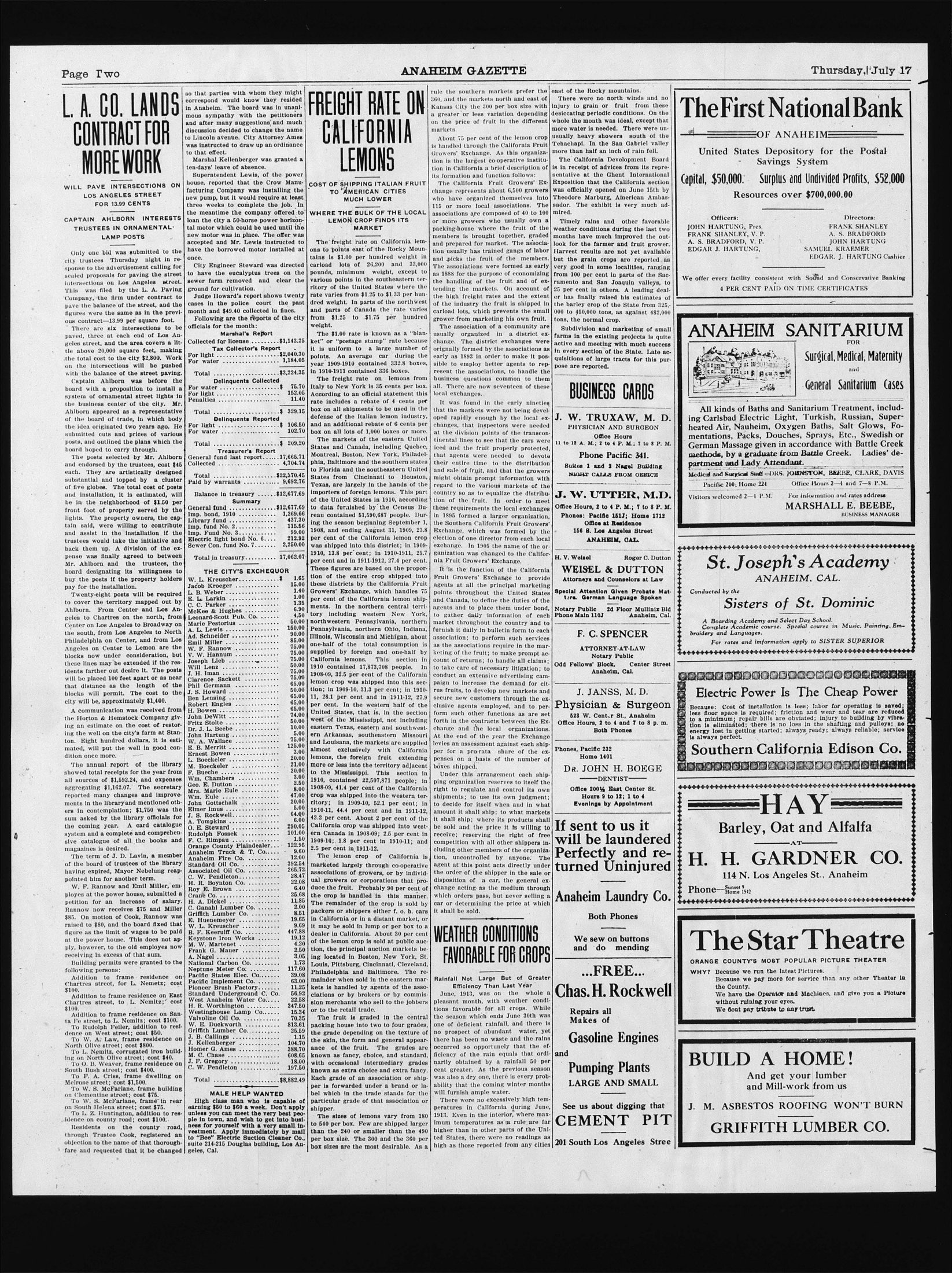
Searchable text
L. A. CO. LANDS CONTRACT FOR MORE WORK
WILL PAVE INTERSECTIONS ON LOS ANGELES STREET FOR 13.99 CENTS
CAPTAIN AHLBORN INTERESTS TRUSTEES IN ORNAMENTAL LAMP POSTS
Only one bid was submitted to the city trustees Thursday night in response to the advertisement calling for sealed proposals for paving the street intersections on Los Angeles street. This was filed by the L. A. Paving Company, the firm under contract to pave the balance of the street, and the figures were the same as in the previous contract—13.99 per square foot.
There are six intersections to be paved, three at each end of Los Angeles street, and the area covers a little above 20,000 square feet, making the total cost to the city $2,800. Work on the intersections will be pushed with the balance of the street paving.
Captain Ahlborn was before the board with a proposition to install a system of ornamental street lights in the business center of the city. Mr. Ahlborn appeared as a representative of the board of trade, in which body the idea originated two years ago. He submitted cuts and prices of various posts, and outlined the plans which the board hoped to carry through.
The posts selected by Mr. Ahlborn and endorsed by the trustees, cost $45 each. They are artistically designed so that parties with whom they might correspond would know they resided in Anaheim. The board was in unanimous sympathy with the petitioners and after many suggestions and much discussion decided to change the name to Lincoln avenue. City Attorney Ames was instructed to draw up an ordinance to that effect.
Marshal Kellenberger was granted a ten-days' leave of absence.
Superintendent Lewis, of the power house, reported that the Crow Manufacturing Company was installing the new pump, but it would require at least three weeks to complete the job. In the meantime the company offered to loan the city a 50-horse power horizontal motor which could be used until the new motor was in place. The offer was accepted and Mr. Lewis instructed to have the borrowed motor installed at once.
City Engineer Steward was directed to have the eucalyptus trees on the sewer farm removed and clear the ground for cultivation.
Judge Howard's report shows twenty cases in the police court the past month and $49.40 collected in fines.
Following are the reports of the city officials for the month:
**Marshal's Report**
Collected for license ... $1,143.25
**Tax Collector's Report**
For light ... $2,040.30
For water ... 1,184.05
Total ... $3,224.35
**Delinquents Collected**
For water ... $75.70
For light ... 152.05
Penalties ... 11.40
Total ... $329.15
**Delinquents Reported**
For light ... $106.50
For water ... 102.70
Total ... $209.20
**Treasurer's Report**
General fund last report... 17,665.71
Collected ... 4,704.74
Total ... $23,470.45
Captain Ahlborn was before the board with a proposition to install a system of ornamental street lights in the business center of the city. Mr. Ahlborn appeared as a representative of the board of trade, in which body the idea originated two years ago. He submitted cuts and prices of various posts, and outlined the plans which the board hoped to carry through.
The posts selected by Mr. Ahlborn and endorsed by the trustees, cost $45 each. They are artistically designed substantial and topped by a cluster of five globes. The total cost of posts and installation, it is estimated, will be in the neighborhood of $1.50 per front foot of property served by the lights. The property owners, the captain said, were willing to contribute and assist in the installation if the trustees would take the initiative and back them up. A division of the expense was finally agreed to between Mr. Ahlborn and the trustees, the board designating its willingness to buy the posts if the property holders pay for the installation.
Twenty-eight posts will be required to cover the territory mapped out by Ahlborn. From Center and Los Angeles to Chartres on the north, from Center on Los Angeles to Broadway on the south, from Los Angeles to North Philadelphia on Center, and from Los Angeles on Center to Lemon are the blocks now under consideration, but these lines may be extended if the residents farther out desire it. The posts will be placed 100 feet apart or as near that distance as the length of the blocks will permit. The cost to the city will be, approximately $1,400.
A communication was received from the Horton & Hemstock Company giving an estimate on the cost of restoring the well on the city's farm at Stanton. Eight hundred dollars, it is estimated, will put the well in good condition once more.
The annual report of the library showed total receipts for the year from all sources of $1,592.24, and expenses aggregating $1,162.07. The secretary reported many changes and improvements in the library and mentioned others in contemplation; $1,750 was the sum asked by the library officials for the coming year. A card catalogue system and a complete and comprehensive catalogue of all the books and magazines is desired.
The term of J. D. Lavin, a member of the board of trustees of the library having expired, Mayor Nebelung reappointed him for another term.
W. F. Rannow and Emil Miller, employees at the power house, submitted a
Delinquents Collected
For water ... $ 75.70
For light ... 152.05
Penalties ... 11.40
Total ... $ 329.15
Delinquents Reported
For light ... $ 106.50
For water ... 102.70
Total ... $ 209.20
Treasurer's Report
General fund last report ... 17,665.71
Collected ... 4,704.74
Total ... $22,370.45
Paid by warrants ... 9,692.76
Balance in treasury ... $12,677.69
Summary
General fund ... $12,677.69
Imp. bond, 1910 ... 1,269.66
Library fund ... 437.30
Imp. fund No. 2 ... 115.56
Imp. Fund No. 3 ... 99.00
Electric light bond No. 6 ... 212.92
Sewer Con. fund No. 7 ... 2,250.00
Total in treasury ... 17,062.07
THE CITY'S EXCHEQUOR
W. L. Kreuscher ... $ 1.65
Jacob Kroeger ... 15.00
L. B. Weber ... 1.40
E. L. Larkin ... 1.00
C. C. Parker ... 1.35
McKee & Hughes ... 6.90
Leonard-Scott Pub. Co... 4.50
Marie Pestorius ... 50.00
A. L. Lewis ... 150.00
Ad. Schneider ... 90.00
Emil Miller ... 85.00
W. F. Rannow ... 75.00
V. W. Hannum ... 75.00
Joseph Lieb ... 75.00
Will Lenz ... 50.00
J. H. Iman ... 75.00
Clarence Sackett ... 75.00
Phil Germann ... 65.00
J. S. Howard ... 50.00
Ben Lensing ... 65.00
Robert Engles ... 65.00
H. Bowen ... 65.00
John DeWitt ... 74.00
Fritz Stolte ... 50.00
Dr.J.L.Beebe ... 10.00
John Hartung ... 5.00
W.A.Wallace ... 75.00
E.B.Merritt ... 125.00
Ernest Bowen ... 3.00
L.Boeckeler ... 20.00
M.Boeckeler ... 21.00
F.Bueche ... 20.00
Wm.Chambers ... 3.00
Geo.E.Dutton ... 2.50
Mrs.Marie Eule ... 8.00
Wm.Eule ... 47.00
John Gottschalk ... 20.00
Elmer Imus ... 5.00
J.S.Rockwell ... 64.00
A.Tompkins ... 6.00
O.E.Steward ... 290.05
Rudolph Fossek ... 101.00
F.C.Rimpau ... 1.50
Orange County Plaindealer... 122.95
Anaheim Truck & T.Co... 9.60
Anaheim Fire Co... 12.00
Standard Oil Co... 392.54
Associated Oil Co... 265.72
C.W.Pendleton... 28.47
H.R.Boynton Co... 22.08
Roy E.Brown... 6.40
Crane Co... 25.68
The freight to Italy to New York According to a rate includes a box on all shipments defense of the sea and an additional box on all lots.
The markets States and Canada Montreal,Boston Philadelphia,Baltimore to Florida and States from Texas are large importers of food of the United States to data furnish reau contained ing the season in 1908,and ending per cent of the was shipped in 1910,13 .8 per cent and in These figures addition of the en these districts Growers' Exchange per cent of th em ents.In th e tory including northwestern Pennsylvania, Illinois, Wisconsin one-half of th e supplied by fo California lem in 1910 contained in 1908-09,32 .5 per lemon crop waition; in 1909-1O,11 ,28 .1 per cent per cent.In th e United States west of the M eastern Texas,ern Arkansas,and Louisiana,t almost exclusive lemons,the fo more or less int othe Mississippi ini tion to the Mississippi ini tion to the Missouri ini tion to the Missouri ini tion to the Missouri ini tion to the Missouri ini tion to the Missouri ini tion to the Missouri ini tion to the Missouri ini tion to the Missouri ini tion to the Missouri ini tion to the Missouri ini tion to the Missouri ini tion to the Missouri ini tion to the Missouri ini tion to the Missouri ini tion to the Missouri ini tion to the Missouri ini tion to
ments in the library and mentioned others in contemplation; $1,750 was the sum asked by the library officials for the coming year. A card catalogue system and a complete and comprehensive catalogue of all the books and magazines is desired.
The term of J. D. Lavin, a member of the board of trustees of the library having expired, Mayor Nebelung reappointed him for another term.
W. F. Rannow and Emil Miller, employes at the power house, submitted a petition for an increase of salary. Rannow now receives $75 and Miller $85. On motion of Cook, Rannow was raised to $80, and the board fixed that figure as the limit of wages to be paid at the power house. This does not apply, however, to the old employes now receiving in excess of that sum.
Building permits were granted to the following persons:
Addition to frame residence on Chartres street, for L. Nemetz; cost $100.
Addition to frame residence on East Chartres street, to L. Nemitz; cost $100.
Addition to frame residence on Santa Fe street, to L. Nemitz; cost $100.
To Rudolph Feller, addition to residence on West street; cost $50.
To W. A. Law, frame residence on North Olive street; cost $800.
To L. Nemitz, corrugated iron building on North Olive street; cost $40.
To O. B. Weaver, frame residence on South Bush street; cost $400.
To F. A. Criss, frame dwelling on Melrose street; cost $1,500.
To W. S. McFarlane, frame building on Clementine street; cost $75.
To W. S. McFarlane, frame in rear on South Helena street; cost $75.
To L. Z. Huntington, addition to residence on county road; cost $100.
Residents on the county road, through Trustee Cook, registered an objection to the name of that thoroughfare and requested that it be changed
Total ... $8,882.49
MALE HELP WANTED
High class man who is capable of earning $50 to $60 a week. Don't apply unless you can meet the very best people in town, and wish to get into business for yourself with a very small investment. Apply immediately by mail to "Bee" Electric Suction Cleaner Co., suite 214-215 Douglas building, Los Angeles, Cal.
ANAHEIM GAZETTE
FREIGHT RATE ON CALIFORNIA LEMONS
COST OF SHIPPING ITALIAN FRUIT TO AMERICAN CITIES MUCH LOWER
WHERE THE BULK OF THE LOCAL LEMON CROP FINDS ITS MARKET
The freight rate on California lemons to points east of the Rocky Mountains is $1.00 per hundred weight in carload lots of 26,200 and 33,000 pounds, minimum weight, except to various points in the southeastern territory of the United States where the rate varies from $1.25 to $1.33 per hundred weight. In parts of the northwest and parts of Canada the rate varies from $1.25 to $1.75 per hundred weight.
The $1.00 rate is known as a "blanket" or "postage stamp" rate because it is uniform to a large number of points. An average car during the year 1909-1910 contained 332.8 boxes, in 1910-1911 contained 336 boxes.
The freight rate on lemons from Italy to New York is 35 cents per box. According to an official statement this rate includes a rebate of 4 cents per box on all shipments to be used in the defense of the Italian lemon industry, and an additional rebate of 6 cents per box on all lots of 1,000 boxes or more.
The markets of the eastern United States and Canada, including Quebec, Montreal, Boston, New York, Philadelphia, Baltimore and the southern states to Florida and the southeastern United States prefer the 360, and the markets north and east of Kansas City the 300 per box size with a greater or less variation depending on the price of fruit in the different markets.
About 75 per cent of the lemon crop is handled through the California Fruit Growers' Exchange. As this organization is the largest co-operative institution in California a brief description of its formation and function follows:
The California Fruit Growers' Exchange represents about 6,500 growers who have organized themselves into 115 or more local associations. The associations are composed of 40 to 100 or more growers who usually own a packing-house where the fruit of the members is brought together, graded and prepared for market. The association usually has trained gangs of labor and picks the fruit of the members. The associations were formed as early as 1888 for the purpose of economizing the handling of the fruit and of extending the markets. On account of the high freight rates and the extent of the industry the fruit is shipped in carload lots, which prevents the small grower from marketing his own fruit.
The association of a community are usually organized in a district exchange. The district exchanges were originally formed by the associations as early as 1893 in order to make it possible to employ better agents to represent the associations, to handle the business questions common to them all. There are now seventeen of these local exchanges.
It was found in the early nineties that the markets were not being developed rapidly enough by the local exchanges, that inspectors were needed at the division points of the transcontinental lines to see that the cars were iceed and the fruit properly protected, that agents were needed to devote their entire time to the distribution and sale of fruit, and that the growers east of the Rocky mountains.
There were no north winds and no injury to grain or fruit from these desiccating periodic conditions. On the whole the month was ideal, except that more water is needed. There were unusually heavy showers south of the Tehachapi. In the San Gabriel valley more than half an inch of rain fell.
The California Development Board is in receipt of advices from its representative at the Ghent International Exposition that the California section was officially opened on June 15th by Theodore Marburg, American Ambassador. The exhibit is very much admired.
Timely rains and other favorable weather conditions during the last two months have much improved the outlook for the farmer and fruit grower. Harvest results are not yet available but the grain crops are reported as very good in some localities, ranging from 100 per cent in parts of the Sacramento and San Joaquin valleys, to 25 per cent in others. A leading dealer has finally raised his estimates of the barley crop of the State from 325,-000 to 450,000 tons, as against 482,000 tons, the normal crop.
Subdivision and marketing of small farms in the existing projects is quite active and meeting with much success in every section of the State. Late acquisitions of large tracts for this purpose are reported.
BUSINESS CARDS
J. W. TRUXAW, M. D.
PHYSICIAN AND SURGEON
Office Hours
11 to 12 A.M.; 2 to 4 P.M.; 7 to 8 P.M.
Phone Pacific 341.
Suites 1 and 2 Nagel Building
NIGHT CALLS FROM OFFICE
The freight rate on lemons from Italy to New York is 35 cents per box. According to an official statement this rate includes a rebate of 4 cents per box on all shipments to be used in the defense of the Italian lemon industry, and an additional rebate of 6 cents per box on all lots of 1,000 boxes or more.
The markets of the eastern United States and Canada, including Quebec, Montreal, Boston, New York, Philadelphia, Baltimore and the southern states to Florida and the southeastern United States from Cincinnati to Houston, Texas, are largely in the hands of the importers of foreign lemons. This part of the United States in 1910, according to data furnished by the Census Bureau contained 51,590,687 people. During the season beginning September 1, 1908, and ending August 31, 1909, 23.8 per cent of the California lemon crop was shipped into this district; in 1909-1910, 13.8 per cent; in 1910-1911, 25.7 per cent and in 1911-1912, 27.4 per cent.
These figures are based on the proportion of the entire crop shipped into these districts by the California Fruit Growers' Exchange, which handles 75 per cent of the California lemon shipments. In the northern central territory including western New York, northwestern Pennsylvania, northern Pennsylvania, northern Ohio, Indiana, Illinois, Wisconsin and Michigan, about one-half of the total consumption is supplied by foreign and one-half by California lemons. This section in 1910 contained 17,873,708 people. In 1908-09, 32.5 per cent of the California lemon crop was shipped into this section; in 1909-10, 31.3 per cent; in 1910-11, 28.1 per cent and in 1911-12, 27.9 per cent. In the western half of the United States, that is, in the section west of the Mississippi, not including eastern Texas, eastern and southwestern Arkansas, southeastern Missouri and Louisiana, the markets are supplied almost exclusively with California lemons, the foreign fruit extending more or less into the territory adjacent to the Mississippi. This section in 1910, contained 22,507,871 people; in 1908-09, 41.4 per cent of the California crop was shipped into the western territory; in 1909-10, 52.1 per cent; in 1910-11, 44.4 per cent and in 1911-12, 42.2 per cent. About 2 per cent of the California crop was shipped into western Canada in 1908-09; 2.5 per cent in 1909-10; 1.8 per cent in 1910-11; and 2.5 per cent in 1911-12.
The lemon crop of California is marketed largely through co-operative associations of growers, or by individual growers or corporations that produce the fruit. Probably 90 per cent of the crop is handled in this manner.
It was found in the early nineties that the markets were not being developed rapidly enough by the local exchanges, that inspectors were needed at the division points of the transcontinental lines to see that the cars were iceed and the fruit properly protected, that agents were needed to devote their entire time to the distribution and sale of fruit, and that the growers might obtain prompt information with regard to the various markets of the country so as to equalize the distribution of the fruit. In order to meet these requirements the local exchanges in 1895 formed a larger organization, the Southern California Fruit Growers' Exchange, which was formed by the election of one director from each local exchange. In 1905 the name of the organization was changed to the California Fruit Growers' Exchange.
It is the function of the California Fruit Growers' Exchange to provide agents at all the principal marketing points throughout the United States and Canada, to define the duties of the agents and to place them under bond, to gather daily information of each market throughout the country and to furnish it daily in bulletin form to each association; to perform such services as the associations require in the marketing of the fruit; to make prompt account of returns; to handle all claims; to take care of necessary litigation; to conduct an extensive advertising campaign to increase the demand for citrus fruits; to develop new markets and secure new customers through the exclusive agents employed; and to perform such other functions as are set forth in the contracts between the Exchange and the local organizations.
At the end of the year the Exchange levies an assessment against each shipper for a pro-rata share of the expenses on a basis of the number of boxes shipped.
Under this arrangement each shipping organization reserves to itself the right to regulate and control its own shipments; to use its own judgment; to decide for itself when and in what amount it shall ship; to what markets it shall ship; where its products shall be sold and the price it is willing to receive; reserving the right of free competition with all other shippers including other members of the organization, uncontrolled by anyone. The agent at this point acts directly under the order of the shipper in the sale or disposition of a car, the general exchange acting as the medium through which orders pass, but never selling a business questions common to them all. There are now seventeen of these local exchanges.
J.W. TRUXAW, M.D.
PHYSICIAN AND SURGEON
Office Hours
11 to 12 A.M.; 2 to 4 P.M.; 7 to 8 P.M.
Phone Pacific 341.
Buites 1 and 2 Nagel Building
NIGHT CALLS FROM OFFICE
J.W. UTTER, M.D.
Office Hours, 2 to 4 P.M.; 7 to 8 P.M.
Phones: Pacific 151J; Home 1712
Office at Residence
156 B. Los Angeles Street
ANAHEIM, CAL.
F.C.SPENCER
ATTORNEY-AT-LAW
Notary Public
Odd Fellows' Block,
Center Street
Anaheim, Cal.
J.JANSS,M.D.
Physician & Surgeon
523 W.Center St., Anaheim
Office Hours, 2 to 4 and 7 to 8 p.m.
Both Phones
Phones,Pacific 232
Home 1401
DR.JOHN H.BOEGE
DENTIST
Office 200½ East Center St.
Hours 9 to 12; 1 to 4
Evenings by Appointment
If sent to us it will be laundered Perfectly and returned Uninjured
Anaheim Laundry Co.
WEATHER CONDITIONS FAVORABLE FOR CROPS
Rainfall Not Large But of Greater Efficiency Than Last Year
June, 1913, was on the whole a pleasant month, with weather conditions favorable for all crops. While the season which ends June 30th was one of deficient rainfall, and there is no prospect of abundant water, yet there has been no waste and the rains occurred so opportunely that the efficiency of the rain equals that ordinarily obtained by a rainfall 50 per cent greater. As the previous season was also a dry one, there is every probability that the coming winter months will furnish ample water.
There were no excessively high temperatures in California during June, 1913. Even in the interior, where maximum temperatures as a rule are far higher than in other parts of the United States, there were no readings as high as those reported from any cities.
Thursday, July 17
The First National Bank
OF ANAHEIM
United States Depository for the Postal Savings System
Capital, $50,000. Surplus and Undivided Profits, $52,000
Resources over $700,000.00
Officers:
JOHN HARTUNG, Pres.
FRANK SHANLEY
FRANK SHANLEY, V. P.
A. S. BRADFORD
A. S. BRADFORD, V. P.
JOHN HARTUNG
EDGAR J. HARTUNG,
SAMUEL KRAEMER
EDGAR J. HARTUNG Cashier
We offer every facility consistent with Sound and Conservative Banking
4 PER CENT PAID ON TIME CERTIFICATES
ANAHEIM SANITARIUM
FOR
Surgical, Medical, Maternity
and
General Sanitarium Cases
All kinds of Baths and Sanitarium Treatment, including Carlsbad Electric Light, Turkish, Russian, Super-heated Air, Nauheim, Oxygen Baths, Salt Glows, Fomentations, Packs, Douches, Sprays, Etc., Swedish or German Massage given in accordance with Battle Creek methods, by a graduate from Battle Creek. Ladies' department and Lady Attendant.
Medical and Surgical Staff — DRS, JOHNSTON, BEEBE, CLARK, DAVIS
BESS CARDS
RUXAW, M. D.
AN AND SURGEON
Office Hours
2 to 4 P.M.; 7 to 8 P.M.
Pacific 341.
and 2 Nagel Building
ALLS FROM OKEICE
UTTER, M.D.
2 to 4 P.M.; 7 to 8 P.M.
Pacific 151J; Home 1712
at Residence
Los Angeles Street
AHEIM, CAL.
Roger C. Dutton
L & DUTTON
and Counselors at Law
tion Given Probate Matan Language Spoken
2d Floor Mullinix Bld
0J Anaheim, Cal.
SPENCER
ORNEY-AT-LAW
Rotary Public
Block Center Street
Aheim, Cal.
ANSS, M. D.
an & Surgeon
Center St., Anaheim
2 to 4 and 7 to 8 p.m.
Both Phones
c 232
1401
HN H. BOEGE
DENTIST—
0½ East Center St.
9 to 12; 1 to 4
by Appointment
General Sanitarium Cases
All kinds of Baths and Sanitarium Treatment, including Carlsbad Electric Light, Turkish, Russian, Superheated Air, Nauheim, Oxygen Baths, Salt Glows, Fomentations, Packs, Douches, Sprays, Etc., Swedish or
German Massage given in accordance with Battle Creek
methods, by a graduate from Battle Creek. Ladies' department and Lady Attendant.
Medical and Surgical Staff—DRS. JOHNSTON, BEEBE, CLARK, DAVIS
Pacific 200; Home 224
Office Hours 2—4 and 7—8 P.M.
Visitors welcomed 2—4 P.M.
For information and rates address
MARSHALL E. BEEBE,
BUSINESS MANAGER
St. Joseph’s Academy
ANAHEIM, CAL.
Conducted by the
Sisters of St. Dominic
A Boarding Academy and Select Day School.
Complete Academic course. Special course in Music, Painting, Embroidery and Languages.
For rates and information apply to SISTER SUPERIOR
Electric Power Is The Cheap Power
Because: Cost of installation is less; labor for operating is saved;
less floor space is required; friction and wear and tear are reduced
to a minimum; repair bills are obviated; injury to building by vibration is eliminated; there is no loss in the shafting and pulleys; no
energy lost in getting started; always ready; always reliable; service
is always perfect.
Southern California Edison Co.
HAY
Barley, Oat and Alfalfa
AT
H. H. GARDNER CO.
114 N. Los Angeles St., Anaheim
Phone—Sunset 9
Home 1542
HAY
Barley, Oat and Alfalfa
AT
H. H. GARDNER CO.
114 N. Los Angeles St., Anaheim
Phone—Sunset 9
Home 1542
The Star Theatre
ORANGE COUNTY'S MOST POPULAR PICTURE THEATER
WHY? Because we run the latest Pictures.
Because we pay more for service than any other Theater in
the County.
We have the Operator and Machines, and give you a Picture
without ruining your eyes.
We don't pay tribute to any trust.
BUILD A HOME!
And get your lumber
and Mill-work from us
J. M. ASBESTOS ROOFING WON'T BURN
GRIFFITH LUMBER CO.