anaheim-gazette 1913-04-24
Scanned page
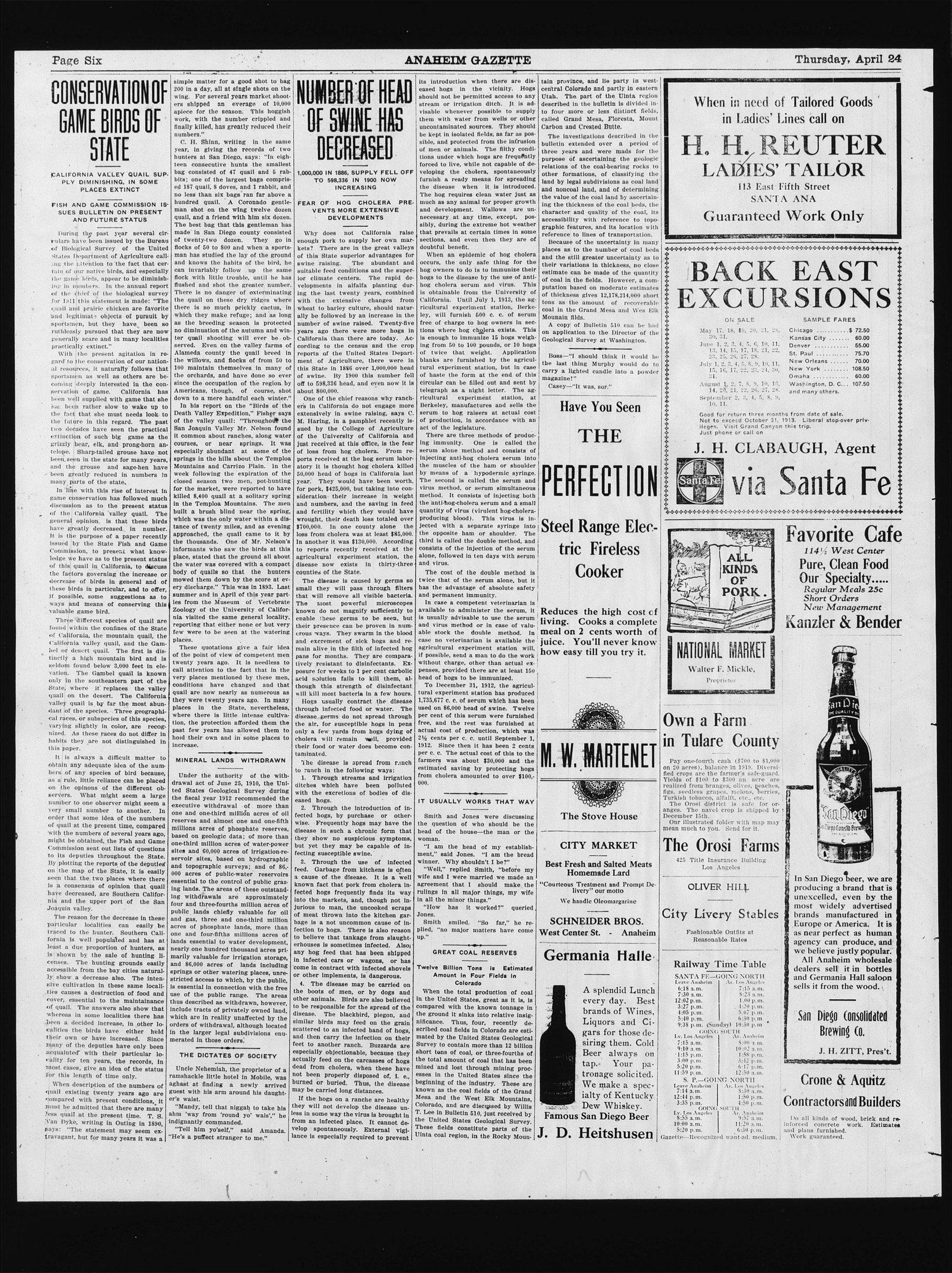
Searchable text
CONSERVATION OF GAME BIRDS OF STATE
CALIFORNIA VALLEY QUAIL SUPPLY DIMINISHING, IN SOME PLACES EXTINCT
FISH AND GAME COMMISSION ISSUES BULLETIN ON PRESENT AND FUTURE STATUS
During the past year several circulars have been issued by the Bureau of Biological Survey of the United States Department of Agriculture calling the attention to the fact that certain of our native birds, and especially the game birds, appear to be diminishing in numbers. In the annual report of the chief of the biological survey for 1911 this statement is made: "The quail and prairie chicken are favorite and legitimate objects of pursuit by sportsmen, but they have been so ruthlessly pursued that they are now generally scare and in many localities practically extinct."
With the present agitation in regard to the conservation of our national resources, it naturally follows that sportsmen as well as others are becoming deeply interested in the conservation of game. California has been well supplied with game that she has been rather slow to wake up to the fact that she must needs look to the future in this regard. The past two decades have seen the practical extinction of such big game as the grizzly bear, elk, and prong-horn antelope. Sharp-tailed grouse have not been seen in the state for many years, and the grouse and sage-hen have been greatly reduced in numbers in simple matter for a good shot to bag 200 in a day, all at single shots on the wing. For several years market shooters shipped an average of 10,000 apiece for the season. This hoggish work, with the number crippled and finally killed, has greatly reduced their numbers."
C. H. Shinn, writing in the same year, in giving the records of two hunters at San Diego, says: "In eighteen consecutive hunts the smallest bag consisted of 47 quail and 5 rabbits; one of the largest bags comprised 187 quail, 8 doves, and 1 rabbit, and no less than six bags ran far above a hundred quail. A Coronado gentleman shot on the wing twelve dozen quail, and a friend with him six dozen. The best bag that this gentleman has made in San Diego county consisted of twenty-two dozen. They go in flocks of 50 to 800 and when a sportsman has studied the lay of the ground and knows the habits of the bird, he can invariably follow up the same flock with little trouble, until he has flushed and shot the greater number. There is no danger of exterminating the quail on these dry ridges where there is so much prickly cactus, in which they make refuge; and as long as the breeding season is protected no diminuation of the autumn and winter quail shooting will ever be observed. Even on the valley farms of Alameda county the quail breed in the willows, and flocks of from 50 to 100 maintain themselves in many of the orchards, and have done so ever since the occupation of the region by Americans, though, of course, shot down to a mere handful each winter."
In his report on the "Birds of the Death Valley Expedition," Fisher says of the valley quail: "Throughout the San Joaquin Valley Mr. Nelson found it common about ranches, along water courses, or near springs. It was especially abundant at some of the springs in the hills about the Temploa Mountains and Carrizo Plain. In the week following the expiration of the
sportsmen as well as others are becoming deeply interested in the conservation of game. California has been well supplied with game that she has been rather slow to wake up to the fact that she must needs look to the future in this regard. The past two decades have seen the practical extinction of such big game as the grizzly bear, elk, and prong-horn antelope. Sharp-tailed grouse have not been seen in the state for many years, and the grouse and sage-hen have been greatly reduced in numbers in many parts of the state.
In line with this rise of interest in game conservation has followed much discussion as to the present status of the California valley quail. The general opinion is that these birds have greatly decreased in number. It is the purpose of a paper recently issued by the State Fish and Game Commission, to present what knowledge we have as to the present status of this quail in California, to discuss the factors governing the increase or decrease of birds in general and of these birds in particular, and to offer, if possible, some suggestions as to ways and means of conserving this valuable game bird.
Three different species of quail are found within the confines of the State of California, the mountain quail, the California valley quail, and the Gambel or desert quail. The first is distinctly a high mountain bird and is seldom found below 3,000 feet in elevation. The Gambel quail is known only in the southeastern part of the State, where it replaces the valley quail on the desert. The California valley quail is by far the most abundant of the species. Three geographical races, or subspecies of this species, varying slightly in color, are recognized. As these races do not differ in habits they are not distinguished in this paper.
It is always a difficult matter to obtain any adequate idea of the numbers of any species of bird because, as a rule, little reliance can be placed on the opinions of the different observers. What might seem a large number to one observer might seem a very small number to another. In order that some idea of the numbers of quail at the present time, compared with the numbers of several years ago, might be obtained, the Fish and Game Commission sent out lists of questions to its deputies throughout the State. By plotting the reports of the deputies on the map of the State, it is easily seen that the two places where there is a consensus of opinion that quail have decreased, are Southern California and have done so ever since the occupation of the region by Americans, though, of course, shot down to a mere handful each winter."
In his report on the "Birds of the Death Valley Expedition," Fisher says of the valley quail: "Throughout the San Joaquin Valley Mr. Nelson found it common about ranches, along water courses, or near springs. It was especially abundant at some of the springs in the hills about the Temploa Mountains and Carrizo Plain. In the week following the expiration of the closed season two men, pot-hunting for the market, were reported to have killed 8,400 quail at a solitary spring in the Temploa Mountains. The men built a brush blind near the spring, which was the only water within a distance of twenty miles, and as evening approached, the quail came to it by the thousands. One of Mr. Nelson's informants who saw the birds at this place, stated that the ground all about the water was covered with a compact body of quails so that the hunters mowed them down by the score at every discharge." This was in 1893. Last summer and in April of this year parties from the Museum of Vertebrate Zoology of the University of California visited the same general locality, reporting that either none or but very few were to be seen at the watering places.
These quotations give a fair idea of the point of view of competent men twenty years ago. It is needless to call attention to the fact that in the very places mentioned by these men, conditions have changed and that quail are now nearly as numerous as they were twenty years ago. In many places in the State, nevertheless, where there is little intense cultivation, the protection afforded them the past few years has allowed them to hold their own and in some places to increase.
MINERAL LANDS WITHDRAWN
Under the authority of the withdrawal act of June 25, 1910, the United States Geological Survey during the fiscal year 1912 recommended the executive withdrawal of more than one and one-third million acres of oil reserves and almost one and one-fifth millions acres of phosphate reserves, based on geologic data; of more than one-third million acres of water-power sites and 60,000 acres of irrigation-reservoir sites, based on hydrographic and topographic surveys; and of 86,000 acres of public-water reservoirs essential to the control of public grazing lands. The areas of these outstanding withdrawals are approximately...
The reason for the decrease in these particular localities can easily be traced to the hunter. Southern California is well populated and has at least a due proportion of hunters, as is shown by the sale of hunting licenses. The hunting grounds easily accessible from the bay cities naturally show a decrease also. The intensive cultivation in these same localities causes a destruction of food and cover, essential to the maintenance of quail. The answers also show that whereas in some localities there has been a decided increase, in other localities the birds have either held their own or have increased. Since many of the deputies have only been acquainted with their particular locality for ten years, the records, in most cases, give an idea of the status for this length of time only.
When description of the numbers of quail existing twenty years ago are compared with present conditions, it must be admitted that there are many less quail at the present time. T. S. Van Dyke, writing in Outing in 1890, says: "The statement may seem extravagant, but for many years it was a
THE DICTATES OF SOCIETY
Uncle Nehemiah, the proprietor of a ramshackle little hotel in Mobile, was aghast at finding a newly arrived guest with his arm around his daughter's waist.
"Mandy, tell that niggah to take his ahm 'way from 'round yo' wais'," he indignantly commanded.
"Tell him yo'self," said Amanda. "He's a puffect stranger to me."
NUMBER OF HEAD OF SWINE HAS DECREASED
1,000,000 IN 1886, SUPPLY FELL OFF TO 598,336 IN 1900 NOW INCREASING
FEAR OF HOG CHOLERA PREVENTS MORE EXTENSIVE DEVELOPMENTS
Why does not California raise enough pork to supply her own markets? There are in the great valleys of this State superior advantages for swine raising. The abundant and suitable feed conditions and the superior climate centers. The rapid developments in alfalfa planting during the last twenty years, combined with the extensive changes from wheat to barley culture, should naturally be followed by an increase in the number of swine raised. Twenty-five years ago there were more hogs in California than there are today. According to the census and the crop reports of the United States Department of Agriculture, there were in this State in 1886 over 1,000,000 head of swine. By 1900 this number fell off to 598,336 head, and even now it is about 800,000.
One of the chief reasons why ranchers in California do not engage more extensively in swine raising, says C. M. Haring, in a pamphlet recently issued by the College of Agriculture of the University of California and just received at this office, is the fear of loss from hog cholera. From reports received at the hog serum laboratory it is thought hog cholera killed 50,000 head of hogs in California last its introduction when there are diseased hogs in the vicinity. Hogs should not be permitted access to any stream or irrigation ditch. It is advisable whenever possible to supply them with water from wells or other uncontaminated sources. They should be kept in isolated fields, as far as possible, and protected from the intrusion of men or animals. The filthy conditions under which hogs are frequently forced to live, while not capable of developing the cholera, spontaneously furnish a ready means for spreading the disease when it is introduced. The hog requires clean water just as much as any animal for proper growth and development. Wallows are unnecessary at any time, except, possibly, during the extreme hot weather that prevails at certain times in some sections, and even then they are of doubtful benefit.
When an epidemic of hog cholera occurs, the only safe thing for the hog owners to do is to immunize their hogs to the disease by the use of anti-hog cholera serum and virus. This is obtainable from the University of California. Until July 1, 1913, the agricultural experiment station, Berkeley, will furnish 500 c. c. of serum free of charge to hog owners in sections where hog cholera exists. This is enough to immunize 15 hogs weighing from 50 to 100 pounds, or 10 hogs of twice that weight. Application blanks are furnished by the agricultural experiment station, but in case of haste the form at the end of this circular can be filled out and sent by telegraph as a night letter. The agricultural experiment station, at Berkeley, manufactures and sells the serum to hog raisers at actual cost of production, in accordance with an act of the legislature.
There are three methods of producing immunity. One is called the serum alone method and consists of injecting anti-hog cholera serum into the muscles of the ham or shoulder by means of a hypodermic syringe.
The investigations described in the bulletin extended over a period of three years and were mads for the purpose of ascertaining the geologic relations of the coal-bearing rocks to other formations, of classifying the land by legal subdivisions as coal land and noncoal land, and of determining the value of the coal land by ascertainting the thickness of the coal beds, the character and quality of the coal, its accessibility with reference to topographic features, and its location with reference to lines of transportation.
Because of the uncertainty in many places as to the number of coal beds and the still greater uncertainty as to their variations in thickness, no close estimate can be made of the quantity of coal in the fields. However, a computation based on moderate estimates of thickness gives 12,178,214,000 short tons as the amount of recoverable coal in the Grand Mesa and Wes Elk Mountain flds.
A copy of Bulletin 510 can be had on application to the Director of the Geological Survey at Washington.
Boss—“I should think it would be the last thing Murphy would do to carry a lighted candle into a powder magazine!”
Casey—“It was, sor.”
Have You Seen THE DERECOTION
of swine. By 1900 this number fell off to 598,336 head, and even now it is about 800,000.
One of the chief reasons why ranchers in California do not engage more extensively in swine raising, says C. M. Haring, in a pamphlet recently issued by the College of Agriculture of the University of California and just received at this office, is the fear of loss from hog cholera. From reports received at the hog serum laboratory it is thought hog cholera killed 50,000 head of hogs in California last year. They would have been worth, for pork, $425,000, but taking into consideration their increase in weight and numbers, and the saving in feed and fertility which they would have wrought, their death loss totaled over $700,000. In one county alone the loss from cholera was at least $85,000. In another it was $130,000. According to reports recently received at the agricultural experiment station, the disease now exists in thirty-three counties of the State.
The disease is caused by germs so small they will pass through filters that will remove all visible bacteria. The most powerful microscopes known do not magnify sufficiently to enable these germs to be seen, but their presence can be proven in numerous ways. They swarm in the blood and excrement of sick hogs and remain alive in the filth of infected hog pans for months. They are comparatively resistant to disinfectants. Exposure for weeks to 1 per cent carbolic acid solution fails to kill them, although this strength of disinfectant will kill most bacteria in a few hours.
Hogs usually contract the disease through infected food or water. The disease germs do not spread through the air, for susceptible hogs in pens only a few yards from hogs dying of cholera will remain well, provided their food or water does become contaminated.
The disease is spread from ranch to ranch in the following ways:
1. Through streams and irrigation ditches which have been polluted with the excretions of bodies of diseased hogs.
2. Through the introduction of infected hogs, by purchase or otherwise. Frequently hogs may have the disease in such a chronic form that they show no suspicious symptoms, but yet they may be capable of infecting susceptible swine.
3. Through the use of infected feed. Garbage from kitchens is often a cause of the disease. It is a well known fact that pork from cholera infected hogs frequently finds its way into the markets and though not in of haste the form at the end of this circular can be filled out and sent by telegraph as a night letter. The agricultural experiment station, at Berkeley, manufactures and sells the serum to hog raisers at actual cost of production, in accordance with an act of the legislature.
There are three methods of producing immunity. One is called the serum alone method and consists of injecting anti-hog cholera serum into the muscles of the ham or shoulder by means of a hypodermic syringe. The second is called the serum and virus method, or serum simultaneous method. It consists of injecting both the anti-hog-cholera serum and a small quantity of virus (virulent hog-cholera-producing blood). This virus is injected with a separate syringe into the opposite ham or shoulder. The third is called the double method, and consists of the injection of the serum alone, followed in ten days with serum and virus.
The cost of the double method is twice that of the serum alone, but it has the advantage of absolute safety and permanent immunity.
In case a competent veterinarian is available to administer the serum, it is usually advisable to use the serum and virus method or in case of valuable stock the double method. In case no veterinarian is available the agricultural experiment station will, if possible, send a man to do the work without charge, other than actual expenses, provided there are at least 150 head of hogs to be immunized.
To December 31, 1912, the agricultural experiment station has produced 1,735,677 c.c. of serum which has been used on 86,000 head of swine. Twelve per cent of this serum were furnished free, and the rest was furnished at actual cost of production, which was 2½ cents per c.c. until September 1, 1912. Since then it has been 2 cents per c.c. The actual cost of this to the farmers was about $30,000 and the estimated saving by protecting hogs from cholera amounted to over $100,-000.
IT USUALLY WORKS THAT WAY
Smith and Jones were discussing the question of who should be the head of the house—the man or the woman.
"I am the head of my establishment," said Jones. "I am the bread winner. Why shouldn't I be?"
"Well," replied Smith, "before my wife and I were married we made an agreement that I should make the rulings in all major things, my wife in all the minor things."
2. Through the introduction of infected hogs, by purchase or otherwise. Frequently hogs may have the disease in such a chronic form that they show no suspicious symptoms, but yet they may be capable of infecting susceptible swine.
3. Through the use of infected feed. Garbage from kitchens is often a cause of the disease. It is a well known fact that pork from cholera infected hogs frequently finds its way into the markets, and, though not injurious to man, the uncooked scraps of meat thrown into the kitchen garbage is a not uncommon cause of infection to hogs. There is also reason to believe that tankage from slaughterhouses is sometimes infected. Also, any hog feed that has been shipped in infected cars or wagons, or has come in contract with infected shovels or other implements, is dangerous.
4. The disease may be carried on the boots of men, or by dogs and other animals. Birds are also believed to be responsible for the spread of the disease. The blackbird, piegon, and similar birds may feed on the grain scattered to an infected band of hogs, and then carry the infection on their feet to another ranch. Buzzards are especially objectionable, because they actually feed on the carcasses of hogs dead from cholera, when these have not been properly disposed of, i.e., burned or buried. Thus, the disease may be carried long distances.
If the hogs on a ranche are healthy they will not develop the disease unless in some way the virus is brought in from an infected place. It cannot develop spontaneously. External vigilance is especially required to prevent
IT USUALLY WORKS THAT WAY
Smith and Jones were discussing the question of who should be the head of the house—the man or the woman.
"I am the head of my establishment," said Jones. "I am the bread winner. Why shouldn't I be?"
"Well," replied Smith, "before my wife and I were married we made an agreement that I should make the rulings in all major things, my wife in all the minor things."
"How has it worked?" queried Jones.
Smith smiled. "So far," he replied, "no major matters have come up."
GREAT COAL RESERVES
Twelve Billion Tons is Estimated Amount in Four Fields in Colorado
When the total production of coal in the United States, great as it is, is compared with the known tonnage in the ground it sinks into relative insignificance. Thus, four, recently described coal fields in Colorado are estimated by the United States Geological Survey to contain more than 12 billion short tons of coal, or three-fourths of the total amount of coal that has been mined and lost through mining processes in the United States since the beginning of the industry. These are known as the coal fields of the Grand Mesa and the West Elk Mountains, Colorado, and are discussed by Willis T. Lee in Bulletin 510, just received by the United States Geological Survey. These fields constitute parts of the Uinta coal region, in the Rocky Mountain.
A splendid Lunch every day. Best brands of Wines, Liquors and Cigars for those desiring them. Cold Beer always on tap. Your patronage solicited. We make a specialty of Kentucky Dew Whiskey.
Famous San Diego Beer
J. D. Heitshusen
Thursday, April 24
When in need of Tailored Goods
in Ladies' Lines call on
H. H. REUTER
LADIES' TAILOR
113 East Fifth Street
SANTA ANA
Guaranteed Work Only
BACK EAST
EXCURSIONS
ON SALE
May 17, 18, 19, 20, 21, 28,
30, 31.
June 1, 2, 3, 4, 5, 6, 10, 11,
13, 14, 15, 17, 18, 21, 22,
23, 25, 26, 27, 28.
July 1, 2, 3, 4, 5, 8, 9, 10, 11,
15, 16, 17, 22, 23, 24, 30,
31.
August 1, 2, 7, 8, 9, 10, 13,
14, 20, 21, 22, 26, 27, 28.
September 2, 3, 4, 5, 8, 9,
10, 11.
SAMPLE FARES
Chicago $72.50
Kansas City 60.00
Denver 55.00
St. Paul 75.70
New Orleans 70.00
New York 108.50
Omaha 60.00
Washington, D.C. 107.50
and many others.
Good for return three months from date of sale.
Not to exceed October 31, 1913. Liberal stop-over privileges. Visit Grand Canyon this trip.
Just phone or call on
J. H. CLABAUGH, Agent
You Seen
HE
ECTION
Good for return three months from date of sale.
Not to exceed October 31, 1913. Liberal stop-over privileges. Visit Grand Canyon this trip.
Just phone or call on
J. H. CLABAUGH, Agent
via Santa Fe
ALL KINDS OF PORK.
NATIONAL MARKET
Walter F. Mickle,
Proprietor
Favorite Cafe
114½ West Center
Pure, Clean Food
Our Specialty...
Regular Meals 25c
Short Orders
New Management
Kanzler & Bender
Own a Farm in Tulare County
Pay one-fourth cash ($700 to $1,000 on 20 acres), balance in 1919. Diversified crops are the farmer's safe-guard.
Yields of $100 to $300 an acre are realized from branges, olives, peaches, figs, seedless grapes, melons, berries, Turkish tobacco, alfalfa, etc., etc.
The Orosi district is safe for oranges. The navel crop is shipped by December 15th.
Our illustrated folder with map may mean much to you. Send for it.
The Orosi Farms
425 Title Insurance Building
Los Angeles
OLIVER HILL
In San Diego beer, we are producing a brand that is unexcelled, even by the
The Orosi Farms
425 Title Insurance Building
Los Angeles
OLIVER HILL
City Livery Stables
Fashionable Outfits at Reasonable Rates
Railway Time Table
SANTA FE—GOING NORTH
Leave Anaheim Ar. Los Angeles
6:18 a.m. 7:15 a.m.
7:30 a.m. 8:23 a.m.
12:02 p.m. 1:00 p.m.
3:27 p.m. 4:20 p.m.
4:05 p.m. 5:07 p.m.
5:40 p.m. 6:30 p.m.
9:38 p.m. (Sunday) 10:30 p.m.
GOING SOUTH
Lv. Los Angeles Ar. Anaheim
7:15 a.m. 8:00 a.m.
9:10 a.m. 10:02 a.m.
1:15 p.m. 1:58 p.m.
3:00 p.m. 3:42 p.m.
5:20 p.m. 6:17 p.m.
11:59 p.m. 12:50 a.m.
S. P.—GOING NORTH
Leave Anaheim Ar. Los Angeles
7:14 a.m. 8:30 a.m.
12:44 p.m. 1:50 p.m.
3:35 p.m. 4:50 p.m.
GOING SOUTH
Lv. Los Angeles Ar. Anaheim
8:55 a.m. 9:57 a.m.
10:00 a.m. 11:20 a.m.
5:20 p.m. 6:30 p.m.
Gazette—Recognized want-ad, medium.
In San Diego beer, we are producing a brand that is unexcelled, even by the most widely advertised brands manufactured in Europe or America. It is as near perfect as human agency can produce, and we believe justly popular.
All Anaheim wholesale dealers sell it in bottles and Germania Hall saloon sells it from the wood.
San Diego Consolidated Brewing Co.
J. H. ZITT, Pres't.
Crone & Aquitz Contractors and Builders
Do all kinds of wood, brick and reinforced concrete work. Estimates and plans furnished.
Work guaranteed.