anaheim-gazette 1913-02-13
Scanned page
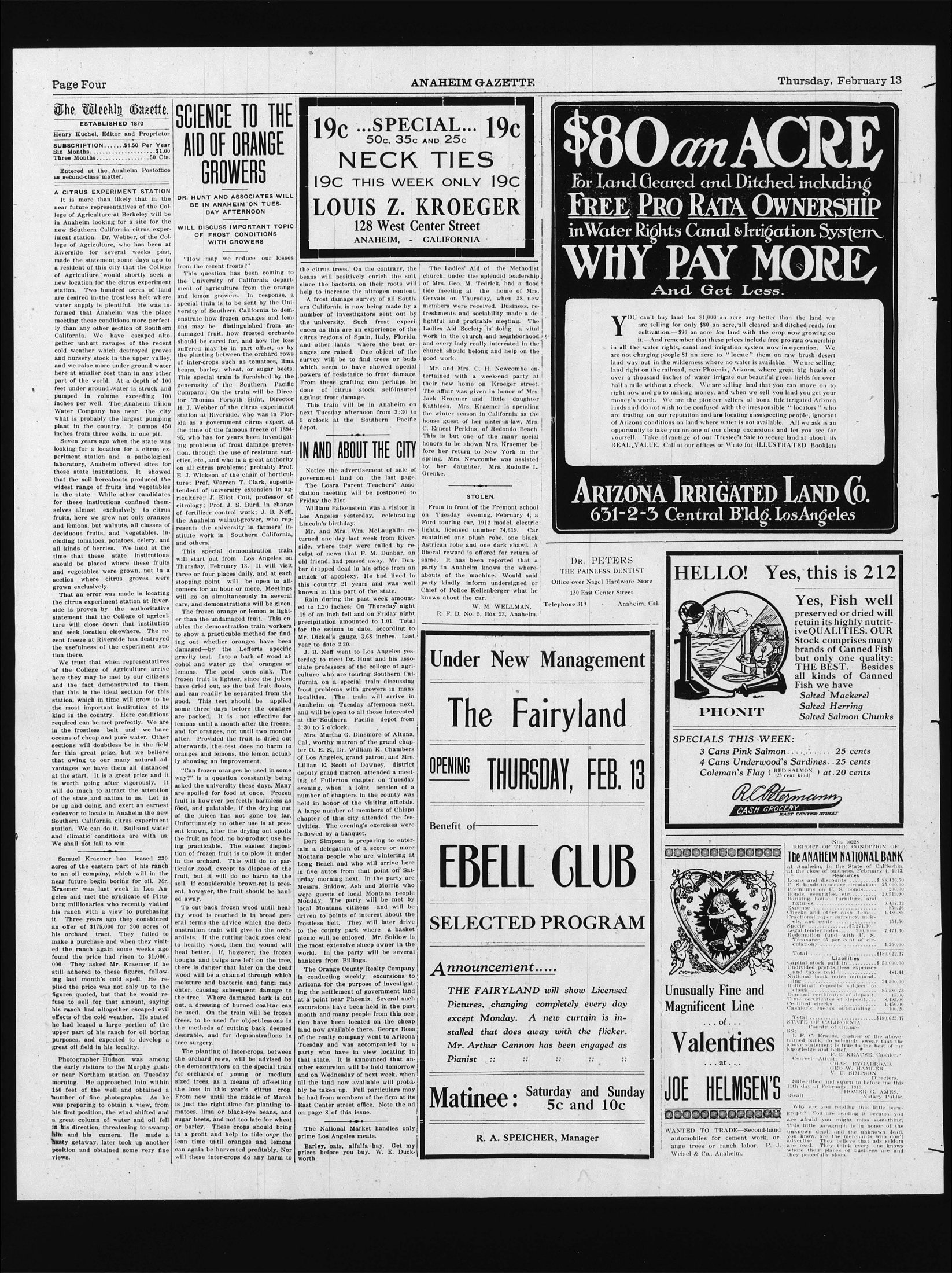
Searchable text
A CITRUS EXPERIMENT STATION
It is more than likely that in the near future representatives of the College of Agriculture at Berkeley will be in Anaheim looking for a site for the new Southern California citrus experiment station. Dr. Webber, of the College of Agriculture, who has been at Riverside for several weeks past, made the statement some days ago to a resident of this city that the College of Agriculture would shortly seek a new location for the citrus experiment station. Two hundred acres of land are desired in the frostless belt where water supply is plentiful. He was informed that Anaheim was the place meeting these conditions more perfectly than any other section of Southern California. We have escaped altogether unhurt ravages of the recent cold weather which destroyed groves and nursery stock in the upper valley, and we raise more under ground water here at smaller cost than in any other part of the world. At a depth of 100 feet under ground water is struck and pumped in volume exceeding 100 inches per well. The Anaheim Union Water Company has near the city what is probably the largest pumping plant in the country. It pumps 450 inches from three wells, in one pit.
Seven years ago when the state was looking for a location for a citrus experiment station and a pathological laboratory, Anaheim offered sites for these state institutions. It showed
SCIENCE TO THE AID OF ORANGE GROWERS
DR. HUNT AND ASSOCIATES WILL BE IN ANAHEIM ON TUESDAY AFTERNOON
WILL DISCUSS IMPORTANT TOPIC OF FROST CONDITIONS WITH GROWERS
"How may we reduce our losses from the recent frosts?"
This question has been coming to the University of California department of agriculture from the orange and lemon growers. In response, a special train is to be sent by the University of Southern California to demonstrate how frozen oranges and lemons may be distinguished from undamaged fruit, how frosted orchards should be cared for, and how the loss suffered may be in part offset, as by planting between the orchard rows of inter-crops such as tomatoes, lima beans, barley, wheat, or sugar beets. This special train is furnished by the generosity of the Southern Pacific Company. On the train will be Director Thomas Forsyth Hunt, Director H. J. Webber of the citrus experiment station at Riverside, who was in Florida as a government citrus expert at the time of the famous freeze of 1894-95, who has for years been investigating problems of frost damage prevention, through the use of resistant varieties, etc., and who is a great authority on all citrus problems; probably Prof. E. L. Wickson of the chair of horticulture."
Seven years ago when the state was looking for a location for a citrus experiment station and a pathological laboratory, Anaheim offered sites for these state institutions. It showed that the soil hereabouts produced the widest range of fruits and vegetables in the state. While other candidates for these institutions confined themselves almost exclusively to citrus fruits, here we grew not only oranges and lemons, but walnuts, all classes of deciduous fruits, and vegetables, including tomatoes, potatoes, celery, and all kinds of berries. We held at the time that these state institutions should be placed where these fruits and vegetables were grown, not in a section where citrus groves were grown exclusively.
That an error was made in locating the citrus experiment station at Riverside is proven by the authoritative statement that the College of agriculture will close down that institution and seek location elsewhere. The recent freeze at Riverside has destroyed the usefulness of the experiment station there.
We trust that when representatives of the College of Agriculture arrive here they may be met by our citizens and the fact demonstrated to them that this is the ideal section for this station, which in time will grow to be the most important institution of its kind in the country. Here conditions required can be met perfectly. We are in the frostless belt and we have oceans of cheap and pure water. Other sections will doubtless be in the field for this great prize, but we believe that owing to our many natural advantages we have them all distanced at the start. It is a great prize and it is worth going after vigorously. It will do much to attract the attention of the state and nation to us. Let us be up and doing, and exert an earnest endeavor to locate in Anaheim the new Southern California citrus experiment station. We can do it. Soil and water and climatic conditions are with us. We shall not fail to win.
Samuel Kraemer has leased 230 acres of the eastern part of his ranch to an oil company, which will in the near future begin boring for oil. Mr. Kraemer was last week in Los Angeles and met the syndicate of Pitts-
This special train is furnished by the generosity of the Southern Pacific Company. On the train will be Director Thomas Forsyth Hunt, Director H. J. Webber of the citrus experiment station at Riverside, who was in Florida as a government citrus expert at the time of the famous freeze of 1894-95, who has for years been investigating problems of frost damage prevention, through the use of resistant varieties, etc., and who is a great authority on all citrus problems; probably Prof. E. J. Wickson of the chair of horticulture; Prof. Warren T. Clark, superintendent of university extension in agriculture; J. Eliot Coit, professor of citrology; Prof. J. S. Burd, in charge of fertilizer control work; J. B. Neff, the Anaheim walnut-grower, who represents the university in farmers' institute work in Southern California, and others.
This special demonstration train will start out from Los Angeles on Thursday, February 13. It will visit three or four places daily, and at each stopping point will be open to all comers for an hour or more. Meetings will go on simultaneously in several cars, and demonstrations will be given.
The frozen orange or lemon is lighter than the undamaged fruit. This enables the demonstration train workers to show a practicable method for finding out whether oranges have been damaged—by the Lefferts specific gravity test. Into a bath of wood alcohol and water go the oranges or lemons. The good ones sink. The frozen fruit is lighter, since the juices have dried out, so the bad fruit floats, and can readily be separated from the good. This test should be applied some three days before the oranges are packed. It is not effective for lemons until a month after the freeze; and for oranges, not until two months after. Provided the fruit is dried out afterwards, the test does no harm to oranges and lemons, the lemon actually showing an improvement.
"Can frozen oranges be used in some way?" is a question constantly being asked the university these days. Many are spoiled for food at once. Frozen fruit is however perfectly harmless as food, and palatable, if the drying out of the juices has not gone too far. Unfortunately no other use is at present known, after the drying out spoils the fruit as food, no by-product use being practicable. The easiest disposition of frozen fruit is to plow it under in the orchard. This will do no particular good, except to dispose of the fruit, but it will do no harm to the soil. If considerable brown-rot is present, however, the fruit should be hauled away.
Notice the advertised government land sale.
The Loara Parc cation meeting w Friday the 21st.
William Falkensen Los Angeles yest Lincoln's birthday.
Mr. and Mrs. W turned one day last side, where they ceipt of news that old friend, had pass bar dropped dead in attack of apoplexy this country 21 ye known in this part.
Rain during the ed to 1.20 inches. .19 of an inch fell a precipitation amount for the season to Mr. Dickel's gauge year to date 2.20.
J. B. Neff went tterday to meet Dr. ciate professors of culture who are to california on a speci frost problems with localities. The t Anaheim on Tuesday and will be open to at the Southern I 3:30 to 5 o'clock.
Mrs. Martha G. L Cal., worthy matron ter O. E. S., Dr.W of Los Angeles, graz Lillian E. Scott of deputy grand matr ing of Fullerton ce evening, when a number of chapters held in honor of th A large number of chapter of this cit activities. The eveni followed by a banq Bert Simpson is tain a delegation o Montana people wh Long Beach and w in five autos from urday morning next Messrs. Snidow, As were guests of loo
Samuel Kraemer has leased 230 acres of the eastern part of his ranch to an oil company, which will in the near future begin boring for oil. Mr. Kraemer was last week in Los Angeles and met the syndicate of Pittsburg millionaries who recently visited his ranch with a view to purchasing it. Three years ago they considered an offer of $175,000 for 200 acres of his orchard tract. They failed to make a purchase and when they visited the ranch again some weeks ago found the price had risen to $1,000,000. They asked Mr. Kraemer if he still adhered to these figures, following last month's cold spell. He replied the price was not only up to the figures quoted, but that he would refuse to sell for that amount, saying his ranch had altogether escaped evil effects of the cold weather. He stated he had leased a large portion of the upper part of his ranch for oil boring purposes, and expected to develop a great oil field in his locality.
Photographer Hudson was among the early visitors to the Murphy gusher near Northam station on Tuesday morning. He approached into within 150 feet of the well and obtained a number of fine photographs. As he was preparing to obtain a view, from his first position, the wind shifted and a great column of water and oil fell in his direction, threatening to swamp him and his camera. He made a hasty getaway, later took up another position and obtained some very fine views.
The planting of inter-crops, between the orchard rows, will be advised by the demonstrators on the special train for orchards of young or medium sized trees, as a means of off-setting the loss in this year's citrus crop. From now until the middle of March is just the right time for planting tomatoes, lima or black-eye beans, and sugar beets, and not too late for wheat or barley. These crops should bring in a profit and help to tide over the lean time until oranges and lemons can again be harvested profitably. Nor will these inter-crops do any harm to fruit is however perfectly harmless as food, and palatable, if the drying out of the juices has not gone too far. Unfortunately no other use is at present known, after the drying out spoils the fruit as food, no by-product use being practicable. The easiest disposition of frozen fruit is to plow it under in the orchard. This will do no particular good, except to dispose of the fruit, but it will do no harm to the soil. If considerable brown-rot is present, however, the fruit should be hauled away.
To cut back frozen wood until healthy wood is reached is in broad general terms the advice which the demonstration train will give to the orchardists. If the cutting back goes clear to healthy wood, then the wound will heal better. If, however, the frozen boughs and twigs are left on the tree, there is danger that later on the dead wood will be a channel through which moisture and bacteria and fungi may enter, causing subsequent damage to the tree. Where damaged bark is cut out, a dressing of burned coal-tar can be used. On the train will be frozen trees, to be used for object-lessons in the methods of cutting back deemed desirable, and for demonstrations in tree surgery.
The planting of inter-crops, between the orchard rows, will be advised by the demonstrators on the special train for orchards of young or medium sized trees, as a means of off-setting the loss in this year's citrus crop. From now until the middle of March is just the right time for planting tomatoes, lima or black-eye beans, and sugar beets, and not too late for wheat or barley. These crops should bring in a profit and help to tide over the lean time until oranges and lemons can again be harvested profitably. Nor will these inter-crops do any harm to fruit is however perfectly harmless as food, and palatable, if the drying out of the juices has not gone too far. Unfortunately no other use is at present known, after the drying out spoils the fruit as food, no by-product use being practicable. The easiest disposition of frozen fruit is to plow it under in the orchard. This will do no particular good, except to dispose of the fruit, but it will do no harm to the soil. If considerable brown-rot is present, however, the fruit should be hauled away.
To cut back frozen wood until healthy wood is reached is in broad general terms the advice which the demonstration train will give to the orchardists. If the cutting back goes clear to healthy wood, then the wound will heal better. If, however, the frozen boughs and twigs are left on the tree, there is danger that later on the dead wood will be a channel through which moisture and bacteria and fungi may enter, causing subsequent damage to the tree. Where damaged bark is cut out, a dressing of burned coal-tar can be used. On the train will be frozen trees, to be used for object-lessons in the methods of cutting back deemed desirable, and for demonstrations in tree surgery.
The planting of inter-crops, between the orchard rows, will be advised by the demonstrators on the special train for orchards of young or medium sized trees, as a means of off-setting the loss in this year's citrus crop. From now until the middle of March is just the right time for planting tomatoes, lima or black-eye beans, and sugar beets, and not too late for wheat or barley. These crops should bring in a profit and help to tide over the lean time until oranges and lemons can again be harvested profitably. Nor will these inter-crops do any harm to fruit is however perfectly harmless as food, and palatable, if the drying out of the juices has not gone too far. Unfortunately no other use is at present known, after the drying out spoils the fruit as food, no by-product use being practicable. The easiest disposition of frozen fruit is to plow it under in the orchard. This will do no particular good, except to dispose of the fruit, but it will do no harm to the soil. If considerable brown-rot is present, however, the fruit should be hauled away.
To cut back frozen wood until healthy wood is reached is in broad general terms the advice which the demonstration train will give to the orchardists. If the cutting back goes clear to healthy wood, then the wound will heal better. If, however, the frozen boughs and twigs are left on the tree, there is danger that later on the dead wood will be a channel through which moisture and bacteria and fungi may enter, causing subsequent damage to the tree. Where damaged bark is cut out, a dressing of burned coal-tar can be used. On the train will be frozen trees, to be used for object-lessons in the methods of cutting back deemed desirable, and for demonstrations in tree surgery.
The planting of inter-crops, between the orchard rows, will be advised by the demonstrators on the special train for orchards of young or medium sized trees, as a means of off-setting the loss in this year's citrus crop. From now until the middle of March is just the right time for planting tomatoes, lima or black-eye beans, and sugar beets, and not too late for wheat or barley. These crops should bring in a profit and help to tide over the lean time until oranges and lemons can again be harvested profitably. Nor will these inter-crops do any harm to fruit is however perfectly harmless as food, and palatable, if the drying out of the juices has not gone too far. Unfortunately no other use is at present known, after the drying out spoils the fruit as food, no by-product use being practicable. The easiest disposition of frozen fruit is to plow it under in the orchard. This will do no particular good, except to dispose of the fruit, but it will do no harm to the soil. If considerable brown-rot is present, however, the fruit should be hauled away.
To cut back frozen wood until healthy wood is reached is in broad general terms the advice which the demonstration train will give to the orchardists. If the cutting back goes clear to healthy wood, then the wound will heal better. If, however, the frozen boughs and twigs are left on the tree, there is danger that later on the dead wood will be a channel through which moisture and bacteria and fungi may enter, causing subsequent damage to the tree. Where damaged bark is cut out, a dressing of burned coal-tar can be used. On the train will be frozen trees, to be used for object-lessons in the methods of cutting back deemed desirable, and for demonstrations in tree surgery.
The planting of inter-crops, between the orchard rows, will be advised by the demonstrators on the special train for orchards of young or medium sized trees, as a means of off-setting the loss in this year's citrus crop. From now until the middle of March is just the right time for planting tomatoes, lima or black-eye beans, and sugar beets, and not too late for wheat or barley. These crops should bring in a profit and help to tide over the lean time until oranges and lemons can again be harvested profitably. Nor will these inter-crops do any harm to fruit is however perfectly harmless as food, and palatable, if the drying out of the juices has not gone too far. Unfortunately no other use is at present known, after the drying out spoils the fruit as food, no by-product use being practicable. The easiest disposition of frozen fruit is to plow it under in the orchard. This will do no particular good, except to dispose of the fruit, but it will do no harm to the soil. If considerable brown-rot is present,however,the fruit should be hauled away.
To cut back frozen wood until healthy wood is reached is in broad general terms the advice which the demonstration train will give to the orchardists. If the cutting back goes clear to healthy wood,then the wound will heal better. If,however,the frozen boughs和twigs are left onthe树,there is danger that later onthedeadwoodwillbeachannelthroughwhichmoistureandbacteriaandfungimayenter,causesubsequentdamagetothetree.Wherethedamagedbarkiscutout,a dressingofburnedcoal-tarcanbeused.Onthetrainwillbefrozentrees,touseffectsonelengthandmanypractitionehavebeenlocatedlandnowabelybe takenup.HerehadfrommemberEastCenterstreetonpage8ofthis
The National Mine prime Los Angeles Barley,oats,also prices before you worth。
19c ...SPECIAL... 19c
50c, 35c AND 25c
NECK TIES
19C THIS WEEK ONLY 19C
LOUIS Z. KROEGER
128 West Center Street
ANAHEIM, - CALIFORNIA
the citrus trees. On the contrary, the beans will positively enrich the soil, since the bacteria on their roots will help to increase the nitrogen content.
A frost damage survey of all Southern California is now being made by a number of investigators sent out by the university. Such frost experiences as this are an experience of the citrus regions of Spain, Italy, Florida, and other lands where the best oranges are raised. One object of the survey will be to find trees or buds which seem to have showed special powers of resistance to frost damage. From these grafting can perhaps be done of citrus stock self-insured against frost damage.
This train will be in Anaheim on next Tuesday afternoon from 3:30 to 5 o'clock at the Southern Pacific depot.
IN AND ABOUT THE CITY
Notice the advertisement of sale of
The Ladies' Aid of the Methodist church, under the splendid leadership of Mrs. Geo. M. Tedrick, had a flood tide meeting at the home of Mrs. Gervais on Thursday, when 38 new members were received. Business, refreshments and sociability made a delightful and profitable meeting. The Ladies Aid Society is doing a vital work in the church and neighborhood and every lady really interested in the church should belong and help on the good work.
Mr. and Mrs. C. H. Newcombe entertained with a week-end party at their new home on Kroeger street. The affair was given in honor of Mrs. Jack Kraemer and little daughter Kathleen. Mrs. Kraemer is spending the winter season in California as the house guest of her sister-in-law, Mrs. C. Ernest Perkins, of Redondo Beach. This is but one of the many social honors to be shown Mrs. Kraemer before her return to New York in the spring. Mrs. Newcombe was assisted by her daughter, Mrs. Rudolfe L. Grenke.
$80 For Land Clearance FREE PRO in Water Right WHY I Ar
IN AND ABOUT THE CITY
Notice the advertisement of sale of government land on the last page.
The Loara Parent Teachers' Association meeting will be postponed to Friday the 21st.
William Falkenstein was a visitor in Los Angeles yesterday, celebrating Lincoln's birthday.
Mr. and Mrs. Wm. McLaughlin returned one day last week from River-side, where they were called by receipt of news that F. M. Dunbar, an old friend, had passed away. Mr. Dunbar dropped dead in his office from an attack of apoplexy. He had lived in this country 21 years and was well known in this part of the state.
Rain during the past week amounted to 1.20 inches. On Thursday night .19 of an inch fell and on Friday night precipitation amounted to 1.01. Total for the season to date, according to Mr. Dickel's gauge, 3.68 inches. Last year to date 2.20.
J. B. Neff went to Los Angeles yesterday to meet Dr. Hunt and his associate professors of the college of agriculture who are touring Southern California on a special train discussing frost problems with growers in many localities. The train will arrive in Anaheim on Tuesday afternoon next, and will be open to all those interested at the Southern Pacific depot from 3:30 to 5 o'clock.
Mrs. Martha G. Dinsmore of Altuna, Cal., worthy matron of the grand chapter O. E. S., Dr. William K. Chambers of Los Angeles, grand patron, and Mrs. Lillian E. Scott of Downey, district deputy grand matron, attended a meeting of Fullerton chapter on Tuesday evening, when a joint session of a number of chapters in the county was held in honor of the visiting officials. A large number of members of Chispa chapter of this city attended the festivities. The evening's exercises were followed by a banquet.
Bert Simpson is preparing to entertain a delegation of a score or more Montana people who are wintering at Long Beach and who will arrive here in five autos from that point on Saturday morning next. In the party are Messrs. Snidow, Ash and Morris who were guests of local Montana people.
STOLEN
From in front of the Fremont school on Tuesday evening, February 4, a Ford touring car, 1912 model, electric lights, licensed unmber 74,619. Car contained one plush robe, one black Astrican robe and one dark shawl. A liberal reward is offered for return of same. It has been reported that a party in Anaheim knows the whereabouts of the machine. Would said party kindly inform undersigned or Chief of Police Kellenberger what he knows about the car.
W. M. WELLMAN,
R. F. D. No. 5, Box 23, Anaheim.
Under New Management
The Fairyland
OPENING THURSDAY, FEB. 13
Benefit of
EBELL CLUB
Benefit of
EBELL CLUB
SELECTED PROGRAM
Announcement...
THE FAIRYLAND will show Licensed Pictures, changing completely every day except Monday. A new curtain is installed that does away with the flicker. Mr. Arthur Cannon has been engaged as Pianist :: :: :: ::
Matinee: Saturday and Sunday
5c and 10c
R. A. SPEICHER, Manager
80 an ACRE
Land Cleared and Ditched including
FREE PRO RATA OWNERSHIP
Water Rights Canal & Irrigation System
WHY PAY MORE
And Get Less.
You can't buy land for $1,000 an acre any better than the land we are selling for only $80 an acre, all cleared and ditched ready for cultivation.—$90 an acre for land with the crop now growing on it. And remember that these prices include free pro rata ownership in all the water rights, canal and irrigation system now in operation. We are not charging people $1 an acre to "locate" them on raw brush desert land way out in the wilderness where no water is available. We are selling land right on the railroad, near Phoenix, Arizona, where great big heads of over a thousand inches of water irrigate our beautiful green fields for over half a mile without a check. We are selling land that you can move on to right now and go to making money, and when we sell you land you get your money's worth. We are the pioneer sellers of bona fide irrigated Arizona lands and do not wish to be confused with the irresponsible "locators" who are trading on our reputation and are locating unsuspecting people, ignorant of Arizona conditions on land where water is not available. All we ask is an opportunity to take you on one of our cheap excursions and let you see for yourself. Take advantage of our Trustee's Sale to secure land at about its REAL VALUE. Call at our offices or Write for ILLUSTRATED Booklets
HELLO! Yes, this is 212
Yes, Fish well preserved or dried will retain its highly nutritiveQUALITIES. OUR Stock comprises many brands of Canned Fish but only one quality: THE BEST. Besides all kinds of Canned Fish we have
Salted Mackerel
Salted Herring
Salted Salmon Chunks
SPECIALS THIS WEEK:
3 Cans Pink Salmon...25 cents
4 Cans Underwood’s Sardines...25 cents
Coleman’s Flag (RED SALMON) at.20 cents
R.C. Petermann
CASH GROcery
EAST CENTER STREET
REPORT OF THE CONDITION OF
The ANAHEIM NATIONAL BANK
at Anaheim, in the State of California,
at the close of business, February 4, 1913.
Resources
Loans and discounts ... $88,436.50
U. S. bonds to secure circulation ... 25,000.00
Premiums on U. S. bonds ... 200.00
Bonds, securities, etc ... 29,519.90
Banking house, furniture, and fixtures ... 9,407.33
Expense ... 959.26
Checks and other cash items ... 1,480.89
Fractional paper currency, nickels, and cents ... 154.50
Specie ... $7,271.30
Legal tender notes ... 200.00—7,471.30
Redemption fund with U. S. Treasurer (5 per cent of circulation) ... 1,250.00
Total ... $180,622.37
Liabilities
Capital stock paid in ... $50,000.00
Undivided profits, less expenses and taxes paid ... 481.44
National bank notes outstanding ... 24,500.00
Individual deposits subject to check ... 95,580.73
Demand certificates of deposit ... 15.00
Time certificates of deposit ... 8,495.00
Certified checks ... 1,450.00
Cashier's checks outstanding ... 100.20
Total ... $180,622.37
STATE OF CALIFORNIA
County of Orange
SS:
I. F. C. Krause, cashier of the above-mained bank, do solemnly swear that the above statement is true to the best of my knowledge and belief.
F. C. KRAUSE, Cashier.
Correct—Attest:
CHAS. EYGABROAD,
GEO W. HAMLER,
V. U. SIMPSON.
Directors.
Subscribed and sworn to before me this 11th day of February, 1913.
HOMER G. AMES.
(Seal)
Notary Public.
Why are you reading this little paragraph? You are reading it because you are afraid you might miss something.
This little paragraph is in honor of the unknown dead, and the unknown dead, you know, are the merchants who don't advertise. They believe that ads seldom are read. They think every one knows where their places of business are and they peacefully sleep.