anaheim-gazette 1913-02-13
Scanned page
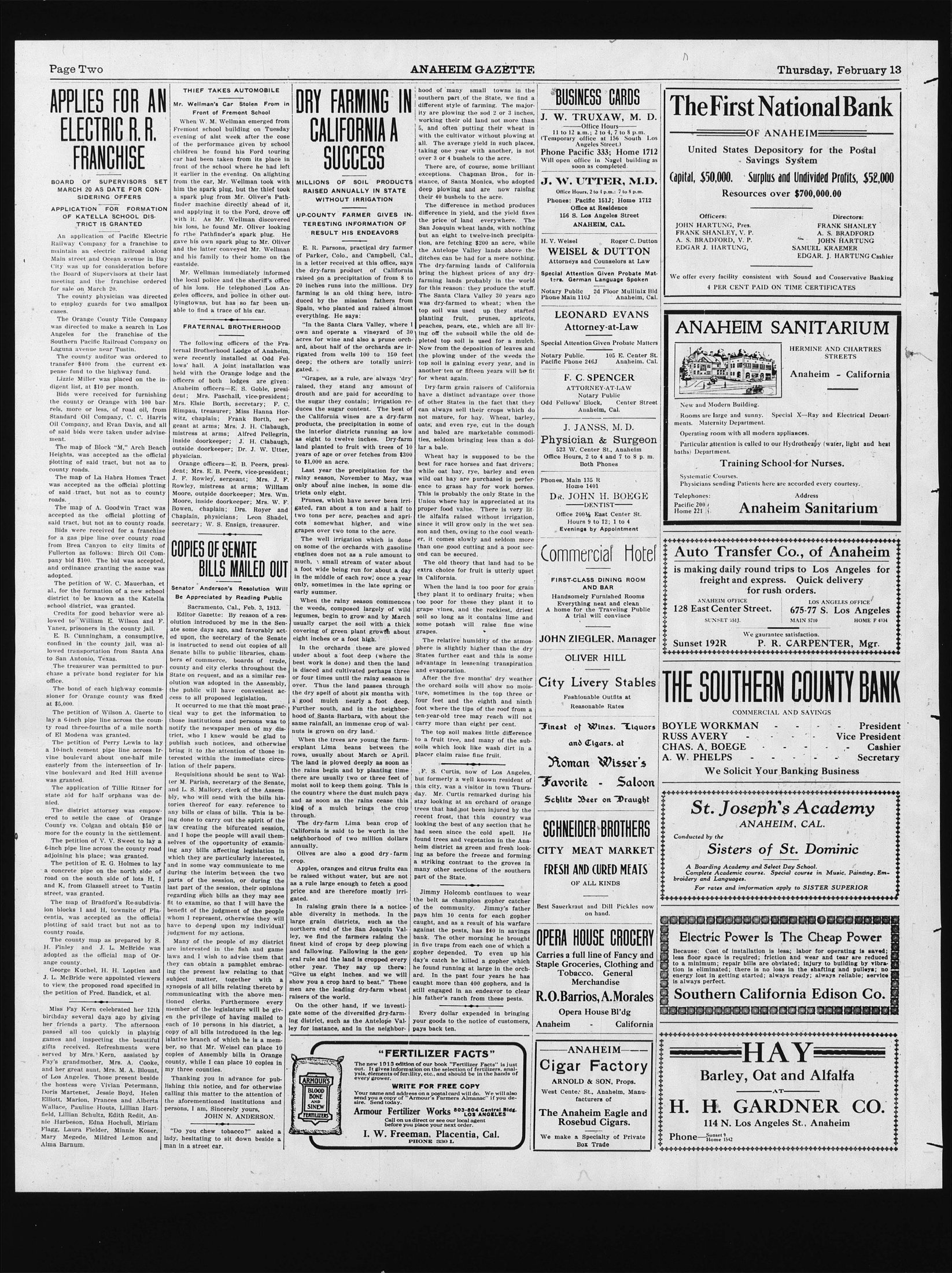
Searchable text
APPLIES FOR AN ELECTRIC R. R. FRANCHISE
BOARD OF SUPERVISORS SET MARCH 20 AS DATE FOR CONSIDERING OFFERS
APPLICATION FOR FORMATION OF KATELLA SCHOOL DISTRICT IS GRANTED
An application of Pacific Electric Railway Company for a franchise to maintain an electric railroad along Main street and Ocean avenue in Bay City was up for consideration before the Board of Supervisors at their last meeting and the franchise ordered for sale on March 20.
The county physician was directed to employ guards for two smallpox cases.
The Orange County Title Company was directed to make a search in Los Angeles for the franchise of the Southern Pacific Railroad Company on Laguna avenue near Tustin.
The county auditor was ordered to transfer $400 from the current expense fund to the highway fund.
Lizzie Miller was placed on the indigent list, at $10 per month.
Bids were received for furnishing the county or Orange with 100 barrels, more or less, of road oil, from Standard Oil Company, C. C. Harris Oil Company, and Evan Davis, and all of said bids were taken under advisement.
The map of Block "M," Arch Beach Heights, was accepted as the official plotting of said tract, but not as to county roads.
THIEF TAKES AUTOMOBILE
Mr. Wellman's Car Stolen From in Front of Fremont School
When W. M. Wellman emerged from Fremont school building on Tuesday evening of alst week after the cose of the performance given by school children he found his Ford touring car had been taken from its place in front of the school where he had left it earlier in the evening. On alighting from the car, Mr. Wellman took with him the spark plug, but the thief took a spark plug from Mr. Oliver's Pathfinder machine directly ahead of it, and applying it to the Ford, drove off with it. As Mr. Wellman discovered his loss, he found Mr. Oliver looking for rthe Pathfinder's spark plug. He gave his own spark plug to Mr. Oliver and the latter conveyed Mr. Wellman and his family to their home on the eastside.
Mr. Wellman immediately informed the local police and the sheriff's office of his loss. He telephoned Los Angeles officers, and police in other outlying towns, but has so far been unable to find a trace of his car.
FRATERNAL BROTHERHOOD
The following officers of the Fraternal Brotherhood Lodge of Anaheim, were recently installed at Odd Fellows' hall. A joint installation was held with the Orange lodge and the officers of both lodges are given: Anaheim officers—E. S. Goble, president; Mrs. Paschall, vice-president; Mrs. Elsie Borth, secretary; F. C. Rimpau, treasurer; Miss Hanna Horwitz, chaplain; Frank Borth, sergeant at arms; Mrs. J. H. Clabaugh, mistress at arms; Alfred Pellegrin, inside doorkeeper; J. H. Clabaugh, outside doorkeeper; Dr. J. W. Utter, physician.
Orange officers—E. B. Peers, president; Mrs. E. B. Peers, vice-president;
Lizzie Miller was placed on the indigent list, at $10 per month.
Bids were received for furnishing the county or Orange with 100 barrels, more or less, of road oil, from Standard Oil Company, C. C. Harris Oil Company, and Evan Davis, and all of said bids were taken under advisement.
The map of Block "M," Arch Beach Heights, was accepted as the official plotting of said tract, but not as to county roads.
The map of La Habra Homes Tract was accepted as the official plotting of said tract, but not as to county roads.
The map of A. Goodwin Tract was accepted as the official plotting of said tract, but not as to county roads.
Bids were received for a franchise for a gas pipe line over county road from Brea Canyon to city limits of Fullerton as follows: Birch Oil Company bid $100. The bid was accepted, and ordinance granting the same was adopted.
The petition of W. C. Mauerhan, et al., for the formation of a new school district to be known as the Katella school district, was granted.
Credits for good behavior were allowed to William E. Wilson and F. Yanez, prisoners in the county jail.
E. B. Cunningham, a consumptive, confined in the county jail, was allowed transportation from Santa Ana to San Antonio, Texas.
The treasurer was permitted to purchase a private bond register for his office.
The bond of each highway commissioner for Orange county was fixed at $5,000.
The petition of Wilson A. Gaerte to lay a 6-inch pipe line across the county road three-fourths of a mile north of El Modena was granted.
The petition of Perry Lewis to lay a 10-inch cement pipe line across Irvine boulevard about one-half mile easterly from the intersection of Irvine boulevard and Red Hill avenue was granted.
The application of Tillie Ritner for state aid for half orphans was denied.
The district attorney was empowered to settle the case of Orange County vs. Colgan and obtain $50 or more for the county in the settlement.
The petition of V. V. Sweet to lay a 6-inch pipe line across the county road adjoining his place; was granted.
The petition of E. G. Holmes to lay a concrete pipe on the north side of road on the south side of lots H, I and K, from Glassell street to Tustin street, was granted.
COPIES OF SENATE BILLS MAILED OUT
Senator Anderson's Resolution Will Be Appreciated by Reading Public
Sacramento, Cal., Feb. 3, 1913.
Editor Gazette: By reason of a resolution introduced by me in the Senate some days ago, and favorably acted upon, the secretary of the Senate is instructed to send out copies of all Senate bills to public libraries, chambers of commerce, boards of trade, county and city clerks throughout the State on request, and as a similar resolution was adopted in the Assembly, the public will have convenient access to all proposed legislation.
It occurred to me that the most practical way to get the information to those institutions and persons was to notify the newspaper men of my district, who I knew would be glad to publish such notices, and otherwise bring it to the attention of those interested within the immediate circulation of their papers.
Requisitions should be sent to Walter M. Parish, secretary of the Senate, and L. S. Mallory, clerk of the Assembly, who will send with the bills histories thereof for easy reference to any bills or class of bills. This is being done to carry out the spirit of the law creating the bifurcated session, and I hope the people will avail themselves of the opportunity of examining any bills affecting legislation in which they are particularly interested, and in some way communicate to me during the interim between the two parts of the session, or during the last part of the session, their opinions regarding such bills as they may see
"Grapes, as a rule raised, they stand drouth and are paid the sugar they produce the sugar content in California wine products, the precipitate interior district as eight to twelve years of age or over to $1,000 an acre.
Last year the preregainry season, November only about nine inches only eight.
Prunes, which have gated, ran about a two tons per acre, cots somewhat high grapes over two tons.
The well irrigation on some of the orchid engines does not as much, small stream a foot wide being run in the middle of each only, sometimes in early summer.
When the rainy season she weeds, compose legumes, begin to grow usually carpet the covering of green plants eight inches or a foot.
In the orchards under about a foot best work is done) area is discarded and cultivated or four times until they over. Thus the land the dry spell of about a good mulch near Further south, andhood of Santa Barbara same rainfall, an imminent nuts is grown on dry.
When the trees are ersplant Lima beans rows, usually about The land is plowed on there are usually two moist soil to keep them in the country where they and as soon as the kind of a mulch through.
The dry-farm Limia California is said to neighborhood of two annually.
Olives are also a crop.
Apples, oranges and be raised without waste as a rule large enough price and are there g rated.
The district attorney was empowered to settle the case of Orange County vs. Colgan and obtain $50 or more for the county in the settlement.
The petition of V. V. Sweet to lay a 6-inch pipe line across the county road adjoining his place; was granted.
The petition of E. G. Holmes to lay a concrete pipe on the north side of road on the south side of lots H, I and K, from Glassell street to Tustin street, was granted.
The map of Bradford's Re-subdivision blocks I and H, townsite of Placentia, was accepted as the official plotting of said tract but not as to county roads.
The county map as prepared by S. H. Finley and J. L. McBride was adopted as the official map of Orange county.
George Kuchel, H. H. Loptien and J. L. McBride were appointed viewers to view the proposed road specified in the petition of Fred. Bandick, et al.
Miss Fay Kern celebrated her 12th birthday several days ago by giving her friends a party. The afternoon passed all too quickly in playing games and inspecting the beautiful gifts received. Refreshments were served by Mrs. Kern, assisted by Fay's grandmother, Mrs. A. Cooke, and her great aunt, Mrs. M. A. Blount, of Los Angeles. Those present beside the hostess were Vivian Petermann, Doris Martenet, Jessie Boyd, Helen Elliott, Marion, Frances and Alberta Wallace, Pauline Houts, Lillian Hartfield, Lillian Schultz, Edith Redit, Annie Harbeson, Edna Hochuli, Miriam Flagg, Laura Fielder, Minnie Koser, Mary Megede, Mildred Lemon and Alma Barnum.
Many of the people of my district are interested in the fish and game laws and I wish to advise them that they can obtain a pamphlet embracing the present law relating to that subject matter, together with a synopsis of all bills relating thereto by communicating with the above mentioned clerks. Furthermore every member of the legislature will be given the privilege of having mailed to each of 10 persons in his district, a copy of all bills introduced in the legislative branch of which he is a member, so that Mr. Weisel can place 10 copies of Assembly bills in Orange county, while I can place 10 copies in my three counties.
Thanking you in advance for publishing this notice, and for otherwise calling this matter to the attention of the aforementioned institutions and persons, I am, Sincerely yours,
JOHN N. ANDERSON.
"Do you chew tobacco?" asked a lady, hesitating to sit down beside a man in a street car.
DRY FARMING IN CALIFORNIA A SUCCESS
MILLIONS OF SOIL PRODUCTS RAISED ANNUALLY IN STATE WITHOUT IRRIGATION
UP-COUNTY FARMER GIVES INTERESTING INFORMATION OF RESULT HIS ENDEAVORS
E. R. Parsons, practical dry farmer of Parker, Colo., and Campbell, Cal., in a letter received at this office, says the dry-farm product of California raised on a precipitation of from 8 to 20 inches runs into the millions. Dry farming is an old thing here, introduced by the mission fathers from Spain, who planted and raised almost everything. He says:
"In the Santa Clara Valley, where I own and operate a vineyard of 30 acres for wine and also a prune orchard, about half of the orchards are irrigated from wells 100 to 150 feet deep; the others are totally unirrigated.
"Grapes, as a rule, are always 'dry' raised, they stand any amount of drought and are paid for according to the sugar they contain; irrigation reduces the sugar content. The best of the California wines are a dry-farm products, the precipitation in some of the interior districts running as low as eight to twelve inches. Dry-farm land planted to fruit with trees of 10 years of age or over fetches from $300 to $1,000 an acre.
Last year the precipitation for the hood of many small towns in the southern part of the State, we find a different style of farming. The majority are plowing the sod 2 or 3 inches, working their old land not more than 5, and often putting their wheat in with the cultivator without plowing at all. The average yield in such places, taking one year with another, is not over 3 or 4 bushels to the acre.
There are, of course, some brilliant exceptions. Chapman Bros., for instance, of Santa Monica, who adopted deep plowing and are now raising their 40 bushels to the acre.
The difference in method produces difference in yield, and the yield fixes the price of land everywhere. The San Joaquin wheat lands, with nothing but an eight to twelve-inch precipitation, are fetching $200 an acre, while the Antelope Valley lands above the ditches can be had for a mere nothing. The dry-farming lands of California bring the highest prices of any dry-farming lands probably in the world for this reason: they produce the stuff. The Santa Clara Valley 30 years ago was dry-farmed to wheat; when the top soil was used up they started planting fruit, prunes, apricots, peaches, pears, etc., which are all living off the subsoil while the old depleted top soil is used for a mulch. Now from the deposition of leaves and the plowing under of the weeds the top soil is gaining every year, and in another ten or fifteen years will be fit for wheat again.
Dry-farm grain raisers of California have a distinct advantage over those of other States in the fact that they can always sell their crops which do not mature, for hay. Wheat, barley, oats, and even rye, cut in the dough and baled are marketable commodities, seldom bringing less than a dollar a bale.
Wheat hay is supposed to be the best for race horses and fast drivers; while oat hay, rye, barley and even..."
BUSINESS CARDS
J. W. TRUXAW, M. D.
Office Hours
11 to 12 a.m.; 2 to 4, 7 to 8 p.m.
(Temporary office at 156 South Los Angeles Street)
Phone Pacific 333; Home 1712
Will open office in Nagel building as soon as completed.
J. W. UTTER, M.D.
Office Hours, 2 to 4 p.m.: 7 to 8 p.m.
Phones: Pacific 151J; Home 1712
Office at Residence
156 S. Los Angeles Street
ANAHEIM, CAL.
H. V. Weisel Roger C. Dutton
WEISEL & DUTTON
Attorneys and Counselors at Law
Special Attention Given Probate Matters. German Language Spoken
Notary Public 2d Floor Mullinix Bld
Phone Main 110J Anaheim, Cal.
LEONARD EVANS
Attorney-at-Law
Special Attention Given Probate Matters
Notary Public. 105 E. Center St.
Pacific Phone 246J Anaheim, Cal.
F. C. SPENCER
ATTORNEY-AT-LAW
Notary Public
Odd Fellows' Block,
Center Street
Anaheim, Cal.
J. JANSS, M. D.
Physician & Surgeon
523 W. Center St., Anaheim
Office Hours, 2 to 4 and 7 to 8 p.m.
Both Phones
"Grapes, as a rule, are always 'dry' raised, they stand any amount of drouth and are paid for according to the sugar they contain; irrigation reduces the sugar content. The best of the California wines are a dry-farm products, the precipitation in some of the interior districts running as low as eight to twelve inches. Dry-farm land planted to fruit with trees of 10 years of age or over fetches from $300 to $1,000 an acre.
Last year the precipitation for the rainy season, November to May, was only about nine inches, in some districts only eight.
Prunes, which have never been irrigated, ran about a ton and a half to two tons per acre, peaches and apricots somewhat higher, and wine grapes over two tons to the acre.
The well irrigation which is done on some of the orchards with gasoline engines does not as a rule amount to much, a small stream of water about a foot wide being run for about a day in the middle of each row, once a year only, sometimes in the late spring or early summer.
When the rainy season commences the weeds, composed largely of wild legumes, begin to grow and by March usually carpet the soil with a thick covering of green plant growth about eight inches or a foot high.
In the orchards these are plowed under about a foot deep (where the best work is done) and then the land is disced and cultivated perhaps three or four times until the rainy season is over. Thus the land passes through the dry spell of about six months with a good mulch nearly a foot deep. Further south, and in the neighborhood of Santa Barbara, with about the same rainfall, an immense crop of walnuts is grown on dry land.
When the trees are young the farmersplant Lima beans between the rows, usually about March or April. The land is plowed deeply as soon as the rains begin and by planting time there are usually two or three feet of moist soil to keep them going. This is the country where the dust mulch pays and as soon as the rains cease this kind of a mulch brings the crop through.
The dry-farm Lima bean crop of California is said to be worth in the neighborhood of two million dollars annually.
Olives are also a good dry-farm crop.
Apples, oranges and citrus fruits can be raised without water, but are not as a rule large enough to fetch a good price and are therefore mostly irrigated.
Dry-farm grain raisers of California have a distinct advantage over those of other States in the fact that they can always sell their crops which do not mature, for hay. Wheat, barley, oats, and even rye, cut in the dough and baled are marketable commodities, seldom bringing less than a dollar a bale.
Wheat hay is supposed to be the best for race horses and fast drivers; while oat hay, rye, barley and even wild oat hay are purchased in preference to grass hay for work horses. This is probably the only State in the Union where hay is appreciated at its proper food value. There is very little alfalfa raised without irrigation, since it will grow only in the wet season and then, owing to the cool weather, it comes slowly and seldom more than one good cutting and a poor second can be secured.
The old theory that land had to be extra choice for fruit is utterly upset in California.
When the land is too poor for grain they plant it to ordinary fruits; when too poor for these they plant it to grape vines, and the rockiest, driest soil so long as it contains lime and some potash will raise fine wine grapes.
The relative humidity of the atmosphere is slightly higher than the dry States further east and this is some advantage in lessening transpiration and evaporation.
After the five months' dry weather the orchard soils will show no moisture, sometimes in the top three or four feet and the eighth and ninth foot where the tips of the roof from a ten-year-old tree may reach will not carry more than eight per cent.
The top soil makes little difference to a fruit tree, and many of the subsoils which look like wash dirt in a placer claim raise fine fruit.
F. S. Curtis, now of Los Angeles, but formerly a well known resident of this city, was a visitor in town Thursday. Mr. Curtis remarked during his stay looking at an orchard of orange trees that had not been injured by the recent frost, that this country was looking the best of any section that he had seen since the cold spell. He found trees and vegetation in the Anaheim district as green and fresh looking as before the freeze and forming a striking contrast to the groves in many other sections of the southern part of the State.
Jimmy Holcomb continues to wear for wheat again.
Dry-farm grain raisers of California have a distinct advantage over those of other States in the fact that they can always sell their crops which do not mature, for hay. Wheat, barley, oats, and even rye, cut in the dough and baled are marketable commodities, seldom bringing less than a dollar a bale.
Wheat hay is supposed to be the best for race horses and fast drivers; while oat hay, rye, barley and even wild oat hay are purchased in preference to grass hay for work horses. This is probably the only State in the Union where hay is appreciated at its proper food value. There is very little alfalfa raised without irrigation, since it will grow only in the wet season and then, owing to the cool weather, it comes slowly and seldom more than one good cutting and a poor second can be secured.
The old theory that land had to be extra choice for fruit is utterly upset in California.
When the land is too poor for grain they plant it to ordinary fruits; when too poor for these they plant it to grape vines, and the rockiest, driest soil so long as it contains lime and some potash will raise fine wine grapes.
The relative humidity of the atmosphere is slightly higher than the dry States further east and this is some advantage in lessening transpiration and evaporation.
After the five months' dry weather the orchard soils will show no moisture, sometimes in the top three or four feet and the eighth and ninth foot where the tips of the roof from a ten-year-old tree may reach will not carry more than eight per cent.
The top soil makes little difference to a fruit tree, and many of the subsoils which look like wash dirt in a placer claim raise fine fruit.
F. S. Curtis, now of Los Angeles, but formerly a well known resident of this city, was a visitor in town Thursday. Mr. Curtis remarked during his stay looking at an orchard of orange trees that had not been injured by the recent frost, that this country was looking the best of any section that he had seen since the cold spell. He found trees and vegetation in the Anaheim district as green and fresh looking as before the freeze and forming a striking contrast to the groves in many other sections of the southern part of the State.
Jimmy Holcomb continues to wear for wheat again.
and as soon as the rains cease this kind of a mulch brings the crop through.
The dry-farm Lima bean crop of California is said to be worth in the neighborhood of two million dollars annually.
Olives are also a good dry-farm crop.
Apples, oranges and citrus fruits can be raised without water, but are not as a rule large enough to fetch a good price and are therefore mostly irrigated.
In raising grain there is a noticeable diversity in methods. In the large grain districts, such as the northern end of the San Joaquin Valley, we find the farmers raising the finest kind of crops by deep plowing and fallowing. Fallowing is the general rule and the land is cropped every other year. They say up there: "Give us eight inches and we will show you a crop hard to beat." These men are the leading dry-farm wheat raisers of the world.
On the other hand, if we investigate some of the diversified dry-farming district, such as the Antelope Valley for instance, and in the neighbor-stay looking at an orchard of orange trees that had not been injured by the recent frost, that this country was looking the best of any section that he had seen since the cold spell. He found trees and vegetation in the Anaheim district as green and fresh looking as before the freeze and forming a striking contrast to the groves in many other sections of the southern part of the State.
Jimmy Holcomb continues to wear the belt as champion gopher catcher of the community. Jimmy's father pays him 10 cents for each gopher caught, and as a result of his warfare against the pests, has $40 in savings bank. The other morning he brought in five traps from each one of which a gopher depended. To even up his day's catch he killed a gopher which he found running at large in the orchard. In the past four years he has caught more than 400 gophers, and is still engaged in an endeavor to clear his father's ranch from these pests.
Every dollar expended in bringing your goods to the notice of customers, pays back ten.
"FERTILIZER FACTS"
The new 1913 edition of our book "Fertilizer Facts" is just out. It gives information on the selection of fertilizers, analysis, elements of fertility, etc., and should be in the hands of every grower.
WRITE FOR FREE COPY
Your name and address on a postal card will do. We will also send you a copy of "Armour's Farmers Almanac" if you desire. Send today.
Armour Fertilizer Works 803-804 Central Bldg. LOS ANGELES
Call on us direct or see our local agent before you place your next order.
I. W. Freeman, Placentia, Cal.
PHONE 330 L
ANAHEIM
Cigar Factory
ARNOLD & SON, Props.
West Center: St., Anaheim, Manufacturers of
The Anaheim Eagle and Rosebud Cigars.
We make a Specialty of Private Box Trade
Thursday, February 13
The First National Bank
OF ANAHEIM
United States Depository for the Postal Savings System
Capital, $50,000. Surplus and Undivided Profits, $52,000
Resources over $700,000.00
Officers:
JOHN HARTUNG, Pres.
FRANK SHANLEY
FRANK SHANLEY, V. P.
A. S. BRADFORD
A. S. BRADFORD, V. P.
EDGAR J. HARTUNG,
SAMUEL KRAEMER
EDGAR J. HARTUNG Cashier
We offer every facility consistent with Sound and Conservative Banking
4 PER CENT PAID ON TIME CERTIFICATES
ANAHEIM SANITARIUM
HERMINE AND CHARTRES STREETS
Anaheim - California
New and Modern Building.
Rooms are large and sunny. Special X—Ray and Electrical Departments. Maternity Department.
Operating room with all modern appliances.
Particular attention is called to our Hydrotheapy (water, light and heat baths) Department.
Training School for Nurses.
New and Modern Building.
Rooms are large and sunny. Special X—Ray and Electrical Departments. Maternity Department.
Operating room with all modern appliances.
Particular attention is called to our Hydrotheapy (water, light and heat baths) Department.
Training School for Nurses.
Systematic Courses.
Physicians sending Patients here are accorded every courtesy.
Telephones:
Pacific 200
Home 221
Anaheim Sanitarium
Auto Transfer Co., of Anaheim
is making daily round trips to Los Angeles for freight and express. Quick delivery for rush orders.
ANAHEIM OFFICE
128 East Center Street.
SUNSET 451J.
LOS ANGELES OFFICE
675-77 S. Los Angeles
MAIN 5710
HOME F 4834
We gaurantee satisfaction.
Sunset 192R
P. R. CARPENTER, Mgr.
THE SOUTHERN COUNTY BANK
COMMERCIAL AND SAVINGS
BOYLE WORKMAN - President
RUSS AVERY - Vice President
CHAS. A. BOEGE - Cashier
A. W. PHELPS - Secretary
We Solicit Your Banking Business
St. Joseph's Academy
ANAHEIM, CAL.
Conducted by the
Sisters of St. Dominic
A Boarding Academy and Select Day School.
Complete Academic course. Special course in Music, Painting, Embroidery and Languages.
For rates and information apply to SISTER SUPERIOR
St. Joseph’s Academy
ANAHEIM, CAL.
Conducted by the
Sisters of St. Dominic
A Boarding Academy and Select Day School.
Complete Academic course. Special course in Music, Painting, Embroidery and Languages.
For rates and information apply to SISTER SUPERIOR
Electric Power Is The Cheap Power
Because: Cost of installation is less; labor for operating is saved;
less floor space is required; friction and wear and tear are reduced
to a minimum; repair bills are obviated; injury to building by vibration is eliminated; there is no loss in the shafting and pulleys; no
energy lost in getting started; always ready; always reliable; service
is always perfect.
Southern California Edison Co.
HAY
Barley, Oat and Alfalfa
AT
H. H. GARDNER CO.
114 N. Los Angeles St., Anaheim
Phone—Sunset 9
Home 1542