anaheim-gazette 1913-01-30
Scanned page
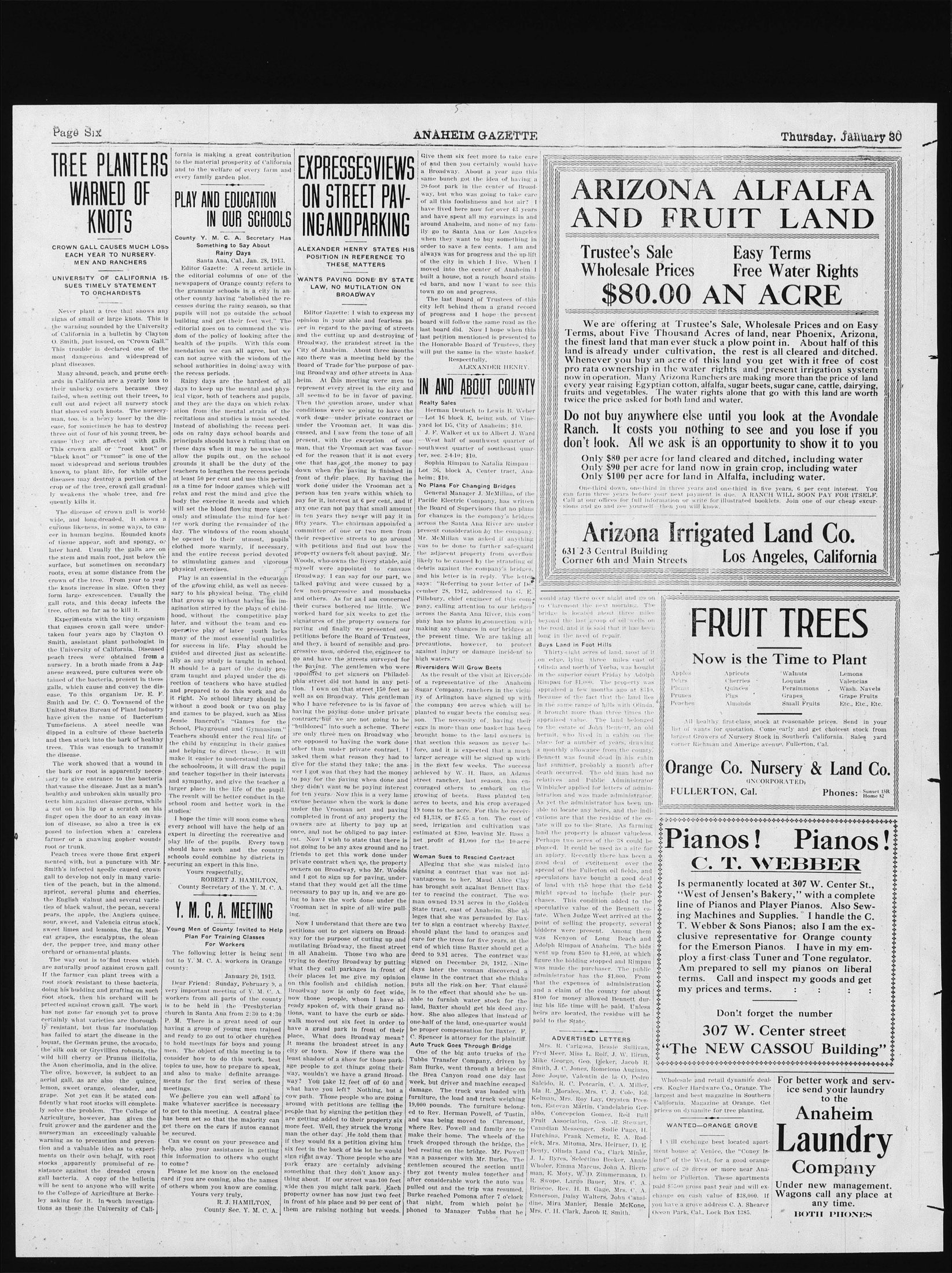
Searchable text
TREE PLANTERS
WARNED OF KNOTS
CROWN GALL CAUSES MUCH LOSS
EACH YEAR TO NURSERYMEN AND RANCHERS
UNIVERSITY OF CALIFORNIA ISSUES TIMELY STATEMENT
TO ORCHARDISTS
Never plant a tree that snows any signs of small or large knots. This is the warning sounded by the University of California in a bulletin by Clayton O. Smith, just issued, on "Crown Gall." This trouble is declared one of the most dangerous and widespread of plant diseases.
Many almond, peach, and prune orchards in California are a yearly loss to their unlucky owners because they failed, when setting out their trees, to cull out and reject all nursery stock that showed such knots. The nurseryman, too, is a heavy loser by the disease, for sometimes he has to destroy three out of four of his young trees, because they are affected with galls. This crown gall or "root knot" or "black knot" or "tumor" is one of the most widespread and serious troubles known to plant life, for while other california is making a great contribution to the material prosperity of California and to the welfare of every farm and every family garden plot.
PLAY AND EDUCATION IN OUR SCHOOLS
County Y. M. C. A. Secretary Has Something to Say About Rainy Days
Santa Ana, Cal., Jan. 28, 1913.
Editor Gazette: A recent article in the editorial columns of one of the newspapers of Orange county refers to the grammar schools in a city in another county having "abolished the recesses during the rainy season, so that pupils will not go outside the school building and get their feet wet." The editorial goes on to commend the wisdom of the policy of looking after the health of the pupils. With this commendation we can all agree, but we cannot agree with the wisdom of the school authorities in doing away with the recess periods.
Rainy days are the hardest of all days to keep up the mental and physical vigor, both of teachers and pupils, and they are the days on which relaxation from the mental strain of the recitations and studies is most needed. Instead of abolishing the recess periods on rainy days school boards and principals should have a ruling that on these days when it may be unwise to allow the pupils out on the school grounds it shall be the duty of the teachers to lengthen the recess periods.
EXPRESSION ON STREETING INGANDHAM
ALEXANDER HEMINGLE
POSITION IN RAILWAY THESE MONTHS
WANTS PAVING LAW, NO MURDER BROADWAY
Editor Gazette: I hope you enjoy this opinion in your abode per in regard to the cutting up Broadway, the grand City of Anaheim. A ago there was a mansion Board of Trade for ing Broadway and othe heim. At this meadow represent every street all seemed to be in Then the question conditions were well work done under the Vroomman cussed, and I saw faint present, with the man, that the Vroomman ed for the reason that one that has got down when the pa
Many airbounds, peach, and prune orchards in California are a yearly loss to their unlucky owners because they failed, when setting out their trees, to cull out and reject all nursery stock that showed such knots. The nursery-man, too, is a heavy loser by the disease, for sometimes he has to destroy three out of four of his young trees, because they are affected with galls. This crown gall or "root knot" or "black knot" or "tumor" is one of the most widespread and serious troubles known, to plant life, for while other diseases may destroy a portion of the crop or of the tree, crown gall gradually weakens the whole tree, and frequently kills it.
The disease of crown gall is worldwide, and long-dreaded. It shows a curious likeness, in some ways, to cancer in human begins. Rounded knots of tissue appear, soft and spongy, or later hard. Usually the galls are on the stem and main root, just below the surface, but sometimes on secondary roots, even at some distance from the crown of the tree. From year to year the knots increase in size. Often they form large exrescences. Usually the gall rots, and this decay infects the tree, often so far as to kill it.
Experiments with the tiny organism that causes crown gall were undertaken four years ago by Clayton O. Smith, assistant plant pathologist in the University of California. Diseased peach trees were obtained from a nursery. In a broth made from a Japanese seaweed, pure cultures were obtained of the bacteria, present in these galls, which cause and convey the disease. To this organism Dr. E. F. Smith and Dr. C. O. Townsend of the United States Bureau of Plant Industry have given the name of Bacterium Tumefaciens. A steel needle was dipped in a culture of these bacteria and then stuck into the bark of healthy trees. This was enough to transmit the disease.
The work showed that a wound in the bark or root is apparently necessary to give entrance to the bacteria that cause the disease. Just as a man's healthy and unbroken skin usually protects him against disease germs, while a cut on his lip or a scratch on his finger open the door to an easy invasion of disease, so also a tree is exposed to infection when a careless farmer or a gnawing gopher wounds root or trunk.
Peach trees were those first experimented with, but a puncture with Mr. Smith's infected needle caused crown gall to develop not only in many varieties of the peach, but in the almond, apricot, several plums and cherries, the English walnut and several varieties of rainy days are the hardest of all days to keep up the mental and physical vigor, both of teachers and pupils, and they are the days on which relaxation from the mental strain of the recitations and studies is most needed. Instead of abolishing the recess periods on rainy days school boards and principals should have a ruling that on these days when it may be unwise to allow the pupils out on the school grounds it shall be the duty of the teachers to lengthen the recess periods at least 50 per cent and use this period as a time for indoor games which will relax and rest the mind and give the body the exercise it needs and which will set the blood flowing more vigorously and stimulate the mind for better work during the remainder of the day. The windows of the room should be opened to their utmost, pupils clothed more warmly, if necessary, and the entire recess period devoted to stimulating games and vigorous physical exercises.
Play is an essential in the education of the growing child, as well as necessary to his physical being. The child that grows up without having his imagination stirred by the plays of childhood, without the competitive play later, and without the team and cooperative play of later youth lacks many of the most essential qualities for success in life. Play should be guided and directed just as scientifically as any study is taught in school. It should be a part of the daily program taught and played under the direction of teachers who have studied and prepared to do this work and do it right. No school library should be without a good book or two on play and games to be played, such as Miss Jessie Bancroft's "Games for the School, Playground and Gymnasium." Teachers should enter the real life of the child by engaging in their games and helping to direct these. It will make it easier to understand them in the schoolroom, it will draw the pupil and teacher together in their interests and sympathy, and give the teacher a larger place in the life of the pupil. The result will be better conduct in the school room and better work in the studies.
I hope the time will soon come when every school will have the help of an expert in directing the recreative and play life of the pupils. Every town should have such and the country schools could combine by districts in securing an expert in this line.
Yours respectfully,
ROBERT J. HAMILTON,
County Secretary of the Y. M. C. A.
Peach trees were those first experimented with, but a puncture with Mr. Smith's infected needle caused crown gall to develop not only in many varieties of the peach, but in the almond, apricot, several plums and cherries, the English walnut and several varieties of black walnut, the pecan, several pears, the apple, the Angiers quince, sour, sweet, and Valencia citrus stock, sweet limes and lemons, the fig, Muscat grapes, the eucalyptus, the oleander, the pepper tree, and many other orchard or ornamental plants.
The way out is to find trees which are naturally proof against crown gall. If the farmer can plant trees with a root stock resistant to these bacteria, doing his budding and grafting on such root stock, then his orchard will be protected against crown gall. The work has not gone far enough yet to prove certainly what varieties are thoroughly resistant, but thus far inoculation has failed to start the disease in the loquat, the German prune, the avocado, the silk oak or Grevillea robusta, the wild hill cherry or Prunus ilicifolia, the Anon cherimolia, and in the olive. The olive, however, is subject to an aerial gall, as are also the quince, lemon, sweet orange, oleander, and grape. Not yet can it be stated confidently what root stocks will completely solve the problem. The College of Agriculture, however, has given the fruit grower and the gardener and the nurseryman an exceedingly valuable warning as to precaution and prevention and a valuable idea as to experiments on their own behalf, with root stocks apparently promiseful of resistance against the dreaded crown gall bacteria. A copy of the bulletin will be sent to anyone who will write to the College of Agriculture at Berkeley asking for it. In such investigations as these the University of Cali-
Y. M. C. A. MEETING
Young Men of County Invited to Help Plan For Training Classes For Workers
The following letter is being sent out to Y. M. C. A. workers in Orange county:
January 20, 1913.
Dear Friend: Sunday, February 9, a very important meeting of Y. M. C. A. workers from all parts of the county is to be held in the Presbyterian church in Santa Ana from 2:30 to 4:30 P.M. There is a great need of our having a group of young men trained and ready to go out to other churches to hold meetings for boys and young men. The object of this meeting is to consider how to do this work, best topics to use, how to prepare to speak, and also to make definite arrangements for the first series of these meetings.
We believe you can well afford to make whatever sacrifice is necessary to get to this meeting. A central place has been set so that the majority can get there on the cars if autos cannot be secured.
Can we count on your presence and help, also your assistance in getting this information to others who ought to come?
Please let me know on the enclosed card if you are coming, also the names of others whom you know are coming.
Yours very truly,
R. J. HAMILTON,
County Sec. Y. M. C. A.
excuse because when under the Vrooman act completed in front of owners are at liberty once, and not be obliged. Now I wish to say not going to be any axe friends to get this w private contract when owners on Broadway,and I got to sign up for stand that they would necessary to pay up in ing to have the work Vrooman act in spite of.
Now I understand that petitions out to get some way for the purpose of mutilating Broadway,and in all Anaheim. Tho trying to destroy Broadway what they call parkas their places let me go on this foolish and on Broadway now is only now those people, who ready spoken of, with tions, want to have th walk moved out six feet have a grand park in place. What does B It means the broadest city or town. Now if least shadow of a show age people to get this way, wouldn't we have way? You take 12 feet what have you left? cow path. Those people around with petitions s people that by signing th are getting added to th more feet. Well, they st man the other day. He if they would fix a petition six feet in the back of h sign right away. Those park crazy are certain something that they do thing about. If our street wide then you might ta property owner has now in front of his place and them are raising nothing
EXPRESSSESVIEWS ON STREET PAVING AND PARKING
ALEXANDER HENRY STATES HIS POSITION IN REFERENCE TO THESE MATTERS
WANTS PAVING DONE BY STATE LAW, NO MUTILATION ON BROADWAY
Editor Gazette: I wish to express my opinion in your able and fearless paper in regard to the paving of streets and the cutting up and destroying of Broadway, the grandest street in the City of Anaheim. About three months ago there was a meeting held by the Board of Trade for the purpose of paving Broadway and other streets in Anaheim. At this meeting were men to represent every street in the city and all seemed to be in favor of paving. Then the question arose, under what conditions were we going to have the work done—under private contract or under the Vrooman act. It was discussed, and I saw from the tone of all present, with the exception of one man, that the Vrooman act was favored for the reason that it is not every one that has got the money to pay down when the paving is finished.
Give them six feet more to take care of and then you certainly would have a Broadway. About a year ago this same bunch got the idea of having a 20-foot park in the center of Broadway, but who was going to take care of all this foolishness and hot air? I have lived here now for over 43 years and have spent all my earnings in and around Anaheim, and none of my family go to Santa Ana or Los Angeles when they want to buy something in order to save a few cents. I am and always was for progress and the up-lift of the city in which I live. When I moved into the center of Anaheim I built a house, not a rough board stained barn, and now I want to see this town go on and progress.
The last Board of Trustees of this city left behind them a grand record of progress and I hope the present board will follow the same road as the last board did. Now I hope when this last petition mentioned is presented to the Honorable Board of Trustees, they will put the same in the waste basket. Respectfully,
ALEXANDER HENRY.
IN AND ABOUT COUNTY
Realty Sales
Herman Deutsch to Lewis B. Weber — Lot 16 block E, being sub. of Vineyard lot D5, City of Anaheim; $10.
J. F. Walker et ux to Albert J. Ward — West half of southwest quarter of southwest quarter of southeast quarter, sec. 2-4-10; $10.
Sophia Rimpau to Natalia Rimpau — Lot 36, block A, Center tract, Ana-
At this meeting were men to represent every street in the city and all seemed to be in favor of paving. Then the question arose, under what conditions were we going to have the work done—under private contract or under the Vrooman act. It was discussed, and I saw from the tone of all present, with the exception of one man, that the Vrooman act was favored for the reason that it is not every one that has got the money to pay down when the paving is finished in front of their place. By having the work done under the Vrooman act a person has ten years within which to pay for it, interest at 6 per cent, and if any one can not pay that small amount in ten years they never will pay it in fifty years. The chairman appointed a committee of one or two men from their respective streets to go around with petitions and find out how the property owners felt about paving. Mr. Woods, who owns the livery stable, and myself were appointed to canvass Broadway. I can say for our part, we talked paving and were cussed by a few non-progressive and mossbacks and others. As far as I am concerned their curses bothered me little. We worked hard for six weeks to get the signatures of the property owners for paving and finally we presented our petitions before the Board of Trustees, and they, a board of sensible and progressive men, ordered the engineer to go and have the streets surveyed for the paving. The gentlemen who were appointed to get signers on Philadelphia street did not hand in any petition. I own on that street 150 feet as well as on Broadway. This gentleman who I have reference to is in favor of having the paying done under private contract, but we are not going to be "bulldozed" into such a scheme. There are only three men on Broadway who are opposed to having the work done other than under private contract. I asked them what reason they had to give for the stand they take; the answer I got was that they had the money to pay for the paving when done and they didn't want to be paying interest for ten years. Now this is a very lame excuse because when the work is done under the Vrooman act and paving completed in front of any property the owners are at liberty to pay up at once, and not be obliged to pay interest. Now I wish to state that there is not going to be any axes ground and no friends to get this work done under private contract when we, the property owners on Broadway, who Mr. Woods and I got to sign up for paving, understand that they would get all the time necessary to pay up in, and we are going to have the work done under the Broadway and other streets in Anaheim.
IN AND ABOUT COUNTY
Realty Sales
Herman Deutsch to Lewis B. Weber — Lot 16 block E, being sub. of Vineyard lot D5, City of Anaheim; $10.
J. F. Walker et ux to Albert J. Ward — West half of southwest quarter of southwest quarter of southeast quarter, sec. 2-4-10; $10.
Sophia Rimpan to Natalia Rimpan — Lot 36, block A, Center tract, Anaheim; $10.
No Plans For Changing Bridges
General Manager J. McMillan, of the Pacific Electric Company, has written the Board of Supervisors that no plans for changes in the company's bridges across the Santa Ana River are under present consideration by the company. Mr. McMillan was asked if anything was to be done to further safeguard the adjacent property from overflow likely to be caused by the stranding of debris against the company's bridges, and his letter is in reply. The letter says: "Referring to your letter of December 28, 1912, addressed to G. E. Pillsbury, chief engineer of this company, calling attention to our bridges across the Santa Ana River, this company has no plans in connection with making any changes in our bridges at the present time. We are taking all precautions, however, to protect against injury or damage incident to high waters."
Riversiders Will Grow Beets
As the result of the visit at Riverside of a representative of the Anaheim Sugar Company, ranchers in the vicinity of Arlington have signed up with the company 400 acres which will be planted to sugar beets the coming season. The necessity of having their eggs in more than one basket has been brought home to the land owners in that section this season as never before, and it is expected that a much larger acreage will be signed up within the next few weeks. The success achieved by W. H. Bass, an Adams street rancher, last season, has encouraged others to embark on the growing of beets. Bass planted ten acres to beets, and his crop averaged 19 tons to the acre. For this he received $1,338, or $7.65 a ton. The cost of seed, irrigation and cultivation was estimated at $300, leaving Mr. Bass a net profit of $1,000 for the 10-acre tract.
Woman Sues to Rescind Contract
Alleging that she was misled into signing a contract that was not advantageous to her, Maud Alice Clay has brought suit against Bennett Baxter to rescind the contract. The woman would stay there over night and go on to Charmont the next morning. The bridge is located about three miles beyond the last group of oil wells on the road, and it is said that it has been long in the need of repair.
Buys Land in Foot Hills
Thirty-eight acres of land, most of it on edge, lying three miles east of Olinda and north of Yorba, was bought in the superior court Friday by Adolph Rimpan for $1,000. The property was appraised a few months ago at $310. Because of the fact that the land lies in the same range of hills with Olinda, it brought more than three times the appraised value. The land belonged to the estate of John Bennett, an old hermit, who lived in a cabin on the place for a number of years, drawing a monthly allowance from the county. Bennett was found dead in his cabin last summer, probably a month after death occurred. The old man had no relatives and Public Administrator Winbigler applied for letters of administration and was made administrator. As yet the administrator has been unable to locate any heirs, and the indications are that the residue of the estate will go to the State. As farming land the property is almost valueless. Perhaps two acres of the 38 could be plowed. It could be used as a site for an apiary. Recently there has been a good deal of excitement over the spread of the Fullerton oil fields, and speculators have bought a good deal of land with the hope that the field might spread to include their purchases.
Arizona
631-2-3 Central Building Corner 6th and Main Street
excuse because when the work is done under the Vrooman act and paving completed in front of any property the owners are at liberty to pay up at once, and not be obliged to pay interest. Now I wish to state that there is not going to be any axes ground and no friends to get this work done under private contract when we, the property owners on Broadway, who Mr. Woods and I got to sign up for paving, understand that they would get all the time necessary to pay up in, and we are going to have the work done under the Vrooman act in spite of all wire pulling.
Now I understand that there are two petitions out to get signers on Broadway for the purpose of cutting up and mutilating Broadway, the finest street in all Anaheim. Those two who are trying to destroy Broadway by putting what they call parkages in front of their places let me give my opinion on this foolish and childish notion. Broadway now is only 60 feet wide, now those people, whom I have already spoken of, with their grand notions, want to have the curb or sidewalk moved out six feet in order to have a grand park in front of their place. What does Broadway mean? It means the broadest street in any city or town. Now if there was the least shadow of a show for those parkage people to get things going their way, wouldn't we have a grand Broadway? You take 12 feet off of 60 and what have you left? Nothing, but a cow path. Those people who are going around with petitions are telling the people that by signing the petition they are getting added to their property six more feet. Well, they struck the wrong man the other day. He told them that if they would fix a petition giving him six feet in the back of his lot he would sign right away. Those people who are park crazy are certainly advising something that they don't know anything about. If our street was 100 feet wide then you might talk park. Each property owner has now just two feet in front of his place and 90 per cent of them are raising nothing but weeds.
Woman Sues to Rescind Contract
Alleging that she was misled into signing a contract that was not advantageous to her, Maud Alice Clay has brought suit against Bennett Baxter to rescind the contract. The woman owned 19.91 acres in the Golden State tract, east of Anaheim. She alleges that she was persuaded by Baxter to sign a contract whereby Baxter should plant the land to oranges and care for the trees for five years, at the end of which time Baxter should get a deed to 9.91 acres. The contract was signed on December 20, 1912. Nine days later the woman discovered a clause in the contract that she thinks puts all the risk on her. That clause is to the effect that should she be unable to furnish water stock for the land, Baxter should get his deed anyhow. She also alleges that instead of one-half of the land, one-quarter would be proper compensation for Baxter. F.C. Spencer is attorney for the plaintiff.
Auto Truck Goes Through Bridge
One of the big auto trucks of the Tubbs Transfer Company, driven by Sam Burke, went through a bridge on the Brea Canyon road one day last week, but driver and machine escaped damage. The truck was loaded with furniture, the load and truck weighing 19,000 pounds. The furniture belonged to Rev. Herman Powell, of Tustin, and was being moved to Claremont, where Rev. Powell and family are to make their home. The wheels of the truck dropped through the bridge, the bed resting on the bridge. Mr. Powell was a passenger with Mr. Burke. The gentlemen scoured the section until they got twenty mules together and after considerable work the auto was pulled out and the trip was resumed. Burke reached Pomona after 7 o'clock that night, from which point he phoned to Manager Tubbs that he acres to beets, and his crop averaged 19 tons to the acre. For this he received $1,338, or $7.65 a ton. The cost of seed, irrigation and cultivation was estimated at $300, leaving Mr. Bass a net profit of $1,000 for the 10-acre tract.
ADVERTISED LETTERS
Mrs. R. Carigosa, Bessie Sullivan, Fred Meer, Miss L. Rolf, J.W. Birnn, Mike George, Geo. Dicker, Jacob R. Smith, J.C. Jones, Romciono Augiano, Jose Joque, Valentin de la O., Pedro Salcido, R.C. Petcarin, C.A. Miller, Ida R.Morales, Mrs.C.J.Cole.Ed.Kelman,Mrs.Roy Lay.Orysten Preston, Estevan Martin,Candelabrio Geraldo.Concepcion Gomez.Red Ball Fruit Association,GEO.R.StewartCanadian Messenger,Sudie Page,H.Hutchins,Frank Nemetz,E.A.Rodeick,Mrs.Mitoma,Mrs.Heirner,D.EBeaty,Olinda Land Co.,Clark Minar,j.L.Byres.Selectino Beeker,Annie Wholer,Emma MarcusJohn A.Biernan,E.Moty.W.D.Zimmermann,R.R.Swope,Largo Bauer,Mrs.C.A.BriscoeRev.H.B.Gage,Mrs.C.A.Enerson,Daisy Walters John Cansidine,Mira Manier,Bessie McKone,Mrs.C.H ClarkJacob R.Smith.
THURSDAY, JANUARY 30
RIZONA ALFALFA
AND FRUIT LAND
Trustee's Sale
Wholesale Prices
Easy Terms
Free Water Rights
$80.00 AN ACRE
We are offering at Trustee's Sale, Wholesale Prices and on Easy
buy about Five Thousand Acres of land, near Phoenix, Arizona,
best land that man ever stuck a plow point in. About half of this
already under cultivation, the rest is all cleared and ditched.
Never you buy an acre of this land you get with it free of cost
ownership in the water rights and present irrigation system
operation. Many Arizona Ranchers are making more than the price of land
sugar raising Egyptian cotton, alfalfa, sugar beets, sugar cane, cattle, dairying,
and vegetables. The water rights alone that go with this land are worth
the price asked for both land and water.
It buy anywhere else until you look at the Avondale
It costs you nothing to see and you lose if you
look. All we ask is an opportunity to show it to you
by $80 per acre for land cleared and ditched, including water
by $90 per acre for land now in grain crop, including water
Many Arizona Ranchers are making more than the price of land
ear raising Egyptian cotton, alfalfa, sugar beets, sugar cane, cattle, dairying,
and vegetables. The water rights alone that go with this land are worth
the price asked for both land and water.
It buy anywhere else until you look at the Avondale
It costs you nothing to see and you lose if you
look. All we ask is an opportunity to show it to you
by $80 per acre for land cleared and ditched, including water
by $90 per acre for land now in grain crop, including water
by $100 per acre for land in Alfalfa, including water.
third down, one-third in three years and one-third in five years, 6 per cent interest. You
three years before your next payment is due. A RANCH WILL SOON PAY FOR ITSELF.
offices for full information or write for illustrated booklets. Join one of our cheap excurso and see yourself then you will know.
Arizona Irrigated Land Co.
Central Building
6th and Main Streets
Los Angeles, California
FRUIT TREES
Now is the Time to Plant
Apples Apricots Walnuts Lemons
Pears Cherries Loquats Valencias
Plums Quinces Persimmons Wash. Navels
Prunes Figs Grapes Grape Fruits
Peaches Almonds Small Fruits Etc., Etc., Etc.
All healthy first-class stock at reasonable prices. Send in your
list of wants for quotation. Come early and get choicest stock from
largest Growers of Nursery Stock in Southern California. Sales yard
corner Richman and Amerige avenue, Fullerton, Cal.
Orange Co. Nursery & Land Co.
(INCORPORATED)
FULLERTON, Cal.
Phones: Sunset 15R Home 82
Pianos! Pianos!
C. T. WEBBER
Is permanently located at 307 W. Center St.,
“West of Jensen’s Bakery,” with a complete
Pianos! Pianos!
C. T. WEBBER
Is permanently located at 307 W. Center St., "West of Jensen's Bakery," with a complete line of Pianos and Player Pianos. Also Sewing Machines and Supplies. I handle the C. T. Webber & Sons Pianos; also I am the exclusive representative for Orange county for the Emerson Pianos. I have in my employ a first-class Tuner and Tone regulator. Am prepared to sell my pianos on liberal terms. Call and inspect my goods and get my prices and terms.
Don't forget the number
307 W. Center street
"The NEW CASSOU Building"
Wholesale and retail dynamite dealers. Kogler Hardware Co., Orange. The largest and best magazine in Southern California. Magazine at Orange. Get prices on dynamite for tree planting.
WANTED—ORANGE GROVE
I will exchange best located apartment house at Venice, the "Coney Island" of the West, for a good orange grove of 20 acres or more near Anaheim or Fullerton. These apartments paid $5500 gross past year and will exchange on cash value of $38,000. If you have a grove address C. A. Shearer Ocean Park, Cal., Lock Box 1385.
For better work and service send your laundry to the Anaheim Laundry Company
Under new management. Wagons call any place at any time.
BOTH PHONES