anaheim-gazette 1913-01-30
Scanned page
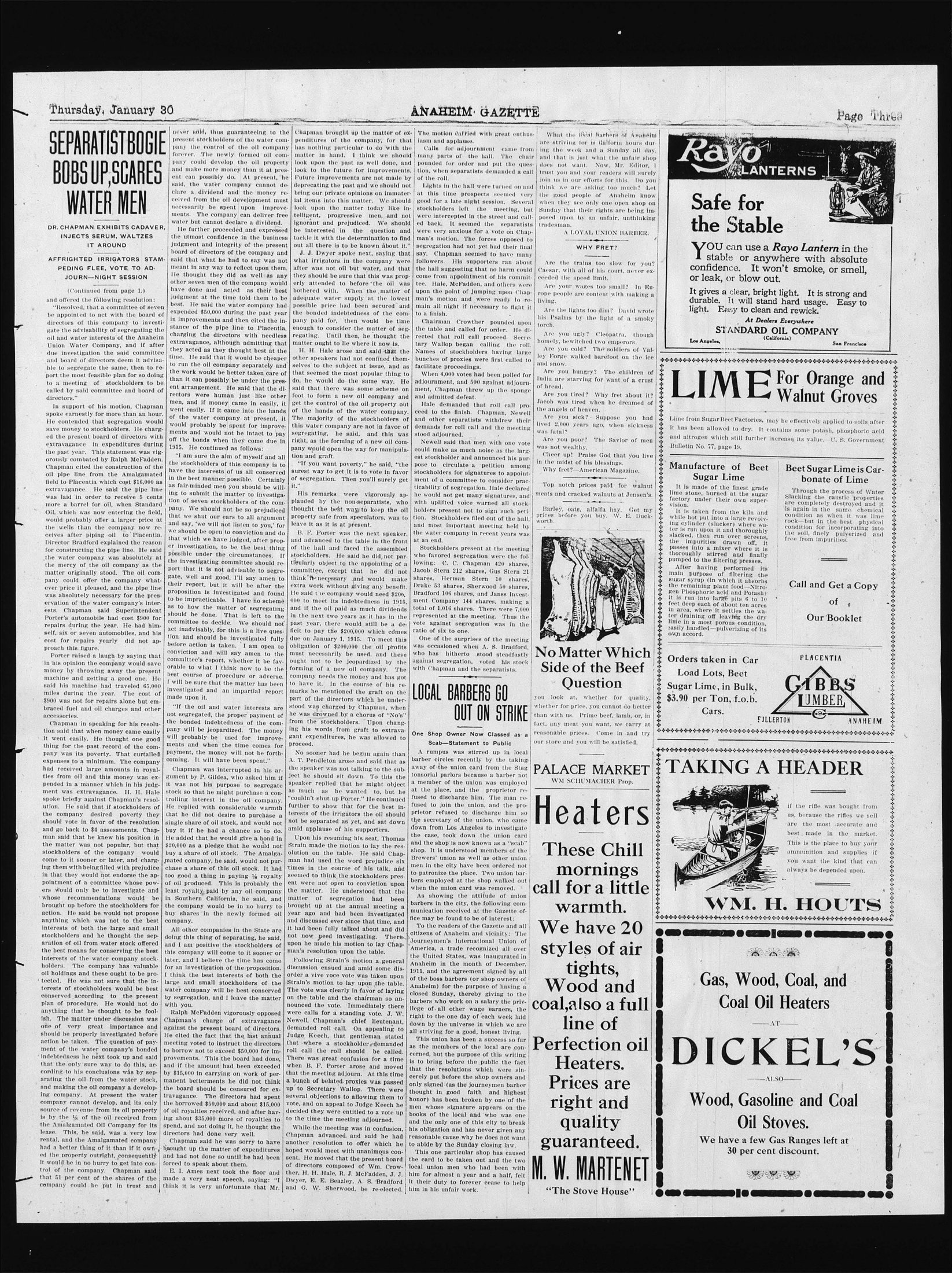
Searchable text
SEPARATIST BOGIE
BOBS UP, SCARES
WATER MEN
DR. CHAPMAN EXHIBITS CADAVER,
INJECTS SERUM, WALTZES
IT AROUND
AFFRIGHTED IRRIGATORS STAMPEDING FLEE, VOTE TO ADJOURN—NIGHT SESSION
(Continued from page 1.)
and offered the following resolution:
"Resolved, that a committee of seven be appointed to act with the board of directors of this company to investigate the advisability of segregating the oil and water interests of the Anaheim Union Water Company, and if after due investigation the said committee and board of directors deem it advisable to segregate the same, then to report the most feasible plan for so doing to a meeting of stockholders to be called by said committee and board of directors."
In support of his motion, Chapman spoke earnestly for more than an hour. He contended that segregation would save money to stockholders. He charged the present board of directors with extravagance in expenditures during the past year. This statement was vigorously combated by Ralph McFadden. Chapman cited the construction of the oil pipeline from the Amalgamated never sold, thus guaranteeing to the present stockholders of the water company the control of the oil company forever. The newly formed oil company could develop the oil property and make more money than it at present can possibly do. At present, he said, the water company cannot declare a dividend and the money received from the oil development must necessarily be spent upon improvements. The company can deliver free water but cannot declare a dividend.
He further proceeded and expressed the utmost confidence in the business judgment and integrity of the present board of directors of the company and said that what he had to say was not meant in any way to reflect upon them. He thought they did as well as any other seven men of the company would have done and acted as their best judgment at the time told them to be best. He said the water company had expended $50,000 during the past year in improvements and then cited the instance of the pipe line to Placentia, charging the directors with needless extravagance, although admitting that they acted as they thought best at the time. He said that it would be cheaper to run the oil company separately and the work would be better taken care of than it can possibly be under the present arrangement. He said that the directors were human just like other men, and if money came in easily, it went easily. If it came into the hands of the water company at present, it would probably be spent for improvements and would not be intact to pay off the bonds when they come due in 1915. He continued as follows:
"I am sure the aim of myself and all the stockholders of this company is to have the interests of us all conserved
Chapman brought up penditures of the company has nothing particular matter in hand. I look upon the past look to the future Future improvement deprecating the past bring our private op- tions items into this new look upon the matter intelligent, progressi- ignant and prejudice be interested in the tackle it with the deter- out all there is to be.
J. J. Dwyer spoke what irrigators in tha- after was not oil bu- they should be sure ther- erly attended to be bothered with. Whi- adequate water supply possible price had b the bonded indebted pany paid for, there enough to consider ther regating. Until there matter ought to lie w
H. H. Hale arose other speakers had re- selves to the subject that seemed the most do, he would do tha said that there was foot to form a new get the control of tha of the hands of tha The majority of tha this water company a segregating, he sai- right, as the forming pany would open the tion and graft.
"If you want poverty surest way to get it..."
In support of his motion, Chapman spoke earnestly for more than an hour. He contended that segregation would save money to stockholders. He charged the present board of directors with extravagance in expenditures during the past year. This statement was vigorously combated by Ralph McFadden. Chapman cited the construction of the oil pipe line from the Amalgamated field to Placentia which cost $16,000 as extravagance. He said the pipe line was laid in order to receive 5 cents more a barrel for oil, when Standard Oil, which was now entering the field, would probably offer a larger price at the wells than the company now receives after piping oil to Placentia. Director Bradford explained the reason for constructing the pipe line. He said the water company was absolutely at the mercy of the oil company as the matter originally stood. The oil company could offer the company whatever price it pleased, and the pipe line was absolutely necessary for the preservation of the water company's interests. Chapman said Superintendent Porter's automobile had cost $900 for repairs during the year. He had himself, six or seven automobiles, and his cost for repairs yearly did not approach this figure.
Porter raised a laugh by saying that in his opinion the company would save money by throwing away the present machine and getting a good one. He said his machine had traveled 65,000 miles during the year. The cost of $900 was not for repairs alone but embraced fuel and oil charges and other accessories.
Chapman in speaking for his resolution said that when money came easily it went easily. He thought one good thing for the past record of the company was its poverty. That curtailed expenses to a minimum. The company had received large amounts in royalties from oil and this money was expended in a manner which in his judgment was extravagance. H. H. Hale spoke briefly against Chapman's resolution. He said that if stockholders of the company desired poverty they should vote in favor of the resolution and go back to $4 assessments. Chapman said that he knew his position in the matter was not popular, but that stockholders of the company would come to it sooner or later, and charging them with being filled with prejudice in that they would not endorse the appointment of a committee whose powers would only be to investigate and whose recommendations would be better taken care of than it can possibly be under the present arrangement. He said that the directors were human just like other men, and if money came in easily, it went easily. If it came into the hands of the water company at present, it would probably be spent for improvements and would not be intact to pay off the bonds when they come due in 1915. He continued as follows:
"I am sure the aim of myself and all the stockholders of this company is to have the interests of us all conserved in the best manner possible. Certainly as fair-minded men you should be willing to submit the matter to investigation of seven stockholders of the company. We should not be so prejudiced that we shut our ears to all argument and say, 'we will not listen to you,' for we should be open to conviction and do that which we have judged, after proper investigation, to be the best thing possible under the circumstances. If the investigating committee should report that it is not advisable to segregate, well and good, I'll say amen to their report, but it will be after the proposition is investigated and found to be impracticable. I have no scheme as to how the matter of segregating should be done. That is left to the committee to decide. We should not act inadvisably, for this is a live question and should be investigated fully before action is taken. I am open to conviction and will say amen to the committee's report, whether it be favorable to what I think now to be the best course of procedure or adverse. I will be sure that the matter has been investigated and an impartial report made upon it.
"If the oil and water interests are not segregated, the proper payment of the bonded indebtedness of the company will be jeopardized. The money will probably be used for improvements and when the time comes for payment, the money will not be forthcoming. It will have been spent."
Chapman was interrupted in his argument by P. Gildea, who asked him if it was not his purpose to segregate stock so that he might purchase a controlling interest in the oil company. He replied with considerable warmth that he did not desire to purchase a single share of oil stock, and would not buy it if he had a chance so to do. He added that he would give a bond in $20,000 as a pledge that he would not buy a share of oil stock. The Amalgamated company, he said, would not purchase a share of this oil stock. It had too good a thing in paying ½ royalty of oil produced. This is probably the least royalty paid by any oil company in Southern California, he said and would be better taken care of than it can possibly be under the present arrangement. He said that the directors were human just like other men, and if money came in easily, it went easily. If it came into the hands of the water company at present, it would probably be spent for improvements and would not be intact to pay off the bonds when they come due in 1915. He continued as follows:
"I am sure the aim of myself and all the stockholders of this company is to have the interests of us all conserved in the best manner possible. Certainly as fair-minded men you should be willing to submit the matter to investigation of seven stockholders of the company. We should not be so prejudiced that we shut our ears to all argument and say, 'we will not listen to you,' for we should be open to conviction and do that which we have judged, after proper investigation, to be the best thing possible under the circumstances. If the investigating committee should report that it is not advisable to segregate, well and good, I'll say amen to their report, but it will be after the proposition is investigated and found to be impracticable. I have no scheme as to how the matter of segregating should be done. That is left to the committee to decide. We should not act inadvisibly, for this is a live question and should be investigated fully before action is taken. I am open to conviction and will say amen to the committee's report, whether it be favorable to what I think now to be the best course of procedure or adverse. I will be sure that the matter has been investigated and an impartial report made upon it.
"If the oil and water interests are not segregated, the proper payment of the bonded indebtedness of the company will be jeopardized. The money will probably be used for improvements and when the time comes for payment, the money will not be forthcoming. It will have been spent."
His remarks were plaudited by the nominee thought the best way property safe from spills leave it as it is at pre-treatment.
B. F. Porter was told and advanced to the hall and faced stockholders. He said titularly object to their committee, except that he thought it necessary extra work without going through it; he said the company would 1000 to meet its indemnity and if the oil paid as much in next two years past year, there would ficit to pay the $200,000 due on January 1, 1919 obligation of $200,000 must necessarily be brought not to be jeopardized forming of a new oil company needs the money to have it. In the marks he mentioned part of the directors stood was charged by he was drowned by a fire from the stockholder ing his words from gargant expenditures, he proceed.
No sooner had he been A. T. Pendleton arose at the speaker was not taken up by object he should sit down speaker replied that as much as he warned "couldn't shut up Porter further to show that terrests of the irrigator not be separated as yet amid applause of his voice."
Upon his resuming Strain made the motionolution on the table man had used the word times in the course seemed to think the stent were not open to me matter. He under matter of segregation
spoke briefly against Chapman's resolution. He said that if stockholders of the company desired poverty they should vote in favor of the resolution and go back to $4 assessments. Chapman said that he knew his position in the matter was not popular, but that stockholders of the company would come to it sooner or later, and charging them with being filled with prejudice in that they would not endorse the appointment of a committee whose powers would only be to investigate and whose recommendations would be brought up before the stockholders for action. He said he would not propose anything which was not to the best interests of both the large and small stockholders and he thought the separation of oil from water stock offered the best means for conserving the best interests of the water company stockholders. The company has valuable oil holdings and these ought to be protected. He was not sure that the interests of stockholders would be best conserved according to the present plan of procedure. He would not do anything that he thought to be foolish. The matter under discussion was one of very great importance and should be properly investigated before action be taken. The question of payment of the water company's bonded indebtedness he next took up and said that the only sure way to do this, according to his conclusions was by separating the oil from the water stock, and making the oil company a developing company. At present the water company cannot develop, and its only source of revenue from its oil property is by the 1/4 of the oil received from the Amalgamated Oil Company for its lease. This, he said, was a very low rental, and the Amalgamated company had a better thing of it than if it owned the property outright, consequently it would be in no hurry to get into control of the company. Chapman said that 51 per cent of the shares of the company could be put in trust and controlling interest in the oil company. He replied with considerable warmth that he did not desire to purchase a single share of oil stock, and would not buy it if he had a chance so to do. He added that he would give a bond in $20,000 as a pledge that he would not buy a share of oil stock. The Amalgamated company, he said, would not purchase a share of this oil stock. It had too good a thing in paying ½ royalty of oil produced. This is probably the least royalty paid by any oil company in Southern California, he said, and the company would be in no hurry to buy shares in the newly formed oil company.
All other companies in the State are doing this thing of separating, he said, and I am positive the stockholders of this company will come to it sooner or later, and I believe the time has come for an investigation of the proposition. I think the best interests of both the large and small stockholders of the water company will be best conserved by segregation, and I leave the matter with you.
Ralph McFadden vigorously opposed Chapman's charge of extravagance against the present board of directors. He cited the fact that the last annual meeting voted to instruct the directors to borrow not to exceed $50,000 for improvements. This the board had done, and if the amount had been exceeded by $15,000 in carrying on work of permanent betterments he did not think the board should be censured for extravagance. The directors had spent the borrowed $50,000 and about $15,000 of oil royalties received, and having about $35,000 more of royalties to spend, and not doing it, he thought the directors had done very well.
Chapman said he was sorry to have brought up the matter of expenditures and had not done so until he had been forced to speak about them.
E. I. Ames next took the floor and made a very neat speech, saying: "I think it is very unfortunate that Mr.
ANAHEIM·GAZETTE
Chapman brought up the matter of expenditures of the company, for that has nothing particular to do with the matter in hand. I think we should look upon the past as well done, and look to the future for improvements. Future improvements are not made by deprecating the past and we should not bring our private opinions on immaterial items into this matter. We should look upon the matter today like intelligent, progressive men, and not ignorant and prejudiced. We should be interested in the question and tackle it with the determination to find out all there is to be known about it."
J. J. Dwyer spoke next, saying that what irrigators in the company were after was not oil but water, and that they should be sure that this was properly attended to before the oil was bothered with. When the matter of adequate water supply at the lowest possible price had been secured and the bonded indebtedness of the company paid for, then would be time enough to consider the matter of segregating. Until then, he thought the matter ought to lie where it now is.
H. H. Hale arose and said that the other speakers had not confined themselves to the subject at issue, and as that seemed the most popular thing to do, he would do the same way. He said that there was some scheme on foot to form a new oil company and get the control of the oil property out of the hands of the water company. The majority of the stockholders of this water company are not in favor of segregating, he said, and this was right, as the forming of a new oil company would open the way for manipulation and graft.
“If you want poverty,” he said, “the surest way to get it is to vote in favor
The motion carried with great enthusiasm and applause.
Calls for adjournment came from many parts of the hall. The chair pounded for order and put the question, when separatists demanded a call of the roll.
Lights in the hall were turned on and at this time prospects seemed very good for a late night session. Several stockholders left the meeting, but were intercepted in the street and called back. It seemed the separatists were very anxious for a vote on Chapman’s motion. The forces opposed to segregation had not yet had their final say. Chapman seemed to have many followers. His supporters ran about the hall suggesting that no harm could come from appointment of his committee. Hale, McFadden, and others were upon the point of jumping upon Chapman’s motion and were ready to remain all night if necessary to fight it to a finish.
Chairman Crowther pounded upon the table and called for order. He directed that roll call proceed. Secretary Wallop began calling the roll. Names of stockholders having large bunches of proxies were first called to facilitate proceedings.
When 4,000 votes had been polled for adjournment, and 500 against adjournment, Chapman threw up the sponge and admitted defeat.
Hale demanded that roll call proceed to the finish. Chapman, Newell and other separatists withdrew their demands for roll call and the meeting stood adjourned.
Newell said that men with one vote could make as much noise as the largest stockholder and announced his purpose to circulate a petition among stockholders for signatures to appoint-
What the ideal barbers of Anaheim are striving for is uniform hours during the week and a Sunday all day, and that is just what the unfair shop does not want. Now, Mr. Editor, I trust you and your readers will surely join us in our efforts for this. Do you think we are asking too much? Let the good people of Anaheim know when they see only one open shop on Sunday that their rights are being imposed upon by an unfair, unthinking tradesman.
A LOYAL UNION BARBER.
WHY FRET?
Are the trains too slow for you? Caesar, with all of his court, never exceeded the speed limit.
Are your wages too small? In Europe people are content with making a living.
Are the lights too dim? David wrote his Psalms by the light of a smoky torch.
Are you ugly? Cleopatra, though homely, bewitched two emperors.
Are you cold? The soldiers of Valley Forge walked barefoot on the ice and snow.
Are you hungry? The children of India are starving for want of a crust of bread.
Are you tired? Why fret about it? Jacob was tired when he dreamed of the angels of heaven.
Are you sick? Suppose you had lived 2,000 years ago, when sickness was fatal?
Are you poor? The Savior of men was not wealthy.
Cheer up! Praise God that you live in the midst of his blessings.
Why fret?—American Magazine.
that seemed the most popular thing to do, he would do the same way. He said that there was some scheme on foot to form a new oil company and get the control of the oil property out of the hands of the water company. The majority of the stockholders of this water company are not in favor of segregating, he said, and this was right, as the forming of a new oil company would open the way for manipulation and graft.
"If you want poverty," he said, "the surest way to get it is to vote in favor of segregation. Then you'll surely get it."
His remarks were vigorously applauded by the non-separatists, who thought the best way to keep the oil property safe from speculators, was to leave it as it is at present.
B. F. Porter was the next speaker, and advanced to the table in the front of the hall and faced the assembled stockholders. He said he did not particularly object to the appointing of a committee, except that he did not think it necessary and would make extra work without giving any benefit. He said the company would need $200,000 to meet its indebtedness in 1915, and if the oil paid as much dividends in the next two years as it has in the past year, there would still be a deficit to pay the $200,000 which comes due on January 1, 1915. To meet this obligation of $200,000 the oil profits must necessarily be used, and these ought not to be jeopardized by the forming of a new oil company. The company needs the money and has got to have it. In the course of his remarks he mentioned the graft on the part of the directors which he understood was charged by Chapman, when he was drowned by a chorus of "No's" from the stockholders. Upon changing his words from graft to extravagant expenditures, he was allowed to proceed.
No sooner had he begun again than A. T. Pendleton arose and said that as the speaker was not talking to the subject he should sit down. To this the speaker replied that he might object as much as he wanted to, but he "couldn't shut up Porter." He continued further to show that for the best interests of the irrigators the oil should not be separated as yet, and sat down amid applause of his supporters.
Upon his resuming his seat, Thomas Strain made the motion to lay the resolution on the table. He said Chapman had used the word prejudice six times in the course of his talk, and seemed to think the stockholders present were not open to conviction upon the matter. He understood that the matter of segregation had been
When 4,000 votes had been polled for adjournment, and 500 against adjournment, Chapman threw up the sponge and admitted defeat.
Hale demanded that roll call proceed to the finish. Chapman, Newell and other separatists withdrew their demands for roll call and the meeting stood adjourned.
Newell said that men with one vote could make as much noise as the largest stockholder and announced his purpose to circulate a petition among stockholders for signatures to appointment of a committee to consider practicability of segregation. Hale declared he would not get many signatures, and with uplifted voice warned all stockholders present not to sign such petition. Stockholders filed out of the hall, and most important meeting held by the water company in recent years was at an end.
Stockholders present at the meeting who favored segregation were following: C. C. Chapman 420 shares, Jacob Stern 212 shares, Gus Stern 21 shares, Herman Stern 10 shares, Drake 53 shares, Sherwood 50 shares, Bradford 106 shares, and Janss Investment Company 144 shares, making a total of 1,016 shares. There were 7,000 represented at the meeting. Thus the vote against segregation was in the ratio of six to one.
One of the surprises of the meeting was occasioned when A. S. Bradford, who has hitherto stood steadfastly against segregation, voted his stock with Chapman and the separatists.
LOCAL BARBERS GO OUT ON STRIKE
One Shop Owner Now Classed as a Scab—Statement to Public
A rumpus was stirred up in local barber circles recently by the taking away of the union card from the Stag tonsorial parlors because a barber not a member of the union was employed at the place, and the proprietor refused to discharge him. The man refused to join the union, and the proprietor refused to discharge him so the secretary of the union, who came down from Los Angeles to investigate the case, took down the union card and the shop is now known as a "scab" shop. It is understood members of the Brewers' union as well as other union men in the city have been ordered not to patronize the place. Two union barbers employed at the shop walked out when the union card was removed.
As showing the attitude of union India are starving for want of a crust of bread.
Are you tired? Why fret about it? Jacob was tired when he dreamed of the angels of heaven.
Are you sick? Suppose you had lived 2,000 years ago, when sickness was fatal?
Are you poor? The Savior of men was not wealthy.
Cheer up! Praise God that you live in the midst of his blessings.
Why fret?—American Magazine.
Top notch prices paid for walnut meats and cracked walnuts at Jensen's.
Barley, oats, alfalfa hay. Get my prices before you buy. W. E. Duckworth.
No Matter Which Side of the Beef Question
you look at, whether for price, you cannot do better than with us. Prime beef, lamb, or, in fact, any meat you want, we carry at reasonable prices. Come in and try our store and you will be satisfied.
PALACE MARKET
WM SCHUMACHER Prop.
Heaters
These Chill mornings call for a little
These Chill mornings call for a little warmth.
We have 20 styles of air tights,
Wood and coal, also a full line of Perfection oil Heaters.
Prices are right and quality guaranteed.
M. W. MARTENET
"The Stove House"
Upon his resuming his seat, Thomas Strain made the motion to lay the resolution on the table. He said Chapman had used the word prejudice six times in the course of his talk, and seemed to think the stockholders present were not open to conviction upon the matter. He understood that the matter of segregation had been brought up at the annual meeting a year ago and had been investigated and discussed ever since that time, and it had been fully talked about and did not now need investigating. Thereupon he made his motion to lay Chapman's resolution upon the table.
Following Strain's motion a general discussion ensued and amid some disorder a vive voce vote was taken upon Strain's motion to lay upon the table. The vote was clearly in favor of laying on the table and the chairman so announced the vote. Immediately there were calls for a standing vote. J. W. Newell, Chapman's chief lieutenant, demanded roll call. On appealing to Judge Keech, that gentleman stated that where a stockholder demanded roll call the roll should be called. There was great confusion for a time when B. F. Porter arose and moved that the meeting adjourn. At this time a bunch of belated proxies was passed up to Secretary Wallop. There were several objections to allowing them to vote, and on appeal to Judge Keech he decided they were entitled to a vote up to the time the meeting adjourned.
While the meeting was in confusion, Chapman advanced and said he had another resolution to offer which he hoped would meet with unanimous consent. He moved that the present board of directors composed of Wm. Crowther, H. H. Hale, R. J. McFadden, J. J. Dwyer, E. E. Beazley, A. S. Bradford and G. W. Sherwood, be re-elected.
Rayo Lanterns
Safe for the Stable
YOU can use a Rayo Lantern in the stable or anywhere with absolute confidence. It won't smoke, or smell, or leak, or blow out.
It gives a clear, bright light. It is strong and durable. It will stand hard usage. Easy to light. Easy to clean and rewick.
At Dealers Everywhere
STANDARD OIL COMPANY
Los Angeles, California
San Francisco
LIME For Orange and Walnut Groves
Lime from Sugar Beet Factories, may be effectively applied to soils after it has been allowed to dry. It contains some potash, phosphoric acid and nitrogen which still further increase its value.—U. S. Government Bulletin No. 77, page 19.
Manufacture of Beet
Beet Sugar Lime is Car-
LIME For Orange and Walnut Groves
Lime from Sugar Beet Factories, may be effectively applied to soils after it has been allowed to dry. It contains some potash, phosphoric acid and nitrogen which still further increase its value. U.S. Government Bulletin No. 77, page 19.
Manufacture of Beet Sugar Lime
It is made of the finest grade lime stone, burned at the sugar factory under their own supervision.
It is taken from the kiln and while hot put into a large revolving cylinder (slacker) where water is run upon it and thoroughly slacked, then run over screens, the impurities drawn off, it passes into a mixer where it is thoroughly stirred and finally pumped to the filtering presses.
After having performed its main purpose of filtering the sugar syrup (in which it absorbs the remaining plant food—Nitrogen Phosphoric acid and Potash) it is run into large pits 6 to 10 feet deep each of about ten acres in area, where it settles the water draining off leaving the dry lime in a most porous condition, easily handled—pulverizing of its own accord.
Beet Sugar Lime is Carbonate of Lime
Through the process of Water Slacking the caustic properties are completely destroyed and it is again in the same chemical condition as when it was lime rock—but in the best physical condition for incorporating into the soil, finely pulverized and free from impurities.
Call and Get a Copy of Our Booklet
Orders taken in Car Load Lots, Beet Sugar Lime, in Bulk, $3.90 per Ton, f.o.b. Cars.
PLACENTIA
GIBBS LUMBER
FULLERTON ANAHEIM
TAKING A HEADER
if the rifle was bought from us, because the rifles we sell are the most accurate and best made in the market.
This is the place to buy your ammunition and supplies if you want the kind that can always be depended upon.
if the rifle was bought from us, because the rifles we sell are the most accurate and best made in the market. This is the place to buy your ammunition and supplies if you want the kind that can always be depended upon.
WM. H. HOUTS
Gas, Wood, Coal, and Coal Oil Heaters
AT
DICKEL'S
ALSO
Wood, Gasoline and Coal Oil Stoves.
We have a few Gas Ranges left at 30 per cent discount.