anaheim-gazette 1913-01-23
Scanned page
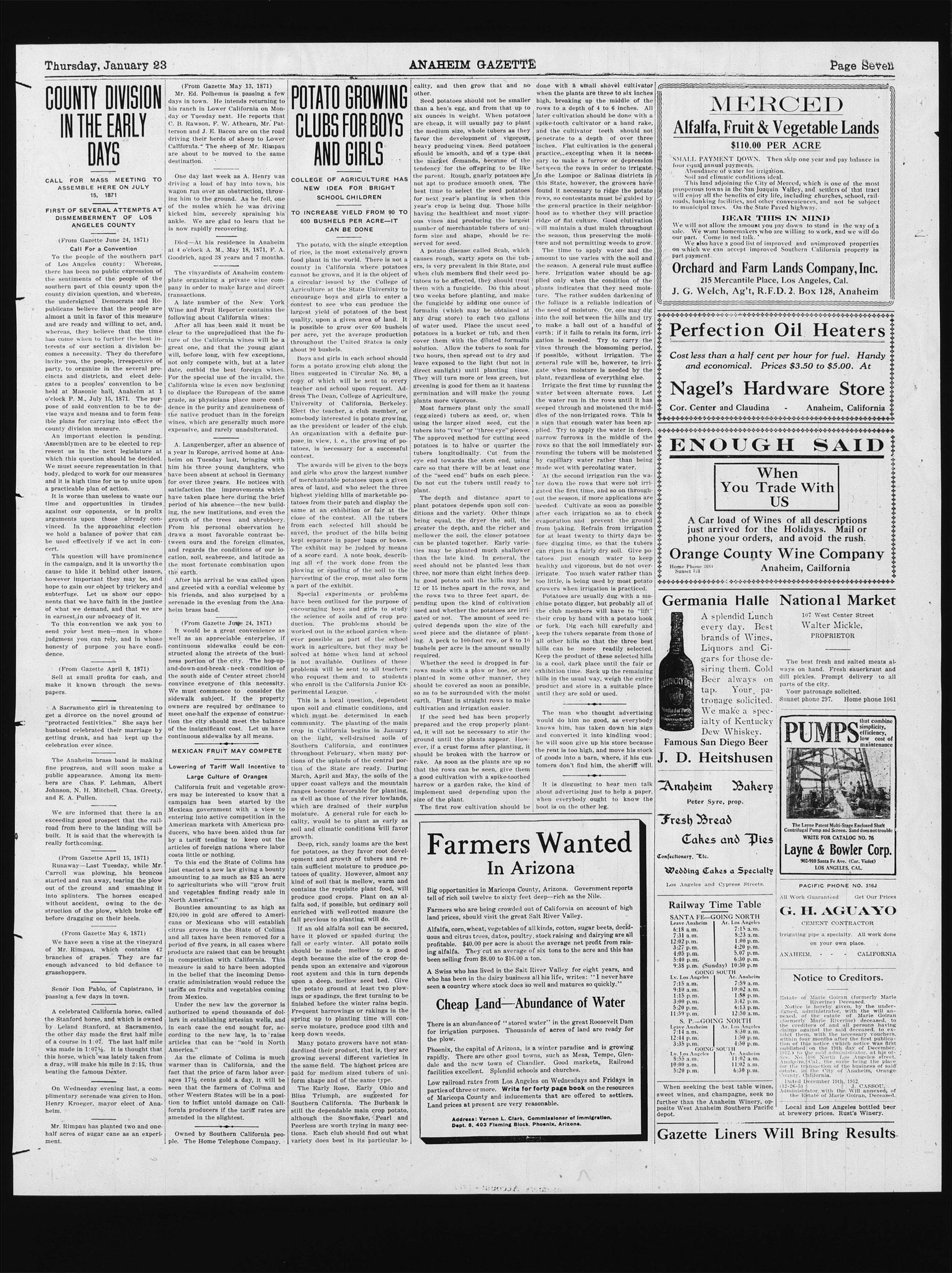
Searchable text
COUNTY DIVISION IN THE EARLY DAYS
CALL FOR MASS MEETING TO ASSEMBLE HERE ON JULY 15, 1871
FIRST OF SEVERAL ATTEMPTS AT DISMEMBERMENT OF LOS ANGELES COUNTY
(From Gazette June 24, 1871)
Call For a Convention
To the people of the southern part of Los Angeles county: Whereas, there has been no public expression of the sentiments of the people of the southern part of this county upon the county division question, and whereas, the undersigned Democrats and Republicans believe that the people are almost a unit in favor of this measure and are ready and willing to act, and, whereas, they believe that the time has come when to further the best interests of our section a division becomes a necessity. They do therefore invite you, the people, irrespective of party, to organize in the several precincts and districts, and elect delegates to a peoples' convention to be held at Masonic hall, Anaheim at 1 o'clock P. M., July 15, 1871. The purpose of said convention to be to devise ways and means and to form feasible plans for carrying into effect the county division measure.
An important election is pending. Assemblymen are to be elected to represent us in the next legislature at which this question should be decided. We must secure representation in that body, pledged to work for our measures.
(From Gazette May 13, 1871)
Mr. Ed. Polhemus is passing a few days in town. He intends returning to his ranch in Lower California on Monday or Tuesday next. He reports that C. B. Rawson, F. W. Athearn, Mr. Patterson and J. E. Bacon are on the road driving their herds of sheep to Lower California. The sheep of Mr. Rimpau are about to be moved to the same destination.
One day last week as A. Henry was driving a load of hay into town, his wagon ran over an obstruction, throwing him to the ground. As he fell, one of the mules which he was driving kicked him, severely spraining his ankle. We are glad to learn that he is now rapidly recovering.
Died—At his residence in Anaheim at 4 o'clock A. M., May 18, 1871, F. A. Goodrich, aged 38 years and 7 months.
The vinyardists of Anaheim contemplate organizing a private wine company in order to make large and direct transactions.
A late number of the New York Wine and Fruit Reporter contains the following about California wines:
After all has been said it must be clear to the unprejudiced that the future of the California wines will be a great one, and that the young giant will, before long, with few exceptions, not only compete with, but at a later date, outbid the best foreign wines. For the special use of the invalid, the California wine is even now beginning to displace the European of the same grade, as physicians place more confidence in the purity and genuineness of the native product than in the foreign wines, which are generally much more expensive, and rarely unadulterated.
A. Langenberger, after an absence of a year in Europe, arrived home at Anaheim on Tuesday last, bringing with him his three young daughters, who have been absent at school in Germany.
POTATO GROUND CLUBS FOR AND GREAT
COLLEGE OF AGRICULTURE NEW IDEA FOR SCHOOL CHILDREN
TO INCREASE YIELD 600 BUSHELS PER CAN BE BUILT
The potato, with the largest yield of potato quality, upon a given contest to see who can grow per acre, yet the average throughout the United States about 90 bushels.
Boys and girls in each form a potato growing lines suggested in College copy of which will be taught by teacher and school uniform dress The Dean, College University of California Elect the teacher, a somebody interested in as the president or leader An organization with pose in view, i.e., the tattoos, is necessary contest.
The awards will be given and girls who grow th
An important election is pending. Assemblymen are to be elected to represent us in the next legislature at which this question should be decided. We must secure representation in that body, pledged to work for our measures and it is high time for us to unite upon a practicable plan of action.
It is worse than useless to waste our time and opportunities in tirades against our opponents, or in prolix arguments upon those already convinced. In the approaching election we hold a balance of power that can be used effectively if we act in concert.
This question will have prominence in the campaign, and it is unworthy the cause to hide it behind other issues, however important they may be, and hope to gain our object by trickery and subterfuge. Let us show our opponents that we have faith in the justice of what we demand, and that we are in earnest in our advocacy of it.
To this convention we ask you to send your best men—men in whose judgment you can rely, and in whose honesty of purpose you have confidence.
(From Gazette April 8, 1871)
Sell at small profits for cash, and make it known through the newspapers.
A Sacramento girl is threatening to get a divorce on the novel ground of "protracted festivities." She says her husband celebrated their marriage by getting drunk, and has kept up the celebration ever since.
The Anaheim brass band is making fine progress, and will soon make a public appearance. Among its members are Chas. F. Lehman, Albert Johnson, N. H. Mitchell, Chas. Greety, and E. A. Pullen.
We are informed that there is an exceeding good prospect that the railroad from here to the landing will be built. It is said that the wherewith is really forthcoming.
(From Gazette April 15, 1871)
Runaway—Last Tuesday, while Mr. Carroll was plowing, his broncos started and ran away, tearing the plow out of the ground and smashing it into splinters. The horses escaped
For the special use of the invalid, the California wine is even now beginning to displace the European of the same grade, as physicians place more confidence in the purity and genuineness of the native product than in the foreign wines, which are generally much more expensive, and rarely unadulterated.
A. Langenberger, after an absence of a year in Europe, arrived home at Anaheim on Tuesday last, bringing with him his three young daughters, who have been absent at school in Germany for over three years. He notices with satisfaction the improvements which have taken place here during the brief period of his absence—the new building, the new institutions, and even the growth of the trees and shrubbery. From his personal observation he draws a most favorable contrast between ours and the foreign climates, and regards the conditions of our location, soil, seabreeze, and latitude as the most fortunate combination upon the earth.
After his arrival he was called upon and greeted with a cordial welcome by his friends, and also surprised by a serenade in the evening from the Anaheim brass band.
(From Gazette June 24, 1871)
It would be a great convenience as well as an appreciable enterprise, if continuous sidewalks could be constructed along the streets of the business portion of the city. The hop-up-and-down-and-break-neck condition of the south side of Center street should convince everyone of this necessity. We must commence to consider the sidewalk subject. If the property owners are required by ordinance to meet one-half the expense of construction the city should meet the balance of the insignificant cost. Let us have continuous sidewalks by all means.
MEXICAN FRUIT MAY COMPETE
Lowering of Tariff Wall Incentive to Large Culture of Oranges
California fruit and vegetable growers may be interested to know that a campaign has been started by the Mexican government with a view to entering into active competition in the American markets with American producers, who have been aided thus far by a tariff tending to keep out the articles of foreign nations where labor costs little or nothing.
To this end the State of Colima has just enacted a new law giving a bounty amounting to as much as $25 an acre to agriculturists who will "grow fruit and vegetables finding ready sale in North America."
The awards will be given and girls who grow them of merchantable potato area of land, and whose highest yielding hills saturate from their patches close of the contest; from each selected saved, the product or kept separate in paper. The exhibit may be of a score card. A notice all of the works plowing or spading or harvesting of the crop a part of the exhibit.
Special experiments have been outlined for encouraging boys and the science of soils production. The probes worked out in the schooled possible as part work in agriculture, solved at home when is not available. Our problems will be sent who request them as soon as they enroll in the Californical League.
This is a local queen upon soil and climatic which must be deterred community. The plant crop in California based on the light, well-drained Southern California throughout February, tions of the uplands owing to State and March, April and May upper coast valleys arrows become favorites as well as those of which are drained on moisture. A general locality, would be to pull soil and climatic con growth.
Deep, rich, sandy loam for potatoes, as they develop and growth contain sufficient moisture tatoes of quality. How kind of soil that is made contains the requisite produce good crops.
We are informed that there is an exceeding good prospect that the railroad from here to the landing will be built. It is said that the wherewith is really forthcoming.
(From Gazette April 15, 1871)
Runaway—Last Tuesday, while Mr. Carroll was plowing, his broncos started and ran away, tearing the plow out of the ground and smashing it into splinters. The horses escaped without accident, owing to the destruction of the plow, which broke off before dragging on their heels.
(From Gazette May 6, 1871)
We have seen a vine at the vineyard of Mr. Rimpau, which contains 42 branches of grapes. They are far enough advanced to bid defiance to grasshoppers.
Senor Don Pablo, of Capistrano, is passing a few days in town.
A celebrated California horse, called the Stanford horse, and which is owned by Leland Stanford, at Sacramento, the other day made the first half mile of a course in 1:07. The last half mile was made in 1:07½. It is thought that this horse, which was lately taken from a dray, will make his mile in 2:15, thus beating the famous Dexter.
On Wednesday evening last, a complimentary serenade was given to Hon. Henry Kroeger, mayor elect of Anaheim.
Mr. Rimpau has planted two and one-half acres of sugar cane as an experiment.
Owned by Southern California people. The Home Telephone Company.
To this end the State of Colima has just enacted a new law giving a bounty amounting to as much as $25 an acre to agriculturists who will "grow fruit and vegetables finding ready sale in North America."
Bounties amounting to as high as $20,000 in gold are offered to Americans or Mexicans who will establish citrus groves in the State of Colima and all taxes have been removed for a period of five years, in all cases where products are raised that can be brought in competition with California. This measure is said to have been adopted in the belief that the incoming Democratic administration would reduce the tariffs on fruits and vegetables coming from Mexico.
Under the new law the governor is authorized to spend thousands of dollars in establishing artesian wells, and in each case the end sought for, according to the new law, is to raise articles that can be "sold in North America."
As the climate of Colima is much warmer than in California, and the fact that the price of farm labor averages 17½ cents gold a day, it will be seen that the farmers of Colima and other Western States will be in a position to inflict untold damage on California producers if the tariff rates are amended in the slightest.
Many potato growers dardized their produce growing several different same field. The paid for medium size form shape and of the Early Rose, Bliss Triumph, are Southern California still the dependable not although the Snow Peerless are worth tractions. Each club shows variety does best in
POTATO GROWING CLUBS FOR BOYS AND GIRLS
COLLEGE OF AGRICULTURE HAS NEW IDEA FOR BRIGHT SCHOOL CHILDREN
TO INCREASE YIELD FROM 90 TO 600 BUSHELLS PER ACRE—IT CAN BE DONE
The potato, with the single exception of rice, is the most extensively grown food plant in the world. There is not a county in California where potatoes cannot be grown, and it is the object of a circular issued by the College of Agriculture at the State University to encourage boys and girls to enter a contest to see who can produce the largest yield of potatoes of the best quality, upon a given area of land. It is possible to grow over 600 bushels per acre, yet the average production throughout the United States is only about 90 bushels.
Boys and girls in each school should form a potato growing club along the lines suggested in Circular No. 80, a copy of which will be sent to every teacher and school upon request. Address The Dean, College of Agriculture, University of California, Berkeley. Elect the teacher, a club member, or somebody interested in potato growing, as the president or leader of the club. An organization with a definite purpose, in view, i.e., the growing of potatoes, is necessary for a successful contest.
The awards will be given to the boys and girls who grow the largest numberality, and then grow that and no other.
Seed potatoes should not be smaller than a hen's egg, and from that up to six ounces in weight. When potatoes are cheap, it will usually pay to plant the medium size, whole tubers as they favor the development of vigorous, heavy producing vines. Seed potatoes should be smooth, and of a type that the market demands, because of the tendency for the offspring to be like the parent. Rough, gnarly potatoes are not apt to produce smooth ones. The best time to select the seed potatoes for next year's planting is when this year's crop is being dug. Those hills having the healthiest and most vigorous vines and producing the largest number of merchantable tubers of uniform size and shape, should be reserved for seed.
A potato disease called Scab, which causes rough, warty spots on the tubers, is very prevalent in this State, and when club members find their seed potatoes to be affected, they should treat them with a fungicide. Do this about two weeks before planting, and make the fungicide by adding one ounce of formalin (which may be obtained at any drug store) to each two gallons of water used. Place the uncut seed potatoes in a bucket or tub, and then cover them with the diluted formalin solution. Allow the tubers to soak for two hours, then spread out to dry and leave exposed to the light (but not in direct sunlight) until planting time. They will turn more or less green, but greening is good for them as it hastens germination and will make the young plants more vigorous.
Most farmers plant only the small (egg-sized) tubers as seed, or, when using the larger sized seed, cut the tubers into "two" or "three eye" pieces. The approved method for cutting seed potatoes is to halve or quarter the tubers longitudinally. Cut from the eye end towards the stem end, using care so that there will be at least one of the "seed end" buds on each piece done with a small shovel cultivator when the plants are three to six inches high, breaking up the middle of the rows to a depth of 4 to 6 inches. All later cultivation should be done with a spike-tooth cultivator or a hand rake, and the cultivator teeth should not penetrate to a depth of over three inches. Flat cultivation is the general practice excepting when it is necessary to make a furrow or depression between the rows in order to irrigate. In the Lompoc or Salinas districts in this State, however, the growers have found it necessary to ridge the potato rows, so contestants must be guided by the general practice in their neighborhood as to whether they will practice ridge of flat culture. Good clutivation will maintain a dust mulch throughout the season, thus preserving the moisture and not permitting weeds to grow.
The time to apply water and the amount to use varies with the soil and the season. A general rule must suffice here. Irrigation water should be applied only when the condition of the plants indicates that they need moisture. The rather sudden darkening of the foliage is a reliable indication of the need of moisture. Or, one may dig into the soil between the hills and try to make a ball out of a handful of earth; if it fails to retain its form, irrigation is needed. Try to carry the vines through the blossoming period, if possible, without irrigation. The general rule will be, however, to irrigate when moisture is needed by the plant, regardless of everything else.
Irrigate the first time by running the water between alternate rows. Let the water run in the rows until it has seeped through and moistened the middles of the non-irrigated rows. This is a sign that enough water has been applied. Try to apply the water in deep, narrow furrows in the middle of the rows so that the soil immediately surrounding the tubers will be moistened by capillary water rather than being made wet with percolating water.
The awards will be given to the boys and girls who grow the largest number of merchantable potatoes upon a given area of land, and who select the three highest yielding hills of marketable potatoes from their patch and display the same at an exhibition or fair at the close of the contest. All the tubers from each selected hill should be saved, the product of the hills being kept separate in paper bags or boxes. The exhibit may be judged by means of a score card. A note book, describing all of the work done from the plowing or spading of the soil to the harvesting of the crop, must also form a part of the exhibit.
Special experiments or problems have been outlined for the purpose of encouraging boys and girls to study the science of soils and of crop production. The problems should be worked out in the school garden whenever possible as part of the school work in agriculture, but they may be solved at home when land at school is not available. Outlines of these problems will be sent to all teachers who request them and to students who enroll in the California Junior Experimental League.
This is a local question, dependent upon soil and climatic conditions, and which must be determined in each community. The planting of the main crop in California begins in January on the light, well-drained soils of Southern California, and continues throughout February, when many portions of the uplands of the central portion of the State are ready. During March, April and May, the soils of the upper coast valleys and the mountain ranges become favorable for planting, as well as those of the river lowlands, which are drained of their surplus moisture. A general rule for each locality, would be to plant as early as soil and climatic conditions will favor growth.
Deep, rich, sandy loams are the best for potatoes, as they favor root development and growth of tubers and retain sufficient moisture to produce potatoes of quality. However, almost any kind of soil that is mellow, warm and contains the requisite plant food, will produce good crops. Plant on an al-
They will turn more or less green, but greening is good for them as it hastens germination and will make the young plants more vigorous.
Most farmers plant only the small (egg-sized) tubers as seed, or, when using the larger sized seed, cut the tubers into "two" or "three eye" pieces. The approved method for cutting seed potatoes is to halve or quarter the tubers longitudinally. Cut from the eye end towards the stem end, using care so that there will be at least one of the "seed end" buds on each piece. Do not cut the tubers until ready to plant.
The depth and distance apart to plant potatoes depends upon soil conditions and the variety. Other things being equal, the dryer the soil, the greater the depth, and the richer and mellower the soil, the closer potatoes can be planted together. Early varieties may be planted much shallower than the late kind. In general, the seed should not be planted less than three, nor more than eight inches deep. In good potato soil the hills may be 12 or 15 inches apart in the rows, and the rows two to three feet apart, depending upon the kind of cultivation used and whether the potatoes are irrigated or not. The amount of seed required depends upon the size of the seed piece and the distance of planting. A peck to 100-foot row, or 8 to 10 bushels per acre is the amount usually required.
Whether the seed is dropped in furrows made with a plow or hoe, or are planted in some other manner, they should be covered as soon as possible, so as to be surrounded with the moist earth. Plant in straight rows to make cultivation and irrigation easier.
If the seed bed has been properly prepared and the crop properly planted, it will not be necessary to stir the ground until the plants appear. However, if a crust forms after planting, it should be broken with the harrow or rake. As soon as the plants are up so that the rows can be seen, give them a good cultivation with a spike-toothed harrow or a garden rake, the kind of implement used depending upon the size of the plant.
The first row cultivation should be irrigate the first time by running the water between alternate rows. Let the water run in the rows until it has seeped through and moistened the middle of the non-irrigated rows. This is a sign that enough water has been applied. Try to apply the water in deep, narrow furrows in the middle of the rows so that the soil immediately surrounding the tubers will be moistened by capillary water rather than being made wet with percolating water.
At the second irrigation run the water down the rows that were not irrigated the first time, and so on throughout the season, if more applications are needed. Cultivate as soon as possible after each irrigation so as to check evaporation and prevent the ground from baking. Refrain from irrigation for at least twenty to thirty days before digging time, so that the tubers can ripen in a fairly dry soil. Give potatoes just enough water to keep healthy and vigorous, but do not over-irrigate. Too much water rather than too little, is being used by most potato growers when irrigation is practiced.
Potatoes are usually dug with a machine potato digger, but probably all of the club members will have to "lift" their crop by hand with a potato hook or fork. Dig each hill carefully and keep the tubers separate from those of all other hills so that the three best hills can be more readily selected. Keep the product of these selected hills in a cool, dark place until the fair or exhibition time. Sack up the remaining hills in the usual way, weigh the entire product and store in a suitable place until they are sold or used.
The man who thought advertising would do him no good, as everybody knows him, has taken down his sign and converted it into kindling wood; he will soon give up his store because the rent is too high, and move his stock of goods into a barn, where, if his customers don't find him, she sheriff will.
It is disgusting to hear men talk about advertising just to help a paper, when everybody ought to know the boot is on the other leg.
Farmers Wanted
In Arizona
Big opportunities in Maricopa County, Arizona. Government reports tell of rich soil twelve to sixty feet deep—rich as the Nile.
Farmers Wanted In Arizona
Big opportunities in Maricopa County, Arizona. Government reports tell of rich soil twelve to sixty feet deep—rich as the Nile.
Farmers who are being crowded out of California on account of high land prices, should visit the great Salt River Valley.
Alfalfa, corn, wheat, vegetables of all kinds, cotton, sugar beets, deciduous and citrus trees, dates, poultry, stock raising and dairying are all profitable. $40.00 per acre is about the average net profit from raising alfalfa. They cut an average of six tons to the acre and this has been selling from $8.00 to $16.00 a ton.
A Swiss who has lived in the Salt River Valley for eight years, and who has been in the dairy business all his life, writes: “I never have seen a country where stock does so well and matures so quickly.”
Cheap Land—Abundance of Water
There is an abundance of “stored water” in the great Roosevelt Dam for irrigation purposes. Thousands of acres of land are ready for the plow.
Phoenix, the capital of Arizona, is a winter paradise and is growing rapidly. There are other good towns, such as Mesa, Tempe, Glen-dale and the new town of Chandler. Good markets, Railroad facilities excellent. Splendid schools and churches.
Low railroad rates from Los Angeles on Wednesdays and Fridays in parties of three or more. Write for forty page book on the resources of Maricopa County and inducements that are offered to settlers. Land prices at present are very reasonable.
Address: Vernon L. Clark, Commissioner of Immigration,
Dept. 8, 403 Fleming Block, Phoenix, Arizona.
MERCED
Alfalfa, Fruit & Vegetable Lands
$110.00 PER ACRE
SMALL PAYMENT DOWN. Then skip one year and pay balance in four equal annual payments.
Abundance of water for irrigation.
Soil and climatic conditions ideal.
This land adjoining the City of Merced, which is one of the most prosperous towns in the San Joaquin Valley, and settlers of that tract will enjoy all the benefits of city life, including churches, school, railroads, banking facilities, and other conveniences, and not be subject to municipal taxes. On the State Paved highway.
BEAR THIS IN MIND
We will not allow the amount you pay down to stand in the way of a sale. We want homemakers who are willing to work, and we will do our part. Come in and talk.
We also have a good list of improved and unimproved properties on which we can accept improved Southern California property in part payment.
Orchard and Farm Lands Company, Inc.
215 Mercantile Place, Los Angeles, Cal.
J. G. Welch, Ag’t, R.F.D. 2, Box 128, Anaheim
Perfection Oil Heaters
Cost less than a half cent per hour for fuel. Handy and economical. Prices $3.50 to $5.00. At
Nagel’s Hardware Store
Cor. Center and Claudina - Anaheim, California
ENOUGH SAID
When
Nagel’s Hardware Store
Cor. Center and Claudina - Anaheim, California
ENOUGH SAID
When You Trade With US
A Car load of Wines of all descriptions just arrived for the Holidays. Mail or phone your orders, and avoid the rush.
Orange County Wine Company
Anaheim, Cailifornia
Germania Halle National Market
A splendid Lunch every day. Best brands of Wines, Liquors and Cigars for those desiring them. Cold Beer always on tap. Your patronage solicited. We make a specialty of Kentucky Dew Whiskey.
Famous San Diego Beer
J. D. Heitshusen
Anaheim Bakery
Peter Syre, prop.
Fresh Bread
Cakes and Pies
Confectionery, Etc.
Wedding Cakes a Specialty
Los Angeles and Cypress Streets.
107 West Center Street
Walter Mickle,
PROPRIETOR
The best fresh and salted meats always on hand. Fresh sauerkraut and dill pickles. Prompt delivery to all parts of the city.
Your patronage solicited.
Sunset phone 297. Home phone 1061
PUMPS that combine simplicity, efficiency, low cost of maintenance
The Layne Patent Multi-Stage Enclosed Shaft Centrifugal Pump and Screen. Sand does not trouble
WRITE FOR CATALOG NO. 76
Layne & Bowler Corp.
902-910 Santa Fe Ave. (Cor. Violet)
LOS ANGELES, CAL.
PACIFIC PHONE NO. 316J
All Work Guaranteed Get Our Prices
Peter Syre, prop.
Fresh Bread
Cakes and Pies
Confectionery, Etc.
Wedding Cakes a Specialty
Los Angeles and Cypress Streets.
Railway Time Table
SANTA FE—GOING NORTH
Leave Anaheim Ar. Los Angeles
6:18 a.m. 7:15 a.m.
7:31 a.m. 8:23 a.m.
12:02 p.m. 1:00 p.m.
3:27 p.m. 4:20 p.m.
4:05 p.m. 5:07 p.m.
5:40 p.m. 6:30 p.m.
9:38 p.m. (Sunday) 10:30 p.m
GOING SOUTH
Lv. Los Angeles Ar. Anaheim
7:15 a.m. 7:59 a.m.
9:10 a.m. 10:02 a.m.
1:15 p.m. 1:58 p.m.
3:00 p.m. 3:42 p.m.
5:20 p.m. 6:13 p.m.
11:59 p.m. 12:50 a.m.
S. P.—GOING NORTH
Leave Anaheim Ar. Los Angeles
7:14 a.m. 8:30 a.m.
12:44 p.m. 1:50 p.m.
3:35 p.m. 4:50 p.m.
GOING SOUTH
Lv. Los Angeles Ar. Anaheim
8:55 a.m. 11:02 a.m.
10:00 a.m. 11:02 a.m.
5:20 p.m. 6:30 p.m.
When seeking the best table wines, sweet wines, and champagne, seek no further than the Anaheim Winery, opposite West Anaheim Southern Pacific depot.
Notice to Creditors.
Estate of Marie Goiran (formerly Marie Riverine) deceased.
Notice is hereby given, by the under-signed, administrator, with the will annexed, of the estate of Marie Goiran (formerly Marie Riverine) deceased, to the creditors of and all persons having claims against the said deceased, to exhibit them, with the necessary vouchers, within four months after the first publication of this notice (which notice was first published on the 19th day of December, 1912.) to the said administrator, at his office, No. 106 North Los Angeles street, Anaheim, Cal., the same being the place for the transaction of the business of said estate, in the City of Anaheim, Orange County, California.
Dated December 19th, 1912.
(12-26-5)
J. CASSOU,
Administrator with the Will annexed, of the Estate of Marie Goiran, Deceased.
Local and Los Angeles bottled beer at brewery prices. Rust's Winery.
Gazette Liners Will Bring Results