anaheim-gazette 1913-01-16
Scanned page
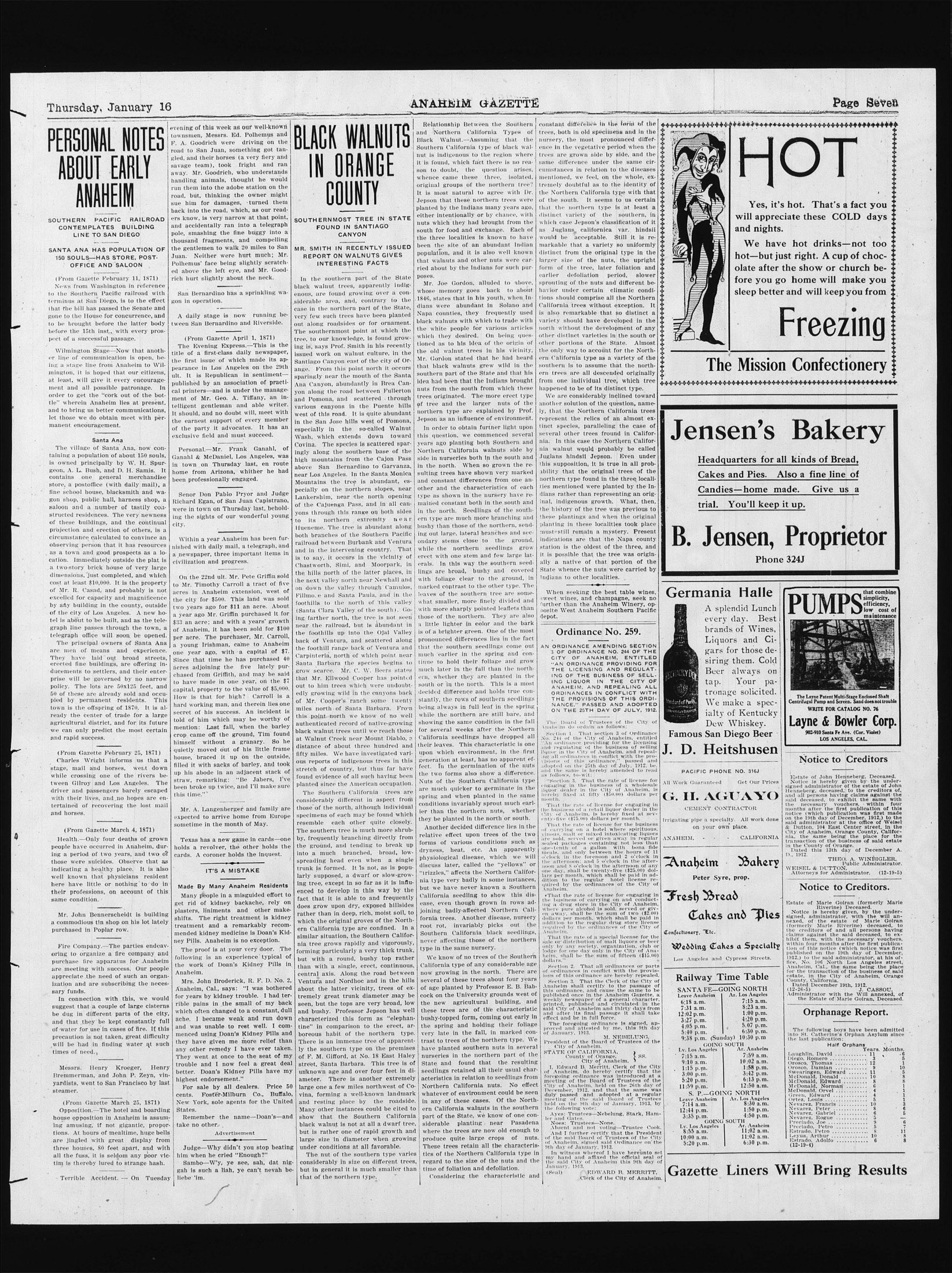
Searchable text
PERSONAL NOTES
ABOUT EARLY
ANAHEIM
SOUTHERN PACIFIC RAILROAD
CONTEMPLATES BUILDING
LINE TO SAN DIEGO
SANTA ANA HAS POPULATION OF
150 SOULS—HAS STORE, POSTOFFICE AND SALOON
(From Gazette February 11, 1871)
News from Washington in reference to the Southern Pacific railroad with terminus at San Diego, is to the effect that the bill has passed the Senate and gone to the House for concurrence, and to be brought before the latter body before the 15th inst., with every prospect of a successful passage.
Wilmington Stage—Now that another line of communication is open, being a stage line from Anaheim to Wilmington, it is hoped that our citizens, at least, will give it every encouragement and all possible patronage. In order to get the "cork out of the bottle" wherein Anaheim lies at present, and to bring us better communications, let those we do obtain meet with permanent encouragement.
Santa Ana
The village of Santa Ana, now containing a population of about 150 souls, is owned principally by W. H. Spurgeon, A. L. Bush, and D. H. Samis. It evening of this week as our well-known townsmen, Messrs. Ed. Polhemus and F. A. Goodrich were driving on the road to San Juan, something got tangled, and their horses (a very fiery and savage team), took fright and ran away. Mr. Goodrich, who understands handling animals, thought he would run them into the adobe station on the road, but, thinking the owner might sue him for damages, turned them back into the road, which, as our readers know, is very narrow at that point, and accidentally ran into a telegraph pole, smashing the fine buggy into a thousand fragments, and compelling the gentlemen to walk 20 miles to San Juan. Neither were hurt much; Mr. Polhemus' face being slightly scratched above the left eye, and Mr. Goodrich hurt slightly about the neck.
San Bernardino has a sprinkling wagon in operation.
A daily stage is now running between San Bernardino and Riverside.
(From Gazette April 1, 1871)
The Evening Express.—This is the title of a first-class daily newspaper, the first issue of which made its appearance in Los Angeles on the 29th ult. It is Republican in sentiment—published by an association of practical printers—and is under the management of Mr. Geo. A. Tiffany, an intelligent gentleman and able writer. It should, and no doubt will, meet with the earnest support of every member of the party it advocates. It has an exclusive field and must succeed.
Personal.—Mr. Frank Ganahl, of Ganahl & McDaniel, Los Angeles, was in town on Thursday last, en route home from Arizona, whither he had
Santa Ana
The village of Santa Ana, now containing a population of about 150 souls, is owned principally by W. H. Spurgeon, A. L. Bush, and D. H. Samis. It contains one general merchandise store, a postoffice (with daily mail), a fine school house, blacksmith and wagon shop, public hall, harness shop, a saloon and a number of tastily constructed residences. The very newness of these buildings, and the continual projection and erection of others, is a circumstance calculated to convince an observing person that it has resources as a town and good prospects as a location. Immediately outside the plat is a two-story brick house of very large dimensions, just completed, and which cost at least $10,000. It is the property of Mr. R. Casad, and probably is not excelled for capacity and magnificence by any building in the county, outside of the city of Los Angeles. A new hotel is about to be built, and as the telegraph line passes through the town, a telegraph office will soon be opened.
The principal owners of Santa Ana are men of means and experience. They have laid out broad streets, erected fine buildings, are offering inducements to settlers, and their enterprise will be governed by no narrow policy. The lots are 50x125 feet, and 50 of these are already sold and occupied by permanent residents. This town is the offspring of 1870. It is already the center of trade for a large agricultural district, and for its future we can only predict the most certain and rapid success.
(From Gazette February 25, 1871)
Charles Wright informs us that a stage, mail and horses, went down while crossing one of the rivers between Gilroy and Los Angeles. The driver and passengers barely escaped with their lives, and no hopes are entertained of recovering the lost mail and horses.
(From Gazette March 4, 1871)
Health.—Only four deaths of grown people have occurred in Anaheim, during a period of two years, and two of those were suicides. Observe that as indicating a healthy place. It is also well known that physicians resident here have little or nothing to do in their professions, on account of this same condition.
It is Republican in sentiment—published by an association of practical printers—and is under the management of Mr. Geo. A. Tiffany, an intelligent gentleman and able writer. It should, and no doubt will, meet with the earnest support of every member of the party it advocates. It has an exclusive field and must succeed.
Personal.—Mr. Frank Ganahl, of Ganahl & McDaniel, Los Angeles, was in town on Thursday last, en route home from Arizona, whither he had been professionally engaged.
Senor Don Pablo Pryor and Judge Richard Egan, of San Juan Capistrano, were in town on Thursday last, beholding the sights of our wonderful young city.
Within a year Anaheim has been furnished with daily mail, a telegraph, and a newspaper, three important items in civilization and progress.
On the 22nd ult. Mr. Pete Griffin sold to Mr. Timothy Carroll a tract of five acres in Anaheim extension, west of the city for $500. This land was sold two years ago for $11 an acre. About a year ago Mr. Griffin purchased it for $33 an acre; and with a year's growth of Anaheim, it has been sold for $100 per acre. The purchaser, Mr. Carroll, a young Irishman, came to Anaheim one year ago, with a capital of $7. Since that time he has purchased 40 acres adjoining the five lately purchased from Griffith, and may be said to have made in one year, on the $7 capital, property to the value of $5,000. How is that for high? Carroll is a hard working man, and therein lies one secret of his success. An incident is told of him which may be worthy of mention: Last fall, when the barley crop came off the ground, Tim found himself without a granary. So he quietly moved out of his little frame house, braced it up on the outside, filled it with sacks of barley, and took up his abode in an adjacent stack of straw, remarking: "Be Jabers, I've been broke up twice, and I'll make sure this time."
Mr. A. Langenberger and family are expected to arrive home from Europe sometime in the month of May.
Texas has a new game in cards—one holds a revolver, the other holds the cards. A coroner holds the inquest.
IT'S A MISTAKE
Made By Many Anaheim Residents
Many people in a misguided effort to sparingly near the north Ana Canyon, abundantly along the south high mountains from above San Bernardino near Los Angeles. In Mountains the tree specially on the north Lankershim, near the south Cajuenga Parkyons through this raid to its northern Hueneme. The tree both branches of the railroad between Burlington and in the intervening is to say, it occurs back of Chastworth, Simi; the hills north of the next valley north on down the valley Fillmoe e and Santa Foothills to the north (Santa Clara Valley) farther north; then near the railroad; then foothills up into back of Ventura; and then foothill range back Carpinteria; north of Santa Barbara the grow scarce. Mr. C that Mr. Ellwood C out to him trees which eddy growing wild in of Mr. Cooper's rail miles north of San Antonio this point north we authenticated record black walnut trees u at Walnut Creek near distance of about fifty miles. We have ous reports of indigent stretch of country; we found evidence of an planted since the Ante.
The Southern California considerably different those of the north specimens of each ranch resemble each other. The southern tree is by frequently branding the ground, and then into a much branched spreading head even trunk is formed. It larply supposed, a ding tree, except in enced to develop in fact that it is able
(From Gazette March 4, 1871)
Health.—Only four deaths of grown people have occurred in Anaheim, during a period of two years, and two of those were suicides. Observe that as indicating a healthy place. It is also well known that physicians resident here have little or nothing to do in their professions, on account of this same condition.
Mr. John Bennerscheidt is building a commodious tin shop on his lot lately purchased in Poplar row.
Fire Company.—The parties endeavoring to organize a fire company and purchase fire apparatus for Anaheim are meeting with success. Our people appreciate the need of such an organization and are subscribing the necessary funds.
In connection with this, we would suggest that a couple of large cisterns be dug in different parts of the city, and that they be kept constantly full of water for use in cases of fire. If this precaution is not taken, great difficulty will be had in finding water at such times of need.
Messrs. Henry Kroeger, Henry Bremmerman, and John P. Zeyn, vinyardists, went to San Francisco by last steamer.
(From Gazette March 25, 1871)
Opposition.—The hotel and boarding house opposition in Anaheim is assuming amusing, if not gigantic, proportions. At hours of mealtime, huge bells are jingled with great display from three houses, 80 feet apart, and with all the fuss, it is seldom any poor victim is thereby lured to strange hash.
Terrible Accident. — On Tuesday
Mr. A. Langenberger and family are expected to arrive home from Europe sometime in the month of May.
Texas has a new game in cards—one holds a revolver, the other holds the cards. A coroner holds the inquest.
IT'S A MISTAKE
Made By Many Anaheim Residents
Many people in a misguided effort to get rid of kidney backache, rely on plasters, liniments and other make-shifts. The right treatment is kidney treatment and a remarkably recommended kidney medicine is Doan's Kidney Pills. Anaheim is no exception.
The proof is at your very door. The following is an experience typical of the work of Doan's Kidney Pills in Anaheim.
Mrs. John Broderick, R. F. D. No. 2, Anaheim, Cal., says: "I was bothered for years by kidney trouble. I had terrible pains in the small of my back which often changed to a constant, dull ache. I became weak and run down and was unable to rest well. I commenced using Doan's Kidney Pills and they have given me more relief than any other remedy I have ever taken. They went at once to the seat of my trouble and I now feel a great deal better. Doan's Kidney Pills have my highest endorsement."
For sale by all dealers. Price 50 cents. Foster-Milburn Co., Buffalo, New York, sole agents for the United States.
Remember the name—Doan's—and take no other.
Advertisement
Judge—Why didn't you stop beating him when he cried "Enough?"
Sambo—W'y, ye see, sah, dat nig-gah is such a liah, ye can't nevah beliebe 'im.
BLACK WALNUTS IN ORANGE COUNTY
SOUTHERNMOST TREE IN STATE FOUND IN SANTIAGO CANYON
MR. SMITH IN RECENTLY ISSUED REPORT ON WALNUTS GIVES INTERESTING FACTS
In the southern part of the State black walnut trees, apparently indigenous, are found growing over a considerable area, and, contrary to the case in the northern part of the State, very few such trees have been planted out along roadsides or for ornament. The southernmost point at which the tree, to our knowledge, is found growing is, says Prof. Smith in his recently issued work on walnut culture, in the Santiago Canyon east of the city of Orange. From this point north it occurs sparingly near the mouth of the Santa Ana Canyon, abundantly in Brea Canyon along the road between Fullerton and Pomona, and scattered through various canyons in the Puente hills west of this road. It is quite abundant in the San Jose hills west of Pomona, especially in the so-called Walnut Wash, which extends down toward Covina. The species is scattered sparingly along the southern base of the high mountains from the Cajon Pass above San Bernardino to Garvanza, near Los Angeles. In the Santa Monica Relationship Between the Southern and Northern California Types of Black Walnut—Assuming that the Southern California type of black walnut is indigenous to the region where it is found, which fact there is no reason to doubt, the question arises, whence came these three, isolated, original groups of the northern tree? It is most natural to agree with Dr. Jepson that these northern trees were planted by the Indians many years ago, either intentionally or by chance, with nuts which they had brought from the south for food and exchange. Each of the three localities is known to have been the site of an abundant Indian population, and it is also well known that walnuts and other nuts were carried about by the Indians for such purposes.
Mr. Joe Gordon, alluded to above, whose memory goes back to about 1846, states that in his youth, when Indians were abundant in Solano and Napa counties, they frequently used black walnuts with which to trade with the white people for various articles which they desired. On being questioned as to his idea of the origin of the old walnut trees in his vicinity, Mr. Gordon stated that he had heard that black walnuts grew wild in the southern part of the State and that his idea had been that the Indians brought nuts from the south from which these trees originated. The more erect type of tree and the larger nuts of the northern type are explained by Prof. Jepson as an influence of environment.
In order to obtain further light upon this question, we commenced several years ago planting both Southern and Northern California walnuts side by side in nurseries both in the south and in the north. When so grown the resulting trees have shown very marked constant difference in the form of the trees, both in old specimens and in the nursery, the most pronounced difference in the vegetative period when the trees are grown side by side, and the same difference under the same circumstances in relation to the diseases mentioned, we feel, on the whole, extremely doubtful as to the identity of the Northern California type with that of the south. It seems to us certain that the northern type is at least a distinct variety of the southern, in which case Jepson's classification of it as Juglans californica var. hindsii would be acceptable. Still it is remarkable that a variety so uniformly distinct from the original type in the larger size of the nuts, the upright form of the tree, later foliation and earlier defoliation period, slower sprouting of the nuts and different behavior under certain climatic conditions should comprise all the Northern California trees without exception. It is also remarkable that so distinct a variety should have developed in the north without the development of any other distinct varieties in the south or other portions of the State. Almost the only way to account for the Northern California type as a variety of the southern is to assume that the northern trees are all descended originally from one individual tree, which tree happened to be of its distinct type.
We are considerably inclined toward another solution of the question, namely, that the Northern California trees represent the relics of an almost extinct species, paralleling the case of several other trees found in California. In this case the Northern California walnut would probably be called Juglans hindsii Jepson. Even under this supposition, it is true in all probability that the original trees of the
sparingly near the mouth of the Santa Ana Canyon, abundantly in Brea Canyon along the road between Fullerton and Pomona, and scattered through various canyons in the Puente hills west of this road. It is quite abundant in the San Jose hills west of Pomona, especially in the so-called Walnut Wash, which extends down toward Covina. The species is scattered sparingly along the southern base of the high mountains from the Cajon Pass above San Bernardino to Garvanza, near Los Angeles. In the Santa Monica Mountains the tree is abundant, especially on the northern slopes, near Lankershim, near the north opening of the Cajuenga Pass, and in all canyons through this range on both sides to its northern extremity near Hueneme. The tree is abundant along both branches of the Southern Pacific railroad between Burbank and Ventura and in the intervening country. That is to say, it occurs in the vicinity of Chastworth, Simi, and Moorpark, in the hills north of the latter places, in the next valley north near Newhall and on down the valley through Camulos, Fillmoe and Santa Paula, and in the foothills to the north of this valley (Santa Clara Valley of the south). Going farther north, the tree is not seen near the railroad, but is abundant in the foothills up into the Ojal Valley back of Ventura, and scattered along the foothill range back of Ventura and Carpinteria, north of which point near Santa Barbara the species begins to grow scarce. Mr. C. W. Beers states that Mr. Ellwood Cooper has pointed out to him trees which were undoubtedly growing wild in the canyons back of Mr. Cooper's ranch some twenty miles north of Santa Barbara. From this point north we know of no well authenticated record of native-growing black walnut trees until we reach those at Walnut Creek near Mount Diablo, a distance of about three hundred and fifty miles. We have investigated various reports of indigenous trees in this stretch of country, but thus far have found evidence of all such having been planted since the American occupation.
The Southern California trees are considerably different in aspect from those of the north, although individual specimens of each may be found which resemble each other quite closely. The southern tree is much more shrubby, frequently branching directly from the ground, and tending to break up into a much branched, broad, low-spreading head even when a single trunk is formed. It is not, as is popularly supposed, a dwarf or slow-growing tree, except in so far as it is influenced to develop in this way by the fact that it is able to and frequently sparingly near the mouth of the Santa Ana Canyon, abundantly in Brea Canyon along the road between Fullerton and Pomona, and scattered through various canyons in the Puente hills west of this road. It is quite abundant in the San Jose hills west of Pomona, especially in the so-called Walnut Wash, which extends down toward Covina. The species is scattered sparingly along the southern base of the high mountains from the Cajon Pass above San Bernardino to Garvanza, near Los Angeles. In the Santa Monica Mountains the tree is abundant, especially on the northern slopes, near Lankershim, near the north opening of the Cajuenga Pass, and in all canyons through this range on both sides to its northern extremity near Hueneme. The tree is abundant along both branches of the Southern Pacific railroad between Burbank and Ventura and in the intervening country. That is to say, it occurs in the vicinity of Chastworth, Simi, and Moorpark, in the hills north of the latter places, in the next valley north near Newhall and on down the valley through Camulos, Fillmoe and Santa Paula, and in the foothills to the north of this valley (Santa Clara Valley of the south). Going farther north, the tree is not seen near the railroad, but is abundant in the foothills up into the Ojal Valley back of Ventura, and scattered along the foothill range back of Ventura and Carpinteria, north of which point near Santa Barbara the species begins to grow scarce. Mr. C. W. Beers states that Mr. Ellwood Cooper has pointed out to him trees which were undoubtedly growing wild in the canyons back of Mr. Cooper's ranch some twenty miles north of Santa Barbara. From this point north we know of no well authenticated record of native-growing black walnut trees until we reach those at Walnut Creek near Mount Diablo, a distance of about three hundred and fifty miles. We have investigated various reports of indigenous trees in this stretch of country, but thus far have found evidence of all such having been planted since the American occupation.
The Southern California trees are considerably different in aspect from those of the north, although individual specimens of each may be found which resemble each other quite closely. The southern tree is much more shrubby, frequently branching directly from the ground, and tending to break up into a much branched, broad, low-spreading head even when a single trunk is formed. It is not, as is popularly supposed, a dwarf or slow-growing tree, except in so far as it is influenced to develop in this way by the fact that it is able to and frequently sparingly near the mouth of the Santa Ana Canyon, abundantly in Brea Canyon along the road between Fullerton and Pomona, and scattered through various canyons in the Puente hills west of this road. It is quite abundant in the San Jose hills west of Pomona, especially in the so-called Walnut Wash, which extends down toward Covina. The species is scattered sparingly along the southern base of the high mountains from the Cajon Pass above San Bernardino to Garvanza, near Los Angeles. In the Santa Monica Mountains the tree is abundant, especially on the northern slopes, near Lankershim, near the north opening of the Cajuenga Pass, and in all canyons through this range on both sides to its northern extremity near Hueneme. The tree is abundant along both branches of the Southern Pacific railroad between Burbank and Ventura and in the intervening country. That is to say, it occurs in the vicinity of Chastworth, Simi, and Moorpark, in the hills north of the latter places, in the next valley north near Newhall and on down the valley through Camulos, Fillmoe and Santa Paula, and in the foothills to the north of this valley (Santa Clara Valley of the south). Going farther north, the tree is not seen near the railroad, but is abundant in the foothills up into the Ojal Valley back of Ventura, and scattered along the foothill range back of Ventura and Carpinteria, north of which point near Santa Barbara the species begins to grow scarce. Mr. C. W. Beers states that Mr. Ellwood Cooper has pointed out to him trees which were undoubtedly growing wild in the canyons back of Mr. Cooper's ranch some twenty miles north of Santa Barbara. From this point north we know of no well authenticated record of native-growing black walnut trees until we reach those at Walnut Creek near Mount Diablo, a distance of about three hundred and fifty miles. We have investigated various reports of indigenous trees in this stretch of country, but thus far have found evidence of all such having been planted since the American occupation.
The Southern California trees are considerably different in aspect from those of the north, although individual specimens of each may be found which resemble each other quite closely. The southern tree is much more shrubby, frequently branching directly from the ground, and tending to break up into a much branched, broad, low-spreading head even when a single trunk is formed. It is not, as is popularly supposed, a dwarf or slow-growing tree, except in so far as it is influenced to develop in this way by the fact that it is able to and frequently sparingly near the mouth of the Santa Ana Canyon, abundantly in Brea Canyon along the road between Fullerton and Pomona, and scattered through various canyons in the Puente hills west of this road. It is quite abundant in the San Jose hills west of Pomona, especially in the so-called Walnut Wash, which extends down toward Covina. The species is scattered sparingly along the southern base of the high mountains from the Cajon Pass above San Bernardino to Garvanza, near Los Angeles. In the Santa Monica Mountains the tree is abundant, especially on the northern slopes, near Lankershim, near the north opening of the Cajuenga Pass, and in all canyons through this range on both sides to its northern extremity near Hueneme. The tree is abundant along both branches ofthe Southern Pacific railroad between Burbank and Ventura and in intervening country. That is to say it occurs in the vicinity of Chastworth,Simi,and Moorpark,inthe hills northofthe latter places,inthe nextvalleynorthnearNewhallanddownthevalleythroughCamulosFillmoeandSantaPaula,andinthefoothillstothenorthofthisvalley(SantaClaraValleyofthesouth).Goingfarthernorth,thetreeisnotseenneartherailroadbutisabundantinthefoothillsupintotheOjalValleybackofVentura,andscatteredalongthefoothillrangebackofVenturaandCarpinteria,northofwhichpointnearsantabarbarathespeciesbeginstocrowscarce.Mr.C.W.BeersstatesthatMr.EllwoodCooperhaspointouttohmtreeswhichwereundoubtedlygrowingwildinthecanyonsbackofMr.Cooper'sranchsometwentymilesnorthofSantaBarbara.Fromthispointnorthweknowofnowellauthenticatedrecordofnative-growingblackwalnuttreesuntilwereachthoseatWalnutCreeknearMountDiablo,adistanceofaboutthreehundredandfiftymiles.Wewhaveinvestigatedvariousreportsofindigenoustreesinthisstretchofcountry,butthusfarhavefoundevidenceofallsuchhavingbeenplantedsincetheAmericanoccupation.
The Southern California trees are considerably different in aspect from those of the north, although individual specimens of each may be found which resemble each other quite closely. The southern tree is much more shrubby,frequently branching directly fromtheground,andtendingtobreakupintoamuchbranched,broadlow-spreadingheadevenwhenasingletrunkisformedItisnotaspopularlysupposed,a dwarfor slow-growingtreeexceptinsofarasitisinfluencedtodevelopinthiswaybythefactthatitisabletoandfrequentlysparinglynearthemouthoftheSantaAnaCanyonabundantlyinBreaCanyonalongtheroadbetweenFullertonandPomona,andscatteredalongthefoothillrangebackofVenturaandCarpinteria,northofwhichpointnearsantabarbarathespeciesbeginstocrowscarce.Mr.C.W.BeersstatesthatMr.EllwoodCooperhaspointouttohmtreeswhichwereundoubtedlygrowingwildinthecanyonsbackofMr.Cooper'sranchsometwentymilesnorthofSantaBarbara.Fromthispointnorthweknowofnowellauthenticatedrecordofnative-growingblackwalnuttreesuntilwereachthoseatWalnutCreeknearMountDiablo,adistanceofaboutthreehundredandfiftymiles.Wewhaveinvestigatedvariousreportsofindigenoustreesinthisstretchofcountry,butthusfarhavefoundevidenceofallsuchhavingbeenplantedsincetheAmericanoccupation.
The Southern California trees are considerably different in aspect from those of the north,although individual specimens of each may be found which resemble each other quite closely.The southern tree is much more shrubby,frequently branching directlyfromtheground,andtendingtobreakupintoamuchbranched,broadlow-spreadingheadevenwhenasingletrunkisformedItisnotaspopularlysupposed,a dwarfor slow-growingtreeexceptinsofarasitisinfluencedtodevelopinthiswaybythefactthatitisabletoandfrequentlysparinglynearthemouthoftheSantaAnaCanyonabundantlyinBreaCanyonalongtheroadbetweenFullertonandPomona,andscatteredalongthefoothillrangebackofVenturaandCarpinteria,northofwhichpointnearsantabarbarathespeciesbeginstocrowscarce.Mr.C.W.Beersstates thatMr.EllwoodCooperhaspointouttohmtreeswhichwereundoubtedlygrowingwildinthecanyonsbackofMr.Cooper'sranchsometwentymilesnorthofSantaBarbara.Fromthispointnorthweknowofnowellauthenticatedrecordofnative-growingblackwalnuttreesuntilwereachthoseatWalnutCreeknearMountDiablo,adistanceofaboutthreehundredandfiftymiles.Wewhaveinvestigatedvariousreportsofindigenoustreesinthisstretchofcountry,butthusfarhavefoundevidenceofallsuchhavingbeenplantedsincetheAmericanoccupation.
The Southern California trees are considerably different in aspect from those of the north,although individual specimens of each may be found which resemble each other quite closely.The southern tree is much more shrubby,frequently branching directlyfromtheground,andtendingtobreakupintoamuchbranched,broadlow-spreadingheadevenwhenasingletrunkisformedItisnotaspopularlysupposed,a dwarfor slow-growingtreeexceptinsofarasitisinfluencedtodevelopinthiswaybythefact that它是 able to和 frequently sparinglynearthemouthoftheSantaAnaCanyonabundantlyinBreaCanyonalongtheroadbetweenFullertonandPomona,andscatteredalongthefoothillrangebackofVenturaandCarpinteria,northofwhichpointnearsantabarbarathespeciesbeginstocrowscarce.Mr.C.W.Beersstates thatMr.EllwoodCooperhaspointouttohmtreeswhichwereundoubtedlygrowingwildinthecanyonsbackofMr.Cooper'sranchsometwentymilesnorthofSantaBarbara.Fromthispointnorthweknowofnowellauthenticatedrecordofnative-growingblackwalnuttreesuntilwereachthoseatWalnutCreeknearMountDiablo,adistanceofaboutthreehundredandfiftymiles.Wewhaveinvestigatedvariousreportsofindigenoustreesinthisstretchofcountry,butthusfarhavefoundevidenceofallsuchhavingbeenplantedsincetheAmericanoccupation.
The Southern California trees are considerably different in aspect from those of the north,although individual specimens of each may be found which resemble each other quite closely.The southern tree is much more shrubby,frequently branching directlyfromtheground,andtendingtobreakupintoamuchbranched,broadlow-spreadingheadevenwhenasingletrunkisformedItisnotaspopularlysupposed,a dwarfor slow-growingtreeexceptinsofarasitisinfluencedtodevelopinthiswaybythefact that它是 able to和 frequently sparinglynearthemouthoftheSantaAnaCanyonabundantlyinBreaCanyonalongtheroadbetweenFullertonandPomona,andscatteredalongthefoothillrangebackofVenturaandCarpinteria,northofwhichpointnearsantabarbarathespeciesbeginstocrowscarce.Mr.C.W.Beersstates thatMr.EllwoodCooperhaspointouttohmtreeswhichwereundoubtedlygrowingwildinthecanyonsbackofMr.Cooper'sranchsometwentymilesnorthofSantaBarbara.Fromthispointnorthweknowofnowellauthenticatedrecordofnative-growingblackwalnuttreesuntilwereachthoseatWalnutCreeknearMountDiablo,adistanceofaboutthreehundredandfiftymiles.Wewhaveinvestigatedvariousreportsofindigenoustreesinthisstretchofcountry,butthusfarhavefoundevidenceofallsuchhavingbeenplantedsincetheAmericanoccupation.
The Southern California trees are considerably different in aspect from those of the north,although individual specimens of each may be found which resemble each other quite closely.The southern tree is much more shrubby,frequently branching directlyfromtheground,andtendingtobreakupintoamuchbranched,broadlow-spreadingheadevenwhenasingletrunkisformedItisnotaspopularlysupposed,a dwarfor slow-growingtreeexceptinsofarasitisinfluencedtodevelopinthiswaybythefact that它是 able to和 frequently sparinglynearthemouthOftheSantaAnaCanyonabundantlyinBreaCanyonalongtheroadbetweenFullertonandPomona,andscatteredalongthefoothillrangebackOfVenturaandCarpinteria,northofwhichpointnearsantabarbaraThespeciesbeginstocrowscarce.Mr.C.W.Beersstates thatMr.EllwoodCooperhaspointouttohmtreeswhichwereundoubtedlygrowingwildinthecanyonsbackofMr.Cooper'sranchsometwentymilesnorthofSantaBarbara.Fromthispointnorthweknow OfnowellauthenticatedrecordOfnative-GrowingBlackWalnutTreesUnlessTheyAreNotInTheCityOfAnaheimWinery,PossiblyWesternAnaheimSouthernPacificDepot.
Ordinance No. 259.
AN ORDINANCE AMENDING SECTION 3 OF ORDINANCE NO. 244 OF THE CITY OF ANAHIME ENTITLED "AN ORDINANCE PROVIDING FOR THE LICENSING AND REGULATING OF THE BUSINESS OF SELLING LIQUOR IN THE CITY OF ANAHIME,"REPEALING ALL ORDERINGS IN CONFLICT WITH THE PROVISIONS OF THIS ORDINANCE,"PASSED AND ADOPTED ON THE 25TH DAY OF JULY,1912.
The Board Of Trustees Of The City Of Anaheim Do ordain as follows:
Section 1: That section 3 Of Ordinance No. 244 Of The City Of Anaheim Entitled "An Ordinance Providing For The Licensing And Regulating Of The Business Of Selling Liquor In The City Of Anaheim,"Repeals All Orders In Conflict With The Provisions Of This Ordinance,"Pashed And Adopted On The 25th Day Of July,1912.
That rate Of License For Engaging In The Business Of A Wholesale Liquor Dealer In The City Of Anaheim Is hereby amended To read As follows:
Section 3: That rate Of license For engaging In The business Of a wholesale liquor Dealer In The City Of Anaheim Is hereby amended To read As follows:
"Section 3: That rate Of license For engaging In The business Of a wholesale liquor Dealer In The City Of Anaheim Is hereby amended To read As follows:
"Section 3: That rate Of license For engaging In The business Of a wholesale liquor Dealer In The City Of Anaheim Is hereby amended To read As follows:
"Section 3: That rate Of license For engaging In The business Of a wholesale liquor Dealer In The City Of Anaheim Is hereby amended To read As follows:
"Section 3: That rate Of license For engaging In The business Of a wholesale liquor Dealer In The City Of Anaheim Is hereby amended To read As follows:
"Section 3: That rate Of license For engaging In The business Of a wholesale liquor Dealer In The City Of Anaheim Is hereby amended To read As follows:
"Section 3: That rate Of license For engaging In The business Of a wholesale liquor Dealer In The City Of Anaheim Is hereby amended To read As follows:
"Section 3: That rate Of license For engaging In The business Of a wholesale liquor Dealer In The City Of Anaheim Is hereby amended To read As follows:
"Section 3: That rate Of license For engaging In The business Of a wholesale liquor Dealer In The City Of Anaheim Is hereby amended To read As follows:
"Section 3: That rate Of license For engaging In The business Of a wholesale liquor Dealer In The City Of Anaheim Is hereby amended To read As follows:
"Section 3: That rate Of license For engaging In The business Of a wholesale liquor Dealer In The City Of Anaheim Is hereby amended To read As follows:
"Section 3: That rate Of license For engaging In The business Of a wholesale liquor Dealer In The City Of Anaheim Is hereby amended To read As follows:
"Section 3: That rate Of license For engaging In The business Of a wholesale liquor Dealer In The City Of Anaheim Is hereby amended To read As follows:
"Section 3: That rate Of license For engaging In The businessOf A Wholesale Liquor Dealer In The CityOfAnaheimIs hereby amendedToreadAsfollows:
"Section 3: That rateOflicenseForengagingInTheBusinessOfAWholesaleLiquorDealerInTheCityOfAnaheimIs hereby amendedToreadAsfollows:
"Section 3: That rateOflicenseForengagingInTheBusinessOfAWholesaleLiquorDealerInTheCityOfAnaheimIs hereby amendedToreadAsfollows:
"Section 3: That rateOflicenseForengagingInTheBusinessOfAWholesaleLiquorDealerInTheCityOfAnaheimIs hereby amendedToreadAsfollows:
"Section 3: That rateOflicenseForengagingInTheBusinessOfAWholesaleLiquorDealerInTheCityOfAnaheimIs hereby amendedToreadAsfollows:
"Section 3: That rateOflicenseForengagingInTheBusinessOfAWholesaleLiquorDealerInTheCityOfAnaheimIs hereby amendedToreadAsfollows:
"Section 3: That rateOflicenseForengagingInTheBusinessOfAWholesaleLiquorDealerInTheCityOfAnaheimIs hereby amendedToreadAsfollows:
"Section 3: That rateOflicenseForengagingInTheBusinessOfAWholesaleLiquorDealerInTheCityOfAnaheimIs hereby amendedToreadAsfollows:
"Section 3: That rateOflicenseForengagingInTheBusinessOfAWholesaleLiquorDealerInTheCityOfAnaheimIs hereby amendedToreadAsfollows:
"Section 3: That rateOflicenseForengagingInTheBusinessOfAWholesaleLiquorDealerInTheCityOfAnaheimIs hereby amendedToreadAsfollows:
"Section 3: That rateOflicenseForengagingInTheBusinessOF AWholesaleLiquorDealerInTheCityOfAnaheimIs hereby amendedToreadAsfollows:
"Section 3: That rateOflicenseForengagingInTheBusinessOF AWholesaleLiquorDealerInTheCityOfAnaheimIs hereby amendedToreadAsfollows:
"Section 3: That rateOflicenseForengagingInTheBusinessOF AWholesaleLiquorDealerInTheCityOfAnaheimIs hereby amendedToreadAsfollows:
"Section 3: That rateOflicenseForengagingInTheBusinessOF AWholesaleLiquorDealerInTheCityOfAnaheimIs hereby amendedToreadAsfollows:
"Section 3: That rateOflicenseForengagingInTheBusinessOF AWholesaleLiquorDealerInTheCityOfAnaheimIs hereby amendedToreadAsfollows:
"Section 3: That rateOflicenseForengagingINationalGrowthAndDevelopmentInThisStreetWithinOneMileFromTheNorthRoad"
"The Southern California trees are considerably different in aspect from those of North,although individual specimens of each may be found which resemble each other quite closely.The southern tree is much more shrubby,frequently branching directlyfromtheground,andtendingtobreakupintoamuchbranched,broadlow-spreadingheadevenwhenasingletrunkisformedItisnotaspopularlysupposed,a dwarfor slow-growingtreeexceptinsofarasitisinfluencedtodevelopinthiswaybythefact that它是 able to和 frequently sparinglynearthemouthOftheSantaAnaCanyonabundantlyinBreaCanyonalongtheroadbetweenFullertonandPomona,andscatteredalongthefoothillrangebackOfVenturaandCarpinteria,northofwhichpointnearsantabarbaraThespeciesbeginstocrowscarce.Mr.C.W.Beersstates thatMr.EllwoodCooperhaspointouttohmtreeswhichwereundoubtedlygrowingwildinthecanyonsbackofMr.Cooper'sranchsometwentymilesnorthofSantaBarbara.Fromthispointnorthweknow OfnowellauthenticatedrecordOfnative-GrowingBlackWalnutTreesUnlessTheyAreNotInTheCityOfAnaheimWinery,PossiblyWesternAnaheimSouthernPacificDepot."
Ordinance No. 259.
AN ORDINANCE AMENDING SECTION 3 OF ORDINANCE NO. 244 OF THE City OF ANAHIME Entrited "An Ordinance Providing For The Licensings And Regulating Of The Business Of Selling Liquor In The City OF ANAHIME,"Repeals All Orders In Conflict With The Provisions Of This Ordinance,"Pashed And Adopted On The 25th Day Of July,1912.
That rate Of License For engaging In The Business Of A Wholesale Liquor Dealer In The CityOfAnaheimIs hereby amendedToreadAsfollows:
"Section 3: That rateOflicenseForengagingInTheBusinessOfAWholesaleLiquorDealerInTheCityOfAnaheimIs hereby amendedToreadAsfollows:
"Section 3: That rateOflicenseForengagingInTheBusinessOfAWholesaleLiquorDealerInTheCityOfAnaholmIs hereby amendedToreadAsfollows:
"Section 3: That rateOflicenseForengagingInTheBusinessOfAWholesaleLiquorDealerInTheCityOfAnaholmIs hereby amendedToreadAsfollows:
"Section 3: That rateOflicenseForengagingInTheBusinessOfAWholesaleLiquorDealerInTheCityOfAnaholmIs hereby amendedToreadAsfollows:
"Section 3: That rateOflicenseForengagingInTheBusinessOF AWholesaleLiquorDealerInTheCityOfAnaholmIs hereby amendedToreadAsfollows:
"Section 3: That rateOflicenseForengagingINationalGrowthAndDevelopmentInThisStreetWithinOneMileFromThe
considerably different in aspect from those of the north, although individual specimens of each may be found which resemble each other quite closely. The southern tree is much more shrubby, frequently branching directly from the ground, and tending to break up into a much branched, broad, low-spreading head even when a single trunk is formed. It is not, as is popularly supposed, a dwarf or slow-growing tree, except in so far as it is influenced to develop in this way by the fact that it is able to and frequently does grow upon dry, exposed hillsides rather than in deep, rich, moist soil, to which the original groves of the Northern California type are confined. In a similar situation, the Southern California tree grows rapidly and vigorously, forming particularly a very thick trunk, but with a round, bushy top rather than with a single, erect, continuous, central axis. Along the road between Ventura and Nordhoc and in the hills about the latter vicinity, trees of extremely great trunk diameter may be seen, but the tops are very broad, low and bushy. Professor Jepson has well characterized this form as "elephantine" in comparison to the erect, arboreous habit of the northern type. There is an immense tree of apparently the southern type on the premises of F. M. Gifford, at No. 18 East Haley street, Santa Barbara. This tree is of unknown age and over four feet in diameter. There is another extremely large one a few miles northwest of Covina, forming a well-known landmark and resting place by the roadside. Many other instances could be cited to show that the Southern California black walnut is not at all a dwarf tree, but is rather one of rapid growth and large size in diameter when growing under conditions at all favorable.
The nut of the southern type varies considerably in size on different trees, but in general it is much smaller than that of the northern type.
Another decided difference lies in the relative effect upon trees of the two forms of various conditions such as dryness, heat, etc. An apparently physiological disease, which we will discuss later, called the "yellows" or "trizzles," affects the Northern California type very badly in some instances, but we have never known a Southern California seedling to show this disease, even though grown in rows adjoining badly-affected Northern California trees. Another disease, nursery root rot, invariably picks out the Southern California black seedlings, never affecting those of the northern type in the same nursery.
We know of no trees of the Southern California type of any considerable age now growing in the north. There are several of these trees about four years of age planted by Professor E. B. Babcock on the University grounds west of the new agricultural building, and these trees are of the characteristic bushy-topped form, coming out early in the spring and holding their foliage very late in the fall, in marked contrast to trees of the northern type. We have planted southern nuts in several nurseries in the northern part of the State and found that the resulting seedlings retained all their usual characteristics in relation to seedlings from Northern California nuts. No effect whatever of environment could be seen in any of these cases. Of the Northern California walnuts in the southern part of the State, we know of one considerable planting near Pasadena where the trees are now old enough to produce quite large crops of nuts. These trees retain all the characteristics of the Northern California type in regard to the size of the nuts and the time of foliation and defoliation.
Considering the characteristic and conditions invariably sprout much earlier than the northern nuts, whether they be planted in the north or south.
That the rate of license for engaging in the business of a retail liquor dealer in the City of Anaheim, is hereby fixed at seventy-five ($75.00) dollars per month.
That the rate of license for the business of carrying on a hotel where spirituous, vinous, malt or mixed intoxicating liquors are sold, served or given away in regular sealed packages containing not less than one-tenth of a gallon with bona fide meals, and only between the hours of 11 o'clock in the forenoon and 2 o'clock in the afternoon and 5 o'clock in the afternoon of any day, shall be twenty-five ($25.00) dollars per month, which shall be paid in addition to the regular drug store license required by the ordinances of the City of Anaheim.
That the rate of license for engaging in the business of carrying on and conducting a drug store in the City of Anaheim, where pure alcohol is sold, served or given away, shall be the sum of two ($2.00) dollars per month, which shall be paid in addition to the regular drug store license required by the ordinances of the City of Anaheim.
That the rate of a special license for the sale or distribution of malt liquors or beer only by any society, organization, club or lodge for one day only in the City of Anaheim, shall be the sum of fifteen ($15.00) dollars."
Section 2. That all ordinances or parts of ordinances in conflict with the provisions of this ordinance are hereby repealed.
Section 3. That the Clerk of the City of Anaheim shall certify to the passage of this ordinance, and cause the same to be published once in the Anaheim Gazette, a weekly newspaper of a general character, printed, published and circulated in the said City of Anaheim and thirty days from and after its final passage it shall take effect and be in full force.
The foregoing ordinance is signed, approved and attested by me, this 9th day of January, 1913.
M. NEBELUNG,
President of the Board of Trustees of the City of Anaheim.
STATE OF CALIFORNIA,
County of Orange,
City of Anaheim,
I. Edward B. Merritt, Clerk of the City of Anaheim, do hereby certify that the foregoing ordinance was introduced at a meeting of the Board of Trustees of the City of Anaheim, held on the 26th day of December, 1912, and that the same was duly passed and adopted at a regular meeting of the said Board of Trustees held on the 9th day of January, 1913, by the following vote:
Ayes: Trustees—Nebelung, Stark, Hamler and Gates.
Noes: Trustees—None.
Absent and not voting—Trustee Cook.
And I further certify that the President of the said Board of Trustees of the City of Anaheim, signed said Ordinance on the 9th day of January, 1913.
In witness whereof I have hereunto set my hand and affixed the official seal of the said City of Anaheim this 9th day of January, 1913.
(Seal)
EDWARD B. MERRITT,
Clerk of the City of Anaheim.
HOT
Yes, it’s hot. That’s a fact you will appreciate these COLD days and nights.
We have hot drinks—not too hot—but just right. A cup of chocolate after the show or church before you go home will make you sleep better and will keep you from Freezing
The Mission Confectionery
Jensen’s Bakery
Headquarters for all kinds of Bread,
Cakes and Pies. Also a fine line of
Jensen's Bakery
Headquarters for all kinds of Bread,
Cakes and Pies. Also a fine line of
Candies—home made. Give us a
trial. You'll keep it up.
B. Jensen, Proprietor
Phone 324J
Germania Halle
A splendid Lunch every day. Best brands of Wines, Liquors and Cigars for those desiring them. Cold Beer always on tap. Your patronage solicited. We make a specialty of Kentucky Dew Whiskey.
Famous San Diego Beer
J. D. Heitshusen
PUMPS
that combine simplicity, efficiency, low cost of maintenance
The Layne Patent Multi-Stage Enclosed Shaft Centrifugal Pump and Screen. Sand does not trouble
WRITE FOR CATALOG NO. 76
Layne & Bowler Corp.
902-910 Santa Fe Ave. (Cor. Violet)
LOS ANGELES, CAL.
Notice to Creditors
Estate of John Henneberg, Deceased.
Notice is hereby given by the undersigned administrator of the estate of John Henneberg, deceased, to the creditors of, and all persons having claims against the said deceased, to exhibit the same with the necessary vouchers, within four months after the first publication of this notice (which publication was first made on the 19th day of December, 1912.) to the said administrator at the office of Weisel & Dutton, 104 East Center street, in the City of Anaheim, Orange County, California, the same being the place for the transaction of the business of said estate in the County of Orange.
Dated this 13th day of December A. D., 1912.
THEO. A. WINBIGLER,
WEISEL & DUTTON,
Attorneys for Administrator. (12-19-5)
Notice to Creditors.
CEMENT CONTRACTOR
Irrigating pipe a specialty. All work done on your own place.
ANAHEIM. CALIFORNIA
Anaheim Bakery
Peter Syre, prop.
Fresh Bread
Cakes and Pies
Confectionery, Etc.
Wedding Cakes a Specialty
Los Angeles and Cypress Streets.
Railway Time Table
SANTA FE—GOING NORTH
Leave Anaheim Ar. Los Angeles
6:18 a.m. 7:15 a.m.
7:31 a.m. 8:23 a.m.
12:02 p.m. 1:00 p.m.
3:27 p.m. 4:20 p.m.
4:05 p.m. 5:07 p.m.
5:40 p.m. 6:30 p.m.
9:38 p.m. (Sunday) 10:30 p.m
GOING SOUTH
Lv. Los Angeles Ar. Anaheim
7:15 a.m. 7:59 a.m.
9:10 a.m. 10:02 a.m.
1:15 p.m. 1:58 p.m.
3:00 p.m. 3:42 p.m.
5:20 p.m. 6:13 p.m.
11:59 p.m. 12:50 a.m.
S. P.—GOING NORTH
Leave Anaheim Ar. Los Angeles
7:14 a.m. 8:30 a.m.
12:44 p.m. 1:50 p.m.
3:35 p.m. 4:50 p.m.
GOING SOUTH
Lv. Los Angeles Ar. Anaheim
8:55 a.m. 11:02 a.m.
10:00 a.m. 11:02 a.m.
5:20 p.m. 6:30 p.m.
said deceased, to exhibit the same with the necessary vouchers, within four months after the first publication of this notice (which publication was first made on the 19th day of December, 1912.) to the said administrator at the office of Weisel & Dutton, 104 East Center street, in the City of Anaheim, Orange County, California, the same being the place for the transaction of the business of said estate in the County of Orange.
Dated this 13th day of December A.D., 1912.
THEO. A. WINBIGLER,
Public Administrator.
WEISEL & DUTTON,
Attorneys for Administrator. (12-19-5)
Notice to Creditors.
Estate of Marie Goiran (formerly Marie Riverine) Deceased.
Notice is hereby given, by the undersigned, administrator, with the will annexed, of the estate of Marie Goiran (formerly Marie Riverine) deceased, to the creditors of and all persons having claims against the said deceased, to exhibit them, with the necessary vouchers, within four months after the first publication of this notice (which notice was first published on the 19th day of December, 1912.) to the said administrator, at his office, No. 106 North Los Angeles street, Anaheim, Cal., the same being the place for the transaction of the business of said estate, in the City of Anaheim, Orange County, California.
Dated December 19th, 1912.
(12-26-5)
Administrator with the Will annexed, of the Estate of Marie Goiran, Deceased.
Orphanage Report.
The following boys have been admitted into St. Catherine's Orphan Asylum since the last publication:
Half Orphans
Years. Months.
Laughlin, David 11 6
Diego, Romero 3 5
Orosco, Thomas 12 1
Orosco, Damian 9 10
Swearingen, Edward 11 5
McDonald, Donald 10 8
McDonald, Edward 8 8
McDonald, Norman 6 1
McDonald, Orvel 4 1
Green, Edward 4 1
Ortez, Louis 5 1
Nevarez, Francis 10 3
Nevarez, Peter 8 6
Nevarez, Gabriel 6 5
Nevarez, Rogue 5 —
Preclado, Joe 9 6
Preclado, Petro 5 7
Estrado, Petro 8 11
Leyua, Arthur 10 8
Estrado, Adolfo 6 8
(12-19-4)
Gazette Liners Will Bring Results