anaheim-gazette 1913-01-16
Scanned page
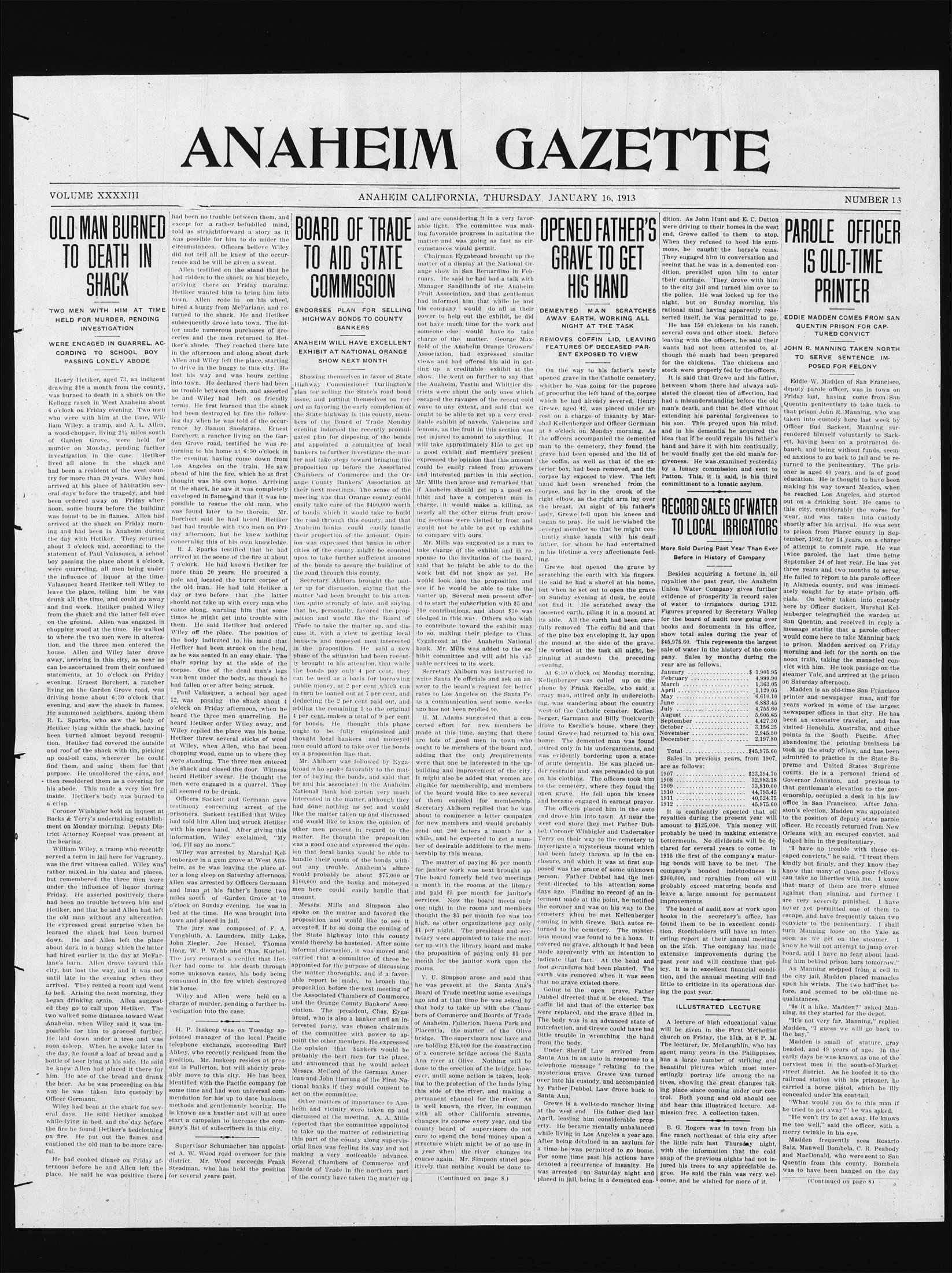
Searchable text
OLD MAN BURNED TO DEATH IN SHACK
TWO MEN WITH HIM AT TIME HELD FOR MURDER, PENDING INVESTIGATION
WERE ENGAGED IN QUARREL, ACCORDING TO SCHOOL BOY PASSING LONELY ABODE
Henry Hetiker, aged 73, an indigent drawing $10 a month from the county, was burned to death in a shack on the Kellogg ranch in West Anaheim about 6 o'clock on Friday evening. Two men who were with him at the time, William Wiley, a tramp, and A. L. Allen, a wood-chopper, living 2½ miles south of Garden Grove, were held for murder on Monday, pending further investigation in the case. Hetiker lived all alone in the shack and had been a resident of the west coun-
had been no trouble between them, and except for a rather befuddled mind, told as straightforward a story as it was possible for him to do under the circumstances. Officers believe Wiley did not tell all he knew of the occurrence and he will be given a sweat.
Allen testified on the stand that he had ridden to the shack on his bicycle, arriving there on Friday morning. Hetiker wanted him to bring him into town. Allen rode in on his wheel, hired a buggy from McFarlane, and returned to the shack. He and Hetiker subsequently drove into town. The latter made numerous purchases of groceries and the men returned to Hetiker's abode. They reached there late in the afternoon and along about dark Allen and Wiley left the place, starting to drive in the buggy to this city. He lost his way and was hours getting into town. He declared there had been no trouble between them, and asserted he and Wiley had left on friendly terms. He first learned that the shack had been destroyed by fire the following day when he was told of the occurrence by Damon Snodgrass. Ernest Borchert, a rancher living on the Garden Grove road, testified he was returning to his home at 6:30 o'clock in the evening, having come down from Los Angeles on the train. He saw ahead of him the fire, which he at first
Henry Hetiker, aged 73, an indigent drawing $10 a month from the county, was burned to death in a shack on the Kellogg ranch in West Anaheim about 6 o'clock on Friday evening. Two men who were with him at the time, William Wiley, a tramp, and A. L. Allen, a wood-chopper, living 2½ miles south of Garden Grove, were held for murder on Monday, pending further investigation in the case. Hetiker lived all alone in the shack and had been a resident of the west country for more than 20 years. Wiley had arrived at his place of habitation several days before the tragedy, and had been ordered away on Friday afternoon, some hours before the building was found to be in flames. Allen had arrived at the shack on Friday morning and had been in Anaheim during the day with Hetiker. They returned about 3 o'clock and, according to the statement of Paul Valasquez, a school boy passing the place about 4 o'clock, were quarreling, all men being under the influence of liquor at the time. Valasquez heard Hetiker tell Wiley to leave the place, telling him he was drunk all the time, and could go away and find work. Hetiker pushed Wiley from the shack and the latter fell over on the ground. Allen was engaged in chopping wood at the time. He walked to where the two men were in altercation, and the three men entered the house. Allen and Wiley later drove away, arriving in this city, as near as can be ascertained from their confused statements, at 10 o'clock on Friday evening. Ernest Borchert, a rancher living on the Garden Grove road, was driving home about 6:30 o'clock that evening, and saw the shack in flames. He summoned neighbors, among them R. L. Sparks, who saw the body of Hetiker lying within the shack, having been burned almost beyond recognition. Hetiker had covered the outside and roof of the shack with tin, picking up coal-oil cans, wherever he could find them, and using them for that purpose. He unsoldered the cans, and then resoldered them as a covering for his abode. This made a very hot fire inside. Hetiker's body was burned to a crisp.
Coroner Winbigler held an inquest at Backs & Terry’s undertaking establishment on Monday morning. Deputy District Attorney Koepsel was present at the hearing.
William Wiley, a tramp who recently served a term in jail here for vagrancy, was the first witness called. Wiley was rather mixed in his dates and places, but remembered the three men were under the influence of liquor during Friday. He asserted positively there lost his way and was hours getting into town. He declared there had been no trouble between them, and asserted he and Wiley had left on friendly terms. He first learned that the shack had been destroyed by fire the following day when he was told of the occurrence by Damon Snodgrass. Ernest Borchert, a rancher living on the Garden Grove road, testified he was returning to his home at 6:30 o'clock in the evening, having come down from Los Angeles on the train. He saw ahead of him the fire, which he at first thought was his own home. Arriving at the shack, he saw it was completely enveloped in flames and that it was impossible to rescue the old man, who was found later to be therein. Mr. Borchert said he had heard Hetiker had had trouble with two men on Friday afternoon, but he knew nothing concerning this of his own knowledge.
R. J. Sparks testified that he had arrived at the scene of the fire at about 7 o'clock. He had known Hetiker for more than 20 years. He procured a pole and located the burnt corpse of the old man. He had told Hetiker a day or two before that the latter should not take up with every man who came along, warning him that some times he might get into trouble with them. He said Hetiker had ordered Wiley off the place. The position of the body indicated to his mind that Hetiker had been struck on the head, as he was seated in an easy chair. The chair spring lay at the side of the corpse. One of the dead man’s legs was hent under the body, as though he had fallen over after being struck.
Paul Valasquez, a school boy aged 12, was passing the shack about 4 o'clock on Friday afternoon, when he heard the three men quarreling. He heard Hetiker order Wiley away, and Wiley replied the place was his home. Hetiker threw several sticks of wood at Wiley, when Allen, who had been chopping wood, came up to where they were standing. The three men entered the shack and closed the door. Witness heard Hetiker swear. He thought the men were engaged in a quarrel. They all seemed to be drunk.
Officers Sackett and Germann gave testimony concerning arrest of the prisoners. Sackett testified that Wiley had told him Allen had struck Hetiker with his open hand. After giving this information, Wiley exclaimed, "My God, I’ll say no more."
Wiley was arrested by Marshal Kellenberger in a gum grove at West Anaheim, as he was leaving the place after a long sleep on Saturday afternoon. Allen was arrested by Officers Germann and Iman at his father’s house two miles south of Garden Grove at 10
Showing themselves Highway Commission plan for selling the issue, and putting to order as favoring the State highway in bers of the Board evening indorsed their gated plan for disposal and appointed a bankers to further interest and take steps to proposition up before Chambers of Commerce range County Banker their next meetings; meeting was that Orden easily take care of bonds which it wished the road through this Anaheim banks cover their proportion of ion was expressed their cities of the county upon to take further of the bonds to assure road through this Secretary Ahlbornter up for discussion matter had been broken quite strongly out that he personally posited and would trade to take the mcuss it, with a view bankers and moneymen in the proposition phase of the situation brought to his attention the bonds pay only can be used as a ba public money, at 2 p.m turn be loaned out deducting the 2 per cent adding the remaining 4 per cent makes a for bonds. He thought ought to be fully thought local bankers men could afford to take on a proposition like Mr. Ahlborn was broad who spoke favorite of buying the book he and his associates National Bank had interested in the matter had done nothing aside like the matter taken and would like to know other men present matter. He thought was a good one and envision that local banks handle their quota out any trouble would probably be $100,000 and the bank men here could earn amount.
Coroner Winbigler held an inquest at Backs & Terry’s undertaking establishment on Monday morning. Deputy District Attorney Koepsel was present at the hearing.
William Wiley, a tramp who recently served a term in jail here for vagrancy, was the first witness called. Wiley was rather mixed in his dates and places, but remembered the three men were under the influence of liquor during Friday. He asserted positively there had been no trouble between him and Hetiker, and that he and Allen had left the old man without any altercation. He expressed great surprise when he learned the shack had been burned down. He and Allen left the place about dark in a buggy which the latter had hired earlier in the day at McFarlane’s barn. Allen drove toward this city, but lost the way, and it was not until late in the evening when they arrived. They rented a room and went to bed. Arising the next morning, they began drinking again. Allen suggested they go to call upon Hetiker. The two walked some distance toward West Anaheim, when Wiley said it was impossible for him to proceed further. He laid down under a tree and was soon asleep. When he awoke later in the day, he found a loaf of bread and a bottle of beer lying at his side. He said he knew Allen had placed it there for him. He ate of the bread and drank the beer. As he was proceeding on his way he was taken into custody by Officer Germann.
Wiley had been at the shack for several days. He said Hetiker smoked while lying in bed, and the day before the fire he found Hetiker’s bedclothing on fire. He put out the flames and cautioned the old man to be more careful.
He had cooked dinner on Friday afternoon before he and Allen left the place. He said he was positive there testimony concerning arrest of the prisoners. Sackett testified that Wiley had told him Allen had struck Hetiker with his open hand. After giving this information, Wiley exclaimed, “My God, I’ll say no more.”
Wiley was arrested by Marshal Kellenberger in a gum grove at West Anaheim, as he was leaving the place after a long sleep on Saturday afternoon. Allen was arrested by Officers Germann and Iman at his father’s house two miles south of Garden Grove at 10 o’clock on Sunday evening. He was in bed at the time. He was brought into town and placed in jail.
The jury was composed of F. A. Yungbluth, A. Launders, Billy Lake, John Ziegler, Joe Hessel, Thomas Hoag, W. P. Webb and Chas. Kuchel. The jury returned a verdict that Hetiker had come to his death through some unknown cause, his body being consumed in the fire which destroyed his home.
Wiley and Allen were held on a charge of murder, pending a further investigation into the case.
H. P. Inskeep was on Tuesday appointed manager of the local Pacific telephone exchange, succeeding Earl Abbey, who recently resigned from the position. Mr. Inskeep resides at present in Fullerton, but will shortly probably move to this city. He has been identified with the Pacific company for some time and had won universal commendation for his up to date business methods and gentlemanly bearing. He is known as a hustler and will at once start a campaign to increase the company’s list of subscribers in this city.
Supervisor Schumacher has appointed A. W. Wood road overseer for this district. Mr. Wood succeeds Frank Steadman, who has held the position for several years past.
Interests: In the matter of doing nothing else like the matter taken care of would like to know other men present at the matter. He thought that was a good one and envisioned that local banks handle their quota out any trouble. Would probably be $100,000 and the bank men here could even amount.
Messrs. Mills and spoke on the matter proposition and would accepted, if by so doing the State highway would thereby be hastened informal discussion carried that a committee appointed for the purge the matter thorough able report be made proposition before the Associated Chamber and the Orange County Association. The president broad, who is also a interested party, was of the committee who point the other member the opinion that he probably the best man and announced that Messrs. McCord of theican and John Harturional banks if they act on the committee.
Other matters of interest inheim and vicinity were discussed at the meeting reported that the committee took up the matter this part of the countyorial lines was feeling making a very noteworthy Several Chambers or Boards of Trade in of the county have taken
ANAHEIM GAZETE
ANAHEIM CALIFORNIA, THURSDAY, JANUARY 16, 1913
BOARD OF TRADE TO AID STATE COMMISSION
ENDORSES PLAN FOR SELLING HIGHWAY BONDS TO COUNTY BANKERS
ANAHEIM WILL HAVE EXCELLENT EXHIBIT AT NATIONAL ORANGE SHOW NEXT MONTH
Showing themselves in favor of State Highway Commissioner Darlington's plan for selling the State's road bond issue, and putting themselves on record as favoring the early completion of the State highway in this county, members of the Board of Trade Monday evening indorsed the recently promulgated plan for disposing of the bonds and appointed a committee of local bankers to further investigate the matter and take steps toward bringing the proposition up before the Associated Chambers of Commerce and the Or.
and are considering it in a very favorable light. The committee was making favorable progress in agitating the matter and was going as fast as circumstances would permit.
Chairman Eygabroad brought up the matter of a display at the National Orange show in San Bernardino in February. He said he had had a talk with Manager Sandilands of the Anaheim Fruit Association, and that gentleman had informed him that while he and his company would do all in their power to help out the exhibit, he did not have much time for the work and someone else would have to take charge of the matter. George Maxfield of the Anaheim Orange Growers' Association, had expressed similar views and had offered his aid in getting up a creditable exhibit at the show. He went on further to say that the Anaheim, Tustin and Whittier districts were about the only ones which escaped the ravages of the recent cold wave to any extent, and said that we ought to be able to get up a very credible exhibit of navels, Valencias and lemons, as the fruit in this section was not injured to amount to anything. It will take approximately $150 to get up a good exhibit and members present expressed the opinion that this amount could be easily raised from growers and interested parties in this section.
OPENED FATHER'S GRAVE TO GET HIS HAND
DEMENTED MAN SCRATCHES AWAY EARTH, WORKING ALL NIGHT AT THE TASK
REMOVES COFFIN LID, LEAVING FEATURES OF DECEASED PAR-ENT EXPOSED TO VIEW
On the way to his father's newly opened grave in the Catholic cemetery, whether he was going for the purpose of procuring the left hand of the corpse which he had already severed, Henry Grewe, aged 42, was placed under arrest on a charge of insanity by Marshal Kellenberger and Officer Germann at 8 o'clock on Monday morning. As the officers accompanied the demented man to the cemetery, they found the grave had been opened and the lid of the coffin, as well as that of the exterior box, had been removed, and the
Showing themselves in favor of State Highway Commissioner Darlington's plan for selling the State's road bond issue, and putting themselves on record as favoring the early completion of the State highway in this county, members of the Board of Trade Monday evening indorsed the recently promulgated plan for disposing of the bonds and appointed a committee of local bankers to further investigate the matter and take steps toward bringing the proposition up before the Associated Chambers of Commerce and the Orange County Bankers' Association at their next meetings. The sense of the meeting was that Orange county could easily take care of the $400,000 worth of bonds which it would take to build the road through this county, and that Anaheim banks could easily handle their proportion of the amount. Opinion was expressed that banks in other cities of the county might be counted upon to take further sufficient amount of the bonds to assure the building of the road through this county.
Secretary Ahlborn brought the matter up for discussion, saying that the matter had been brought to his attention quite strongly of late, and saying that he, personally, favored the proposition and would like the Board of Trade to take the matter up, and discuss it, with a view to getting local bankers and moneyed men interested in the proposition. He said a new phase of the situation had been recently brought to his attention, that while the bonds pay only 4 per cent, they can be used as a basis for borrowing public money, at 2 per cent which can in turn be loaned out at 7 per cent, and deducting the 2 per cent paid out, and adding the remaining 5 to the original 4 per cent, makes a total of 9 per cent for bonds. He thought this phase ought to be fully emphasized and thought local bankers and moneyed men could afford to take over the bonds on a proposition like that.
Mr. Ahlborn was followed by Eygabroad who spoke favorably to the matter of buying the bonds, and said that he and his associates in the Anaheim National Bank had gotten very much interested in the matter, although they had done nothing as yet and would like the matter taken up and discussed and would like to know the opinion of other men present in regard to the matter. He thought the proposition was a good one and expressed the opinion that local banks would be able to handle their quota of the bonds without any trouble. Anaheim's share would probably be about $75,000 or $100,000 and the banks and moneyed men here could easily handle that amount.
He went on further to say that the Anaheim, Tustin and Whittier districts were about the only ones which escaped the ravages of the recent cold wave to any extent, and said that we ought to be able to get up a very credible exhibit of navels, Valencias and lemons, as the fruit in this section was not injured to amount to anything. It will take approximately $150 to get up a good exhibit and members present expressed the opinion that this amount could be easily raised from growers and interested parties in this section. Mr. Mills then arose and remarked that if Anaheim should get up a good exhibit and have a competent man in charge, it would make a killing, as nearly all the other citrus fruit growing sections were visited by frost and would not be able to get up exhibits to compare with ours.
Mr. Mills was suggested as a man to take charge of the exhibit and in response to the invitation of the board, said that he might be able to do the work but did not know as yet. He would look into the proposition and see if he would be able to take the matter up. Several men present offered to start the subscription with $5 and $10 contributions, and about $30 was pledged in this way. Others who wish to contribute toward the exhibit may do so, making their pledge to Chas. Eygabroad at the Anaheim National bank. Mr. Mills was added to the exhibit committee and will add his valuable services to its work.
Secretary Ahlborn was instructed to write Santa Fe officials and ask an answer to the board's request for better rates to Los Angeles on the Santa Fe, as a communication sent some weeks ago has not been replied to.
H. M. Adams suggested that a concerted effort for new members be made at this time, saying that there are lots of good men in town who ought to be members of the board and, adding that the only requirements were that one be interested in the upbuilding and improvement of the city. It might also be added that women are eligible for membership, and members of the board would like to see several of them enrolled for membership. Secretary Ahlborn replied that he was about to commence a letter campaign for new members and would probably send out 200 letters a month for a while, and he expected to get a number of desirable additions to the membership by this means.
The matter of paying $5 per month for janitor work was next brought up. The board formerly held two meetings a month in the rooms at the library and paid $5 per month for janitor's services. Now the board meets annually.
opened grave in the Catholic cemetery, whither he was going for the puprose of procuring the left hand of the corpse which he had already severed, Henry Grewe, aged 42, was placed under arrest on a charge of insanity by Marshal Kellenberger and Officer Germann at 8 o'clock on Monday morning. As the officers accompanied the demented man to the cemetery, they found the grave had been opened and the lid of the coffin, as well as that of the exterior box, had been removed, and the corpse lay exposed to view. The left hand had been wrenched from the corpse, and lay in the crook of the right elbow, as the right arm lay over the breast. At sight of his father's body, Grewe fell upon his knees and began to pray. He said he wished the severed member so that he might constantly shake hands with his dead father, for whom he had entertained in his lifetime a very affectionate feeling.
Grewe had opened the grave by scratching the earth with his fingers. He said he had a shovel at his home, but when he set out to open the grave on Sunday evening at dusk, he could not find it. He scratched away the loosened earth, piling it in a mound at its side. All the earth had been carefully removed. The coffin lid and that of the pine box enveloping it, lay upon the mound at the side of the grave. He worked at the task all night, beginning at sundown the preceding evening.
At 6:30 o'clock on Monday morning, Kellenberger was called up on the phone by Frank Escalle, who said a crazy man, attired only in underclothing, was wandering about the country west of the Catholic cemetery. Kellenberger, Garmann and Billy Duckworth drove to Escalle's house, where they found Grewe had returned to his own home. The demented man was found attired only in his undergarments, and was evidently bordering upon a state of acute dementia. He was placed under restraint and was persuaded to put on his clothing. The officers took him to the cemetery, where they found the open grave. He fell upon his knees and became engaged in earnest prayer.
The officers placed him in the auto and drove him into town. At near the west end store they met Father Dubbel, Coroner Winbigler and Undertaker Terry on their way to the cemetery to investigate a mysterious mound which had been lately thrown up in the enclosure, and which it was at first supposed was the grave of some unknown person. Father Dubbel had the incident directed to his attention some days ago. Finding no record of an interment made at the point he notified
interested in the matter, although they had done nothing as yet and would like the matter taken up and discussed and would like to know the opinion of other men present in regard to the matter. He thought the proposition was a good one and expressed the opinion that local banks would be able to handle their quota of the bonds without any trouble. Anaheim's share would probably be about $75,000 or $100,000 and the banks and moneyed men here could easily handle that amount.
Messrs. Mills and Simpson also spoke on the matter and favored the proposition and would like to see it accepted, if by so doing the coming of the State highway into this county would thereby be hastened. After some informal discussion, it was moved and carried that a committee of three be appointed for the purpose of discussing the matter thoroughly, and if a favorable report be made, to broach the proposition before the next meeting of the Associated Chambers of Commerce and the Orange County Bankers' Association. The president, Chas. Eygabroad, who is also a banker and an interested party, was chosen chairman of the committee with power to appoint the other members. He expressed the opinion that bankers would be probably the best men for the place, and announced that he would select Messrs. McCord of the German American and John Hartung of the First National banks if they would consent to act on the committee.
Other matters of importance to Anaheim and vicinity were taken up and discussed at the meeting. A. A. Mills reported that the committee appointed to take up the matter of redistricting this part of the county along supervisorial lines was feeling its way and not making a very noticeable advance. Several Chambers of Commerce and Boards of Trade in the northern part of the county have taken the matter up of them enrolled for membership. Secretary Ahlborn replied that he was about to commence a letter campaign for new members and would probably send out 200 letters a month for a while, and he expected to get a number of desirable additions to the membership by this means.
The matter of paying $5 per month for janitor work was next brought up. The board formerly held two meetings a month in the rooms at the library and paid $5 per month for janitor's services. Now the board meets only one night in the rooms and members thought the $5 per month fee was too high, as other organizations pay only $1 per night. The president and secretary were appointed to take the matter up with the library board and make the proposition of paying only $1 per month for the janitor work upon the rooms.
V. U. Simpson arose and said that he was present at the Santa Ana's Board of Trade meeting some evenings ago and at that time he was asked by that body to take up with the Chambers of Commerce and Boards of Trade of Anaheim, Fullerton, Buena Park and Placentia, the matter of the Olive bridge. The supervisors now have and are holding $35,000 for the construction of a concrete bridge across the Santa Ana river at Olive. Nothing will be done to the erection of the bridge, however, until some action is taken, looking to the protection of the lands lying this side of the river, and making a permanent channel for the river. As is well known, the river, in common with all other California streams, changes its course every year, and the county board of supervisors do not care to spend the bond money upon a structure which might be of no use in a year when the river changes its course again. Mr. Simpson stated positively that nothing would be done to
(Continued on page 8.)
ZETTE
JULY 16, 1913
NUMBER 13
FATHER'S
TO GET
HAND
AN SCRATCHES
WORKING ALL
THE TASK
IN LID, LEAVING
DECEASED PARLED TO VIEW
his father's newly
the Catholic cemetery,
being for the puprose
t hand of the corpse
ady severed, Henry
was placed under art of insanity by Marand Officer Germann
monday morning. As
manied the demented
ery, they found the
rened and the lid of
as that of the exremoved, and the
dition. As John Hunt and E. C. Dutton
were driving to their homes in the west
end, Grewe called to them to stop.
When they refused to heed his summons, he caught the horse's reins.
They engaged him in conversation and seeing that he was in a demented condition, prevailed upon him to enter their carriage. They drove with him to the city jail and turned him over to the police. He was locked up for the night, but on Sunday morning, his rational mind having apparently reasserted itself, he was permitted to go.
He has 150 chickens on his ranch, several cows and other stock. Before leaving with the officers, he said their wants had not been attended to, although the mash had been prepared for the chickens. The chickens and stock were properly fed by the officers.
It is said that Grewe and his father, between whom there had always subsisted the closest ties of affection, had had a misunderstanding before the old man's death, and that he died without extending his parental forgiveness to his son. This preyed upon his mind, and in his dementia he acquired the idea that if he could regain his father's hand and have it with him continually, he would finally get the old man's forgiveness. He was examined yesterday by a lunacy commission and sent to
PAROLE OFFICER
IS OLD-TIME PRINTER
EDDIE MADDEN COMES FROM SAN QUENTIN PRISON FOR CAPTURED CONVICT
JOHN R. MANNING TAKEN NORTH TO SERVE SENTENCE IMPOSED FOR FELONY
Eddie W. Madden of San Francisco, deputy parole officer, was in town on Friday last, having come from San Quentin penitentiary to take back to that prison John R. Manning, who was taken into custody here last week by Officer Bud Sackett. Manning surrendered himself voluntarily to Sackett, having been on a protracted debauch, and being without funds, seemed anxious to go back to jail and be returned to the penitentiary. The prisoner is aged 40 years, and is of good
It is said that Grewe and his father, between whom there had always subsisted the closest ties of affection, had had a misunderstanding before the old man's death, and that he died without extending his parental forgiveness to his son. This preyed upon his mind, and in his dementia he acquired the idea that if he could regain his father's hand and have it with him continually, he would finally get the old man's forgiveness. He was examined yesterday by a lunacy commission and sent to Patton. This, it is said, is his third commitment to a lunatic asylum.
RECORD SALES OF WATER TO LOCAL IRRIGATORS
More Sold During Past Year Than Ever Before in History of Company
Besides acquiring a fortune in oil royalties the past year, the Anaheim Union Water Company gives further evidence of prosperity in record sales of water to irrigators during 1912. Figures prepared by Secretary Wallop for the board of audit now going over books and documents in his office, show total sales during the year of $45,975.60. This represents the largest sale of water in the history of the company. Sales by months during the year are as follows:
January ... $1,901.95
February ... $4,999.90
March ... $1,363.05
April ... $1,129.05
May ... $6,610.10
June ... $6,883.45
July ... $4,755.60
August ... $5,605.65
September ... $4,427.30
October ... $3,156.25
November ... $2,945.50
December ... $2,197.80
Total ... $45,975.60
Sales in previous years, from 1907, are as follows:
1907 ... $23,394.70
1908 ... $32,983.18
1909 ... $33,810.00
1910 ... $44,793.45
1911 ... $40,524.75
1912 ... $45,975.60
It is confidently expected that oil royalties during the present year will amount to $125,000. This money will probably be used in making extensive betterments. No dividends will be declared for several years to come. In 1915 the first of the company's maturing bonds will have to be met. The company's bonded indebtedness is $300,000, and royalties from oil will probably exceed maturing bonds and leave a large amount for permanent Eddie W. Madden of San Francisco, deputy parole officer, was in town on Friday last, having come from San Quentin penitentiary to take back to that prison John R. Manning, who was taken into custody here last week by Officer Bud Sackett. Manning surrendered himself voluntarily to Sackett, having been on a protracted debauch, and being without funds, seemed anxious to go back to jail and be returned to the penitentiary. The prisoner is aged 40 years, and is of good education. He is thought to have been making his way toward Mexico, when he reached Los Angeles, and started out on a drinking bout. He came to this city, considerably the worse for wear, and was taken into custody shortly after his arrival. He was sent to prison from Placer county in September, 1902, for 14 years, on a charge of attempt to commit rape. He was twice paroled, the last time being September 24 of last year. He has yet three years and two months to serve. He failed to report to his parole officer in Alameda county, and was immediately sought for by state prison officials. On being taken into custody here by Officer Sackett, Marshal Kellenberger telegraphed the warden at San Quentin, and received in reply a message stating that a parole officer would come here to take Manning back to prison. Madden arrived on Friday morning and left for the north on the noon train, taking the manacled convict with him. He took passage on the steamer Yale, and arrived at the prison on Saturday afternoon.
Madden is an old-time San Francisco printer and newspaper man, and for years worked in some of the largest newspaper offices in that city. He has been an extensive traveler, and has visited Honolulu, Australia, and other points in the South Pacific. After abandoning the printing business he took up the study of law, and has been admitted to practice in the State Supreme courts. He is a personal friend of Governor Johnston, and previous to that gentleman's elevation to the governorship, occupied a desk in his law office in San Francisco. After Johnston's election, Madden was appointed to the position of deputy state parole officer. He recently returned from New Orleans with an escaped convict, and lodged him in the penitentiary.
"I have no trouble with these escaped convicts," he said. "I treat them kindly but firmly, and they know they know that many of these poor fellows can take no liberties with me. I know that many of them are more sinned against than sinning, and further I..."
It is confidently expected that oil royalties during the present year will amount to $125,000. This money will probably be used in making extensive betterments. No dividends will be declared for several years to come. In 1915 the first of the company's maturing bonds will have to be met. The company's bonded indebtedness is $300,000, and royalties from oil will probably exceed maturing bonds and leave a large amount for permanent improvements.
The board of audit now at work upon books in the secretary's office, has found them to be in excellent condition. Stockholders will have an interesting report at their annual meeting on the 25th. The company has made extensive improvements during the past year and will continue that policy. It is in excellent financial condition, and the annual meeting will find little to criticize in its operations during the past year.
ILLUSTRATED LECTURE
A lecture of high educational value will be given in the First Methodist church on Friday, the 17th, at 8 P. M. The lecturer, Dr. McLaughlin, who has spent many years in the Philippines, has a large number of striking and beautiful pictures which most interestingly portray life among the natives, showing the great changes taking place since coming under our control. Both young and old should see and hear this illustrated lecture. Admission free. A collection taken.
B. G. Rogers was in town from his fine ranch northeast of this city after the little rain last Thursday night, with the information that the cold snap of the previous nights had not injured his trees to any appreciable degree. He said the rain was very welcome, and he wished for more of it.
Madden was appointed to the position of deputy state parole officer. He recently returned from New Orleans with an escaped convict, and lodged him in the penitentiary.
"I have no trouble with these escaped convicts," he said. "I treat them kindly but firmly, and they know they know that many of these poor fellows can take no liberties with me. I know that many of them are more sinned against than sinning, and further I are very severely punished. I have never yet permitted one of them to escape, and have frequently taken two convicts to the penitentiary. I shall turn Manning loose on the Yale as soon as we get on the steamer. I know he will not attempt to jump overboard, and I have no fear about landing him behind prison bars tomorrow."
As Manning stepped from a cell in the city jail, Madden placed manacles upon his wrists. The two had met before, and seemed to be old-time acquaintances.
"Is it a hike, Madden?" asked Manning, as they started for the depot.
"It's not very far, Manning," replied Madden, "I guess we will go back to the bay."
Madden is small of stature, gray headed, and 49 years of age. In the early days he was known as one of the nerviest men in the south-of-Market-street district. As he hoofed it to the railroad station with his prisoner, he carried a horse pistol, which he ill concealed under his coat-tail.
“What would you do to this man if he tried to get away?” he was asked.
“他 won't try to get away. He knows me too well,” said the officer, with a merry twinkle in his eye.
Madden frequently sees Rosario Saiz, Manwell Bombela, C. R. Peabody and MacDonald, who were sent to San Quentin from this county. Bombela was to have been hanged on the day office in San Francisco. After Johnston's election, Madden was appointed to the position of deputy state parole officer. He recently returned from New Orleans with an escaped convict, and lodged him in the penitentiary.
"It have no trouble with these escaped convicts," he said. "I treat them kindly but firmly, and they know they know that many of these poor fellows can take no liberties with me. I know that many of them are more sinned against than sinning, and further I are very severely punished. I have never yet permitted one of them to escape, and have frequently taken two convicts to the penitentiary. I shall turn Manning loose on the Yale as soon as we get on the steamer. I know he will not attempt to jump overboard, and I have no fear about landing him behind prison bars tomorrow."
As Manning stepped from a cell in the city jail, Madden placed manacles upon his wrists. The two had met before, and seemed to be old-time acquaintances.
"Is it a hike, Madden?" asked Manning, as they started for the depot.
"It's not very far, Manning," replied Madden, "I guess we will go back to the bay."
Madden is small of stature, gray headed, and 49 years of age. In the early days he was known as one of the nerviest men in the south-of-Market-street district. As he hoofed it to the railroad station with his prisoner, he carried a horse pistol, which he ill concealed under his coat-tail.
“What would you do to this man if he tried to get away?” he was asked.
“他 won't try to get away. He knows me too well,” said the officer, with a merry twinkle in his eye.
Madden frequently sees Rosario Saiz, Manwell Bombela, C. R. Peabody and MacDonald, who were sent to San Quentin from this county. Bombela was to have been hanged on the day (Continued on page 8)