anaheim-gazette 1913-01-09
Scanned page
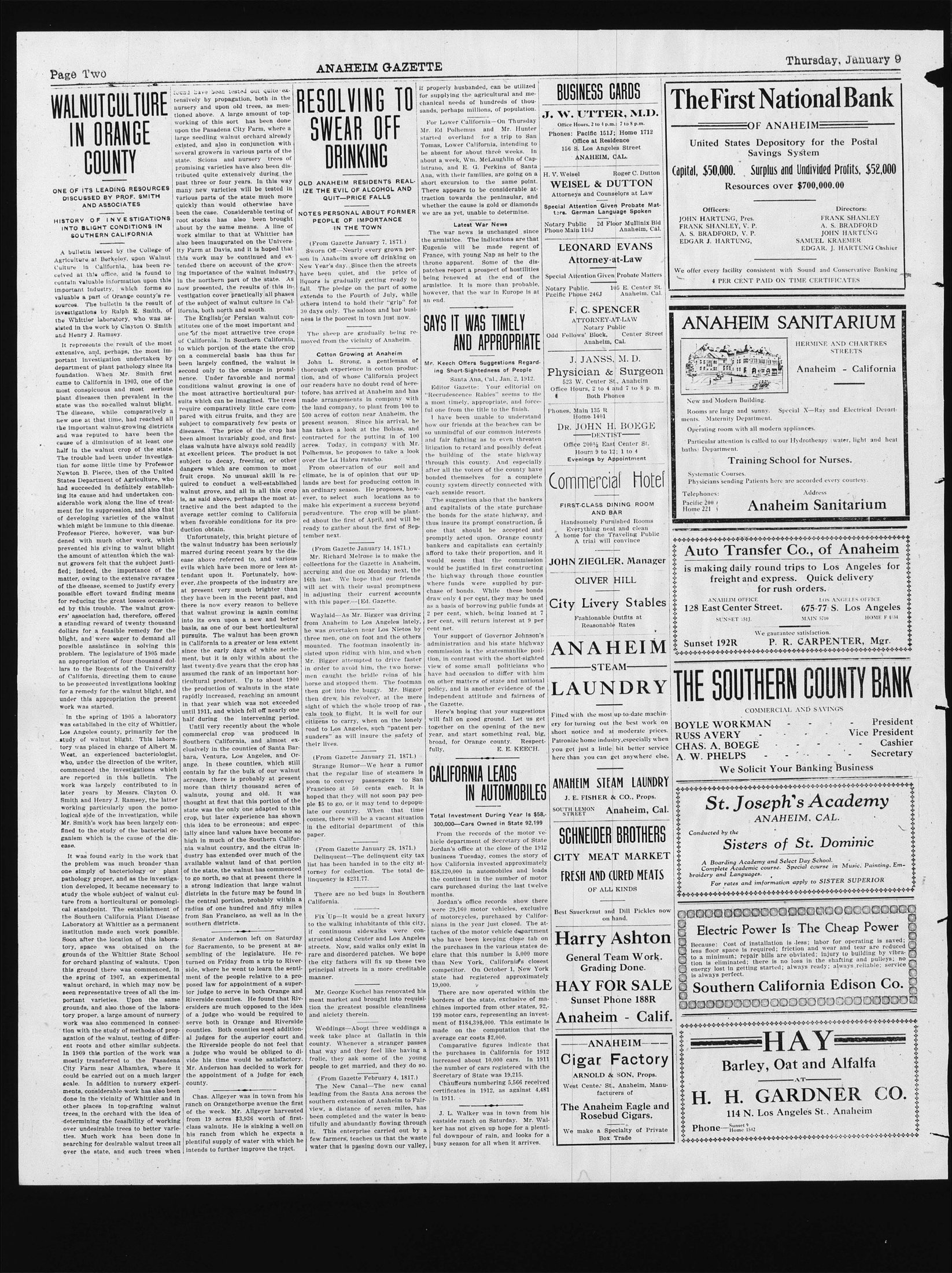
Searchable text
WALNUTCULTURE IN ORANGE COUNTY
ONE OF ITS LEADING RESOURCES DISCUSSED BY PROF. SMITH AND ASSOCIATES
HISTORY OF INVESTIGATIONS INTO BLIGHT CONDITIONS IN SOUTHERN CALIFORNIA
A bulletin issued by the College of Agriculture at Berkeley, upon Walnut Culture in California, has been received at this office, and is found to contain valuable information upon this important industry, which forms so valuable a part of Orange county's resources. The bulletin is the result of investigations by Ralph E. Smith, of the Whittier laboratory, who was assisted in the work by Clayton O. Smith and Henry J. Ramsey.
It represents the result of the most extensive, and, perhaps, the most important investigation undertaken by department of plant pathology since its foundation. When Mr. Smith first came to California in 1903, one of the most conspicuous and most serious plant diseases then prevalent in the state was the so-called walnut blight. The disease, while comparatively a new one at that time, had reached all the important walnut-growing districts and was reputed to have been the cause of a diminution of at least one half in the walnut crop of the state. The trouble had been under investigation for some little time by Professor Newton B. Pierce, then of the United States have been tested out quite extensively by propagation, both in the nursery and upon old trees, as mentioned above. A large amount of top-working of this sort has been done upon the Pasadena City Farm, where a large seedling walnut orchard already existed, and also in conjunction with several growers in various parts of the state. Scions and nursery trees of promising varieties have also been distributed quite extensively during the past three or four years. In this way many new varieties will be tested in various parts of the state much more quickly than would otherwise have been the case. Considerable testing of root stocks has also been brought about by the same means. A line of work similar to that at Whittier has also been inaugurated on the University Farm at Davis, and it is hoped that this work may be continued and extended there on account of the growing importance of the walnut industry in the northern part of the state. As now presented, the results of this investigation cover practically all phases of the subject of walnut culture in California, both north and south.
The English or Persian walnut constitutes one of the most important and one of the most attractive tree crops of California. In Southern California, to which portion of the state the crop on a commercial basis has thus far been largely confined, the walnut is second only to the orange in prominence. Under favorable and normal conditions walnut growing is one of the most attractive horticultural pursuits which can be imagined. The trees require comparatively little care compared with citrus fruits, and they are subject to comparatively few pests or diseases. The price of the crop has been almost invariably good, and first-class walnuts have always sold readily at excellent prices. The product is not subject to decay, freezing, or other dangers which are common to most fruit trees. No unusual skill is required.
RESOLVE SWEAR DRINK
OLD ANAHEIM PRESS THE EVIL OF QUIT—PRINT NOTES PERSONAL PEOPLE OF IN THE
(From Gazette)
Sworn Off—Near son in Anaheim swine New Year's day. Sworn have been quiet, liquors is gradually fall. The pledge extends to the For others intend to live 30 days only. Theness is the poorest.
The sheep are moved from the vicinity.
Cotton Grower
John L. Strong thorough experience, and of whose readers have retofore, has arrived made arrangement for the land company 500 acres of cotton present season. Has taken a look contracted for these acres. Today, in Polhemus, he provover the La Habra From observati
When Mr. Smith first came to California in 1903, one of the most conspicuous and most serious plant diseases then prevalent in the state was the so-called walnut blight. The disease, while comparatively a new one at that time, had reached all the important walnut-growing districts and was reputed to have been the cause of a diminution of at least one half in the walnut crop of the state. The trouble had been under investigation for some little time by Professor Newton B. Pierce, then of the United States Department of Agriculture, who had succeeded in definitely establishing its cause and had undertaken considerable work along the line of treatment for its suppression, and also that of developing varieties of the walnut which might be immune to this disease. Professor Pierce, however, was burdened with much other work, which prevented his giving to walnut blight the amount of attention which the walnut growers felt that the subject justified; indeed, the importance of the matter, owing to the extensive ravages of the disease, seemed to justify every possible effort toward finding means for reducing the great losses occasioned by this trouble. The walnut growers' association had, therefore, offered a standing reward of twenty thousand dollars for a feasible remedy for the blight, and were eager to demand all possible assistance in solving this problem. The legislature of 1905 made an appropriation of four thousand dollars to the Regents of the University of California, directing them to cause to be prosecuted investigations looking for a remedy for the walnut blight, and under this appropriation the present work was started.
In the spring of 1905 a laboratory was established in the city of Whittier, Los Angeles county, primarily for the study of walnut blight. This laboratory was placed in charge of Albert M. West, an experienced bacteriologist, who, under the direction of the writer, commenced the investigations which are reported in this bulletin. The work was largely contributed to in later years by Messrs. Clayton O. Smith and Henry J. Ramsey, the latter working particularly upon the pomological side of the investigation, while Mr. Smith's work has been largely confined to the study of the bacterial organism which is the cause of the disease.
It was found early in the work that the problem was much broader than one simply of bacteriology or plant pathology proper, and as the investigation developed, it became necessary to study the whole subject of walnut cul-
Under favorable and normal conditions walnut growing is one of the most attractive horticultural pursuits which can be imagined. The trees require comparatively little care compared with citrus fruits, and they are subject to comparatively few pests or diseases. The price of the crop has been almost invariably good, and first-class walnuts have always sold readily at excellent prices. The product is not subject to decay, freezing, or other dangers which are common to most fruit crops. No unusual skill is required to conduct a well-established walnut grove, and all in all this crop is, as said above, perhaps the most attractive and the best adapted to the average settler coming to California when favorable conditions for its production obtain.
Unfortunately, this bright picture of the walnut industry has been seriously marred during recent years by the disease above referred to, and various evils which have been more or less attendant upon it. Fortunately, however, the prospects of the industry are at present very much brighter than they have been in the recent past, and there is now every reason to believe that walnut growing is again coming into its own upon a new and better basis, as one of our best horticultural pursuits. The walnut has been grown in California to a greater or less extent since the early days of white settlement, but it is only within about the last twenty-five years that the crop has assumed the rank of an important horticultural product. Up to about 1900 the production of walnuts in the state rapidly increased, reaching an amount in that year which was not exceeded until 1911, and which fell off nearly one half during the intervening period.
Until very recently about the whole commercial crop was produced in Southern California, and almost exclusively in the counties of Santa Barbara, Ventura, Los Angeles, and Orange. In these counties, which still contain by far the bulk of our walnut acreage, there is probably at present more than thirty thousand acres of walnuts, young and old. It was thought at first that this portion of the state was the only one adapted to this crop, but later experience has shown this idea to be erroneous; and especially since land values have become so high in much of the Southern California walnut country, and the citrus industry has extended over much of the available walnut land of that portion of the state, the walnut has commenced to go north, so that at present there is a strong indication that large walnut districts in the future may be found in their natural section probably within a
Smith and Henry J. Ramsey, the latter working particularly upon the pomological side of the investigation, while Mr. Smith's work has been largely confined to the study of the bacterial organism which is the cause of the disease.
It was found early in the work that the problem was much broader than one simply of bacteriology or plant pathology proper, and as the investigation developed, it became necessary to study the whole subject of walnut culture from a horticultural or pomological standpoint. The establishment of the Southern California Plant Disease Laboratory at Whittier as a permanent institution made such work possible. Soon after the location of this laboratory, space was obtained on the grounds of the Whittier State School for orchard planting of walnuts. Upon this ground there was commenced, in the spring of 1907, an experimental walnut orchard, in which may now be seen representative trees of all the important varieties. Upon the same grounds, and also those of the laboratory proper, a large amount of nursery work was also commenced in connection with the study of methods of propagation of the walnut, testing of different roots and other similar subjects. In 1909 this portion of the work was mostly transferred to the Pasadena City Farm near Alhambra, where it could be carried out on a much larger scale. In addition to nursery experiments, considerable work has also been done in the vicinity of Whittier and in other places in top-grafting walnut trees in the orchard with the idea of determining the feasibility of working over undesirable trees to better varieties. Much work has been done in searching for desirable walnut trees all over the state, and such trees when thought at first that this portion of the state was the only one adapted to this crop, but later experience has shown this idea to be erroneous; and especially since land values have become so high in much of the Southern California walnut country, and the citrus industry has extended over much of the available walnut land of that portion of the state, the walnut has commenced to go north, so that at present there is a strong indication that large walnut districts in the future may be found in the central portion, probably within a radius of one hundred and fifty miles from San Francisco, as well as in the southern districts.
Senator Anderson left on Saturday for Sacramento, to be present at assembling of the legislature. He returned on Friday from a trip to Riverside, where he went to learn the sentiment of the people relative to a proposed law for appointment of a superior judge to serve in both Orange and Riverside counties. He found that Riversiders are much opposed to the idea of a judge who would be required to serve both in Orange and Riverside counties. Both counties need additional judges for the superior court and the Riverside people do not feel that a judge who would be obliged to divide his time would be satisfactory. Mr. Anderson has decided to work for the appointment of a judge for each county.
Chas. Allgeyer was in town from his ranch on Orangethorpe avenue the first of the week. Mr. Allgeyer harvested from 19 acres $3,936 worth of first-class walnuts. He is sinking a well on his ranch from which he expects a plentiful supply of water with which he intends to further improve the tract.
RESOLVING TO SWEAR OFF DRINKING
OLD ANAHEIM RESIDENTS REALIZE THE EVIL OF ALCOHOL AND QUIT—PRICE FALLS
NOTES PERSONAL ABOUT FORMER PEOPLE OF IMPORTANCE IN THE TOWN
(From Gazette January 7, 1871.)
Sworn Off—Nearly every grown person in Anaheim swore off drinking on New Year's day. Since then the streets have been quiet, and the price of liquors is gradually getting ready to fall. The pledge on the part of some extends to the Fourth of July, while others intend to hold their "grip" for 30 days only. The saloon and bar business is the poorest in town just now.
The sheep are gradually being removed from the vicinity of Anaheim.
Cotton Growing at Anaheim
John L. Strong, a gentleman of thorough experience in cotton production, and of whose California project our readers have no doubt read of herefore, has arrived at Anaheim and has made arrangements in company with the land company, to plant from 100 to 500 acres of cotton near Anaheim, the present season. Since his arrival, he has taken a look at the Bolsas, and contracted for the putting in of 100 acres. Today, in company with Mr. Polhemus, he proposes to take a look over the La Habra rancho.
From observation of our soil and climate he is of opinion that our up-
If properly husbanded, can be utilized for supplying the agricultural and mechanical needs of hundreds of thousands, perhaps millions, of population.
For Lower California—On Thursday Mr. Ed Polhemus and Mr. Hunter started overland for a trip to San Tomas, Lower California, intending to be absent for about three weeks. In about a week, Wm. McLaughlin of Capistrano, and E. G. Perkins of Santa Ana, with their families, are going on a short excursion to the same point. There appears to be considerable attraction towards the peninsular, and whether the cause is gold or diamonds we are as yet, unable to determine.
Latest War News
The war news is unchanged since the armistice. The indications are that Eugenie will be made regent of France, with young Nap as heir to the throne apparent. Some of the dispatches report a prospect of hostilities being renewed at the end of the armistice. It is more than probable, however, that the war in Europe is at an end.
SAYS IT WAS TIMELY AND APPROPRIATE
Mr. Keech Offers Suggestions Regarding Short-Sightedness of People
Santa Ana, Cal., Jan. 2, 1912.
Editor Gazette: Your editorial on "Recrudescence Rabies" seems to me a most timely, appropriate, and forceful one from the title to the finish.
I have been unable to understand how our friends at the beaches can be so unmindful of our common interests and fair fighting as to even threaten litigation to retard and possibly defeat the building of the state highway through this county. And especially after all the voters of the county have
and of whose California project our readers have no doubt read of here-tofore, has arrived at Anaheim and has made arrangements in company with the land company, to plant from 100 to 500 acres of cotton near Anaheim, the present season. Since his arrival, he has taken a look at the Bolsas, and contracted for the putting in of 100 acres. Today, in company with Mr. Polhemus, he proposes to take a look over the La Habra rancho.
From observation of our soil and climate, he is of opinion that our uplands are best for producing cotton in an ordinary season. He proposes, however, to select such locations as to make his experiment a success beyond peradventure. The crop will be planted about the first of April, and will be ready to gather about the first of September next.
(From Gazette January 14, 1871.)
Mr. Richard Melrose is to make the collections for the Gazette in Anaheim, accruing and due on Monday next, the 16th inst. We hope that our friends will act with their usual promptness in adjusting their current accounts with this paper.—[Ed. Gazette]
Waylaid—As Mr. Bigger was driving from Anaheim to Los Angeles lately, he was overtaken near Los Nietos by three men, one on foot and the others mounted. The footman insolently insisted upon riding with him, and when Mr. Bigger attempted to drive faster in order to avoid him, the two horsemen caught the bridle reins of his horse and stopped them. The footman then got into the buggy. Mr. Bigger then drew his revolver, at the mere sight of which the whole troop of rascals took to flight. It is well for our citizens to carry, when on the lonely road to Los Angeles, such "patent persuaders" as will insure the safety of their lives.
(From Gazette January 21, 1871.)
Strange Rumor—We hear a rumor that the regular line of steamers is soon to convey passengers to San Francisco at 50 cents each. It is hoped that they will not soon pay people $5 to go, or it may tend to depopulate our country. When that time comes, there will be a vacant situation in the editorial department of this paper.
(From Gazette January 28, 1871.)
Delinquent—The delinquent city tax list has been handed in to the city attorney for collection. The total delinquency is $231.77.
There are no bed bugs in Southern Santa Ana, Cal., Jan. 2, 1912.
Editor Gazette: Your editorial on "Recrudescence Rabies" seems to me a most timely, appropriate, and forceful one from the title to the finish.
I have been unable to understand how our friends at the beaches can be so unmindful of our common interests and fair fighting as to even threaten litigation to retard and possibly defeat the building of the state highway through this county. And especially after all the voters of the county have bonded themselves for a complete county system directly connected with each seaside resort.
The suggestion also that the bankers and capitalists of the state purchase the bonds for the state highway, and thus insure its prompt construction, is one that should be accepted and promptly acted upon. Orange county bankers and capitalists can certainly afford to take their proportion, and it would seem that the commission would be justified in first constructing the highway through those counties where funds were supplied by purchase of bonds. While these bonds draw only 4 per cent, they may be used as a basis of borrowing public funds at 2 per cent, which, being loaned at 7 per cent, will return interest at 9 per cent net.
Your support of Governor Johnson's administration and his state highway commission is the statesmanlike position, in contrast with the short-sighted view of some small politicians who have had occasion to differ with him on other matters of state and national policy, and is another evidence of the independent attitude and fairness of the Gazette.
Here's hoping that your suggestions will fall on good ground. Let us get together on the opening of the new year, and start something real, big, broad, for Orange county. Respectfully,
E. E. KEECH.
CALIFORNIA LEADS IN AUTOMOBILES
Total Investment During Year Is $58,-300,000—Cars Owned in State 92,199
From the records of the motor vehicle department of Secretary of State Jordan's office at the close of the 1912 business Tuesday, comes the story of how California invested approximately $58,320,000 in automobiles and leads the continent in the number of motor cars purchased during the last twelve months.
Total Investment During Year Is $58,-300,000—Cars Owned in State 92,199
From the records of the motor vehicle department of Secretary of State Jordan's office at the close of the 1912 business Tuesday, comes the story of how California invested approximately $58,320,000 in automobiles and leads the continent in the number of motor cars purchased during the last twelve months.
Jordan's office records show there were 29,160 motor vehicles, exclusive of motorcycles, purchased by Californians in the year just closed. The attaches of the motor vehicle department who have been keeping close tab on the purchases in the various states declare that this number is 5,000 more than New York, California's closest competitor. On October 1, New York state had registered approximately 19,000.
There are now operated within the borders of the state, exclusive of machines imported from other states, 92,-199 motor cars, representing an investment of $184,398,000. This estimate is made on the computation that the average car costs $2,000.
Comparative figures indicate that the purchases in California for 1912 increased about 10,000 cars. In 1911 the number of cars registered with the Secretary of State was 19,215.
Chauffeurs numbering 5,566 received certificates in 1912, as against 4,481 in 1911.
J. L. Walker was in town from his eastside ranch on Saturday. Mr. Walker has not given up hope for a plentiful downpour of rain, and looks for a busy season for all when it arrives.
Thursday, January 9
The First National Bank
OF ANAHEIM
United States Depository for the Postal Savings System
Capital, $50,000. Surplus and Undivided Profits, $52,000
Resources over $700,000.00
Officers:
JOHN HARTUNG, Pres.
FRANK SHANLEY
FRANK SHANLEY, V. P.
A. S. BRADFORD
A. S. BRADFORD, V. P.
EDGAR J. HARTUNG,
SAMUEL KRAEMER
EDGAR. J. HARTUNG Cashier
We offer every facility consistent with Sound and Conservative Banking
4 PER CENT PAID ON TIME CERTIFICATES
ANAHEIM SANITARIUM
HERMINE AND CHARTRES STREETS
Anaheim - California
New and Modern Building.
Rooms are large and sunny. Special X—Ray and Electrical Departments. Maternity Department.
Operating room with all modern appliances.
Particular attention is called to our Hydrotheapy (water, light and heat baths) Department.
Training School for Nurses.
New and Modern Building.
Rooms are large and sunny. Special X—Ray and Electrical Departments. Maternity Department.
Operating room with all modern appliances.
Particular attention is called to our Hydrotheapy (water, light and heat baths) Department.
Training School for Nurses.
Systematic Courses.
Physicians sending Patients here are accorded every courtesy.
Telephones:
Pacific 200
Home 221
Anaheim Sanitarium
Auto Transfer Co., of Anaheim
is making daily round trips to Los Angeles for freight and express. Quick delivery for rush orders.
ANAHEIM OFFICE
128 East Center Street.
SUNSET 45J.
LOS ANGELES OFFICE
675-77 S. Los Angeles
MAIN 5710
HOME F 4034
We guarantee satisfaction.
Sunset 192R
P. R. CARPENTER, Mgr.
THE SOUTHERN COUNTY BANK
COMMERCIAL AND SAVINGS
BOYLE WORKMAN - President
RUSS AVERY - Vice President
CHAS. A. BOEGE - Cashier
A. W. PHELPS - Secretary
We Solicit Your Banking Business
St. Joseph’s Academy
ANAHEIM, CAL.
Conducted by the
Sisters of St. Dominic
A Boarding Academy and Select Day School.
Complete Academic course. Special course in Music, Painting, Embroidery and Languages.
For rates and information apply to SISTER SUPERIOR
St. Joseph's Academy
ANAHEIM, CAL.
Conducted by the
Sisters of St. Dominic
A Boarding Academy and Select Day School.
Complete Academic course. Special course in Music, Painting, Embroidery and Languages.
For rates and information apply to SISTER SUPERIOR
Electric Power Is The Cheap Power
Because: Cost of installation is less; labor for operating is saved;
less floor space is required; friction and wear and tear are reduced
to a minimum; repair bills are obviated; injury to building by vibration is eliminated; there is no loss in the shafting and pulleys; no
energy lost in getting started; always ready; always reliable; service
is always perfect.
Southern California Edison Co.
HAY
Barley, Oat and Alfalfa
AT
H. H. GARDNER CO.
114 N. Los Angeles St., Anaheim
Phone—Sunset 9
Home 1542