anaheim-gazette 1912-11-14
Scanned page
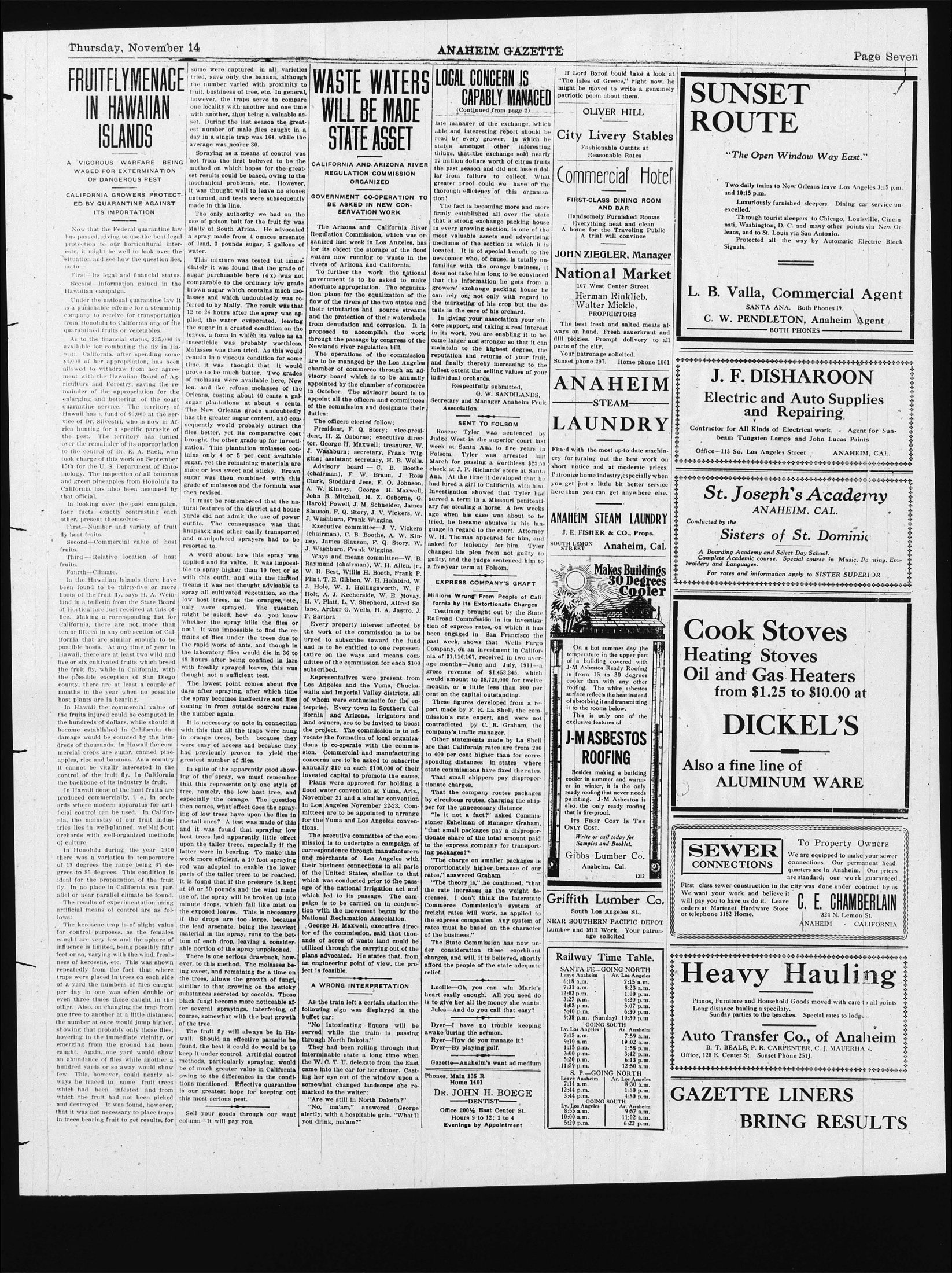
Searchable text
FRUITFLYMENACE IN HAWAIIAN ISLANDS
A VIGOROUS WARFARE BEING WAGED FOR EXTERMINATION OF DANGEROUS PEST
CALIFORNIA GROWERS PROTECTED BY QUARANTINE AGAINST ITS IMPORTATION
Now that the Federal quarantine law has passed, giving to use the best legal protection to our horticultural interests, it might be well to look over the situation and see how the question lies, as to—
First—Its legal and financial status.
Second—Information gained in the Hawaiian campaign.
Under the national quarantine law it is a punishable offense for a steamship company to receive for transportation from Honolulu to California any of the quarantined fruits or vegetables.
As to the financial status, $35,000 is available for combating the fly in Hawaii. California, after spending some $4,000 of her appropriation, has been allowed to withdraw from her agreement with the Hawaiian Board of Agriculture and Forestry, saving the remainder of the appropriation for the enlarging and bettering of the coast quarantine service. The territory of Hawaii has a fund of $6,000 at the service of Dr. Silvestri, who is now in Africa hunting for a specific parasite of the pest. The territory has turned over the remainder of its appropriation to the control of Dr. E. A. Back, who took charge of this work on September 15th for the U. S. Department of Entomology. The inspection of all bananas some were captured in all varieties tried, save only the banana, although the number varied with proximity to fruit, bushiness of tree, etc. In general, however, the traps serve to compare one locality with another and one time with another, thus being a valuable asset. During the last season the greatest number of male flies caught in a day in a single trap was 164, while the average was nearer 30.
Spraying as a means of control was not from the first believed to be the method on which hopes for the greatest results could be based, owing to the mechanical problems, etc. However, it was thought well to leave no stones unturned, and tests were subsequently made in this line.
The only authority we had on the use of poison bait for the fruit fly was Mally of South Africa. He advocated a spray made from 4 ounces arsenate of lead, 3 pounds sugar, 5 gallons of water.
This mixture was tested but immediately it was found that the grade of sugar purchasable here (4 x) was not comparable to the ordinary low grade brown sugar which contains much molasses and which undoubtedly was referred to by Mally. The result was that 12 to 24 hours after the spray was applied, the water evaporated, leaving the sugar in a crusted condition on the leaves, a form in which its value as an insecticide was probably worthless. Molasses was then tried. As this would remain in a viscous condition for some time, it was thought that it would prove to be much better. Two grades of molasses were available here, New Ion, and the refuse molasses of the Orleans, costing about 40 cents a gal-sugar plantations at about 4 cents. The New Orleans grade undoubtedly has the greater sugar content, and consequently would probably attract the flies better, yet its comparative cost brought the other grade up for investigation. This plantation molasses contains only 4 or 5 per cent available sugar, yet the remaining materials are more or less sweet and sticky. Brown
ment with the Hawaiian Board of Agriculture and Forestry, saving the remainder of the appropriation for the enlarging and bettering of the coast quarantine service. The territory of Hawaii has a fund of $6,000 at the service of Dr. Silvestri, who is now in Africa hunting for a specific parasite of the pest. The territory has turned over the remainder of its appropriation to the control of Dr. E. A. Back, who took charge of this work on September 15th for the U. S. Department of Entomology. The inspection of all bananas and green pineapples from Honolulu to California has also been assumed by that official.
In looking over the past campaign, four facts exactly contrasting each other, present themselves—
First—Number and variety of fruit fly host fruits.
Second—Commercial value of host fruits.
Third—Relative location of host fruits.
Fourth—Climate.
In the Hawaiian Islands there have been found to be thirty-five or more hosts of the fruit fly, says H. A. Weinland in a bulletin from the State Board of Horticulture just received at this office. Making a corresponding list for California, there are not more than ten or fifteen in any one section of California that are similar enough to be possible hosts. At any time of year in Hawaii, there are at least two wild and five or six cultivated fruits which breed the fruit fly, while in California, with the possible exception of San Diego county, there are at least a couple of months in the year when no possible host plants are in bearing.
In Hawaii the commercial value of the fruits injured could be computed in the hundreds of dollars, while should it become established in California the damage would be counted by the hundreds of thousands. In Hawaii the commercial crops are sugar, canned pineapples, rice and bananas. As a country it cannot be vitally interested in the control of the fruit fly. In California the backbone of its industry is fruit.
In Hawaii none of the host fruits are produced commercially, i.e., in orchards where modern apparatus for artificial control can be used. In California, the mainstay of our fruit industries lies in well-planned, well-laid-out orchards with well-organized methods of culture.
In Honolulu during the year 1910 there was a variation in temperature of 18 degrees the range being 67 degrees to 85 degrees. This condition is ideal for the propagation of the fruit fly. In no place in California can parallel or near parallel climate be found.
It must be remembered that the natural features of the district and house yards did not admit the use of power outfits. The consequence was that knapsack and other easily transported and manipulated sprayers had to be resorted to.
A word about how this spray was applied and its value. It was impossible to spray higher than 10 feet or so with this outfit, and with the limited means it was not thought advisable to spray all cultivated vegetation, so the low host trees, as the oranges, etc., only were sprayed. The question might be asked, how do you know whether the spray kills the flies or not? It was impossible to find the remains of flies under the trees due to the rapid work of ants, and though in the laboratory flies would die in 36 to 48 hours after being confined in jars with freshly sprayed leaves, this was thought not a sufficient test.
The lowest point comes about five days after spraying, after which time the spray becomes ineffective and flies coming in from outside sources raise the number again.
It is necessary to note in connection with this that all the traps were hung in orange trees, both because they were easy of access and because they had previously proven to yield the greatest number of flies.
In spite of the apparently good showing of the spray, we must remember that this represents only one style of tree, namely, the low host tree, and especially the orange. The question then comes, what effect does the spraying of low trees have upon the flies in the tall ones? A test was made of this and it was found that spraying low host trees had apparently little effect upon the taller trees, especially if the latter were in bearing. To make this work more efficient, a 10 foot spraying rod was adopted to enable the lower parts of the taller trees to be reached. It is found that if the pressure is kept at 40 or 50 pounds and the wind made use of, the spray will be broken up into
visory board w appointed by the October. The appoint all the officers of the commission duties:
The officers eld President, F.
dent, H. Z. Osb
tor, George H. M.
J. Washburn; s
gins; assistant ad
Advisory boa
(chairman), F.
Clark, Stoddard,
A. W. Kinney,
John S. Mitchel,
Harold Powell, J.
Slauson, F. Q. S.
J. Washburn, Fr
Executive com
(chairman), C. H.
ney, James Slau
J. Washburn, Fr
Ways and mea
Raymund (chair
W. R. Best, Willi
Flint, T. E. Gibbo
J. Hole, W. I. N
Holt, A. J. Kech
H. V. Platt, L. V.
Iano, Arthur G. V.
F. Sartori.
Every property
the work of the
urged to subscr
and is to be enti
ative on the wi
mittee of the com
subscribed.
Representatives
Los Angeles and
walla and Imperio
of whom were emterprise. Every t
ifornia and Aris
land owners, are e
the project. They
vocate the format
tions to co-opera
sion. Commercial
concerns are to b
annually $10 on e
invested capital th
Plans were appl
lood water convee
November 21 and
in Los Angeles N
mittees are to be
for the Yuma and
tions.
The executive cormission is to unde correspondence th
and merchants o
their business cone
of the United St
which was conduc
age of the nation
which led to its
produced commercially, i.e., in orchards where modern apparatus for artificial control can be used. In California, the mainstay of our fruit industries lies in well-planned, well-laid-cut orchards with well-organized methods of culture.
In Honolulu during the year 1910 there was a variation in temperature of 18 degrees the range being 67 degrees to 85 degrees. This condition is ideal for the propagation of the fruit fly. In no place in California can parallel or near parallel climate be found.
The results of experimentation using artificial means of control are as follows:
The kerosene trap is of slight value for control purposes, as the females caught are very few and the sphere of influence is limited, being possibly fifty feet or so, varying with the wind, freshness of kerosene, etc. This was shown repeatedly from the fact that where traps were placed in trees on each side of a yard the numbers of flies caught per day in one was often double or even three times those caught in the other. Also, on changing the trap from one tree to another at a little distance, the number at once would jump higher, showing that probably only those flies, hovering in the immediate vicinity, or emerging from the ground had been caught. Again, one yard would show an abundance of flies while another a hundred yards or so away would show few. This, however, could nearly always be traced to some fruit trees which had been infested and from which the fruit had not been picked and destroyed. It was found, however, that it was not necessary to place traps in trees bearing fruit to get results, for especially the orange. The question then comes, what effect does the spraying of low trees have upon the flies in the tall ones? A test was made of this and it was found that spraying low host trees had apparently little effect upon the taller trees, especially if the latter were in bearing: To make this work more efficient, a 10 foot spraying rod was adopted to enable the lower parts of the taller trees to be reached. It is found that if the pressure is kept at 40 or 50 pounds and the wind made use of, the spray will be broken up into minute drops, which fall like mist on the exposed leaves. This is necessary if the drops are too large, because the lead arsenate, being the heaviest material in the spray, runs to the bottom of each drop, leaving a considerable portion of the spray unpolished.
There is one serious drawback, however, to this method. The molasses being sweet, and remaining for a time on the trees, allows the growth of fungi, similar to that growing on the sticky substances secreted by coccids. These black fungi become more noticeable after several sprayings, interfering, of course, somewhat with the best growth of the tree.
The fruit fly will always be in Hawaii. Should an effective parasite be found, the best it could do would be to keep it under control. Artificial control methods, particularly spraying, would be of much greater value in California owing to the differences in the conditions mentioned. Effective quarantine is our greatest hope for keeping out this most serious pest.
Sell your goods through our want column—It will pay you.
WASTE WATERS WILL BE MADE STATE ASSET
CALIFORNIA AND ARIZONA RIVER REGULATION COMMISSION ORGANIZED
GOVERNMENT CO-OPERATION TO BE ASKED IN NEW CONSERVATION WORK
The Arizona and California River Regulation Commission, which was organized last week in Los Angeles, has for its object the storage of the flood waters now running to waste in the rivers of Arizona and California.
To further the work the national government is to be asked to make adequate appropriation. The organization plans for the equalization of the flow of the rivers of the two states and their tributaries and source streams and the protection of their watersheds from denudation and corrosion. It is proposed to accomplish the work through the passage by congress of the Newlands river regulation bill.
The operations of the commission are to be managed by the Los Angeles chamber of commerce through an advisory board which is to be annually appointed by the chamber of commerce in October. The advisory board is to appoint all the officers and committees of the commission and designate their duties:
The officers elected follow:
President, F. Q. Story; vice-president, H. Z. Osborne; executive director, George H. Maxwell; treasurer, W. J. Washburn; secretary, Frank Wiggins; assistant secretary, H. B. Wells.
Advisory board — C. B. Boothe (chairman), E. W. Braun, J. Ross
LOCAL CONCERN IS CAPABLY MANAGED
(Continued from page 2)
late manager of the exchange, which able and interesting report should be read by every grower, in which he states amongst other interesting things, that the exchange sold nearly 17 million dollars worth of citrus fruits the past season and did not lose a dollar from failure to collect. What greater proof could we have of the thorough efficiency of this organization!
The fact is becoming more and more firmly established all over the state that a strong exchange packing house in every growing section, is one of the most valuable assets and advertising mediums of the section in which it is located. It is of special benefit to the newcomer who, of cause, is totally unfamiliar with the orange business, it does not take him long to be convinced that the information he gets from a growers' exchange packing house he can rely on; not only with regard to the marketing of his crop but the details in the care of his orchard.
In giving your association your sincere support, and taking a real interest in its work, you are enabling it to become larger and stronger so that it can maintain to the highest degree, the reputation and returns of your fruit, and finally thereby increasing to the fullest extent the selling values of your individual orchards.
Respectfully submitted,
G. W. SANDILANDS,
Secretary and Manager Anaheim Fruit Association.
SENT TO FOLSOM
Roscoe Tyler was sentenced by Judge West in the superior court last week at Santa Ana to five years in Folsom. Tyler was arrested last March for passing a worthless $23.50 check at J. P. Richards' store at Santa Ana.
If Lord Byron could take a look at "The Isles of Greece," right now, he might be moved to write a genuinely patriotic poem about them.
OLIVER HILL
City Livery Stables
Fashionable Outfits at Reasonable Rates
Commercial Hotel
FIRST-CLASS DINING ROOM AND BAR
Handsomely Furnished Rooms
Everything neat and clean
A home for the Traveling Public
A trial will convince
JOHN ZIEGLER, Manager
National Market
107 West Center Street
Herman Rinklieb,
Walter Mickle,
PROPRIETORS
The best fresh and salted meats always on hand. Fresh sauerkraut and dill pickles. Prompt delivery to all parts of the city.
Your patronage solicited.
Sunset phone 297. Home phone 1061
ANAHEIM STEAM
LAUNDRY
Fitted with the most up-to-date machinery for turning out the best work on short notice and at moderate prices.
Patronize home industry especially when
visory board which is to be annually appointed by the chamber of commerce in October. The advisory board is to appoint all the officers and committees of the commission and designate their duties:
The officers elected follow:
President, F. Q. Story; vice-president, H. Z. Osborne; executive director, George H. Maxwell; treasurer, W. J. Washburn; secretary, Frank Wiggins; assistant secretary, H. B. Wells.
Advisory board — C. B. Boothe (chairman), F. W. Braun, J. Ross Clark, Stoddard Jess, F. O. Johnson, A. W. Kinney, George H. Maxwell, John S. Mitchell, H. Z. Osborne, G. Harold Powell, J. M. Schneider, James Slauson, F. Q. Story, J. V. Vickers, W. J. Washburn, Frank Wiggins.
Executive committee—J. V. Vickers (chairman), C. B. Boothe, A. W. Kinney, James Slauson, F. Q. Story, W. J. Washburn, Frank Wiggins.
Ways and means committee—W. B. Raymund (chairman), W. H. Allen, Jr., W. R. Best, Willis H. Booth, Frank P. Flint, T. E. Gibbon, W. H. Holabird, W. J. Hole, W. I. Hollingsworth, W. F. Holt, A. J. Kecherside, W. E. Movay, H.V.Platt, L.V.Shepherd, Alfred Solano, Arthur G.Wells, H.A.Jastro, J.F.Sartori.
Every property interest affected by the work of the commission is to be urged to subscribe toward the fund and is to be entitled to one representative on the ways and means committee of the commission for each $100 subscribed.
Representatives were present from Los Angeles and the Yuma, Chuckawalla and Imperial Valley districts, all of whom were enthusiastic for the enterprise. Every town in Southern California and Arizona, irrigators and land owners, are to be invited to boost the project. The commission is to advocate the formation of local organizations to co-operate with the commission.
Commercial and manufacturing concerns are to be asked to subscribe annually $10 on each $100,000 of their invested capital to promote the cause.
Plans were approved for holding a flood water convention at Yuma, Arlz., November 21 and a similar convention in Los Angeles November 22-23. Committees are to be appointed to arrange for the Yuma and Los Angeles conventions.
The executive committee of the commission is to undertake a campaign of correspondence through manufacturers and merchants of Los Angeles with their business connections in all parts of the United States, similar to that which was conducted prior to the passage of the national irrigation act and which led to its passage.
Respectfully submitted,
G.W.SANDILANDS,
Secretary and Manager Anaheim Fruit Association.
SENT TO FOLSOM
Roscoe Tyler was sentenced by Judge West in the superior court last week at Santa Ana to five years in Folsom. Tyler was arrested last March for passing a worthless $23,500 check at J.P.Richards' store at Santa Ana. At the time it developed that he had lured a girl to California with him.
Investigation showed that Tyler served a term in a Missouri penitentiary for stealing a horse. A few weeks ago when his case was about to be tried, he became abusive in his language in regard to the court.
Attorney W.H.Thomas appeared for him, and asked for leniency for him. Tyler changed his plea from not guilty to guilty, and the judge sentenced him to a five-year term at Folsom.
EXPRESS COMPANY'S GRAFT
Millions Wrung From People of California by Its Extortionate Charges
Testimony brought out by the State Railroad Commission in its investigation of express rates, on which it has been engaged in San Francisco the past week, shows that Wells Fargo Company, on an investment in California of $1,116,167, received in two average months—June and July, 1911—a gross revenue of $1,453,345, which would amount to $8,720,000 for twelve months, or a little less than 800 per cent on the capital outstanding.
These figures developed from a report made by F.R.La Shell, the commission's rate expert, and were not contradicted by C.R.Graham, the company's traffic manager.
Other statements made by La Shell are that California rates are from 200 to 400 per cent higher than for corresponding distances in states where state commissions have fixed the rates.
That small shippers pay disproportionate charges.
That the company routes packages by circuitous routes, charging the shipper for the unnecessary distance.
"Is it not a fact?" asked Commissioner Eshelman of Manager Graham,
"that small packages pay a disproportionate share of the total amount paid to the express company for transporting packages?"
"The charge on smaller packages is proportionately higher because of our rates," answered Graham.
"The theory is," he continued,"that the rate increases as the weight decreases.I don't think the Interstate...
A WRONG INTERPRETATION
As the train left a certain station the following sign was displayed in the buffet car:
"No intoxicating liquors will be served while the train is passing through North Dakota."
They had been rolling through that interminable state a long time when the W.C.T.U. delegate from the East came into the car for her dinner. Casting her eye out of the window upon a somewhat changed landscape she remarked to the waiter:
"Are we still in North Dakota?"
"No, ma'am," answered George alertly, with a hospitable grin. "What'll you drink, ma'am?"
SUNSET ROUTE
"The Open Window Way East."
Two daily trains to New Orleans leave Los Angeles 3:15 p.m. and 10:15 p.m.
Luxuriously furnished sleepers. Dining car service unexcelled.
Through tourist sleepers to Chicago, Louisville, Cincinnati, Washington, D.C. and many other points via New Orleans, and to St. Louis via San Antonio.
Protected all the way by Automatic Electric Block Signals.
L. B. Valla, Commercial Agent
SANTA ANA. Both Phones 19.
C. W. PENDLETON, Anaheim Agent
BOTH PHONES
J. F. DISHAROON
Electric and Auto Supplies and Repairing
Contractor for All Kinds of Electrical work. - Agent for Sunbeam Tungsten Lamps and John Lucas Paints
Office—113 So. Los Angeles Street ANAHEIM, CA.
J. F. DISHAROON
Electric and Auto Supplies
and Repairing
Contractor for All Kinds of Electrical work. Agent for Sunbeam Tungsten Lamps and John Lucas Paints
Office—113 So. Los Angeles Street ANAHEIM, CAL.
St. Joseph’s Academy
ANAHEIM, CAL.
Conducted by the
Sisters of St. Dominic
A Boarding Academy and Select Day School.
Complete Academic course. Special course in Music, Painting, Embroidery and Languages.
For rates and information apply to SISTER SUPERIOR
Cook Stoves
Heating Stoves
Oil and Gas Heaters
from $1.25 to $10.00 at
DICKEL'S
Also a fine line of
ALUMINUM WARE
SEWER CONNECTIONS
To Property Owners
We are equipped to make your sewer connections. Our permanent head quarters are in Anaheim. Our prices are standard; our work guaranteed.
First class sewer construction in the city was done under contract by us
We want your work and believe it
SEWER CONNECTIONS
To Property Owners
We are equipped to make your sewer connections. Our permanent head quarters are in Anaheim. Our prices are standard; our work guaranteed.
First class sewer construction in the city was done under contract by us.
We want your work and believe it will pay you to have us do it. Leave orders at Martenet Hardware Store or telephone 1182 Home.
C. E. CHAMBERLAIN
324 N. Lemon St.
ANAHEIM CALIFORNIA
Heavy Hauling
Pianos, Furniture and Household Goods moved with care to all points
Long distance hauling a specilaty.
Sunday parties to the beaches. Special rates to lodge.
Auto Transfer Co., of Anaheim
B. T. BEALE, P. R. CARPENTER, C. J. MAUERHAJ.
Office, 128 E. Center St. Sunset Phone 251J.
GAZETTE LINERS
BRING RESULTS