anaheim-gazette 1912-11-07
Scanned page
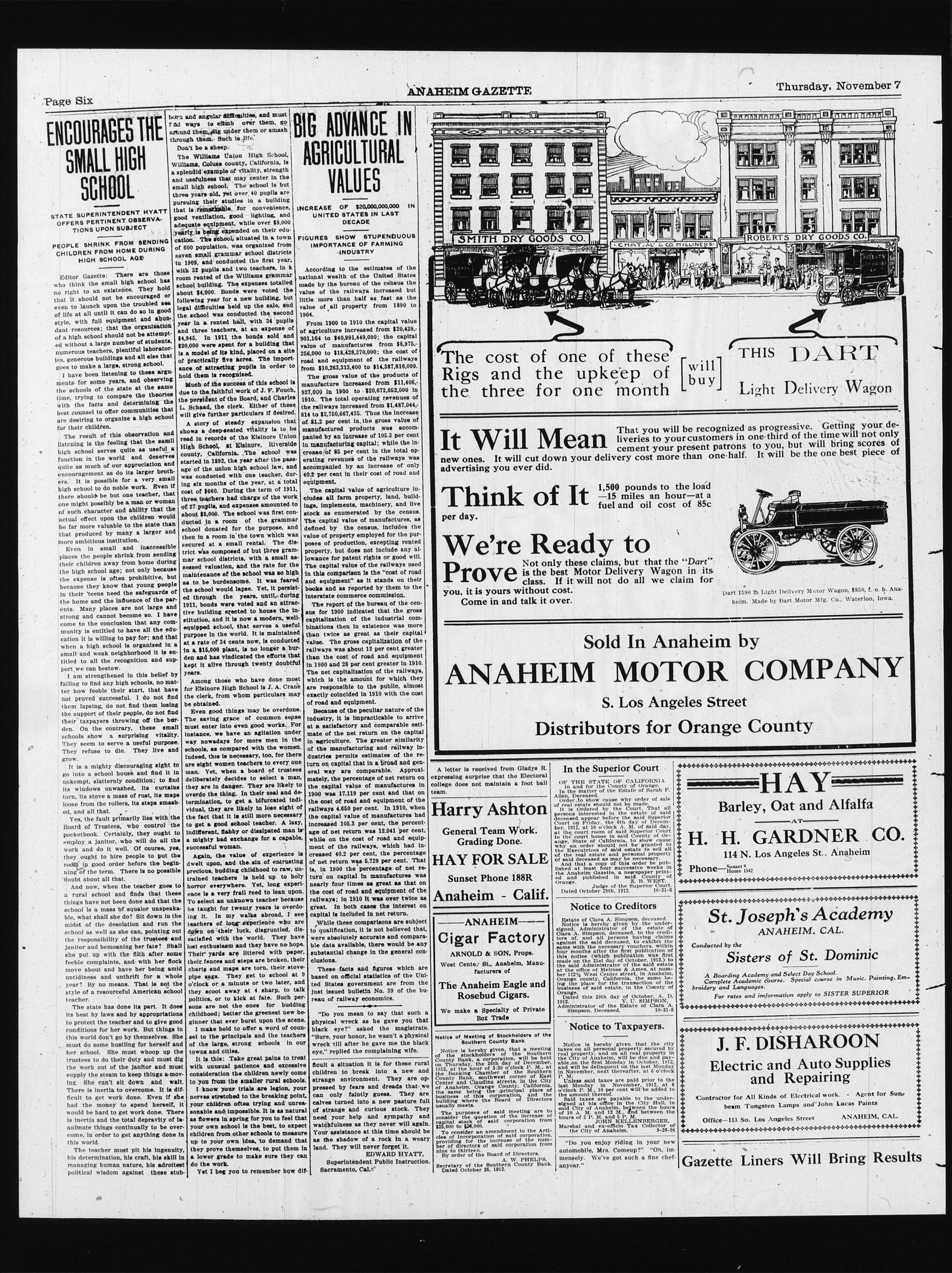
Searchable text
ENCOURAGES THE SMALL HIGH SCHOOL
STATE SUPERINTENDENT HYATT OFFERS PERTINENT OBSERVATIONS UPON SUBJECT
PEOPLE SHRINK FROM SENDING CHILDREN FROM HOME DURING HIGH SCHOOL AGE
Editor Gazette: There are those who think the small high school has no right to an existence. They hold that it should not be encouraged or even to launch upon the troubled sea of life at all until it can do so in good style, with full equipment and abundant resources; that the organization of a high school should not be attempted without a large number of students, numerous teachers, plentiful laboratories, generous buildings and all else that goes to make a large, strong school.
I have been listening to these arguments for some years, and observing the schools of the state at the same time, trying to compare the theories with the facts and determining the best counsel to offer communities that are desiring to organize a high school for their children.
The result of this observation and listening is the feeling that the samll high school serves quite as useful a function in the world and deserves quite as much of our appreciation and encouragement as do its larger broth-
born and angular difficulties, and must find ways to climb over them, go around them, dig under them or smash through them. Such is life.
Don't be a sheep.
The Williams Union High School, Williams, Colusa county, California, is a splendid example of vitality, strength and usefulness that may center in the small high school. The school is but three years old, yet over 40 pupils are pursuing their studies in a building that is remarkable for convenience, good ventilation, good lighting, and adequate equipment, while over $8,000 yearly is being expended on their education. The school situated in a town of 600 population, was organized from seven small grammar school districts in 1909, and conducted the first year, with 32 pupils and two teachers, in a room rented of the Williams grammar school building. The expenses totalled about $4,000. Bonds were voted the following year for a new building, but legal difficulties held up the sale, and the school was conducted the second year in a rented hall, with 34 pupils and three teachers, at an expense of $4,945. In 1911 the bonds sold and $20,000 were spent for a building that is a model of its kind, placed on a site of practically five acres. The importance of attracting pupils in order to hold them is recognized.
Much of the success of this school is due to the faithful work of J. F. Fouch, the persistent of the Board, and Charles L. Schaad, the clerk. Either of these will give further particulars if desired.
A story of steady expansion that shows a deep-seated vitality is to be read in records of the Elsinore Union High School, at Elsinore, Riverside county, California. The school was started in 1892, the year after the passage of the union high school law, and conducted with one teacher dur-
I have been listening to these arguments for some years, and observing the schools of the state at the same time, trying to compare the theories with the facts and determining the best counsel to offer communities that are desiring to organize a high school for their children.
The result of this observation and listening is the feeling that the samll high school serves quite as useful a function in the world and deserves quite as much of our appreciation and encouragement as do its larger brothers. It is possible for a very small high school to do noble work. Even if there should be but one teacher, that one might possibly be a man or woman of such character and ability that the actual effect upon the children would be far more valuable to the state than that produced by many a larger and more ambitious institution.
Even in small and inaccessible places the people shrink from sending their children away from home during the high school age; not only because the expense is often prohibitive, but because they know that young people in their 'teens need the safeguards of the home and the influence of the parents. Many places are not large and strong and cannot become so. I have come to the conclusion that any community is entitled to have all the education it is willing to pay for; and that when a high school is organized in a small and weak neighborhood it is entitled to all the recognition and support we can bestow.
I am strengthened in this belief by failing to find any high schools, no matter how feeble their start, that have not proved successful. I do not find them lapsing, do not find them losing the support of their people, do not find their taxpayers throwing off the burden. On the contrary, these small schools show a surprising vitality. They seem to serve a useful purpose. They refuse to die. They live and grow.
It is a mighty discouraging sight to go into a school house and find it in unkempt, slatternly condition; to find its windows unwashed, its curtains torn, its stove a mass of rust, its maps loose from the rollers, its steps smashed, and all that.
Yes, the fault primarily lies with the Board of Trustees, who control the pocketbook. Certainly, they ought to employ a janitor, who will do all the work and do it well. Of course, yes, they ought to hire people to put the room in good order before the beginning of the term. There is no possible doubt about all that.
And now, when the teacher goes to a rural school and finds that these
Much of the success of this school is due to the faithful work of J. F. Fouch, the persistent of the Board, and Charles L. Schaad, the clerk. Either of these will give further particulars if desired.
A story of steady expansion that shows a deep-seated vitality is to be read in records of the Elsinore Union High School, at Elsinore, Riverside county, California. The school was started in 1892, the year after the passage of the union high school law, and was conducted with one teacher, during six months of the year, at a total cost of $660. During the term of 1911, three teachers had charge of the work of 27 pupils, and expenses amounted to about $5,000. The school was first conducted in a room of the grammar school donated for the purpose, and then in a room in the town which was secured at a small rental. The district was composed of but three grammar school districts, with a small assessed valuation, and the rate for the maintenance of the school was so high as to be burdensome. It was feared the school would lapse. Yet, it persisted through the years, until during 1911, bonds were voted and an attractive building erected to house the institution, and it is now a modern, well-equipped school, that serves a useful purpose in the world. It is maintained at a rate of 34 cents now, is conducted in a $15,000 plant, is no longer a burden and has vindicated the efforts that kept it alive through twenty doubtful years.
Among those who have done most for Elsinore High School is J. A. Crane the clerk, from whom particulars may be obtained.
Even good things may be overdone. The saving grace of common sense must enter into even good works. For instance, we have an agitation under way nowadays for more men in the schools, as compared with the women. Indeed, this is necessary, too, for there are eight women teachers to every one man. Yet, when a board of trustees deliberately decides to select a man, they are in danger. They are likely to overdo the thing. In their zeal and determination, to get a bifurcated individual, they are likely to lose sight of the fact that it is still more necessary to get a good school teacher. A lazy, indifferent, flabby or dissipated man is a mighty bad exchange for a capable, successful woman.
Again, the value of experience is dwelt upon, and the sin of entrusting precious, budding childhood to raw, untrained teachers is held up to holy horror everywhere. Yet, long experience is a very frail reed to lean upon.
The gross value manufacture increases 927,000 in 1900 to 1910. The total value of railways increases 814 to $2,750,667,433 of $1.2 per cent in manufactured products panied by an increase in manufacturing crease of 85 per cent operating revenues accompanied by 40.2 per cent in equipment.
The capital value includes all farmings, implements stock as enumeration. The capital value defined by the value of property poses of productive property, but does lowance for patent. The capital value in this comparison and equipment" books and as represinterstate commute.
The report of sus for 1900 indicates capitalization of binations then less than twice as great value. The gross railways was abolished than the cost owed in 1900 and 28 per cent. The net capitalization which is the area responsible for exactly coincides of road and equividence.
Because of the industry, it is fast at a satisfactory mate of the net in agriculture. Of the manufactures permits turn on capital terms are metely, the percentage capital value 1900 was 17.119% cost of road railways 4.650% capital value increased 105.3% age of net return while on the cument of the rate decreased 40.2 per cent of net return was in 1900 then turn on capital nearly four times the cost of road railways: in 1900
Yes, the fault primarily lies with the Board of Trustees, who control the pocketbook. Certainly, they ought to employ a janitor, who will do all the work and do it well. Of course, yes, they ought to hire people to put the room in good order before the beginning of the term. There is no possible doubt about all that.
And now, when the teacher goes to a rural school and finds that these things have not been done and that the school is a mass of squalor unspeakable, what shall she do? Sit down in the midst of the desolation and run the school as well as she can, pointing out the responsibility of the trustees and janitor and bemoaning her fate? Shall she put up with the filth after some feeble complaints, and with her flock move about and have her being amid untidiness and unthrift for a whole year? By no means. That is not the style of a resourceful American school teacher.
The state has done its part. It does its best by laws and by appropriations to protect the teacher and to give good conditions for her work. But things in this world don't go by themselves. She must do some hustling for herself and her school. She must whoop up the trustees to do their duty and must dig the work out of the janitor and must supply the steam to keep things a-moving. She can't sit down and wait. There is inertia to overcome. It is difficult to get work done. Even if she had the money to spend herself, it would be hard to get work done. There is inertia and the total depravity of imanimate things continually to be overcome, in order to get anything done in this world.
The teacher must pit his ingenuity, his determination, his craft, his skill in managing human nature, his adroitest political wisdom against these stub-termination, to get a bifurcated individual, they are likely to lose sight of the fact that it is still more necessary to get a good school teacher. A lazy, indifferent, slabby or dissipated man is a mighty bad exchange for a capable, successful woman.
Again, the value of experience is dwelt upon, and the sin of entrusting precious, budding childhood to raw, untrained teachers is held up to holy horror everywhere. Yet, long experience is a very frail reed to lean upon. To select an unknown teacher because he taught for twenty years is overdoing it. In my walks abroad, I see teachers of long experience who are down on their luck, disgruntled, dissatisfied with the world. They have lost enthusiasm and they have no hope. Their yards are littered with paper, their fences and steps are broken, their charts and maps are torn, their stovepipe sags. They get to school at 9 o'clock or a minute or two later, and they scoot away at 4 sharp, to talk politics, or to kick at fate. Such persons are not the ones for budding childhood; better the greenest new beginner that ever burst upon the scene.
I make bold to offer a word of counsel to the principals and the teachers of the large, strong schools in our towns and cities.
It is this: Take great pains to treat with unusual patience and excessive consideration the children newly come to you from the smaller rural schools.
I know your trials are legion, your nerves stretched to the breaking point, your children often trying and unreasonable and impossible. It is as natural as flowers in spring for you to feel that your own school is the best, to expect children from other schools to measure up to your own idea, to demand that they prove themselves, to put them in a lower grade to make sure they can do the work.
Yet I beg you to remember how dif-
BIG ADVANCE IN AGRICULTURAL VALUES
INCREASE OF $20,000,000,000 IN UNITED STATES IN LAST DECADE
FIGURES SHOW STUPENDOUS IMPORTANCE OF FARMING INDUSTRY
According to the estimates of the national wealth of the United States made by the bureau of the census the value of the railways increased but little more than half as fast as the value of all property from 1890 to 1904.
From 1900 to 1910 the capital value of agriculture increased from $20,439,-901,164 to $40,991,449,090; the capital value of manufactures from $8,975,-256,000 to $18,428,270,000; the cost of road and equipment of the railways from $10,263,313,400 to $14,387,816,099.
The gross value of the products of manufacture increased from $11,406,-927,000 in 1900 to $20,672,052,000 in 1910. The total operating revenues of the railways increased from $1,487,044,-814 to $2,750,667,435. Thus the increase of 81.2 per cent in the gross value of manufactured products was accompanied by an increase of 105.3 per cent in manufacturing capital; while the increase of 85 per cent in the total operating revenues of the railways was accompanied by an increase of only 40.2 per cent in their cost of road and
The cost of one of these Rigs and the upkeep of the three for one month
It Will Mean That you will liveries to your cement your new ones. It will cut down your delivery cost more advertising you ever did.
The gross value of the products of manufacture increased from $11,406,927,000 in 1900 to $20,672,052,000 in 1910. The total operating revenues of the railways increased from $1,487,044,814 to $2,750,667,435. Thus the increase of 81.2 per cent in the gross value of manufactured products was accompanied by an increase of 105.3 per cent in manufacturing capital; while the increase of 85 per cent in the total operating revenues of the railways was accompanied by an increase of only 40.2 per cent in their cost of road and equipment.
The capital value of agriculture includes all farm property, land, buildings, implements, machinery, and live stock as enumerated by the census. The capital value of manufactures, as defined by the census, includes the value of property employed for the purposes of production, excepting rented property, but does not include any allowance for patent rights or good will. The capital value of the railways used in this comparison is the "cost of road and equipment" as it stands on their books and as reported by them to the interstate commerce commission.
The report of the bureau of the census for 1900 indicated that the gross capitalization of the industrial combinations then in existence was more than twice as great as their capital value. The gross capitalization of the railways was about 12 per cent greater than the cost of road and equipment in 1900 and 28 per cent greater in 1910. The net capitalization of the railways, which is the amount for which they are responsible to the public, almost exactly coincided in 1910 with the cost of road and equipment.
Because of the peculiar nature of the industry, it is impracticable to arrive at a satisfactory and comparable estimate of the net return on the capital in agriculture. The greater similarity of the manufacturing and railway industries permits estimates of the return on capital that in a broad and general way are comparable. Approximately, the percentage of net return on the capital value of manufactures in 1900 was 17.119 per cent and that on the cost of road and equipment of the railways 4.650 per cent. In 1910, when the capital value of manufactures had increased 105.3 per cent, the percentage of net return was 12.041 per cent, while on the cost of road and equipment of the railways, which had increased 40.2 per cent, the percentage of net return was 5.729 per cent. That is, in 1900 the percentage of net return on capital in manufactures was nearly four times as great as that on the cost of road and equipment of the railways; in 1910 it was over twice as
It Will Mean That you will liveries to your new ones. It will cut down your delivery cost more advertising you ever did.
Think of It 1,500 pounds to fuel and oil cost per day.
We're Ready to Prove Not only these claims, but that this is the best Motor Delivery Wage class. If it will not do all we can you, it is yours without cost.
Come in and talk it over.
Sold In An ANAHEIM MOTOR S. Los Angle Distributors for
A letter is received from Gladys R. expressing surprise that the Electoral college does not maintain a foot ball team.
Harry Ashton General Team Work. Grading Done.
HAY FOR SALE Sunset Phone 188R Anaheim - Calif.
In the Superior Court OF THE STATE OF CALIFORNIA In and for the County of Orange In the matter of the Estate of Sarah F. Allen, Deceased Order to show cause why order of sale of real estate should not be made.
It is Ordered by the Court. That all persons interested in the estate of said deceased appear before the said Superior Court on Friday, the 6th day of December, 1912, at 10 o'clock A.M. of said day, at the court room of said Superior Court in the court house in said County of Orange, State of California, to show cause why an order should not be granted to the Executrices of said estate to sell all of the real estate and personal property of said deceased as may be necessary.
And that a copy of this order be published at least four successive weeks in the Anaheim Gazette, a newspaper printed and published in said County of Orange.
Judge of the Superior Court. Dated October 28th, 1912.
Harry Ashton
General Team Work.
Grading Done.
HAY FOR SALE
Sunset Phone 188R
Anaheim - Calif.
ANAHEIM——
Cigar Factory
ARNOLD & SON, Props.
West Cente: St., Anaheim, Manufacturers of
The Anaheim Eagle and Rosebud Cigars.
We make a Specialty of Private Box Trade
"Do you mean to say that such a physical wreck as he gave you that black eye?" asked the magistrate. "Sure, your honor, he wasn't a physical wreck till after he gave me the black eye," replied the complaining wife.
ficult a situation it is for these rural children to break into a new and strange environment. They are oppressed by fears and dreads that we can only faintly guess. They are calves turned into a new pasture full of strange and curious stock. They need your help and sympathy and watchfulness as they never will again. Your assistance at this time should be as the shadow of a rock in a weary land. They will never forget it.
EDWARD HYATT,
Superintendent Public Instruction.
Sacramento, Cal.
Notice of Meeting of Stockholders of the Southern County Bank
Notice is hereby given, that a meeting of the stockholders of the Southern County Bank, a corporation, will be held on Thursday, the 26th day of December, 1912, at the hour of 3:30 o'clock P.M., at the Banking Chamber of the Southern County Bank, southwest corner of East Center and Claudina streets, in the City of Anaheim, Orange County, California, the same being the principal place of business of this corporation, and the building where the Board of Directors usually meets.
The purposes of said meeting are to consider the question of the increase of capital stock of said corporation from $25,000 to $26,000.
To consider an amendment to the Articles of Incorporation of said corporation, providing for the increase of the number of directors of said corporation from nine to thirteen.
By order of the Board of Directors.
A. W. PHELPS,
Secretary of the Southern County Bank.
Dated October 26, 1912.
Notice to Creditors
Estate of Clara A. Simpson, deceased.
Notice is hereby given by the undersigned, Administrator of the estate of Clara A. Simpson, deceased, to the creditors of, and all persons having claims against the said deceased, to exhibit the same with the necessary vouchers, within four months after the first publication of this notice (which publication was first made on the 31st day of October, 1912.) to the said Administrator of the said estate at the office of Melrose & Ames, at number 112½ West Center street, in Anaheim, Orange county, California, the same being the place for the transaction of the business of said estate, in the County of Orange.
Dated this 29th day of October, A.D. 1912,
V. U. SIMPSON,
Administrator of the Estate of Clara A. Simpson, Deceased.
Notice to Taxpayers.
Notice is hereby given that the city taxes on all personal property secured by real property, and on all real property in the City of Anaheim, will be due and payable on the first Monday in October, 1912, and will be delinquent on the last Monday in November, next thereafter, at 6 o'clock P.M.
Unless said taxes are paid prior to the last Monday in November, 1912, at 6 o'clock P.M., 10 per cent will be added to the amount thereof.
Said taxes are payable to the undersigned at his office in the City Hall, in said City of Anaheim, between the hours of 10 A.M. and 12 M., and between the hours of 2 P.M. and 5 P.M.
JOHN KELLENBERGER,
Marshal and ex-officio Tax Collector of the City of Anaheim.
"Do you enjoy riding in your new automobile, Mrs. Comeup?" "On, immensely. We've got such a fine chee anyear."
Thursday, November 7
ROBERTS DRY GOODS CO.
of these keep of the month
will buy
THIS DART
Light Delivery Wagon
That you will be recognized as progressive. Getting your deliveries to your customers in one-third of the time will not only cement your present patrons to you, but will bring scores of delivery cost more than one-half. It will be the one best piece of
That you will be recognized as progressive. Getting your deliveries to your customers in one-third of the time will not only cement your present patrons to you, but will bring scores of delivery cost more than one-half. It will be the one best piece of
1,500 pounds to the load—15 miles an hour—at a fuel and oil cost of 85c
Dart 1590 lb Light Delivery Motor Wagon, $850, f. o. b. Anaheim. Made by Dart Motor Mfg. Co., Waterloo, Iowa.
Sold In Anaheim by
MOTOR COMPANY
S. Los Angeles Street
authors for Orange County
Superior Court
STATE OF CALIFORNIA
the County of Orange,
of the Estate of Sarah F.
new cause why order of sale should not be made.
by the Court. That allotted in the estate of said or before the said Superior day, the 6th day of December, o'clock A. M. of said day, from of said Superior Court house in said County of OrCalifornia, to show cause should not be granted to lots of said estate to sell all estate and personal property and as may be necessary.
copy of this order be published successive weeks in gazette, a newspaper printed in said County of Z. B. WEST.
Judge of the Superior Court.
Per 28th, 1912.
10-31-6
HAY
Barley, Oat and Alfalfa
AT
H. H. GARDNER CO.
114 N. Los Angeles St., Anaheim
Phone—Sunset 9
Home 1542
Barley, Oat and Alfalfa
AT
H. H. GARDNER CO.
114 N. Los Angeles St., Anaheim
Phone—Sunset 9
Home 1542
St. Joseph’s Academy
ANAHEIM, CAL.
Conducted by the
Sisters of St. Dominic
A Boarding Academy and Select Day School.
Complete Academic course. Special course in Music, Painting, Embroidery and Languages.
For rates and information apply to SISTER SUPERIOR
J. F. DISHAROON
Electric and Auto Supplies and Repairing
Contractor for All Kinds of Electrical work. Agent for Sunbeam Tungsten Lamps and John Lucas Paints
Office—113 So. Los Angeles Street
ANAHEIM, CAL.
Gazette Liners Will Bring Results