anaheim-gazette 1912-10-24
Scanned page
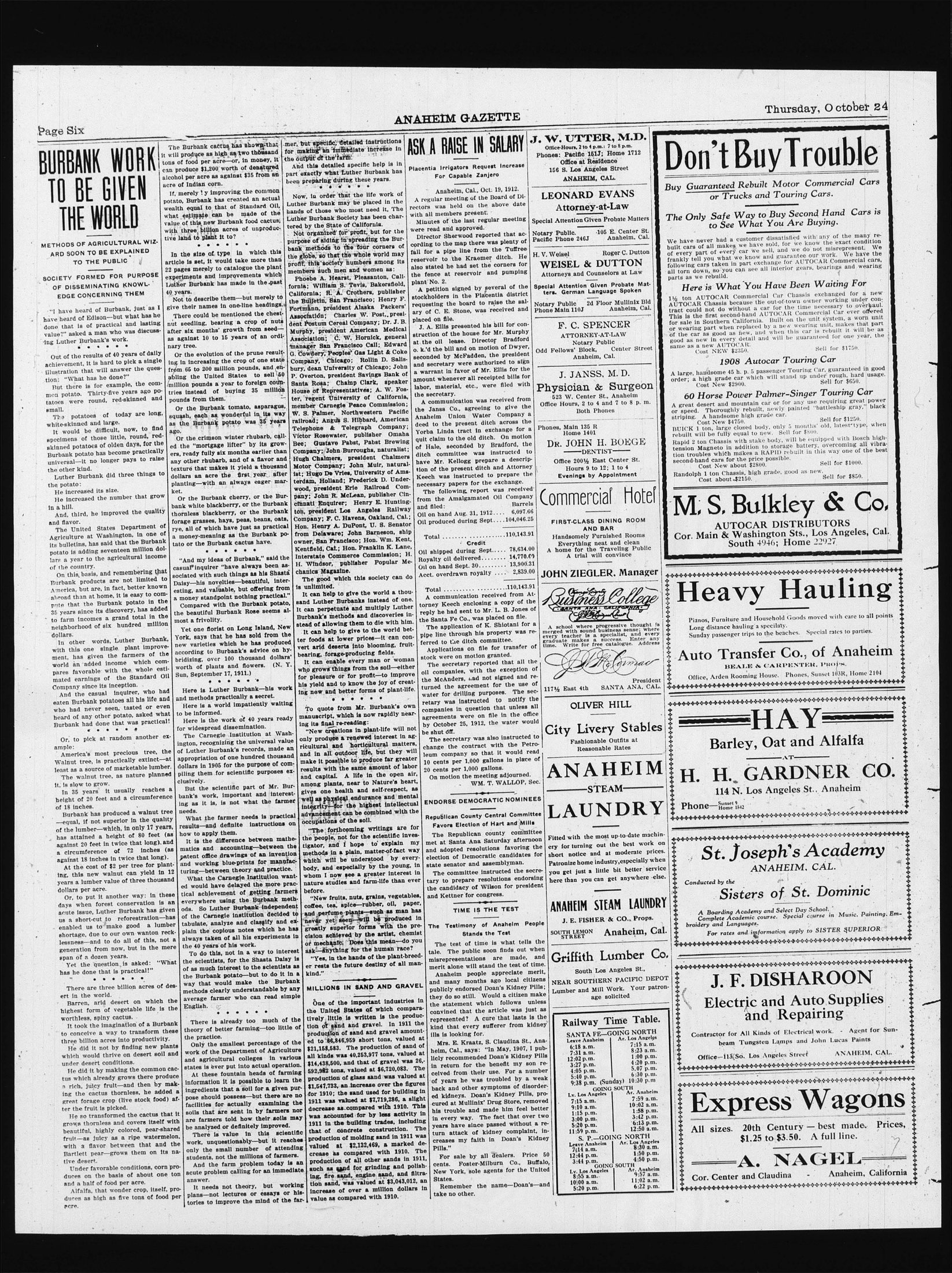
Searchable text
BURBANK WORK TO BE GIVEN THE WORLD
METHODS OF AGRICULTURAL WIZARD SOON TO BE EXPLAINED TO THE PUBLIC
SOCIETY FORMED FOR PURPOSE OF DISSEMINATING KNOWLEDGE CONCERNING THEM
"I have heard of Burbank, just as I have heard of Edison—but what has he done that is of practical and lasting value?" asked a man who was discussing Luther Burbank's work.
Out of the results of 40 years of daily achievement, it is hard to pick a single illustration that will answer the question: "What has he done?"
But there is for example, the common potato. Thirty-five years ago potatoes were round, red-skinned and small.
The potatoes of today are long, white-skinned and large.
It would be difficult, now, to find specimens of those little, round, red-skinned potatoes of olden days, for the Burbank potato has become practically universal—it no longer pays to raise the other kind.
The Burbank cactus has shown that it will produce as high as two thousand tons of food per acre—or, in money, it can produce $1,200 worth of denatured alcohol per acre as against $35 from an acre of Indian corn.
If, merely! improving the common potato, Burbank has created an actual wealth equal to that of Standard Oil, what estimate can be made of the value of this new Burbank food cactus, with three billion acres of unproductive land to plant it to?
In the size of type in which this article is set, it would take more than 22 pages merely to catalogue the plant experiments and improvements which Luther Burbank has made in the past 40 years.
Not to describe them—but merely to give their names in one-line headings.
There could be mentioned the chestnut seedling, bearing a crop of nuts after six months' growth from seed—as against 10 to 15 years of an ordinary tree.
Or the evolution of the prune resulting in increasing the crop of one state from 65 to 200 million pounds, and enabling the United States to sell 50 million pounds a year to foreign countries instead of buying 35 million pounds from them.
Or the Burbank tomato, asparagus, squash, each as wonderful in its way as the Burbank potato was 35 years ago.
Or the crimson winter rhubarb, called the "mortgage lifter" by its growers, ready fully six months earlier than any other rhubarb, and of a flavor and texture that makes it yield a thousand dollars but specific, detailing for making an immediate output of the farm.
And this detailed part exactly what Luther Burbank been preparing during this period.
Now, in order that Luther Burbank may help hands of those who make Luther Burbank Society tered by the State of California; William S. Teal California; R. A. Crouse the Bulletin, San Francisco Fortmann, president Association; Charles dent Postum Cereal Company Murphy, president Association; C. W. manager San Francisco G. Cowdery, Peoples Company, Chicago; bury, dean University P. Overton, president Santa Rosa; Chaimp House of Representatives; regent Universities member Carnegie Pe W. S. Palmer, North railroad; Angus S. H Telephone & Telephone Victor Rosewater, Bee; Gustave Pabs Company; John Burr Hugh Chalmers, pres Motor Company; Jost; Hugo De Vries, U
But there is for example, the common potato. Thirty-five years ago potatoes were round, red-skinned and small.
The potatoes of today are long, white-skinned and large.
It would be difficult, now, to find specimens of those little, round, red-skinned potatoes of olden days, for the Burbank potato has become practically universal—it no longer pays to raise the other kind.
Luther Burbank did three things to the potato:
He increased its size.
He increased the number that grow in a hill.
And, third, he improved the quality and flavor.
The United States Department of Agriculture at Washington, in one of its bulletins, has said that the Burbank potato is adding seventeen million dollars a year to the agricultural income of the country.
On this basis, and remembering that Burbank products are not limited to America, but are, in fact, better known abroad than at home, it is easy to compute that the Burbank potato in the 35 years since its discovery, has added to farm incomes a grand total in the neighborhood of six hundred million dollars.
In other words, Luther Burbank, with this one single plant improvement, has given the farmers of the world an added income which compares favorable with the whole estimated earnings of the Standard Oil Company since its inception.
And the casual inquirer, who had eaten Burbank potatoes all his life and who had never seen, tasted or even heard of any other potato, asked what Burbank had done that was practical!
Or, to pick at random another example:
America's most precious tree, the Walnut tree, is practically extinct—at least as a source of marketable lumber.
The walnut tree, as nature planned it, is slow to grow.
In 35 years it usually reaches a height of 20 feet and a circumference of 18 inches.
Burbank has produced a walnut tree—equal, if not superior in the quality of the lumber—which, in only 17 years, has attained a height of 80 feet (as against 20 feet in twice that long) and a circumference of 72 inches (as against 18 inches in twice that long).
At the cost of $2 per tree for planting, this new walnut can yield in 12 years a lumber value of three thousand dollars per acre.
Or, to put it another way: in these abling the United States to sell 60 million pounds a year to foreign countries instead of buying 35 million pounds from them.
Or the Burbank tomato, asparagus, squash, each as wonderful in its way as the Burbank potato was 35 years ago.
Or the crimson winter rhubarb, called the "mortgage lifter" by its growers, ready fully six months earlier than any other rhubarb, and of a flavor and texture that makes it yield a thousand dollars an acre the first year after planting—with an always eager market.
Or the Burbank cherry, or the Burbank white blackberry, or the Burbank thornless blackberry, or the Burbank forage grasses, hays, peas, beans, oats, rye, all of which have just as practical a money-meaning as the Burbank potato or the Burbank cactus have.
"And my ideas of Burbank," said the casual inquirer "have always been associated with such things as his Shasta Daisy—his novelties—beautiful, interesting, and valuable, but offering from a money standpoint nothing practical."
Compared with the Burbank potato, the beautiful Burbank Rose seems almost a frivolity.
Yet one florist on Long Island, New York, says that he has sold from the new varieties which he has produced according to Burbank's advice on hybridizing, over 100 thousand dollars' worth of plants and flowers. (N. Y. Sun, September 17, 1911.)
Here is Luther Burbank—his work and methods practically a secret.
Here is a world impatiently waiting to be informed.
Here is the work of 40 years ready for widespread dissemination.
The Carnegie Institution at Washington, recognizing the universal value of Luther Burbank's records, made an appropriation of one hundred thousand dollars in 1905 for the purpose of compiling them for scientific purposes exclusively.
But the scientific part of Mr. Burbank's work important and interesting as it is, is not what the farmer needs.
What the farmer needs is practical results—and definite instructions on how to apply them.
It is the difference between mathematics and accounting—between the patent office drawings of an invention and working blueprints for manufacturing—between theory and practice.
What the Carnegie Institution wanted would have delayed the more practical achievement of getting farmers abbling the United States to sell 60 million pounds a year to foreign countries instead of buying 35 million pounds from them.
Or the Burbank tomato, asparagus, squash, each as wonderful in its way as the Burbank potato was 35 years ago.
Or the crimson winter rhubarb, called the "mortgage lifter" by its growers, ready fully six months earlier than any other rhubarb, and of a flavor and texture that makes it yield a thousand dollars an acre the first year after planting—with an always eager market.
Or the Burbank cherry, or the Burbank white blackberry, or the Burbank thornless blackberry, or the Burbank forage grasses, hays, peas, beans, oats, rye, all of which have just as practical a money-meaning as the Burbank potato or the Burbank cactus have.
"And my ideas of Burbank," said the casual inquirer "have always been associated with such things as his Shasta Daisy—his novelties—beautiful, interesting, and valuable, but offering from a money standpoint nothing practical."
Compared with the Burbank potato, the beautiful Burbank Rose seems almost a frivolity.
Yet one florist on Long Island, New York, says that he has sold from the new varieties which he has produced according to Burbank's advice on hybridizing, over 100 thousand dollars' worth of plants and flowers. (N. Y. Sun, September 17, 1911.)
Here is Luther Burbank—his work and methods practically a secret.
Here is a world impatiently waiting to be informed.
Here is the work of 40 years ready for widespread dissemination.
The Carnegie Institution at Washington, recognizing the universal value of Luther Burbank's records, made an appropriation of one hundred thousand dollars in 1905 for the purpose of compiling them for scientific purposes exclusively.
But the scientific part of Mr. Burbank's work important and interesting as it is, is not what the farmer needs.
What the farmer needs is practical results—and definite instructions on how to apply them.
It is the difference between mathematics and accounting—between the patent office drawings of an invention and working blueprints for manufacturing—between theory and practice.
What the Carnegie Institution wanted would have delayed the more practical achievement of getting farmers abbling the United States to sell 60 million pounds a year to foreign countries instead of buying 35 million pounds from them.
Or the Burbank tomato, asparagus, squash, each as wonderful in its way as the Burbank potato was 35 years ago.
Or the crimson winter rhubarb, called the "mortgage lifter" by its growers, ready fully six months earlier than any other rhubarb, and of a flavor and texture that makes it yield a thousand dollars an acre the first year after planting—with an always eager market.
Or the Burbank cherry, or the Burbank white blackberry, or the Burbank thornless blackberry, or the Burbank forage grasses, hays, peas, beans, oats, rye, all of which have just as practical a money-meaning as the Burbank potato or the Burbank cactus have.
"And my ideas of Burbank," said the casual inquirer "have always been associated with such things as his Shasta Daisy—his novelties—beautiful, interesting, and valuable, but offering from a money standpoint nothing practical."
Compared with the Burbank potato, the beautiful Burbank Rose seems almost a frivolity.
Yet one florist on Long Island, New York, says that he has sold from the new varieties which he has produced according to Burbach's advice on hybridizing, over 100 thousand dollars' worth of plants and flowers. (N. Y. Sun,September 17,1911.)
Here is Luther Burbank—his work and methods practically a secret.
Here is a world impatiently waiting to be informed.
Here is the work of 40 years ready for widespread dissemination.
The Carnegie Institution at Washington,recognizing the universal value of Luther Burbach's records,made an appropriation of one hundred thousand dollars in 1905 for the purpose of compiling them for scientific purposes exclusively.
But the scientific part of Mr. Burbach's work important and interesting as it is,is not what the farmer needs.
What the farmer needs is practical results—and definite instructions on how to apply them.
It is the difference between mathematics and accounting—between the patent office drawings of an invention and working blueprints for manufacturing—between theory and practice.
What the Carnegie Institution wanted would have delayed the more practical achievement of getting farmers abbling the United States to sell 60 million pounds a year to foreign countries instead of buying 35 million pounds from them.
Or the burban tomato,asparagus,squash,each as wonderful in its way as the burban potato was 35 years ago.
Or the crimson winter rhubarb,called the "mortgage lifter" by its growers,ready fully six months earlier than any other rhubarb,and of a flavor and texture that makes it yield a thousand dollars an acre the first year after planting—with an always eager market.
Or the burban cherry,or the burban white blackberry,or the burban thornless blackberry,or the burban forage grasses,hays,peas,beans,oats,rye,all of which have just as practical a money-meaning as the burban potato or the burban cactus have.
"And my ideas of Burban," said the casual inquirer "have always been associated with such things as his Shasta Daisy—his novelties—beautiful,interesting,and valuable,但 offering from a money standpoint nothing practical."
Compared with the burban potato,the beautiful Burban Rose seems almost a frivolity.
Yet one florist on Long Island,New York, says that he has sold from the new varieties which he has produced according to Burbach's advice on hybridizing,over 100 thousand dollars' worth of plants and flowers. (N. Y. Sun,September 17,1911.)
Here is Luther Burban—his work and methods practically a secret.
Here is a world impatiently waiting to be informed.
Here is the work of 40 years ready for widespread dissemination.
The Carnegie Institution at Washington,recognizing the universal value of Luther Burbach's records,made an appropriation of one hundred thousand dollars in 1905 for the purpose of compiling them for scientific purposes exclusively.
But the scientific part of Mr. Burbach's work important and interesting as it is,is not what the farmer needs.
What the farmer needs is practical results—and definite instructions on how to apply them.
It is the difference between mathematics and accounting—between the patent office drawings of an invention and working blueprints for manufacturing—between theory and practice.
What The Carnegie Institution wanted would have delayed the more practical achievement of getting farmers abbling The United States to sell 60 million pounds a year to foreign countries instead of buying 35 million pounds from them.
Burbank has produced a walnut tree—equal, if not superior in the quality of the lumber—which, in only 17 years, has attained a height of 80 feet (as against 20 feet in twice that long) and a circumference of 72 inches (as against 18 inches in twice that long).
At the cost of $2 per tree for planting, this new walnut can yield in 12 years a lumber value of three thousand dollars per acre.
Or, to put it another way: in these days when forest conservation is an acute issue, Luther Burbank has given us a short-cut to reforestation—has enabled us to make good a lumber shortage, due to our own wanton recklessness—and to do all of this, not a generation from now, but in the mere span of a dozen years.
Yet the question is asked: "What has he done that is practical!"
There are three billion acres of desert in the world.
Barren, arid desert on which the highest form of vegetable life is the worthless, spiny cactus.
It took the imagination of a Burbank to conceive a way to transform these three billion acres into productivity.
He did it not by finding new plants which would thrive on desert soil and under desert conditions.
He did it by making the common cactus which already grows there produce a rich, juicy fruit—and then by making the cactus thornless, he added a great forage crop (live stock food) after the fruit is picked.
He so transformed the cactus that it grows thornless and covers itself with beautiful, highly colored, pear-shared fruit—as juicy as a ripe watermelon, with a flavor between that and the Bartlett pear—grows them on its native desert.
Under favorable conditions, corn produces on the basis of about one ton and a half of food per acre.
Alfalfa, that wonder crop, itself, produces as high as five tons of food per acre.
What the farmer needs is practical results—and definite instructions on how to apply them.
It is the difference between mathematics and accounting—between the patent office drawings of an invention and working blue-prints for manufacturing—between theory and practice.
What the Carnegie Institution wanted would have delayed the more practical achievement of getting farmers everywhere using the Burbank methods. So Luther Burbank independent of the Carnegie institution decided to tabulate, analyze and classify and explain the copious notes which he has always taken of all his experiments in the 40 years of his work.
To do this, not in a way to interest the scientists, for the Shasta Daisy is of as much interest to the scientists as the Burbank potato—but to do it in a way that would make the Burbank methods clearly understandable by any average farmer who can read simple English.
There is already too much of the theory of better farming—too little of the practice.
Only the smallest percentage of the work of the Department of Agriculture and agricultural colleges in various states is ever put into actual operation.
At these fountain heads of farming information it is possible to learn the ingredients that a soil for a given purpose should possess—but there are no facilities for actually examining the soils that are sent in by farmers nor are farmers told how their soils may be analyzed or definitely improved.
There is value in this scientific work, unquestionably—but it reaches only the small number of attending students, not the millions of farmers.
And the farm problem today is an acute problem calling for an immediate answer.
It needs not theory, but working plans—not lectures or essays or histories to improve the mind of the far-
One of the in the United States tively little is vation of sand and production of sailed to 66,846,959 $21,158,583. The all kinds was 40 $14,438,500, and 592,982 tons, valuation of glacier $1,547,733, an im- for 1910; the said 1911 was valued decrease as com- was accounted at 1911 in the bulb that of concrete production of mowed at $2 crease as com-production of such as sand firing fire sand, tion sand, was increase of over-value as comp-
mer, but specific, detailed instructions for making an immediate increase in the output of the farm.
And this detailed specific help is in part exactly what Luther Burbank has been preparing during these years.
Now, in order that the life work of Luther Burbank may be placed in the hands of those who most need it, The Luther Burbank Society has been chartered by the State of California.
Not organized for profit, but for the purpose of aiding in spreading the Burbank methods to the four corners of the globe, so that the whole world may profit, this society numbers among its members such men and women as:
Phoebe A. Hearst, Pleasanton, California; William S. Tevis, Bakersfield, California; R. A. Crothers, publisher the Bulletin, San Francisco; Henry F. Fortmann, president Alaska Packers' Association; Charles W. Post., president Postum Cereal Company; Dr. J. B. Murphy, president American Medical Association; C. W. Hornick, general manager San Francisco Call; Edward G. Cowdery, People's Gas Light & Coke Company, Chicago; Rollin D. Salisbury, dean University of Chicago; John P. Overton, president Savings Bank of Santa Rosa; Champ Clark, speaker House of Representatives; A. W. Foster, regent University of California, member Carnegie Peace Commission; W. S. Palmer, Northwestern Pacific railroad; Angus S. Hibbard, American Telephone & Telegraph Company; Victor Rosewater, publisher Omaha Bee; Gustave Pabst, Pabst Brewing Company; John Burroughs, naturalist; Hugh Chalmers, president Chalmers Motor Company; John Muir, naturalist; Hugo De Vries, University of Amsterdam.
ASK A RAISE IN SALARY
Placentia Irrigators Request Increase For Capable Zanjero
Anaheim, Cal., Oct. 19, 1912.
A regular meeting of the Board of Directors was held on the above date with all members present.
Minutes of the last regular meeting were read and approved.
Director Sherwood reported that according to the map there was plenty of fall for a pipe line from the Tuffree reservoir to the Kraemer ditch. He also stated he had set the corners for the fence at reservoir and pumping plant No. 2.
A petition signed by several of the stockholders in the Placentia district requesting the board to raise the salary of C. E. Stone, was received and placed on file.
J. A. Ellis presented his bill for construction of the house for Mr. Murphy at the oil lease. Director Bradford o.k.'d the bill and on motion of Dwyer, seconded by McFadden, the president and secretary were authorized to sign a warrant in favor of Mr. Ellis for the amount whenever all receipted bills for labor, material, etc., were filed with the secretary.
A communication was received from the Janss Co., agreeing to give the Anaheim Union Water Company a deed to the present ditch across the Yorba Linda tract in exchange for a quit claim to the old ditch. On motion of Hale, seconded by Bradford, the ditch committee was instructed to have Mr. Kellogg prepare a description of the present ditch and Attorney Office 200½ East Center St.
Hours 9 to 12; 1 to 4
P. Overton, president Savings Bank of Santa Rosa; Champ Clark, speaker House of Representatives; A. W. Foster, regent University of California, member Carnegie Peace Commission; W. S. Palmer, Northwestern Pacific railroad; Angus S. Hibbard, American Telephone & Telegraph Company; Victor Rosewater, publisher Omaha Bee; Gustave Pabst, Pabst Brewing Company; John Burroughs, naturalist; Hugh Chalmers, president Chalmers Motor Company; John Muir, naturalist; Hugo De Vries, University of Amsterdam, Holland; Frederick D. Underwood, president Erie Railroad Company; John R. McLean, publisher Cincinnati Enquirer; Henry E. Huntington, president Los Angeles Railway Company; F. C. Havens, Oakland, Cal.; Hon. Henry A. DuPont, U. S. Senator from Delaware; John Barneson, ship owner, San Francisco; Hon. Wm. Kent, Kentfield, Cal.; Hon. Franklin K. Lane, Interstate Commerce Commission; H. H. Windsor, publisher Popular Mechanics Magazine.
The good which this society can do is unlimited.
It can help to give the world a thousand Luther Burbanks instead of one. It can perpetuate and multiply Luther Burbank's methods and discoveries instead of allowing them to die with him.
It can help to give to the world better foods at lower prices—it can convert arid deserts into blooming fruit-bearing, forage-producing fields.
It can enable every man or woman who grows things from the soil—either for pleasure or for profit—to improve his yield and to know the joy of creating new and better forms of plant-life.
To quote from Mr. Burbank's own manuscript, which is now rapidly nearing its final re-reading:
"New creations in plant-life will not only produce a renewed interest in agricultural and horticultural matters, and in all outdoor life, but they will make it possible to produce far greater results with the same amount of labor and capital. A life in the open air, among plants, near to Nature's heart, gives one health and self-respect, as well as physical endurance and mental integrity—for the highest intellectual advancement can be combined with the occupations of the soil."
"The forthcoming writings are for the people, not for the scientific investigator, and I hope to explain my methods in a plain, matter-of-fact way which will be understood by everybody, and especially by the young, in whom I now see a greater interest in nature studies and farm-life than ever before."
"New fruits, nuts, grains, vegetables,
amount whenever all received bills for labor, material, etc., were filed with the secretary.
A communication was received from the Janss Co., agreeing to give the Anaheim Union Water Company a deed to the present ditch across the Yorba Linda tract in exchange for a quit claim to the old ditch. On motion of Hale, seconded by Bradford, the ditch committee was instructed to have Mr. Kellogg prepare a description of the present ditch and Attorney Keech was instructed to prepare the necessary papers for the exchange.
The following report was received from the Amalgamated Oil Company and filed:
Barrels
Oil on hand Aug. 31, 1912... 6,097.66
Oil produced during Sept...104,046.25
Total...110,143.91
Credit
Oil shipped during Sept...78,634.00
Royalty oil delivered...14,770.69
Oil on hand Sept. 30...13,900.31
Acct. overdrawn royalty...2,839.00
Total...110,143.91
A communication received from Attorney Keech enclosing a copy of the reply he had sent to Mr. L. B. Jones of the Santa Fe Co., was placed on file.
The application of K. Shiotani for a pipe line through his property was referred to the ditch committee.
Applications on file for transfer of stock were on motion granted.
The secretary reported that all the oil companies, with the exception of the McAnders, had not signed and returned the agreement for the use of water for drilling purposes. The secretary was instructed to notify the companies in question that unless all agreements were on file in the office by October 25, 1912, the water would be shut off.
The secretary was also instructed to change the contract with the Petroleum company so that it would read 10 cents per 1,000 gallons in place of 20 cents per 1,000 gallons.
On motion the meeting adjourned.
WM. T. WALLOP, Sec.
ENDORSE DEMOCRATIC NOMINEES
Republican County Central Committee
Favors Election of Hart and Mills
The Republican county committee met at Santa Ana Saturday afternoon and adopted resolutions favoring the election of Democratic candidates for state senator and assemblyman.
The committee instructed the secretary to prepare resolutions endorsing the candidacy of Wilson for president and Kettner for congress.
J. JANSS, M.D.
Physician & Surgeon
523 W. Center St., Anaheim
Office Hours, 2 to 4 and 7 to 8 p.m.
Both Phones
Phones, Main 135 R
Home 1401
DR. JOHN H. BOEGE
DENTIST
Office 200½ East Center St.
Hours 9 to 12; 1 to 4
Evenings by Appointment
Commercial Hotel
FIRST-CLASS DINING ROOM AND BAR
Handsomely Furnished Rooms
Everything neat and clean
A home for the Traveling Public
A trial will convince
JOHN ZIEGLER, Manager
Business College
A school where progressive thought is merged with sound business sense; where every teacher is a specialist, and every graduate makes a success. Enter any time. Write for free catalogue. Address
117½ East 4th
SANTA ANA, CAL.
OLIVER HILL
City Livery Stables
Fashionable Outfits at Reasonable Rates
ANAHEIM
STEAM
LAUNDRY
Fitted with the most up-to-date machinery for turning out the best work on short notice and at moderate prices. Patronize home industry, especially when you get just a little bit better service here than you can get anywhere else.
"The forthcoming writings are for the people, not for the scientific investigator, and I hope to explain my methods in a plain, matter-of-fact way which will be understood by everybody, and especially by the young, in whom I now see a greater interest in nature studies and farm-life than ever before.
"New fruits, nuts, grains, vegetables, coffee, tea, spice—rubber, oil, paper, and perfume plants—such as man has never yet seen—will be produced in greatly superior forms with the precision achieved by the artist, chemist or mechanic. Does this mean—do you ask—anything for the human race?
"Yes, in the hands of the plant-breeder rests the future destiny of all mankind."
MILLIONS IN SAND AND GRAVEL
One of the important industries in the United States of which comparatively little is written is the production of sand and gravel. In 1911 the production of sand and gravel amounted to 86,846,959 short tons, valued at $21,158,583. The production of sand of all kinds was 40,253,977 tons, valued at $14,438,500, and that of gravel was 26,-592,982 tons, valued at $6,720,083. The production of glass sand was valued at $1,547,733, an increase over the figures for 1910; the sand used for building in 1911 was valued at $7,719,286, a slight decrease as compared with 1910. This was accounted for by less activity in 1911 in the building trades, including that of concrete construction. The production of molding sand in 1911 was valued at $2,132,469, a marked decrease as compared with 1910. The production of all other sands in 1911, such as sand for grinding and polishing, fire sand, engine sand, and filtration sand, was valued at $3,043,012, an increase of over a million dollars in value as compared with 1910.
Republican County Central Committee Favors Election of Hart and Mills
The Republican county committee met at Santa Ana Saturday afternoon and adopted resolutions favoring the election of Democratic candidates for state senator and assemblyman.
The committee instructed the secretary to prepare resolutions endorsing the candidacy of Wilson for president and Kettner for congress.
TIME IS THE TEST
The test of time is what tells the tale. The public soon finds out when misrepresentations are made, and merit alone will stand the test of time.
Anaheim people appreciate merit, and many months ago local citizens publicly endorsed Doan's Kidney Pills; they do so still. Would a citizen make the statement which follows unless convinced that the article was just as represented? A cure that lasts is the kind that every sufferer from kidney illis is looking for.
Mrs. E. Kraatz, S. Claudina St., Anaheim, Cal., says: "In May, 1907, I publicly recommended Doan's Kidney Pills in return for the benefit my son received from their use. For a number of years he was troubled by a weak back and other symptoms of disordered kidneys. Doan's Kidney Pills, procured at Mullinix' Drug Store, removed his trouble and made him feel better in every way. The fact that over two years have since passed without a return attack of kidney complaint, increases my faith in Doan's Kidney Pills."
For sale by all dealers. Price 50 cents. Foster-Milburn Co., Buffalo, New York, sole agents for the United States.
Remember the name—Doan's—and take no other.
ANAHEIM STEAM LAUNDRY
J. E. FISHER & CO., Props.
SOUTH LEMON STREET
Anaheim, Cal.
GRiffith Lumber Co,
South Los Angeles St., NEAR SOUTHERN PACIFIC DEPOT Lumber and Mill Work. Your patronage solicited
Railway Time Table.
SANTA FE—GOING NORTH
Leave Anaheim Ar. Los Angeles
6:18 a.m. 7:15 a.m.
7:31 a.m. 8:23 a.m.
12:02 p.m. 1:00 p.m.
3:27 p.m. 4:20 p.m.
4:05 p.m. 5:07 p.m.
5:40 p.m. 6:30 p.m.
9:38 p.m. (Sunday) 10:30 p.m.
GOING SOUTH
Lv. Los Angeles Ar. Anaheim
7:15 a.m. 7:59 a.m.
9:10 a.m. 10:02 a.m.
1:15 p.m. 1:58 p.m.
3:00 p.m. 3:42 p.m.
5:20 p.m. 6:13 p.m.
11:59 p.m. 12:50 a.m.
S.P.-GOING NORTH
Leave Anaheim Ar. Los Angeles
7:14 a.m. 8:30 a.m.
12:44 p.m. 1:50 p.m.
3:44 p.m. 4:50 p.m.
GOING SOUTH
Lv. Los Angeles Ar. Anaheim
8:55 a.m. 9:57 a.m.
10:00 a.m. 11:02 a.m.
5:20 p.m. 6:22 p.m.
Don’t Buy Trouble
Buy Guaranteed Rebuilt Motor Commercial Cars or Trucks and Touring Cars.
The Only Safe Way to Buy Second Hand Cars is to See What You Are Buying.
We have never had a customer dissatisfied with any of the many rebuilt cars of all makes we have sold, for we know the exact condition of every part of every car we sell, and we do not misrepresent. We frankly tell you what we know and guarantee our work. We have the following cars taken in part exchange for AUTOCAR Commercial cars, all torn down, so you can see all interior gears, bearings and wearing parts as we rebuild.
Here is What You Have Been Waiting For
1½ ton AUTOCAR Commercial Car Chassis exchanged for a new AUTOCAR Chassis because the out-of-town owner working under contract could not do without a car for the time necessary to overhaul. This is the first second-hand AUTOCAR Commercial Car ever offered for sale in Southern California. Built on the unit system, a worn unit or wearing part when replaced by a new wearing unit, makes that part of the car as good as new, and when this car is rebuilt it will be as good as new in every detail and will be guaranteed for one year, the same as a new AUTOCAR.
Cost NEW $2350. Sell for $1750.
1908 Autocar Touring Car
A large, handsome 45 h. p. 5 passenger Touring Car, guaranteed in good order; a high grade car which will stand up under rough, hard usage.
Cost New $2900. Sell for $650.
60 Horse Power Palmer-Singer Touring Car
A great desert and mountain car or for any use requiring great power or speed. Thoroughly rebuilt, newly painted “battleship gray,” black striping. A handsome high grade car.
Cost New $4750. Sell for $1250.
BUICK 1 ton, large closed body, only 5 months’ old, latest type, when rebuilt will be fully equal to new. Sell for $800.
Rapid 2 ton Chassis with stake body, will be equipped with Bosch high-tension Magneto in addition to storage battery, overcoming all vibration troubles which makes a RAPID rebuilt in this way one of the best second-hand cars for the price possible.
Cost New about $2800. Sell for $1000.
Randolph 1 ton Chassis, high grade, good as new.
60 Horse Power Palmer-Singer Touring Car
A great desert and mountain car or for any use requiring great power or speed. Thoroughly rebuilt, newly painted "battleship gray," black striping. A handsome high grade car.
Cost New $4750.
Sell for $1250.
BUICK 1 ton, large closed body, only 5 months' old, latest type, when rebuilt will be fully equal to new. Sell for $800.
Rapid 2 ton Chassis with stake body, will be equipped with Bosch high-tension Magneto in addition to storage battery, overcoming all vibration troubles which makes a RAPID rebuilt in this way one of the best second-hand cars for the price possible.
Cost New about $2800.
Sell for $1000.
Randolph 1 ton Chassis, high grade, good as new.
Cost about $2150.
Sell for $850.
M, S. Bulkley & Co,
AUTOCAR DISTRIBUTORS
Cor. Main & Washington Sts., Los Angeles, Cal.
South 4946; Home 22927
Heavy Hauling
Pianos, Furniture and Household Goods moved with care to all points
Long distance hauling a specilaty.
Sunday passenger trips to the beaches. Special rates to parties.
Auto Transfer Co., of Anaheim
BEALE & CARPENTER, PROPS.
Office, Arden Rooming House. Phones, Sunset 103R, Home 2104
HAY
Barley, Oat and Alfalfa
AT
H. H. GARDNER CO.
114 N. Los Angeles St., Anaheim
Phone—Sunset 9
Home 1542
St. Joseph's Academy
ANAHEIM, CAL.
Conducted by the
Sisters of St. Dominic
St. Joseph’s Academy
ANAHEIM, CAL.
Conducted by the
Sisters of St. Dominic
A Boarding Academy and Select Day School.
Complete Academic course. Special course in Music, Painting, Embroidery and Languages.
For rates and information apply to SISTER SUPERIOR
J. F. DISHAROON
Electric and Auto Supplies and Repairing
Contractor for All Kinds of Electrical work. Agent for Sunbeam Tungsten Lamps and John Lucas Paints
Office—113 So. Los Angeles Street ANAHEIM, CAL.
Express Wagons
All sizes. 20th Century — best made. Prices,
$1.25 to $3.50. A full line.
A. NAGEL
Cor. Center and Claudina - Anaheim, California