anaheim-gazette 1912-10-10
Scanned page
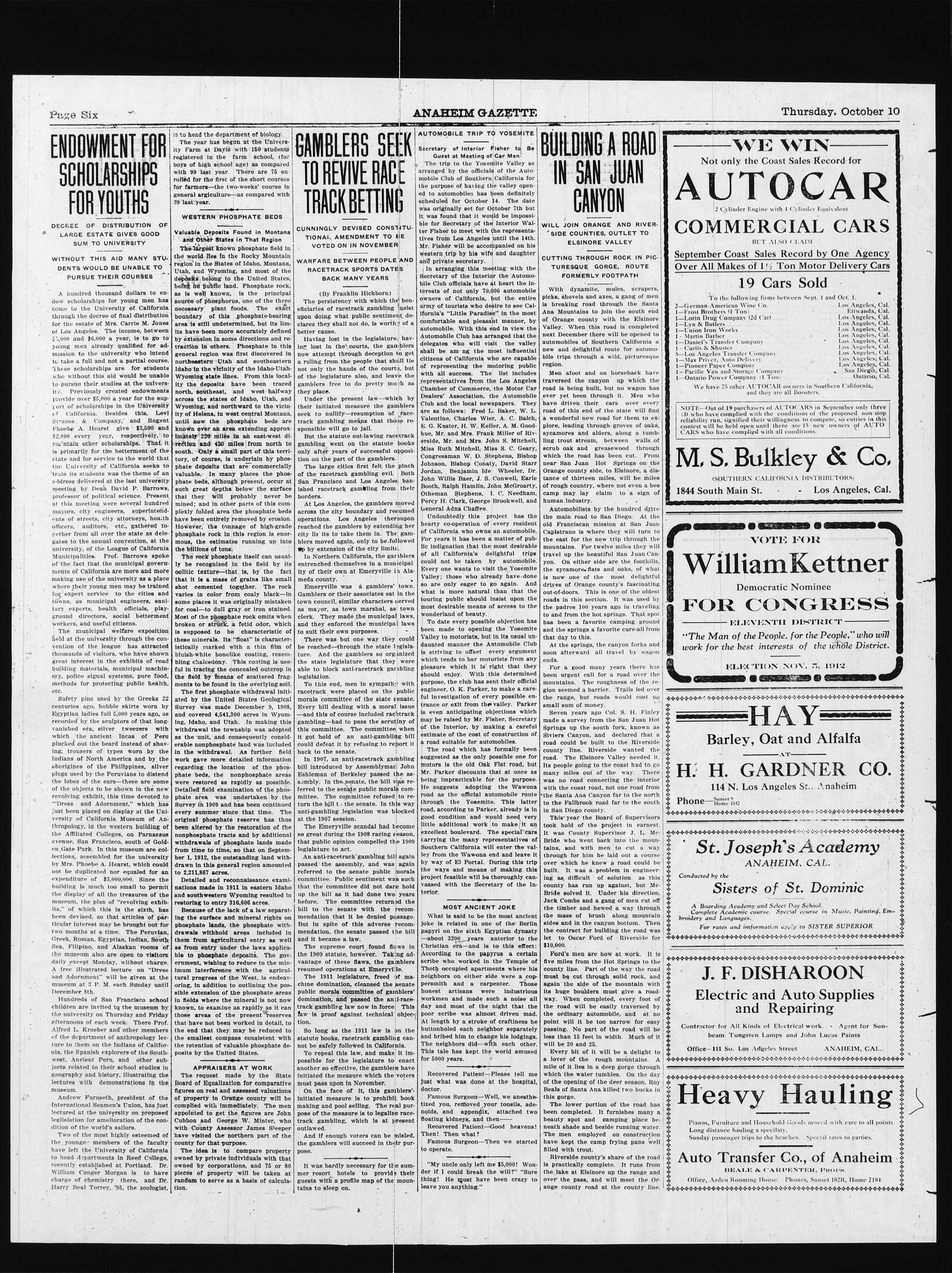
Searchable text
ENDOWMENT FOR SCHOLARSHIPS FOR YOUTHS
DECREE OF DISTRIBUTION OF LARGE ESTATE GIVES GOOD SUM TO UNIVERSITY
WITHOUT THIS AID MANY STUDENTS WOULD BE UNABLE TO PURSUE THEIR COURSES
A hundred thousand dollars to endow scholarships for young men has come to the University of California through the decree of final distribution for the estate of Mrs. Carrie M. Jones of Los Angeles. The income, between $7,000 and $6,000 a year, is to go to young men already qualified for admission to the university who intend to take a full and not a partial course. These scholarships are for students who without this aid would be unable to pursue their studies at the university. Previously created endowments provide over $5,000 a year for the support of scholarships in the University of California. Besides this, Levi Strauss & Company, and Regent Phoebe A. Hearst give $3,500 and $2,400 every year, respectively, to maintain other scholarships. That it is primarily for the betterment of the state and for service to the world that the University of California seeks to train its students was the theme of an is to head the department of biology.
The year has begun at the University Farm at Davis with 150 students registered in the farm school, (for boys of high school age) as compared with 99 last year. There are 75 enrolled for the first of the short courses for farmers—the two-weeks' course in general agriculture—as compared with 39 last year.
WESTERN PHOSPHATE BEDS
Valuable Deposits Found in Montana and Other States in That Region
The largest known phosphate field in the world lies in the Rocky Mountain region in the States of Idaho, Montana, Utah, and Wyoming, and most of the deposits belong to the United States, being on public land. Phosphate rock, as is well known, is the principal source of phosphorus, one of the three necessary plant foods. The exact boundary of this phosphate-bearing area is still undetermined, but its limits have been more accurately defined by extension in some directions and traction in others. Phosphate in this general region was first discovered in northeastern Utah and southeastern Idaho in the vicinity of the Idaho-Utah-Wyoming state lines. From this locality the deposits have been traced north, southeast, and west halfway across the states of Idaho, Utah, and Wyoming, and northward to the vicinity of Helena, in west central Montana, until now the phosphate beds are known over an area extending approximately 220 miles in an east-west direction and 420 miles from north to south. Only a small part of this territory, of course, is underlain by phosphate deposits that are commercially valuable. In many places the phos-
who without this aid would be unable to pursue their studies at the university. Previously created endowments provide over $5,000 a year for the support of scholarships in the University of California. Besides this, Levi Strauss & Company, and Regent Phoebe A. Hearst give $3,500 and $2,400 every year, respectively, to maintain other scholarships. That it is primarily for the betterment of the state and for service to the world that the University of California seeks to train its students was the theme of an address delivered at the last university meeting by Deah David P. Barrows, professor of political science. Present at this meeting were several hundred mayors, city engineers, superintendents of streets, city attorneys, health officers, auditors, etc., gathered together from all over the state as delegates to the annual convention, at the university, of the League of California Municipalities. Prof. Barrows spoke of the fact that the municipal governments of California are more and more making use of the university as a place where their young men may be trained for expert service to the cities and towns, as municipal engineers, sanitary experts, health officials, playground directors, social betterment workers, and useful citizens.
The municipal welfare exposition held at the university through the convention of the league has attracted thousands of visitors, who have shown great interest in the exhibits of road building materials, municipal machinery, police signal systems, pure food, methods for protecting public health, etc.
Safety pins used by the Greeks 22 centuries ago, hobble skirts worn by Egyptian ladies full 5,000 years ago, as recorded by the sculptors of that long-vanished era, silver tweezers with which the ancient Incas of Peru plucked out the beard instead of shaving, trousers of types worn by the Indians of North America and by the aborigines of the Philippines, silver plugs used by the Peruvians to distend the lobes of the ears—these are some of the objects to be shown in the new revolving exhibit, this time devoted to "Dress and Adornment," which has just been placed on display at the University of California Museum of Anthropology, in the western building of the Affiliated Colleges, on Parnassus avenue, San Francisco, south of Golden Gate Park. In this museum are collections, assembled for the university by Mrs. Phoebe A. Hearst, which could not be duplicated nor equaled for an expenditure of $3,000,000. Since the building is much too small to permit the display of all the treasures of the Wyoming state lines. From this locality the deposits have been traced north, southeast, and west halfway across the states of Idaho, Utah, and Wyoming, and northward to the vicinity of Helena, in west central Montana, until now the phosphate beds are known over an area extending approximately 220 miles in an east-west direction and 420 miles from north to south. Only a small part of this territory, of course, is underlain by phosphate deposits that are commercially valuable. In many places the phosphate beds although present, occur at such great depths below the surface that they will probably never be mined; and in other parts of this complexly folded area the phosphate beds have been entirely removed by erosion. However, the tonnage of high-grade phosphate rock in this region is enormous, the estimates running up into the billions of tons.
The rock phosphate itself can usually be recognized in the field by its oolitic texture—that is, by the fact that it is a mass of grains like small shot cemented together. The rock varies in color from coaly black—in some places it was originally mistaken for coal—to dull gray or iron stained. Most of the phosphate rock omits when broken or struck, a fetid odor, which is supposed to be characteristic of these minerals. Its "float" is characteristically marked with a thin film of bluish-white bonelike coating, resembling chalcedony. This coating is useful in tracing the concealed outcrop in the field by means of scattered fragments to be found in the overlying soil.
The first phosphate withdrawal initiated by the United States Geological Survey was made December 9, 1908, and covered 4,541,300 acres in Wyoming, Idaho, and Utah. In making this withdrawal the township was adopted as the unit, and consequently considerable nonphosphate land was included in the withdrawal. As further field work gave more detailed information regarding the location of the phosphate beds, the nonphosphate areas were restored as rapidly as possible. Detailed field examination of the phosphate area was undertaken by the Survey in 1909 and has been continued every summer since that time. The original phosphate reserve has thus been altered by the restoration of the nonphosphate tracts and by additional withdrawals of phosphate lands made from time to time, so that on September 1, 1912, the outstanding land withdrawn in this general region amounted to 2,211,867 acres.
Detailed and reconnaissance examinations made in 1911 in eastern Idaho and southwestern Wyoming resulted in
Under the presence their initiated measure seek to nullify—repeat track gambling more responsible will go to.
But the statute of gambling went on only after years operation on the part of it.
The large cities of the racetrack game San Francisco and ished racetrack game borders.
At Los Angeles, there across the city bourgeois operations. Los Angeles reached the gamble city lir its to take burglers moved again up by extension of it.
In Northern California entrenched themselves city of their own at meda county.
Emeryville was a Gamblers or their town council, similar as mayor, as town clerk. They made it and they enforced it to suit their own purpose.
There was but no breach—through nature. And the game the state legislature able to block anti-gambling legislation.
To this end, mercury racetrack were placed morals committee in Every bill dealing with—and this of course gambling—had to pass this committee. That it got hold of an could defeat it by not back to the senate.
In 1907, an anti-bill introduced by Eshleman of Berkshire. In the senateferred to the senate committee. The committee turn the bill tion against-gambling legislation at the 1907 session.
The Emeryville said so great during that that public opinion legislature to act.
An anti-racetrack passed the assembly referred to the senate committee. Public that the committee up the bill as it h
"Dress and Adornment," which has just been placed on display at the University of California Museum of Anthropology, in the western building of the Affiliated Colleges, on Parnassus avenue, San Francisco, south of Golden Gate Park. In this museum are collections, assembled for the university by Mrs. Phoebe A. Hearst, which could not be duplicated nor equaled for an expenditure of $3,000,000. Since the building is much too small to permit the display of all the treasures of the museum, the plan of "revolving exhibits," of which this is the sixth, has been devised, so that articles of particular interest may be brought out for two months at a time. The Peruvian, Greek, Roman, Egyptian, Indian, South Sea, Filipino, and Alaskan rooms of the museum also are open to visitors daily except Monday, without charge. A free illustrated lecture on "Dress and Adornment" will be given at the museum at 3 P. M. each Sunday until December 8th.
Hundreds of San Francisco school children are invited to the museum by the university on Thursday and Friday afternoons of each week. There Prof. Alfred L. Kroeber and other members of the department of anthropology lecture to them on the Indians of California, the Spanish explorers of the Southwest, Ancient Peru, and other subjects related to their school studies in geography and history, illustrating the lectures with demonstrations in the museum.
Andrew Furuseh, president of the International Seamen's Union, has just lectured at the university on proposed legislation for amelioration of the condition of the world's sailors.
Two of the most highly esteemed of the younger members of the faculty have left the University of California to head departments in Reed College, recently established at Portland. Dr. William Conger Morgan is to have charge of chemistry there, and Dr. Harry Beal Torrey, '95, the zoologist,
APPRAISERS AT WORK
The request made by the State Board of Equalization for comparative figures on real and assessed valuations of property in Orange county will be complied with immediately. The men appointed to get the figures are John Cubbon and George W. Minter, who with County Assessor James Sleeper have visited the northern part of the county for that purpose.
The idea is to compare property owned by private individuals with that owned by corporations, and 75 or 80 pieces of property will be taken at random to serve as a basis of calculation.
ANAHEIM GAZETTE
GAMBLERS SEEK TO REVIVE RACE TRACK BETTING
CUNNINGLY DEVISED CONSTITUTIONAL AMENDMENT TO BE VOTED ON IN NOVEMBER
WARFARE BETWEEN PEOPLE AND RACETRACK SPORTS DATES BACK MANY YEARS
(By Franklin Hichborn)
The persistency with which the beneficiaries of racetrack gambling insist upon doing what public sentiment declares they shall not do, is worthy of a better cause.
Having lost in the legislature, having lost in the courts, the gamblers now attempt through deception to get a ruling from the people that shall tie not only the hands of the courts, but of the legislature also, and leave the gamblers free to do pretty much as they place.
Under the present law—which by their initiated measure the gamblers seek to nullify—resumption of racetrack gambling means that those responsible will go to jail.
But the statute out-lawing racetrack gambling went on the statute books only after years of successful opposition on the part of the gamblers.
The large cities first felt the pinch of the racetrack gambling evil. Both
AUTOMOBILE TRIP TO YOSEMITE
Secretary of Interior Fisher to Be Guest at Meeting of Car Men
The trip to the Yosemite Valley as arranged by the officials of the Automobile Club of Southern California for the purpose of having the valley opened to automobiles has been definitely scheduled for October 14. The date was originally set for October 7th but it was found that it would be impossible for Secretary of the Interior Walter Fisher to meet with the representatives from Los Angeles until the 14th. Mr. Fisher will be accompanied on his western trip by his wife and daughter and private secretary.
In arranging this meeting with the Secretary of the Interior the Automobile Club officials have at heart the interests of not only 70,000 automobile owners of California, but the entire army of tourists who desire to see California’s “Little Paradise” in the most comfortable and pleasant manner, by automobile. With this end in view the Automobile Club has arranged that the delegates who will visit the valley shall be among the most influential citizens of California who are capable of representing the motoring public with all success. The list includes representatives from the Los Angeles Chamber of Commerce, the Motor Car Dealers’ Association, the Automobile Club and the local newspapers. They are as follows: Fred L. Baker, W. L. Valentine, Charles Wier, A. C. Balch, E. G. Kuster, H. W. Keller, A. M. Goodhue, Mr. and Mrs. Frank Miller of Riverside, Mr. and Mrs. John S. Mitchell, Miss Ruth Mitchell, Miss S. C. Geary, Congressman W. D. Stephens, Bishop Johnson, Bishop Conaty, David Starr Jordan, Benjamin Ide Wheeler, Dr.
BUILDING A ROAD IN SAN JUAN CANYON
WILL JOIN ORANGE AND RIVER-SIDE COUNTIES, OUTLET TO ELSINORE VALLEY
CUTTING THROUGH ROCK IN PICTURESQUE GORGE, ROUTE FORMERLY FOOTPATH
With dynamite, mules, scrapers, picks, shovels and axes, a gang of men is breaking road through the Santa Ana Mountains to join the south end of Orange county with the Elsinore Valley. When this road is completed next December there will be opened to automobiles of Southern California a new and delightful route for automobile trips through a wild, picturesque region.
Men afoot and on horseback have traversed the canyon up which the road is being built, but no wagon has ever yet been through it. Men who have driven their cars over every road of this end of the state will find a wonderful new road for them to explore, leading through groves of oaks, sycamores and alders, along a tumbling trout stream, between walls of scrub oak and greasewood through which the road has been cut. From near San Juan Hot Springs on the Orange county side, to Elsinore, a dis-
of the legislature also, and leave the gamblers free to do pretty much as they place.
Under the present law—which by their initiated measure the gamblers seek to nullify—resumption of racetrack gambling means that those responsible will go to jail.
But the statute outlawing racetrack gambling went on the statute books only after years of successful opposition on the part of the gamblers.
The large cities first felt the pinch of the racetrack gambling evil. Both San Francisco and Los Angeles banished racetrack gambling from their borders.
At Los Angeles, the gamblers moved across the city boundary and resumed operations. Los Angeles thereupon reached the gamblers by extending her city lir its to take them in. The gamblers moved again, only to be followed up by extension of the city limits.
In Northern California, the gamblers entrenched themselves in a municipality of their own at Emeryville in Alameda county.
Emeryville was a gamblers' town. Gamblers or their associates sat in the town council, similar characters served as mayor, as town marshal, as town clerk. They made the municipal laws, and they enforced the municipal laws to suit their own purposes.
There was but one way they could be reached—through the state legislature. And the gamblers so organized the state legislature that they were able to block anti-racetrack gambling legislation.
To this end, men in sympathy with racetrack were placed on the public morals committee of the state senate. Every bill dealing with a moral issue—and this of course included racetrack gambling—had to pass the scrutiny of this committee. The committee when it got hold of an anti-gambling bill could defeat it by refusing to report it back to the senate.
In 1907, an anti-racetrack gambling bill introduced by Assemblymar John Eshleman of Berkeley passed the assembly. In the senate, the bill was referred to the senate public morals committee. The committee refused to return the bill to the senate. In this way anti-gambling legislation was blocked at the 1907 session.
The Emeryville scandal had become so great during the 1908 racing season, that public opinion compelled the 1909 legislature to act.
An anti-racetrack gambling bill again passed the assembly, and was again referred to the senate public morals committee. Public sentiment was such that the committee did not dare hold up the bill as it had done two years with all success. The list includes representatives from the Los Angeles Chamber of Commerce, the Motor Car Dealers’ Association, the Automobile Club and the local newspapers. They are as follows: Fred L. Baker, W. L. Valentine, Charles Wier, A. C. Balch, E. G. Kuster, H. W. Keller, A. M. Goodhue, Mr. and Mrs. Frank Miller of Riverside, Mr. and Mrs. John S. Mitchell, Miss Ruth Mitchell, Miss S. C. Geary, Congressman W. D. Stephens, Bishop Johnson, Bishop Conaty, David Starr Jordan, Benjamin Ide Wheeler, Dr. John Willis Baer, J. S. Conwell, Earle Booth, Ralph Hamlin, John McGroarty, Otheman Stephens, I. C. Needham, Percy H. Clark, George Brookwell, and General Adna Chaffee.
Undoubtedly this project has the hearty co-operation of every resident of California who owns an automobile. For years it has been a matter of public indignation that the most desirable of all California's delightful trips could not be taken by automobile. Every one wants to visit the Yosemite Valley; those who already have done so are only eager to go again. And what is more natural than that the touring public should insist upon the most desirable means of access to the wonderland of beauty.
To date every possible objection has been made to opening the Yosemite Valley to motorists, but in its usual undaunted manner the Automobile Club is striving to offset every argument which tends to bar motorists from any pleasure which it is right that they should enjoy. With this determined purpose, the club has sent their official engineer, O. K. Parker, to make a careful investigation of every possible entrance or exit from the valley. Parker is even anticipating objections which may be raised by Mr. Fisher, Secretary of the Interior, by making a careful estimate of the cost of construction of a road suitable for automobiles.
The road which has formally been suggested as the only possible one for motors is the old Oak Flat road, but Mr. Parker discounts that at once as being impracticable for the purpose. He suggests adopting the Wawona road as the official automobile route through the Yosemite. This latter road, according to Parker, already is in good condition and would need very little additional work to make it an excellent boulevard. The special cars carrying many representatives of Southern California will enter the valley from the Wawona end and leave it by way of El Portal. During this trip the ways and means of making this project feasible will be thoroughly canvassed with the Secretary of the Interior.
Men about and on horseback have traversed the canyon up which the road is being built, but no wagon has ever yet been through it. Men who have driven their cars over every road of this end of the state will find a wonderful new road for them to explore, leading through groves of oaks, sycamores and alders, along a tumbling trout stream, between walls of scrub oak and greasewood through which the road has been cut. From near San Juan Hot Springs on the Orange county side, to Elsinore, a distance of thirteen miles, will be miles of rough country, where not even a bee camp may lay claim to a sign of human industry.
Automobilists by the hundred drive the main road to San Diego. At the old Franciscan mission at San Juan Capistrano is where they will turn to the east for the new trip through the mountains. For twelve miles they will travel up the beautiful San Juan Canyon. On either side are the foothills, the sycamore flats and oaks, of what is now one of the most delightful drives of Orange county's fascinating out-of-doors. This is one of the oldest roads in this section. It was used by the padres 100 years ago in travelling to and from the hot springs. That spot has been a favorite camping ground and the springs a favorite cure-all from that day to this.
At the springs, the canyon forks and soon afterward all travel by wagon ends.
For a good many years there has been urgent call for a road over the mountains. The roughness of the region seemed a barrier. Trails led over the range, but roads would cost no small sum of money.
Seven years ago Col. S. H. Finley made a survey from the San Juan Hot Springs up the south fork, known as Slivers Canyon, and declared that a road could be built to the Riverside county line. Riverside wanted the road. The Elsinore Valley needed it. Its people going to the coast had to go many miles out of the way. There was no road connecting the interior with the coast road, not one road from Santa Ana Canyon far to the north to the Fallbrook road far to the south in San Diego county.
This year the Board of Supervisors took hold of the project in earnest. It was County Supervisor J. L. McBride who went back into the mountains, and with men to cut a way through for him he laid out a course over which he knew a road could be built. It was a problem in engineering as difficult of solution as this county has run up against, but McBride solved it. Under his direction,
Josh Gamble and
The Emeryville scandal had become so great during the 1908 racing season, that public opinion compelled the 1909 legislature to act.
An anti-racetrack gambling bill again passed the assembly, and was again referred to the senate public morals committee. Public sentiment was such that the committee did not dare hold up the bill as it had done two years before. The committee returned the bill to the senate with the recommendation that it be denied passage. But in spite of this adverse recommendation, the senate passed the bill and it became a law.
The supreme court found flaws in the 1909 statute, however. Taking advantage of these flaws, the gamblers resumed operations at Emeryville.
The 1911 legislature, freed of machine domination, cleansed the senate public morals committee of gamblers' domination, and passed the anti-racetrack gambling law now in force. This law is proof against technical objection.
So long as the 1911 law is on the statute books, racetrack gambling cannot be safely followed in California.
To repeal this law, and make it impossible for the legislature to enact another so effective, the gamblers have initiated the measure which the voters must pass upon in November.
On the face of it, this gamblers'-initiated measure is to prohibit book making and pool selling. The real purpose of the measure is to legalize race-track gambling, which is at present outlawed.
And if enough voters can be misled, the gamblers will succeed in their purpose.
It was hardly necessary for the summer resort hotels to provide their guests with a profile map of the mountains to sleep on.
MOST ANCIENT JOKE
What is said to be the most ancient joke is related in one of the Berlin papyri on the sixth Egyptian dynasty—about 3200 years anterior to the Christian era—and is to this effect: According to the papyrus a certain scribe who worked in the Temple of Thoth occupied apartments where his neighbors on either side were a copersmith and a carpenter. Those honest artisans were industrious workmen and made such a noise all day and most of the night that the poor scribe was almost driven mad. At length by a stroke of craftiness he buttonholed each neighbor separately and bribed him to change his lodgings. The neighbors did—with each other. This tale has kept the world amused for 5000 years.
Recovered Patient—Please tell me just what was done at the hospital, doctor.
Famous Surgeon—Well, we anesthetized you, removed your tonsils, adenoids, and appendix, attached two floating kidneys, and then——
Recovered Patient—Good heavens! Then! Then what?
Famous Surgeon—Then we started to operate.
"My uncle only left me $5,000! Wonder if I could break the will?" "Sure thing! He must have been crazy to leave you anything."
to the Fallbrook road far to the south in San Diego county.
This year the Board of Supervisors took hold of the project in earnest. It was County Supervisor J. L. McBride who went back into the mountains, and with men to cut a way through for him he laid out a course over which he knew a road could be built. It was a problem in engineering as difficult of solution as this county has run up against, but McBride solved it. Under his direction, Jack Combs and a gang of men cut off the timber and hewed a way through the mass of brush along mountain sides and in the canyon bottom. Then the contract for building the road was let to Oscar Ford of Riverside for $10,000.
Ford's men are now at work. It is five miles from the Hot Springs to the county line. Part of the way the road must be cut through solid rock, and again the side of the mountain with its huge boulders must give a roadway. When completed, every foot of the road will be easily traversed by the ordinary automobile, and at no point will it be too narrow for easy passing. No part of the road will be less than 15 feet in width. Much of it will be 20 and 25.
Every bit of it will be a delight to a lover of the rough mountains. A mile of it lies in a deep gorge through which the water tumbles. On the day of the opening of the deer season, Roy Beals of Santa Ana killed two bucks in this gorge.
The lower portion of the road has been completed. It furnishes many a beauty spot and camping place beneath shade and beside running water. The men employed on construction have kept the camp frying pans well filled with trout.
Riverside county's share of the road is practically complete. It runs from the lake at Elsinore up the range and over the pass, and will meet the Orange county road at the county line.
THURSDAY, October 10
WE WIN
Not only the Coast Sales Record for
AUTOCAR
2 Cylinder Engine with 4 Cylinder Equivalent
COMMERCIAL CARS
BUT ALSO CLAIM
September Coast Sales Record by One Agency
Over All Makes of 1½ Ton Motor Delivery Cars
19 Cars Sold
To the following firms between Sept. 1 and Oct. 1.
2—German-American Wine Co. Los Angeles, Cal.
1—Frost Brothers (1 Ton) Etiwanda, Cal.
1—Lorin Drug Company (2d Car) Los Angeles, Cal.
1—Lyn & Butlers Los Angeles, Cal.
1—Union Iron Works Los Angeles, Cal.
1- Martin Barber Los Angeles, Cal.
1—Daniel's Transfer Company Los Angeles, Cal.
1- Curtis & Shuster Los Angeles, Cal.
5—Los Angeles Transfer Company Los Angeles, Cal.
1-Max Priver, Auto Delivery Los Angeles, Cal.
1-Pioneer Paper Company Los Angeles, Cal.
1-Pacific Van and Storage Company San Diego, Cal.
1-Ontario Power Company (1 Ton) Ontario, Cal.
We have 75 other AUTOCAR owners in Southern California,
and they are all Boosters.
NOTE—Out of 19 purchasers of AUTOCARS in September only three
(3) who have complied with the conditions of the proposed non-stop
reliability run, signified their willingness to compete, so entries in this
contest will be held open until there are 15 new owners of AUTOCARS who have complied with all conditions.
M, S. Bulkley & Co.
1—Ontario Power Company (1 Ton)
Ontario, Cal.
We have 75 other AUTOCAR owners in Southern California,
and they are all Boosters.
NOTE—Out of 19 purchasers of AUTOCARS in September only three
(3) who have complied with the conditions of the proposed non-stop
reliability run, signified their willingness to compete, so entries in this
contest will be held open until there are 15 new owners of AUTOCARS who have complied with all conditions.
M. S. Bulkley & Co,
(SOUTHERN CALIFORNIA DISTRIBUTORS)
1844 South Main St. - Los Angeles, Cal.
VOTE FOR
WilliamKettner
Democratic Nominee
FOR CONGRESS
ELEVENTH DISTRICT
"The Man of the People, for the People," who will
work for the best interests of the whole District.
ELECTION NOV. 5, 1912
HAY
Barley, Oat and Alfalfa
AT
H. H. GARDNER CO.
114 N. Los Angeles St., Anaheim
Phone—Sunset 9
Home 1542
St. Joseph’s Academy
ANAHEIM, CAL.
Conducted by the
Sisters of St. Dominic
St. Joseph’s Academy
ANAHEIM, CAL.
Conducted by the
Sisters of St. Dominic
A Boarding Academy and Select Day School.
Complete Academic course. Special course in Music, Painting, Embroidery and Languages.
For rates and information apply to SISTER SUPERIOR
J. F. DISHAROON
Electric and Auto Supplies and Repairing
Contractor for All Kinds of Electrical work. Agent for Sunbeam Tungsten Lamps and John Lucas Paints
Office—111 So. Los Angeles Street ANAHEIM, CAL.
Heavy Hauling
Pianos, Furniture and Household Goods moved with care to all points
Long distance hauling a specilaty.
Sunday passenger trips to the beaches. Special rates to parties.
Auto Transfer Co., of Anaheim
BEALE & CARPENTER, PROPS.
Office, Arden Rooming House. Phones, Sunset 102R, Home 2104