anaheim-gazette 1912-10-03
Scanned page
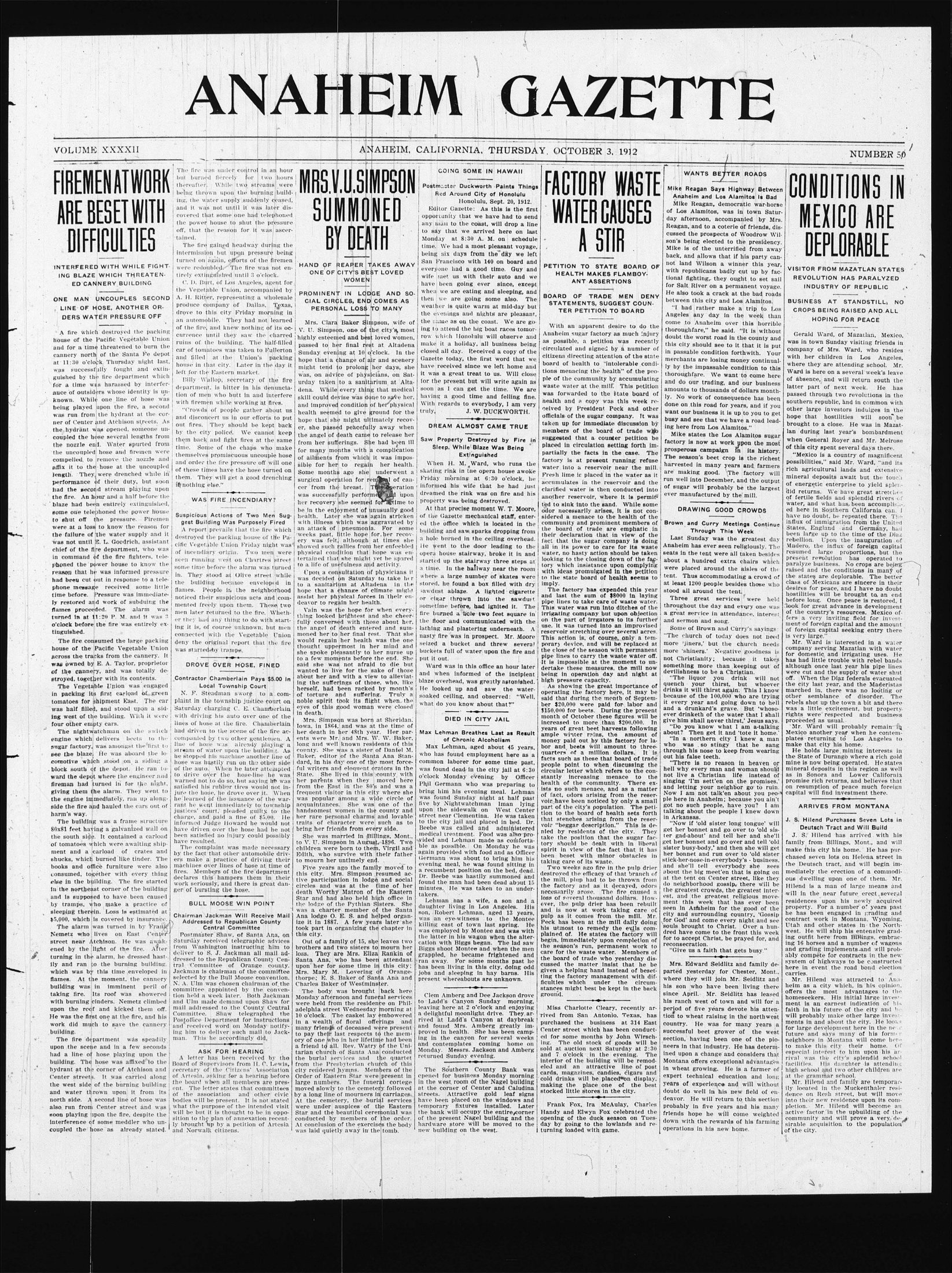
Searchable text
FIREMEN AT WORK ARE BESET WITH DIFFICULTIES
INTERFERED WITH WHILE FIGHTING BLAZE WHICH THREATENED CANNERY BUILDING
ONE MAN UNCOUPLES SECOND LINE OF HOSE, ANOTHER ORDERS WATER PRESSURE OFF
A fire which destroyed the packing house of the Pacific Vegetable Union and for a time threatened to burn the cannery north of the Santa Fe depot at 11:30 o'clock Thursday night last, was successfully fought and extinguished by the fire department which for a time was harassed by interference of outsiders whose identity is unknown. While one line of hose was being played upon the fire, a second was run from the hydrant at the corner of Center and Atchison streets. As the hydrant was opened, someone uncoupled the hose several lengths from the nozzle end. Water spurred from the uncoupled hose and firemen were compelled to remove the nozzle and affix it to the hose at the uncoupled length. They were drenched while in The fire was under control in an hour but burned fiercely for two hours thereafter. While two streams were being thrown upon the burning building, the water supply suddenly ceased, and it was not until it was later discovered that some one had telephoned the power house to shut the pressure off, that the reason for it was ascertained.
The fire gained headway during the intermission but upon pressure being turned on again, efforts of the firemen were redoubled. The fire was not entirely extinguished until 3 o'clock.
C. D. Burt, of Los Angeles, agent for the Vegetable Union, accompanied by A. H. Ritter, representing a wholesale produce company of Dallas, Texas, drove to this city Friday morning in an automobile. They had not learned of the fire, and knew nothing of its occurrence until they saw the charred ruins of the building. The half-filled car of tomatoes was taken to Fullerton and filled at the Union's packing house in that city. Later in the day it left for the Eastern market.
Billy Wallop, secretary of the fire department, is bitter in his denunciation of men who butt in and interfere with firemen while working at fires.
"Crowds of people gather about us and disconcert us in our efforts to put out fires. They should be kept back by the city police. We cannot keep them back and fight fires at the same time. Some of the chaps who make themselves promiscuous uncouple hose and order the fire pressure off will one of these times have the hose turned on."
guished by the fire department which for a time was harassed by interference of outsiders whose identity is unknown. While one line of hose was being played upon the fire, a second was run from the hydrant at the corner of Center and Atchison streets. As the hydrant was opened, someone uncoupled the hose several lengths from the nozzle end. Water spurted from the uncoupled hose and firemen were compelled to remove the nozzle and affix it to the hose at the uncoupled length. They were drenched while in performance of their duty, but soon had the second stream playing upon the fire. An hour and a half before the blaze had been entirely extinguished, some one telephoned the power house to shut off the pressure. Firemen were at a loss to know the reason for the failure of the water supply and it was not until E. L. Goodrich, assistant chief of the fire department, who was in command of the fire fighters, telephoned the power house to know the reason that he was informed pressure had been cut out in response to a telephone message received some little time before. Pressure was immediately restored and work of subduing the flames proceeded. The alarm was turned in at 11:20 P.M. and it was 3 o'clock before the fire was entirely extinguished.
The fire consumed the large packing house of the Pacific Vegetable Union across the tracks from the cannery. It was owned by E. A. Taylor, proprietor of the cannery, and was totally destroyed, together with its contents.
The Vegetable Union was engaged in packing its first carload of green tomatoes for shipment East. The car was half filled, and stood upon a siding west of the building. With it were four other empty cars.
The nightwatchman on the switch engine which delivers beets to the sugar factory, was amongst the first to see the blaze. He was aboard the locomotive which stood on a siding a block south of the depot. He ran toward the depot where the engineer and fireman had turned in for the night, giving them the alarm. They went to the engine immediately, ran up alongside the fire and hauled the cars out of harm's way.
The building was a frame structure 80x81 feet having a galvanized wall on the south side. It contained a carload of tomatoes which were awaiting shipment and a carload of crates and shucks, which burned like tinder. The books and office furniture were also consumed, together with every thing else in the building. The fire started in the northeast corner of the building and is supposed to have been caused
Billy Wallop, secretary of the fire department, is bitter in his denunciation of men who butt in and interfere with firemen while working at fires.
"Crowds of people gather about us and disconcert us in our efforts to put out fires. They should be kept back by the city police. We cannot keep them back and fight fires at the same time. Some of the chaps who make themselves promiscuous uncoupled hose and order the fire pressure off will one of these times have the hose turned on them. They will get a good drenching if nothing else."
WAS FIRE INCENDIARY?
Suspicious Actions of Two Men Suggest Building Was Purposely Fired
A report prevails that the fire which destroyed the packing house of the Pacific Vegetable Union Friday night was of incendiary origin. Two men were seen running west on Chartres street some time before the alarm was turned in. They stood at Olive street while the building became enveloped in flames. People in the neighborhood noticed their suspicious acts and commented freely upon them. These two men later returned to the fire. Whether they had any thing to do with starting it is, of course unknown, but men connected with the Vegetable Union deny the original report that the fire was started by tramps.
DROVE OVER HOSE, FINED
Contractor Chamberlain Pays $5.00 In Local Township Court
N. F. Steadman swore to a complaint in the township justice court on Saturday charging C. E. Chamberlain with driving his auto over one of the lines of hose at the fire. Chamberlain had driven to the scene of the fire accompanied by two other gentlemen. A line of hose was already playing a stream of water upon the building. As he stopped his machine another line of hose was hastily run on the other side of the auto. When he later attempted to drive over the hose-line he was warned not to do so, but saying he was satisfied his rubber tires would not injure the hose, he drove over it. When he learned of the issuance of the warrant he went immediately to township justices' court, pleaded guilty to the charge, and paid a fine of $5.00. He informed Judge Howard he would not have driven over the hose had he not been satisfied no injury could possibly have resulted.
The complaint was made necessary by the fact that other automobile drivers make a practice of driving their machines over lines of hose at time of fires. Members of the fire department declares this hampers them in their work seriously, and there is great danger of bursting the hose.
Was on advice of her husband taken to a daydna. While everyone skill could devise ways and improved condition health seemed to give hope that she might erer, she passed peace with angel of death from her sufferings for many months without ailments from wsible for her to m Some months ago surgical operation cer from the break was successfully performed her recovery she seized in her enjoyment health. Later she with illness which she an attack of pneumonia weeks past, little berry was felt, although showed such rallies physical condition pertained that she relied on a life of usefulness.
Upon a consultation was decided on Saratoga to a sanitarium at hope that a change assist her physical deavour to regain her Vain was the hose thing looked bright fully conversed with the angel of death moned her to her fi would regain her thought uppermost she spoke pleasantly said she was not wanted to live for about her and with ing the sufferings she herself, had been used of torture and so noble spirit took in eyes of this good win in death.
Mrs. Simpson was Iowa, in 1864, and her death in her 48 ents were Mr. and long and well known county. She was as Baker, editor of thard, in his day one ful writers and eloq State. She lived in her parents when from the East in frequent visitor in that was popular among acquaintances. She handsomest women her rare personal characteristics bring her friends frees.
She was married to V. U. Simpson in children were born Edith, who survived to mourn her untimely Five years ago this city. Mrs. Simpson participation in circles and was at death Worthy Matr Star and had also
The building was a frame structure 80x81 feet having a galvanized wall on the south side. It contained a carload of tomatoes which were awaiting shipment and a carload of crates and shucks, which burned like tinder. The books and office furniture were also consumed, together with every thing else in the building. The fire started in the northeast corner of the building and is supposed to have been caused by tramps, who make a practice of sleeping therein. Loss is estimated at $5,000, which is covered by insurance.
The alarm was turned in by Frank Nemetz who lives on East Center street near Atchison. He was awakened by the light of the fire. After turning in the alarm, he dressed hastily and ran to the burning building, which was by this time enveloped in flames. At the moment, the cannery building was in imminent peril of taking fire. Its roof was showered with burning cinders. Nemetz climbed upon the roof and kicked them off. He was the first one at the fire, and his work did much to save the cannery building.
The fire department was speedily upon the scene and in a few seconds had a line of hose playing upon the building. The hose was affixed to the hydrant at the corner of Atchison and Center streets. It was carried along the west side of the burning building and water thrown upon it from its north side. A second line of hose was also run from Center street and was soon playing upon the fire, despite the interference of some meddler who uncoupled the hose as already stated.
BULL MOOSE WIN POINT
Chairman Jackman Will Receive Mail Addressed to Republican County Central Committee
Postmaster Shaw, of Santa Ana, on Saturday received telegraphic advices from Washington instructing him to deliver to S. J. Jackman all mail addressed to the Republican County Central Committee of Orange county. Jackman is chairman of the committee selected by the Bull Moose convention. N. A. Ulm was chosen chairman of the committee appointed by the convention held a week later. Both Jackman and Ulm made demand upon Shaw for mail addressed to the County Central Committee. Shaw telegraphed the Postoffice Department for instructions and received word on Monday notifying him to deliver such mail to Jackman. This he accordingly did.
ASK FOR HEARING
A letter has been received by the Board of Supervisors from H. C. Lewis, secretary of the Citizens' Association of Artesia, asking for a hearing before the board when all members are present. The letter states that committees of the association and other civic bodies will be present. It is not stated what the purpose of the intended visit will be but it is thought to be in opposition to the plan of annexation recently brought up by a petition of Artesia and Norwalk citizens.
She was married to V. U. Simpson in children were born Edith, who survived to mourn her untimely five years ago this city. Mrs. Simpson participated in circles and was at death Worthy Matr Star and had also led the lodge of the Pyra was a charter member Ana lodge O. E. S. size it in 1887. A foul took part in organizing this city.
Out of a family of brothers and two sisters loss. They are Mr. Santa Ana, who has upon her for some Mrs. Mary M. Love thorpe; E. S. Baker Charles Baker of W.
The body was buried Monday afternoon after were held from the adelphia street Wed 10 o'clock. The case in a wealth of flowers many friends of deceased to pay their last restory of one who in her friend to all. Rev. tarian church of San the burial services from the Presbyterian city rendered hymns Order of Eastern St large numbers. The moved slowly to the by a long line of mound At the cemetery, they were under auspice Star and the beautified conducted by memb At conclusion of the was laid quietly away
ANAHEIM, CALIFORNIA, THURSDAY. OCTOBER 3, 1912
MRS.V.U.SIMPSON
SUMMONED
BY DEATH
HAND OF REAPER TAKES AWAY
ONE OF CITY'S BEST LOVED WOMEN
PROMINENT IN LODGE AND SOCIAL CIRCLES, END COMES AS PERSONAL LOSS TO MANY
Mrs. Clara Baker Simpson, wife of V. U. Simpson, one of the city's most highly esteemed and best loved women, passed to her final rest at Altadena Sunday evening at 10 o'clock. In the hope that a change of air and scenery might tend to prolong her days, she was, on advice of physicians, on Saturday taken to a sanitarium at Altadena. While every thing that medical skill could devise was done to save her, and improved condition of her physical health seemed to give ground for the hope that she might ultimately recover, she passed peacefully away when the angel of death came to release her from her sufferings. She had been ill for many months with a complication of ailments from which it was impossible for her to regain her health. Some months ago she underwent a
GOING SOME IN HAWAII
Postmaster Duckworth Paints Things
Red Around City of Honolulu
Honolulu, Sept. 20, 1912.
Editor Gazette: As this is the first opportunity that we have had to send any man to the coast, will drop a line to say that we arrived here on last Monday at 8:30 A.M. on schedule time. We had a most pleasant voyage, being six days from the day we left San Francisco with 140 on board and everyone had a good time. Guy and wife met us with their auto and we have been going ever since, except when we are eating and sleeping, and then we are going some also. The weather is quite warm at mid-day but the evenings and nights are pleasant, the same as on the coast. We are going to attend the big boat races tomorrow which Honolulu will observe and make it a holiday, all business being closed all day. Received a copy of the Gazette today, the first word that we have received since we left home and it was a great treat to us. Will close for the present but will write again as soon as I can get the time. We are having a good time and felling fine. With regards to everybody, I am very truly,
DREAM ALMOST CAME TRUE
Saw Property Destroyed by Fire in Sleep. While Blaze Was Being Extinguished
When H. M. Ward, who runs the skating rink in the opera house awoke
FACTORY WASTE
WATER CAUSES
A STIR
PETITION TO STATE BOARD OF HEALTH MAKES FLAMBOY-ANT ASSERTIONS
BOARD OF TRADE MEN DENY STATEMENTS, SUGGEST COUNTER PETITION TO BOARD
With an apparent desire to do the Anaheim sugar factory as much injury as possible, a petition was recently circulated and signed by a number of citizens directing attention of the state board of health to "intolerable conditions menacing the health" of the people of the community by accumulating waste water at the mill. This petition was forwarded to the state board of health and a copy was this week received by President Peck and other officials of the sugar company. It was taken up for immediate discussion by members of the board of trade who suggested that a counter petition be placed in circulation setting forth impartially the facts in the case. The factory is at present running refuse water into a reservoir near the mill. Fresh lime is placed in the water as it
was, on advice of physicians, on Saturday taken to a sanitarium at Alta-dena. While every thing that medical skill could devise was done to save her, and improved condition of her physical health seemed to give ground for the hope that she might ultimately recover, she passed peacefully away when the angel of death came to release her from her sufferings. She had been ill for many months with a complication of ailments from which it was impossible for her to regain her health. Some months ago she underwent a surgical operation for removal of cancer from the breast. This operation was successfully performed and upon her recovery she seemed for a time to be in the enjoyment of unusually good health. Later she was again stricken with illness which was aggravated by an attack of pneumonia. For some weeks past, little hope for her recovery was felt, although at times she showed such rallies from her enfeebled physical condition that hope was entertained that she might yet be spared to a life of usefulness and activity.
Upon a consultation of physicians it was decided on Saturday to take her to a sanitarium at Altadena in the hope that a change of climate might assist her physical forces in their endeavor to regain her health.
Vain was the hope for when everything looked brightest and she cheerfully conversed with those about her, the angel of death entered and summoned her to her final rest. That she would regain her health was the one thought uppermost in her mind and she spoke pleasantly to her nurse up to a few moments before the end. She said she was not afraid to die but wanted to live for the sake of those about her and with a view to alleviating the sufferings of those, who, like herself, had been racked by month's of torture and suffering. Truly a noble spirit took its flight when the eyes of this good woman were closed in death.
Mrs. Simpson was born at Sheridan, Iowa, in 1864, and was at the time of her death in her 48th year. Her parents were Mr. and Mrs. W. W. Baker, long and well known residents of this county. She was a sister of Daniel M. Baker, editor of the Santa Ana Standard, in his day one of the most forceful writers and eloquent orators in the State. She lived in this county with her parents when they moved here from the East in the 80’s and was a frequent visitor in this city where she was popular among a wide circle of acquaintances. She was one of the handsomest women in the county and her rare personal charms and lovable traits of character were such as to bring her friends from every side.
She was married in Billings, Mont., to V. U. Simpson in August, 1896. Two children were born to them, Virgil and Edith, who survive with their father to mourn her untimely end.
Five years ago the family moved to this city. Mrs. Simpson resumed active participation in lodge and social circles and was at the time of her death Worthy Matron of the Eastern Star and had also held high office in
it was a great treat to us. Will close for the present but will write again as soon as I can get the time. We are having a good time and felling fine. With regards to everybody, I am very truly,
J. W. DUCKWORTH.
DREAM ALMOST CAME TRUE
Saw Property Destroyed by Fire in Sleep, While Blaze Was Being Extinguished
When H. M. Ward, who runs the skating rink in the opera house awoke Friday morning at 6:30 o’clock, he informed his wife that he had just dreamed the rink was on fire and his property was being destroyed.
At that precise moment W. T. Moore, of the Gazette mechanical staff, entered the office which is located in the building and saw sparks dropping from a hole burned in the ceiling overhead. He went to the door leading to the opera house stairway, broke it in and started up the stairway three steps at a time. In the hallway near the room where a large number of skates were stored, he found a box filled with dry sawdust ablaze. A lighted cigarette or cigar thrown into the sawdust sometime before, had ignited it. The fire burned a hole two feet square in the floor and communicated with the lathing and plastering underneath. A nasty fire was in prospect. Mr. Moore seized a bucket and threw several buckets full of water upon the fire and put it out.
Ward was in this office an hour later and when informed of the incipient blaze overhead, was greatly astonished. He looked up and saw the water-soaked ceiling, and observed: “Well, what do you know about that?”
DIED IN CITY JAIL
Max Lehman Breathes Last as Result of Chronic Alcoholism
Max Lehman, aged about 45 years, who has found employment here as a common laborer for some time past, was found dead in the city jail at 6:30 o’clock Monday evening by Officer Phil Germann who was preparing to bring him his evening meal. Lehman was found Sunday night at half past five by Nightwatchman Iman lying upon the sidewalk on West Center street near Clementina. He was taken to the city jail and placed in bed. Dr. Beebe was called and administered medical treatment. Food was also provided and Lehman made as comfortable as possible. On Monday he was again provided with food and as Officer Germann was about to bring him his evening meal, he was found sitting in a recumbent position on the bed, dead. Dr. Beebe was hastily summoned and found the man had been dead about 15 minutes. He was taken to an undertakers.
ple of the community by accumulating waste water at the mill. This petition was forwarded to the state board of health and a copy was this week received by President Peck and other officials of the sugar company. It was taken up for immediate discussion by members of the board of trade who suggested that a counter petition be placed in circulation setting forth impartially the facts in the case. The factory is at present running refuse water into a reservoir near the mill. Fresh lime is placed in the water as it accumulates in the reservoir and the clarified water is then conducted into another reservoir, where it is permitted to sink into the sand. While some odor necessarily arises, it is not considered a menace to the health of the community and prominent members of the board of trade are emphatic in their declaration that in view of the fact that the sugar company is doing all in its power to care for its waste water, no hasty action should be taken looking to the closing down of the factory which insistence upon complying with ideas promulgated in the petition to the state board of health seems to imply.
The factory has expended this year and last the sum of $8000 in laying pipe lines to take care of waste water. This water was run into ditches of the irrigating company but upon objection on the part of irrigators to its further use. It was turned into an improvised reservoir stretching over several acres. This action is, of course, only a temporary device, and will be replaced at the close of the season with permanent pipe lines to carry the waste water off. It is impossible at the moment to undertake these measures, the mill now being in operation day and night at high pressure capacity.
As showing the great importance of operating the factory here, it may be said that during the month of September $20,000 were paid for labor and $150,000 for beets. During the present month of October these figures will be increased to more than $200,000. In years of great beet harvests following ample winter rains, the amount of money paid out by this factory for labor and beets will amount to three-quarters of a million dollars. It is facts such as these that board of trade people point to when discussing the circular letter which refers to the constantly increasing menace to the health of the community. There exists no such menace, and as a matter of fact, odors arising from the reservoir have been noticed by only a small part of the city’s population. The petition to the board of health sets forth that stenches arising from the reservoir “beggar description.” This is denied by residents of the city. They take the position that the sugar factory should be dealt with in liberal spirit in view of the fact that it has been beset with minor obstacles in taking care of its waste.
Two weeks ago fire in the pulp drier destroyed the efficacy of that branch of the mill, plup had to be thrown from the factory and as it decayed, odors necessarily arose. The fire caused a loss of several thousand dollars. How-
was popular among a wide circle of acquaintances. She was one of the handsomest women in the county and her rare personal charms and lovable traits of character were such as to bring her friends from every side.
She was married in Billings, Mont., to V. U. Simpson in August, 1896. Two children were born to them, Virgil and Edith, who survive with their father to mourn her untimely end.
Five years ago the family moved to this city. Mrs. Simpson resumed active participation in lodge and social circles and was at the time of her death Worthy Matron of the Eastern Star and had also held high office in the lodge of the Pythian Sisters. She was a charter member of the Santa Ana lodge O. E. S. and helped organize it in 1887. A few years later she took part in organizing the chapter in this city.
Out of a family of 15, she leaves two brothers and two sisters to mourn her loss. They are Mrs. Eliza Rankin of Santa Ana, who has been attendant upon her for some time in this city; Mrs. Mary M. Lovering of Orange-thorpe; E. S. Baker of Santa Ana and Charles Baker of Westminster.
The body was brought back here Monday afternoon and funeral services were held from the residence on Philadelphia street Wednesday morning at 10 o'clock. The casket lay embowered in a wealth of floral offerings and many friends of deceased were present to pay their last respects to the memory of one who in her lifetime had been a friend to all. Rev. Watry of the Unitarian church of Santa Ana conducted the burial services and the quartet from the Presbyterian church of this city rendered hymns. Members of the Order of Eastern Star were present in large numbers. The funeral cortex moved slowly to the cemetery followed by a long line of mourners in carriages. At the cemetery, the burial services were under auspices of the Eastern Star and the beautiful ceremonial was conducted by members of the order. At conclusion of the exercises the body was laid quietly away in the tomb.
Clem Amberg and Dee Jackson drove to Ladd's Canyon Sunday morning, leaving here at 2 o'clock and enjoying a delightful moonlight drive. They arrived at Ladd's Canyon at daybreak and found Mrs. Amberg greatly improved in health. She has been camping in the canyon for several weeks and contemplates coming home on Monday. Messrs. Jackson and Amberg returned Sunday evening.
The Southern County Bank was opened for business Monday morning in the west room of the Nagel building at the corner of Center and Caludina streets. Attractive gold leaf signs have been placed on the windows and temporary fixtures installed. Later the bank will occupy the entire corner of the present Nagel building and the hardware store will be moved to the new building on the west.
voir have been noticed by only a small part of the city's population. The petition to the board of health sets forth that stenches arising from the reservoir "beggar description." This is denied by residents of the city. They take the position that the sugar factory should be dealt with in liberal spirit in view of the fact that it has been beset with minor obstacles in taking care of its waste.
Two weeks ago fire in the pulp drier destroyed the efficacy of that branch of the mill, plup had to be thrown from the factory and as it decayed, odors necessarily arose. The fire caused a loss of several thousand dollars. However, the pulp drier has been rebuilt and is now at work taking care of pulp as it comes from the mill. Mr. Peck has been at the mill daily doing his utmost to remedy the evils complained of. He states the factory will begin, immediately upon completion of the season's run, permanent work to care for the waste water. Members of the board of trade who yesterday discussed the matter insist that he be given a helping hand instead of besetting the factory management with difficulties which under the circumstances might best be kept in the background.
Miss Charlotte Cleary, recently arrived from San Antonio, Texas, has purchased the business at 314 East Center street which has been conducted for some months by John Wirsching. The old stock of goods will be sold at auction next Saturday at 2:30 and 7 o'clock in the evening. The interior of the building will be remodeled and an attractive line of post cards, magazines, candies, cigars and cold drinks will be placed on display, making the place one of the best stocked little stores in the city.
Frank Fox, Ira McAulay, Charles Handy and Elwyn Fox celebrated the opening of the duck season on Tuesday by going to the lowlands and returning loaded with game.
MAR 3, 1912
WANTS BETTER ROADS
Mike Reagan Says Highway Between Anaheim and Los Alamitos Is Bad
Mike Reagan, democratic war-horse of Los Alamitos, was in town Saturday afternoon, accompanied by Mrs. Reagan, and to a coterie of friends, discussed the prospects of Woodrow Wilson's being elected to the presidency. Mike is of the unerrified from away back, and allows that if his party cannot land Wilson a winner this year, with republicans badly cut up by factional fighting, they ought to set sail for Salt River on a permanent voyage. He also took a crack at the bad roads between this city and Los Alamitos.
"I had rather make a trip to Los Angeles any day in the week than come to Anaheim over this horrible thoroughfare," he said. "It is without doubt the worst road in the county and this city should see to it that it is put in passable condition forthwith. Your merchants are losing money continually by the impassable condition to this thoroughfare. We want to come here and do our trading, and our business amounts to thousands of dollars monthly. No work of consequence has been done on this road for years, and if you want our business it is up to you to get busy and see that we have a road leading here from Los Alamitos."
Mike states the Los Alamitos sugar factory is now at work upon the most prosperous campaign in its history. The season's beet crop is the richest harvested in many years and farmers are making good. The factory will
CONDITIONS IN MEXICO ARE DEPLORABLE
VISITOR FROM MAZATLAN STATES REVOLUTION HAS PARALYZED INDUSTRY OF REPUBLIC
BUSINESS AT STANDSTILL, NO CROPS BEING RAISED AND ALL HOPING FOR PEACE
Gerald Ward, of Mazatlan, Mexico, was in town Sunday visiting friends in company of Mrs. Ward, who resides with her children in Los Angeles, where they are attending school. Mr. Ward is here on a several week's leave of absence, and will return south the latter part of next week. He has passed through two revolutions in the southern republic, and in common with other large investors indulges in the hope that hostilities will soon be brought to a close. He was in Mazatlan during last year's bombardment when General Royer and Mr. Melrose of this city spent several days there.
"Mexico is a country of magnificent possibilities," said Mr. Ward, "and its rich agricultural lands and extensive
expended this year of $8000 in laying care of waste water. In into ditches of the bay but upon objection gators to its further into an improvised dig over several acres. course, only a tem- will be replaced at union with permanent the waste water off. The moment to un-sures, the mill now on day and night at city.
great importance of story here, it may be one month of Septem-paid for labor and During the present these figures will be less than $200,000. In that harvests following us, the amount of this factory for la-ll amount to three-million dollars. It is be that board of trade when discussing the which refers to the con-g menace to the community. There ex-erce, and as a matter being from the reser-iced by only a small population. The peti-of health sets forth ling from the reser-ception." This is de- of the city. They that the sugar fac- salt with in liberal the fact that it has minor obstacles in waste.
fire in the pulp drier coy of that branch of to be thrown from it decayed, odors The fire caused a thousand dollars. How-
We want to come here and do our trading, and our business amounts to thousands of dollars monthly. No work of consequence has been done on this road for years, and if you want our business it is up to you to get busy and see that we have a road leading here from Los Alamitos."
Mike states the Los Alamitos sugar factory is now at work upon the most prosperous campaign in its history. The season's beet crop is the richest harvested in many years and farmers are making good. The factory will run well into December, and the output of sugar will probably be the largest ever manufactured by the mill.
DRAWING GOOD CROWDS
Brown and Curry Meetings Continue Through This Week
Last Sunday was the greatest day Anaheim has ever seen religiously. The seats in the tent were all taken besides about a hundred extra chairs which were placed around the aisles of the tent. Thus accommodating a crowd of at least 1200 people besides those who stood all around the tent.
Three great services were held throughout the day and every one was a great service in attendance, interest and sermon and song.
Some of Brown and Curry's sayings: "The church of today does not need more 'jiners,' but the church needs more 'shiners.' Negative goodness is not Christianity; because it takes something more than keeping out of devilishness to be a Christian.
"The liquor you drink will not quench your thirst, but whoever drinks it will thirst again. This I know because of the 100,000 who are trying it every year and going down to hell and a drunkard's grave. But 'whosoever drinketh of the water that I shall give him shall never thirst,' Jesus says.
"Do you know what I am a-talking about? Then get it and 'tote it home."
In a northern city I knew a man who was so stingy that he sang through his nose to keep from wearing out his false teeth.
"There is no reason in heaven or hell why every man and woman should not live a Christian life instead of singing I'm sett'en on the promises,' and letting your neighbor go to ruin. Now I am not talk'en about you people here in Anahelm; because you ain't got no such people, have you? I am talking about the people I knew down in Arkansas.
"Now if 'old sister long tongue' will get her bonnet and go over to 'old sister gad-about' and tell her and she'll get her bonnet and go over and tell 'old sister busy-body,' and then she will get her bonnet and run over to 'old sister stick-he-nose-in-everybody's - business, and she'll tell everybody she sees about the big meet'en that is going on at the tent on Center street, like they do neighborhood gossip, there will be the greatest crowds, the greatest interest, and the greatest religious move-
Mexico is a country of magnificent possibilities," said Mr. Ward, "and its rich agricultural lands and extensive mineral deposits await but the touch of energetic enterprise to yield splendid returns. We have great stretches of fertile fields and splendid rivers of water, and what has been accomplished here in Southern California can I have no doubt, be repeated there. The influx of immigration from the United States, England and Germany, had been large up to the time of the Diaz rebellion. Upon the inauguration of Madero, the influx of foreign capital resumed large proportions, but the present revolution has operated to paralyze business. No crops are being raised and the conditions in many of the states are deplorable. The better class of Mexicans are sincere in their desires for peace, and I have no doubt hostilities will be brought to an end before long. Once peace is restored, I look for great advance in development of the country's resources. Mexico offers a very inviting field for investment of foreign capital and the amount of foreign capital seeking entry there is very large."
Mr. Ward is interested in a water company serving Mazatlan with water for domestic and irrigating uses. He has had little trouble with rebel bands although once last year his pipe lines were cut and the supply of water shut off. When the Diaz federals evacuated the city last year, and the Maderistas marched in, there was no looting or other semblance of disorder. The rebels shot up the town a bit and there was a little excitement, but property rights were respected and business proceeded as usual.
Mr. Ward will probably remain in Mexico another year when he contemplates returning to Los Angeles to make that city his home.
He holds large mining interests in the State of Durango where a rich gold mine is now being operated. He states mineral deposits in this region as well as in Sonora and Lower California promise rich returns, and believes that on resumption of peace much foreign capital will find investment there.
ARRIVES FROM MONTANA
J. S. Hilend Purchases Seven Lots in Deutsch Tract and Will Build
J. S. Hilend has arrived with his family from Billings, Mont., and will make this city his home. He has purchased seven lots on Helena street in the Deutsch tract, and will begin immediately the erection of a commodious dwelling upon one of them. Mr. Hilend is a man of large means and will in the near future erect several
ARRIVES FROM MONTANA
J. S. Hilend Purchases Seven Lots in Deutsch Tract and Will Build
J. S. Hilend has arrived with his family from Billings, Mont., and will make this city his home. He has purchased seven lots on Helena street in the Deutsch tract, and will begin immediately the erection of a commodious dwelling upon one of them. Mr. Hilend is a man of large means and will in the near future erect several residences upon his newly acquired property. For a number of years past he has been engaged in grading and contract work in Montana, Wyoming, Utah and other states in the Northwest. He will ship his extensive grading outfit here from Billings, embracing 16 horses and a number of wagons and grading implements and will probably compete for contracts in the new system of highways to be constructed here in event the road bond election carries.
Mr. Hilend was attracted to Anaheim as a city which, in his opinion, offers the most advantages to the homeseekers. His initial large investment is an earnest indication of his faith in his future of the city and he will probably make other large investments in and about the city. He looks for large development here in the near future and says many of his former neighbors in Montana will come here to make this city their home. Of especial interest to him upon his arrival was the city's splendid school facilities. His daughter is attending high school and two other children are at the grammar school.
Mr. Hilend and family are temporarily located in the Muckenthaler residence on Resh street, but will move into their new residence upon its completion. Mr. Hilend will become an active factor in the upbuilding of the community and will prove a very desirable acquisition to the population of the city.