anaheim-gazette 1912-08-22
Scanned page
Searchable text
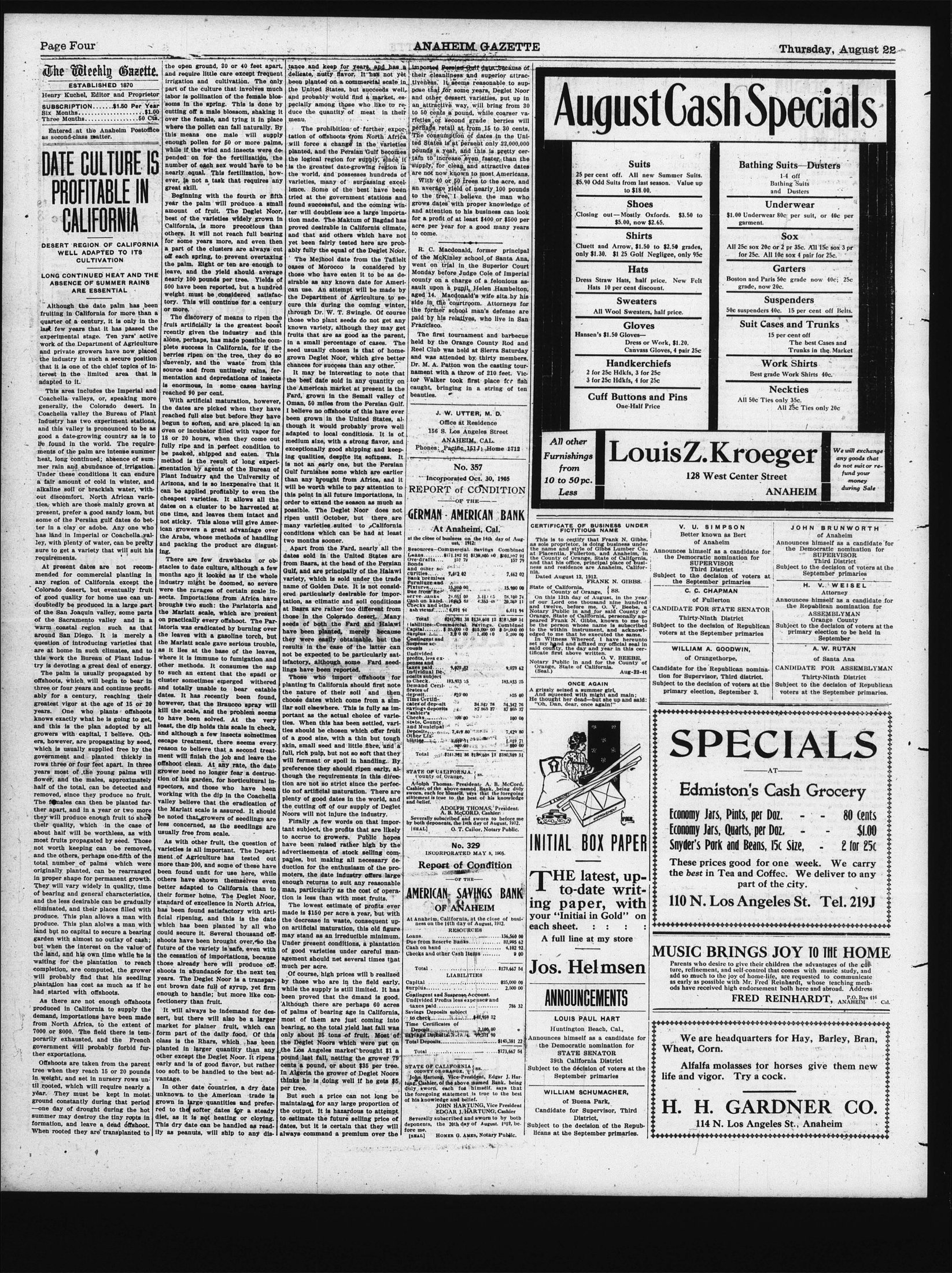
DATE CULTURE IS PROFITABLE IN CALIFORNIA
DESERT REGION OF CALIFORNIA WELL ADAPTED TO ITS CULTIVATION
LONG CONTINUED HEAT AND THE ABSENCE OF SUMMER RAINS ARE ESSENTIAL
Although the date palm has been fruiting in California for more than a quarter of a century, it is only in the last few years that it has passed the experimental stage. Ten yars' active work of the Department of Agriculture and private growers have now placed the industry in such a secure position that it is one of the chief topics of interest in the limited area that is adapted to it.
This area includes the Imperial and Coachella valleys, or, speaking more generally, the Colorado desert. In Coachella valley the Bureau of Plant Industry has two experiment stations, and this valley is pronounced to be as good a date-growing country as is to be found in the world. The requirements of the palm are intense summer heat, long continued; absence of summer rain and abundance of irrigation. Under these conditions it can endure the open ground, 30 or 40 feet apart, and require little care except frequent irrigation and cultivation. The only part of the culture that involves much labor is pollination of the female blossoms in the spring. This is done by cutting off a male blossom, shaking it over the female, and tying it in place where the pollen can fall naturally. By this means one male will supply enough pollen for 50 or more palms, while if the wind and insects were depended on for the fertilization, the number of each sex would have to be nearly equal. This fertilization, however, is not a task that requires any great skill.
Beginning with the fourth or fifth year the palm will produce a small amount of fruit. The Deglet Noor, best of the varieties widely grown in California, is more precocious than others. It will not reach full bearing for some years more, and even then a part of the clusters are always cut off each spring, to prevent overtaxing the palm. Eight or ten are enough to leave, and the yield should average nearly 100 pounds per tree. Yields of 500 have been reported, but a hundred weight must be considered satisfactory. This will continue for a century or more.
The discovery of means to ripen the fruit artificially is the greatest boost recently given the industry and this alone, perhaps, has made possible complete success in California, for if the berries ripen on the tree, they do so unevenly, and the waste from this source and from untimely rains, fermentation and depredations of insects is enormous, in some cases having reached 90 per cent.
With artificial maturation, however, the dates are picked when they have reached full size but before they have begun to soften, and are placed in an oven or incubator filled with vapor for 18 or 20 hours, when they come out fully ripe and in perfect condition to be packed, shipped and eaten. This method is the result of long experimentation by agents of the Bureau of Plant Industry.
The prohibition on citation of offshoots from will force a change planted, and the Persistence logical region for is the greatest date-grown world, and possesses varieties, many of which have been fairly testedably fully the equal of others.
The Mejhool date fives oases of Morocco is those who plant seeds known variety, although fruits that are as good in a small percentage seed usually chosen in grown Deglet Noor, with chances for success through Dr. W. T. Swain those who plant seeds known variety, although fruits that are as good in a small percentage seed usually chosen in grown Deglet Noor, with chances for success through Dr. W. T. Swain those who plant seeds known variety, although fruits that are as good in a small percentage seed usually chosen in grown Deglet Noor, with chances for success through Dr. W. T. Swain those who plant seeds known variety, although fruits that are as good in a small percentage seed usually chosen in grown Deglet Noor, with chances for success through Dr. W. T. Swain those who plant seeds known variety, although fruits that are as good in a small percentage seed usually chosen in grown Deglet Noor, with chances for success through Dr. W. T. Swain those who plant seeds known variety, although fruits that are as good in a small percentage seed usually chosen in grown Deglet Noor, with chances for success through Dr. W. T. Swain those who plant seeds known variety, although fruits that are as good in a small percentage seed usually chosen in grown Deglet Noor, with chances for success through Dr. W. T. Swain those who plant seeds known variety, although fruits that are as good in a small percentage seed usually chosen in grown Deglet Noor, with chances for success through Dr. W. T. Swain those who plant seeds known variety, although fruits that are as good in a small percentage seed usually chosen in grown Deglet Noor, with chances for success through Dr. W. T. Swain those who plant seeds known variety, although fruits that are as good in a small percentage seed usually chosen in grown Deglet Noor, with chances for success through Dr. W. T. Swain those who plant seeds known variety, although fruits that are as good in a small percentage seed usually chosen in grown Deglet Noor, with chances for success through Dr. W. T. Swain those who plant seeds known variety, although fruits that are as good in a small percentage seed usually chosen in grown Deglet Noor, with chances for success through Dr. W. T. Swain those who plant seeds known variety, although fruits that are as good in a small percentage seed usually chosen in grown Deglet Noor, with chances for success through Dr. W. T. Swain those who plant seeds known variety, although fruits that are as good in a small percentage seed usually chosen in grown Deglet Noor, with chances for success through Dr. W. T. Swain those who plant seeds known variety, although fruits that are as good in a small percentage seed usually chosen in grown Deglet Noor, with chances for success through Dr. W. T. Swain those who plant seeds known variety, although fruits that are as good in a small percentage seed usually chosen in grown Deglet Noor, with chances for success through Dr. W. T. Swain those who plant seeds known variety, although fruits that are as good in a small percentage seed usually chosen in grown Deglet Noor, with chances for success through Dr. W. T. Swain those who plant seeds known variety, although fruits that are as good in a small percentage seed usually chosen in grown Deglet Noor, with chances for success through Dr. W. T. Swain those who plant seeds known variety, although fruits that are as good in a small percentage seed usually chosen in grown Deglet Noor, with chances for success through Dr. W. T. Swain those who plant seeds known variety, although fruits that are as good in a small percentage seed usually chosen in grown Deglet Noor, with chances for success through Dr. W. T. Swain those who plant seeds known variety, although fruits that are as good in a small percentage seed usually chosen in grown Deglet Noor, with chances for success through Dr. W. T. Swain those who plant seeds known variety, although fruits that are as good in a small percentage seed usually chosen in grown Deglet Noor, with chances for success through Dr. W. T. Swain those who plant seeds known variety, although fruits that are as good in a small percentage seed usually chosen in grown Deglet Noor, with chances for success through Dr. W. T. Swain those who plant seeds known variety, although fruits that are as good in a small percentage seed usually chosen in grown Deglet Noor, with chances for success through Dr. W. T. Swain those who plant seeds known variety, although fruits that are as good in a small percentage seed usually chosen in grown Deglet Noor, with chances for success through Dr. W. T. Swain those who plant seeds known variety, although fruits that are as good in a small percentage seed usually chosen in grown Deglet Noor, with chances for success through Dr. W. T. Swain those who plant seeds known variety, although fruits that are as good in a small percentage seed usually chosen in grown Deglet Noor, with chances for success through Dr. W. T. Swain those who plant seeds known variety, although fruits that are as good in a small percentage seed usually chosen in grown Deglet Noor, with chances for success through Dr.W.T.Swain those who plant seeds known variety, although fruits that are as good in a small percentage seed usually chosen in grown Deglet Noor, with chances for success through Dr.W.T.Swain those who plant seeds known variety, although fruits that are as good in a small percentage seed usually chosen in grown Deglet Noor, with chances for success through Dr.W.T.Swain those who plant seeds known variety, although fruits that are as good in a small percentage seed usually chosen in grown Deglet Noor, with chances for success through Dr.W.T.Swain those who plant seeds known variety, although fruits that are as good in a small percentage seed usually chosen in grown Deglet Noor
This area includes the Imperial and Coachella valleys, or, speaking more generally, the Colorado desert. In Coachella valley the Bureau of Plant Industry has two experiment stations, and this valley is pronounced to be as good a date-growing country as is to be found in the world. The requirements of the palm are intense summer heat, long continued; absence of summer rain and abundance of irrigation. Under these conditions it can endure a fair amount of cold in winter, and alkaline soil or brackish water, without discomfort. North African varieties, which are those mainly grown at present, prefer a good sandy loam, but some of the Persian gulf dates do better in a clay or adobe. Any one who has land in Imperial or Coachella valley, with plenty of water, can be pretty sure to get a variety that will suit his requirements.
At present dates are not recommended for commercial planting in any region of California except the Colorado desert, but eventually fruit of good quality for home use can undoubtedly be produced in a large part of the San Joaquin valley, some parts of the Sacramento valley and in a warm coastal region such as that around San Diego. It is merely a question of introducing varieties that are at home in such climates, and to this work the Bureau of Plant Industry is devoting a great deal of energy.
The palm is usually propagated by offshoots, which will begin to bear in three or four years and continue profitably for a century, reaching their greatest vigor at the age of 15 or 20 years. One who plants offshoots knows exactly what he is going to get, and this is the plan adopted by all growers with capital, I believe. Others, however, are propagating by seed, which is usually supplied free by the government and planted thickly in rows three or four feet apart. In three years most of the young palms will flower, and the males, approximately half of the total, can be detected and removed, since they produce no fruit. The females can then be planted farther apart, and in a year or two more they will produce enough fruit to show their quality, which in the case of about half will be worthless, as with most fruits propagated by seed. Those not worth keeping can be removed, and the others, perhaps one-fifth of the total number of palms which were originally planted, can be rearranged in proper shape for permanent growth. They will vary widely in quality, time of bearing and general characteristics,
With artificial maturation, however, the dates are picked when they have reached full size but before they have begun to soften, and are placed in an oven or incubator filled with vapor for 18 or 20 hours, when they come out fully ripe and in perfect condition to be packed, shipped and eaten. This method is the result of long experimentation by agents of the Bureau of Plant Industry and the University of Arizona, and is so inexpensive that it can be applied profitably to even the cheapest varieties. It allows all the dates on a cluster to be harvested at one time, and leaves them intact and not sticky. This alone will give American growers a great advantage over the Arabs, whose methods of handling and packing the product are disgusting.
There are few drawbacks or obstacles to date culture, although a few months ago it looked as if the whole industry might be doomed, so severe were the ravages of certain scale insects. Importations from Africa have brought two such: the Parlatoria and the Marlatt scale, which are present on practically every offshoot. The Parlatoria was eradicated by burning over the leaves with a gasoline torch, but the Marlatt scale gave serious trouble, as it lies at the base of the leaves, where it immune to fumigation and other methods. It consumes the sap to such an extent that the spadi or cluster sometimes emerged withered and totally unable to bear eatable dates. It has recently been found, however, that the Braucco spray will kill the scale, and the problem seems to have been solved. At the very least, the dip holds this scale in check, and although a few insects sometimes escape treatment, there seems every reason to believe that a second treatment will finish the job and leave the offshoot clean. At any rate, the date grower need no longer fear a destruction of his garden, for horticultural inspectors, and those who have been working with the dip in the Coachella valley believe that the eradication of the Marlatt scale is assured. It should be noted that growers of seedlings are less concerned, as the seedlings are usually free from scale.
As with other fruit, the question of varieties is all important. The Department of Agriculture has tested out more than 200, and some of these have been found unfit for use here, while others have shown themselves even better adapted to California than to their former home. The Deglet Noor,
It may be interesting that best date sold in the American market is Fard, grown in the S.Oman, 50 miles from tha I believe no offshoots o been grown in the Un though it would probably adapted to local cond medium size, with a st exceptionally good shipping qualities, despite it is not an early one, b Gulf furnishes some w than any brought from will be worth while to p this point in all future order to extend the seas possible. The Deglet Noir ripen until October, b many varieties suited conditions which can be two months sooner.
Apart from the Fard, dates sold in the United from Basra, at the head Gulf, and are principally variety, which is sold under name of Golden Date. I ered particularly desires tation, as climatic and at Basra are rather too those in the Colorado seeds of both the Fard have been planted, m they were easily obtain results in the case of not be expected to be pr isfactory, although some lings have been reported.
Those who import planting in California shi the nature of their so choose dates which coniilar soil elsewhere. This portant as the actual c ties. When this has bee ties should be chosen w w of a good size, with a skin, small seed and little full, rich pulp, but not so will ferment or spoil in preference they should d though the requirement tion are not so strict siio not artificial maturat plenty of good dates in th e cutting off of our su Noors will not injure th e
Finally ,a few words tant subject,the profits to accrue to growers. have been raised rather advertisements of stock panies, but making allduction for the enthusiasm moters,the date indust enough returns to suit a man, particularly as th e tion is less than with m
The females can then be planted farther apart, and in a year or two more they will produce enough fruit to show their quality, which in the case of about half will be worthless, as with most fruits propagated by seed. Those not worth keeping can be removed, and the others, perhaps one-fifth of the total number of palms which were originally planted, can be rearranged in proper shape for permanent growth. They will vary widely in quality, time of bearing and general characteristics, and the less desirable can be gradually eliminated, and their places filled with produce. This plan allows a man with produce. This plan aloows a man with land but no capital to secure a bearing garden with almost no outlay of cash; but when the interest on the value of the land, and his own time while he is waiting for the plantation to reach completion, are computed, the grower will probably find that his seedling plantation has cost as much as if he had started with offshoots.
As there are not enough offshoots produced in California to supply the demand, importations have been made from North Africa, to the extent of 7000 or 8000. The field there is temporarily exhausted, and the French government will probably forbid further exportations.
Offshoots are taken from the parent tree when they reach 15 or 20 pounds in weight, and set in nursery rows until rooted, which will require nearly a year. They must be kept in moist ground constantly during that period—one day of drought during the hot summer may destroy the tiny roots in formation, and leave a dead offshoot. When rooted they are transplanted to valley believe that the eradication of the Marlatt scale is assured. It should be noted that growers of seedlings are less concerned, as the seedlings are usually free from scale.
As with other fruit, the question of varieties is all important. The Department of Agriculture has tested out more than 200, and some of these have been found unfit for use here, while others have shown themselves even better adapted to California than to their former home. The Deglet Noor, standard of excellence in North Africa, has been found satisfactory with artificial ripening, and this is the date which has been planted by all who could secure it. Several thousand offshoots have been brought over, so the future of the variety is safe, even with the cessation of importations, because those already here will produce offshoots in abundance for the next ten years. The Deglet Noor is a transparent brown date full of syrup, yet firm enough to handle; but more like confectionery than fruit.
It will always be indemand for dessert, but there will also be a larger market for plainer fruit, which can form part of the daily food. Of this class is the Rhars, which has been planted in larger quantity than any other except the Deglet Noor. It ripens early and is of good flavor, but rather too soft to be handled to the best advantage.
In other date countries, a dry date unknown to the American trade is grown in large quantities and preferred to the softer dates for a steady diet, as it is not heating or cloying. This dry date can be handled as readily as peanuts, will ship to any dis-
Finally, a few words on tant subject, the profits to accrue to growers. have been raised rather advertisements of stock panes, but making all production for the enthusiastic moters, the date industry enough returns to suit a man, particularly as the tion is less than with m
The lowest estimate made is $150 per acre after the decrease in waste on artificial maturation, may stand as an irreducible under present conditions of good varieties under agement should net seven much per acre.
Of course, high prices by those who are in till while the supply is still been proved that the d Although there are per palms of bearing age most of them are just bearing, so the total yield only about 25 tons of the Deglet Noors which the Los Angeles market pound last fall, netting cents a pound, or about In Algeria the grower oft thinks he is doing well per tree.
But such a price can maintained for any larger output. It is hazardous to estimate the future se dates, but it is certain always command a prem
tance and keep for years, and has a delicate, nutty flavor. It has not yet been planted on a commercial scale in the United States, but succeeds well, and probably would find a market, especially among those who like to reduce the quantity of meat in their menu.
The prohibition of further exportation of offshoots from North Africa will force a change in the varieties planted, and the Persian Gulf becomes the logical region for supply, since it is the greatest date-growing region in the world, and possesses hundreds of varieties, many of surpassing excellence. Some of the best have been tried at the government stations and found successful, and the coming winter will doubtless see a large importation made. The Maktum of Bagdad has proved desirable in California climate, and that and others which have not yet been fairly tested here are probably fully the equal of the Deglet Noor.
The Mejhool date from the Tafilelt oases of Morocco is considered by those who have eaten it to be as desirable as any known date for American use. An attempt will be made by the Department of Agriculture to secure this during the coming winter, through Dr. W. T. Swingle. Of course those who plant seeds do not get any known variety, although they may get fruits that are as good as the parent, in a small percentage of cases. The seed usually chosen is that of homegrown Deglet Noor, which give better chances for success than any other.
It may be interesting to note that the best date sold in any quantity on the American market at present is the Fard, grown in the Semail valley of Oman, 50 miles from the Persian Gulf. I believe no offshoots of this have ever been grown in the United States, although it would probably prove well adapted to local conditions. It is of medium size, with a strong flavor, and exceptionally good shipping and keeping qualities, despite its softness. It is not an early one, but the Persian Gulf furnishes some which are earlier imported Persian Gulf dates because of their cleanliness and superior attractiveness. It seems reasonable to suppose that for some years, Deglet Noor and other dessert varieties, put up in an attractive way, will bring from 30 to 50 cents a pound, while coarser varieties or second grade berries will perhaps retail at from 15 to 30 cents. The consumption of dates in the United States is at parent only 22,000,000 pounds a year, and this is pretty certain to increase even faster than the supply, for clean and attractive dates are not now known to most Americans.
With 40 or 50 frees to the acre, and an average yield of nearly 100 pounds to the tree, I believe the man who grows dates with proper knowledge of and attention to his business can look for a profit of at least $400 or $500 per acre per year for a good many years to come.
R. C. Macdonald, former principal of the McKinley school of Santa Ana, went on trial in the Superior Court Monday before Judge Cole of Imperial county on a charge of a felonious assault upon a pupil, Helen Hambelton, aged 14. Macdonald's wife sits by his side in the courtroom. Attorneys for the former school man's defense are paid by his relatives, who live in San Francisco.
The first tournament and barbecue held by the Orange County Rod and Reel Club was held at Sierra Saturday and was attended by thirty members. Dr. M. A. Patton won the casting tournament with a throw of 210 feet. Victor Walker took first place for fish caught, bringing in a string of ten beauties.
J. W. UTTER, M. D.
Office at Residence
156 S. Los Angeles Street
ANAHEIM, CAL.
Phones: Pacific 151J; Home 1712
No. 357
It may be interesting to note that the best date sold in any quantity on the American market at present is the Fard, grown in the Semail valley of Oman, 50 miles from the Persian Gulf. I believe no offshoots of this have ever been grown in the United States, although it would probably prove well adapted to local conditions. It is of medium size, with a strong flavor, and exceptionally good shipping and keeping qualities, despite its softness. It is not an early one, but the Persian Gulf furnishes some which are earlier than any brought from Africa, and it will be worth while to pay attention to this point in all future importations, in order to extend the season as much as possible. The Deglet Noor does not ripen until October, but there are many varieties suited to California conditions which can be had at least two months sooner.
Apart from the Fard, nearly all the dates sold in the United States are from Basra, at the head of the Persian Gulf, and are principally of the Halawi variety, which is sold under the trade name of Golden Date. It is not considered particularly desirable for importation, as climatic and soil conditions at Basra are rather too different from those in the Colorado desert. Many seeds of both the Fard and Halawi have been planted, merely because they were easily obtainable, but the results in the case of the latter can not be expected to be particularly satisfactory, although some Fard seedlings have been reported.
Those who import offshoots for planting in California should first note the nature of their soil and then choose dates which come from a similar soil elsewhere. This is fully as important as the actual choice of varieties. When this has been settled, varieties should be chosen which offer fruit of a good size, with a thin but tough skin, small seed and little fibre, and a full, rich pulp, but not so soft that they will ferment or spoil in handling. By preference they should ripen early, although the requirements in this direction are not so strict since the perfection not artificial maturation. There are plenty of good dates in the world, and the cutting off of our supply of Deglet Noors will not injure the industry.
Finally, a few words on that important subject, the profits that are likely to accrue to growers. Public hopes have been raised rather high by the advertisements of stock selling companies, but making all necessary deduction for the enthusiasm of the promoters, the date industry offers large enough returns to suit any reasonable man, particularly as the cost of operation is less than with most fruits.
J. W. UTTER, M. D.
Office at Residence
156 S. Los Angeles Street
ANAHEIM, CAL.
Phones: Pacific 151J; Home 1712
No. 357
Incorporated Oct. 30, 1905
REPORT OF CONDITION
OF THE
GERMAN - AMERICAN BANK
At Anaheim, Cal.
at the close of business on the 14th day of August, 1912:
Resources—Commercial Savings Combined Leans.....$711,829 $139,805 $801,867 91
Overdrafts.....157 79 157 79
Bonds and other securities.....7,462 02 7,462 02
Bank premises
Furniture and Fixtures.....15,900 00 15,900 00
Due from Reserve sanks.....24,651 09 3,411 05 28,100 74
Cash on hand.....16,953 63 4,353 48 20,369 11
Checks and other cash items.....6,611 94 6,611 94
Total.....$241,981 38 $138,608 13 $38),589 51
liabilities—Commercial Savings Combined Capital.....$85,000 00 $15,000 00 $56,000 00
Surplus.....3,800 00 1,400 00 5,200 00
Contingent and Suspense accounts
Undivided profits, less expenses and taxes paid.....9,978 62 9,978 62
Individual Deposits subject to Check.....183,933 25 183,933 25
Demand Certificates of deposit.....825 00 825 00
Time Certificates of deposit.....34,842 76 34,842 76
Savings deposits Cashier's Checks.....87,865 37 87,865 37
State County and Municipal Deposits.....7,429 80 7,429 80
Other Life benefits.....1,019 71 1,019 71
Total.....$241,981 38 $138,608 13 $38),589 51
STATE OF CALIFORNIA.
County of Orange,
Adolph Thomas. President. A. B. McCord,
Cashier, of the above-named Bank being duly sworn, each for himself says that the foregoing statement is true to the best of his knowledge and belief.
ADOLPH THOMAS. President.
A. B. McCORD, Cashier.
Severally subscribed and sworn to before me by both deponents, the lath day of August, 1912.
[SEAL]
O. T. Cailor, Notary Public.
NO. 329
INCORPORATED MAY 8, 1905.
Report of Condition
OF THE
AMERICAN-SAVINGS BANK
CERTIFICATE OF BUSINESS UNDER FICTITIOUS NAME
This is to certify that Frank N. Gibbs,
as sole proprietor, is doing business under the name and style of Gibbs Lumber Co., at Placentia, Fullerton, and Anaheim, in the County of Orange State of California,
and that his office, principal place of business and residence are Anaheim California.
Dated August 12, 1912.
FRANK N. GIBBS.
State of California,
County of Orange,
SS.
On this 13th day of August, in the year of our Lord one thousand nine hundred and twelve, before me, O. V. Beebe, a Notary Public in and for said County of Orange State of California personally appeared Frank N. Gibbs known to me to be the person whose name is subscribed to the within instrument, and acknowledged to me that he executed the same.
In Witness Whereof, I have hereunto set my hand and affixed my official seal in said county, the day and year in this certificate first above written.
O. V. BEEBE,
Notary Public in and for the County of Orange State of California.
(Seal.) Aug-22-4t
ONCE AGAIN
A grizzly seized a summer girl,
And squeezed with might and main;
He thought her dead—but she up and said:
"Oh Dan, dear once again!"
Finally, a few words on that important subject, the profits that are likely to accrue to growers. Public hopes have been raised rather high by the advertisements of stock selling companies, but making all necessary deduction for the enthusiasm of the promoters, the date industry offers large enough returns to suit any reasonable man, particularly as the cost of operation is less than with most fruits.
The lowest estimate of profits ever made is $150 per acre a year, but with the decrease in waste, consequent upon artificial maturation, this old figure may stand as an irreducible minimum. Under present conditions, a plantation of good varieties under careful management should net several times that much per acre.
Of course, high prices will be realized by those who are in the field early, while the supply is still limited. It has been proved that the dmand is good. Although there are perhaps 60 acres of palms of bearing age in California, most of them are just coming into bearing, so the total yield last fall was only about 25 tons of fruit. Most of the Deglet Noors which were put on the Los Angeles market brought $1 a pound last fall, netting the grower 79 cents a pound, or about $35 per tree. In Algeria the grower of Deglet Noors thinks he is doing well if he gets $5 per tree.
But such a price can not long be maintained for any large proportion of the output. It is hazardous to attempt to estimate the future selling price of dates, but it is certain that they will always command a premium over the
August Cash Specials
Suits
cent off. All new Summer Suits.
dd Suits from last season. Value up
to $18.00.
Shoes
out—Mostly Oxford. $3.50 to
$5.00, now $2.65.
Shirts
and Arrow, $1.50 to $2.50 grades,
$3.30. $1 25 Golf Negligee, only 95c
Hats
Straw Hats, half price. New Felt
ts 10 per cent discount.
Sweaters
All Wool Sweaters, half price.
Gloves
's $1.50 Gloves—
Dress or Work, $1.20.
Canvass Gloves, 4 pair 25c
Handkerchiefs
for 25c Hdkfs, 3 for 25c
or 25c Hdkfs, 4 for 25c
Buff Buttons and Pins
One-Half Price
Bathing Suits—Dusters
1-4 off
Bathing Suits
and Dusters
Underwear
$1.00 Underwear 80c per suit, or 40c per
garment.
Sox
All 25c sox 20c or 2 pr 35c. All 15c sox 3 pr
for 25c. All 10c sox 4 pair for 25c.
Garters
Boston and Paris 50c grade now 40c; 25c
grade, now 20c.
Suspenders
50c suspenders 40c. 15 per cent off Belts.
Suit Cases and Trunks
15 per cent off
The best Cases and
Trunks in the Market
Work Shirts
Best grade Work Shirts 40c.
Neckties
All 50c Ties only 35c.
All 25c Ties only 20c
LouisZ.Kroeger
We will exchange any goods that do not suit or refund your
LouisZ.Kroeger
128 West Center Street
ANAHEIM
We will exchange any goods that do not suit or refund your money during Sale
BUSINESS UNDER NAME
At Frank N. Gibbs,
ing business under
Gibbs Lumber Co.
and Anaheim, in
state of California,
capital place of busiAnaheim, CaliforANK N. GIBBS.
August, in the year
and nine hundred
O. V. Beebe, a
or said County of
minia, personally apknown to me to
name is subscribed
int, and acknowledcited the same.
I have hereunto my official seal in
year in this certen.
O. V. BEEBE,
for the County of
California.
Aug-22-4t
AIN
er girl,
right and main;
but she up and said:
again!"
V. U. SIMPSON
Better known as Bert
of Anaheim
Announces himself as a candidate for
the Democratic nomination for
SUPERVISOR
Third District
Subject to the decision of voters at the September primaries
C. C. CHAPMAN
of Fullerton
CANDIDATE FOR STATE SENATOR
Thirty-Ninth District
Subject to the decision of Republican voters at the September primaries
WILLIAM A. GOODWIN,
of Orangethorpe,
Candidate for the Republican nomination for Supervisor, Third district.
Subject to the decision of voters at the primary election, September 3.
JOHN BRUNWORTH
of Anaheim
Announces himself as a candidate for
the Democratic nomination for
SUPERVISOR
Third District
Subject to the decision of voters at the September primaries
H. V. WEISEL
Attorney
Announces himself as a candidate for
the Republican nomination for
ASSEMBLYMAN
Orange County
Subject to the decision of voters at the primary election to be held in September
A. W. RUTAN
of Santa Ana
CANDIDATE FOR ASSEMBLYMAN
Thirty-Ninth District
Subject to the decision of Republican voters at the September primaries.
SPECIALS
AT
Edmiston's Cash Grocery
Economy Jars, Pints, per Doz. - 80 Cents
Economy Jars, Quarts, per Doz. - $1.00
Snyder's Pork and Beans, 15c Size, - 2 for 25c
These prices good for one week. We carry the best in Tea and Coffee. We deliver to any part of the city.
110 N. Los Angeles St., Tel: 2191
Economy Jars, Pints, per Doz. - 80 Cents
Economy Jars, Quarts, per Doz. - $1.00
Snyder's Pork and Beans, 15c Size, - 2 for 25c
These prices good for one week. We carry the best in Tea and Coffee. We deliver to any part of the city.
110 N. Los Angeles St. Tel. 219J
MUSIC BRINGS JOY TO THE HOME
Parents who desire to give their children the advantages of the culture, refinement, and self-control that comes with music study, and add so much to the joy of home-life, are requested to communicate as early as possible with Mr. Fred Reinhardt, whose teaching methods have received high endorsement both here and abroad. Address
FRED REINHARDT, P.O. Box 416 ANAHEIM Cal.
We are headquarters for Hay, Barley, Bran, Wheat, Corn.
Alfalfa molasses for horses give them new life and vigor. Try a cock.
H. H. GARDNER CO.
114 N. Los Angeles St., Anaheim