anaheim-gazette 1912-08-15
Scanned page
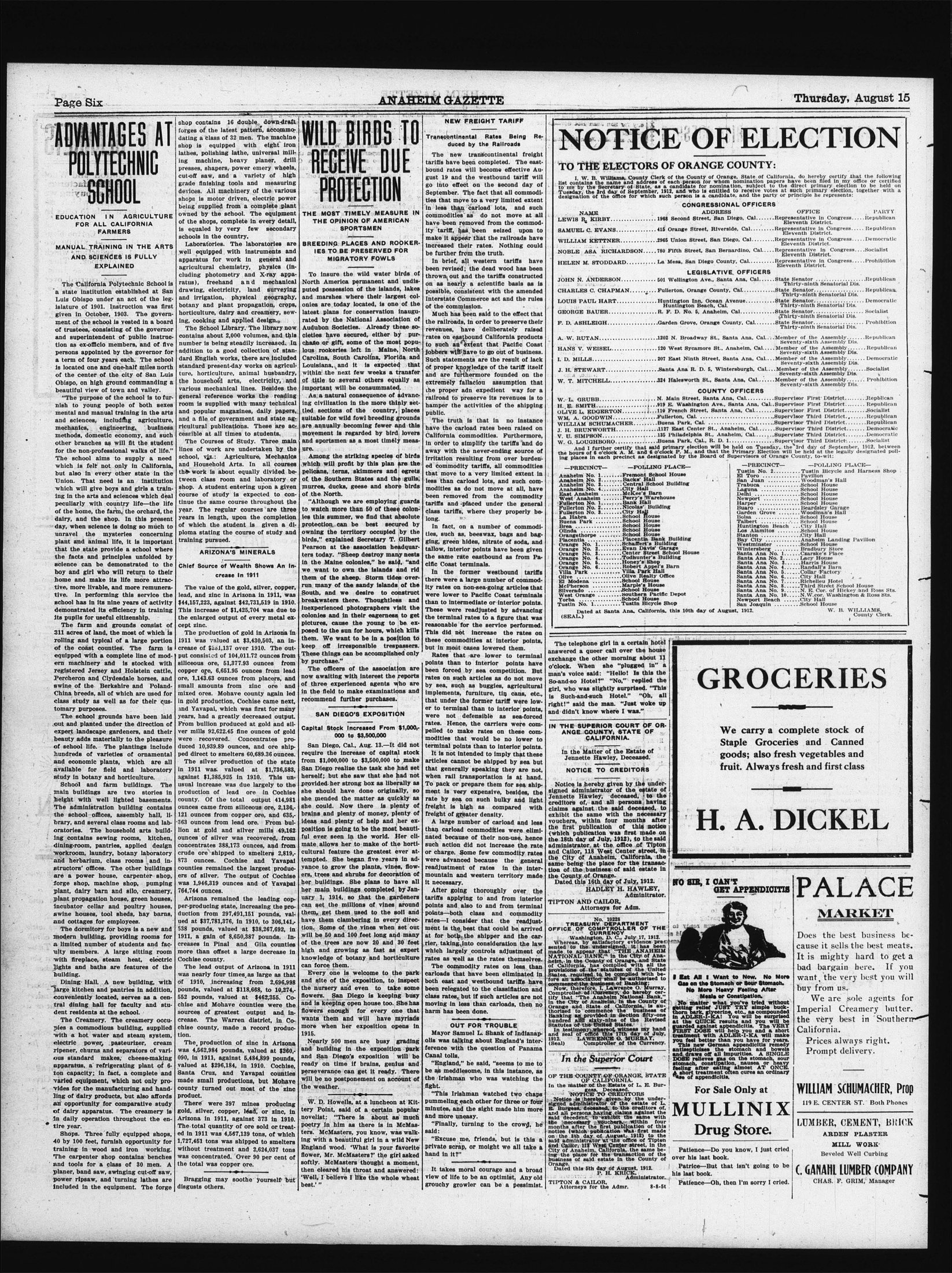
Searchable text
ADVANTAGES AT POLYTECHNIC SCHOOL
EDUCATION IN AGRICULTURE FOR ALL CALIFORNIA FARMERS
MANUAL TRAINING IN THE ARTS AND SCIENCES IS FULLY EXPLAINED
The California Polytechnic School is a state institution established at San Luis Obispo under an act of the legislature of 1901. Instruction was first given in October, 1903. The government of the school is vested in a board of trustees, consisting of the governor and superintendent of public instruction as ex-officio members, and of five persons appointed by the governor for a term of four years each. The school is located one and one-half miles north of the center of the city of San Luis Obispo, on high ground commanding a beautiful view of town and valley.
"The purpose of the school is to furnish to young people of both sexes mental and manual training in the arts and sciences, including agriculture, mechanics, engineering, business methods, domestic economy, and such other branches as will fit the student for the non-professional walks of life."
The school aims to supply a need which is felt not only in California, but also in every other state in the shop contains 16 double down-draft forges of the latest pattern, accommodating a class of 32 men. The machine shop is equipped with eight iron lathes, polishing lathe, universal milling machine, heavy planer, drill presses, shapers, power emery wheels, cut-off saw, and a variety of high grade finishing tools and measuring devices. All machinery of the various shops is motor driven, electric power being supplied from a complete plant owned by the school. The equipment of the shops, complete in every detail, is equaled by very few secondary schools in the country.
Laboratories. The laboratories are well equipped with instruments and apparatus for work in general and agricultural chemistry, physics (including photometry and X-ray apparatus), freehand and mechanical drawing, electricity, land surveying and irrigation, physical geography, botany and plant propagation, crops, horticulture, dairy and creamery, sewing, cooking and applied design.
The School Library. The library now contains about 2,000 volumes, and this number is being steadily increased. In addition to a good collection of standard English works, there are included standard present-day works on agriculture, horticulture, animal husbandry, the household arts, electricity, and various mechanical lines. Besides the general reference works the reading room is supplied with many technical and popular magazines, daily papers, and a file of government and state agricultural publications. These are accessible at all times to students.
The Courses of Study. Three main lines of work are undertaken by the school, viz.: Agriculture, Mechanics and Household Arts. In all courses the work is about equally divided be-
The purpose of the school is to furnish to young people of both sexes mental and manual training in the arts and sciences, including agriculture, mechanics, engineering, business methods, domestic economy, and such other branches as will fit the student for the non-professional walks of life.
The school aims to supply a need which is felt not only in California, but also in every other state in the Union. That need is an institution which will give boys and girls a training in the arts and sciences which deal peculiarly with country life—the life of the home, the farm, the orchard, the dairy, and the shop. In this present day, when science is doing so much to unravel the mysteries concerning plant and animal life, it is important that the state provide a school where the facts and principles unfolded by science can be demonstrated to the boy and girl who will return to their home and make its life more attractive, more livable, and more remunerative. In performing this service the school has in its nine years of activity demonstrated its efficiency in training its pupils for useful citizenship.
The farm and grounds consist of 311 acres of land, the most of which is rolling and typical of a large portion of the coast counties. The farm is equipped with a complete line of modern machinery and is stocked with registered Jersey and Holstein cattle, Percheron and Clydesdale horses, and swine of the Berkshire and Poland-China breeds, all of which are used for class study as well as for their customary purposes.
The school grounds have been laid out and planted under the direction of expert landscape gardeners, and their beauty adds materially to the pleasure of school life. The plantings include hundreds of varieties of ornamental and economic plants, which are all available for field and laboratory study in botany and horticulture.
School and farm buildings. The main buildings are two stories in height with well lighted basements. The administration building contains the school offices, assembly hall, library, and several classrooms and laboratories. The household arts building contains sewing rooms, kitchen, dining-room, pantries, applied design workroom, laundry, botany laboratory and herbarium, class rooms and instructors' offices. The other buildings are a power house, carpenter shop, forge shop, machine shop, pumping plant, dairy barn and silo, creamery, plant propagation house, green houses.
Arizona's Minerals
Chief Source of Wealth Shows An Increase in 1911
The value of the gold, silver, copper, lead, and zinc in Arizona in 1911 was $44,157,223, against $42,731,519 in 1910. This increase of $1,425,704 was due to the enlarged output of every metal except zinc.
The production of gold in Arizona in 1911 was valued at $3,430,503, an increase of $281,137 over 1910. The output consisted of 104,011.72 ounces from siliceous ore, 51,377.93 ounces from copper ore, 6,651.95 ounces from lead ore, 1,143.63 ounces from placers, and small amounts from zinc ore and mixed ores. Mohave county again led in gold production, Cochise came next, and Yavapai, which was first for many years, had a greatly decreased output. From bullion produced at gold and silver mills 92,622.45 fine ounces of gold were recovered. Concentrates produced 10,939.89 ounces, and ore shipped direct to smelters 60,689.36 ounces.
The silver production of the state in 1911 was valued at $1,736,583, against $1,385,925 in 1910. This unusual increase was due largely to the production of lead ore in Cochise county. Of the total output 414,981 ounces came from siliceous ore, 2,136,-121 ounces from copper ore, and 635,-363 ounces from lead ore. From bullion at gold and silver mills 49,162 ounces of silver was recovered from concentrates 388,173 ounces, and from crude ore shipped to smelters 2,819,-873 ounces. Cochise and Yavapai counties remained the largest producers of silver. The output of Cochise was 1,946,319 ounces and of Yavapai 764,744 ounces.
Arizona remained the leading con-tainer of agriculture animal husbandry the household arts electricity,and various mechanical lines.Besides the general reference works the reading room is supplied with many technical and popular magazines,daily papers,and a file of government and state agricultural publications. These are accessible at all times to students.
The Courses of Study. Three main lines of work are undertaken by the school,viz.: Agriculture,Mechanics and Household Arts.In all courses the work is about equally divided between class room and laboratory or shop.A student entering upon a given course of study is expected to continue the same course throughout the year.The regular courses are three years in length upon the completion of which the student is given a diploma stating the course of study and training pursued.
ARIZONA'S MINERALS
Chief Source of Wealth Shows An Increase in 1911
The value of the gold,silver,copper lead,and zinc in Arizona in 1911 was $44,157,223 against $42,731,519 in 1910.This increase of $1,425,704 was due to the enlarged output of every metal except zinc.
The production of gold in Arizona in 1911 was valued at $3,430,503 an increase of $281,137 over 1910.The output consisted of 104,011.72 ounces from siliceous ore,51,377.93 ounces from copper ore,6,651.95 ounces from lead ore,1,143.63 ounces from placers,and small amounts from zinc oreand mixed ores.Mohave county again led in gold production,Cochise came next,and Yavapaiwhich was first for many years,had a greatly decreased output.From bullion produced at gold and silver mills 92,622.45 fine ounces of gold were recovered.Concentrates produced 10,939.89 ounces,and ore shipped direct to smelters 60,689.36 ounces.
The silver production of the state in 1911 was valued at $1,736,583against$1,385,925in 1910.This unusual increase was due largely to the production of lead ore in Cochise county.Ofthe totaloutput414,981ounces camefromsiliceousore,2,136,-121ouncesfromcopperore,and635,-363ouncesfromleadore.Frombulionatgoldandsilvermills49,162ouncesofsilverwasrecoveredfromconcentrates388,173ounces,andfromcrudeoreshippedtosmelters2,819,-873ounces.CochiseandYavapailountiesremainedthelargestproducersofsilver.TheoutputofCochisewas1,946,319ouncesandofYavapail764,744ounces.
Arizona remained the leading con-tainerofagricultureanimalhusbandrythehouseholdarts,electricityandvariousmechanicallines.Besidesthegeneralreferenceworksthereadingroomissuppliedwithmanytechnicalandpopularmagazines,dailypapers,andafileofgovernmentandstateagrificulturalpublicationsTheseareaccessibleatalltimestostudents.
The Courses of Study.Three main lines of work are undertaken bytheschool,viz.:Agriculture,MechanicsandHouseholdArts.Inallcoursestheworkisaboutequallydividedbetweenclassroomandlaboratoryorshop.Astudententeringupa givencourseofstudyisexpectedtocontinuethesamecoursethroughouttheyear.Theregularcoursesarethreeyearsinlengthuponthecompletionofwhichthestudentisgivena Diplomasthecourseoftheserritibirdsexpelled.Pearsonattheserters today.“Shee-intheMainecollegewewanttoownthemoftheshee-runmanyoftheSouth,andbewreakwatersthereinexperiencedphoton coloniesandinh pictures,cause themposedtothesunfilthem.Wewanttokeepoffirerespectingbypurchase.”
The officersofnowawaitingwithofthreeexperieminethefieldtomainrecommendfurther.
San Diego.Calculaterequiretheincreasefrom$1,000,000totheSanDiegorealizeherself;butsheprovidedherstrongsheshouldhave shemendedthen shecould.Nowbrainsandplentyideasandplentypositionisgoingt fuleverseenin mateallowshertculturalfeaturettempted.Shebeginancegrowtherers,treesandshrinerbuildings.Shhemainbuildingjuary1,1914,s
The administration building contains the school offices, assembly hall, library, and several class rooms and laboratories. The household arts building contains sewing rooms, kitchen, dining-room, pantries, applied design workroom, laundry, botany laboratory and herbarium, class rooms and instructors' offices. The other buildings are a power house, carpenter shop, forge shop, machine shop, pumping plant, dairy barn and silo, creamery, plant propagation house, green houses, incubator cellar and poultry houses, swine houses, tool sheds, hay barns, and cottages for employees.
The dormitory for boys is a new and modern building, providing rooms for a limited number of students and faculty members. A large sitting room with fireplace, steam heat, electric lights and baths are features of the building.
Dining Hall. A new building, with large kitchen and pantries in addition, conveniently located, serves as a central dining hall for faculty and student residents at the school.
The Creamery. The creamery occupies a commodious building, supplied with a hot water and steam system, electric power, pasteurizer, cream ripener, churns and separators of various standard makes; cheese-making apparatus, a refrigerating plant of 6 ton capacity; in fact, a complete and varied equipment, which not only provides for the manufacturing and handling of dairy products, but also affords an opportunity for comparative study of dairy apparatus. The creamery is in daily operation throughout the entire year.
Shops. Three fully equipped shops, 40 by 100 feet, furnish opportunity for training in wood and iron working. The carpenter shop contains benches and tools for a class of 30 men. A planer, band saw, swinging cut-off saw, power ripsaw, and turning lathes are included in the equipment. The forge county. Of the total output 414,981 ounces came from siliceous ore, 2,136,-121 ounces from copper ore, and 635,-363 ounces from lead ore. From bullion at gold and silver mills 49,162 ounces of silver was recovered, from concentrates 388,173 ounces, and from crude ore shipped to smelters 2,819,-873 ounces. Cochise and Yavapai counties remained the largest producers of silver. The output of Cochise was 1,946,319 ounces and of Yavapai 764,744 ounces.
Arizona remained the leading copper-producing state, increasing the production from 297,491,151 pounds, valued at $37,781,376, in 1910, to 306,141,-538 pounds, valued at $38,267,692, in 1911, a gain of 8,650,387 pounds. Increases in Pinal and Gila counties more than offset a large decrease in Cochise county.
The lead output of Arizona in 1911 was nearly four times as large as that of 1910, increasing from 2,696,998 pounds, valued at $118,668, to 10,274,-552 pounds, valued at $462,355. Cochise and Mohave counties were the sources of greatest output and increase. The Warren district, in Cochise county, made a record production.
The production of zinc in Arizona was 4,562,984 pounds, valued at $260,-090, in 1911 against 5,484,899 pounds, valued at $296,184, in 1910. Cochise, Santa Cruz, and Yavapai counties made small productions, but Mohave county turned out most of the zinc product.
There were 397 mines producing gold, silver, copper, lead, or zinc in Arizona in 1911 against 373 in 1910. The total quantity of ore sold or treated in 1911 was 4,567,139 tons, of which 1,727,451 tons was shipped to smelters without treatment and 2,624,037 tons was concentrated. Over 90 per cent of the total was copper ore.
Bragging may soothe yourself but disgusts others.
WILD BIRDS TO RECEIVE DUE PROTECTION
THE MOST TIMELY MEASURE IN THE OPINION OF AMERICAN SPORTSMEN
BREEDING PLACES AND ROOKERIES TO BE PRESERVED FOR MIGRATORY FOWLS
To insure the wild water birds of North America permanent and undisputed possession of the islands, lakes and marshes where their largest colonies are today located, is one of the latest plans for conservation inaugurated by the National Association of Audubon Societies. Already these societies have secured, either by purchase or gift, some of the most populous rookeries left in Maine, North Carolina, South Carolina, Florida and Louisiana, and it is expected that within the next few weeks a transfer of title to several others equally as important will be consummated.
As a natural consequence of advancing civilization in the more thinly settled sections of the country, places suitable for wild fowl breeding grounds are annually becoming fewer and this movement is regarded by bird lovers and sportsmen as a most timely measure.
Among the striking species of birds which will profit by this plan are the pelicans, terns, skimmers and egrets
NEW FREIGHT TARIFF
Transcontinental Rates Being Reduced by the Railroads
The new transcontinental freight tariffs have been completed. The eastbound rates will become effective August 19 and the westbound tariff will go into effect on the second day of September. The fact that all commodities that move to a very limited extent in less than carload lots, and such commodities as do not move at all have been removed from the commodity tariff, has been seized upon to make it appear that the railroads have increased their rates. Nothing could be further from the truth.
In brief, all western tariffs have been revised; the dead wood has been thrown out and the tariffs constructed on as nearly a scientific basis as is possible, consistent with the amended Interstate Commerce act and the rules of the commission.
Much has been said to the effect that the railroads, in order to preserve their revenues, have deliberately raised rates on eastbound California products to such an extent that Pacific Coast jobbers will have to go out of business. Such statements are the result of lack of proper knowledge of the tariff itself and are furthermore founded on the extremely fallacious assumption that the proper adn expedient way for a railroad to preserve its revenues is to hamper the activities of the shipping public.
The truth is that in no instance have the carload rates been raised on California commodities. Furthermore, in order to simplify the tariffs and do away with the never-ending source of irritation resulting from over burdened commodity tariffs, all commodities that move to a very limited extent in
As a natural consequence of advancing civilization in the more thinly settled sections of the country, places suitable for wild fowl breeding grounds are annually becoming fewer and this movement is regarded by bird lovers and sportsmen as a most timely measure.
Among the striking species of birds which will profit by this plan are the pelicans, terns, skimmers and egrets of the Southern States and the gulls, murres, ducks, geese and shore birds of the North.
"Although we are employing guards to watch more than 50 of these colonies this summer, we find that absolute protection can be best secured by owning the territory occupied by the birds," explained Secretary T. Gilbert Pearson at the association headquarters today. "Sheep destroy many nests in the Maine colonies," he said, "and we want to own the islands and rid them of the sheep. Storm tides overrun many of the sandy islands of the South, and we desire to construct breakwaters there. Thoughtless and inexperienced photographers visit the colonies and in their eagerness to get pictures, cause the young to be exposed to the sun for hours, which kills them. We want to be in a position to keep off irresponsible trespassers. These things can be accomplished only by purchase."
The officers of the association are now awaiting with interest the reports of three experienced agents who are in the field to make examinations and recommend further purchases.
SAN DIEGO'S EXPOSITION
Capital Stock Increased From $1,000,-000 to $3,500,000
San Diego, Cal., Aug. 13.—It did not require the increase of capital stock from $1,000,000 to $3,500,000 to make San Diego realize the task she had set herself; but she saw that she had not provided her strong box as liberally as she should have done originally, so she mended the matter as quickly as she could. Now there is plenty of brains and plenty of money, plenty of ideas and plenty of help and her exposition is going to be the most beautiful ever seen in the world. Her climate allows her to make of the horticultural feature the greatest ever attempted. She began five years in advance to grow the plants, vines, flowers, trees and shrubs for decoration of her buildings. She plans to have all her main buildings completed by January 1, 1914, so that the gardeners and are furthermore founded on the extremely fallaciou assumption that the proper adn expedient way for a railroad to preserve its revenues is to hamper the activities of the shipping public.
The truth is that in no instance have the carload rates been raised on California commodities. Furthermore, in order to simplify the tariffs and do away with the never-ending source of irritation resulting from over burdened commodity tariffs, all commodities that move to a very limited extent in less than carload lots, and such commodities as do not move at all, have been removed from the commodity tariffs and placed under the general class tariffs, where they properly belong.
In fact, on a number of commodities, such as, beeswax, bags and bagging, green hides, nitrate of soda, and tallow, interior points have been given the same rate eastbound as from Pacific Coast terminals.
In the former westbound tariffs there were a large number of commodity rates on non-sea-going articles that were lower to Pacific Coast terminals than to intermediate or interior points. These were readjusted by advancing the terminal rates to a figure that was reasonable for the service performed. This did not increase the rates on these commodities at interior points, but in most cases lowered them.
Rates that are lower to terminal points than to interior points have been forced by sea competition. But rates on such articles as do not move by sea, such as buggies, agricultural implements, furniture, tin cans, etc., that under the former tariff were lower to terminal than to interior points, were not defensible as sea-forced rates. Hence, the carriers were compelled to make rates on these commodities that would be no lower to terminal points than to interior points.
It is not intended to imply that these articles cannot be shipped by sea but that generally speaking they are not, when rail transportation is at hand. To pack or prepare them for sea shipment is very expensive, besides, the rate by sea on such bulky and light freight is high compared with freight of greater density.
A large number of carload and less than carload commodities were eliminated because of their non-use, hence such action did not increase the rate or charge. Some few commodity rates were advanced because the general readjustment of rates in the intermountain and western territory made it necessary.
After going thoroughly over the tariffs applying to and from interior and are furthermore founded on the extremely fallaciou assumption that the proper adn expedient way for a railroad to preserve its revenues is to hamper the activities of the shipping public.
The truth is that in no instance have the carload rates been raised on California commodities. Furthermore, in order to simplify the tariffs and do away with the never-ending source of irritation resulting from over burdened commodity tariffs, all commodities that move to a very limited extent in less than carload lots, and such commodities as do not move at all, have been removed from the commodity tariffs and placed under the general class tariffs, where they properly belong.
In fact, on a number of commodities, such as, beeswax, bags and bagging, green hides, nitrate of soda, and tallow, interior points have been given the same rate eastbound as from Pacific Coast terminals.
In the former westbound tariffs there were a large number of commodity rates on non-sea-going articles that were lower to Pacific Coast terminals than to intermediate or interior points. These were readjusted by advancing the terminal rates to a figure that was reasonable for the service performed. This did not increase the rates on these commodities at interior points, but in most cases lowered them.
Rates that are lower to terminal points than to interior points have been forced by sea competition. But rates on such articles as do not move by sea, such as buggies, agricultural implements, furniture, tin cans, etc., that under the former tariff were lower to terminal than to interior points, were not defensible as sea-forced rates. Hence, the carriers were compelled to make rates on these commodities that would be no lower to terminal points than to interior points.
It is not intended to imply that these articles cannot be shipped by sea but that generally speaking they are not, when rail transportation is at hand. To pack or prepare them for sea shipment is very expensive, besides, the rate by sea on such bulky and light freight is high compared with freight of greater density.
A large number of carload and less than carload commodities were eliminated because of their non-use, hence such action did not increase the rate or charge. Some few commodity rates were advanced because the general readjustment of rates in the intermountain and western territory made it necessary.
After going thoroughly over the tariffs applying to and from interior and are furthermore founded on the extremely fallaciou assumption that the proper adn expedient way for a railroad to preserve its revenues is to hamper the activities of the shipping public.
The truth is that in no instance have the carload rates been raised on California commodities. Furthermore, in order to simplify the tariffs and do away with the never-ending source of irritation resulting from over burdened commodity tariffs, all commodities that move to a very limited extent in less than carload lots, and such commodities as do not move at all, have been removed from the commodity tariffs and placed under the general class tariffs, where they properly belong.
In fact, on a number of commodities, such as, beeswax, bags and bagging, green hides, nitrate of soda, and tallow, interior points have been given the same rate eastbound as from Pacific Coast terminals.
In the former westbound tariffs there were a large number of commodity rates on non-sea-going articles that were lower to Pacific Coast terminals than to intermediate or interior points. These were readjusted by advancing the terminal rates to a figure that was reasonable for the service performed. This did not increase the rates on these commodities at interior points, but in most cases lowered them.
Rates that are lower to terminal points than to interior points have been forced by sea competition. But rates on such articles as do not move by sea, such as buggies, agricultural implements, furniture, tin cans, etc., that under the former tariff were lower to terminal than to interior points, were not defensible as sea-forced rates. Hence, the carriers were compelled to make rates on these commodities that would be no lower to terminal points than to interior points.
It is not intended to imply that these articles cannot be shipped by sea but that generally speaking they are not, when rail transportation is at hand. To pack or prepare them for sea shipment is very expensive, besides, the rate by sea on such bulky and light freight is high compared with freight of greater density.
A large number of carload and less than carload commodities were eliminated because of their non-use, hence such action did not increase the rate or charge. Some few commodity rates were advanced because the general readjustment of rates in the intermountain and western territory made it necessary.
After going thoroughly over the tariffs applying to and from interior and are furthermore founded on the extremely fallaciou assumption that the proper adn expedient way for a railroad to preserve its revenues is to hamper the activities of the shipping public.
The truth is that in no instance have the carload rates been raised on California commodities. Furthermore, in order to simplify the tariffs and do away with the never-ending source of irritation resulting from over burdened commodity tariffs, all commodities that move to a very limited extent in less than carload lots, and such commodities as do not move at all, have been removed from the commodity tariffs and placed under the general class tariffs, where they properly belong.
In fact, on a number of commodities, such as, beeswax, bags and bagging, green hides, nitrate of soda, and tallow,interpoints have been given the same rate eastbound as from Pacific Coast terminals,
In the former westbound tariffs there were a large number of commodity rates on non-sea-going articles that were lower to Pacific Coast terminals than to intermediate or interior points. These were readjusted by advancing the terminal rates to a figure that was reasonable for the service performed. This did not increase the rates on these commodities at interior points,but in most cases lowered them.
Rates that are lower to terminal points than to interior points have been forced by sea competition. But rates on such articles as do not move by sea,such as buggies,agricultural implements,furniture,tin cans,etc., that under the former tariff were lower to terminal than to interior points,were not defensible as sea-forced rates. Hence,the carriers were compelled to make rates on these commodities that would be no lower to terminal points than to interior points.
It is not intended to imply that these articles cannot be shipped by sea but that generally speaking they are not,when rail transportation is at hand.To pack or prepare them for sea shipment is very expensive,besides,the rate by sea on such bulky and light freight is high compared with freight of greater density.
A large number of carload and less than carload commodities were eliminated because of their non-use,hence such action did not increase the rate or charge.Some few commodity rates were advanced because the general readjustment of rates in the intermountain and western territory made it necessary.
After going thoroughly over the tariffs applying to and from interior and are furthermore founded on the extremely fallaciou assumption that the proper adn expedient way for a railroad to preserve its revenues is to hamper the activities of the shipping public.
The truth is that in no instance have the carload rates been raised on Californiacommodities. Furthermore,in order to simplifythetariffsanddoawaywiththeneverenduringsourceofirritationresultingfromoverburdenedcommoditytariffsallcommoditiesthatmovetoverylimitedextentinlessthancarloadlots,andsuchcommoditiesasdonotmoveatall,havebeenremovedfromthecommoditytariffsandplacedunderthegeneralclasstariffswheretheyproperlybelong.
In fact,ona numberofcommodities,suchasbeeswax,bagsandbagging,greenhides,nitrateofsoda,andtallow,themewereremovedfromthecommoditytariffsandplacedunderthegeneralclasstariffswheretheyproperlybelong.
Intheformerwestboundtariffstherewerealargenumberofcommodityratesonnon-sea-goivingarticlesthatwerelowertopacificcoastterminalsthantotheintermediateorinteriorpoints.thantotheintermountainandwesternterritorymadeitnecessary.
Thetelephonegirlinacertainhotelansweredaqueercalloverthehouseexchangetheothermorningabout11o'clock.Whenshe"pluggedin"amansvoicesaid:"Hello!IsthisSo-and-soHotel?" "No,"repliedthegirlwhowasslightlysurprised."ThisisSuch-and-suchHotel." "Oh.allright!"saidtheman."Justwokeupanddidn'tknowwherewas."
IN THE SUPERIOR COURT OF ORANGE COUNTY,SATE OF CALIFORNIA.
IntheMatteroftheEstateofJennetteHawleyDeceased.
NOTICE TO CREDITORS
Noticeis herebygivenbytheunder-signedadministratoroftheestateofJennetteHawleydeceased.tothecreditorsof,andallpersonshavingclaimsagainstthesaiddeceased.toexhibitthesamewiththenecessaryvouchers withinfourmonthsafterthefirstpublicificationofthisnotice(whichpublicitationwasfirstmadeonthe18thdayofJuly ,1912),totheaidadministrator.attheofficeofTiptonandCailor ,118WestCenter街,在CityofAnaheim,California,thesamebeingtheplaceforthetransactionofthebusinessofsald estateintheCountyOfOrange.Datedthis16thdayofJuly ,1912.HADLEYH.AHAWLEYAdminitrator.
The telephonegirlinacertainhotelansweredaqueercalloverthehouseexchangetheothermorningabout11o'clock.Whenshe"pluggedin"amansvoicesaid:"Hello!IsthisSo-and-soHotel?" "No,"repliedthegirlwhowasslightlysurprised."ThisisSuch-and-suchHotel." "Oh.allright!"saidtheman."Justwokeupanddidn'tknowwherewas."
she mended the matter as quickly as she could. Now there is plenty of brains and plenty of money, plenty of ideas and plenty of help and her exposition is going to be the most beautiful ever seen in the world. Her climate allows her to make of the horticultural feature the greatest ever attempted. She began five years in advance to grow the plants, vines, flowers, trees and shrubs for decoration of her buildings. She plans to have all her main buildings completed by January 1, 1914, so that the gardeners can set the millions of vines around them, get them used to the soil and have them clambering in every direction. Some of the vines when set out will be 50 and 100 feet long and many of the trees are now 20 and 30 feet high and growing as fast as expert knowledge of botany and horticulture can force them.
Every one is welcome to the park and site of the exposition, to inspect the nursery and even to take some flowers. San Diego is keeping busy and is keeping open house too. She has flowers enough for every one that wants them and will have myriads more when her exposition opens in 1915.
Nearly 500 men are busy grading and building in the exposition park and San Diego’s exposition will be ready on time if brains, genius and perseverance can get it ready. There will be no postponement on account of the weather.
W. D. Howells, at a luncheon at Kittery Point, said of a certain popular novelist; “There is about as much poetry in him as there is in McMasters. McMasters, you know, was walking with a beautiful girl in a wild New England wood. ‘What is your favorite flower, Mr. McMasters?’ the girl asked softly. McMasters thought a moment, then cleared his throat and answered: ‘Well, I believe I like the whole wheat best.’”
A large number of carload and less than carload commodities were eliminated because of their non-use, hence such action did not increase the rate or charge. Some few commodity rates were advanced because the general readjustment of rates in the intermountain and western territory made it necessary.
After going thoroughly over the tariffs applying to and from interior points and also to and from terminal points—both class and commodity rates—I consider that the readjustment is the best that could be arrived at for both the shipper and the carrier, taking into consideration the law which largely controls adjustment of rates as well as the rates themselves.
The commodity rates on less than carloads that have been eliminated in both east and westbound tariffs have been relegated to the classification and class rates, but if such articles are not moving in less than carloads, then no harm has been done.
OUT FOR TROUBLE
Mayor Samuel L. Shank of Indianapolis was talking about England's interference with the question of Panama Canal tolls.
“England,” he said, “seems to me to be as meddlesome, in this instance, as the Irishman who was watching the fight.
“This Irishman watched two chaps pummeling each other for three or four minutes, and the sight made him more and more uneasy.
“Finally, turning to the crowd, he said:
“Excuse me, friends, but is this a private scrap, or moight we all take a hand in it?”
It takes moral courage and a broad view of life to be an optimist. Any old grouchy growler can be a pessimist.
In the Superior Court
OF THE COUNTY OF ORANGE, STATE OF CALIFORNIA.
In the matter of the Estate of L. E. Burgess, Deceased.
NOTICE TO CREDITORS
Notice is hereby given by the undersigned administrator of the estate of L. E. Burgess, deceased, to the creditors of, and all persons having claims against the said decedent, to exhibit the same with the necessary vouchers, within four months after the first publication of this notice (which publication was first made on the 8th day of July, 1912) to the said administrator at the office of Tipton and Callor, 118 West Center street, in the City of Anaheim, California, the same being the place for the transaction of the business of said estate in the County of Orange.
Dated this 5th day of August, 1912.
P. H. KRICK,
Administrator.
TIPTON & CAILOR,
Attorneys for Admr.
NOTICE OF ELECTION
THE ELECTORS OF ORANGE COUNTY:
Williams, County Clerk of the County of Orange, State of California, do hereby certify that the following
the name and address of each person for whom nomination papers have been filed in my office or certified
Secretary of State, as a candidate for nomination, subject to the direct primary election to be held on
the 3rd day of September, 1912, and who is entitled to receive votes at such primary election, together with a
office for which such person is a candidate, and the party or principle he represents:
CONGRESSIONAL OFFICERS
ADDRESS OFFICE PARTY
BERBY...1963 Second Street, San Diego, Cal....Representative in Congress...Republican
EVANS...415 Orange Street, Riverside, Cal....Representative in Congress...Republican
ETTNER...2965 Union Street, San Diego, Cal....Representative in Congress...Democratic
RICHARDSON...780 Fifth Street, San Bernardino, Cal....Representative in Congress...Socialist
OTODDARD...La Mesa, San Diego County, Cal....Representative in Congress...Prohibition
LEGISLATIVE OFFICERS
DERSON...501 Wellington Ave., Santa Ana, Cal....State Senator...Republican
CHAPMAN...Fullerton, Orange County, Cal....State Senator...Republican
HART...Huntington Inn, Ocean Avenue...State Senator...Democratic
UER...R. F. D. No. 5, Anaheim, Cal....State Senator...Socialist
IGH...Garden Grove, Orange County, Cal....State Senator...Prohibition
N..1202 N. Broadway St., Santa Ana, Cal....Member of the Assembly...Republican
ISSEL...120 West Sycamore St., Anaheim, Cal....Member of the Assembly...Republican
207 East Ninth Street, Santa Ana, Cal....Member of the Assembly...Democratic
ORT..Santa Ana R. D. 5, Wintersburgh, Cal....Member of the Assembly...Socialist
ELL..324 Halesworth St., Santa Ana, Cal....Member of the Assembly...Prohibition
COUNTY OFFICERS
B.N. N. Main Street, Santa Ana, Cal....Supervisor First District...Republican
.919 E. Washington Ave., Santa Ana, Cal....Supervisor First District...Republican
GERTON.110 French Street, Santa Ana, Cal....Supervisor First District...Socialist
DWIN.Fullerton, Cal....Supervisor Third District,...Republican
HUMACHER.Buena Park, Cal....Supervisor Third District.....Republican
WORTH..1127 East Center St., Anaheim, Cal....Supervisor Third District.....Democratic
N..135 Philadelphia St., Anaheim, Cal....Supervisor Third District.....Democratic
IBORO.Buena Park, Cal., R. D. 1....Supervisor Third District.....Socialist
Further certify that said primary election will be held on Tuesday, the 3rd day of September, 1912, between
o'clock A. M. and 6 o'clock P. M., and that the Primary Election will be held at the legally designated polieach precinct as designated by the Board of Supervisors of Orange County, to-wit:
COUNTY OFFICERS
N. Main Street, Santa Ana, Cal. Supervisor First District. Republican
919 E. Washington Ave., Santa Ana, Cal. Supervisor First District. Republican
110 French Street, Santa Ana, Cal. Supervisor First District. Socialist
Fullerton, Cal. Supervisor Third District. Republican
Buena Park, Cal. Supervisor Third District. Republican
Anaheim, Cal. Supervisor Third District. Democratic
Anaheim, Cal. Supervisor Third District. Democratic
Buena Park, Cal. R. D. 1. Supervisor Third District. Socialist
Further certify that said primary election will be held on Tuesday, the 3rd day of September, 1912, between o'clock A.M. and 6 o'clock P.M., and that the Primary Election will be held at the legally designated poll-each precinct as designated by the Board of Supervisors of Orange County, to-wit:
POLLING PLACE—
1. Fremont School House
2. Backs Hall
3. Central School Building
4. City Hall
5. McKee's Barn
6. Perry's Warehouse
7. Bank Hall
8. Nicolas' Building
9. City Hall
10. School House
11. School House
12. School House
13. School House
14. School House
15. School House
16. School House
17. Placentia Bank Building
18. Schaffert's Building
19. Evan Davis' Garage
20. Center Street School House
21. Todhunter's Building
22. Honey's Shop
23. Robert Appel's Barn
24. Villa Park Hall
25. Olive Realty Office
26. School House
27. Marple's House
28. School House
29. Southern Pacific Depot
30. School House
31. Tustin Bicycle Shop
PRECINCT—
Tustin No. 2... Tustin Bicycle and Harness Shop
El Toro... Pavilion
San Juan... Woodman's Hall
Trabuca... School House
Laguna... School House
Delhi... School House
Newport... School House
Harper... School House
Buaro... Beardsley Garage
Garden Grove... Woodman's Hall
Bolsa... School House
Talbert... School House
Huntington Beach... City Hall
Los Alamitos... School House
Stanton... City Hall
Bay City... Anaheim Landing Pavillon
Westminster... School House
Wintersberg... Bradbury Store
Santa Ana No. 1... Czarske's Place
Santa Ana No. 2... Lacy House
Santa Ana No. 3... Harris House
Santa Ana No. 4... Randall's Barn
Santa Ana No. 5... Collar Factory
Santa Ana No. 6... City Hall
Santa Ana No. 7... Richelieu Hotel
Santa Ana No. 8... Third Street School House
Santa Ana No. 9... N.E.Cor. of Hickey and Ross Sts.
Santa Ana No. 10... N.W.cor. Washington & Ross Sts.
Newport Beach... City Hall
San Joaquin... School House
GROCERIES
We carry a complete stock of Staple Groceries and Canned goods; also fresh vegetables and fruit. Always fresh and first class.
H. A. DICKEL
NO SIR, I CAN'T GET APPENDICITIS
H. A. DICKEL
NO SIR, I CAN'T GET APPENDICITIS
I Eat All I Want to Now. No More Gas on the Stomach or Sour Stomach. No More Heavy Feeling After Meals or Constipation.
No matter what you've tried without getting relief JUST TRY simple buckthorn bark, glycerine, etc., as compounded in ADLER-I-KA! You will be surprised at the QUICK results and you will be guarded against appendicitis. The VERY FIRST DOSE will help you and a short treatment with ADLER-I-KA will make you feel better than you have for years.
This new German appendicitis remedy antisepticizes the stomach and bowels and draws off all impurities. A SINGLE DOSE relieves gas on the stomach, sour stomach, constipation, nausea or heavy feeling after eating almost AT ONCE. A short treatment often cures an ordinary case of appendicitis.
For Sale Only at MULLINIX Drug Store.
Patience—Do you know, I just cried over his last book.
Patrice—But that isn't going to be his last book.
Patience—Oh, then I'm sorry I cried.
PALACE MARKET
Does the best business because it sells the best meats. It is mighty hard to get a bad bargain here. If you want, the very best you will buy from us.
We are sole agents for Imperial Creamery butter. the very best in Southern California.
Prices always right.
Prompt delivery.
WILLIAM SCHUMACHER, Prop
119 E. CENTER ST. Both Phones
LUMBER, CEMENT, BRICK
ARDEN PLASTER
MILL WORK
Beveled Well Curbing
C. GANAHL LUMBER COMPANY
CHAS. F. GRIM, Manager