anaheim-gazette 1912-08-08
Scanned page
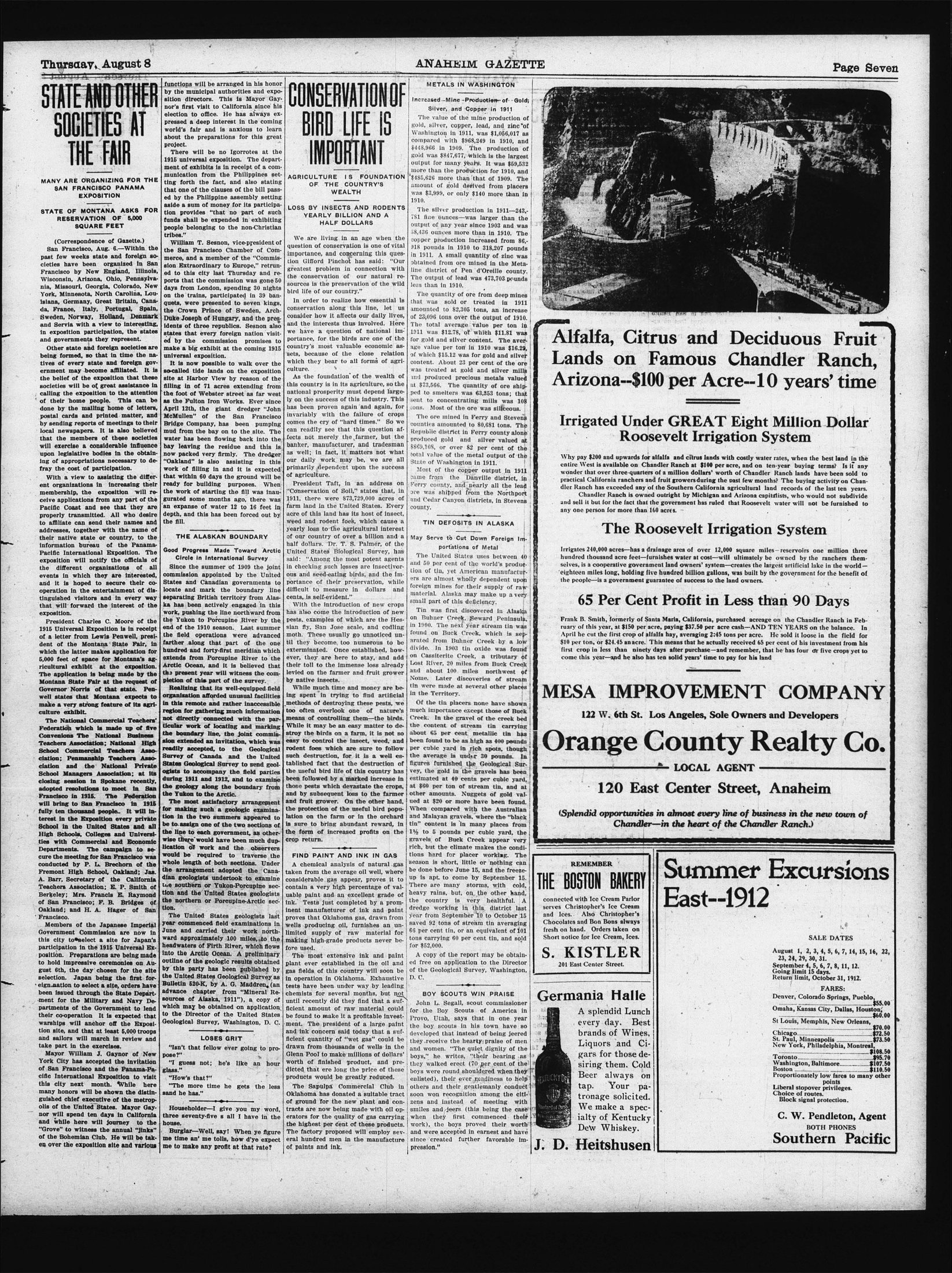
Searchable text
STATE AND OTHER SOCIETIES AT THE FAIR
MANY ARE ORGANIZING FOR THE SAN FRANCISCO PANAMA EXPOSITION
STATE OF MONTANA ASKS FOR RESERVATION OF 5,000 SQUARE FEET
(Correspondence of Gazette.)
San Francisco, Aug. 6.—Within the past few weeks state and foreign societies have been organized in San Francisco by New England, Illinois, Wisconsin, Arizona, Ohio, Pennsylvania, Missouri, Georgia, Colorado, New York, Minnesota, North Carolina, Louisiana, Germany, Great Britain, Canada, France, Italy, Portugal, Spain, Sweden, Norway, Holland, Denmark and Servia with a view to interesting, in exposition participation, the states and governments they represent.
Other state and foreign societies are being formed, so that in time the natives of every state and foreign government may become affiliated. It is the belief of the exposition that these societies will be of great assistance in calling the exposition to the attention of their home people. This can be done by the mailing home of letters, postal cards and printed matter, and by sending reports of meetings to their local newspapers. It is also believed that the members of these societies will exercise a considerable influence upon legislative bodies in the obtaining of appropriations necessary to defray the cost of participation.
functions will be arranged in his honor by the municipal authorities and exposition directors. This is Mayor Gaynor's first visit to California since his election to office. He has always expressed a deep interest in the coming world's fair and is anxious to learn about the preparations for this great project.
There will be no Igorrotes at the 1915 universal exposition. The department of exhibits is in receipt of a communication from the Philippines setting forth the fact, and also stating that one of the clauses of the bill passed by the Philippine assembly setting aside a sum of money for its participation provides "that no part of such funds shall be expended in exhibiting people belonging to the non-Christian tribes."
William T. Sesnon, vice-president of the San Francisco Chamber of Commerce, and a member of the "Commission Extraordinary to Europe," retruned to this city last Thursday and reports that the commission was gone 50 days from London, spending 30 nights on the trains, participated in 39 banquets, were presented to seven kings, the Crown Prince of Sweden, Arch-Duke Joseph of Hungary, and the presidents of three republics. Sesnon also states that every foreign nation visited by the commission promises to make a big exhibit at the coming 1915 universal exposition.
It is now possible to walk over the so-called tide lands on the exposition site at Harbor View by reason of the filling in of 71 acres extending from the foot of Webster street as far west as the Fulton Iron Works. Ever since April 12th, the giant dredger "John McMullen" of the San Francisco Bridge Company, has been pumping mud from the bay on to the site. The water has been flowing back into the bay leaving the residue and this is now packed very firmly. The dredger "Oakland" is also assisting in this work of filling in and it is expected...
the belief of the exposition that these societies will be of great assistance in calling the exposition to the attention of their home people. This can be done by the mailing home of letters, postal cards and printed matter, and by sending reports of meetings to their local newspapers. It is also believed that the members of these societies will exercise a considerable influence upon legislative bodies in the obtaining of appropriations necessary to defray the cost of participation.
With a view to assisting the different organizations in increasing their membership, the exposition will receive applications from any part of the Pacific Coast and see that they are properly transmitted. All who desire to affiliate can send their names and addresses, together with the name of their native state or country, to the information bureau of the Panama-Pacific International Exposition. The exposition will notify the officials of the different organizations of all events in which they are interested, and it is hoped to secure their cooperation in the entertainment of distinguished visitors and in every way that will forward the interest of the exposition.
President Charles C. Moore of the 1915 Universal Exposition is in receipt of a letter from Lewis Penwell, president of the Montana State Fair, in which the latter makes application for 5,000 feet of space for Montana's agricultural exhibit at the exposition. The application is being made by the Montana State Fair at the request of Governor Norris of that state. Penwell states that Montana expects to make a very strong feature of its agriculture exhibit.
The National Commercial Teachers' Federation which is made up of five Convenions The National Business Teachers Association; National High School Commercial Teachers Association; Penmanship Teachers Association and the National Private School Managers Association; at its closing session in Spokane recently, adopted resolutions to meet in San Francisco in 1915. The Federation will bring to San Francisco in 1915 fully ten thousand people.. It will interest in the Exposition every private School in the United States and all High Schools, Colleges and Universities with Commercial and Economic Departments. The campaign to secure the meeting for San Francisco was conducted by P. L. Brechorn of the Fremont High School, Oakland; Jas. A. Barr, Secretary of the California Teachers Association; E. P. Smith of Berkeley; Mrs. Francis E. Raymond site at Harbor View by reason of the filling in of 71 acres extending from the foot of Webster street as far west as the Fulton Iron Works. Ever since April 12th, the giant dredger "John McMullen" of the San Francisco Bridge Company, has been pumping mud from the bay on to the site. The water has been flowing back into the bay leaving the residue and this is now packed very firmly. The dredger "Oakland" is also assisting in this work of filling in and it is expected that within 60 days the ground will be ready for building purposes. When the work of starting the fill was inaugurated some months ago, there was an expanse of water 12 to 16 feet in depth, and this has been forced out by the fill.
THE ALASKAN BOUNDARY
Good Progress Made Toward Arctic Circle in International Survey
Since the summer of 1909 the joint commission appointed by the United States and Canadian governments to locate and mark the boundary line separating British territory from Alaska has been actively engaged in this work, pushing the line northward from the Yukon to Porcupine River by the end of the 1910 season. Last summer the field operations were advanced farther along that part of the one hundred and forty-first meridian which extends from Porcupine River to the Arctic Ocean, and it is believed that this present year will witness the completion of this part of the survey.
Realizing that its well-equipped field organization afforded unusual facilities in this remote and rather inaccessible region for gathering much information not directly connected with the particular work of locating and marking the boundary line, the joint commission extended an invitation, which was readily accepted, to the Geological Survey of Canada and the United States Geological Survey to send geologists to accompany the field parties during 1911 and 1912, and to examine the geology along the boundary from the Yukon to the Arctic.
The most satisfactory arrangement for making such a geologic examination in the two summers appeared to be to assign one of the two sections of the line to each government, as otherwise there would have been much duplication of work and the observers would be required to traverse the whole length of both sections. Under the arrangement adopted the Canadian geologists undertook to examine the southern or Yukon-Porcupine section and the United States geologists the northern or Yukon-Porcupine section at Harbor View by reason of the filling in of 71 acres extending from the foot of Webster street as far west as the Fulton Iron Works. Ever since April 12th, the giant dredger "John McMullen" of the San Francisco Bridge Company, has been pumping mud from the bay on to the site. The water has been flowing back into the bay leaving the residue and this is now packed very firmly. The dredger "Oakland" is also assisting in this work of filling in and it is expected that within 60 days the ground will be ready for building purposes. When the work of starting the fill was inaugurated some months ago, there was an expanse of water 12 to 16 feet in depth, and this has been forced out by the fill.
President Taft, in his "Conservation of Soil," 1911, there were 873,747 farm land in the United States acre of this land has its weed and rodent foes, yearly loss to the agriculture of our country over half dollars. Dr. T. S., United States Biologist said: "Among the most in checking such lossesous and seed-eating birds portance of their presence difficult to measure in cents, is self-evident."
With the introduction has also come the intrigues, examples of which sian fly, San Jose scam moth. These usually gill they become too many exterminated. Once ever, they are here to their toll to the immense levied on the farmer and by native insects.
While much time and ing spent in trying to methods of destroying too often overlook one means of controlling them While it may be an easy stroy the birds on a fast easy to control the introd roent foes which are such destruction, for established fact that tha useful bird life of t he been followed by a ma those pests which deva and by subsequent loss and fruit grower. On tha protection of th e uation on th e farm or is sure to bring abun ce th e form of increased crop return.
FIND PAINT AND
A chemical analysis taken from the average considerable gas appears contain a very high peru able paint and an ex
will bring to San Francisco in 1915 fully ten thousand people. It will interest in the Exposition every private School in the United States and all High Schools, Colleges and Universities with Commercial and Economic Departments. The campaign to secure the meeting for San Francisco was conducted by P. L. Brechorn of the Fremont High School, Oakland; Jas. A. Barr, Secretary of the California Teachers Association; E. P. Smith of Berkeley; Mrs. Francis E. Raymond of San Francisco; F. B. Bridges of Oakland; and H. A. Hager of San Francisco.
Members of the Japanese Imperial Government Commission are now in this city to select a site for Japan's participation in the 1915 Universal Exposition. Preparations are being made to hold impressive ceremonies on August 6th, the day chosen for the site selection. Japan being the first foreign nation to select a site, orders have been issued through the State Department for the Military and Navy Departments of the Government to lend their co-operation. It is expected that warships will anchor off the Exposition site, and that at least 5,000 troops and sailors will march in review and take part in the exercises.
Mayor William J. Gaynor of New York City has accepted the invitation of San Francisco and the Panama-Pacific International Exposition to visit this city next month. While here many honors will be shown the distinguished chief executive of the metropolis of the United States. Mayor Gaynor will spend ten days in California and while here will journey to the "Grove" to witness the annual "jinks" of the Bohemian Club. He will be taken over the exposition site and various
The most satisfactory arrangement for making such a geologic examination in the two summers appeared to be to assign one of the two sections of the line to each government, as otherwise there would have been much duplication of work and the observers would be required to traverse the whole length of both sections. Under the arrangement adopted the Canadian geologists undertook to examine the southern or Yukon-Porcupine section and the United States geologists the northern or Porcupine-Arctic section.
The United States geologists last year commenced field examinations in June and carried their work northward approximately 100 miles, to the headwaters of Firth River, which flows into the Arctic Ocean. A preliminary outline of the geologic results obtained by this party has been published by the United States Geological Survey as Bulletin 520-K, by A. G. Maddren (an advance chapter from "Mineral Resources of Alaska, 1911"), a copy of which may be obtained on application to the Director of the United States Geological Survey, Washington, D.C.
LOSES GRIT
"Isn't that fellow ever going to propose?"
"I guess not; he's like an hour glass."
"How's that?"
"The more time he gets the less sand he has."
Householder—I give you my word, three seventy-five s all I have in the house.
Burglar—Well, say! When ye figure me time an' me tolls, how d'ye expect me to make any profit at that rate?
CONSERVATION OF BIRD LIFE IS IMPORTANT
AGRICULTURE IS FOUNDATION OF THE COUNTRY'S WEALTH
LOSS BY INSECTS AND RODENTS YEARLY BILLION AND A HALF DOLLARS
We are living in an age when the question of conservation is one of vital importance, and concerning this question Gifford Pinchot has said: "Our greatest problem in connection with the conservation of our natural resources is the preservation of the wild bird life of our country."
In order to realize how essential is conservation along this line, let us consider how it affects our daily lives, and the interests thus involved. Here we have a question of national importance, for the birds are one of the country's most valuable economic assets, because of the close relation which they bear to all forms of agriculture.
As the foundation of the wealth of this country is in its agriculture, so the national prosperity must depend largely on the success of this industry. This has been proven again and again, for invariably with the failure of crops comes the cry of "hard times." So we can readily see that this question affects not merely the farmer, but the banker, manufacturer, and tradesman as well; in fact, it matters not what our daily work may be, we are all primarily dependent upon the success of agriculture.
METALS IN WASHINGTON
Increased Mine Production of Gold; Silver, and Copper in 1911
The value of the mine production of gold, silver, copper, lead, and zinc of Washington in 1911, was $1,056,017 as compared with $968,249 in 1910, and $448,966 in 1909. The production of gold was $847,677, which is the largest output for many years. It was $59,532 more than the production for 1910, and $485,626 more than that of 1909. The amount of gold derived from placers was $3,999, or only $140 more than in 1910.
The silver production in 1911—243,-781 fine ounces—was larger than the output of any year since 1903 and was 38,436 ounces more than in 1910. The copper production increased from 86,-918 pounds in 1910 to 318,207 pounds in 1911. A small quantity of zinc was obtained from ore mined in the Metallic district of Pen d'Oreille county. The output of lead was 473,703 pounds less than in 1910.
The quantity of ore from deep mines that was sold or treated in 1911 amounted to 82,305 tons, an increase of 23,096 tons over the output of 1910. The total average value per ton in 1911 was $12.78, of which $11.81 was for gold and silver content. The average value per ton in 1910 was $16.29, of which $15.12 was for gold and silver content. About 23 per cent of the ore was treated at gold and silver mills and produced precious metals valued at $73,566. The quantity of ore shipped to smelters was 63,353 tons; that sent to concentrating mills was 108 tons. Most of the ore was siliceous.
The ore mined in Ferry and Stevens counties amounted to 80,681 tons. The Republic district in Ferry county alone produced gold and silver valued at $869,108, or over 82 per cent of the total value of the metal output of the State of Washington in 1911.
Most of the copper output in 1911
As the foundation of the wealth of this country is in its agriculture, so the national prosperity must depend largely on the success of this industry. This has been proven again and again, for invariably with the failure of crops comes the cry of "hard times." So we can readily see that this question affects not merely the farmer, but the banker, manufacturer, and tradesman as well; in fact, it matters not what our daily work may be, we are all primarily dependent upon the success of agriculture.
President Taft, in an address on "Conservation of Soil," states that, in 1911, there were 873,729,000 acres of farm land in the United States. Every acre of this land has its host of insect, weed and rodent foes, which cause a yearly loss to the agricultural interest of our country of over a billion and a half dollars. Dr. T. S. Palmer, of the United States Biological Survey, has said: "Among the most potent agents in checking such losses are insectivorous and seed-eating birds, and the importance of their preservation, while difficult to measure in dollars and cents, is self-evident."
With the introduction of new crops has also come the introduction of new pests, examples of which are the Hesian fly, San Jose scale, and codling moth. These usually go unnoticed until they become too numerous to be exterminated. Once established, however, they are here to stay, and add their toll to the immense loss already levied on the farmer and fruit grower by native insects.
While much time and money are being spent in trying to find artificial methods of destroying these pests, we too often overlook one of nature's means of controlling them—the birds. While it may be an easy matter to destroy the birds on a farm, it is not so easy to control the insect, weed, and rodent foes which are sure to follow such destruction, for it is a well established fact that the destruction of the useful bird life of this country has been followed by a marked increase in those pests which devastate the crops, and by subsequent loss to the farmer and fruit grower. On the other hand, the protection of the useful bird population on the farm or in the orchard is sure to bring abundant reward, in the form of increased profits on the crop return.
FIND PAINT AND INK IN GAS
A chemical analysis of natural gas taken from the average oil well, where considerable gas appear, proves it to contain a very high percentage of valuable paint and an excellent grade of
and produced precious metals valued at $73,566. The quantity of ore shipped to smelters was 63,353 tons; that sent to concentrating mills was 108 tons. Most of the ore was siliceous.
The ore mined in Ferry and Stevens counties amounted to 80,681 tons. The Republic district in Ferry county alone produced gold and silver valued at $869,108, or over 82 per cent of the total value of the metal output of the State of Washington in 1911.
Most of the copper output in 1911 came from the Danville district, in Ferry county, and nearly all the lead ore was shipped from the Northport and Cedar Canyon districts, in Stevens county.
TIN DEFOSITS IN ALASKA
May Serve to Cut Down Foreign Importations of Metal
The United States uses between 40 and 50 per cent of the world's production of tin, yet American manufacturers are almost wholly dependent upon foreign mines for their supply of raw material. Alaska may make up a very small part of this deficiency.
Tin was first discovered in Alaska on Buhner Creek, Seward Peninsula, in 1900. The next year stream tin was found on Buck Creek, which is separated from Buhner Creek by a low divide. In 1903 tin oxide was found on Cassiterite Creek, a tributary of Lost River, 20 miles from Buck Creek and about 100 miles northwest of Nome. Later discoveries of stream tin were made at several other places in the Territory.
Of the tin placers none have shown much importance except those of Buck Creek. In the gravel of the creek bed the content of stream tin carrying about 65 per cent metallic tin has been found to be as high as 400 pounds per cubic yard in rich spots, though the average is under 30 pounds. In figures furnished the Geological Survey, the gold in the gravels has been estimated at 40 cents per cubic yard, at $60 per ton of stream tin, and at other amounts. Nuggets of gold valued at $20 or more have been found. When compared with the Australian and Malayan gravels, where the "black tin" content is in many places from 1½ to 5 pounds per cubic yard, the gravels of Buck Creek appear very rich, but the climate makes the conditions hard for placer working. The season is short, little or nothing can be done before June 15, and the freeze-up is apt to come by September 15. There are many storms, with cold, heavy rains, but, on the other hand, the country is very healthy.
Irrigated Under CoRooseve
Why pay $200 and upwards for alfalfa entire West is available on Chandler Ranch wonder that over three-quarters of a million practical California ranchers and fruit grower Ranch has exceeded any of the Soils Chandler Ranch is owned outright and sell it but for the fact that the government any one person for more than 160 acres
65 Per Cent P
Frank B. Smith, formerly of Santa Maria ruary of this year, at $150 per acre, pay April he cut the first crop of alfalfa hay $10 per ton, or $24.45 an acre. This me first crop in less than ninety days come this year—and he also has ten so
MESA IMPROVEMENTS
Orange County
120 East C
(Splendid opportunities in alfalfa Chandler—in
and fruit grower. On the other hand, the protection of the useful bird population on the farm or in the orchard is sure to bring abundant reward, in the form of increased profits on the crop return.
FIND PAINT AND INK IN GAS
A chemical analysis of natural gas taken from the average oil well, where considerable gas appear, proves it to contain a very high percentage of valuable paint and an excellent grade of ink. Tests just completed by a prominent manufacturer of ink and paint proves that Oklahoma gas, drawn from wells producing oil, furnishes an unlimited supply of raw material for making high-grade products never before used.
The most extensive ink and paint plant ever established in the oil and gas fields of this country will soon be in operation in Oklahoma. Exhaustive tests have been under way by leading chemists for several months, but not until recently did they find that a sufficient amount of raw material could be found to make it a profitable investment. The president of a large paint and ink concern said today that a sufficient quantity of "wet gas" could be drawn from thousands of wells in the Glenn Pool to make millions of dollars' worth of finished product, and predicted that ere long the price of these products would be greatly reduced.
The Sapulpa Commercial Club in Oklahoma has donated a suitable tract of ground for the new plant and contracts are now being made with oil operators for the quality of gas carrying the highest per cent of these products. The factory proposed will employ several hundred men in the manufacture of paints and ink.
BOY SCOUTS WIN PRAISE
John L. Segall, scout commissioner for the Boy Scouts of America in Provo, Utah, says that in one year the boy scouts in his town have so developed that instead of being jeered they receive the hearty praise of men and women. "The quiet dignity of the boys," he writes, "their bearing as they walked erect (70 per cent of the boys were round shouldered when they enlisted), their ever readiness to help others and their gentlemanly conduct soon won recognition among the citizens and instead of meeting with smiles and jeers (this being the case when they first commenced their work), the boys proved their worth and were accepted in earnest and have since created further favorable impression."
alfa, Citrus and Deciduous Fruit
lands on Famous Chandler Ranch,
ona--$100 per Acre--10 years' time
United Under GREAT Eight Million Dollar
Roosevelt Irrigation System
Arizona--$100 per Acre--10 years' time
United Under GREAT Eight Million Dollar Roosevelt Irrigation System
100 and upwards for alfalfa and citrus lands with costly water rates, when the best land in the county is available on Chandler Ranch at $100 per acre, and on ten-year buying terms? Is it any over three-quarters of a million dollars' worth of Chandler Ranch lands have been sold to California ranchers and fruit growers during the past few months? The buying activity on Chanmas exceeded any of the Southern California agricultural land records of the last ten years. Chandler Ranch is owned outright by Michigan and Arizona capitalists, who would not subdivide it for the fact that the government has ruled that Roosevelt water will not be furnished to them for more than 160 acres.
The Roosevelt Irrigation System
2,000 acres—has a drainage area of over 12,000 square miles—reservoirs one million three thousand acre feet—furnishes water at cost—will ultimately be owned by the ranchers themoperative government land owners’ system—creates the largest artificial lake in the world—lies long, holding five hundred billion gallons, was built by the government for the benefit of this a government guarantee of success to the land owners.
Per Cent Profit in Less than 90 Days
With, formerly of Santa Maria, California, purchased acreage on the Chandler Ranch in Febyear, at $150 per acre, paying $37.50 per acre cash—and TEN YEARS on the balance. In
the first crop of alfalfa hay, averaging 2:45 tons per acre. He sold it loose in the field for
or $24.45 an acre. This means that he actually received 65 per cent of his investment from his less than ninety days after purchase—and remember, that he has four or five crops yet to
ear—and he also has ten solid years’ time to pay for his land.
IMPROVEMENT COMPANY
W. 6th St. Los Angeles, Sole Owners and Developers
Range County Realty Co.
LOCAL AGENT
120 East Center Street, Anaheim
opportunities in almost every line of business in the new town of Chandler—in the heart of the Chandler Ranch.)
Summer Excursions
East--1912
SALE DATES
August 1, 2, 3, 4, 5, 6, 7, 14, 15, 16, 22,
23, 24, 29, 30, 31.
September 4, 5, 6, 7, 8, 11, 12.
Going limit 15 days.
Return limit, October 31, 1912.
FARES:
Denver, Colorado Springs, Pueblo,
$55.00
Omaha, Kansas City, Dallas, Houston,
$60.00
St Louis, Memphis, New Orleans,
$70.00
Chicago,$72.50
St. Paul, Minneapolis,$73.50
New York, Philadelphia, Montreal,
$108.50
Toronto,$95.70
Washington,Baltimore,$107.50
Boston,$110.50
Proportionately low fares to many other points
Liberal stopover privileges.
Choice of routes.
Block signal protection.
C. W. Pendleton, Agent
BOTH PHONES
Southern Pacific