anaheim-gazette 1912-07-25
Scanned page
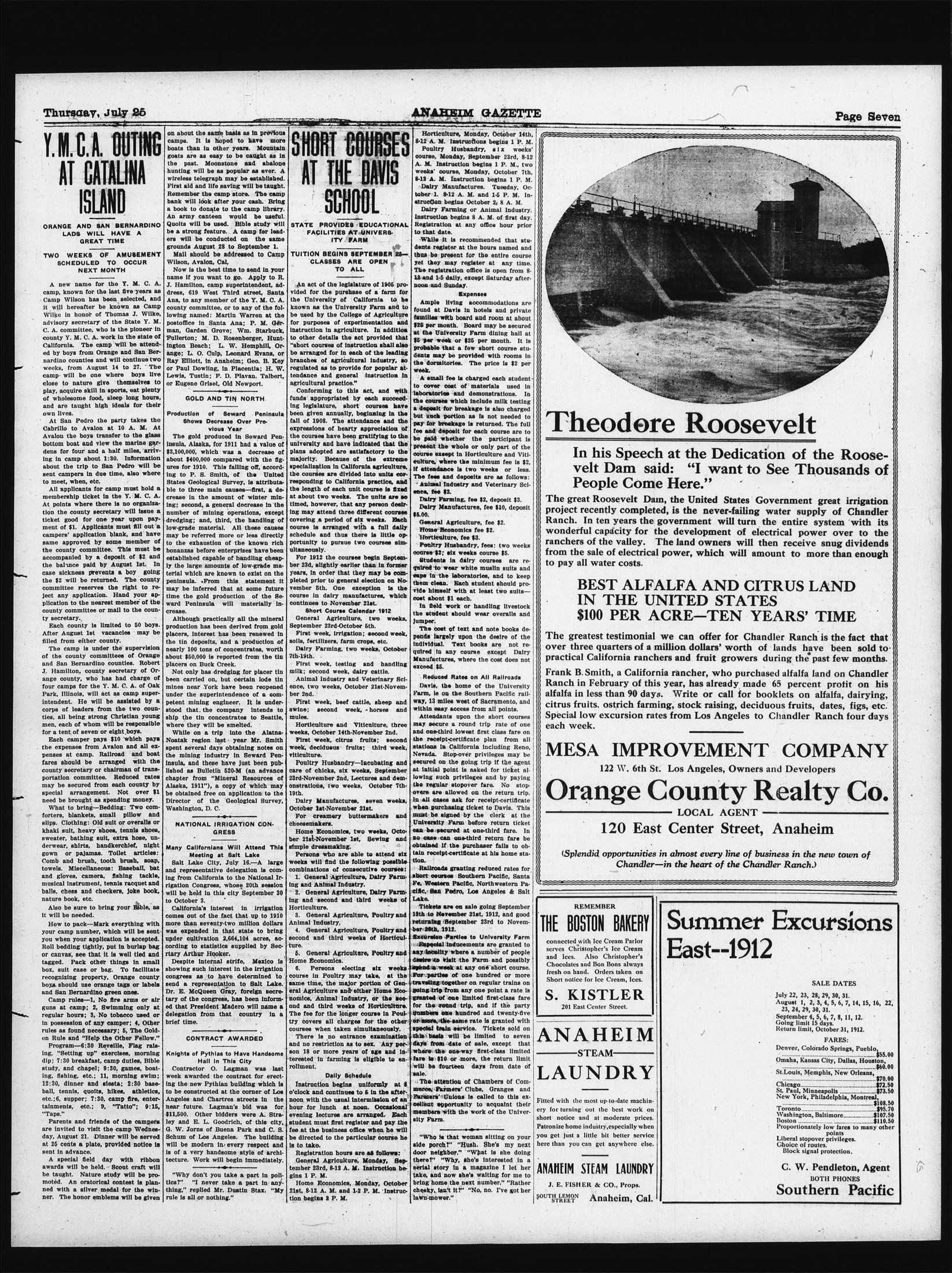
Searchable text
Thursday, July 25
Y.M.C.A. OUTING AT CATALINA ISLAND
ORANGE AND SAN BERNARDINO LADS WILL HAVE A GREAT TIME
TWO WEEKS OF AMUSEMENT SCHEDULED TO OCCUR NEXT MONTH
A new name for the Y. M. C. A. camp, known for the last five years as Camp Wilson has been selected, and it will hereafter be known as Camp Wilke in honor of Thomas J. Wilke, advisory secretary of the State Y. M. C. A. committee, who is the pioneer in county Y. M. C. A. work in the state of California. The camp will be attended by boys from Orange and San Bernardino counties and will continue two weeks, from August 14 to 27. The camp will be one where boys live close to nature give themselves to play, acquire skill in sports, eat plenty of wholesome food, sleep long hours, and are taught high ideals for their own lives.
At San Pedro the party takes the Cabrillo to Avalon at 10 A. M. At Avalon the boys transfer to the glass bottom boat and view the marine gardens for four and a half miles, arriving in camp about 1:30. Information about the trip to San Pedro will be sent campers in due time, also where on about the same basis as in previous camps. It is hoped to have more boats than in other years. Mountain goats are as easy to be caught as in the past. Moonstone and abalone hunting will be as popular as ever. A wireless telegraph may be established. First aid and life saving will be taught. Remember the camp store. The camp bank will look after your cash. Bring a book to donate to the camp library. An army canteen would be useful. Quolts will be used. Bible study will be a strong feature. A camp leaders will be conducted on the same grounds August 28 to September 1.
Mall should be addressed to Camp Wilson, Avalon, Cal,
Now is the best time to send in your name if you want to go. Apply to R. J. Hamilton, camp superintendent, address, 619 West Third street, Santa Ana, to any member of the Y. M. C. A. county committee, or to any of the following named: Martin Warren at the postoffice in Santa Ana; P. M. German, Garden Grove; Wm. Starbuck, Fullerton; M. D. Rosenberger, Huntington Beach; L. W. Hemphill, Orange; L. O. Culp, Leonard Evans, or Ray Elliott, in Anaheim; Geo. B. Key or Paul Dowling, in Placentia; H. W. Lewis, Tustin; F. D. Plavan, Talbert, or Eugene Griset, Old Newport.
GOLD AND TIN NORTH
Production of Seward Peninsula Shows Decrease Over Previous Year
The gold produced in Seward Peninsula, Alaska, for 1911 had a value of $3,100,000, which was a decrease of about $400,000 compared with the figures for 1910. This falling off, according to P. S. Smith of the United States Provides Facilities at City School
An act of the legislature vided for the purchase of the University of California known as the University be used by the College for purposes of expedition instruction in agriculture to other details the "short courses of institute be arranged for in each branches of agriculture regulated as to provide tendance and general agricultural practice."
Conforming to this funds appropriated by the legislature, short been given annually fall of 1908. The att expressions of hearty the courses have been university and have in plans adopted are said majority. Because of specialization in California the courses are divided
At San Pedro the party takes the Cabrillo to Avalon at 10 A.M. At Avalon the boys transfer to the glass bottom boat and view the marine gardens for four and a half miles, arriving in camp about 1:30. Information about the trip to San Pedro will be sent campers in due time, also where to meet, when, etc.
All applicants for camp must hold a membership ticket in the Y. M. C. A. At points where there is no organization the county secretary will issue a ticket good for one year upon payment of $1. Applicants must fill out a campers' application blank, and have same approved by some member of the county committee. This must be accompanied by a deposit of $2 and the balance paid by August 1st. In case sickness prevents a boy going the $2 will be returned. The county committee reserves the right to reject any application. Hand your application to the nearest member of the county committee or mail to the county secretary.
Each county is limited to 50 boys. After August 1st vacancies may be filled from either county.
The camp is under the supervision of the county committees of Orange and San Bernardino counties. Robert J. Hamilton, county secretary of Orange county, who has had charge of four camps for the Y. M. C. A. of Oak Park, Illinois, will act as camp superintendent. He will be assisted by a corps of leaders from the two counties, all being strong Christian young men, each of whom will be responsible for a tent of seven or eight boys.
Each camper pays $10 which pays the expenses from Avalon and all expenses at camp. Railroad and boat fares should be arranged with the county secretary or chairman of transportation committee. Reduced rates may be secured from each county by special arrangement. Not over $1 need be brought as spending money.
What to bring—Bedding: Two comforters, blankets, small pillow and slips. Clothing: Old suit or overalls or khaki suit, heavy shoes, tennis shoes, sweater, bathing suit, extra hose, underwear, shirts, handkerchief, night gown or pajamas. Toilet articles: Comb and brush, tooth brush, soap, towels. Miscellaneous: Baseball, bat and gloves, camera, fishing tackle, musical instrument, tennis racquet and balls, chess and checkers, joke book, nature book etc.
GOLD AND TIN NORTH
Production of Seward Peninsula Shows Decrease Over Previous Year
The gold produced in Seward Peninsula, Alaska, for 1911 had a value of $3,100,000, which was a decrease of about $400,000 compared with the figures for 1910. This falling off, according to P. S. Smith, of the United States Geological Survey, is attributable to three main causes—first, a decrease in the amount of winter mining; second, a general decrease in the number of mining operations, except dredging; and third, the handling of low-grade material. All these causes may be referred more or less directly to the exhaustion of the known rich bonanzas before enterprises have been established capable of handling cheaply the large amounts of low-grade material which are known to exist on the peninsula. From this statement it may be inferred that at some future time the gold production of the Seward Peninsula will materially increase.
Although practically all the mineral production has been derived from gold placers, interest has been renewed in the tin deposits, and a production of nearly 100 tons of concentrates, worth about $50,000 is reported from the tin placers on Buck Creek.
Not only has dredging for placer tin been carried on, but certain lode tin mines near York have been reopened under the superintendence of a competent mining engineer. It is understood that the company intends to ship the tin concentrates to Seattle, where they will be smelted.
While on a trip into the Alatna-Noatak region last year Mr. Smith spent several days obtaining notes on the mining industry in Seward Peninsula, and these have just been published as Bulletin 520-M (an advance chapter from "Mineral Resources of Alaska, 1911"), a copy of which may be obtained free on application to the Director of the Geological Survey, Washington, D.C.
NATIONAL IRRIGATION CONGRESS
Many Californians Will Attend This Meeting at Salt Lake
Salt Lake City, July 16.—A large and representative delegation is coming from California to the National Irrigation Congress, whose 20th session will be held in this city September 30.
Conforming to this funds appropriated by legislation, short been given annually, fall of 1908. The attractions of hearty courses have been university and have adopted are majority. Because of specialization in California the courses are divided responding to California the length of each unit at about two weeks.
Timed, however, that timing may attend three covering a period of a course is arranged with schedule and thus portunity to pursueultaneously.
For 1912 the course ber 23d, slightly earlier years, in order that tited prior to genera vember 5th. One e course in dairy man continues to November.
Short Course Ca
General Agriculture September 23rd-October First week, irrigation soils, fertilizers, farm Dairy Farming, two 7th-19th.
First week, testing milk; second week, da Animal Industry ence, two weeks, October 2nd.
First week, beef c swine; second week mules.
Horticulture and weeks, October 14th-N First week, citrus week, deciduous fruit viticulture.
Poultry Husbandry care of chicks, six w 23rd-November 2nd, L constrations, two weeks 19th.
Dairy Manufacturer October 1st-November For creamery bu cheeseemakers.
Home Economics terber 21st-November 1st simple dressmaking.
Persons who are all weeks will find the few combinations of cons:
1. General Agricultural and Animal Industries.
2. General Agricultural and second
What to bring—Bedding: Two comforters, blankets, small pillow and slips. Clothing: Old suit or overalls or khaki suit, heavy shoes, tennis shoes, sweater, bathing suit, extra hose, underwear, shirts, handkerchief, night gown or pajamas. Toilet articles: Comb and brush, tooth brush, soap, towels. Miscellaneous: Baseball, bat and gloves, camera, fishing tackle, musical instrument, tennis racquet and balls, chess and checkers, joke book, nature book, etc.
Also be sure to bring your Bible, as it will be needed.
How to pack—Mark everything with your camp number, which will be sent you when your application is accepted. Roll bedding tightly, put in burlap bag or canvas, see that it is well tied and tagged. Pack other things in small box, suit case or bag. To facilitate recognizing property, Orange county boys should use orange tags or labels and San Bernardino green ones.
Camp rules—1. No fire arms or air guns at camp; 2. Swimming only at regular hours; 3. No tobacco used or in possession of any camper; 4. Other rules as found necessary; 5. The Golden Rule and "Help the Other Fellow."
Program—6:30 Reveille, Flag raising, "Setting up" exercises, morning dip; 7:30 breakfast, camp duties, Bible study, and chapel; 9:30 games, boating, fishing, etc.; 11, morning swim; 12:30, dinner and siesta; 2:30 baseball, tennis, quoits, hikes, athletics, etc.; 6, supper; 7:30, camp fire, entertainments, etc.; 9, "Tatto"; 9:15, "Taps."
Parents and friends of the campers are invited to visit the camp Wednesday, August 21. Dinner will be served at 25 cents a plate, provided notice is sent in advance.
A special field day with ribbon awards will be held. Scout craft will be taught. Nature study will be promoted. An oratorical contest is planned with a silver medal for the winner. The honor emblems will be given
NATIONAL IRRIGATION CONGRESS
Many Californians Will Attend This Meeting at Salt Lake
Salt Lake City, July 16. A large and representative delegation is coming from California to the National Irrigation Congress, whose 20th session will be held in this city September 30 to October 3.
California's interest in irrigation comes out of the fact that up to 1910 more than seventy-two million dollars was expended in that state to bring under cultivation 2,664,104 acres, according to statistics supplied by Secretary Arthur Hooker.
Despite internal strife, Mexico is showing such interest in the irrigation congress as to have determined to send a representation to Salt Lake. Dr. E. McQueen Gray, foreign secretary of the congress, has been informed that President Madero will name a delegation from that country in a brief time.
CONTRACT AWARDED
Knights of Pythias to Have Handsome Hall in This City
Contractor O. Lagman was last week awarded the contract for erecting the new Pythian building which is to be constructed at the corner of Los Angeles and Chartres streets in the near future. Lagman's bid was for $11,500. Other bidders were A. Straley and E. L. Goodrich, of this city, G. W. Jorns of Buena Park and C. S. Schum of Los Angeles. The building will be modern in every respect and is of a very handsome style of architecture. Work will begin immediately.
"Why don't you take a part in politics?" "I never take a part in anything," replied Mr. Dustin Stax. "My rule is all or nothing."
SHORT COURSES AT THE DAVIS SCHOOL
STATE PROVIDES EDUCATIONAL FACILITIES AT UNIVERSITY FARM
TUITION BEGINS SEPTEMBER 23—CLASSES ARE OPEN TO ALL
An act of the legislature of 1905 provided for the purchase of a farm for the University of California to be known as the University Farm and to be used by the College of Agriculture for purposes of experimentation and instruction in agriculture. In addition to other details the act provided that "short courses of instruction shall also be arranged for in each of the leading branches of agricultural industry, so regulated as to provide for popular attendance and general instruction in agricultural practice."
Conforming to this act, and with funds appropriated by each succeeding legislature, short courses have been given annually, beginning in the fall of 1908. The attendance and the expressions of hearty appreciation of the courses have been gratifying to the university and have indicated that the plans adopted are satisfactory to the majority. Because of the extreme specialization in California agriculture, the courses are divided into units cor-
Horticulture, Monday, October 14th, 8-12 A.M. Instructions begins 1 P.M.
Poultry Husbandry, six weeks' course, Monday, September 23rd, 8-12 A.M. Instruction begins 1 P.M., two weeks' course, Monday, October 7th, 8-12 A.M. Instruction begins 1 P.M.
Dairy Manufactures. Tuesday, October 1. 8-12 A.M. and 1-5 P.M. Instruction begins October 2, 8 A.M.
Dairy Farming or Animal Industry. Instruction begins 8 A.M. of first day. Registration at any office hour prior to that date.
While it is recommended that students register at the hours named and thus be present for the entire course yet they may register at any time. The registration office is open from 8-12 and 1-5 daily, except Saturday afternoon and Sunday.
Expenses
Ample living accommodations are found at Davis in hotels and private families with board and room at about $25 per month. Board may be secured at the University Farm dining hall at $5 per week or $25 per month. It is probable that a few short course students may be provided with rooms in the dormitories. The price is $2 per week.
A small fee is charged each student to cover cost of materials used in laboratories and demonstrations. In the courses which include milk testing a deposit for breakage is also charged but such portion as is not needed to pay for breakage is returned. The full fee and deposit for each course are to be paid whether the participant is present the whole or only part of the course except in Horticulture and Vitis-culture, where the minimum fee is $2, if attendance is two weeks or less.
Theodore
In his Speech a velt Dam said:
Conforming to this act, and with funds appropriated by each succeeding legislature, short courses have been given annually, beginning in the fall of 1908. The attendance and the expressions of hearty appreciation of the courses have been gratifying to the university and have indicated that the plans adopted are satisfactory to the majority. Because of the extreme specialization in California agriculture, the courses are divided into units corresponding to California practice, and the length of each unit course is fixed at about two weeks. The units are so timed, however, that any person desiring may attend three different courses covering a period of six weeks. Each course is arranged with a full daily schedule and thus there is little opportunity to pursue two courses simultaneously.
For 1912 the courses begin September 23rd, slightly earlier than in former years, in order that they may be completed prior to general election on November 5th. One exception is the course in dairy manufactures, which continues to November 21st.
Short Course Calendar 1912
General Agriculture, two weeks, September 23rd-October 5th.
First week, irrigation; second week, soils, fertilizers, farm crops, etc.
Dairy Farming, two weeks, October 7th-19th.
First week, testing and handling milk; second week, dairy cattle.
Animal Industry and Veterinary Science, two weeks, October 21st-November 2nd.
First week, beef cattle, sheep and swine; second week, horses and mules.
Horticulture and Viticulture, three weeks, October 14th-November 2nd.
First week, citrus fruits; second week, deciduous fruits; third week, viticulture.
Poultry Husbandry—Incubating and care of chicks, six weeks, September 23rd-November 2nd, Lectures and demonstrations, two weeks, October 7th-19th.
Dairy Manufactures, seven weeks, October 1st-November 21st.
For creamery buttermakers and cheesemakers.
Home Economics, two weeks, October 21st-November 1st, Sewing and simple dressmaking.
Persons who are able to attend six weeks will find the following possible combinations of consecutive courses:
1. General Agriculture, Dairy Farming and Animal Industry.
2. General Agriculture, Dairy Farming and second and third weeks of A small fee is charged each student to cover cost of materials used in laboratories and demonstrations. In the courses which include milk testing a deposit for breakage is also charged but such portion as is not needed to pay for breakage is returned. The full fee and deposit for each course are to be paid whether the participant is present the whole or only part of the course except in Horticulture and Viticulture, where the minimum fee is $2 if attendance is two weeks or less. The fees and deposits are as follows:
Animal Industry and Veterinary Science, fee $2.
Dairy Farming, fee $2, deposit $3.
Dairy Manufactures, fee $10, deposit $5.00.
General Agriculture, fee $2.
Home Economics fee $2.
Horticulture, fee $3.
Poultry Husbandry, fees: two weeks course $2; six weeks course $5.
Students in dairy courses are required to wear white muslin suits and caps in the laboratories, and to keep them clean. Each student should provide himself with at least two suits—cost about $1 each.
In field work or handling livestock the student should wear overalls and jumper.
The cost of text and note books depends largely upon the desire of the individual. Text books are not required in any course except Dairy Manufactures, where the cost does not exceed $5.
Reduced Rates on All Railroads
Davis, the home of the University Farm, is on the Southern Pacific railway, 13 miles west of Sacramento, and within easy access from all points.
Attendants upon the short courses may secure a round trip rate of one and one-third lowest first class fare on the receipt-certificate plan from all stations in California including Reno, Nevada. Stop-over privileges may be secured on the going trip if the agent at initial point is asked for ticket allowing such privileges and by paying the regular stopover fare. No stopovers are allowed on the return trip. In all cases ask for receipt-certificate when purchasing ticket to Davis. This must be signed by the clerk at the University Farm before return ticket can be secured at one-third fare. In no case can one-third return fare be obtained if the purchaser fails to obtain receipt-certificate at his home station.
Railroads granting reduced rates for short courses Southern Pacific, Santa Fe, Western Pacific, Northwestern Pacific, San Pedro, Los Angeles & Salt Lake
Dairy Manufactures, seven weeks, October 1st-November 21st.
For creamery buttermakers and cheesemakers.
Home Economics, two weeks, October 21st-November 1st, Sewing and simple dressmaking.
Persons who are able to attend six weeks will find the following possible combinations of consecutive courses:
1. General Agriculture, Dairy Farming and Animal Industry.
2. General Agriculture, Dairy Farming and second and third weeks of Horticulture.
3. General Agriculture, Poultry and Animal Industry.
4. General Agriculture, Poultry and second and third weeks of Horticulture.
5. General Agriculture, Poultry and Home Economics.
6. Persons electing six weeks course in Poultry may take, at the same time, the major portion of General Agriculture and either Home Economics, Animal Industry, or the second and third weeks of Horticulture. The fee for the longer course in Poultry covers all charges for the other courses when taken simultaneously.
There is no entrance examination and no restriction as to sex. Any person 18 or more years of age and interested in farming is eligible to enrollment.
Daily Schedule
Instruction begins uniformly at 8 o'clock and continues to 5 in the afternoon with the usual intermission of an hour for lunch at noon. Occasional evening lectures are arranged. Each student must first register and pay the fee at the business office when he will be directed to the particular course he is to take.
Registration hours are as follows:
General Agriculture, Monday, September 23rd, 8-12 A.M. Instruction begins 1 P.M.
Home Economics, Monday, October 21st, 8-12 A.M. and 1-2 P.M. Instruction begins 2 P.M.
Tickets are on sale going September 13th to November 21st, 1912, and good returning September 23rd to November 26th, 1912.
Excursion Parties to University Farm
Special inducements are granted to any locality where a number of people desire to visit the Farm and possibly spend a week at any one short course. For parties of one hundred or more traveling together on regular trains on going trip from any one point a rate is granted of one limited first-class fare for the round trip, and if the party numbers one hundred and twenty-five or more, the same rate is granted with special train service. Tickets sold on this basis will be limited to seven days from date of sale, except that where the one-way first-class limited fare is $10 or more, the return limit will be fourteen days from date of sale.
The attention of Chambers of Commerce, Farmers' Clubs, Granges and Farmers' Unions is called to this excellent opportunity to acquaint their members with the work of the University Farm.
"Who is that woman sitting on your side porch?" "Hush. She's my next door neighbor." "What is she doing there?" "Why, she's interested in a serial story in a magazine I let her take, and now she's waiting for me to bring home the next number." "Rather cheeky, isn't it?" "No, no. I've got her lawn-mower."
REMEMBER
THE BOSTON BAKERY
connected with Ice Cream Parlor serves Christopher's Ice Cream and Ices. Also Christopher's Chocolates and Bon Bons always fresh on hand. Orders taken on Short notice for Ice Cream, Ices.
S. KISTLER
201 East Center Street.
ANAHEIM STEAM LAUNDRY
Fitted with the most up-to-date machinery for turning out the best work on short notice and at moderate prices. Patronize home industry, especially when you get just a little bit better service here than you can get anywhere else.
ANAHEIM STEAM LAUNDRY
J. E. FISHER & CO., Props.
SOUTH LEMON STREET Anaheim, Cal.
Page Seven
Theodore Roosevelt
His Speech at the Dedication of the RooseDam said: "I want to See Thousands of
Roosevelt Dam, the United States Government great irrigation recently completed, is the never-failing water supply of Chandler ten years the government will turn the entire system with its capacity for the development of electrical power over to the valley. The land owners will then receive snug dividends of electrical power, which will amount to more than enough water costs.
EST ALFALFA AND CITRUS LAND
THE UNITED STATES
10 PER ACRE—TEN YEARS' TIME
Test testimonial we can offer for Chandler Ranch is the fact that quarters of a million dollars' worth of lands have been sold to California ranchers and fruit growers during the past few months.
Smith, a California rancher, who purchased alfalfa land on Chandler February of this year, has already made 65 percent profit on his less than 90 days. Write or call for booklets on alfalfa, dairying, ostrich farming, stock raising, deciduous fruits, dates, figs, etc.
Excursion rates from Los Angeles to Chandler Ranch four days
A IMPROVEMENT COMPANY
122 W. 6th St. Los Angeles, Owners and Developers
Range County Realty Co.
LOCAL AGENT
120 East Center Street, Anaheim
Opportunities in almost every line of business in the new town of Chandler—in the heart of the Chandler Ranch.)
Summer Excursions
East--1912
SALE DATES
July 22, 23, 28, 29, 30, 31.
August 1, 2, 3, 4, 5, 6, 7, 14, 15, 16, 22,
23, 24, 29, 30, 31.
September 4, 5, 6, 7, 8, 11, 12.
Going limit 15 days.
Return limit, October 31, 1912.
FARES:
Denver, Colorado Springs, Pueblo,
$55.00
Omaha, Kansas City, Dallas, Houston,
$60.00
St. Louis, Memphis, New Orleans,
$70.00
Chicago $72.50
St. Paul, Minneapolis $73.50
New York, Philadelphia, Montreal,
$108.50
Toronto $95.70
Washington, Baltimore $107.50
Boston $110.50
Proportionately low fares to many other points
Liberal stopover privileges.
Choice of routes.
Block signal protection.
C. W. Pendleton, Agent
BOTH PHONES
Southern Pacific