anaheim-gazette 1912-07-18
Scanned page
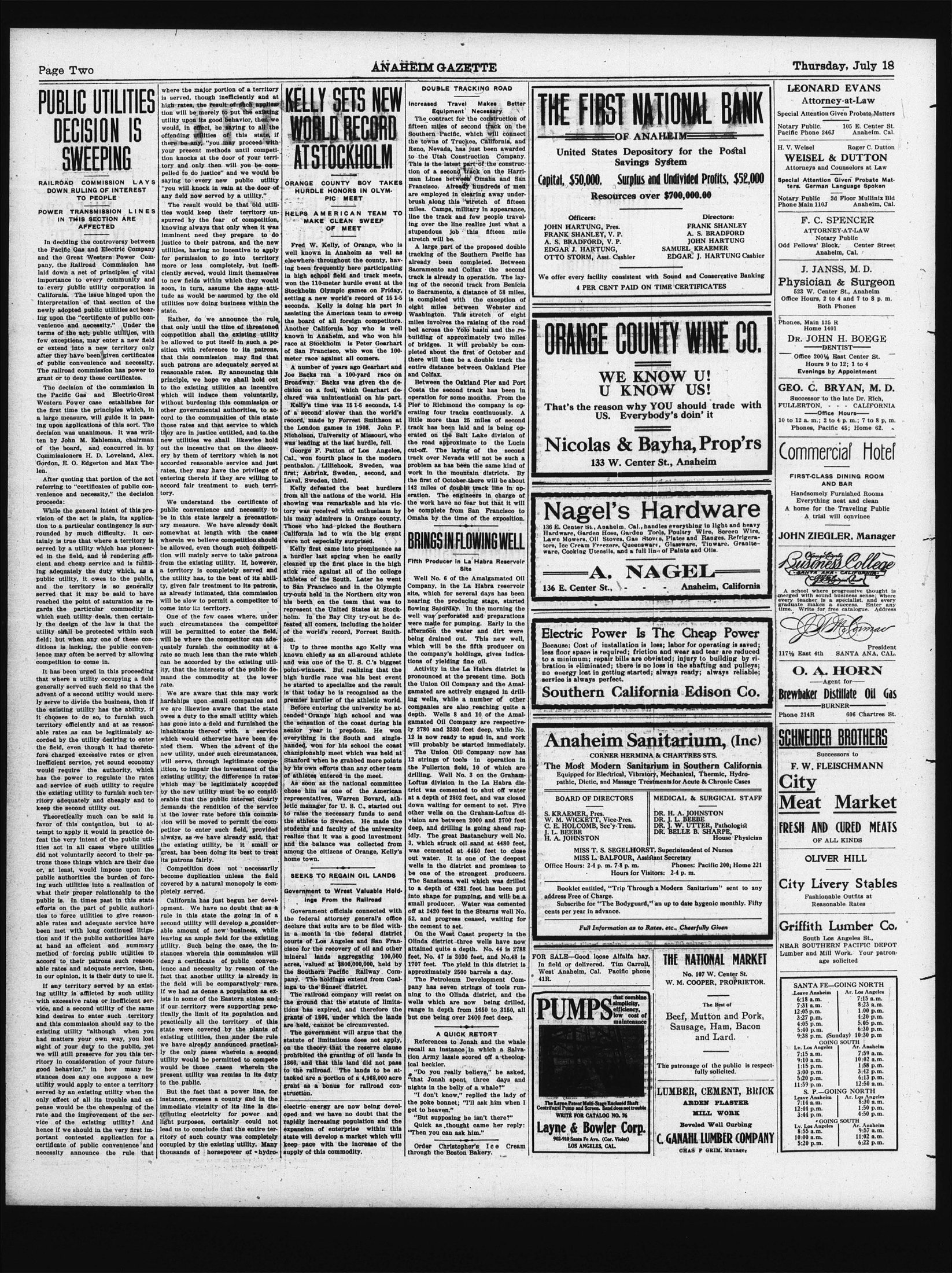
Searchable text
PUBLIC UTILITIES DECISION IS SWEEPING
RAILROAD COMMISSION LAYS DOWN RULING OF INTEREST TO PEOPLE
POWER TRANSMISSION LINES IN THIS SECTION ARE AFFECTED
In deciding the controversy between the Pacific Gas and Electric Company and the Great Western Power Company, the Railroad Commission has laid down a set of principles of vital importance to every community and to every public utility corporation in California. The issue hinged upon the interpretation of that section of the newly adopted public utilities act bearing upon the "certificate of public convenience and necessity." Under the terms of the act, public utilities, with few exceptions, may enter a new field or extend into a new territory only after they have been given certificates of public convenience and necessity. The railroad commission has power to grant or to deny these certificates.
The decision of the commission in the Pacific Gas and Electric-Great Western Power case establishes for the first time the principles which, in a large measure, will guide it in passing upon applications of this sort. The decision was unanimous. It was written by John M. Eshleman, chairman of the board, and concurred in by Commissioners H. D. Loveland, Alex. Gordon, E. O. Edgerton and Max Thelen.
where the major portion of a territory is served, though inefficiently and at high rates, the result of such application will be merely to put the existing utility upon its good behavior, then we would, in effect, be saying to all the offending utilities of this state, if there be any, "you may proceed with your present methods until competition knocks at the door of your territory and only then will you be compelled to do justice" and we would be saying to every new public utility "you will knock in vain at the door of any field now served by a utility."
The result would be that old utilities would keep their territory unsurprered by the fear of competition, knowing always that only when it was imminent need they prepare to do justice to their patrons, and the new utilities, having no incentive to apply for permission to go into territory more or less completely, but inefficiently served, would limit themselves to new fields within which they would soon, in turn, assume the same attitude as would be assumed by the old utilities now doing business within the state.
Rather, do we announce the rule that only until the time of threatened competition shall the existing utility be allowed to put itself in such a position with reference to its patrons, that this commission may find that such patrons are adequately served at reasonable rates. By announcing this principle, we hope we shall hold out to the existing utilities an incentive which will induce them voluntarily, without burdening this commission or other governmental authorities, to accord to the communities of this state those rates and that service to which they are in justice entitled, and to the new utilities we shall likewise hold out the incentive that on the discovery by them of territory which is not accorded reasonable service and just rates, they may have the privilege of...
The decision of the commission in the Pacific Gas and Electric-Great Western Power case establishes for the first time the principles which, in a large measure, will guide it in passing upon applications of this sort. The decision was unanimous. It was written by John M. Eshleman, chairman of the board, and concurred in by Commissioners H. D. Loveland, Alex Gordon, E. O. Edgerton and Max Thelen.
After quoting that portion of the act referring to "certificates of public convenience and necessity," the decision proceeds:
While the general intent of this provision of the act is plain, its application to a particular contingency is surrounded by much difficulty. It certainly is true that where a territory is served by a utility which has pioneered in the field, and is rendering efficient and cheap service and is fulfilling adequately the duty which, as a public utility, it owes to the public, and the territory is so generally served that it may be said to have reached the point of saturation as regards the particular commodity in which such utility deals, then certainly the design of the law is that the utility shall be protected within such field; but when any one of these conditions is lacking, the public convenience may often be served by allowing competition to come in.
It has been urged in this proceeding that where a utility occupying a field generally served such field so that the advent of a second utility would merely serve to divide the business, then if the existing utility has the ability, if it chooses to do so, to furnish such territory efficiently and at as reasonable rates as can be legitimately accorded by the utility desiring to enter the field, even though it had therefore charged excessive rates or given inefficient service, yet sound economy would require the authority, which has the power to regulate the rates and service of such utility to require the existing utility to furnish such territory adequately and cheaply and to keep the second utility out.
Theoretically much can be said in favor of this contention, but to attempt to apply it would in practice defeat the very intent of the public utilities act in all cases where utilities did not voluntarily accord to their patrons those things which are their due or, at least, would impose upon the public authorities the burden of forcing such utilities into a realization of what their proper relationship to the public is.
By unanimously agreeing on principle, we hope we shall hold out to the existing utilities an incentive which will induce them voluntarily, without burdening this commission or other governmental authorities, to accord to the communities of this state those rates and that service to which they are in justice entitled, and to the new utilities we shall likewise hold out the incentive that on the discovery by them of territory which is not accorded reasonable service and just rates, they may have the privilege of entering therein if they are willing to accord fair treatment to such territory.
We understand the certificate of public convenience and necessity to be in this state largely a precautionary measure. We have already dealt somewhat at length with the cases wherein we believe competition should be allowed, even though such competition will mainly serve to take patrons from the existing utility. If, however, a territory is completely served and the utility has, to the best of its ability, given fair treatment to its patrons, as already intimated, this commission will be slow to permit a competitor to come into its territory.
One of the few cases where, under such circumstances the competitor will be permitted to enter the field, will be where the competitor can adequately furnish the commodity at a rate so much less than the rate which can be accorded by the existing utility, that the interests of the public demand the commodity at the lower rate.
We are aware that this may work hardships upon small companies and we are likewise aware that the state owes a duty to the small utility which has gone into a field and furnished the inhabitants thereof with a service which would otherwise have been denied them. When the advent of the new utility, under such circumstances, will serve, through legitimate competition, to impair the investment of the existing utility, the difference in rates which may be legitimately accorded by the new utility must be so considerable that the public interest clearly demands the rendition of the service at the lower rate before this commission will be moved to permit the competitor to enter such field, provided always, as we have already said, that the existing utility, be it small or great, has been doing its best to treat its patrons fairly.
Competition does not necessarily become duplication unless the field covered by a natural monopoly is completely served.
Joe Backs ran a 100 Broadway. Backs was cision on a foul, which clared was unintention.
Kelly's time was 15:15 of a second slower than record, made by Forrester London games in Nicholson, University of was leading at the last.
George F. Patton of Cal., won fourth place penthalon. Lilliehook, first; Asbrink, Sweden Laval, Sweden, third.
Kelly defeated them from all the nations of showing was remarkable history was received with his many admirers in Ohio Those who had picked California lad to win were not especially surprised.
Kelly first came into a hurdler last spring w cleaned up the first play stick race against all athletes of the South. To San Francisco and try-outs held in the North he berth on the team represent United Statesholm. In the Bay City feated all comers, include of the world's record son.
Up to three months known chiefly as an alliance and was one of the U.S. point-winners. But reside high hurdle race was he started to specialize is that today he is recorder hurdler of the city.
Before entering the extended Orange high school the sensation of the senior year in preparation everything in the South handed, won for his sole championship meet while Stanford when he grabs by his own efforts than of athletes entered in.
As soon as the nation chose him as one of representatives, Warren let manager for U.S. to raise the necessary athlete to Sweden. Students and faculty of realize that it was a good and balance was among the citizens of home town.
Theoretically much can be said in favor of this contention, but to attempt to apply it would in practice defeat the very intent of the public utilities act in all cases where utilities did not voluntarily accord to their patrons those things which are their due or, at least, would impose upon the public authorities the burden of forcing such utilities into a realization of what their proper relationship to the public is. In times past in this state efforts on the part of public authorities to force utilities to give reasonable rates and adequate service have been met with long continued litigation and if the public authorities have at hand an efficient and summary method of forcing public utilities to accord to their patrons such reasonable rates and adequate service, then, in our opinion, it is their duty to use it.
If any territory served by an existing utility is afflicted by such utility with excessive rates or inefficient service, and a second utility of the same kind desires to enter such territory and this commission should say to the existing utility "although when you had matters your own way, you lost sight of your duty to the public, yet we will still preserve for you this territory in consideration of your future good behavior," in how many instances does any one suppose a new utility would apply to enter a territory served by an existing utility when the only effect of all its trouble and expense would be the cheapening of the rate and the improvement of the service of the existing utility? And hence if we should in the very first important contested application for a certificate of public convenience and necessity announce the rule that
Competition does not necessarily become duplication unless the field covered by a natural monopoly is completely served.
California has just begun her development. We have no doubt that as a rule in this state the going in of a second utility will develop a considerable amount of new business, while leaving an ample field for the existing utility. Such being the case, the instances wherein this commission will deny a certificate of public convenience and necessity by reason of the fact that another utility is already in the field will be comparatively rare. If we had as dense a population as exists in some of the Eastern states and if our territory were supporting practically the limit of its population and practically all the territory of this state were covered by the plants of existing utilities, then under the rule we have already announced practically the only cases wherein a second utility would be permitted to compete would be those cases wherein the present utility was remiss in its duty to the public.
But the fact that a power line, for instance, crosses a county and in the immediate vicinity of its line is distributing electricity for power and light purposes, certainly could not lead us to conclude that the entire territory of such county was completely occupied by the existing utility. Many thousands of horsepower of hydro-
KELLY SETS NEW WORLD RECORD AT STOCKHOLM
ORANGE COUNTY BOY TAKES HURDLE HONORS IN OLYMPIC MEET
HELPS AMERICAN TEAM TO MAKE CLEAN SWEEP OF MEET
Fred W. Kelly, of Orange, who is well known in Anaheim as well as elsewhere throughout the county, having been frequently here participating in high school field and track meets, won the 110-meter hurdle event at the Stockholm Olympic games on Friday, setting a new world’s record of 151-5 seconds. Kelly is doing his part in assisting the American team to sweep the board of all foreign competitors. Another California boy who is well known in Anaheim, and who won his race at Stockholm is Peter Gearhart of San Francisco, who won the 100-meter race against all comers.
A number of years ago Gearhart and Joe Backs ran a 100-yard race on Broadway. Backs was given the decision on a foul, which Gearhart declared was unintentional on his part.
Kelly's time was 151-5 seconds, 1-5 of a second slower than the world's record, made by Forrest Smithson at the London games in 1908. John P. Nicholson, University of Missouri, who was leading at the last hurdle, fell.
George F. Patton of Los Angeles, Cal., won fourth place in the modern penthalon. Lilliehook, Sweden, was first; Asbrink, Sweden, second, and DOUBLE TRACKING ROAD
Increased Travel Makes Better Equipment Necessary
The contract for the construction of fifteen miles of second track on the Southern Pacific, which will connect the towns of Truckee, California, and Reno, Nevada, has just been awarded to the Utah Construction Company. This is the latest part of the construction of a second track on the Harriman Lines between Omaha and San Francisco. Already hundreds of men are employed in clearing away underbrush along this stretch of fifteen miles. Camps, military in appearance, line the track and few people traveling over the line realize just what a stupendous job this fifteen mile stretch will be.
A large part of the proposed double tracking of the Southern Pacific has already been completed. Between Sacramento and Colfax the second track is already in operation. The laying of the second track from Benicia to Sacramento, a distance of 58 miles, is completed with the exception of eight miles between Webster and Washington. This stretch of eight miles involves the raising of the road bed across the Yolo basin and the rebuilding of approximately two miles of bridges. It will probably be completed about the first of October and there will then be a double track the entire distance between Oakland Pier and Colfax.
Between the Oakland Pier and Port Costa the second track has been in operation for some months. From the Pier to Richmond the company is operating four tracks continuously. A little more than 25 miles of second track has been laid and is being operated on the Salt Lake division of the road approximate to the Lucin cut-off. The laying of the second track over Nevada will not be such a problem as has been the same kind of work in the mountain districts. By
Joe Backs ran a 100-yard race on Broadway. Backs was given the decision on a foul, which Gearhart declared was unintentional on his part.
Kelly's time was 151-5 seconds, 1-5 of a second slower than the world's record, made by Forrest Smithson at the London games in 1908. John P. Nicholson, University of Missouri, who was leading at the last hurdle, fell.
George F. Patton of Los Angeles, Cal., won fourth place in the modern penthalon. Lilliehook, Sweden, was first; Asbrink, Sweden, second, and Laval, Sweden, third.
Kelly defeated the best hurdlers from all the nations of the world. His showing was remarkable and his victory was received with enthusiasm by his many admirers in Orange county. Those who had picked the Southern California lad to win the big event were not especially surprised.
Kelly first came into prominence as a hurdler last spring when he easily cleaned up the first place in the high stick race against all of the college athletes of the South. Later he went to San Francisco and in the Olympic try-outs held in the Northern city won his berth on the team that was to represent the United States at Stockholm. In the Bay City try-out he defeated all comers, including the holder of the world's record, Forrest Smithson.
Up to three months ago Kelly was known chiefly as an all-around athlete and was one of the U. S. C.'s biggest point-winners. But realizing that the high hurdle race was his best event he started to specialize and the result is that today he is recognized as the premier hurdler of the athletic world.
Before entering the university he attended Orange high school and was the sensation of the coast during his senior year in prepdom. He won everything in the South and single-handed, won for his school the coast championship meet which was held at Stanford when he grabbed more points by his own efforts than any other team of athletes entered in the meet.
As soon as the national committee chose him as one of the American representatives, Warren Bovard, athletic manager for U. S. C., started out to raise the necessary funds to send the athlete to Sweden. He made the students and faculty of the university realize that it was a good investment and the balance was collected from among the citizens of Orange, Kelly's home town.
SEEKS TO REGAIN OIL LANDS
Government to Wrest Valuable Holdings From The Railroad
Between the Oakland Pier and Port Costa the second track has been in operation for some months. From the Pier to Richmond the company is operating four tracks continuously. A little more than 25 miles of second track has been laid and is being operated on the Salt Lake division of the road approximate to the Lucin cut-off. The laying of the second track over Nevada will not be such a problem as has been the same kind of work in the mountain districts. By the first of October there will be about 142 miles of double track line in operation. The engineers in charge of the work have no fear but that it will be complete from San Francisco to Omaha by the time of the exposition.
BRINGS IN FLOWING WELL
Fifth Producer in La Habra Reservoir Site
Well No. 6 of the Amalgamated Oil Company, in the La Habra reservoir site, which for several days has been nearing the producing stage, started flowing Saturday. In the morning the well was perforated and preparations were made for pumping. Early in the afternoon the water and dirt were being drained out. This new well, which will be the fifth producer on the company's holdings, gives indications of yielding fine oil.
Activity in the La Habra district is pronounced at the present time. Both the Union Oil Company and the Amalgamated are actively engaged in drilling wells, while a number of other companies are also reaching quite a depth. Wells 8 and 10 of the Amalgamated Oil Company are respectively 2780 and 2330 feet deep, while No. 12 is now ready to spud in, and work will probably be started immediately.
The Union Oil Company now has 12 strings of tools in operation in the Fullerton field, 10 of which are drilling. Well No. 3 on the Graham-Loftus division in the La Habra district was cemented to shut off water at a depth of 2802 feet, and was closed down waiting for cement to set. Five other wells on the Graham-Loftus division are between 2000 and 2700 feet deep, and drilling is going ahead rapidly. The great Bastanchury well No. 3, which struck oil sand at 4480 feet, was cemented at 4450 feet to close out water. It is one of the deepest wells in the district and promises to be one of the strongest producers. The Sansinena well which was drilled to a depth of 4281 feet has been put into shape for pumping, and will be a
SEEKS TO REGAIN OIL LANDS
Government to Wrest Valuable Holdings From the Railroad
Government officials connected with the federal attorney general's office declare that suits are to be filed within a month in the federal district courts of Los Angeles and San Francisco for the recovery of oil and other mineral lands aggregating 100,000 acres, valued at $800,000,000, held by the Southern Pacific Railway Company. The holdings extend from Coalinga to the Sunset district.
The railroad company will resist on the ground that the statute of limitations has expired, and therefore the grants of 1866, under which the lands are held, cannot be circumvented.
The government will argue that the statute of limitations does not apply, on the theory that the reserve clause prohibited the granting of oil lands in 1866, and that this land did not pass to the railroad. The lands to be attacked are a portion of a 4,968,000 acre grant as a bonus for railroad construction.
electric energy are now being developed and we have no doubt that the rapidly increasing population and the expansion of enterprise within this state will develop a market which will keep pace with the increase of the supply of this commodity.
A QUICK RETORT
References to Jonah and the whale recall an instance in which a Salvation Army lassie scored off a theological heckler.
"Do you really believe," he asked, "that Jonah spent three days and nights in the belly of a whale?"
"I don't know," replied the lady of the poke bonnet; "I'll ask him when I get to heaven."
"But supposing he isn't there?"
Quick as thought came her reply: "Then you can ask him."
Order Christopher's Ice Cream through the Boston Bakery.
THURSDAY, July 18
FIRST NATIONAL BANK
OF ANAHEIM
States Depository for the Postal Savings System
D. Surplus and Undivided Profits, $52,000
Resources over $700,000.00
Directors:
G, Pres.
EY, V. P.
D, V. P.
TUNG,
Asst. Cashier
FRANK SHANLEY
A. S. BRADFORD
JOHN HARTUNG
SAMUEL KRAEMER
EDGAR. J. HARTUNG Cashier
Utility consistent with Sound and Conservative Banking
CENT PAID ON TIME CERTIFICATES
LEONARD EVANS
Attorney-at-Law
Special Attention Given Probate Matters
Notary Public. 105 E. Center St.
Pacific Phone 246J Anaheim. Cal.
H. V. Weisel
Roger C. Dutton
WEISEL & DUTTON
Attorneys and Counselors at Law
Special Attention Given Probate Matters. German Language Spoken
Notary Public 2d Floor Mullinix Bld
Phone Main 110J Anaheim, Cal.
F. C. SPENCER
ATTORNEY-AT-LAW
Notary Public
Odd Fellows' Block; Center Street
Anaheim, Cal.
J. JANSS, M. D.
Physician & Surgeon
523 W. Center St., Anaheim
Office Hours, 2 to 4 and 7 to 8 p.m.
Both Phones
Phones, Main 135 R
Home 1401
DR. JOHN H. BOEGE
DENTIST
Office 200½ East Center St.
Hours 9 to 12; 1 to 4
Evenings by Appointment
GEO. C. BRYAN, M. D.
Successor to the late Dr. Rich,
FULLERTON, - - - CALIFORNIA
Office Hours
10 to 12 a. m.; 2 to 4 p. m.; 7 to 8 p.m.
Phones, Pacific 45; Home 62.
Commercial Hotel
WE KNOW U!
YOU KNOW US!
reason why YOU should trade with
US. Everybody's doin' it
as & Bayha, Prop'rs
33 W. Center St., Anaheim
el's Hardware
Anaheim, Cal., handles everything in light and heavy
Hose, Garden Tools, Poultry Wire, Screen Wire,
Stoves, Gas Stoves, Plates and Ranges, Refrigeratreezers, Queensware, Glassware, Tinware, Graniteensils, and a full line of Paints and Oils.
A. NAGEL
St., Anaheim, California
Power Is The Cheap Power
installation is less; labor for operating is saved;
required; friction and wear and tear are reduced
repair bills are obviated; injury to building by viated; there is no loss in the shafting and pulleys;
getting started; always ready; always reliable;
perfect.
California Edison Co.
Heim Sanitarium, (Inc)
ORNER HERMINA & CHARTRES STS.
Modern Sanitarium in Southern California
Electrical, Vibratory, Mechanical, Thermic, Hydroand Massage Treatments for Acute & Chronic Cases
DIRECTORS
MEDICAL & SURGICAL STAFF
DR. H. A. JOHNSTON
DR. J. L. BEEBE
DR. J. W. UTTER, Pathologist
DR. BELLE B. SHARPE,
House Physician
S. SEGELHORST, Superintendent of Nurses
BALFOUR, Assistant Secretary
p.m. 7-8 p.m.
Phones: Pacific 200; Home 221
Hours for Visitors: 2-4 p.m.
GEO. C. BRYAN, M.D.
Successor to the late Dr. Rich,
FULLERTON, - - - CALIFORNIA
Office Hours—
10 to 12 a.m.; 2 to 4 p.m.; 7 to 8 p.m.
Phones, Pacific 45; Home 62.
Commercial Hotel
FIRST-CLASS DINING ROOM
AND BAR
Handsomely Furnished Rooms
Everything neat and clean
A home for the Traveling Public
A trial will convince
JOHN ZIEGLER, Manager
Business College
SANTA ANA, CALIFORNIA
A school where progressive thought is merged with sound business sense; where every teacher is a specialist, and every graduate makes a success. Enter any time. Write for free catalogue. Address
President
117½ East 4th SANTA ANA, CAL.
O. A. HORN
Agent for
Brewbaker Distillate Oil Gas
BURNER
Phone 214R 606 Chartres St.
SCHNEIDER BROTHERS
Successors to
F. W. FLEISCHMANN
City Meat Market
FRESH AND CURED MEATS
OF ALL KINDS
OLIVER HILL
City Livery Stables
Fashionable Outfits at
THE NATIONAL MARKET
No. 107 W. Center St.
W. M. COOPER, PROPRIETOR.
The Best of
Beef, Mutton and Pork,
Sausage, Ham, Bacon
and Lard.
The patronage of the public is respectfully solicited.
LUMBER, CEMENT, BRICK
ARDEN PLASTER
MILL WORK
Beveled Well Curbing
C. GANAHL LUMBER COMPANY
CHAS F GRIM. Manager
SANTA FE—GOING NORTH
Leave Anaheim Ar. Los Angeles
6:18 a.m. 7:15 a.m.
7:31 a.m. 8:23 a.m.
12:05 p.m. 1:00 p.m.
3:27 p.m. 4:20 p.m.
4:05 p.m. 5:05 p.m.
5:40 p.m. 6:30 p.m.
9:38 p.m. (Sunday) 10:30 p.m
GOING SOUTH
Lv. Los Angeles Ar. Anaheim
7:15 a.m. 7:59 a.m.
9:10 a.m. 10:02 a.m.
1:15 p.m. 1:58 p.m.
3:00 p.m. 3:42 p.m.
5:20 p.m. 6:13 p.m.
11:59 p.m. 12:50 a.m.
S. P.—GOING NORTH
Leave Anaheim Ar. Los Angeles
7:14 a.m. 8:30 a.m.
12:44 p.m. 1:50 p.m.
3:44 p.m. 4:50 p.m.
GOING SOUTH
Lv. Los Angeles Ar. Anaheim
8:55 a.m. 9:57 a.m.
10:00 a.m. 11:02 a.m.
5:20 p.m. 6:22 p.m.