anaheim-gazette 1912-06-27
Scanned page
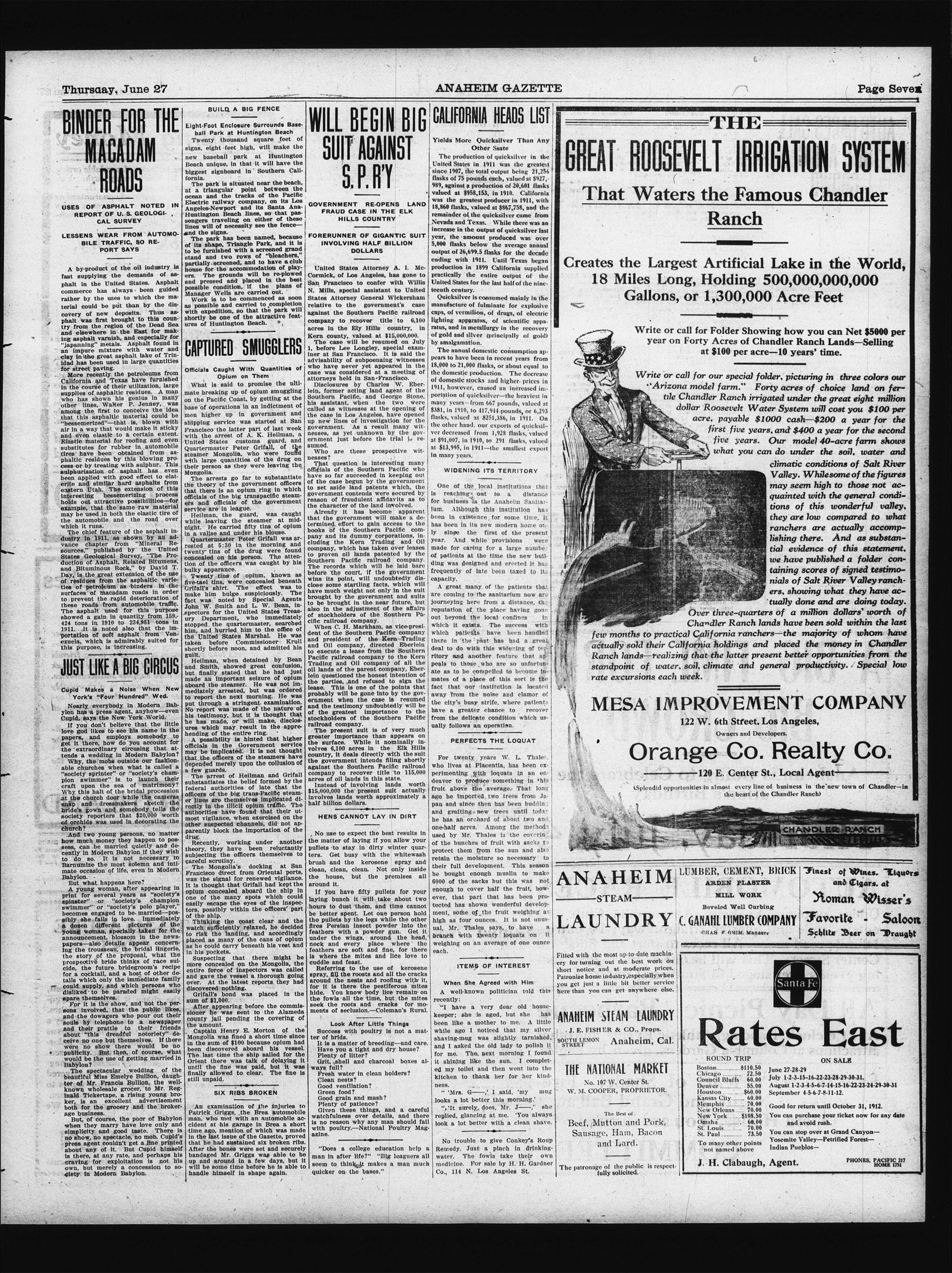
Searchable text
BINDER FOR THE MACADAM ROADS
USES OF ASPHALT NOTED IN REPORT OF U.S. GEOLOGICAL SURVEY
LESSENS WEAR FROM AUTOMOBILE TRAFFIC, SO REPORT SAYS
A by-product of the oil industry is fast supplying the demands of asphalt in the United States. Asphalt commerce has always been guided rather by the uses to which the material could be put than by the discovery of new deposits. Thus asphalt was first brought to this country from the region of the Dead Sea and elsewhere in the East for making asphalt varnish, and especially for "japanning" metals. Asphalt found in an impure mixture with water and clay in the great asphalt lake of Trinidad has been used in large quantities for street paving.
More recently the petroleum from California and Texas have furnished in the course of their utilization, large supplies of asphaltic residues. A man who has shown his genius in many other lines, Walter P. Jenney, was among the first to conceive the idea that this asphaltic material could be "bessemerized"—that is, blown with air in a way that would make it sticky and even elastic to a certain extent. Elastic material for roofing and even substitutes for rubber in automobile tires have been obtained from asphaltic residues by this blowing process or by treating with sulphur. This sulphurization of asphalt has even...
More recently the petroleum from California and Texas have furnished in the course of their utilization, large supplies of asphaltic residues. A man who has shown his genius in many other lines, Walter P. Jenney, was among the first to conceive the idea that this asphaltic material could be "bessemerized"—that is, blown with air in a way that would make it sticky and even elastic to a certain extent. Elastic material for roofing and even substitutes for rubber in automobile tires have been obtained from asphaltic residues by this blowing process or by treating with sulphur. This sulphurization of asphalt has even been applied with good effect to elaterite and similar hard asphalts from eastern Utah. The extension of this interesting bessemerizing process holds out attractive possibilities—for example, that the same raw material may be used in both the elastic tire of the automobile and the road over which it runs.
The chief feature of the asphalt industry in 1911, as shown by an advance chapter from "Mineral Resources," published by the United States Geological Survey, "The Production of Asphalt, Related Bitumens, and Bituminous Rock," by David T. Day, is the great extension of the use of residues from the asphaltic varieties of petroleum as binders in the surfaces of macadam roads in order to prevent the rapid deterioration of these roads from automobile traffic. The asphalt used for this purpose showed a gain in quantity from 159,424 tons in 1910 to 234,951 tons in 1911. It is noted also that the importation of soft asphalt from Venezuela, which is admirably suited for this purpose, is increasing.
JUST LIKE A BIG CIRCUS
Cupid Makes a Noise When New York's "Four Hundred" Wed.
Nearly everybody in Modern Babylon has a press agent, anyhow—even Cupid, says the New York World.
If you don't believe that the little love god likes to see his name in the papers, and employs somebody to get it there, how do you account for the extraordinary circling that attends a wedding in Modern Babylon?
Why, the mobs outside our fashionable churches when what is called a "society sprinter" or "society's champion swimmer" is to launch their craft upon the sea of matrimony? Why this halt of the bridal procession at the church door while the cameras snap and dressmakers sketch the bride's gown and somebody tells the society reporters that $20,000 worth of orchids was used in decorating the church?
And two young persons, no matter how much money they happen to possess, can be married quietly and decently in Modern Babylon if they wish to do so. It is not necessary to Barnumize the most solemn and intimate occasion of life, even in Modern Babylon.
But what happens here?
A young woman, after appearing in print for several years as "society's petroleum," has said to promise the ultimate breaking up of opium smuggling on the Pacific Coast, by getting at the base of operations in an indictment of men higher up in government and shipping service was started at San Francisco—the latter part of last week with the arrest of A. K. Heilman, a United States customs guard, and Quartermaster Peter Grifall, of the steamer Mongolia, who were found with large quantities of the drug on their person as they were leaving the Mongolia.
The arrests go far to substantiate the theory of the government officers that there is an opium ring in which officials of the big transpacific steamers and officials of the government service are in league.
Heilman, the guard, was caught while leaving the steamer at midnight. He carried fifty tins of opium in a vallse and under his blouse.
Quartermaster Peter Grifall was arrested at 5:30 in the morning and twenty tins of the drug were found concealed on his person. The attention of the officers was caught by his bulky appearance.
Twenty tins of opium, known as five-tael tins, were concealed beneath Grifall's shirt. The effect was to make him bulge suspiciously. The fact was noted by Special Agents John W. Smith and L. W. Bean, inspectors for the United States Treasury Department, who immediately stopped the quartermaster, searched him, and hurried him to the office of the United States Marshal. He was taken before Commissioner Krull shortly before noon, and admitted his guilt.
Heilman, when detained by Bean and Smith, showed great confusion, but finally stated that he had just made an important seizure of opium aboard the steamer. He was not immediately arrested, but was ordered to report the next morning. He was put through a stringent examination. No report was made of the nature of his testimony, but it is thought that he has made, or will make, disclosures which may result in the apprehending of the entire ring.
A possibility is hinted that higher officials in the Government service may be implicated. It is not thought that the officers of the steamers have depended merely upon the collusion of a few guards.
The arrest of Heilman and Grifall substantiates the belief formed by the federal authorities of late that the officers of the big trans-Pacific steamers are themselves implicated directly in the illicit opium traffic. The authorities have found that their utmost vigilance, when exercised on the other suspected channels, did not apparently block the importation of the drug.
Recently, working under another theory, they have been reluctantly subjecting the officers themselves to careful scrutiny.
The Mongolia's docking at San Francisco direct from Oriental ports, was the signal for renewed vigilance. It is thought that Grifall had kept the opium concealed aboard the ship in one of the many spots which could
at the church door while the cameras snap and dressmakers sketch the bride's gown and somebody tells the society reporters that $20,000 worth of orchids was used in decorating the church?
And two young persons, no matter how much money they happen to possess, can be married quietly and decently in Modern Babylon if they wish to do so. It is not necessary to Barnumize the most solemn and intimate occasion of life, even in Modern Babylon.
But what happens here?
A young woman, after appearing in print for several years as "society's spinster" or "society's champion swimmer" or "society's polo player," becomes engaged to be married—possibly she falls in love. Immediately a dozen different pictures of the young woman, specially taken for the announcement, blossom in the newspapers—also details appear concerning the trousseau, the bridal lingerie, the story of the proposal, what the prospective bride thinks of race suicide, the future bridegroom's recipe for a cocktail, and a host of other details which only the immediate family could supply, and which persons who disliked to be paraded might easily spare themselves.
For it is the show, and not the persons involved, that the public likes, and the dowagers who pour out their souls by telephone to a newspaper and their prattle to their friends about "this dreadful notoriety" deceive no one but themselves. If there were no show there would be no publicity. But then, of course, what would be the use of getting married in Babylon?
The spectacular wedding of the beautiful Miss Emelye Bullion, daughter of Mr. Francis Bullion, the well-known wholesale grocer, to Mr. Reginald Tickertape, a rising young broker, is an excellent advertisement both for the grocery and the brokerage business.
But, of course, the poor of Babylon when they marry have love only and simplicity and good taste. There is no show, no spectacle, no mob. Cupid's press agent couldn't get a line printed about any of it. But Cupid himself is there, at any rate, and perhaps his craving for exploitation is not his own, but merely a concession to society in Modern Babylon.
SIX RIBS BROKEN
An examination of the injuries to Patrick Griggs, the Brea automobile man, who met with an automobile accident at his garage in Brea a short time ago, mention of which was made in the last issue of the Gazette, proved that he had sustained six broken ribs. After the bones were set and securely bandaged Mr. Griggs was able to be up and around in a few days, but it will be some time before he is able to handle himself in shape again.
WILL BEGIN BIG SUIT AGAINST S.P.R'Y
GOVERNMENT RE-OPENS LAND FRAUD CASE IN THE ELK HILLS COUNTRY
FORERUNNER OF GIGANTIC SUIT INVOLVING HALF BILLION DOLLARS
United States Attorney A. I. McCormick, of Los Angeles, has gone to San Francisco to confer with Willis N. Mills, special assistant to United States Attorney General Wickersham relative to the government's case against the Southern Pacific railroad company to recover title to 6,100 acres in the Ely Hills country, in Kern county, valued at $15,000,000.
The case will be resumed on July 1, before Lee Longley, special examiner at San Francisco. It is said the advisability of subpoenaing witnesses who have never yet appeared in the case was considered at a meeting of attorneys held in San-Francisco.
Disclosures by Charles W. Eberlein, former acting land agent of the Southern Pacific, and George Stone, his assistant, when the two were called as witnesses at the opening of the case in Los Angeles, have opened up new lines of investigation for the government. As a result many witnesses, as yet unknown by the government just before the trial is resumed.
Who are these prospective witnesses?
That question is interesting many officials of the Southern Pacific who have so far succeeded in keeping out
CALIFORNIA HEADS LIST
Yields More Quicksilver Than Any Other Ssate
The production of quicksilver in the United States in 1911 was the greatest since 1907, the total output being 21,256 flasks of 75 pounds each, valued at $927,-989, against a production of 20,601 flasks valued at $958,153, in 1910. California was the greatest producer in 1911, with 18,860 flasks, valued at $867,758, and the remainder of the quicksilver came from Nevada and Texas. While there was an increase in the output of quicksilver last year, the amount produced was over 5,000 flasks below the average annual output of 26,699.5 flasks for the decade ending with 1911. Until Texas began production in 1899 California supplied practically the entire output of the United States for the last half of the nineteenth century.
Quicksilver is consumed mainly in the manufacture of fulminate for explosive caps, of vermilion, of drugs, of electric lighting apparatus, of scientific apparatus, and in metallurgy in the recovery of gold and silver (principally of gold) by amalgamation.
The annual domestic consumption appears to have been in recent years from 18,000 to 21,000 flasks, or about equal to the domestic production. The decrease of domestic stocks and higher prices in 1911, however, caused an increased importation of quicksilver—the heaviest in many years—from 667 pounds, valued at $381, in 1910, to 417,944-pounds, or 6,293 flasks, valued at $251,386, in 1911. On the other hand our exports of quicksilver decreased from 1,928 flasks, valued at $91,007, in 1910, to 291 flasks, valued at $13,995, in 1911—the smallest export in many years.
GREAT ROOS
That Water
Creates the Largest
18 Miles Lo
Gallons
Write or year o
Write or "Arizona tile"
Disclosures by Charles W. Eberlein, former acting land agent of the Southern Pacific, and George Stone, his assistant, when the two were called as witnesses at the opening of the case in Los Angeles, have opened up new lines of investigation for the government. As a result many witnesses, as yet unknown by the government just before the trial is resumed.
Who are these prospective witnesses?
That question is interesting many officials of the Southern Pacific who have so far succeeded in keeping out of the case begun by the government to set aside land patents which, the government contends were secured by reason of fraudulent affidavits as to the character of the land involved.
Already it has become apparent that the government will make a determined effort to gain access to the books of the Southern Pacific company and its dummy corporations, including the Kern Trading and Oil company, which has taken over leases to proven oil lands patented by the Southern Pacific railroad company. The records which will be laid bare before the court, if the government wins its point, will undoubtedly disclose some startling facts, which will have much weight not only in the suit brought by the government and suits to be brought in the near future, but also in the adjustment of the affairs of stockholders of the Southern Pacific railroad company.
When C. H. Markham, as vice-president of the Southern Pacific company and president of the Kern Trading and Oil company, directed Eberlein to execute a lease from the Southern Pacific railroad company to the Kern Trading and Oil company of all the oil lands of the parent company, Eberlein questioned the honest intention of the parties, and refused to sign the lease. This is one of the points that probably will be gone into by the government when the case is resumed and the testimony undoubtedly will be of the greatest importance to the stockholders of the Southern Pacific railroad company.
The present suit is of very much greater importance than appears on the surface. While it nominally involves 6,100 acres in the Elk Hills country, it deals directly with the suit the government intends filing shortly against the Southern Pacific railroad company to recover title to 115,000 acres of oil lands in this state.
Instead of involving lands worth $15,000,000 the present suit actually involves lands worth approximately a half billion dollars.
HENS CANNOT LAY IN DIRT
No use to expect the best results in the matter of laying if you allow your pullets to stay in dirty winter quarters. Get busy with the whitewash brush and the kerosene spray and clean, clean, clean. Not only inside the house, but the premises all around it.
If you have fifty pullets for your laying bunch it will take about two domestic production. The decrease of domestic stocks and higher prices in 1911, however, caused an increased importation of quicksilver—the heaviest in many years—from 667 pounds, valued at $381, in 1910, to 417,944 pounds, or 6,293 flasks, valued at $251,386, in 1911. On the other hand, our exports of quicksilver decreased from 1,928 flasks, valued at $91,007, in 1910, to 291 flasks, valued at $13,995, in 1911—the smallest export in many years.
WIDENING ITS TERRITORY
One of the local institutions that is reaching out to a distance for business is the Anaheim Sanitarium. Although this institution has been in existence for some time, it has been in its new modern home only since the first of the present year. And while provisions were made for caring for a large number of patients at the time the new building was designed and erected it has frequently of late been taxed to its capacity.
A great many of the patients that are coming to the sanitarium now are journeying here from a distance, the reputation of the place having gone out beyond the local confines in which it exists. The success with which patients have been handled there in the past has had a great deal to do with this widening of territory and another feature that appeals to those who are so unfortunate as to be compelled to become inmates of a place of this sort is the fact that our institution is located away from the noise and clamor of the city's busy strife, where patients have a greater chance to recover from the delicate condition which usually follows an operation.
PERFECTS THE LOQUAT
For twenty years W. L. Thales, who lives at Placentia, has been experimenting with loquats in an endeavor to produce something in this fruit above the average. That long ago he imported two trees from Japan and since then has been budding and grafting new trees until today he has an orchard of about two and one-half acres. Among the methods used by Mr. Thales is the covering of the bunches of fruit with sacks to protect them from the sun and also retain the moisture so necessary to their full development. This season he bought enough muslin to make 6000 of the sacks but this was not enough to cover half the fruit, however that part that has been pro-
HENS CANNOT LAY IN DIRT
No use to expect the best results in the matter of laying if you allow your pullets to stay in dirty winter quarters. Get busy with the whitewash brush and the kerosene spray and clean, clean, clean. Not only inside the house, but the premises all around it.
If you have fifty pullets for your laying bunch it will take about two hours to dust them, and time cannot be better spent. Let one person hold the pullets by the legs while the other fires Persian insect powder into the feathers with a powder gun. Get it under the wings, around the head, neck and every place where the feathers are soft and fine, for there is where the mites and lice love to cuddle and feast.
Referring to the use of kerosene spray, fill the roosts and all the cracks around the nests and roofing with it, for it is there the pestiferous mites hide. You know body lice remain on the fowls all the time, but the mites seek the roots and cracks for moments of seclusion.—Coleman's Rural.
Look After Little Things
Success with poultry is not a matter of brids.
It is a matter of breeding—and care.
Have you a tight and dry house?
Plenty of litter?
Grit, shell and charcoal boxes always full?
Fresh water in clean holders?
Clean nests?
Good ventilation?
Green food?
Good grain and mash?
Plenty of patience?
Given these things, and a careful watchfulness over details, and there is no reason why any man should fall with poultry.—National Poultry Magazine.
"Does a college education help a man in after life?" "Big leaguers all seem to think it makes a man much quicker on the bases."
When She Agreed with Him
A well-known politician told this recently:
"I have a very dear old house-keeper; she is aged, but she has been like a mother to me. A little while ago I noticed that my silver shaving-mug was slightly tarnished, and I asked the old lady to polish it for me. The next morning I found it shining like the sun. I completed my toilet and then went into the kitchen to thank her for her kindness.
"'Mrs. G——,' I said, 'my mug looks a lot better this morning.'"
"It surely does, Mr. J——,' she replied, glancing at me. 'You always look a lot better with a clean shave."
No trouble to give Conkey's Roup Remedy. Just a pinch in drinking-water. The fowls take their own medicine. For sale by H. H. Gardner Co., 114 N. Los Angeles St.
ANAHEIM STEAM LAUNDRY
J. E. FISHER & CO., Props.
SOUTH LEMON STREET
Anaheim, Cal.
THE NATIONAL MARKET
No. 107 W. Center St.
W. M. COOPER, PROPRIETOR.
The Best of Beef, Mutton and Pork,
Sausage, Ham, Bacon
and Lard.
The patronage of the public is respectfully solicited.
THE
ROOSEVELT IRRIGATION SYSTEM
What Waters the Famous Chandler
Ranch
ates the Largest Artificial Lake in the World,
18 Miles Long, Holding 500,000,000,000
Gallons, or 1,300,000 Acre Feet
Write or call for Folder Showing how you can Net $5000 per
year on Forty Acres of Chandler Ranch Lands—Selling
at $100 per acre—10 years' time.
Write or call for our special folder, picturing in three colors our
"Arizona model farm." Forty acres of choice land on fertile Chandler Ranch irrigated under the great eight million dollar Roosevelt Water System will cost you $100 per acre, payable $1000 cash-$200 a year for the first five years, and $400 a year for the second five years. Our model 40-acre farm shows what you can do under the soil, water and climatic conditions of Salt River Valley. Whilsome of the figures
Write or call for our special folder, picturing in three colors our "Arizona model farm." Forty acres of choice land on fertile Chandler Ranch irrigated under the great eight million dollar Roosevelt Water System will cost you $100 per acre, payable $1000 cash—$200 a year for the first five years, and $400 a year for the second five years. Our model 40-acre farm shows what you can do under the soil, water and climatic conditions of Salt River Valley. Whilesome of the figures may seem high to those not acquainted with the general conditions of this wonderful valley, they are low compared to what ranchers are actually accomplishing there. And as substantial evidence of this statement, we have published a folder containing scores of signed testimonials of Salt River Valley ranchers, showing what they have actually done and are doing today.
Over three-quarters of a million dollars' worth of Chandler Ranch lands have been sold within the last new months to practical California ranchers—the majority of whom have actually sold their California holdings and placed the money in Chandler Ranch lands—realizing that the latter present better opportunities from the standpoint of water, soil, climate and general productivity. Special low rate excursions each week.
MESA IMPROVEMENT COMPANY
122 W. 6th Street, Los Angeles,
Owners and Developers.
Orange Co. Realty Co.
120 E. Center St., Local Agent
(Splendid opportunities in almost every line of business in the 'new town of Chandler—in the heart of the Chandler Ranch)
AHEIM
STEAM
UNDRY
STEAM LAUNDRY
HER & CO., Props.
N Anaheim, Cal.
NATIONAL MARKET
107 W. Center St.
DOPER, PROPRIETOR.
The Best of
Mutton and Pork,
ge, Ham, Bacon
and Lard.
LUMBER, CEMENT, BRICK
ARDEN PLASTER
MILL WORK
Beveled Well Curbing
C. GANAHL LUMBER COMPANY
CHAS F GRIM. Manager
Finest of Wines, Liquors
and Cigars, at
Roman Wisser's
Favorite - Saloon
Schlitz Beer on Draught
Santa Fe
Rates East
ROUND TRIP
Boston..... $110.50
Chicago..... 72.50
Council Bluffs..... 60.00
Denver..... 55.00
Houston..... $60.00
Kansas City..... 60.00
Memphis..... 70.00
New Orleans..... 70.00
New York..... $108.50
Omaha..... 60.00
St. Louis..... 70.00
St. Paul..... 73.50
ON SALE
June 27-28-29
July 1-2-3-15-16-22-23-28-29-30-31.
August 1-2-3-4-5-6-7-14-15-16-22-23-24-29-30-31
September 4-5-6-7-8-11-12.
Good for return until October 31, 1912.
You can purchase your ticket now for any date and avoid rush.
You can stop over at Grand Canyon—
Yosemite Valley—Petrified Forest—Indian Pueblos—
J. H. Clabaugh, Agent.
PHONES, PACIFIC 217
HOME 1751