anaheim-gazette 1912-06-13
Scanned page
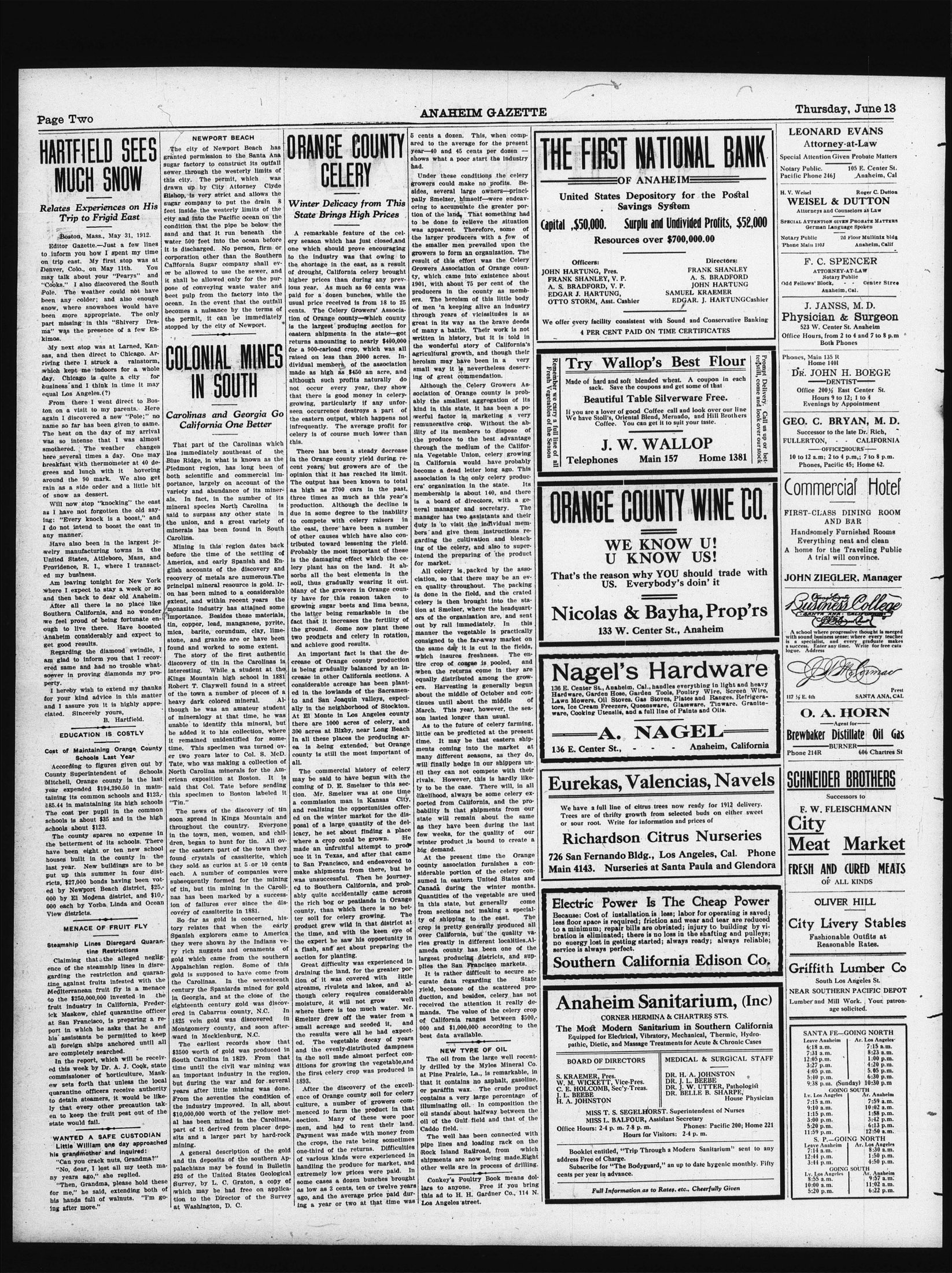
Searchable text
HARTFIELD SEES MUCH SNOW
Relates Experiences on His Trip to Frigid East
Boston, Mass., May 31, 1912.
Editor Gazette.—Just a few lines to inform you how I spent my time on trip east. My first stop was at Denver, Colo., on May 11th. You may talk about your "Pearys" and "Cooks." I also discovered the South Pole. The weather could not have been any colder; and also enough snow, where snowshoes would have been more appropriate. The only part missing in this "Shivery Drama" was the presence of a few Eskimos.
My next stop was at Larned, Kansas, and then direct to Chicago. Arriving there I struck a rainstorm, which kept me indoors for a whole day. Chicago is quite a city for business and I think in time it may equal Los Angeles.(?)
From there I went direct to Boston on a visit to my parents. Here again I discovered a new "Pole;" no name so far has been given to same. The heat on the day of my arrival was so intense that I was almost smothered. The weather changes here several times a day. One may breakfast with thermometer at 40 degrees and lunch with it hovering over Newport Beach.
The city of Newport Beach has granted permission to the Santa Ana sugar factory to construct its outfall sewer through the westerly limits of this city. The permit, which was drawn up by City Attorney Clyde Bishop, is very strict and allows the sugar company to put the drain 8 feet inside the westerly limits of the city and into the Pacific ocean on the condition that the pipe be below the sand and that it run beneath the water 500 feet into the ocean before it is discharged. No person, firm or corporation other than the Southern California Sugar company shall ever be allowed to use the sewer, and it shall be allowed only for the purpose of conveying waste water and beet pulp from the factory into the ocean. In the event that the outfall becomes a nuisance by the terms of the permit, it can be immediately stopped by the city of Newport.
COLONIAL MINES IN SOUTH
Carolinas and Georgia Go California One Better
That part of the Carolinas which lies immediately southeast of the Blue Ridge, in what is known as the Piedmont region, has long been of both scientific and commercial im-
FROM there I went direct to Boston on a visit to my parents. Here again I discovered a new "Pole;" no name so far has been given to same. The heat on the day of my arrival was so intense that I was almost smothered. The weather changes here several times a day. One may breakfast with thermometer at 40 degrees and lunch with it hovering around the 90 mark. We also get rain as a side order and a little bit of snow as dessert.
Will now stop "knocking" the east as I have not forgotten the old saying: "Every knock is a boost," and I do not intend to boost the east in any manner.
Have also been in the largest jewelry manufacturing towns in the United States, Attleboro, Mass, and Providence, R. I., where I transacted my business.
Am leaving tonight for New York where I expect to stay a week or so and then back to dear old Anaheim.
After all there is no place like Southern California, and no wonder we feel proud of being fortunate enough to live there. Have boosted Anaheim considerably and expect to get good results.
Regarding the diamond swindle, I am glad to inform you that I recovered same and had no trouble whatsoever in proving diamonds my property.
I hereby wish to extend my thanks for your kind advice in this matter and I assure you it is highly appreciated. Sincerely yours,
B. Hartfield.
EDUCATION IS COSTLY
Cost of Maintaining Orange County Schools Last Year
According to figures given out by County Superintendent of Schools Mitchell, Orange county in the last year expended $194,390.50 in maintaining its common schools and $123,-185.44 in maintaining its high schools. The cost per pupil in the common schools is about $35 and in the high schools about $123.
The county spares no expense in the betterment of its schools. There have been eight or ten new school houses built in the county in the last year. New buildings are to be put up this summer in four districts, $27,000 bonds having been voted by Newport Beach district, $25,-000 by El Modena district, and $10,-000 by Southern Cali-
IN SOUTH
Carolinas and Georgia Go California One Better
That part of the Carolinas which lies immediately southeast of the Blue Ridge, in what is known as the Piedmont region, has long been of both scientific and commercial importance, largely on account of the variety and abundance of its minerals. In fact, in the number of its mineral species North Carolina is said to surpass any other state in the union, and a great variety of minerals has been found in South Carolina.
Mining in this region dates back before the time of the settling of America, and early Spanish and English accounts of the discovery and recovery of metals are numerous.The principal mineral resource is gold. Iron has been mined to a considerable extent, and within recent years the monazite industry has attained some importance. Besides these materials, tin, copper, lead, manganese, pyrite, mica, barite, corundum, clay, limestone, and granite are or have been found and worked to some extent.
The story of the first authentic discovery of tin in the Carolinas is interesting. While a student at the Kings Mountain high school in 1881 Robert T. Claywell found in a street of the town a number of pieces of a heavy dark colored mineral. Although he was an amateur student of mineralogy at that time, he was unable to identify this mineral, but he added it to his collection, where it remained unidentified for sometime. This specimen was turned over two years later to Col. S. McD. Tate, who was making a collection of North Carolina minerals for the American exposition at Boston. It is said that Col. Tate before sending this specimen to Boston labeled it "Tin."
The news of the discovery of tin soon spread in Kings Mountain and throughout the country. Everyone in the town, men, women, and children, began to hunt for tin. All over the eastern part of the town they found crystals of cassiterite, which they sold as curios at 5 or 10 cents each. A number of companies were subsequently formed for the mining of tin, but tin mining in the Carolinas has been marked by a success-
An important fact crease of Orange county is being gradually be crease in other Cali considerable acreage ed in the lowlands to and San Joaquin ally in the neighborhood At El Monte in Los there are 1000 acres 300 acres at Bixby, In all these places ea is being exten county is still the m all.
The commercial may be said to have coming of D. E. Smition. Mr. Smelzer a commission man and realizing the op ed on the winter m posal of a large quicacy, he set about where a crop could made an unfruitful ce it in Texas, and to San Francisco, a make shipments fro was unsuccessful. ed to Southern Caliably quite accident
MENACE OF FRUIT FLY
Steamship Lines Disregard Quarantine Restrictions
Claiming that the alleged negligence of the steamship lines in disregarding the restriction and quarantine against fruits infested with the Mediterranean fruit fly is a menace to the $250,000,000 invested in the fruit industry in California, Frederick Maskew, chief quarantine officer at San Francisco, is preparing a report in which he asks that he and his assistants be permitted to keep all foreign ships anchored until all are completely searched.
In the report, which will be received this week by Dr. A. J. Cook, state commissioner of horticulture, Maskew sets forth that unless the local quarantine officers receive authority to detain steamers, it would be likely that every other precaution taken to keep the fruit pest out of the state would fail.
WANTED A SAFE CUSTODIAN
Little William one day approached his grandmother and inquired:
"Can you crack nuts, Grandma?"
"No, dear, I lost all my teeth many years ago," she replied.
"Then, Grandma, please hold these for me," he said, extending both of his hands full of walnuts. "I'm going after more."
The news of the discovery of tin soon spread in Kings Mountain and throughout the country. Everyone in the town, men, women, and children, began to hunt for tin. All over the eastern part of the town they found crystals of cassiterite, which they sold as curios at 5 or 10 cents each. A number of companies were subsequently formed for the mining of tin, but tin mining in the Carolinas has been marked by a succession of failures ever since the discovery of cassiterite in 1881.
So far as gold is concerned, history relates that when the early Spanish explorers came to America they were shown by the Indians very rich nuggets and ornaments of gold which came from the southern Appalachian region. Some of this gold is supposed to have come from the Carolinas. In the seventeenth century the Spaniards mined for gold in Georgia, and at the close of the eighteenth century gold was discovered in Cabarrus county, N.C. In 1825 vein gold was discovered in Montgomery county, and soon afterward in Mecklenburg, N.C.
The earliest records show that $3500 worth of gold was produced in South Carolina in 1829. From that time until the civil war mining was an important industry in the region, but during the war and for several years after little mining was done. From the seventies the condition of the industry improved. In all, about $10,000,000 worth of the yellow metal has been mined in the Carolinas, part of it derived from placer deposits and a larger part by hard-rock mining.
A general description of the gold and tin deposits of the southern Appalachians may be found in Bulletin 293 of the United States Geological Survey, by L. C. Graton, a copy of which may be had free on application to the Director of the Survey at Washington, D. C.
Great difficulty was draining the land, felling of it was cow streams, rivulets and though celery required moisture, it will where there is too Smelzer drew off small acreage and the results were ed. The vegetable and the evenly-distributed soil made aditions for growing the first celery crop 1893.
After the discovery of Orange culture, a number menced to farm the section. Many of men, and had to Payment was made the crops, the rate one-third of the reef of various kinds was handling the product extremely low price some cases a dozen as low as 3 cents ago, and the averaging a year or two
ORANGE COUNTY CELERY
Winter Delicacy from This State Brings High Prices
A remarkable feature of the celery season which has just closed, and one which should prove encouraging to the industry was that owing to the shortage in the east, as a result of drought, California celery brought higher prices than during any previous year. As much as 60 cents was paid for a dozen bunches, while the usual price received is from 18 to 25 cents. The Celery Growers' Association of Orange county—which county is the largest producing section for eastern shipments in the state—got returns amounting to nearly $400,000 for a 900-carload crop, which was all raised on less than 2000 acres. Individual members of the association made as high as $450 an acre, and although such profits naturally do not occur every year, they show that there is good money in celery-growing, particularly if any unforeseen occurrence destroys a part of the eastern output, which happens not infrequently. The average profit for celery is of course much lower than this.
There has been a steady decrease in the Orange county yield during recent years, but growers are of the opinion that it has reached its limit.
5 cents a dozen. This, when compared to the average for the present year—40 and 45 cents per dozen—shows what a poor start the industry had.
Under these conditions the celery growers could make no profits. Besides, several large owners—principally Smelzer, himself—were endeavoring to accumulate the greater portion of the land. That something had to be done to relieve the situation was apparent. Therefore, some of the larger producers with a few of the smaller men prevailed upon the growers to form an organization. The result of this effort was the Celery Growers Association of Orange county, which came into existence about 1901, with about 75 per cent of the producers in the county as members. The heroism of this little body of men 'n keeping alive an industry through years of vicissitudes is as great in its way as the brave deeds of many a battle. Their work is not written in history, but it is told in the wonderful story of California's agricultural growth, and though their heroism may have been in a very small way it is nevertheless deserving of great commendation.
Although the Celery Growers Association of Orange county is probably the smallest aggregation of its kind in this state, it has been a powerful factor in marketing a very remunerative crop. Without the ability of its members to dispose of the produce to the best advantage through the medium of the California Vegetable Union, celery growing in California would have probably become a dead letter long ago.
although such profits naturally do not occur every year, they show that there is good money in celery-growing, particularly if any unforeseen occurrence destroys a part of the eastern output, which happens not infrequently. The average profit for celery is of course much lower than this.
There has been a steady decrease in the Orange county yield during recent years, but growers are of the opinion that it has reached its limit. The output has been known to total as high as 2700 cars in the past, three times as much as this year's production. Although the decline is due in some degree to the inability to compete with celery raisers in the east, there have been a number of other causes which have also contributed toward lessening the yield. Probably the most important of these is the damaging effect which the celery plant has on the land. It absorbs all the best elements in the soil, thus gradually wearing it out. Many of the growers in Orange county have for this reason taken to growing sugar beets and lima beans, the latter being remarkable in the fact that it increases the fertility of the ground. Some now plant these two products and celery in rotation, and achieve good results.
An important fact is that the decrease of Orange county production is being gradually balanced by an increase in other California sections. A considerable acreage has been planted in the lowlands of the Sacramento and San Joaquin valleys, especially in the neighborhood of Stockton. At El Monte in Los Angeles county there are 1000 acres of celery, and 300 acres at Bixby, near Long Beach. In all these places the producing area is being extended; but Orange county is still the most important of all.
The commercial history of celery may be said to have begun with the coming of D. E. Smelzer to this section. Mr. Smelzer was at one time a commission man in Kansas City, and realizing the opportunities offered on the winter market for the disposal of a large quantity of the delicacy, he set about finding a place where a crop could be grown. He made an unfruitful attempt to produce it in Texas, and after that came to San Francisco, and endeavored to make shipments from there, but he was unsuccessful. Then he journeyed to Southern California, and probably quite accidentally came across
a commission man in Kansas City, and realizing the opportunities offered on the winter market for the disposal of a large quantity of the delicacy, he set about finding a place where a crop could be grown. He made an unfruitful attempt to produce it in Texas, and after that came to San Francisco, and endeavored to make shipments from there, but he was unsuccessful. Then he journeyed to Southern California, and probably quite accidentally came across the rich bog or peatlands in Orange county, than which there is no better soil for celery growing. The product grew wild in that district at the time, and with the keen eye of the expert he saw his opportunity in a flash, and set about preparing the section for planting.
Great difficulty was experienced in draining the land, for the greater portion of it was covered with little streams, rivulets and lakes, although celery requires considerable moisture, it will not grow well where there is too much water. Mr. Smelzer drew off the water from a small acreage and seeded it, and the results were all he had expected. The vegetable decay of years and the evenly-distributed dampness in the soil made almost perfect conditions for growing the vegetable, and the first celery crop was produced in 1893.
After the discovery of the excellence of Orange county soil for celery culture, a number of growers commenced to farm the product in that section. Many of these were poor men, and had to rent their land. Payment was made with money from the crops, the rate being sometimes one-third of the returns. Difficulties of various kinds were experienced in handling the produce for market, and extremely low prices were paid. In some cases a dozen bunches brought as low as 3 cents, ten or twelve years ago, and the average price paid during a year or two at that time was
ported from California, and the probability is that shipments from our state will remain about the same as they have been during the last few weeks, for the quality of our winter product is bound to create a big demand.
At the present time the Orange county association furnishes a considerable portion of the celery consumed in eastern United States and Canada during the winter months. Quantities of the vegetable are used in this state, but generally come from sections not making a specialty of shipping to the east. The crop is pretty generally produced all over California, but the quality varies greatly in different localities. Alameda county has been one of the largest producing districts, and supplies the San Francisco markets.
It is rather difficult to secure accurate data regarding the State yield, because of the scattered production, and besides, celery has not received the attention it really demands. The value of the celery crop of California ranges between $500,-000 and $1,000,000 according to the best data available.
NEW TYPE OF OIL
The oil from the large well recently drilled by the Myles Mineral Co. at Pine Prairie, La., is remarkable, in that it contains no asphalt, gasoline, or paraffin wax. The crude product contains a very large percentage of illuminating oil. In composition the oil stands about halfway between the oil of the Gulf field and that of the Caddo field.
The well has been connected with pipe lines and loading rack on the Rock Island Railroad, from which shipments are now being made.Eight other wells are in process of drilling.
Conkey's Poultry Book means dollars to anyone. Free if you bring this ad to H. H. Gardner Co., 114 N. Los Angeles street.
THURSDAY, JUNE 13
FIRST NATIONAL BANK OF ANAHEIM
States Depository for the Postal Savings System
$100. Surplus and Undivided Profits, $52,000
Resources over $700,000.00
Directors:
G. Pres.
FRANK SHANLEY
LEY, V. P.
A. S. BRADFORD
RD, V. P.
JOHN HARTUNG
RTUNG,
SAMUEL KRAEMER
Asst. Cashier
EDGAR. J. HARTUNGCashier
Facility consistent with Sound and Conservative Banking
R CENT PAID ON TIME CERTIFICATES
Wallop's Best Flour
Hard and soft blended wheat. A coupon in each pack. Save the coupons and get some of that beautiful Table Silverware Free.
J. W. WALLOP
Phones Main 157 Home 1381
LEONARD EVANS
Attorney-at-Law
Special Attention Given Probate Matters
Notary Public 105 E. Center St.
Pacific Phone 246J Anaheim, Cal
H. V. Weisel
Roger C. Dutton
WEISEL & DUTTON
Attorneys and Counselors at Law
SPECIAL ATTENTION GIVEN PROBATE MATTERS German Language Spoken
Notary Public 2d Floor Mullinix bldg
Phone Main 110J Anaheim, Cal
F. C. SPENCER
ATTORNEY-AT-LAW
Notary Public
Odd Fellows' Block, Center Street Anaheim, Cal.
J. JANSS, M. D.
Physician & Surgeon
523 W. Center St. Anaheim
Office Hours, from 2 to 4 and 7 to 8 p.m.
Both Phones
Phones, Main 135 R
Home 140l
DR. JOHN H. BOEGE
DENTIST
Office 200½ East Center St.
Hours 9 to 12; 1 to 4 Evenings by Appointment
GEO. C. BRYAN, M. D.
Successor to the late Dr. Rich,
FULLERTON, CALIFORNIA
OFFICE:HOURS
10 to 12 a.m; 2 to 4 p.m.; 7 to 8 p.m.
Phones, Pacific 45; Home 62.
J. W. WALLOP
ones Main 157 Home 1381
GE COUNTY WINE CO.
WE KNOW U!
U KNOW US!
reason why YOU should trade with
US. Everybody's doin' it
Las & Bayha, Prop'rs
133 W. Center St., Anaheim
gel's Hardware
St., Anaheim, Cal., handles everything in light and heavy
Garden Hose, Garden Tools, Poultry Wire, Screen Wire,
Oil Stoves, Gas Stoves, Plates and Ranges, Refrigeration
Freezers, Queensware, Glaseware, Tinware, GraniteUtensils, and a full line of Paints and Oils.
A. NAGEL
Enter St., Anaheim, California
kas, Valencias, Navels
full line of citrus trees now ready for 1912 delivery.
of thrifty growth from selected buds on either sweet
t. Write for information and prices of
Hardson Citrus Nurseries
Fernando Bldg., Los Angeles, Cal. Phone
Nurseries at Santa Paula and Glendora
DR. JOHN H. BOEGE
DENTIST
Office 200½ East Center St.
Hours 9 to 12; 1 to 4
Evenings by Appointment
GEO. C. BRYAN, M. D.
Successor to the late Dr. Rich,
FULLERTON, CALIFORNIA
OFFICE HOURS—
10 to 12 a.m; 2 to 4 p.m.; 7 to 8 p.m.
Phones, Pacific 45; Home 62.
Commercial Hotel
FIRST-CLASS DINING ROOM
AND BAR
Handsomely Furnished Rooms
Everything neat and clean
A home for the Traveling Public
A trial will convince.
JOHN ZIEGLER, Manager
Business College
A school where progressive thought is merged
with sound business sense; where every teacher
is a specialist, and every graduate makes
a success. Enter any time. Write for free catalogue. Address
Prest
117 ½ E. 4th SANTA ANA, CAL.
O. A. HORN
Agent for
Brewbaker Distillate Oil Gas
BURNER
Phone 214R 606 Chartres St
SCHNEIDER BROTHERS
Successors to
F. W. FLEISCHMANN
City
Meat Market
FRESH AND CURED MEATS
OF ALL KINDS
FULL LINE OF citrus trees now ready for 1912 delivery.
of thrifty growth from selected buds on either sweet
st. Write for information and prices of
Hardson Citrus Nurseries
Nernando Bldg., Los Angeles, Cal. Phone
Nurseries at Santa Paula and Glendora
Power Is The Cheap Power
Cost of installation is less; labor for operating is saved;
time is required; friction and wear and tear are reduced;
repair bills are obviated; injury to building by vitiminated; there is no loss in the shafting and pulleys;
just in getting started; always ready; always reliable;
always perfect.
California Edison Co.
Neim Sanitarium, (Inc)
CORNER HERMINA & CHARTREŞ STS.
Modern Sanitarium in Southern California
for Electrical, Vibratory, Mechanical, Thermic, Hydroacetic, and Massage Treatments for Acute & Chronic Cases
OF DIRECTORS
Dr. H. A. JOHNSTON
Dr. J. L. BEEBE
Dr. J. W. UTTER, Pathologist
Dr. BELLE B. SHARPE,
House Physician
SS T. S. SEGELHORST. Superintendent of Nurses
SS L. BALFOUR, Assistant Secretary
Phones: Pacific 200; Home 221
Hours for Visitors: 2-4 p.m.
Entitled, "Trip Through a Modern Sanitarium" sent to any
Charge.
For "The Bodyguard," an up to date hygienic monthly. Fifty
per cent in advance.
Full Information as to Rates, etc., Cheerfully Given
F. W. FLEISCHMANN
City Meat Market
FRESH AND CURED MEATS
OF ALL KINDS
OLIVER HILL
City Livery Stables
Fashionable Outfits at
Reasonable Rates.
Griffith Lumber Co
South Los Angeles St.
NEAR SOUTHERN PACIFIC DEPOT
Lumber and Mill Work. Your patronage solicited.
SANTA FE—GOING NORTH
Leave Anaheim Ar. Los Angeles
6:18 a.m. 7:15 a.m.
7:31 a.m. 8:23 a.m.
12:05 p.m. 1:00 p.m.
3:27 p.m. 4:20 p.m.
4:05 p.m. 5:05 p.m.
5:40 p.m. 6:30 p.m.
9:38 p.m. (Sunday) 10:30 p.m
GOING SOUTH
Lv. Los Angeles Ar. Anaheim
7:15 a.m. 7:59 a.m.
9:10 a.m. 10:02 a.m.
1:15 p.m. 1:58 p.m.
3:00 p.m. 3:42 p.m.
5:20 p.m. 6:13 p.m.
11:59 p.m. 12:50 a.m.
S. P.—GOING NORTH
Leave Anaheim Ar. Los Angeles
7:14 a.m. 8:30 a.m.
12:44 p.m. 1:50 p.m.
3:44 p.m. 4:50 p.m.
GOING SOUTH
Lv. Los Angeles Ar. Anaheim
8:55 a.m. 9:57 a.m.
10:00 a.m. 11:02 a.m.
5:20 p.m. 6:22 p.m.