anaheim-gazette 1912-06-06
Scanned page
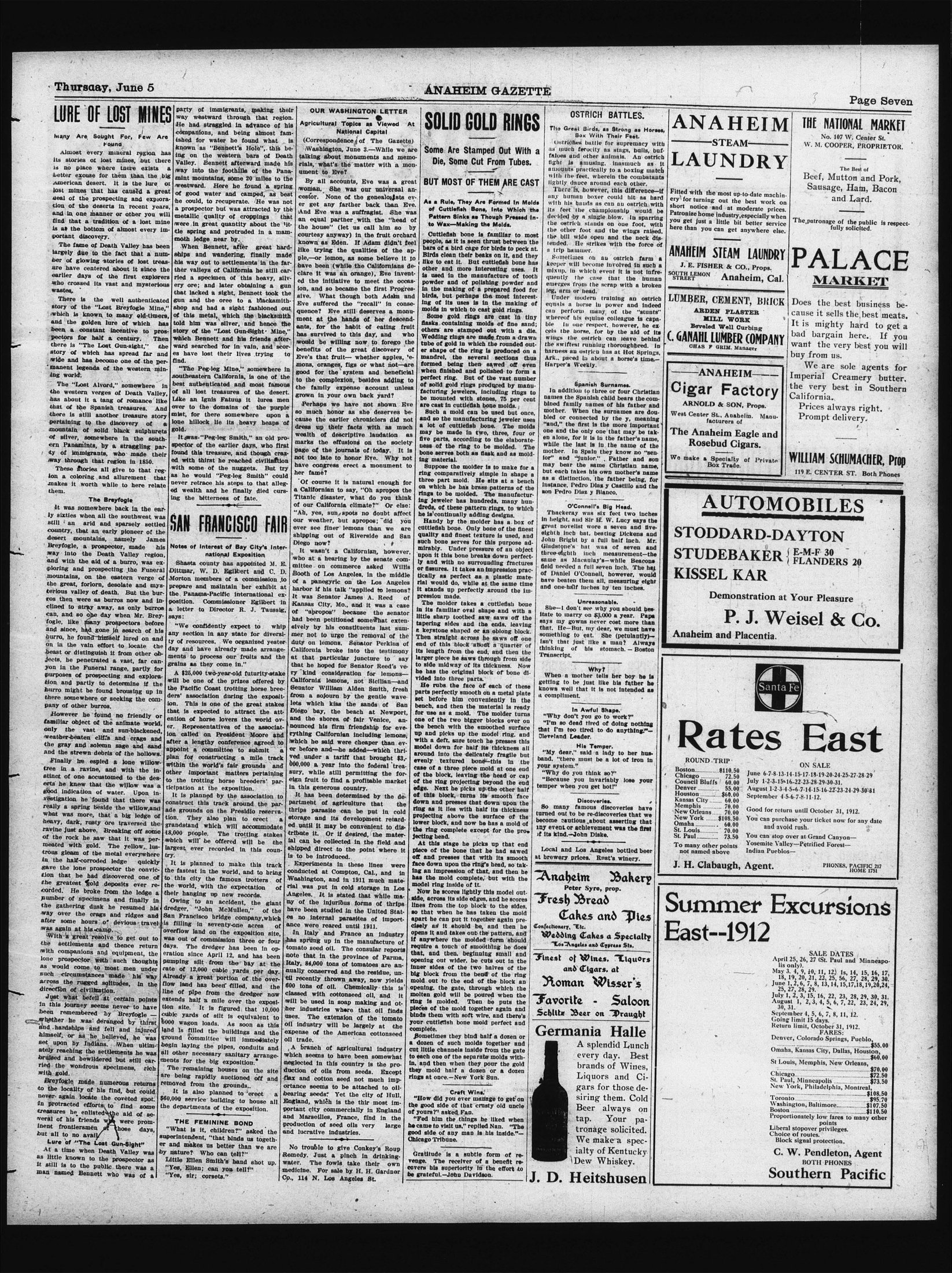
Searchable text
LURE OF LOST MINES
Many Are Sought For, Few Are Found
Almost every mineral region has its stories of lost mines, but there is no place where there exists a better excuse for them than the big American desert. It is the lure or lost mines that has caused a great deal of the prospecting and exploration of the deserts in recent years, and in one manner or other you will find that a tradition of a lost mine is at the bottom of almost every important discovery.
The fame of Death Valley has been largely due to the fact that a number of glowing stories of lost treasure have centered about it since the earlier days of the first explorers who crossed its vast and mysterious wastes.
There is the well authenticated story of the "Lost Breyfogle Mine," which is known to many old-timers, and the golden lure of which has been a constant incentive to prospectors for half a century. Then there is "The Lost Gun-sight," the story of which has spread far and wide and has become one of the permanent legends of the western mining world.
The "Lost Alvord," somewhere in the western verges of Death Valley, has about it a tang of romance like that of the Spanish treasures. And there is still another treasure story pertaining to the discovery of a mountain of solid black sulphurlets of silver, somewhere in the southern Panamints, by a straggling party of immigrants, who made their way through that region in 1850.
These stories all give to that region of immigrants, making their way westward through that region. He had straggled in advance of his companions, and being almost famished for water he found what is known as "Bennett's Hole", this being on the western bars of Death Valley. Bennett afterward made his way into the foothills of the Panamint mountains, some 20 miles to the westward. Here he found a spring of good water and camped, as best he could, to recuperate. He was not a prospector but was attracted by the metallic quality of croppings that were in great quantity about the little spring and protruded in a mammoth ledge near by.
When Bennett, after great hardships and wandering, finally made his way out to settlements in the farther valleys of California he still carried a specimen of this heavy, silvery ore; and later obtaining a gun that lacked a sight, Bennett took the gun and the oree to a blacksmith shop and had a sight fashioned out of this metal, which the blacksmith told him was silver, and hence the story of the "Lost Gun-Sight" Mine," which Bennett and his friends afterward searched for in vain, and scores have lost their lives trying to find.
"The Peg-leg Mine," somewhere in southeastern California, is one of the best authenticated and most famous of all lost treasures of the desert. Like an Ignis Fatuus it lures men ever to the domains of the purple mist, for there somewhere upon a lone hillock lie its heavy heaps of gold.
It was "Peg-leg Smith," an old prospector of the earlier days, who first found this treasure, and though crazed with thirst he reached civilization with some of the nuggets. But try as he would "Peg-leg Smith."
The "Lost Alvord," somewhere in the western verges of Death Valley, has about it a tang of romance like that of the Spanish treasures. And there is still another treasure story pertaining to the discovery of a mountain of solid black sulphurets of silver, somewhere in the southern Panamints, by a straggling party of immigrants, who made their way through that region in 1850.
These stories all give to that region a coloring and allurement that makes it worth while to here relate them.
The Breyfogle
It was somewhere back in the early sixties when all the southwest was still an arid and sparsely settled country, that an early pioneer of the desert mountains, namely James Breyfogle, a prospector, made his way into the Death Valley region, and with the aid of a burro, was exploring and prospecting the Funeral mountains, on the eastern verge of the great, forlorn, desolate and mysterious valley of death. But the burros then were as burros now and inclined to stray away, as only burros can, and so one day when Mr. Breyfogle, like many prospectors before and since, had gone in search of his burro, he found himself lured on and on in the vain effort to locate the beast or distinguish it from other objects, he penetrated a vast, far canyon in the Funeral range, partly for purposes of prospecting and exploration and partly to determine if the burro might be found brousing up in there somewhere or seeking the company of other burros.
However he found no friendly or familiar object of the animate world, only the vast and sun-blackened, weather-beaten cliffs and crags and the gray and solemn sage and sand and the strewn debris of the hollows.
Finally he espied a lone willow-free in a ravine, and with the instinct of one accustomed to the deserts he knew that the willow was a good indication of water. Upon investigation he found that there was really a spring beside the willow,and what was more, that a big ledge of heavy, dark, rusty ore traversed the ravine just above. Breaking off some of the rock he saw that it was permeated with gold. The yellow, lustrous gleam of the metal everywhere in the half-corroded ledge quickly gave the lone prospector the conviction that he had discovered one of the greatest gold deposits ever recorded. He broke from the ledge a number of specimens and finally in southeastern California, is one of the best authenticated and most famous of all lost treasures of the desert. Like an Ignis Fatuus it lures men ever to the domains of the purple mist, for there somewhere upon a lone hillock lie its heavy heaps of gold.
It was "Peg-leg Smith," an old prospector of the earlier days, who first found this treasure, and though crazed with thirst he reached civilization with some of the nuggets. But try as he would "Peg-leg Smith" could never retrace his steps to that alleged wealth and he finally died cursing the bitterness of fate.
SAN FRANCISCO FAIR
Notes of Interest of Bay City's International Exposition
Shasta county has appointed M. E. Dittmar, W. D. Egilbert and C. D. Morton members of a commission to prepare and maintain her exhibit at the Panama-Pacific international exposition. Commissioner Egilbert in a letter to Director R. J. Taussig, says:
"We confidently expect to whip any section in any state for diversity of resources. We organized yesterday and have already made arrangements to process our fruits and the grains as they come in."
A $25,000 two-year-old futurity-stake will be one of the prizes offered by the Pacific Coast trotting horse breeders' association during the exposition. This is one of the great stakes that is expected to attract the attention of horse lovers the world over. Representatives of the association called on President Moore and after a lengthy conference agreed to appoint a committee to submit a plan for constructing a mile track within the world's fair grounds and other important matters pertaining to the trotting horse breeders' participation at the exposition.
It is planned by the association to construct this track around the parade grounds on the Presidio reservation. They also plan to erect a grandstand which will accommodate 18,000 people. The trotting stakes which will be offered will be the largest ever recorded in this country.
It is planned to make this track the fastest in the world, and to bring to this city the famous trotters of the world, with the expectation of their hanging up new records.
Perhaps we have so much honor as cause the earlier order dress up their facade wealth of description marks the effusion page of the journal not too late to honour have congress erect her fame?
Of course it is not a Californian to say Titanic disaster, woe of our California cliff "Ah, yes, sun spots our weather, but a ever see finer lemon shipping out of Rio Diego now?
It wasn't a Californian who at a hearing by committee on commerce Booth of Los Angeles of a panegyric on harbor if his talk "Ah It was Senator Jam Kansas City, Mo., after of "abpropos" because had been petitioned sensibly by his constituency not to urge duty on lemons. Se California broke into at that particular junction that he hoped for Sory kind consideration California lemons, no Senator William Aldo from a sojourn by lets which kiss the Diego bay, the beach and the shores of founced his firm frightthing California in which he said were oer before and—he ad ved under a tariff t 000,000 a year into t surry, while still per seeign fruit to find a p in this generous countr.
It has been determined partiment of agriculture thrips parasite can storage and its dev ed until it may be co ntribute it. Or if des al can be collected in shipped direct to th re is to be introduced.
Experiments in th e conducted at Compton Washington, and in 1913rial was put in cold Angeles. It is stated
vestigation he found that there was really a spring beside the willow, and what was more, that a big ledge of heavy, dark, rusty ore traversed the ravine just above. Breaking off some of the rock he saw that it was permeated with gold. The yellow, lustrous gleam of the metal everywhere in the half-corroded ledge quickly gave the lone prospector the conviction that he had discovered one of the greatest gold deposits ever recorded. He broke from the ledge a number of specimens and finally in the gathering dusk he resumed his way over the crags and ridges and after some hours of devious travel was again at his camp.
With a great resolve to get out to the settlements and thence return with companions and equipment, the lone prospector with such thoughts as would come to most men under such circumstances made his way across the rugged solitudes, in the direction of civilization.
Just what befell at certain points in this journey seems never to have been remembered by Breyfogle — whether he was deranged by thirst and hardships and fell and injured himself, or as he believed, he was set upon by Indians. When ultimately reaching the settlements he was bruised and bewildered but still carried the wondrous specimens, rich with gold.
Breyfogle made numerous returns to the locality of his find, but could never again locate the coveted spot. In protracted efforts to find some treasures he enlisted the aid of several of his friends who were prominent frontiersmen of those days, but all to no avail.
Lure of "The Lost Gun-Sight"
At a time when Death Valley was as little known to the prospector as it still is to the public there was a man named Bennett who was of a construct this track around the parade grounds on the Presidio reservation. They also plan to erect a grandstand which will accommodate 18,000 people. The trotting stakes which will be offered will be the largest ever recorded in this country.
It is planned to make this track the fastest in the world, and to bring to this city the famous trotters of the world, with the expectation of their hanging up new records.
Owing to an accident, the giant dredger, "John McMullen," of the San Francisco bridge company, which is filling in seventy-one acres of overflow land on the exposition site, was out of commission three or four days. The dredger has been in operation since April 12, and has been pumping silt from the bay at the rate of 12,000 cubic yards per day. Already a great portion of the overflow land has been filled, and the line of pipe from the dredger now extends half a mile over the exposition site. It is figured that 10,000 cubic yards of silt is equivalent to 6000 wagon loads. As soon as this land is filled the buildings and the ground committee will immediately begin laying the pipes, conduits and all other necessary sanitary arrangements for the big exposition.
The remaining houses on the site are being rapidly auctioned off and removed from the grounds...
It is also planned to erect a $60,000 service building to house all the departments of the exposition.
THE FEMININE BOND
"What is it, children?" asked the superintendent, "that binds us together and makes us better than we are by nature? Who can tell?"
Little Ellen Smith's hand shot up. "Yes, Ellen; can you tell?"
"Yes, sir; corsets."
OUR WASHINGTON LETTER
Agricultural Topics as Viewed At National Capital
(Correspondence of The Gazette)
Washington, June 3.—While we are talking about monuments and memorials, what's the matter with a monument to Eve?
By all accounts, Eve was a great woman. She was our universal ancestor. None of the genealogists ever get any farther back than Eve. And Eve was a suffragist. She was an equal partner with the "head of the house" (let us call him so by courtesy anyway) in the fruit orchard known as Eden. If Adam didn't feel like trying the qualities of the apple,—or lemon, as some believe it to have been (while the Californians declare it was an orange), Eve invented the initiative to meet the occasion, and so became the first Progressive. What though both Adam and Eve suffered the "recall" in consequence? Eve still deserves a monument at the hands of her descendants, for the habit of eating fruit has survived to this day, and who would be willing now to forego the benefits of the great discovery of Eve's that fruit—whether apples, lemons, oranges, figs or what not—are good for the system and beneficial to the complexion, besides adding to the family expense account unless grown in your own back yard?
Perhaps we have not shown Eve so much honor as she deserves because the earlier chroniclers did not dress up their facts with as much wealth of descriptive laudation as marks the effusions on the society page of the journals of today. It is not too late to honor Eve. Why not have congress erect a monument to her fame?
SOLID GOLD RINGS
Some Are Stamped Out With a Die, Some Cut From Tubes.
BUT MOST OF THEM ARE CAST
As a Rule, They Are Formed In Molds of Cuttlefish Bone, Into Which the Pattern Sinks as Though Pressed Into Wax—Making the Molds.
Cuttlefish bone is familiar to most people, as it is seen thrust between the bars of a bird cage for birds to peck at. Birds clean their beaks on it, and they like to eat it. But cuttlefish bone has other and more interesting uses. It is used in the manufacture of tooth powder and of polishing powder and in the making of a prepared food for birds, but perhaps the most interesting of its uses is in the making of molds in which to cast gold rings.
Some gold rings are cast in tiny flasks containing molds of fine sand; others are stamped out with a die. Wedding rings are made from a drawn tube of gold in which the rounded outer shape of the ring is produced on a mandrel, the several sections thus formed being then sawed off even when finished and polished to form a perfect ring. But of the vast number of solid gold rings produced by manufacturing jewelers, including rings to be mounted with stones, 75 per cent are cast in cuttlefish bone molds.
Such a mold can be used but once, and so the manufacturing jeweler uses a lot of cuttlefish bone. The molds may be made in two, three, four or five parts, according to the elaborateness of the ring to be molded. The bone serves both as flask and as molding material.
Suppose the molder is to make for a ring comparatively simple in shape a
OSTRICH BATTLES.
The Great Birds, as Strong as Horses, Box With Their Feet.
Ostriches battle for supremacy with as much ferocity as stags, bulls, buffaloes and other animals. An ostrich fight is amusing, inasmuch as it amounts practically to a boxing match with the feet, wherein the combatants lightly dance around each other.
There is, however, this difference—if any human boxer could hit as hard with his hauds as can an ostrich with its feet the championship would be decided by a single blow. In sparring the ostrich stands on one foot, with the other foot and the wings raised, the bill wide open and the neck distended. He strikes with the force of a trip hammer.
Sometimes on an ostrich farm a keeper will become involved in such a mixup, in which event it is not infrequently the case that the human emerges from the scrap with a broken leg, arm or head.
Under modern training an ostrich equals a horse in power and indeed can perform many of the "stunts" whereof his equine colleague is capable in one respect, however, he excels the horse, for by the aid of its wings the ostrich can leave behind the swiftest running thoroughbred. In harness an ostrich has at Hot Springs, Ark., paced in about a horse's time. Harper's Weekly.
Spanish Surnames.
In addition to three or four Christian names the Spanish child bears the combined family names of his father and mother. When the surnames are doubled or connected by the y, meaning "and," the first is the more important one and the only one that may be taken alone, for it is in the father's name, while the last is in the name of the mother. In Spain they know no "senior" and "Junior." Father and son may bear the same Christian name, but each takes his own mother's name
to the complexion, besides adding to the family expense account unless grown in your own back yard?
Perhaps we have not shown Eve so much honor as she deserves because the earlier chroniclers did not dress up their facts with as much wealth of descriptive laudation as marks the effusions on the society page of the journals of today. It is not too late to honor Eve. Why not have congress erect a monument to her fame?
Of course it is natural enough for a Californian to say, "Oh apropos the Titanic disaster, what do you think of our California climate?" Or else: "Ah, yes, sun spots no doubt affect our weather, but apropos; did you ever see finer lemons than we are shipping out of Riverside and San Diego now?
It wasn't a Californian, however, who at a hearing by the senate committee on commerce asked Willis Booth of Los Angeles, in the middle of a panegyric on the Los Angeles harbor if his talk "applied to lemons? It was Senator James A. Reed of Kansas City, Mo., and it was a case of "apropos" because the senator had been petitioned somewhat extensively by his constituents last summer not to urge the removal of the duty on lemons. Senator Perkins of California broke into the testimony at that particular juncture to say that he hoped for Senator Reed's very kind consideration for lemons—California lemons, not Sicilian—and Senator William Alden Smith, fresh from a sojourn by the gentle wavelets which kiss the sands of San Diego bay, the beach at Newport, and the shores of fair Venice, announced his firm friendship for everything Californian including lemons, which he said were cheaper than ever before and—he added—which thrived under a tariff that brought $3,000,000 a year into the federal treasury, while still permitting the foreign fruit to find a profitable market in this generous country.
It has been determined by the department of agriculture that the thrips parasite can be put in cold storage and its development retarded until it may be convenient to distribute it. Or if desired, the material can be collected in the field and shipped direct to the point where it is to be introduced.
Experiments in these lines were conducted at Compton, Cal., and in Washington, and in 1911 much material was put in cold storage in Los Angeles. It is stated that while maperfect ring. But of the vast number of solid gold rings produced by manufacturing jewelers, including rings to be mounted with stones, 75 per cent are cast in cuttlefish bone molds.
Such a mold can be used but once, and so the manufacturing jeweler uses a lot of cuttlefish bone. The molds may be made in two, three, four or five parts, according to the elaborateness of the ring to be molded. The bone serves both as flask and as molding material.
Suppose the molder is to make for a ring comparatively simple in shape a three part mold. He sits at a bench on which he has brass patterns of the rings to be molded. The manufacturing jeweler has hundreds, many hundreds, of these pattern rings, to which he is continually adding designs.
Handy by the molder has a box of cuttlefish bone. Only bone of the finest quality and finest texture is used, and such bone serves for this purpose admirably. Under pressure of an object upon it this bone breaks down perfectly and with no surrounding fractures or fissures. It takes an impression practically as perfect as a plastic material would do, while at the same time it stands up perfectly around the impression made.
The molder takes a cuttlefish bone in its familiar oval shape and with a little sharp toothed saw saws off the tapering sides and the ends, leaving a keystone shaped or an oblong block. Then straight across he saws off one end of this block about a quarter of its length from the end, and then the larger piece he saws through from side to side midway of its thickness. Now he has the original block of bone divided into three parts.
He rubs the face of each of these parts perfectly smooth on a metal plate set before him conveniently in the bench, and then the material is ready for use as a mold. The molder turns one of the two bigger blocks over on the bench with the smoothed surface up and picks up the model ring, and with a deft, sure touch he presses this model down for half its thickness all around into the delicately fragile but evenly textured bone—this in the case of a three piece mold at one end of the block, leaving the head or cap of the ring projecting beyond the end edge. Next he picks up the other half of this block, turns its smooth face down and presses that down upon the ring as it lies with half its thickness projecting above the surface of the lower block, and now he has a mold of the ring complete except for the projecting head.
At this stage he picks up that end piece of the bone that he had sawed off and presses that with its smooth face down upon the ring's head, so taking an impression of that, and then he has the mold complete, but with the model ring inside of it.
Now he scores lightly this model outside its side edges and he scores
Spanish Surnames.
In addition to three or four Christian names the Spanish child bears the combined family names of his father and mother. When the surnames are doubled or connected by the y, meaning "and," the first is the more important one and the only one that may be taken alone, for it is in the father's name, while the last is in the name of the mother. In Spain they know no "senior" and "Junior." Father and son may bear the same Christian name, but each takes his own mother's name as a distinction, the father being, for instance, Pedro Díaz y Castillo and the son Pedro Díaz y Blanco.
O'Connell's Big Head.
Thackeray was six feet two inches in height, and Sir H. W. Lucy says the great novelist wore a seven and five-eighth inch bat, beating Dickens and John Bright by a full half inch. Mr. Gladstone's hat was of seven and three-eighth inch measurement—the same as Macaulay's—while Beacons field needed a full seven inch. The haj of Daniel O'Connell, however, would have beaten them all, measuring eight and one-half inches by ten inches.
Unreasonable.
She—I don't see why you should hesitate to marry on $3,000 a year. Papa says my gowns never cost more than that. He—But, my dear, we must have something to eat. She (petulantly)—Isn't that just like a man? Always thinking of his stomach. — Boston Transcript.
Why?
When a mother tells her boy he is getting to be just like his father he knows well that it is not intended as a compliment.
In Awful Shape.
"Why don't you go to work?"
"I'm so dead tired of doing nothing that I'm too tired to do anything."—Cleveland Leader.
His Temper.
"My dear," said a lady to her husband. "there must be a lot of iron in your system."
"Why do you think so?"
"Because you invariably lose your temper when you get hot!"
Discoveries.
So many famous discoveries have turned out to be re-discoveries that we become cautious about asserting that any event or achievement was the first of its kind.—John Diske.
Local and Los Angeles bottled beer at brewery prices. Rust's winery.
Anaheim Bakery
Peter Syre, prop.
partment of agriculture that the thrips parasite can be put in cold storage and its development reiarded until it may be convenient to distribute it. Or if desired, the material can be collected in the field and shipped direct to the point where it is to be introduced.
Experiments in these lines were conducted at Compton, Cal., and in Washington, and in 1911 much material was put in cold storage in Los Angeles. It is stated that while many of the injurious forms of thrips have been studied in the United States no internal parasites of importance were reared until 1911.
In Italy and France an industry has sprung up in the manufacture of tomato seed oil. The consular reports note that in the province of Parma, Italy, 84,000 tons of tomatoes are annually conserved and the residue, until recently thrown away, now yields 600 tons of oil. Chemically this is classed with cottonseed oil, and it will be used in soap making and other industries where that oil finds uses. The extension of the tomato oil industry will be largely at the expense of the American cottonseed oil trade.
A branch of agricultural industry which seems to have been somewhat neglected in this country is the production of oils from seeds. Except flax and cotton seed not much importance seems to be attached to oil-bearing seeds: Yet the city of Hull, England, which is the thir most important city commercially in England and Marseilles, France, find in the production of seed oils very large and lucrative industries.
No trouble to give Conkey's Roup Remedy. Just a pinch in drinking-water. The fowls take their own medicine. For sale by H. H. Gardner Co., 114 N. Los Angeles St.
down and presses that down upon the ring as it lies with half its thickness projecting above the surface of the lower block, and now he has a mold of the ring complete except for the projecting head.
At this stage he picks up that end piece of the bone that he had sawed off and presses that with its smooth face down upon the ring's head, so taking an impression of that, and then he has the mold complete, but with the model ring inside of it.
Now he scores lightly this model outside, across its side edges, and he scores lines from the top block to the sides, so that when he has taken the mold apart he can put it together again precisely as it should be, and then he opens it and takes out the pattern, and if anywhere the molded form should require a touch of smoothing he does that, and then, beginning small and opening out wider, he cuts out in the inner sides of the two halves of the big block from the bend of the ring mold out to the end of the block an opening, the gate, through which the molten gold will be poured when the ring is molded. Then he puts the pieces of the mold together again and binds them with soft wire, and there's your cottlefish bone mold perfect and complete.
Sometimes they bind half a dozen or a dozen of such molds together and cut little channels inside from the gate to each one of the separate molds within, and then when they pour the gold they mold half a dozen or a dozen rings at once.—New York Sun.
Craft Wins.
"How did you ever manage to get on the good side of that crusty old uncle of yours?" asked Fan.
"Fed him the things he liked when he came to visit us," replied Nan. "The good side of any man is his inside."—Chicago Tribune.
Gratitude is a subtle form of revenge. The receiver of a benefit recovers his superiority in the effort to be grateful.—John Davidson.
INAHEIM
STEAM
LAUNDRY
Fitted with the most up-to-date machinery for turning out the best work on short notice and at moderate prices. Patronize home industry, especially when you get just a little bit better service here than you can get anywhere else.
ANAHEIM STEAM LAUNDRY
J. E. FISHER & CO., Props.
SOUTH LEMON STREET Anaheim, Cal.
LUMBER, CEMENT, BRICK
ARDEN PLASTER
MILL WORK
Beveled Well Curbing
C. GANAHL LUMBER COMPANY
CHAS F GRIM. Manager
ANAHEIM
Cigar Factory
ARNOLD & SON, Props.
West Center St., Anaheim. Manufacturers of The Anaheim Eagle and Rosebud Cigars.
We make a Specialty of Private Box Trade.
THE NATIONAL MARKET
No. 107 W. Center St.
W. M. COOPER, PROPRIETOR.
The Best of Beef, Mutton and Pork,
Sausage, Ham, Bacon and Lard.
The patronage of the public is respectfully solicited.
PALACE
MARKET
Does the best business because it sells the best meats. It is mighty hard to get a bad bargain here. If you want the very best you will buy from us.
We are sole agents for Imperial Creamery butter. the very best in Southern California.
Prices always right.
Prompt delivery.
WILLIAM SCHUMACHER, Prop
119 E. CENTER ST. Both Phones
Cigar Factory
ARNOLD & SON, Props.
West Center St., Anaheim. Manufacturers of
The Anaheim Eagle and Rosebud Cigars.
We make a Specialty of Private Box Trade.
WILLIAM SCHUMACHER, Prop
119 E. CENTER ST. Both Phones
AUTOMOBILES
STODDARD-DAYTON
STUDEBAKER {E-M-F 30
FLANDERS 20
KISSEL KAR
Demonstration at Your Pleasure
P. J. Weisel & Co.
Anaheim and Placentia.
Rates East
ROUND TRIP
Boston $110.50
Chicago 72.50
Council Bluffs 60.00
Denver 55.00
Houston $60.00
Kansas City 60.00
Memphis 70.00
New Orleans 70.00
New York $108.50
Omaha 60.00
St. Louis 70.00
St. Paul 73.50
On Sale
June 6-7-8-13-14-15-17-18-19-20-24-25-27-28-29
July 1-2-3-15-16-22-23-28-29-30-31.
August 1-2-3-4-5-6-7-14-15-16-22-23-24-29-30-31
September 4-5-6-7-8-11-12.
Good for return until October 31, 1912.
You can purchase your ticket now for any date and avoid rush.
You can stop over at Grand Canyon—
Yosemite Valley—Petrified Forest—Indian Pueblos—
J. H. Clabaugh, Agent.
PHONES, PACIFIC 217
HOME 1751
Summer Excursions
East--1912
SALE DATES
April 25, 26, 27 (St. Paul and Minneapolis only).
May 3, 4, 9, 10, 11, 12, 1s, 14, 15, 16, 17,
18, 19, 20, 21, 22, 25, 56, 27, 28, 29, 30.
June 1, 2, 6, 7, 8, 13, 14, 15, 17, 18, 19, 20, 24,
25, 27, 28, 29.
July 1, 2, 3, 15, 16, 22, 23, 28, 29, 30, 31.
August 1, 2, 3, 4, 5, 6, 7, 22, 23, 24, 29,
30, 31.
September 4, 5, 6, 7, 8, 11, 12.
Going limit 15 days.
Return limit October 31, 1912.
FARES:
Denver, Colorado Springs, Pueblo,
$55.00
Omaha, Kansas City, Dallas, Houston,
$60.00
St Louis, Memphis, New Orleans,
$70.00
Chicago,$72.50
St. Paul, Minneapolis,$73.50
New York, Philadelphia,Montreal,
$108.50
Toronto,$95.70
Washington,Baltimore,$107.50
Boston,$110.50
Proportionately low fares to many other points
Liberal stopover privileges.
Choice of routes.
Block signal protection.
C. W. Pendleton, Agent
BOTH PHONES
Southern Pacific