anaheim-gazette 1912-06-06
Scanned page
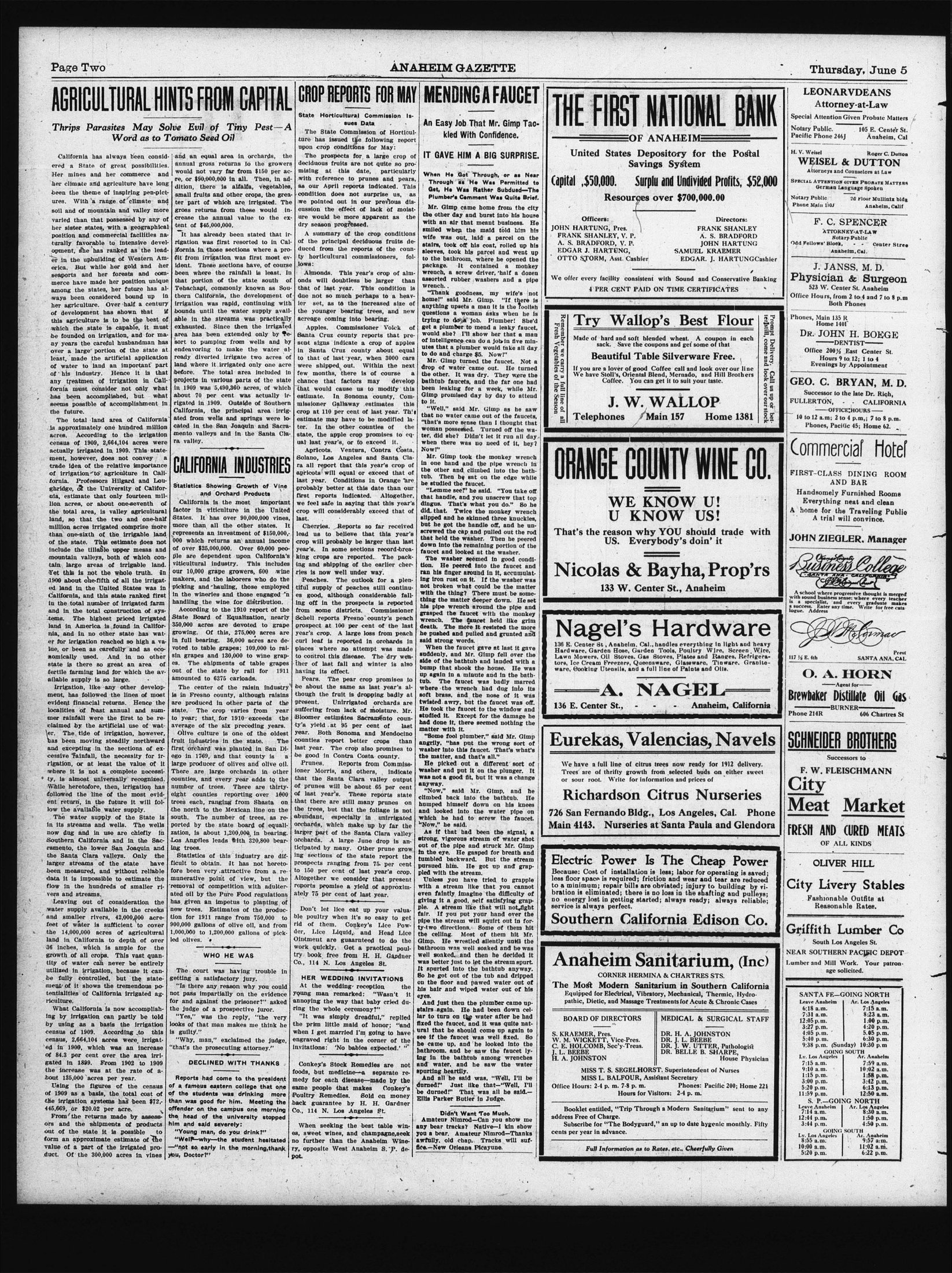
Searchable text
AGRICULTURAL HINTS FROM CAPITAL
Thrips Parasites May Solve Evil of Tiny Pest—A Word as to Tomato Seed Oil
California has always been considered a State of great possibilities. Her mines and her commerce and her climate and agriculture have long been the theme of inspiring pen-pictures. With a range of climate and soil and of mountain and valley more varied than that possessed by any of her sister states, with a geographical position and commercial facilities naturally favorable to intensive development, she has ranked as the leader in the upbuilding of Western America. But while her gold and her seaports and her forests and commerce have made her position unique among the states, her future has always been considered bound up in her agriculture. Over half a century of development has shown that if this agriculture is to be the best of which the state is capable, it must be founded on irrigation, and for many years the careful husbandman has over a large portion of the state at least, made the artificial application of water to land an important part of his industry. Hence it is that any treatmen of irrigation in California must consider not only what has been accomplished, but what seems possible of accomplishment in the future.
The total land area of California is approximately one hundred million acres. According to the irrigation census of 1909, 2,664,104 acres were actually irrigated in 1909. This statement, however, does not convey a trade idea of the relative importance of irrigation to agriculture in Cali-
and an equal area in orchards, the annual gross returns to the growers would not vary far from $150 per acre, or $90,000,000 in all. Then, in addition, there is alfalfa, vegetables, small fruits and other crops, the greater part of which are irrigated. The gross returns from these would increase the annual value to the extent of $45,000,000.
It has already been stated that irrigation was first resorted to in California in those sections where a profit from irrigation was first most evident. These sections have, of course been where the rainfall is least. In that portion of the state south of Tehachapi, commonly known as Southern California, the development of irrigation was rapid, continuing with bounds until the water supply available in the streams was practically exhausted. Since then the irrigated area has been extended only by resort to pumping from wells and by endeavoring to make the water already diverted irrigate two acres of land where it irrigated only one acre before. The total area included in projects in various parts of the state in 1909 was 5,490,360 acres, of which about 70 per cent was actually irrigated in 1909. Outside of Southern California, the principal area irrigated from wells and springs were located in the San Joaquin and Sacramento valleys and in the Santa Clara valley.
CALIFORNIA INDUSTRIES
CROP REPORT
State Horticultural suces
The State Commune has issued ther upon crop condition.
The prospects for deciduous fruits are mising at this time with reference to our April report condition does not we pointed out in discussion the effecture would be more dry season progress.
A summary of tthe principal duced from the rety horticultural coows:
Almonds. This bonds will doubtless that of last year. Due not so much later set, as to the younger bearer acreage coming in.
Apples. Commiss Santa Cruz county sent signs indicate in Santa Cruz ce to that of last year were shipped out few months, there chance that factor that would cause estimate. In Son missioner Gallawa crop at 110 per cent estimate may have ter. In the other state, the apple crusual last year's, or Apricots. Ventu Solano, Los Angeles ra all report that apricots will equal
The total land area of California is approximately one hundred million acres. According to the irrigation census of 1909, 2,664,104 acres were actually irrigated in 1909. This statement, however, does not convey a trade idea of the relative importance of irrigation to agriculture in California. Professors Hilgard and Loughridge, of the University of California, estimate that only fourteen million acres, or about one-seventh of the total area, is valley agricultural land, so that the two and one-half million acres irrigated comprise more than one-sixth of the irrigable land of the state. This estimate does not include the tillable upper mesas and mountain valleys, both of which contain large areas of irrigable land. Yet this is not the whole truth. In 1909 about one-fifth of all the irrigated land in the United States was in California, and this state ranked first in the total number of irrigated farm and in the total construction of systems. The highest priced irrigated land in America is found in California, and in no other state has water for irrigation reached so high a value, or been as carefully and as economically used. And in no other state is there so great an area of fertile farming land for which the available supply is so large.
Irrigation, like any other development, has followed the lines of most evident financial returns. Hence the localities of least annual and summer rainfall were the first to be claimed by the artificial use of water. The tide of irrigation, however, has been moving steadily northward and excepting in the sections of excessive rainfall, the necessity for irrigation, or at least the value of it where it is not a complete necessity, is almost universally recognized. While heretofore, then, irrigation has followed the line of the most evident return, in the future it will follow the available water supply.
The water supply of the State is in its streams and wells. The wells now dug and in use are chiefly in Southern California and in the Sacramento, the lower San Joaquin and the Santa Clara valleys. Only the larger streams of the state have been measured, and without reliable data it is impossible to estimate the flow in the hundreds of smaller rivers and streams.
California is the most important factor in viticulture in the United States. It has over 90,000,000 vines, more than all the other states. It represents an investment of $150,000,000 which returns an annual income of over $25,000,000. Over 60,000 people are dependent upon California's viticultural industry. This includes our 10,000 grape growers, 600 wine makers, and the laborers who do the picking and hauling, those employed in the wineries and those engaged in handling the wine for distribution.
According to the 1910 report of the State Board of Equalization, nearly 350,000 acres are devoted to grape growing. Of this, 275,000 acres are in full bearing. 36,000 acres are devoted to table grapes; 109,000 to raisin grapes and 130,000 to wine grapes. The shipments of table grapes out of the state by rail for 1911 amounted to 6375 carloads.
The center of the raisin industry is in Fresno county, although raisins are produced in other parts of the state. The crop varies from year to year; that for 1910 exceeds the average of the six preceding years.
Olive culture is one of the oldest fruit industries in the state. The first orchard was planted in San Diego in 1769, and that county is a large producer of olives and olive oil. There are large orchards in other counties, and every year adds to the number of trees. There are thirty-eight counties reporting over 1000 trees each, ranging from Shasta on the north to the Mexican line on the south. The number of trees, as reported by the state board of equalization, is about 1,200,000 in bearing Los Angeles leads with 320,800 bearing trees.
Statistics of this industry are difficult to obtain. It has not heretofore been very attractive from a remunerative point of view, but the removal of competition with adulterated oil by the Pure Food regulations new months, there chance that factors that would cause an estimate. In Some missioner Gallawa crop at 110 per cent estimate may have later. In the other state, the apple crop usual last year's, or Apricots. Venture Solano, Los Angeles all report that apricots will equal last year. Condition probably better at first reports indicate we feel safe in say we crop will consider last.
Cherries. Report lead us to believe crop will probably be year's. In some seeding crops are repaired and shipping onries is now well untreated.
Peaches. The opportune supply of peaches good, although off in the process from some districts. Schell reports Fresh prospect at 100 per year's crop. A large curl leaf is reported places where no control this disease therof last fall are having its effect.
Pears. The pear be about the same though the fruit is present. Unirrigation suffering from lack Bloomer estimates city's yield at 95 per year. Both Sonoma counties report be last year. The crop be good in Contractions.
Prunes. Report loner Morris, and that the Santa Clara of prunes will be a last year's. That there are still orchards, which may larger part of the Santa Clara orchards. A large participant by many ing sections of these prospects ranging from 150 per cent to Altogether we const reports promise a relatively 75 per cent
ent return, in the future it will follow the available water supply.
The water supply of the State is in its streams and wells. The wells now dug and in use are chiefly in Southern California and in the Sacramento, the lower San Joaquin and the Santa Clara valleys. Only the larger streams of the state have been measured, and without reliable data it is impossible to estimate the flow in the hundreds of smaller rivers and streams.
Leaving out of consideration the water supply available in the creeks and smaller rivers, 42,000,000 acre-feet of water is sufficient to cover the 14,000,000 acres of agricultural land in California to depth of over 36 inches, which is ample for the growth of all crops. This vast quantity of water can never be entirely utilized in irrigation, because it can be fully controlled, but the statement of it shows the tremendous potentialities of California irrigated agriculture.
What California is now accomplishing by irrigation can partly be told by using as a basis the irrigation census of 1909. According to this census, 2,664,104 acres were irrigated in 1909, which was an increase of 84.3 per cent over the area irrigated in 1899. From 1902 to 1909 the increase was at the rate of about 135,000 acres per year.
Using the figures of the census of 1909 as a basis, the total cost of the irrigation systems has been $72,-445,669, or $20.02 per acre.
From the returns made by assessors and the shipments of products out of the state it is possible to form an approximate estimate of the value of a part of the irrigated product. Of the 300,000 acres in vines trees each, ranging from Shasta on the north to the Mexican line on the south. The number of trees, as reported by the state board of equalization, is about 1,200,000 in bearing. Los Angeles leads with 320,800 bearing trees.
Statistics of this industry are difficult to obtain. It has not heretofore been very attractive from a remunerative point of view, but the removal of competition with adulterated oil by the Pure Food regulations has given an impetus to planting of new trees. Estimates of the production for 1911 range from 750,000 to 900,000 gallons of olive oil, and from 1,000,000 to 1,200,000 gallons of pickled olives.
WHO HE WAS
The court was having trouble in getting a satisfactory jury.
"Is there any reason why you could not pass impartially on the evidence for and against the prisoner?" asked the judge of a prospective juror.
"Yes," was the reply, "the very looks of that man makes me think he is guilty."
"Why, man," exclaimed the judge, "that's the prosecuting attorney."
DECLINED WITH THANKS
Reports had come to the president of a famous eastern college that one of the students was drinking more than was good for him. Meeting the offender on the campus one morning the head of the university stopped him and said severely:
"Young man, do you drink?"
"Well—why—the student hesitated—'not so early in the morning thank you, Doctor?"
Don’t let lice eatable poultry when it rid of them. Consider Lice Liquid. Ointment are guava work quickly. Get your try book free from Co., 114 N. Los Aves.
HER WEDDING
At the wedding young man remarked annoying the way they ring the whole ceremony.
"It was simply on the prim little male when I get married engraved right in their invitations: 'No bad Conkey's Stock Reds foods, but medicine medy for each disease same people that my Poultry Remedies back guarantee by Co., 114 N. Los Aves."
When seeking these es, sweet wines, and no further than the ry, opposite West A pot.
CROP REPORTS FOR MAY
State Horticultural Commission Issues Data
The State Commission of Horticulture has issued the following report upon crop conditions for May:
The prospects for a large crop of deciduous fruits are not quite so promising at this date, particularly with reference to prunes and pears, as our April reports indicated. This condition does not surprise us, as we pointed out in our previous discussion the effect of lack of moisture would be more apparent as the dry season progressed.
A summary of the crop conditions of the principal deciduous fruits deduced from the reports of the county horticultural commissioners follows:
Almonds. This year's crop of almonds will doubtless be larger than that of last year. This condition is due not so much perhaps to a heavier set, as to the increased size of the younger bearing trees, and new acreage coming into bearing.
Apples. Commissioner Volck of Santa Cruz county reports that present signs indicate a crop of apples in Santa Cruz county about equal to that of last year, when 3000 cars were shipped out. Within the next few months, there is of course a chance that factors may develop that would cause us to modify this estimate. In Sonoma county, Commissioner Gallaway estimates this crop at 110 per cent of last year. This estimate may have to be modified later. In the other counties of the state, the apple crop promises to equal last year's, or to exceed it.
Apricots. Ventura, Contra Costa, Solano, Los Angeles and Santa Clara all report that this year's crop of apricots will equal or exceed that of
MENDING A FAUCET
An Easy Job That Mr. Gimp Tackled With Confidence.
IT GAVE HIM A BIG SURPRISE.
When He Got Through, or as Near Through as He Was Permitted to Get, He Was Rather Subdued—The Plumber's Comment Was Quite Brief.
Mr. Gimp came home from the city the other day and burst into his house with an air that meant business. He smiled when the maid told him his wife was out, laid a parcel on the stairs, took off his coat, rolled up his sleeves, took his parcel and went up to the bathroom, where he opened the package. It contained a monkey wrench, a screw driver, half a dozen assorted rubber washers and a pipe wrench.
"Thank goodness, my wife's not home!" said Mr. Gimp. "If there is anything upsets a man it is the foolish questions a woman asks when he is trying to do a job. Plumber! She'd get a plumber to mend a leaky faucet, would she? I'll show her that a man of intelligence can do a job in five minutes that a plumber would take all day to do and charge $5. Now!"
Mr. Gimp turned the faucet. Not a drop of water came out. He turned the other. It was dry. They were the bathtub faucets, and the far one had been leaking for a week, while Mr. Gimp promised day by day to attend to it.
"Well," said Mr. Gimp as he saw that no water came out of the faucets, "that's more sense than I thought that woman possessed. Turned off the water, did she? Didn't let it run all day when there was no need of it, hey? Now!"
Mr. Gimp took the monkey wrench in one hand and the pipe wrench in the other and climbed into the bath-
In Sonoma county, Commissioner Gallaway estimates this crop at 110 per cent of last year. This estimate may have to be modified later. In the other counties of the state, the apple crop promises equal last year's, or to exceed it.
Apricots. Ventura, Contra Costa, Solano, Los Angeles and Santa Clara all report that this year's crop of apricots will equal or exceed that of last year. Conditions in Orange are probably better at this date than our first reports indicated. Altogether, we feel safe in saying that this year's crop will considerably exceed that of last.
Cherries. Reports so far received lead us to believe that this year's crop will probably be larger than last year's. In some sections record-breaking crops are reported. The packing and shipping of the earlier cherries is now well under way.
Peaches. The outlook for a plentiful supply of peaches still continues good, although considerable falling off in the prospects is reported from some districts. Commissioner Schell reports Fresno county's peach prospect at 100 per cent of the last year's crop. A large loss from peach curl leaf is reported in orchards in places where no attempt was made to control this disease. The dry weather of last fall and winter is also having its effect.
Pears. The pear crop promises to be about the same as last year's although the fruit is dropping badly at present. Unirrigated orchards are suffering from lack of moisture. Mr. Bloomer estimates Sacramento county's yield at 95 per cent of last year. Both Sonoma and Mendocino counties report better crops than last year. The crop also promises to be good in Contra Costa county.
Prunes. Reports from Commissioner Morris, and others, indicate that the Santa Clara valley output of prunes will be about 65 per cent of last year's. These reports state that there are still many prunes on the trees, but that the foliage is not abundant, especially in unirrigated orchards, which make up by far the larger part of the Santa Clara valley orchards. A large June drop is anticipated by many. Other prune growing sections of the state report the prospects ranging from 75 per cent to 150 per cent of last year's crop. Altogether we consider that present reports promise a yield of approximately 75 per cent of last year.
They were the bathtub faucets, and the far one had been leaking for a week, while Mr. Gimp promised day by day to attend to it.
"Well," said Mr. Gimp as he saw that no water came out of the faucets, "that's more sense than I thought that woman possessed. Turned off the water, did she? Didn't let it run all day when there was no need of it, hey? Now!"
Mr. Gimp took the monkey wrench in one hand and the pipe wrench in the other and climbed into the bath tub. Then he sat on the edge while he studied the faucet.
"Lemme see!" he said. "You take off that handle, and you unscrew that top dingus. That's what you do." So he did that. Twice the monkey wrench slipped and he skinned three knuckles, but he got the handle off, and he unscrewed the cap and pulled out the rod that held the washer. Then he peered down into the remaining portion of the faucet and looked at the washer.
The washer seemed in good condition. He peered into the faucet and ran his finger around it, accumulating iron rust on it. If the washer was not broken what could be the matter with the thing? There must be something the matter deeper down. He set his pipe wrench around the pipe and grasped the faucet with the monkey wrench. The faucet held like grim death. The more it resisted the more he pushed and pulled and grunted and said strong words.
When the faucet gave at last it gave suddenly, and Mr. Gimp fell over the side of the bathtub and landed with a bump that shook the house. He was up again in a minute and in the bathtub. The faucet was badly marred where the wrench had dug into its soft brass, and the nose of it was twisted awry, but the faucet was off. He took the faucet to the window and studied it. Except for the damage he had done it, there seemed nothing the matter with it.
"Some fool plumber," said Mr. Gimp angrily, "has put the wrong sort of washer into this faucet. That’s what’s the matter, and that’s all."
He pleked out a different sort of washer and put it on the plunger. It was not a good fit, but it was a change anyway.
"Now," said Mr. Gimp, and he climbed back into the bathtub. He humped himself down on his knees and looked into the water pipe on which he had to screw the faucet.
"Now," he said.
As if that had been the signal, a strong, vigorous stream of water shot out of the pipe and struck Mr. Gimp in the eye. He gasped for breath and tumbled backward. But the stream pursued him. He got up and grappled with the stream.
Unless you have tried to grapple with a stream like that you cannot even faintly imagine the difficulty of giving it a good self-satisfying bite.
We have Stoll's, Oriental Blend, Coffee. You can get it here.
ORANGE COUNTY
WE KNOW U KNOW
That's the reason why YOU US. Everybody
Nicolas & Bay
133 W. Center S
A. NA
136 E. Center St.,
Eurekas, Valen
We have a full line of citrus trees Trees are of thrifty growth from se or sour root. Write for information
Richardson Citr
726 San Fernando Bldg., Los Main 4143. Nurseries at San Electric Power Is Th
Because: Cost of installation is less; less floor space is required; friction a to a minimum; repair bills are obviat bration is eliminated; there is no loss
that there are still many prunes on the trees, but that the foliage is not abundant, especially in unirrigated orchards, which make up by far the larger part of the Santa Clara valley orchards. A large June drop is anticipated by many. Other prune growing sections of the state report the prospects ranging from 75 per cent to 150 per cent of last year's crop. Altogether we consider that present reports promise a yield of approximately 75 per cent of last year.
Don't let lice eat up your valuable poultry when it's so easy to get rid of them. Conkey's Lice Powder, Lice Liquid, and Head Lice Ointment are guarnteed to do the work quickly. Get a practical poultry book free from H. H. Gardner Co., 114 N. Los Angeles St.
HER WEDDING INVITATIONS
At the wedding reception the young man remarked: "Wasn't it annoying the way that baby cried during the whole ceremony?"
"It was simply dreadful," replied the prim little maid of honor; "and when I get married I'm going to have engraved right in the corner of the invitations: 'No babies expected.'"
Conkey's Stock Remedies are not foods, but medicine—a separate remedy for each disease—made by the same people that makes Conkey's Poultry Remedies. Sold on money back guarantee by H. H. Gardner Co., 114 N. Los Angeles St.
When seeking the best table wines, sweet wines, and champagne, seek no further than the Anaheim Winery, opposite West Anaheim S. P. depot.
Didn't Want Too Much.
Amateur Nimrod—Can you show me any bear tracks? Native—I kin show you a bear. Amateur Nimrod—Thanks awfully, old chap. Tracks will suffice—New Orleans Picayune.
FIRST NATIONAL BANK
OF ANAHEIM
United States Depository for the Postal Savings System
$10,000. Surplus and Undivided Profits, $52,000
Resources over $700,000.00
Directors:
UNG, Pres.
ANLEY, V. P.
FORD, V. P.
MARTUNG,
RM, Asst. Cashier
FRANK SHANLEY
A. S. BRADFORD
JOHN HARTUNG
SAMUEL KRAEMER
EDGAR. J. HARTUNGCashier
Facility consistent with Sound and Conservative Banking
PER CENT PAID ON TIME CERTIFICATES
Wallop's Best Flour
hard and soft blended wheat. A coupon in each sack. Save the coupons and get some of that Beautiful Table Silverware Free.
are a lover of good Coffee call and look over our line Stoll's, Oriental Blend, Mernado, and Hill Brothers Coffee. You can get it to suit your taste.
J. W. WALLOP
phones Main 157 Home 1381
LEONARVDEANS
Attorney-at-Law
Special Attention Given Probate Matters
Notary Public. 105 E. Center St.
Pacific Phone 246J Anaheim, Cal
H. V. Weisel
Roger C. Dutton
WEISEL & DUTTON
Attorneys and Counselors at Law
SPECIAL ATTENTION GIVEN PROBATE MATTERS German Language Spoken
Notary Public 2d Floor Mullinix bldg
Phone Main 110J Anaheim, Calf
F. C. SPENCER
ATTORNEY-AT-LAW
Notary Public
Odd Fellows' Block, Center Street Anaheim, Cal.
J. JANSS, M. D.
Physician & Surgeon
523 W. Center St. Anaheim
Office Hours, from 2 to 4 and 7 to 8 p.m Both Phones
Phones, Main 135 R Home 1401
DR. JOHN H. BOEGE
DENTIST
Office 200½ East Center St.
Hours 9 to 12; 1 to 4 Evenings by Appointment
GEO. C. BRYAN, M. D.
Successor to the late Dr. Rich,
FULLERTON, CALIFORNIA
OFFICE HOURS
10 to 12 a.m; 2 to 4 p.m.; 7 to 8 p.m.
Phones, Pacific 45; Home 62.
Commercial Hotel
FIRST-CLASS DINING ROOM
J. W. WALLOP
phones Main 157 Home 1381
GE COUNTY WINE CO.
WE KNOW U!
U KNOW US!
The reason why YOU should trade with
US. Everybody's doin' it
Las & Bayha, Prop'res
133 W. Center St., Anaheim
gel's Hardware
St., Anaheim, Cal., handles everything in light and heavy
Garden Hose, Garden Tools, Poultry Wire, Screen Wire,
Oil Stoves, Gas Stoves, Plates and Ranges, Refrigeration
Freezers, Queensware, Glassware, Tinware, GraniteUtensils, and a full line of Palms and Olits.
A. NAGEL
Center St., Anaheim, California
Texas, Valencias, Navels
full line of citrus trees now ready for 1912 delivery.
of thrifty growth from selected buds on either sweet
ot. Write for information and prices of
Hardson Citrus Nurseries
Fernando Bldg., Los Angeles, Cal. Phone
Nurseries at Santa Paula and Glendora
Power Is The Cheap Power
of installation is less; labor for operating is saved;
is required; friction and wear and tear are reduced;
repair bills are obviated; injury to building by vininated; there is no loss in the shafting and pulleys;
GEO. C. BRYAN, M.D.
Successor to the late Dr. Rich,
FULLERTON, CALIFORNIA
OFFICE HOURS —
10 to 12 a.m.; 2 to 4 p.m.; 7 to 8 p.m.
Phones, Pacific 45; Home 62.
Commercial Hotel
FIRST-CLASS DINING ROOM
AND BAR
Handsomely Furnished Rooms
Everything neat and clean
A home for the Traveling Public
A trial will convince.
JOHN ZIEGLER. Manager
Business College
A school where progressive thought is merged
with sound business sense; where every teacher
is a specialist, and every graduate makes
a success. Enter any time. Write for free catalogue. Address
Prest
117½ E. 4th
SANTA ANA, CAL
O. A. HORN
Agent for
Brewbaker Distillate Oil Gas
BURNER
Phone 214R 606 Chartres St
SCHNEIDER BROTHERS
Successors to
F. W. FLEISCHMANN
City
Meat Market
FRESH AND CURED MEATS
OF ALL KINDS
OLIVER HILL
City Livery Stables
Fashionable Outfits at
Power Is The Cheap Power
of installation is less; labor for operating is saved;
is required; friction and wear and tear are reduced;
repair bills are obviated; injury to building by viminated; there is no loss in the shafting and pulleys;
in getting started; always ready; always reliable;
always perfect.
Heim Sanitarium, (Inc)
CORNER HERMINA & CHARTRES STS.
Modern Sanitarium in Southern California
for Electrical, Vibratory, Mechanical, Thermic, Hydrotic, and Massage Treatments for Acute & Chronic Cases
DIRECTORS
Pres.
TT, Vice-Pres.
MB, Sec'y-Treas.
ON
DR. H. A. JOHNSTON
DR. J. L. BEEBE
DR. J. W. UTTER, Pathologist
DR. BELLE B. SHARPE,
House Physician
T. S. SEGELHORST. Superintendent of Nurses
L. BALFOUR, Assistant Secretary
Phones: Pacific 200; Home 221
Hours for Visitors: 2-4 p.m.
Titled, "Trip Through a Modern Sanitarium" sent to any
Charge.
For "The Bodyguard," an up to date hygienic monthly. Fifty
days advance.
Information as to Rates, etc., Cheerfully Given
Meat Market
FRESH AND CURED MEATS
OF ALL KINDS
OLIVER HILL
City Livery Stables
Fashionable Outfits at
Reasonable Rates.
Griffith Lumber Co
South Los Angeles St.
NEAR SOUTHERN PACIFIC DEPOT
Lumber and Mill Work. Your patronage solicited.
SANTA FE—GOING NORTH
Leave Anaheim Ar. Los Angeles
6:18 a.m. 7:15 a.m.
7:31 a.m. 8:23 a.m.
12:05 p.m. 1:00 p.m.
3:27 p.m. 4:20 p.m.
4:05 p.m. 5:05 p.m.
5:40 p.m. 6:30 p.m.
9:38 p.m. (Sunday) 10:30 p.m.
GOING SOUTH
Lv. Los Angeles Ar. Anaheim
7:15 a.m. 7:59 a.m.
9:10 a.m. 10:02 a.m.
1:15 p.m. 1:58 p.m.
3:00 p.m. 3:42 p.m.
5:20 p.m. 6:13 p.m.
11:59 p.m. 12:50 a.m.
S. P.—GOING NORTH
Leave Anaheim Ar. Los Angeles
7:14 a.m. 8:30 a.m.
12:44 p.m. 1:50 p.m.
3:44 p.m. 4:50 p.m.
GOING SOUTH
Lv. Los Angeles Ar. Anaheim
8:55 a.m. 9:57 a.m.
10:00 a.m. 11:02 a.m.
5:20 p.m. 6:22 p.m.