anaheim-gazette 1912-05-30
Scanned page
Searchable text
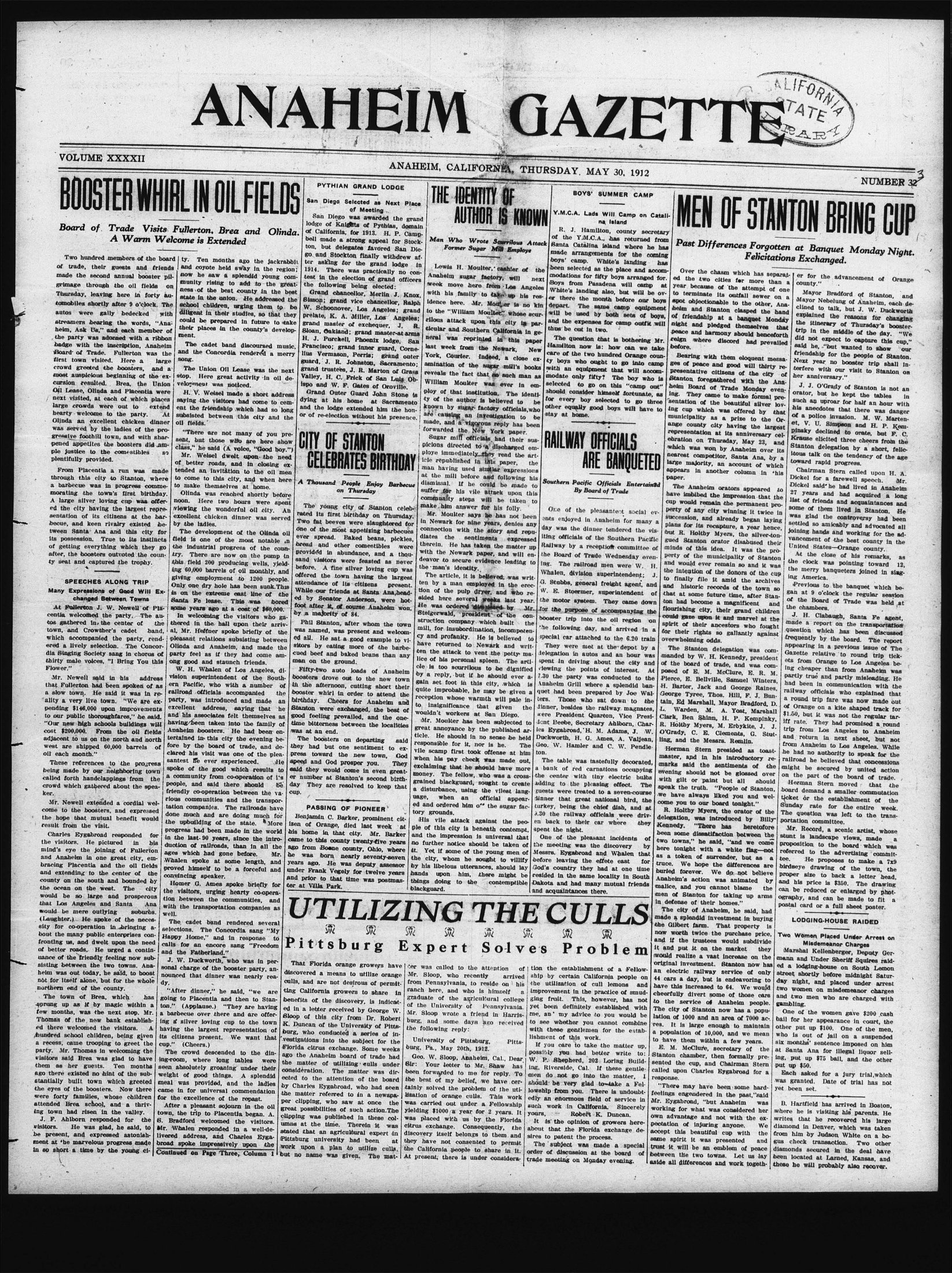
VOLUME XXXXII
BOOSTER WHIRL IN OIL FIELDS
Board of Trade Visits Fullerton, Brea and Olinda. A Warm Welcome is Extended
Two hundred members of the board of trade, their guests and friends made the second annual booster pilgrimage through the oil fields on Thursday, leaving here in forty automobiles shortly after 9 o'clock. The autos were gaily bedecked with streamers bearing the words, "Anaheim, Ask Us," and each member of the party was adorned with a ribbon badge with the inscription, Anaheim Board of Trade. Fullerton was the first town visited. Here a large crowd greeted the boosters, and a most auspicious beginning of the excursion resulted. Brea, the Union Oil Lease, Olinda and Placentia were next visited, at each of which places large crowds were out to extend hearty welcome to the party. At Olinda an excellent chicken dinner was served by the ladies of the progressive foothill town, and with sharpened appetites the boosters did ample justice to the comestibles so plentifully provided.
From Placentia a run was made by Ten months ago the jackrabbit and coyote held sway in the region; now he saw a splendid young community rising to add to the greatness of the best county in the best state in the union. He addressed the school children, urging them to be diligent in their studies, so that they could be prepared in future to take their places in the county's development.
The cadet band discoursed music, and the Concordia rendered a merry song.
The Union Oil Lease was the next stop. Here great activity in oil development was noticed.
H. V. Weisel made a short address saying the visitors had come to cement the friendship which had so long subsisted between this city and the oil fields.
"There are not many of you present, but those who are here show class," he said (A voice, "Good boy.")
Mr. Weisel dwelt upon the need of better roads, and in closing extended an invitation to the oil men...
SPEECHES ALONG TRIP
Many Expressions of Good Will Exchanged Between Towns
At Fullerton J. W. Newell of Placentia welcomed the party. The autos gathered in the center of the town, and Crowther's cadet band, which accompanied the party, rendered a lively selection. The Concordia Singing Society sang in chorus of thirty male voices, "I Bring You this Flower."
Mr. Newell said in his address that Fullerton had been spoken of as a slow town. He said it was in reality a very live town. "We are expending $146,000 upon improvements to our public thoroughfares," he said. "Our new high schools buildings will cost $200,000. From the oil fields adjacent to us on the north and north west are shipped 60,000 barrels of oil each month."
These references to the progress being made by our neighboring town called forth handclappings from the crowd which gathered about the speaker.
Mr. Newell extended a cordial welcome to the boosters, and expressed the hope that mutual benefit would result from the visit.
Charles Eygabroad responded for the visitors. He pictured in his mind's eye the joining of Fullerton and Anaheim in one great city, embracing Placentia and the oil fields and extending to the center of the county on the south and bounded by the ocean on the west. The city would be so large and prosperous most auspicious beginning of the excursion resulted. Brea, the Union Oil Lease, Olinda and Placentia were next visited, at each of which places large crowds were out to extend hearty welcome to the party. At Olinda an excellent chicken dinner was served by the ladies of the progressive foothill town, and with sharpened appetites the boosters didample justice to the comestibles so plentifully provided.
From Placentia a run was made through this city to Stanton, where a barbecue was in progress commemorating the town's first birthday. A large silver loving cup was offered the city having the largest representation of its citizens at the barbecue, and keen rivalry existed between Santa Ana and this city for its possession. True to its instincts of getting everything which they go after, the boosters outvoted the county seat and captured the trophy.
H. V. Weisel made a short address saying the visitors had come to cement the friendship which had so long subsisted between this city and the oil fields.
"There are not many of you present, but those who are here show class," he said (A voice, "Good boy.")
Mr. Weisel dwelt upon the need of better roads, and in closing extended an invitation to the oil men to come to this city, and when here to make themselves at home.
Olinda was reached shortly before noon. Here two hours were spent viewing the wonderful oil city. An excellent chicken dinner was served by the ladies.
The development of the Olinda oil field is one of the most notable in the industrial progress of the country. There are now on the pump in this field 200 producing wells, yielding 60,000 barrels of oil monthly, and giving employment to 1200 people. Only one dry hole has been sunk. This is on the extreme east line of the Santa Fe lease. This was bored some years ago at a cost of $60,000.
In welcoming the visitors who gathered in the hall upon their arrival, Mr. Heffner spoke briefly of the pleasant relations subsisting between Olinda and Anaheim, and made the party feel as if they had come among good and staunch friends.
W. H. Whalen of Los Angeles, division superintendent of the Southern Pacific, who with a number of railroad officials accompanied the party, was introduced and made an excellent address, saying that he and his associates felt themselves as having been taken into the family of Anaheim boosters. He had been entertained in this city the evening before by the board of trade, and declared his visit was one of the pleasantest he ever experienced.
He spoke of the good which results to a community from co-operation of its people, and said there should be friendly co-operation between various communities and the transportation companies. The railroads have done much and are doing much for the upbuilding of the state. More progress had been made in the world in the last 90 years, since the introduction of railroads, than in all the ages which had gone before. Mr. Whalen spoke at some length, and proved himself to be a forceful and convincing speaker.
Homer G. Ames spoke briefly for the visitors, urging hearty co-operation between the communities and stop. Here great activity in oil development was noticed.
Grand Outer Gulf dying at his house and the lodge extinct or of re-election wi
Mr. Newell extended a cordial welcome to the boosters, and expressed the hope that mutual benefit would result from the visit.
Charles Eygabroad responded for the visitors. He pictured in his mind's eye the joining of Fullerton and Anaheim in one great city, embracing Placentia and the oil fields and extending to the center of the county on the south and bounded by the ocean on the west. The city would be so large and prosperous that Los Angeles and Santa Ana would be mere outlying suburbs. (Laughter.) He spoke of the necessity for co-operation in bringing about the many public enterprises confronting us, and dwelt upon the need of better roads. He urged a continuance of the friendly feeling now subsisting between the two towns. Anaheim was out today, he said, to boost not for itself alone, but for the whole northern end of the county.
The town of Brea, which has sprung up as if by magic within a few months, was the next stop. Mr. Thomas of the new bank established there welcomed the visitors. A hundred school children, being given a recess, came trooping to greet the party. Mr. Thomas in welcoming the visitors said Brea was glad to have them as her guests. Ten months ago there existed no hint of the substantially built town which greeted the eyes of the boosters. Now there were forty families, whose children attended Brea school, and a thriving town had risen in the valley.
J. F. Ahlborn responded for the visitors. He was glad, he said, to be present, and expressed astonishment at the marvelous progress made in so short a time by the young ci-
ious communities and the transportation companies. The railroads have done much and are doing much for the upbuilding of the state. More progress had been made in the world in the last 90 years, since the introduction of railroads, than in all the ages which had gone before. Mr. Whalen spoke at some length, and proved himself to be a forceful and convincing speaker.
Homer G. Ames spoke briefly for the visitors, urging hearty co-operation between the communities, and with the transportation companies as well.
The cadet band rendered several selections. The Concordia sang "My Happy Home," and in response to calls for an encore sang "Freedom and the Fatherland."
J. W. Duckworth, who was in personal charge of the booster party, announced that dinner was nearly ready.
"After dinner," he said, "we are going to Placentia and then to Stanton." (Applause.) "They are having a barbecue over there and are offering a silver loving cup to the town having the largest representation of its citizens present. We want that cup." (Cheers.)
The crowd descended to the dining-room, where long tables were seen absolutely groaning under their weight of good things. A splendid meal was provided, and the ladies came in for universal commendation for the excellence of the repast.
After a pleasant sojourn in the oil town, the trip to Placentia began. A. S. Bradford welcomed the visitors. Mr. Whalen responded in a well-delivered address, and Charles Eygabroad spoke impressively upon the
Continued on Page Three, Column I
AHEIM GAZET
ANAHEIM, CALIFORNIA, THURSDAY. MAY 30, 1912
PYTHIAN GRAND LODGE
San Diego Selected as Next Place of Meeting
San Diego was awarded the grand lodge of Knights of Pythias, domain of California, for 1913. H. P. Campbell made a strong appeal for Stockton, but delegates favored San Diego and Stockton finally withdrew after asking for the grand lodge in 1914. There was practically no contest in the election of grand officers the following being elected:
Grand chancellor, Merlin J. Knox, Sisson; grand vice chancellor, Ralph W. Schoonover, Los Angeles; grand prelate, K. A. Miller, Los Angeles; grand master of exchequer, J. R. Sloan, Oakland; grand master-at-arms H. J. Purchell, Phoenix lodge, San Francisco; grand inner guard, Corneillus Vermason, Perris; grand outer guard, J. R. Johnston, Sacramento; grand trustees, J. R. Marton of Grass Valley, H. C. Frick of San Luis Obispo and W. F. Gates of Oroville.
Grand Outer Guard John Stone is dying at his home at Sacramento and the lodge extended him the honor of re-election without his presence.
CITY OF STANTON CELEBRATES BIRTHDAY
THE IDENTITY OF AUTHOR IS KNOWN
Man Who Wrote Scurrilous Attack Former Sugar Mill Employe
Lewis H. Moulter, cashier of the Anaheim sugar factory, will next week move here from Los Angeles with his family to take up his residence here. Mr. Moulter is no kin to the "William Moulter" whose scurrilous attack upon this city in particular and Southern California in general was reprinted in this paper last week from the Newark, New York, Courier. Indeed, a close examination of the sugar mill's books reveals the fact that no such man as William Moulter was ever in employ of that institution. The identity of the author is believed to be known by sugar factory officials, who are causing an investigation to be made, and a vigorous reply has been forwarded the New York paper.
Sugar mill officials had their suspicions directed to a discharged employee immediately they read the article republished in this paper, the man having used similar expressions at the mill before.
BOYS' SUMMER CAMP
Y.M.C.A. Lads Will Camp on Catalina Island
R. J. Hamilton, county secretary of the Y.M.C.A., has returned from Santa Catalina island where he has made arrangements for the coming boys' camp. White's landing has been selected as the place and accommodations for fifty boys arranged for. Boys from Pasadena will camp at White's landing also, but will be over there the month before our boys depart. The same camp equipment will be used by both sets of boys, and the expenses for camp outfit will thus be cut in two.
The question that is bothering Mr. Hamilton now is: how can we take care of the two hundred Orange county boys who ought to go into camp with an equipment that will accommodate only fifty? The boy who is selected to go on this "camp out" should consider himself fortunate, as for every boy selected to go three other equally good boys will have to stay at home.
RAILWAY OFFICIALS ARE BANQUETED
CITY OF STANTON CELEBRATES BIRTHDAY
A Thousand People Enjoy Barbecue on Thursday
The young city of Stanton celebrated its first birthday on Thursday. Two fat beeves were slaughtered for one of the most appetizing barbecues ever spread. Baked beans, pickles, bread and other comestibles were provided in abundance, and a thousand visitors were feasted as never before. A fine silver loving cup was offered the town having the largest attendance of its citizens present. While our friends at Santa Ana-headed by Senator Anderson, were hot-foot after it, of course Anaheim won, by a majority of 84.
Phil Stanton, after whom the town was named, was present and welcomed all. He sat a good example to visitors by eating more of the barbeued beef and baked beans than any man on the ground.
Fifty-two auto loads of Anaheim boosters drove out to the new town in the afternoon, cutting short their booster whirl in order to attend the birthday. Cheers for Anaheim and Stanton were exchanged, the best of good feeling prevailed, and the one-time bitterness between the localities was at an end.
The boosters on departing said they had but one sentiment to express toward the new town, God speed and God prosper you. They said they would come in even greater number at Stanton's second birthday. They are resolved to keep that cup.
PASSING OF PIONEER
Benjamin C. Barker, prominent citizen of Orange, died last week at his home in that city. Mr. Barker came to this county twenty-five years ago from Boone county, Ohio, where he was born nearly seventy-seven years ago. He was deputy assessor under Frank Vegely for twelve years and prior to that time was postmaster at Villa Park.
William Moulter was ever in employ of that institution. The identity of the author is believed to be known by sugar factory officials, who are causing an investigation to be made, and a vigorous reply has been forwarded the New York paper.
Sugar mill officials had their suspicions directed to a discharged employee immediately they read the article republished in this paper, the man having used similar expressions at the mill before and following his dismissal. If he could be made to suffer for his vile attack upon this community steps will be taken to make him answer for his folly.
Mr. Moulter says he has not been in Newark for nine years, denies any connection with the story and repudiates the sentiments expressed therein. He has taken the matter up with the Newark paper, and will endeavor to secure evidence leading to the man's identity.
The article, it is believed, was written by a man employed in the erection of the pulp dryer, and who resided here several weeks last year. He was ordered dismissed by Mr. Steigerwald, president of the construction company which built the mill, for insubordination, incompetency and profanity. He is believed to have returned to Newark and written the attack to vent the petty malice of his personal spleen. The article is too scurrilous to be dignified by a reply, but if he should ever again set foot in this city, which is quite improbable, he may be given a reception whose warmth will pale into insignificance that given the wouldn't workers at San Diego.
Mr. Moulter has been subjected to great annoyance by the published article. He should in no sense be held responsible for it, nor is he. The vile scamp first took offense at him when his pay check was made out, exclaiming that he should have more money. The fellow, who was a cross-grained blackguard, sought to create a disturbance, using the vilest language, when an official appeared and ordered him o'r the sugar factory grounds.
His vile attack against the people of this city is beneath contempt, and the impression is universal that no further notice should be taken of it. Yet if some of the young men of the city, whom he sought to villify by his libelous utterances, should lay hands upon him, there might be things doing to the contemptible blackguard.
One of the pleasant incidents of the meeting was the discovery by Messrs. Eygabroad and Whalen that before leaving the effete east for God's country they had at one time resided in the same locality in South Dakota and had many mutual friends and acquaintances there.
RAILWAY OFFICIALS ARE BANQUETED
Southern Pacific Officials Entertained By Board of Trade
One of the pleasant social events enjoyed in Anaheim for many a day was the dinner tendered the visiting officials of the Southern Pacific Railway by a reception committee of the Board of Trade Wednesday evening. The railroad men were W. H. Whalen, division superintendent; J. G. Stubbs, general freight agent, and W. E. Stoermer, superintendent of the motor system. They came down for the purpose of accompanying the booster trip into the oil region on the following day, and arrived in a special car attached to the 6:20 train.
They were met at the depot by a delegation in autos and an hour was spent in driving about the city and viewing the points of interest. At 7:30 the party was conducted to Anaheim Grill where a splendid banquet had been prepared by Joe Walters. Those who sat down to the dinner, besides the railway magnates, were President Quarton, Vice President Beebe, Secretary Ahlborn, Charles Eygabroad,'H. M. Adams, J. W. Duckworth, H. G. Ames, A. Valjean, Geo. W. Hamler and C. W. Pendleton.
The table was tastefully decorated, a bank of red carnations occupying the center with tiny electric bulbs adding to the pleasing effect. The guests were treated to a seven-course dinner that great national bird, the turkey, being the chief dish, and at 6:30 the railway officials were driven back to their car where they spent the night.
One of the pleasant incidents of the meeting was the discovery by Messrs. Eygabroad and Whalen that before leaving the effete east for God's country they had at one time resided in the same locality in South Dakota and had many mutual friends and acquaintances there.
PASSING OF PIONEER
Benjamin C. Barker, prominent citizen of Orange, died last week at his home in that city. Mr. Barker came to this county twenty-five years ago from Boone county, Ohio, where he was born nearly seventy-seven years ago. He was deputy assessor under Frank Vegely for twelve years and prior to that time was postmaster at Villa Park.
His vile attack against the people of this city is beneath contempt, and the impression is universal that no further notice should be taken of it. Yet if some of the young men of the city, whom he sought to villify by his libelous utterances, should lay hands upon him, there might be things doing to the contemptible blackguard.
One of the pleasant incidents of the meeting was the discovery by Messrs. Eygabroad and Whalen that before leaving the effete east for God's country they had at one time resided in the same locality in South Dakota and had many mutual friends and acquaintances there.
UTILIZING THE CULLS
Pittsburg Expert Solves Problem
That Florida orange growers have discovered a means to utilize orange culls, and are not desirous of permitting California growers to share in benefits of the discovery, is indicated in a letter received by George W. Sloop of this city from Dr. Robert K. Duncan of the University of Pittsburg, who conducted a series of investigations into the subject for the Florida citrus exchange. Some weeks ago the Anaheim board of trade had the matter of utilizing culls under consideration. The matter was directed to the attention of the board by Charles Eygabroad, who had seen the matter referred to in a newspaper clipping, who saw at once the great possibilities of such action. The clipping was published in these columns at the time. Therein it was stated that an agricultural expert in Pittsburg university had been at work upon a plan to utilize culls, but no name was given. The matter was called to the attention of Mr. Sloop, who recently arrived from Pennsylvania, to reside on his ranch here, and who is himself a graduate of the agricultural college of the University of Pennsylvania. Mr. Sloop wrote a friend in Harrisburg, and some days ago received the following reply:
University of Pittsburg, Pittsburg, Pa., May 20th, 1912.
Geo. W. Sloop, Anaheim, Cal., Dear Sir: Your letter to Mr. Shaw has been forwarded to me for reply. To the best of my belief, we have certainly solved the problem of the utilization of orange culls. This work was carried out under a Fellowship yielding $1000 a year for 2 years. It was placed with us by the Florida citrus exchange. Consequently, the discovery itself belongs to them and they have not consented to permit the California people to share in it. At present; there is under considera-tion the establishment of a Fellowship by certain California people on the utilization of cull lemons and improvement in the practice of smudging fruit. This, however, has not yet been definitely established with me, and my advice to you would be to see whether you cannot combine with these gentlemen for the establishment of this work.
If you care to take the matter up, possibly you had better write to: W. P. Shepherd, 202 Loring Building, Riverside, Cal. If these gentlemen do not go into the matter, I should be very glad to take a Fellowship from you. There is undoubtedly an enormous field of service in such work in California. Sincerely yours,
Robert K. Duncan.
It is the opinion of growers hereabout that the Florida exchange desires to patent the process.
The subject was made a special order of discussion at the board of trade meeting on Monday evening.
MEN OF STANTON BRING CUP
Past Differences Forgotten at Banquet Monday Night. Felicitations Exchanged.
Over the chasm which has separated the two cities for more than a year because of the attempt of one to terminate its outfall sewer on a spot objectionable to the other, Anaheim and Stanton clasped the hand of friendship at a banquet Monday night and pledged themselves that peace and harmony should henceforth reign where discord had prevailed before.
Bearing with them eloquent messages of peace and good will thirty representative citizens of the city of Stanton foregathered with the Anaheim Board of Trade Monday evening. They came to make formal presentation of the beautiful silver loving cup which was offered by that municipality as a prize to the Orange county city having the largest representation at its anniversary celebration on Thursday, May 23, and which was won by Anaheim over its nearest competitor, Santa Ana, by a large majority, an account of which appears in another column in his er for the advancement of Orange county."
Mayor Bradford of Stanton, and Mayor Nebelung of Anaheim, each declined to talk, but J. W. Duckworth explained the reasons for changing the itinerary of Thursday's booster-trip in the middle of the day. "We did not expect to capture this cup," said he, "but wanted to show our friendship for the people of Stanton. Next year no booster trip shall interfere with our visit to Stanton on her anniversary."
J. J. O'Grady of Stanton is not an orator, but he kept the tables in such an uproar for half an hour with his anecdotes that there was danger of a police invasion. M. W. Martenet, V. U. Simpson and H. P. Kempinsky declined to orate, but F. C. Krause elicited three cheers from the Stanton delegation by a short, felicitous talk on the tendency of the age toward rapid progress.
Chairman Stern called upon H. A.
The boy who is on this "camp out" himself fortunate, as selected to go three good boys will have to be accompanied the oil region on and arrived in a depot by a bus and an hour was about the city and of interest. At the conduct to the railway magnates, Barton, Vice Presidency Ahlborn, Charl M. Adams, J. W. Ames, A. Valjean, and C. W. Pendle stefully decorated nations occupying any electric bulbs using effect. The to a seven-course national bird, the chief dish, and officials were drivar where they ant incidents of discovery by Whalen that effete east for had at one time locality in South by mutual friends here.
Stanton foregathered with the Anaheim Board of Trade Monday evening. They came to make formal presentation of the beautiful silver loving cup which was offered by that municipality as a prize to the Orange county city having the largest representation at its anniversary celebration on Thursday, May 23, and which was won by Anaheim over its nearest competitor, Santa Ana, by a large majority, an account of which appears in another column in his paper.
The Anaheim orators appeared to have imbibed the impression that the cup would remain the permanent property of any city winning it twice in succession, and already began laying plans for its recapture, a year hence, but R. Holby Myers, the silver-tongued Stanton orator disabused their minds of this idea. It was the property of the municipality of Stanton and would ever remain so and it was the intention of the donors of the cup to finally file it amid the archives and historic records of the town so that at some future time, after Stanton had become a magnificent and flourishing city, their grand children could gaze upon it and marvel at the spirit of their ancestors who fought for their rights so gallantly against overwhelming odds.
The Stanton delegation was commanded by W. H. Kennedy, president of the board of trade, and was composed of E. M. McClure, E. R. M. Pierce, E. Bellville, Samuel Winters, H. Barter, Jack and George Raines, George Tyree, Thos. Hill, F. J. Buntain, Ed Marshall, Mayor Bradford, D. L. Warden, M. A. Yost, Marshall Clark, Ben Shinn, H. P. Kempinky, R. Holby Myers, M. Erbykite, J. J. O'Grady, C. E. Clements, G. Stutling, and the Messrs. Remlin.
Herman Stern presided as toastmaster, and in his introductory remarks said the sentiments of the evening should not be glossed over with gilt or paint but all should speak the truth. "People of Stanton, we have always liked you and welcome you to our board tonight."
R. Holby Myers, the orator of the delegation, was introduced by Billy Kennedy. "There has heretofore been some dissatisfaction between the two towns," he said, "and we come here tonight with a white flag—not as a token of surrender, but as a truce. We hope the differences are buried forever. We do not believe Anaheim's action was animated by malice, and you cannot blame the men of Stanton for taking up arms her anniversary."
J. J. O'Grady of Stanton is not an orator, but he kept the tables in such an uproar for half an hour with his anecdotes that there was danger of a police invasion. M. W. Martenet, V. U. Simpson and H. P. Kempinsky declined to orate, but F. C. Krause elicited three cheers from the Stanton delegation by a short, felicitous talk on the tendency of the age toward rapid progress.
Chairman Stern called upon H. A. Dickel for a farewell speech. Mr. Dickel said he had lived in Anaheim 27 years and had acquired a long list of friends and acquaintances and some of them lived in Stanton. He was glad the controversy had been settled so amicably and advocated all joining hands and working for the advancement of the best county in the United States—Orange county.
At the close of his remarks, as the clock was pointing toward 12, the merry banqueters joined in singing America.
Previous to the banquet which began at 9 o'clock the regular session of the Board of Trade was held at the chambers.
J. H. Clabaugh, Santa Fe agent, made a report on the transportation question which has been discussed frequently by the board. The report appearing in a previous issue of The Gazette relative to round trip tickets from Orange to Los Angeles being cheaper than from Anaheim was partly true and partly misleading. He had been in communication with the railway officials who explained that a round trip fare was now made out of Orange on a kite shaped track for $1.50, but it was not the regular tariff rate. They had promised a round trip from Los Angeles to Anaheim and return in next sheet, but not from Anaheim to Los Angeles. While he had no authority to speak for the railroad he believed that concessions might be secured by united action on the part of the board of trade.
Herman Stern moved that the board demand a smaller commutation ticket or the establishment of the Sunday rate for the entire week. The question was left to the transportation committee.
Mr. Record, a scenic artist, whose stunt is landscape views, made a proposition to the board which was referred to the advertising committee. He proposes to make a 7x9 birdseye drawing of the town, the proper size to back a letter head, and his price is $350. The drawing can be reduced or enlarged by photography, and can be made to fit
R. Holtby Myers, the orator of the delegation, was introduced by Billy-Kennedy. "There has heretofore been some dissatisfaction between the two towns," he said, "and we come here tonight with a white flag—not as a token of surrender, but as a truce. We hope the differences are buried forever. We do not believe Anaheim's action was animated by malice, and you cannot blame the men of Stanton for taking up arms in defense of their homes."
The city of Anaheim, he said, had made a splendid investment in buying the Gilbert farm. That property is now worth twice the purchase price, and if the trustees would subdivide it and put it on the market they would realize a vast increase on the original investment. Stanton now has an electric railway service of only 44 cars a day, but is endeavoring to have this increased to 64. We would cheerfully divert some of those cars to the service of Anaheim people.
The city of Stanton now has a population of 1000 and an area of 7000 acres. It is large enough to maintain a population of 10,000, and we mean to have them within a few years.
E. M. McClure, secretary of the Stanton chamber, then formally presented the cup, and Chairman Stern called upon Charles Eygabroad for a response.
"There may have been some hard feelings engendered in the past," said Mr. Eygabroad, "but Anaheim was working for what was considered her own advantage and not with the expectation of injuring anyone. We accept this beautiful cup with the same spirit it was presented and trust it will be an emblem of peace between the two towns. Let us lay aside all differences and work together or the establishment of the Sunday rate for the entire week. The question was left to the transportation committee.
Mr. Record, a scenic artist, whose stunt is landscape views, made a proposition to the board which was referred to the advertising committee. He proposes to make a 7x9 birdseye drawing of the town, the proper size to back a letter head, and his price is $350. The drawing can be reduced or enlarged by photography, and can be made to fit a postal card or a full sheet poster.
LODGING-HOUSE RAIDED
Two Women Placed Under Arrest on Misdemeanor Charges
Marshal Kellenberger, Deputy Germann and Under Sheriff Squires raided a lodging-house on South Lemon street shortly before midnight Saturday night, and placed under arrest two women on misdemeanor charges and two men who are charged with gambling.
One of the women gave $200 cash bail for her appearance in court, the other put up $100. One of the men, who is out of jail on a suspended six months' sentence imposed on him at Santa Ana for illegal liquor selling, put up $75 bail, and the other put up $50.
Each asked for a jury trial, which was granted. Date of trial has not yet been set.
B. Hartfield has arrived in Boston, where he is visiting his parents. He writes that he recovered his large diamond in Denver, which was taken from him by Judson White on a bogus check transaction. Two other diamonds secured in the deal have been located at Larned, Kansas, and these he will probably also recover.