anaheim-gazette 1912-05-16
Scanned page
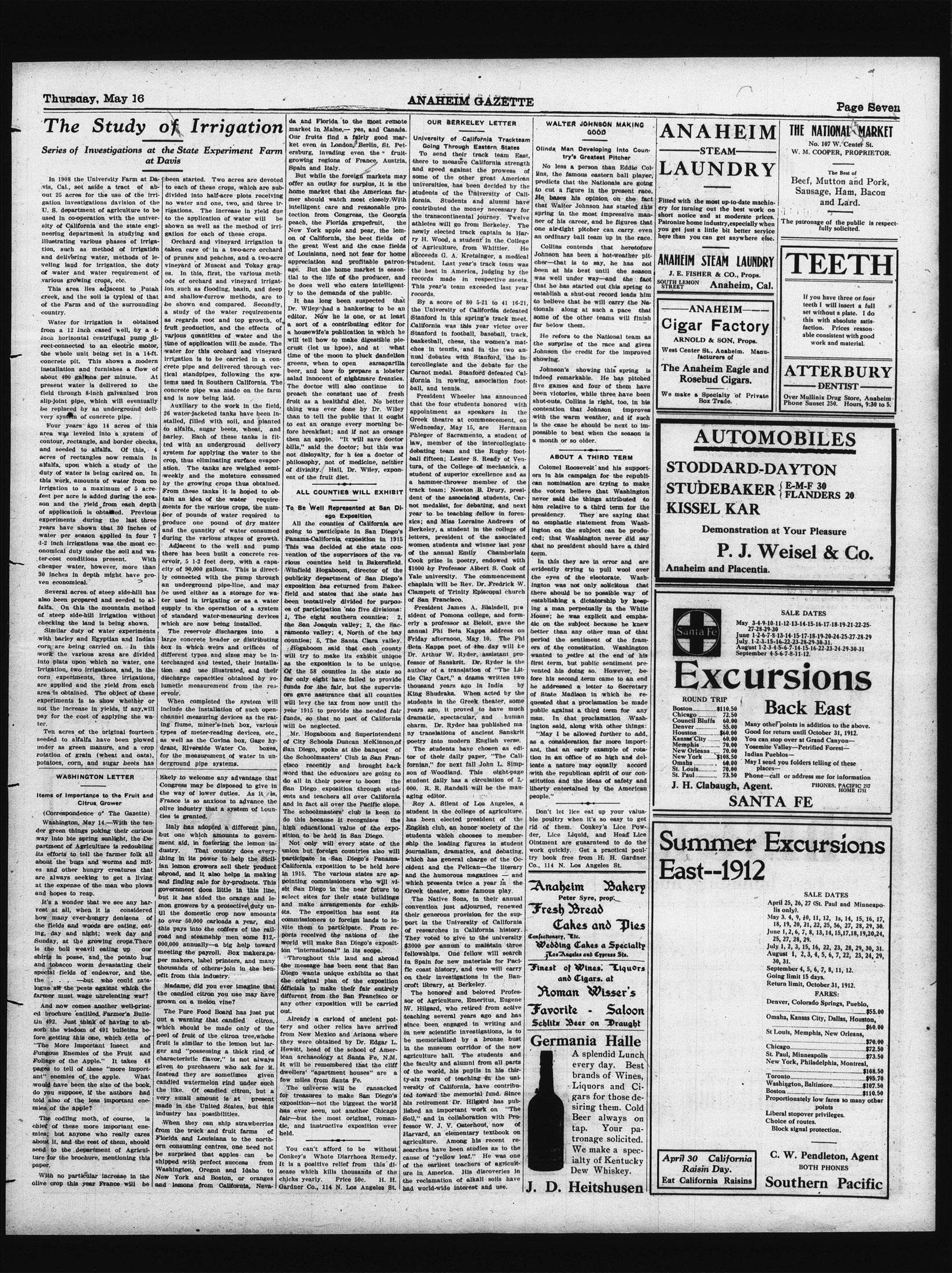
Searchable text
Thursday, May 16
The Study of Irrigation
Series of Investigations at the State Experiment Farm at Davis
In 1908 the University Farm at Davis, Cal., set aside a tract of about 25 acres for the use of the irrigation investigations davision of the U.S. department of agriculture to be used in co-operation with the university of California and the state engineering department in studying and illustrating various phases of irrigation, such as method of irrigation and delivering water, methods of leveling land for irrigation, the duty of water and water requirement of various growing crops, etc.
This area lies adjacent to Putah creek, and the soil is typical of that of the Farm and of the surrounding country.
Water for irrigation is obtained from a 12 inch cased well, by a 4-inch horizontal centrifugal pump direct-connected to an electric motor, the whole unit being set in a 14-ft. concrete pit. This shows a modern installation and furnishes a flow of about 400 gallons per minute. At present water is delivered to the field through 8-inch galvanized iron slip-joint pipe, which will eventually be replaced by an underground delivery system of concrete pipe.
Four years ago 14 acres of this area was leveled into a system of contour, rectangle, and border checks, and seeded to alfalfa. Of this, 4 acres of rectangles now remain in alfalfa, upon which a study of the duty of water is being carried on. In been started. Two acres are devoted to each of these crops, which are subdivided into half-acre plots receiving no water and one, two, and three irrigations. The increase in yield due to the application of water will be shown as well as the method of irrigation for each of these crops.
Orchard and vineyard irrigation is taken care of in a two-acre orchard of prunes and peaches, and a two-acre vineyard of Muscat and Tokay grapes. In this, first, the various methods of orchard and vineyard irrigation such as flooding, basin, and deep and shallow-furrow methods, are to be shown and compared. Secondly, a study of the water requirements as regards root and top growth, of fruit production, and the effects of various quantities of water and the time of application will be made. The water for this orchard and vineyard irrigation is to be carried in a concrete pipe and delivered through vertical standpipes, following the systems used in Southern California. The concrete pipe was made on the farm and is now being laid.
Auxiliary to the work in the field, 26 water-jacketed tanks have been installed, filled with soil, and planted to alfalfa, sugar beets, wheat, and barley. Each of these tanks is fitted with an underground delivery system for applying the water to the crop, thus eliminating surface evaporation. The tanks are weighed semi-annually and the moisture consumed da and Florida to the market in Maine—y Our fruits find a fret even in London ersburg, invading every growing regions of Spain and Italy.
But while the forebear offer an outlay for some home market that ther mer should watch more intelligent care and protection from Congregational peach, the Florida gra New York apple and on of California, there the great West and of Louisiana, need no appreciation and praise. But the home material to the life of ther he does well who can rely to the demands of it has long been Dr. Wiley had a hand editor. Now he is on a sort of a contribution a housewife's publication will tell how to make crust (let us hpoe), time of the moon to greens, when to open beer, and how to prepare salad innocent of night. The doctor will also preach the constant fruit as a healthful thing was ever done than to tell the public to eat an orange even before breakfast; and if then an apple. "It will bills," said the doctor not disloyalty, for h philosophy, not of me of divinity. Hail, Dr.
about 400 gallons per minute. At present water is delivered to the field through 8-inch galvanized iron slip-joint pipe, which will eventually be replaced by an underground delivery system of concrete pipe.
Four years ago 14 acres of this area was leveled into a system of contour, rectangle, and border checks, and seeded to alfalfa. Of this, 4 acres of rectangles now remain in alfalfa, upon which a study of the duty of water is being carried on. In this work, amounts of water from no irrigation to a maximum of 5 acre-feet per acre is added during the season and the yield from each depth of application is obtained. Previous experiments during the last three years have shown that 30 inches of water per season applied in four 7-12 inch irrigations was the most economical duty under the soil and water-cost conditions present. With cheaper water, however, more than 30 inches in depth might have proven economical.
Several acres of steep side-hill has also been prepared and seeded to alfalfa. On this the mountain method of steep side-hill irrigation without checking the land is being shown.
Similar duty of water experiments with barley and Egyptian and Indian corn are being carried on. In this work the various areas are divided into plats upon which no water, one irrigation, two irrigations, and, in the corn experiments, three irrigations, are applied and the yield from each area is obtained. The object of these experiments is to show whether or not the increase in yields, if any, will pay for the cost of applying the water.
Ten acres of the original fourteen seeds to alfalfa have been plowed under as green manure, and a crop rotation of grain (wheat and oats), potatoes, corn, and sugar beets has
WASHINGTON LETTER
Items of Importance to the Fruit and Citrus Grower
(Correspondence of The Gazette)
Washington, May 14.—With the tender green things poking their curious way into hte spring sunlight, the Department of Agriculture is redoubling its efforts to tell the farmer folk all about the bugs and worms and mites and other hungry creatures that are always seeking to get a living at the expense of the man who plows and hopes to reap.
likely to welcome any advantage that Congress may be disposed to give in the way of lower duties. As it is, France is so anxious to advance the olive industry that a system ofounties is granted.
Italy has adopted a different plan, but one which amounts to government aid, in fostering the lemon industry. That country does everything in its power to help the Sicilian lemon growers sell their product abroad, and it also helps in making and finding sale for by-products. This government does little in this line, but it has aided the orange and tical standpipes, following the systems used in Southern California. The concrete pipe was made on the farm and is now being laid.
Auxiliary to the work in the field, 26 water-jacketed tanks have been installed, filled with soil, and planted to alfalfa, sugar beets, wheat, and barley. Each of these tanks is fitted with an underground delivery system for applying the water to the crop, thus eliminating surface evaporation. The tanks are weighed semi-weekly and the moisture consumed by the growing crops thus obtained.
From these tanks it is hoped to obtain an idea of the water requirements for the various crops, the number of pounds of water required to produce one pound of dry matter and the quantity of water consumed during the various stages of growth.
Adjacent to the well and pump there has been built a concrete reservoir, 5 1-2 feet deep, with a capacity of 90,000 gallons. This is directly connected with the pump through an underground pipe-line, and may be used either as a storage for water used in irrigating or as a water supply in the operation of a system of standard water-measuring devices which are now being installed.
The reservoir discharges into a large concrete header or distributing box in which weirs and orifices of different types and sizes may be interchanged and tested, their installation and use illustrated, and their discharge capacities obtained by volumetric measurement from the reservoir.
When completed the system will include the installation of such open-channel measuring devices as the rating flume, miner's-inch box, various types of meter-reading devices, etc., as well as the Covina box, Gage hydrant, Riverside Water Co. boxes, for the measurement of water in underground pipe systems.
All the counties of going to participate in Panama-California expoition. This was decided atvention of the supervicious counties held Winfield Hogaboom, on publicity department exposition has returned field and states that they been tentatively divided es of participation into 1. The eight southern San Joaquin valley; 4. No counties; 5. The Santa Hogaboom said that will try to make its as the exposition is Of the 58 counties in far only eight have fair funds for the fair, bucks gave assurance that will levy the tax from year 1915 to provide th funds, so that no parish will be neglected.
Mr. Hogaboom and his City Schools Duncan San Diego spoke at the Schoolmasters' Club cisco recently and word that the educator do all in their power San Diego exposition ents and teachers all o d and in fact all over them The schoolmasters' club do this because it reco high educational value sition to be held in San
Not only will every union but foreign councip particulate in San Diego California exposition to in 1915. The various pointing commissioners sit San Diego in the select sites for their
Citrus Grower
(Correspondence of The Gazette)
Washington, May 14.—With the tender green things poking their curious way into hte spring sunlight, the Department of Agriculture is redoubling its efforts to tell the farmer folk all about the bugs and worms and mites and other hungry creatures that are always seeking to get a living at the expense of the man who plows and hopes to reap.
It's a wonder that we see any harvest at all, when it is considered how many ever-hungry denizens of the fields and woods are eating, eating, day and night; week day and Sunday, at the growing crops. There is the boll weevil eating up our shirts in posse, and the potato bug and tobacco worm devastating their special fields of endeavor, and the, the . . . —but who could catalogue all the pests against which the farmer must wage unrelenting war?
And now comes another well-printed brochure entitled, Farmer's Bulletin 492. Just think of having to absorb the wisdom of 491 bulletins before getting this one, which tells of "The More Important Insect and Fungous Enemies of the Fruit and Foliage of the Apple." It takes 48 pages to tell of these "more important" enemies of the apple. What would have been the size of the book, do you suppose, if the authors had told also of the less important enemies of the apple?
The codling moth, of course, is chief of these more important enemies; but anyone who really cares about it, and the rest of them, should send to the department of Agriculture for the brochure, mentioning this paper.
With no particular increase in the olive crop this year France will be France is so anxious to advance the olive industry that a system ofounties is granted.
Italy has adopted a different plan, but one which amounts to government aid, in fostering the lemon industry. That country does everything in its power to help the Sicilian lemon growers sell their product abroad, and it also helps in making and finding sale for by-products. This government does little in this line, but it has aided the orange and lemon growers by a protective duty until the domestic crop now amounts to over 50,000 carloads a year, and this pays into the coffers of the railroad and steamship men some $12,-000,000 annually—a big help toward meeting the payroll. Box makers, paper makers, label printers, and many thousands of others join in the benefit from this industry.
Madame, did you ever imagine that the candied citron you use may have grown on a melon vine?
The Pure Food Board has just put out a warning that candied citron, which should be made only of the peel of fruit of the citron tree, whose fruit is similar to the lemon but larger and "possessing a thick rind of characteristic flavor," is not always given to purchasers who ask for it. Instead they are sometimes given candied watermelon rind under such like. Of candied citron, but a very small amount is at present made in the United States, but this industry has possibilities.
When they can ship strawberries from the truck and fruit farms of Florida and Louisiana to the northern consuming centres, one need not be surprised that apples can be shipped with perfect success from Washington, Oregon and Idaho to New York and Boston, or oranges and lemons from California, Neva-
ANAHEIM GAZETTE
da and Florida to the most remote market in Maine,—yes, and Canada. Our fruits find a fairly good market even in London, Berlin, St. Petersburg, invading even the fruit-growing regions of France, Austria, Spain and Italy.
But while the foreign markets may offer an outlay for surplus, it is the home market that the American farmer should watch most closely. With intelligent care and reasonable protection from Congress, the Georgia peach, the Florida grapefruit, the New York apple and pear, the lemon of California, the beet fields of the great West and the cane fields of Louisiana, need not fear for home appreciation and profitable patronage. But the home market is essential to the life of the producer, and he does well who caters intelligently to the demands of the public.
It has long been suspected that Dr. Wiley had a hankering to be an editor. Now he is one, or at least a sort of a contributing editor for a housewife's publication in which he will tell how to make digestible pie crust (let us hpoe), and at what time of the moon to pluck dandelion greens, when to open sarsaparilla beer, and how to prepare a lobster salad innocent of nightmare frenzies. The doctor will also continue to preach the constant use of fresh fruit as a healthful diet. No better thing was ever done by Dr. Wiley than to tell the public that it ought to eat an orange every morning before breakfast; and if not an orange then an apple. "It will save doctor bills," said the doctor; but this was not disloyalty, for hies a doctor of philosophy, not of medicine, neither of divinity. Hail, Dr. Wiley, expon-
OUR BERKELEY LETTER
University of California Trackteam Going Through Eastern States
To send their track team East, there to measure California strength and speed against the prowess of some of the other great American universities, has been decided by the students of the University of California. Students and alumni have contributed the money necessary for the transcontinental journey. Twelve athletes will go from Berkeley. The newly elected track captain is Harry H. Wood, a student in the College of Agriculture, from Whittier. He succeeds G. A. Kretsinger, a medical student. Last year's track team was the best in America, judging by the records made in respective meets. This year's team exceeded last year records.
By a score of 80 5-21 to 41 16-21, the University of California defeated Stanford in this spring's track meet. California was this year victor over Stanford in football, baseball, track, basketball, chess, the women's matches in tennis, and in the two annual debates with Stanford, the intercollegiate and the debate for the Carnot medal. Stanford defeated California in rowing, association football, and tennis.
President Wheeler has announced that the four students honored with appointment as speakers in the Greek theatre at commencement, on Wednesday, May 15, are Hermann Phleger of Sacramento, a student of law, member of the intercollegiate debating team and the Rugby football fifteen; Lester S. Ready of Ventura, of the College of mechanics, a student of superior excellence and as
WALTER JOHNSON MAKING GOOD
Olinda Man Developing Into Country's Greatest Pitcher
No less a person than Eddie Collins, the famous eastern ball player, predicts that the Nationals are going to cut a figure in the present race. He bases his opinion on the fact that Walter Johnson has started this spring in the most impressive manner of his career, and he figures that one air-tight pitcher can carry even an ordinary ball team up in the race.
Collins contends that heretofore Johnson has been a hot-weather pitcher—that is to say, he has not been at his best until the season was well under way—and the fact that he has started out this spring to establish a shut-out record leads him to believe that he will carry the Nationals along at such a pace that some of the other teams will finish far below them.
He refers to the National team as the surprise of the race and gives Johnson the credit for the improved showing.
Johnson's showing this spring is indeed remarkable. He has pitched five games and four of them have been victories, while three have been shut-outs. Collins is right, too, in his contention that Johnson improves with the warm weather, and if such is the case he should be next to impossible to beat when the season is a month or so older.
ABOUT A THIRD TERM
Colonel Roosevelt and his supporters in his campaign for the re-election
ALL COUNTIES WILL EXHIBIT
To Be Well Represented at San Diego Exposition
All the counties of California are going to participate in San Diego's Panama-California exposition in 1915. This was decided at the state convention of the supervisors of the various counties held in Bakersfield. Winfield Hogaboom, director of the publicity department of San Diego's exposition has returned from Bakerfield and states that the state has been tentatively divided for purposes of participation into five divisions:
1. The eight southern counties;
2. the San Joaquin valley;
3. the Sacramento valley;
4. North of the bay counties;
5. The Santa Clara valley.
Hogaboom said that each county will try to make its exhibit unique as the exposition is to be unique. Of the 58 counties in the state so far only eight have failed to provide funds for the fair, but the supervisors gave assurance that all counties will levy the tax from now until the year 1915 to provide the needed fair funds, so that no part of California will be neglected.
Mr. Hogaboom and Superintendent of City Schools Duncan McKinnon of San Diego, spoke at the banquet of the Schoolmasters' Club in San Francisco recently and brought back word that the educators are going to do all in their power to boost the San Diego exposition through students and teachers all over California and in fact all over the Pacific slope.
The schoolmasters' club is keen to do this because it recognizes the high educational value of the exposition to be held in San Diego.
Not only will every state of the union but foreign countries also will participate in San Diego's Panama-California exposition to be held here in 1915. The various states are appointing commissioners who will visit San Diego in the near future to select sites for their state buildings.
President Wheeler has announced that the four students honored with appointment as speakers in the Greek theatre at commencement, on Wednesday, May 15, are Hermann Phleger of Sacramento, a student of law, member of the intercollegiate debating team and the Rugby football fifteen; Lester S. Ready of Ventura, of the College of mechanics, a student of superior excellence and as a hammer-thrower member of the track team; Newton B. Drury, president of the associated students, Carnot medalist, for debating, and next year to be teaching fellow in forensics; and Miss Lorraine Andrews of Berkeley, a student in the college of letters, president of the associated women students and winner last year of the annual Emily Chamberlain Cook prize in poetry, endowed with $1000 by Professor Albert S. Cook of Yale university. The commencement chaplain will be Rev. Dr. Fredrick W. Clampett of Trinity Episcopal church of San Francisco.
President James A. Blaisdell, president of Pomona college, and formerly a professor at Beloit, gave the annual Phil Beta Kappa address on Friday afternoon, May 10. The Phil Beta Kappa poet of the day will be Dr. Arthur W. Ryder, assistant professor of Sanskrit. Dr. Ryder is the author of a translation of "The Little Clay Cart," a drama written two thousand years ago in India by King Shudraka. When acted by the students in the Greek theater, some years ago, it proved to have much dramatic, spectacular, and human charm. Dr. Ryder has published many translations of ancient Sanskrit poetry into modern English verse.
The students have chosen as editor of their daily paper, "The Californian," for next fall John L. Simpson of Woodland. This eight-page student daily has a circulation of 2,000. R. R. Randall will be the managing editor.
Roy A. Silent of Los Angeles, a student in the college of agriculture, has been elected president of the English club, an honor society of the students which chooses to membership the leading figures in student journalism, dramatics, and debating, which has general charge of the Occident and the Pelican—the literary and the humorous magazines—and which presents twice a year in the Greek theater, some famous play.
The Native Sons in their annual indeed remarkable. He has pitched five games and four of them have been victories, while three have been shut-outs. Collins is right, too, in his contention that Johnson improves with the warm weather, and if such is the case he should be next to impossible to beat when the season is a month or so older.
ABOUT A THIRD TERM
Colonel Roosevelt and his supporters in his campaign for the republican nomination are trying to make the voters believe that Washington never said the things attributed to him relative to a third term for the presidency. They are saying that no emphatic statement from Washington on the subject can be produced; that Washington never did say that no president should have a third term.
In this they are in error and are evidently trying to pull wool over the eyes of the electorate. Washington was not only solicitous that there should be no possible way of establishing a dictatorship by keeping a man perpetually in the White House; he was explicit and emphatic on the subject because he knew better than any other man of that period the sentiment of the framers of the constitution. Washington wanted to retire at the end of his first term, but public sentiment prevented his doing so. However, before his second term came to an end he addressed a letter to Secretary of State Madison in which he requested that a proclamation be made public against a third term for any man. In that proclamation Washington said, along with other things:
"May I be allowed further to add, as a consideration far more important, that an early example of rotation in an office of so high and delicate a nature may equally accord with the republican spirit of our constitution and the ideas of safety and liberty entertained by the American people."
Don't let lice eat up your valuable poultry when it's so easy to get rid of them. Conkey's Lice Powder, Lice Liquid, and Head Lice Ointment are guarneted to do the work quickly. Get a practical poultry book free from H. H. Gardner Co., 114 N. Los Angeles St.
Anaheim Bakery
Peter Syre, prop.
and in fact all over the Pacific slope. The schoolmasters' club is keen to do this because it recognizes the high educational value of the exposition to be held in San Diego.
Not only will every state of the union but foreign countries also will participate in San Diego's Panama-California exposition to be held here in 1915. The various states are appointing commissioners who will visit San Diego in the near future to select sites for their state buildings and make arrangements for exhibits. The exposition has sent its commissioners to foreign lands to invite them to participate. From reports received the nations of the world will make San Diego's exposition "international" in its scope.
Throughout this land and abroad the message has been sent that San Diego wants unique exhibits so that the original plan of the exposition officials to make their fair entirely different from the San Francisco or any other exposition will be carried out.
Already a carload of ancient pottery and other relics have arrived from New Mexico and Arizona where they were obtained by Dr. Edgar L. Hewitt, head of the school of American archaeology at Santa Fe, N.M. It will be remembered that the cliff dwellers' "apartment houses" are a few miles from Santa Fe.
The universe will be ransacked for treasures to make San Diego's exposition—not the biggest the world has ever seen, not another Chicago fair—but the most original, romantic, and instructive exposition ever held.
You can't afford to be without Conkey's Whote Diarrhoea Remedy. It is a positive relief from this disease which kills thousands of the chicks yearly. Price 50c. H. H. Gardner Co., 114 N. Los Angeles St.
Roy A. Silent of Los Angeles, a student in the college of agriculture, has been elected president of the English club, an honor society of the students which chooses to membership the leading figures in student journalism, dramatics, and debating, which has general charge of the Occident and the Pelican—the literary and the humorous magazines—and which presents twice a year in the Greek theater, some famous play.
The Native Sons, in their annual convention just adjourned, renewed their generous provision for the support in the University of California of researches in California history. They voted to give to the university $3000 per annum to maintain three fellowships. One fellow will search in Spain for new materials for Pacific coast history, and two will carry on their investigations in the Bancroft library, at Berkeley.
The honored and beloved Professor of Agriculture, Emeritus, Eugene W. Hilgard, who retired from active teaching several years ago and has since been engaged in writing and in new scientific investigations, is to be memorialized by a bronze bust in the museum corridor of the new agriculture hall. The students and the faculty and alumni from all parts of the world, his pupils in his thirty-six years of teaching in the university of California, have contributed toward the memorial fund. Since his retirement Dr. Hilgard has published an important work on "The Soil," and in collaboration with Professor W. J. V. Osterhout, now of Harvard, an elementary textbook on agriculture. Among his recent researches have been studies as to the cause of "yellow leaf." He was one of the earliest teachers of agriculture in America. His discoveries in the reclamation of alkali soils have had world-wide interest and use.
Don't let lice eat up your valuable poultry when it's so easy to get rid of them. Conkey's Lice Powder, Lice Liquid, and Head Lice Ointment are guarnrteed to do the work quickly. Get a practical poultry book free from H. H. Gardner Co., 114 N. Los Angeles St.
Anaheim Bakery
Peter Syre, prop.
Fresh Bread
Cakes and Pies
Confectionery, Etc.
Wedding Cakes a Specialty
Los Angeles and Express Sts.
Finest of Wines: Liquors and Cigars, at Roman Wisser's
Favorite - Saloon Schlitz Beer on Draught
Germania Halle
A splendid Lunch every day. Best brands of Wines, Liquors and Cigars for those desiring them. Cold Beer always on tap. Your patronage solicited. We make a specialty of Kentucky Dew Whiskey.
J. D. Heitshusen
ANAHEIM
STEAM
LAUNDRY
Fitted with the most up-to-date machinery for turning out the best work on short notice and at moderate prices. Patronize home industry, especially when you get just a little bit better service here than you can get anywhere else.
ANAHEIM STEAM LAUNDRY
J. E. FISHER & CO., Props.
SOUTH LEMON STREET Anaheim, Cal.
ANAHEIM
Cigar Factory
ARNOLD & SON, Props.
West Center St., Anaheim. Manufacturers of The Anaheim Eagle and Rosebud Cigars.
We make a Specialty of Private Box Trade.
THE NATIONAL MARKET
No. 107 W. Center St.
W. M. COOPER, PROPRIETOR.
The Best of Beef, Mutton and Pork,
Sausage, Ham, Bacon and Lard.
The patronage of the public is respectfully solicited.
TEETH
If you have three or four teeth I will insert a full set without a plate. I do this with absolute satisfaction. Prices reasonable consistent with good work and material.
ATTERBURY
DENTIST
Over Mullinix Drug Store, Anaheim Phone Sunset 250. Hours, 9:30 to 5.
AUTOMOBILES
STODDARD-DAYTON
Rosebud Cigars.
We make a Specialty of Private Box Trade.
AUTOMOBILES
STODDARD-DAYTON
STUDEBAKER { E-M-F 30 FLANDERS 20
KISSEL KAR
Demonstration at Your Pleasure
P. J. Weisel & Co.
Anaheim and Placentia.
SALE DATES
May 3-4-9-10-11-12-13-14-15-16-17-18-19-21-22-2527-28-29-30
June 1-2-6-7-8-13-14-15-17-18-19-20-24-25-27-28-29
July 1-2-3-15-16-22-23-28-29-30-31.
August 1-2-3-4-5-6-7-14-15-16-22-23-24-29-30-31
September 4-5-6-7-8-11-12.
Excursions
ROUND TRIP
Boston $110.50
Chicago 72.50
Council Bluffs 60.00
Denver 55.00
Houston $60.00
Kansas City 60.00
Memphis 70.00
New Orleans 70.00
New York $108.50
Omaha 60.00
St. Louis 70.00
St. Paul 73.50
Back East
Many other points in addition to the above.
Good for return until October 31, 1912.
You can stop over at Grand Canyon—
Yosemite Valley—Petrified Forest—
Indian Pueblos—
May I send you folders telling of these places—
Phone—call or address me for information
J. H. Clabaugh, Agent.
PHONES, PACIFIC 217
HOME 1751
Summer Excursions
East--1912
SALE DATES
Summer Excursions
East--1912
SALE DATES
April 25, 26, 27 (St. Paul and Minneapolis only).
May 3, 4, 9, 10, 11, 12, 1s, 14, 15, 16, 17,
18, 19, 20, 21, 22, 25, 56, 27, 28, 29, 30.
June 1, 2, 6, 7, 8, 13, 14, 15, 17, 18, 19, 20, 24,
25, 27, 28, 29.
July 1, 2, 3, 15, 16, 22, 23, 28, 29, 30, 31.
August 1, 2, 3, 4, 5, 6, 7, 22, 23, 24, 29,
30, 31.
September 4, 5, 6, 7, 8, 11, 12.
Going limit 15 days.
Return limit October 31, 1912.
FARES:
Denver, Colorado Springs, Pueblo,
$55.00
Omaha, Kansas City, Dallas, Houston,
$60.00
St Louis, Memphis, New Orleans,
$70.00
Chicago,$72.50
St. Paul, Minneapolis,$73.50
New York, Philadelphia,Montreal,
$108.50
Toronto,$95.70
Washington,Baltimore,$107.50
Boston,$110.50
Proportionately low fares to many other points
Liberal stopover privileges.
Choice of routes.
Block signal protection.
April 30 California Raisin Day.
Eat California Raisins
C. W. Pendleton, Agent
BOTH PHONES
Southern Pacific