anaheim-gazette 1912-05-09
Scanned page
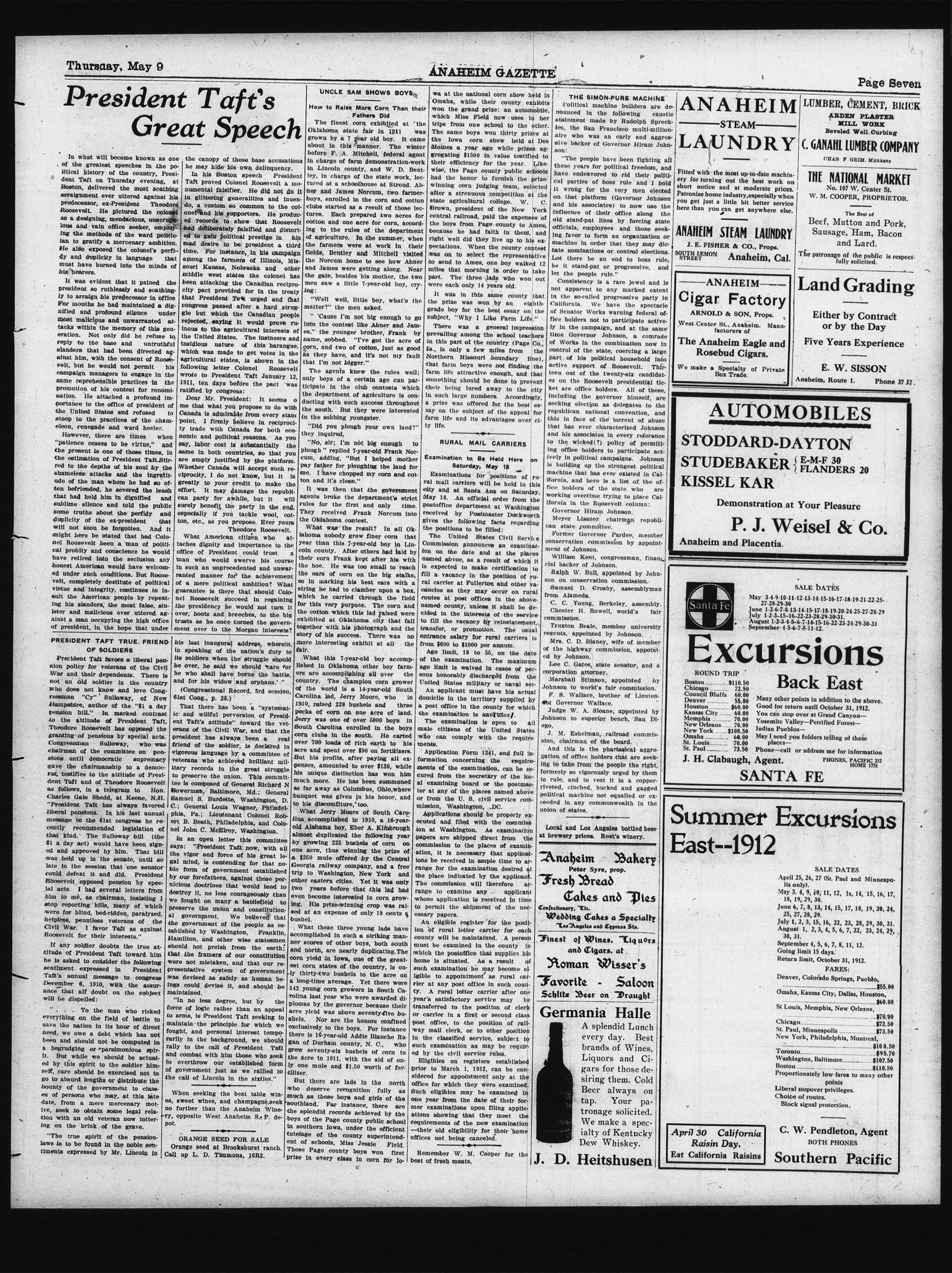
Searchable text
Thursday, May 9
President Taft's Great Speech
In what will become known as one of the greatest speeches in the political history of the country, President Taft on Thursday evening, at Boston, delivered the most scathing arraignment ever uttered against his predecessor, ex-President Theodore Roosevelt. He pictured the colonel as a designing, mendacious, unscrumulous and vain office seeker, employing the methods of the ward politician to gratify a mercenary ambition. He also exposed the colonel's perfidy and duplicity in language that must have burned into the minds of his hearers.
It was evident that it pained the president so ruthlessly and scathingly to arraign his predecessor in office. For months he had maintained a dignified and profound silence under most malicious and unwarranted attacks within the memory of this generation. Not only did he refuse to reply to the base and untruthful slanders that had been directed against him, with the consent of Roosevelt, but he would not permit his campaign managers to engage in the same reprehensible practices in the promotion of his contest for renomination. He attached a profound importance to the office of president of the United States and refused to stoop to the practices of the chameleon, renegade and ward heeler.
However, there are times when "patience ceases to be virtue," and the present is one of those times, in the estimation of President Taft. Stirred to the depths of his soul by the shameless attacks and the ingratitude the canopy of these base accusations he may hide his own delinquency.
In his Boston speech President Taft proved Colonel Roosevelt a monumental falsifier. He did not do it in glittering generalities and inuendo, a custom so common to the colonel and his supporters. He produced records to show that Roosevelt had deliberately falsified and distorted to gain political prestige in his mad desire to be president a third time. For instance, in his campaign among the farmers of Illinois, Missouri Kansas, Nebraska and other middle west states the colonel has been attacking the Canadian reciprocity pact provided for in the treaty that President Taft urged and that congress passed after a hard struggle but which the Canadian people rejected, saying it would prove ruinous to the agricultural interests of the United States. The insincere and insidious nature of this harangue, which was made to get votes in the agricultural states, is shown in the following letter Colonel Roosevelt wrote to President Taft January 12, 1911, ten days before the pact was ratified by congress:
Dear Mr. President: It seems ome that what you propose to do with Canada is admirable from every stand point. I firmly believe in reciprocity trade with Canada for both economic and political reasons. As you say, labor cost is substantially the same in both countries, so that you are amply justified by the platform. Whether Canada will accept such reciprocity I do not know but it
UNCLE SAW
How to Raise F
The finest of Oklahoma state grown by a 7 year about in this city before F. A. M. in charge of farm in Lincoln county, in charge of tured at a school ner and James boys, enrolled in clubs started as pictures. Each pr cotton and one ing to the rule of agriculture. the farmers were fields, Bentley the Norcum homeland and James were the gate, besides men saw a little ling:
"Well well, I matter?" the me
"'Cause I'm into the contest es," the younger name, sobbed.
"Corn, and two off as they have, and that I'm not bigger.
The agents knew only boys of a c participate in the department of ducting with such the south. But tha in the sobbing yo
"Did you plough they inquired,
"No, sir; I'm n plough" replied 7 cum, adding, "But pay father for plough me. I have chomp
PRESIDENT TAFT TRUE. FRIEND OF SOLDIERS
Precident Taft favors a liberal pension policy for veterans of the Civil War and their dependents. There is not an old soldier in the country who does not know and love Congressman "Cy" Sulloway, of New Hampshire, author of the "$1 a day pension bill." In marked contrast to the attitude of President Taft, Theodore Roosevelt has opposed the granting of pensions by special acts. Congressman Sulloway, who was chairman of the committee on pensions until democratic supremacy gave the chairmanship to a democrat, testifies to the attitude of President Taft and of Theodore Roosevelt as follows, in a telegram to Hon. Charles Gale Shedd, at Keene, N.H. "President Taft has always favored liberal pensions. In his last annual message to the 61st congress he recently recommended legislation of that kind. The Sulloway bill (the $1 a day act) would have been signed and approved by him. That bill was held up in the senate, until so late in the session that one senator could defeat it and did. President Roosevelt opposed pension by special acts. I had several letters from him to me, as chairman, insisting I wrote to President Taft January 12, 1911, ten days before the pact was ratified by congress:
Dear Mr. President: It seems ome that what you propose to do with Canada is admirable from every stand point. I firmly believe in reciprocity trade with Canada for both economic and political reasons. As you say, labor cost is substantially the same in both countries, so that you are amply justified by the platform. Whether Canada will accept such reciprocity, I do not know, but it is greatly to your credit to make the effort. It may damage the republican party for awhile, but it will surely benefit the party in the end, especially if you tackle wool, cotton, etc., as you propose. Ever yours
Theodore Roosevelt.
What American citizen who attaches dignity and importance to the office of President could trust a man who would swerve his course in such an unprecedented and unwarranted manner for the achievement of a mere political ambition? What guarantee is there that should Colonel Roosevelt succeed in regaining the presidency he would not turn it over, boots and breeches, to the big trusts as he once turned the government over to the Morgan interests?
(Congressional Record, 3rd session, 61st Cong., p. 28.)
That there has been a "systematic and willful perversion of President Taft's attitude" toward the veterans of the Civil War, and that the president has always been a real friend of the soldier, is declared in vigorous language by a committee of veterans who achieved brilliant military records in the great struggle to preserve the union. This committee is composed of General Richard N Bowerman, Baltimore, Md.; General Samuel S. Burdette, Washington, D.C.; General Louis Wagner, Philadelphia, Pa.; Lieutenant Colonel Robert B. Beath, Philadelphia, and Colonel John C. McElroy, Washington.
In an open letter this committee says: "President Taft now, with all the vigor and force of his great legal mind, is contending for that noble form of government established by our forefathers, against those pernicious doctrines that would tend to destroy it, no less courageously than only boys of a certain age in the department of ducting with such the south. But they in the sobbing you"
"Did you plough they inquired,
"No, sir; I'm not plough" replied 7-cum, adding, "But pay father for plough me. I have chopperton and it's clean.
It was then that agents broke the rules for the first They received Kill the Oklahoma conspiracy.
What was the lahoma nobody grew year than this 7-year colin county. After their corn Frank hit the hoe. He was eared of corn so in marking his string he had to c which he carried for this very purpose the cotton which exhibited at Oklahe together with his history of his success more interesting e fair.
What this 7-year published in Oklahoma are accomplish country. The chance of the world is a Carolina lad, Jerry was one of our South Carolina enriched corn clubs in the over 700 loads of m acres and spent over But his profits, after penses, amounted to his unique distinction much more. He had as far away as Colu banquet was given to his discomfiture,
What Jerry Moore olina accomplished h old Alabama boy, El almost duplicated th by growing 225 bus one acre, thus win a $250 mule offered Georgia railway com trip to Washington other eastern cities. two years before t even become interest
"President Taft has always favored liberal pensions. In his last annual message to the 61st congress he recently recommended legislation of that kind. The Sulloway bill (the $1 a day act) would have been signed and approved by him. That bill was held up in the senate, until so late in the session that one senator could defeat it and did. President Roosevelt opposed pension by special acts. I had several letters from him to me, as chairman, insisting I stop reporting bills, many of which were for blind, bed-ridden, paralyzed, helpless, penniless veterans of the Civil War. I favor Taft as against Roosevelt for their interests."
If any soldier doubts the true attitude of President Taft toward him he is asked to consider the following sentiment expressed in President Taft's annual message to congress December 6, 1910, with the assurance that all doubt on the subject will be dispelled:
"To the man who risked everything on the field of battle to save the nation in its hour of direst need, we owe a debt which has not been and should not be computed in a begrudging or parsimonious spirit. But while we should be actuated by this spirit to the soldier himself, care should be exercised not to go to absurd lengths or distribute the bounty of the government to classes of persons who may, at this late date, from a mere mercenary motive, seek to obtain some legal relation with an old veteran now tottering on the brink of the grave.
"The true spirit of the pension-laws is to be found in the noble sentiments expressed by Mr. Lincoln in Samuel S. Burdette, Washington, D.C.; General Louis Wagner, Philadelphia, Pa.; Lieutenant Colonel Robert B. Beath, Philadelphia, and Colonel John C. McElroy, Washington.
In an open letter this committee says: "President Taft now, with all the vigor and force of his great legal mind, is contending for that noble form of government established by our forefathers, against those pernicious doctrines that would tend to destroy it, no less courageously than we fought on many a battlefield to preserve the union and constitutional government. We believed that the government of the people as established by Washington, Franklin, Hamilton, and other wise statesmen should not preish from the earth; that the framers of our constitution were not mistaken, and that our representative system of government was devised as safely as human beings could devise it, and should be maintained.
"In no less degree, but by the force of logic rather than an appeal to arms, is President Taft seeking to maintain the principle for which we fought, and personal interest temporarily in the background, we should rally to the call of President Taft and combat with him those who seek to overthrow our established form of government just as we rallied to the call of Lincoln in the sixties."
When seeking the best table wines, sweet wines, and champagne, seek no further than the Anaheim Winery, opposite West Anaheim S.P. depot.
ORANGE SEED FOR SALE
Orange seed at Brookshurst ranch.
Call up L. D. Timmons, 16R2.
What Jerry Moore accomplished in suchner scores of otherand north, are nearlycorn yield in Iowa,cwest corn states of thly thirty-two bushels,a long-time average,
142 young corn growerrolina last year whoplomas by the governmacre yield was aboveshels. Nor are theyexclusively to the boythere is 16-year-old Agan of Durham countgrew seventy-six bushethe acre in 1911,withly one mule and $1.5tilizer.
But there are ladswho deserve recognmuch as these boys aresouthland. For instaethe splendid records aboys of the Page countern southern Iowa, undutelage of the counment of schools, MissThese Page county bprize in every class
UNCLE SAM SHOWS BOYS
How to Raise More Corn Than their Fathers Did
The finest corn exhibited at the Oklahoma state fair in 1911 was grown by a 7 year old boy. It came about in this manner. The winter before F. A. Mitchell, federal agent in charge of farm demonstration-work in Lincoln county, and W. D. Bentley, in charge of the state work, lectured at a schoolhouse at Stroud. Abner and James Norcum, two farmer-boys, enrolled in the corn and cotton clubs started as a result of those lectures. Each prepared two acres for cotton and one acre for corn, according to the rules of the department of agriculture. In the summer, when the farmers were at work in their fields, Bentley and Mitchell visited the Norcum home to see how Abner and James were getting along. Near the gate, besides his mother, the two men saw a little 7-year-old boy, crying:
"Well well, little boy, what's the matter?" the men asked.
"'Cause I'm not big enough to go into the contest like Abner and James," the younger brother, Frank by name, sobbed. "I've got the acre of corn, and two of cotton, just as good as they have, and it's not my fault that I'm not bigger."
The agents knew the rules well; only boys of a certain age can participate in the club contests which the department of agriculture is conducting with such success throughout the south. But they were interested in the sobbing youngster.
"Did you plough your own land?" they inquired,
"No, sir; I'm not big enough to plough" replied 7-year-old Frank Norcum, adding, "But I helped mother pay father for ploughing the land for me. I have chopped my corn and cot-wa at the national corn show held in Omaha, while their county exhibits won the grand prize: an automobile, which Miss Field now uses in her trips from one school to the other. The same boys won thirty prizes at the Iowa corn show held at Des Moines a year ago while prizes aggregating $1500 in value testified to their efficiency for the year. Likewise, the Page county public schools had the honor to furnish the prize-winning corn judging team, selected after a strenuous competition at the state agricultural college. W. C. Brown, president of the New York central railroad, paid the expenses of the boys from Page county to Ames, because he had faith in them, and right well did they live up to his expectations. When the county contest was on to select the representative to send to Ames, one boy walked 12 miles that morning in order to take part. The three lads who won out were each only 14 years old.
It was in this same county that the prize was won by an eighth-grade boy for the best essay on the subject, "Why I Like Farm Life."
There was a general impression prevailing among the school teachers in this part of the country (Page Co., Ia., is only a few miles from the Northern Missouri boundary line), that farm boys were not finding the farm life attractive enough, and that something should be done to prevent their being lured away to the city in such large numbers. Accordingly, a prize was offered for the best essay on the subject of the appeal for farm life and its advantages over city life.
RURAL MAIL CARRIERS
Examination to Be Held Here on Saturday, May 18
THE SIMON-PURE MACHINE
Political machine builders are denounced in the following caustic statement made by Rudolph Spreckles, the San Francisco multi-millionaire who was an early and aggressive backer of Governor Hiram Johnson:
"The people have been fighting all these years for political freedom, and have endeavored to rid their political parties of boss rule and I hold it wrong for the very men elected on that platform (Governor Johnson and his associates) to now use the influence of their office along the old stand-pat lines by forcing state officials, employees and those seeking favor to form an organization or machine in order that they may dictate nominations or control elections. Let there be an end to boss rule, be it stand-pat or progressive, and let the people rule."
Consistency is a rare jewel and is not apparent to any marked extent in the so-called progressive party in California. We have the spectacle of Senator Works warning federal office holders not to participate actively in the campaign, and at the same time Governor Johnson, a comrade of Works in the combination now in control of the state, coercing a large part of his political household into active support of Roosevelt. Thirteen out of the twenty-six candidates on the Roosevelt presidential ticket are office holders. All of these, including the governor himself, are seeking election as delegates to the republican national convention, and this in face of the torrent of abuse that has ever characterized Johnson and his associates in every reference to the wicked(?) policy of permitting office holders to participate actively in political campaigns. Johnson is building up the strongest political machine that has ever existed in Cali-
only boys of a certain age can participate in the club contests which the department of agriculture is conducting with such success throughout the south. But they were interested in the sobbing youngster.
"Did you plough your own land?" they inquired,
"No, sir; I'm not big enough to plough" replied 7-year-old Frank Norcum, adding, "But I helped mother pay father for ploughing the land for me. I have chopped my corn and cotton and it's clean."
It was then that the government agents broke the department's strict rules for the first and only time. They received Frank Norcum into the Oklahoma contest.
What was the result? In all Oklahoma nobody grew finer corn that year than this 7-year-old boy in Lincoln county. After others had laid by their corn Frank kept after his with the hoe. He was too small to reach the ears of corn on the big stalks, so in marking his best ears with a string he had to clamber upon a box, which he carried through the field for this very purpose. The corn and the cotton which this lad raised were exhibited at Oklahoma city that fall together with his photograph and the story of his success. There was no more interesting exhibit at all the fair.
What this 7-year-old boy accomplished in Oklahoma other boy farmers are accomplishing all over the country. The champion corn grower of the world is a 14-year-old South Carolina lad, Jerry Moore, who in 1910, raised 228 bushels and three pecks of corn on one acre of land. Jerry was one of over 5000 boys in South Carolina enrolled in the boys corn clubs in the south. He carted over 700 loads of rich earth to his acre and spent over $90 on fertilizers. But his profits, after paying all expenses, amounted to over $130, while his unique distinction has won him much more. He has been summoned as far away as Columbus, Ohio, where banquet was given in his honor, and to his discomfiture, too.
What Jerry Moore of South Carolina accomplished in 1910, a 16-year-old Alabama boy, Eber A. Kimbrough almost duplicated the following year by growing 225 bushels of corn on one acre, thus winning the prize of a $250 mule offered by the Central Georgia railway company, and a free trip to Washington, New York and other eastern cities. Yet it was only two years before that this lad had even become interested in corn grow-
RURAL MAIL CARRIERS
Examination to Be Held Here on Saturday, May 18
Examinations for positions of rural mail carriers will be held in this city and at Santa Ana on Saturday, May 18. An official order from the postoffice department at Washington received by Postmaster Duckworth gives the following facts regarding the positions to be filled:
The United States Civil Service Commission announces an examination on the date and at the places named abvoe, as a result of which it is expected to make certification to fill a vacancy in the position of rural carrier at Fullerton and other vacancies as they may occur on rural routes at post offices in the above-named county, unless it shall be decided in the interests of the service to fill the vacancy by reinstatement, transfer, or promotion. The usual entrance salary for rural carriers is from $600 to $1000 per annum.
Age limit, 18 to 55, on the date of the examination. The maximum age limit is waived in cases of persons honorably discharged from the United States military or naval serien.
An applicant must have his actual domicile in the territory supplied by a post office in the county for which the examination is annuity/.
The examination is open to all male citizens of the United States who can comply with the requirements.
Application Form 1341, and full information concerning the requirements of the examination, can be secured from the secretary of the local examining board or the postmaster at any of the places named above or from the U.S. civil service commission, Washington,.DC.
Applications should be properly executed and filed with the commission at Washington. As examination papers are shipped direct from the commission to the places of examination, it is necessary that applications be received in ample time to arrange for the examination desired at the place indicated by the applicant. The commission will therefore arrange to examine any applicant whose application is received in time seen out of the twenty-six candidates on the Roosevelt presidential ticket are office holders. All of these, including the governor himself, are seeking election as delegates to the republican national convention, and this in face of the torrent of abuse that has ever characterized Johnson and his associates in every reference to the wicked(?) policy of permitting office holders to participate actively in political campaigns. Johnson is building up the strongest political machine that has ever existed in California, and here is a list of the office holders of the state who are working overtime trying to place California in the Roosevelt column:
Governor Hiram Johnson.
Meyer Lissner chairman republican state committee.
Former Governor Pardee, member conservation commission by appointment of Johnson.
William Kent, congressman, financial backer of Johnson.
Ralph W. Bull, appointed by Johnson on conservation commission.
Samuel D. Crosby, assemblyman from Alameda.
C. C. Young, Berkeley, assembly.
Chester H. Rowell, world's fair commission.
Truxton Beale, member university regents, appointed by Johnson.
Mrs. C. D. Blaney, wife of member of the highway commission, appointed by Johnson.
Lee C. Gates, state senator, and a corporation attorney.
Marshall Stimson, appointed by Johnson to world's fair commission.
F. S. Wallace, brother of Lieutenant Governor Wallace.
Judge W. A. Sloane, appointed by Johnson to superior bench, San Diego.
J. M. Eshelman, railroad commission, chairman of the board.
And this is the pharisaical aggregation of office holders that are seeking to take from the people the right, formerly so vigorously urged by them to rule, and to vest it in a copper-riveted, cinched, bucked and gagged political machine not equalled or exceeded in any commonwealth in the union of states.
Local and Los Angeles bottled beer at brewery prices. Rust's winery.
What Jerry Moore of South Carolina accomplished in 1910, a 16-year-old Alabama boy, Eber A. Kimbrough almost duplicated the following year by growing 225 bushels of corn on one acre, thus winning the prize of a $250 mule offered by the Central Georgia railway company, and a free trip to Washington, New York and other eastern cities. Yet it was only two years before that this lad had even become interested in corn growing. His prize-winning crop was raised at an expense of only 19 cents a bushel.
What these three young lads have accomplished in such a striking manner scores of other boys, both south and north, are nearly duplicating. The corn yield in Iowa, one of the greatest corn states of the country, is only thirty-two bushels to the acre on a long-time average. Yet there were 142 young corn growers in South Carolina last year who were awarded diplomas by the governor because their acre yield was above seventy-five bushels. Nor are the honors confined exclusively to the boys. For instance there is 16-year-old Addie Blanche Ragan of Durham county, N. C., who grew seventy-six bushels of corn to the acre in 1911, with the aid of only one mule and $1.50 worth of fertilizer.
But there are lads in the north who deserve recognition fully as much as these boys and girls of the southland. For instance, there are the splendid records achieved by the boys of the Page county public school in southern Iowa, under the efficient tutelage of the county superintendent of schools, Miss Jessie Field. These Page county boys won first prize in every class in corn for Io-
Applications should be properly executed and filed with the commission at Washington. As examination papers are shipped direct from the commission to the places of examination, it is necessary that applications be received in ample time to arrange for the examination desired at the place indicated by the applicant. The commission will therefore arrange to examine any applicant whose application is received in time to permit the shipment of the necessary papers.
An eligible register for the position of rural letter carrier for each county will be maintained. A person must be examined in the county in which the postoffice that supplies his home is situated. As a result of such examination he may become eligible to appointment as rural carrier at any post office in such county. A rural letter carrier after one year's satisfactory service may be transferred to the position of clerk or carrier in a first or second class post office, to the position of railway mail clerk, or to other position in the classified service, subject to such examination as may be required by the civil service rules.
Eligibles on registers established prior to March 1, 1912, can be considered for appointment only at the office for which they were examined. Such eligibles may be examined in one year from the date of their former examinations upon filing applications showing that they meet the requirements of the new examination—their old eligibility for their home offices not being canceled.
Remember W. M. Cooper for the best of fresh meats.
ANAHEIM
STEAM
LAUNDRY
Fitted with the most up-to-date machinery for turning out the best work on short notice and at moderate prices. Patronize home industry, especially when you get just a little bit better service here than you can get anywhere else.
ANAHEIM STEAM LAUNDRY
J. E. FISHER & CO., Props.
SOUTH LEMON STREET Anaheim, Cal.
ANAHEIM
Cigar Factory
ARNOLD & SON, Props.
West Center St., Anaheim. Manufacturers of The Anaheim Eagle and Rosebud Cigars.
We make a Specialty of Private Box Trade.
LUMBER, CEMENT, BRICK
ARDEN PLASTER
MILL WORK
Beveled Well Curbing
C. GANAHL LUMBER COMPANY
CHAS F GRIM. Manager
THE NATIONAL MARKET
No. 107 W. Center St.
W. M. COOPER, PROPRIETOR.
The Best of Beef, Mutton and Pork,
Sausage, Ham, Bacon and Lard.
The patronage of the public is respectfully solicited.
Land Grading
Either by Contract or by the Day
Five Years Experience
E. W. SISSON
Anaheim, Route 1. Phone 37 J2.
AUTOMOBILES
STODDARD-DAYTON
STUDEBAKER {E-M-F 30
FLANDERS 20}
AUTOMOBILES
STODDARD-DAYTON
STUDEBAKER {E-M-F 30
FLANDERS 20
KISSEL KAR
Demonstration at Your Pleasure
P. J. Weisel & Co.
Anaheim and Placentia.
SALE DATES
May 3-4-9-10-11-12-13-14-15-16-17-18-19-21-22-2527-28-29-30
June 1-2-6-7-8-13-14-15-17-18-19-20-24-25-27-28-29
July 1-2-3-15-16-22-23-28-29-30-31.
August 1-2-3-4-5-6-7-14-15-16-22-23-24-29-30-31
September 4-5-6-7-8-11-12.
Excursions
ROUND TRIP
Boston $110.50
Chicago 72.50
Council Bluffs 60.00
Denver 55.00
Houston $60.00
Kansas City 60.00
Memphis 70.00
New Orleans 70.00
New York $108.50
Omaha 60.00
St. Louis 70.00
St. Paul 73.50
Back East
Many other points in addition to the above.
Good for return until October 31, 1912.
You can stop over at Grand Canyon—
Yosemite Valley—Petrified Forest—
Indian Pueblos—
May I send you folders telling of these places—
Phone—call or address me for information
J. H. Clabaugh, Agent.
PHONES, PACIFIC 217
HOME 1751
Summer Excursions
East--1912
SALE DATES
April 25, 26, 27 (St. Paul and Minneapolis only).
May 3. 4, 9, 10, 11, 12, 1s, 14, 15, 16, 17,
18, 19, 29, 30
Summer Excursions
East--1912
SALE DATES
April 25, 26, 27 (St. Paul and Minneapolis only).
May 3, 4, 9, 10, 11, 12, 1s, 14, 15, 16, 17,
18, 19, 29, 30.
June 6, 7, 8, 13, 14, 15, 17, 18, 19, 20, 24,
25, 27, 28, 29.
July 1, 2, 3, 15, 16, 22, 23, 28, 29, 30, 31.
August 1, 2, 3, 4, 5, 6, 7, 22, 23, 24, 29,
30, 31.
September 4, 5, 6, 7, 8, 11, 12.
Going limit 15 days.
Return limit, October 31, 1912.
FARES:
Denver, Colorado Springs, Pueblo,
$55.00
Omaha, Kansas City, Dallas, Houston,
$60.00
St Louis, Memphis, New Orleans,
$70.00
Chicago $72.50
St. Paul, Minneapolis $73.50
New York, Philadelphia, Montreal,
$108.50
Toronto $95.70
Washington, Baltimore $107.50
Boston $110.50
Proportionately low fares to many other points
Liberal stopover privileges.
Choice of routes.
Block signal protection.
April 30 California Raisin Day.
Eat California Raisins
C. W. Pendleton, Agent
BOTH PHONES
Southern Pacific