anaheim-gazette 1912-04-25
Scanned page
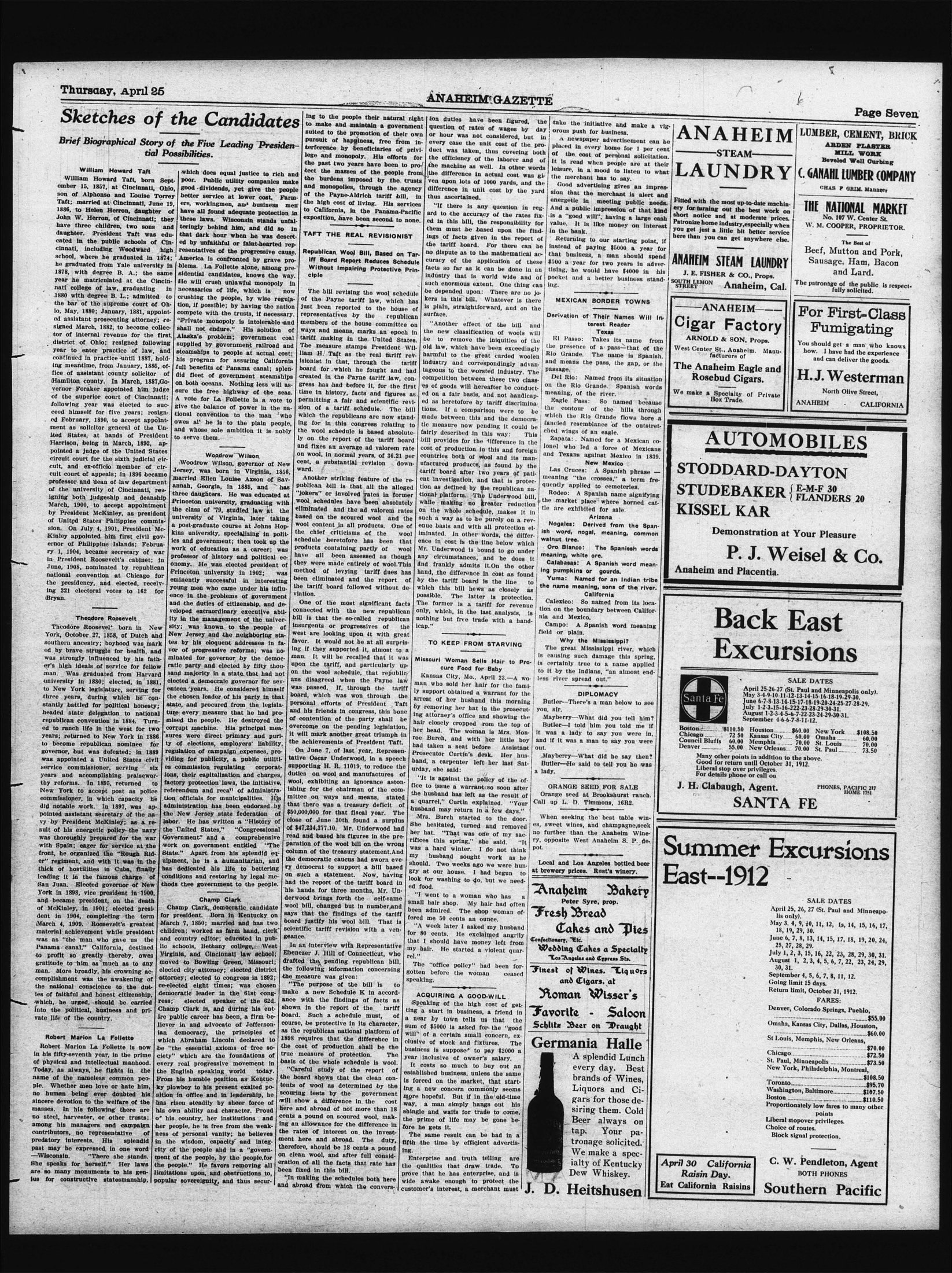
Searchable text
Thursaay, April 25
Sketches of the Candidates
Brief Biographical Story of the Five Leading Presidential Possibilities.
William Howard Taft
William Howard Taft, born September 15, 1857, at Cincinnati, Ohio, son of Alphonso and Louise Torrey Taft; married at Cincinnati, June 19, 1886, to Helen Herron, daughter of John W. Herron, of Cincinnati; they have three children, two sons and daughter. President Taft was educated in the public schools of Cincinnati, including Woodward high school, where he graduated in 1874; he graduated from Yale university in 1878, with degree B. A.; the same year he matriculated at the Cincinnati college of law, graduating in 1880 with degree B. L.; admitted to the bar of the supreme court of Ohio, May, 1880; January, 1881, appointed assistant prosecuting attorney; resigned March, 1882, to become collector of internal revenue for the first district of Ohio; resigned following year to enter practice of law, and continued in practice until 1887, holding meantime, from January, 1885, office of assistant county solicitor of Hamilton county. In March, 1887, Governor Foraker appointed him judge of the superior court of Cincinnati; following year was elected to succeed himself for five years; resigned February, 1890, to accept appointment as solicitor general of the United States; at hands of President Harrison, being in March, 1892, appointed a judge of the United States circuit court for the sixth judicial circuit, and ex-officio member of circuit court of appeals; in 1896 became which does equal justice to rich and poor. Public utility companies make good dividends, yet give the people better service at lower cost. Farmers, workingmen, and business men have all found adequate protection in these laws. Wisconsin stands unfalteringly behind him, and did so in that dark hour when he was deserted by unfaithful or faint-hearted representatives of the progressive cause. America is confronted by grave problems. La Follette alone, among presidential candidates, knows the way. He will crush unlawful monopoly in necessaries of life, which is now crushing the people, by wise regulation, if possible; by having the nation compete with the trusts, if necessary. "Private monopoly is intolerable and shall not endure." His solution of Alaska's problem; government coal supplied by government railroad and steamships to people at actual cost; his program for assuring California full benefits of Panama canal; splendid fleet of government steamships on both oceans. Nothing less will assure the free highway of the seas. A vote for La Follette is a vote to give the balance of power in the national convention to the man who owes al' he is to the plain people, and whose sole ambition it is nobly to serve them.
Woodrow Wilson
Woodrow Wilson, governor of New Jersey, was born in Virginia, 1856,
ing to the people to make and mend suited to the prudent pursuit of happiness by the lege and monopoly the past two years protect the masses the burdens imminent and monopolies of the Payne-Albany the high cost of to California, in exposition, have
TAFT THE REAL
Republican Woolfiff Board Reporter Without Impairciple
The bill revising of the Payne tax just been reported represents members of the ways and means tariff making in The measure stated William H. Taft aslisionist in that, the board for which created in the Paynegress has had before time in history, for permitting a fair sion of a tariff which the republication for in this case the wool schedule only on the report and fixes an average on wool, in normal cent, a substantial ward.
Theodore Roosevelt
Theodore Roosevelt born in New York, October 27, 1858, of Dutch and southern ancestry; boyhood was marked by brave struggle for health, and was strongly influenced by his father's high ideals of service for fellow man. Was graduated from Harvard university in 1880; elected, in 1881, to New York legislature, serving for three years, during which he constantly battled for political honesty; headed state delegation to national republican convention in 1884. Turned to ranch life in the west for two years; returned to New York in 1886 to become republican nominee for governor, but was defeated; in 1889 was appointed a United States civil service commissioner, serving six years and accomplishing praiseworthy reforms. In 1895, returned to New York to accept post as police commissioner, in which capacity he did notable work. In 1897, was appointed assistant secretary of the navy by President McKinley; as a result of his energetic policy the navy was thoroughly prepared for the war with Spain; eager for service at the front, he organized the "Rough Rider" regiment, and with it was in the thick of hostilities in Cuba, finally leading it in the famous charge of San Juan. Elected governor of New York in 1898, vice president in 1900, and became president in 1902.
Woodrow Wilson
Woodrow Wilson, governor of New Jersey, was born in Virginia, 1856, married Ellen Louise Axson of Savannah, Georgia, in 1885, and has three daughters. He was educated at Princeton university, graduating with the class of '79, studied law at the university of Virginia, later taking a post-graduate course at Johns Hopkins university, specializing in politics and government; then took up the work of education as a career; was professor of history and political economy. He was elected president of Princeton university in 1902; was eminently successful in interesting young men who came under his influence in the problems of government and the duties of citizenship, and developed extraordinary executive ability in the management of the university; was known to the people of New Jersey and the neighboring states by his eloquent addresses in favor of progressive reforms; was nominated for governor by the democratic party and elected by fifty thousand majority in a state that had not elected a democratic governor for seventeen years. He considered himself the chosen leader of his party in that state, and procured from the legislature every measure that he had promised the people. He destroyed the corrupt machine. His principal measures were direct primary and purity of elections, employers' liability, regulation of campaign expenses, providing for publicity, a public utilities commission regulating corporations, their capitalization and charges, factory protection laws, the initiative, referendum and recall of administration officials for municipalities. His administration has been endorsed by the New Jersey state federation of labor. He has written a "History of the United States," "Congressional Government;" and a comprehensive work on government entitled "The State." Apart from his splendid equipment, he is a humanitarian, and has dedicated his life to bettering conditions and restoring by legal methods the government to the people.
Another striking publican bill is the "jokers" or involve wool schedules have eliminated and the based on the scourge wool content in all the chief criticism schedule heretofore products containing have all been as they were made entail method of levying been eliminated and the tariff board follviation.
One of the most connected with the bill is that the so-insurgents or program west are looking up favor. It would not be if they supported man. It will be received upon the tariff, and on the wool schedule ans disagreed when was passed. If, this board, which was w personal efforts of and his friends in cof of contention of the overcome on the per it will mark another of the achievements of.
On June 7, of lastitative Oscar Underwent supporting H. R. 1101 duties on wool and m wool, exhibiting an ishing for the chairm mittee on ways and that there was a treat $50,000,000 for that f close of June 30th f of $47,234,377.10. Mr. read and based his fig paration of the wool b column of the treasury the democratic caucus ry democrat to support on such a statement. had the report of the his hands for three m derwood brings forth
Robert Marion La Follette
Robert Marion La Follette is now in his fifty-seventh year, in the prime of physical and intellectual manhood. Today, as always, he fights in the name of the nameless common people. Whether men love or hate him, no human being ever doubted his sincere devotion to the welfare of the masses. In his following there are no steel, harvester, or other trusts; among his managers and campaign contributors, no representative of predatory interests. His splendid past may be expressed in one word—Wisconsin. "There she stands. She speaks for herself." Her laws are so many monuments to his genius for constructive statesmanship,
Champ Clark
Champ Clark, democratic candidate for president. Born in Kentucky on March 7, 1850; married and has two children; worked as farm hand, clerk and country editor; educated in public schools, Bethany college, West Virginia, and Cincinnati law school; moved to Bowling Green, Missouri; elected city attorney; elected district attorney; elected to congress in 1892; re-elected eight times; was chosen democratic leader in the 61st congress; elected speaker of the 62d. Champ Clark is, and during his entire public career has been, a firm believer in and advocate of Jeffersonian democracy, the principles of which Abraham Lincoln declared to be "the essential axioms of free society" which are the foundations of every real progressive movement in the English speaking world today. From his humble position as Kentucky plowboy to his present exalted position in office and in leadership, he has risen steadily by sheer force of his own ability and character. Proud of his country, her institutions and her people, he is free from the weakness of personal vanity; he believes in the wisdom, capacity and integrity of the people and in a "government of the people, by the people, for the people." He favors removing all limitations upon, and obstructions to, popular sovereignty, and thus secur-
administration has been endorsed by the New Jersey state federation of labor. He has written a "History of the United States," "Congressional Government" and a comprehensive work on government entitled "The State." Apart from his splendid equipment, he is a humanitarian, and has dedicated his life to bettering conditions and restoring by legal methods the government to the people.
In an interview with Ebenezer J. Hill of Crafted the pending rite the following information the measure was given:
"The purpose of the make a new Scheduleance with the findings shown in the report o board. Such a schedule course, be protective in as the republican nation 1898 requires that the cost of production true measure of prote basis of the whole scheme."
"Careful study of the board shows that th tentes of wool as determine scouring tests by the will show a difference here and abroad of not cents a pound on scouring an allowance for the rates of interest or ment here and abroad. therefore, should be 18 c on clean wool, and after eration of all the facts t been fixed in this bill."
In making the schedule and abroad from which
ANAHEIM GAZETTE
ing to the people their natural right to make and maintain a government suited to the promotion of their own pursuit of happiness, free from interference by beneficiaries of privilege and monopoly. His efforts for the past two years have been to protect the masses of the people from the burdens imposed by the trusts and monopolies, through the agency of the Payne-Aldrich tariff bill, in the high cost of living. His services to California, in the Panama-Pacific exposition, have been second to none.
TAFT THE REAL REVISIONIST
Republican Wool Bill, Based on Tariff Board Report Reduces Schedule Without Impairing Protective Principle
The bill revising the wool schedule of the Payne tariff law, which has just been reported to the house of representatives by the republican members of the house committee on ways and means, marks an epoch in tariff making in the United States. The measure stamps President William H. Taft as the real tariff revisionist in that, through the tariff board for which he fought and had created in the Payne tariff law, congress has had before it, for the first time in history, facts and figures as permitting a fair and scientific revision of a tariff schedule. The bill which the republicans are now standing for in this congress relating to the wool schedule is based absolutely on the report of the tariff board and fixes an average ad valorem rate on wool, in normal years, of 36.21 per cent, a substantial revision downward.
duties have been figured, the question of rates of wages by day or hour was not considered, but in every case the unit cost of the product was taken, thus covering both the efficiency of the laborer and of the machine as well. In other words the difference in actual cost was given upon lots of 1000 yards, and the difference in unit cost by the yard thus ascertained.
“If there is any question in regard to the accuracy of the rates fixed in this bill, the responsibility for them must be based upon the findings of facts given in the report of the tariff board. For there can be no dispute as to the mathematical accuracy of the application of these facts so far as it can be done in an industry that is world wide and of such enormous extent. One thing can be depended upon: There are no jokers in this bill. Whatever is there is plain, straightforward, and on the surface.
“Another effect of the bill and the new classification of wools will be to remove the iniquities of the old law, which have been exceedingly harmful to the great carded woolen industry and correspondingly advantageous to the worsted industry. The competition between these two classes of goods will hereafter be conducted on a fair basis, and not handicapped as heretofore by tariff discriminations. If a comparison were to be made between this and the democratic measure now pending it could be fairly described in this way: This bill provides for the difference in the cost of production in this and foreign countries both of wool and its manufactured products, as found by the tariff board after two years of pati-
take the initiative and make a vigorous push for business.
A newspaper advertisement can be placed in every home for 1 per cent of the cost of personal solicitation. It is read when people are at their leisure, in a mood to listen to what the merchant has to say.
Good advertising gives an impression that the merchant is alert and energetic in meeting public needs. And a public impression of that kind is a “good will”, having a large cash value. It is like money on interest in the bank.
Returning to our starting point, if instead of paying $5000 a year for that business, a man should spend $500 a year for two years in advertising, he would have $4000 in his pocket and a better business standing.
MEXICAN BORDER TOWNS
Derivation of Their Names Will Interest Reader Texas
El Passo: Takes its name from the presence of a pass—that of the Rio Grande. The name is Spanish, and means the pass, the gap, or the passage.
Del Rio: Named from its situation on the Rio Grande. Spanish words meaning, of the river.
Eagle Pass: So named because the contour of the hills through which the Rio Grande flows bore a fancied resemblance of the outstretched wings of an eagle.
Zapata: Named for a Mexican colonel who led a force of Mexicans and Texans against Mexico in 1839.
New Mexico
Las Cruces: A Spanish phrase —
created in the Payne tariff law, congress has had before it, for the first time in history, facts and figures as permitting a fair and scientific revision of a tariff schedule. The bill which the republicans are now standing for in this congress relating to the wool schedule is based absolutely on the report of the tariff board and fixes an average ad valorem rate on wool, in normal years, of 36.21 per cent, a substantial revision downward.
Another striking feature of the republican bill is that all the alleged "jokers" or involved rates in former wool schedules have been absolutely eliminated and the ad valorem rates based on the scoured wool and the wool content in all products. One of the chief criticisms of the wool schedule heretofore has been that products containing partly of wool have all been assessed as though they were made entirely of wool. This method of levying tariff dues has been eliminated and the report of the tariff board followed without deviation.
One of the most significant facts connected with the new republican bill is that the so-called republican insurgents or progressives of the west are looking upon it with great favor. It would not be at all surprising if they supported it, almost to a man. It will be recalled that it was upon the tariff, and particularly upon the wool schedule, that republicans disagreed when the Payne law was passed. If, through the tariff board, which was won through the personal efforts of President Taft and his friends in congress, this bone of contention of the party shall be overcome on the pending legislation, it will mark another great triumph in the achievements of President Taft.
On June 7, of last year, Representative Oscar Underwood, in a speech supporting H. R. 11019, to reduce the duties on wool and manufactures of wool, exhibiting an ignorance astonishing for the chairman of the committee on ways and means, stated that there was a treasury deficit of $50,000,000 for that fiscal year. The close of June 30th found a surplus of $47,234,377.10. Mr. Underwood had read and based his figures in the preparation of the wool bill on the wrong column of the treasury statement. And the democratic caucus had sworn every democrat to support a bill based on such a statement. Now, having had the report of the tariff board in his hands for three months, Mr. Underwood brings forth the self-same competition between these two classes of goods will hereafter be conducted on a fair basis, and not handicapped as heretofore by tariff discriminations. If a comparison were to be made between this and the democratic measure now pending it could be fairly described in this way: This bill provides for the difference in the cost of production in this and foreign countries both of wool and its manufactured products, as found by the tariff board after two years of patient investigation, and that is protection as defined by the republican national platform. The Underwood bill, while making no greater reduction on the whole schedule, makes it in such a way as to be purely on a revenue basis and with all protection eliminated. In other words, the difference in cost is the line below which Mr. Underwood is bound to go under any circumstances, and he does it and frankly admits it.On the other hand, the difference in cost as found by the tariff board is the line to which this bill hews as closely as possible. The latter is protection. The former is a tariff for revenue only, which, in the last analysis, is nothing but free trade with a handicap."
TO KEEP FROM STARVING
Missouri Woman Sells Hair to Procure Food for Baby
Kansas City, Mo., April 23.—A woman who sold her hair for the family support obtained a warrant for the arrest of her husband this morning by removing her hat in the prosecuting attorney's office and showing the hair closely cropped rom the top of her head. The woman is Mrs. Monroe Burch, and with her little boy had taken a seat before Assistant Prosecutor Curtin's desk. Her husband, a carpenter left her last Saturday, she said:
"It is against the policy of the office to issue a warrant so soon after the husband has left as the result of a quarrel," Curtin explained. "Your husband may return in a few days."
Mrs. Burch started to the door. She hesitated, turned and removed her hat. "That was one of my sacrifices this spring," she said. "It was a hard winter. I do not think my husband sought work as he should. Two weeks ago we were hungry at our house. I had begun to look for washing to do, but we needed food."
"I went to a woman who has a
that there was a treasury deficit of $50,000,000 for that fiscal year. The close of June 30th found a surplus of $47,234,377.10. Mr. Underwood had read and based his figures in the preparation of the wool bill on the wrong column of the treasury statement. And the democratic caucus had sworn every democrat to support a bill based on such a statement. Now, having had the report of the tariff board in his hands for three months, Mr. Underwood brings forth the self-same wool bill, changed but in number, and says that the findings of the tariff board justify his wool bill. That is scientific tariff revision with a vengeance.
In an interview with Representative Ebenezer J. Hill of Connecticut, who drafted the pending republican bill, the following information concerning the measure was given:
"The purpose of the bill is to make a new Schedule K in accordance with the findings of facts as shown in the report of the tariff board. Such a schedule must, of course, be protective in its character, as the republican national platform of 1898 requires that the difference in the cost of production shall be the true measure of protection. The basis of the whole schedule is wool.
"Careful study of the report of the board shows that the clean contents of wool as determined by the scouring tests by the government will show a difference in the cost here and abroad of not more than 18 cents a pound on scoured wool, making an allowance for the difference in the rates of interest on the investment here and abroad. The duty, therefore, should be 18 cents a pound on clean wool, and after full consideration of all the facts that rate has been fixed in this bill.
"In making the schedules both here and abroad from which the convers-
a quarrel," Curtin explained. "Your husband may return in a few days."
Mrs. Burch started to the door. She hesitated, turned and removed her hat. "That was one of my sacrifices this spring," she said. "It was a hard winter. I do not think my husband sought work as he should. Two weeks ago we were hungry at our house. I had begun to look for washing to do, but we needed food.
"I went to a woman who has a small hair shop. My hair had often been admired. The shop woman offered me 50 cents an ounce.
"A week later I asked my husband for 80 cents. He exclaimed angrily that I should have money left from my hair. He started a violent quarrel."
The "office policy" had been forgotten before the woman ceased speaking.
ACQUIRING A GOOD-WILL
Speaking of the high cost of getting a start in business, a friend in a near by town tells us that the sum of $5000 is asked for the "good will" of a certain small concern, exclusive of stock and fixtures. The business is supposed to pay $2000 a year inclusive of owner's salary.
It costs so much to buy out an established business, unless the same is forced on the market, that starting a new concern commonly seems more hopeful. But if in the old-time way, a man simply hangs out his shingle and waits for trade to come, the prime of life may be gone before he gets it.
The same result can be had in a fifth time by efficient advertising.
Enterprise and truth telling are the qualities that draw trade. To prove that he has enterprise, and is wide awake enough to protect the customer's interest, a merchant must
ANAHEIM
STEAM
LAUNDRY
Fitted with the most up-to-date machinery for turning out the best work on short notice and at moderate prices. Patronize home industry, especially when you get just a little bit better service here than you can get anywhere else.
ANAHEIM STEAM LAUNDRY
J. E. FISHER & CO., Props.
SOUTH LEMON STREET Anaheim, Cal.
ANAHEIM
Cigar Factory
ARNOLD & SON, Props.
West Center St., Anaheim. Manufacturers of
The Anaheim Eagle and Rosebud Cigars.
We make a Specialty of Private Box Trade.
LUMBER, CEMENT, BRICK
ARDEN PLASTER
MILL WORK
Beveled Well Curbing
C. GANAHL LUMBER COMPANY
CHAS P GRIM. Manager
THE NATIONAL MARKET
No. 107 W. Center St.
W. M. COOPER, PROPRIETOR.
The Best of Beef, Mutton and Pork,
Sausage, Ham, Bacon and Lard.
The patronage of the public is respectfully solicited.
For First-Class Fumigating
You should get a man who knows how. I have had the experience and can deliver the goods.
H.J. Westerman
North Olive Street,
ANAHEIM CALIFORNIA
AUTOMOBILES
STODDARD-DAYTON
Rosebud Cigars.
We make a Specialty of Private Box Trade.
AUTOMOBILES
STODDARD-DAYTON
STUDEBAKER {E-M-F 30
FLANDERS 20
KISSEL KAR
Demonstration at Your Pleasure
P. J. Weisel & Co.
Anaheim and Placentia.
Back East Excursions
SALE DATES
April 25-26-27 (St. Paul and Minneapolis only).
May 3-4-9-10-11-12-13-14-15-16-18-19-29-30.
June 6-7-8-13-14-15-17-18-19-20-24-25-27-28-29.
July 1-2-3-15-16-222-23-28-29-30-31.
August 1-2-3-4-5-6-7-22-23-24-29-30-31.
September 4-6-6-7-8-11-12.
Boston $110.50 Houston $60.00 New York $108.50
Chicago 72.50 Kansas City 60.00 Omaha 60.00
Council Bluffs 60.00 Memphis 70.00 St. Louis 70.00
Denver 55.00 New Orleans 70.00 St. Paul 73.50
Many other points in addition to the above.
Good for return until October 31, 1912.
Liberal stop over privileges.
For details phone or call on
J. H. Clabaugh, Agent.
PHONES, PACIFIC 217
HOME 1751
Summer Excursions
East--1912
Summer Excursions
East--1912
SALE DATES
April 25, 26, 27 (St. Paul and Minneapolis only).
May 3, 4, 9, 10, 11, 12, 1s, 14, 15, 16, 17,
18, 19, 29, 30.
June 6, 7, 8, 13, 14, 15, 17, 18, 19, 20, 24,
25, 27, 28, 29.
July 1, 2, 3, 15, 16, 22, 23, 28, 29, 30, 31.
August 1, 2, 3, 4, 5, 6, 7, 22, 23, 24, 29,
30, 31.
September 4, 5, 6, 7, 8, 11, 12.
Going limit 15 days.
Return limit, October 31, 1912.
FARES:
Denver, Colorado Springs, Pueblo,
$55.00
Omaha, Kansas City, Dallas, Houston,
$60.00
St Louis, Memphis, New Orleans,
$70.00
Chicago $72.50
St. Paul, Minneapolis $73.50
New York, Philadelphia, Montreal,
$108.50
Toronto $95.70
Washington, Baltimore $107.50
Boston $110.50
Proportionately low fares to many other points
Liberal stopover privileges.
Choice of routes.
Block signal protection.
April 30 California Raisin Day.
Eat California Raisins
C. W. Pendleton, Agent
BOTH PHONES
Southern Pacific