anaheim-gazette 1912-04-18
Scanned page
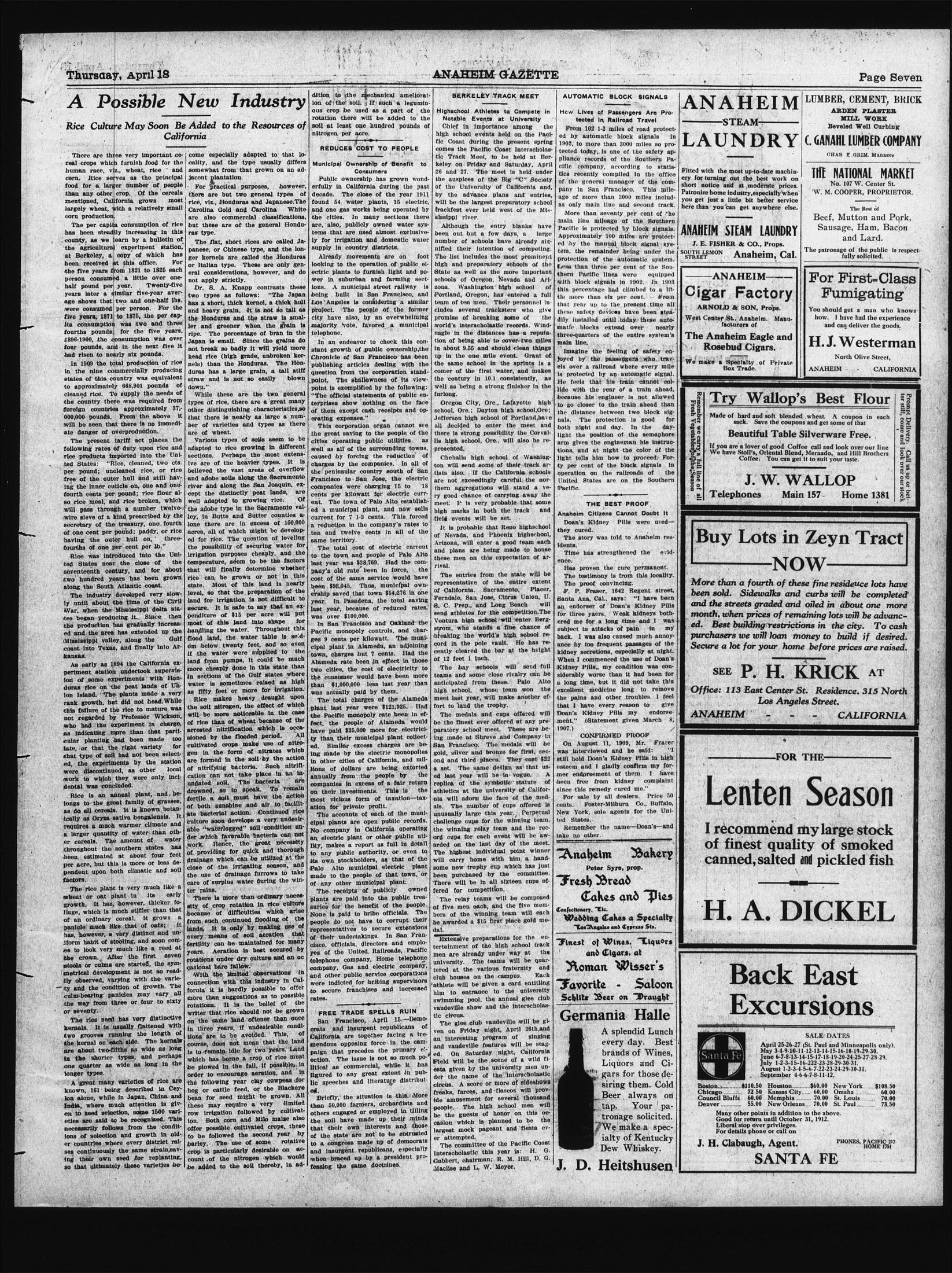
Searchable text
Thursday, April 18
A Possible New Industry
Rice Culture May Soon Be Added to the Resources of California
There are three very important cereal crops which furnish food for the human race, viz., wheat, rice and corn. Rice serves as the principal food for a larger number of people than any other crop. Of the cereals mentioned, California grows most largely wheat, with a relatively small corn production.
The per capita consumption of rice has been steadily increasing in this county, as we learn by a bulletin of the agricultural experiment station, at Berkeley, a copy of which has been received at this office. For the five years from 1821 to 1825 each person consumed a little over one-half pound per year. Twenty-five years later a similar five-year average shows that two and one-half lbs. were consumed per person. For the five years, 1871 to 1875, the per capita consumption was two and three fourths pounds; for the five years, 1896-1900, the consumption was over four pounds, and in the next five it had risen to nearly six pounds.
In 1909 the total production of rice in the nine commercially producing states of this country was equivalent to approximately 668,901 pounds of cleaned rice. To supply the needs of the country there was required from foreign countries approximately 37,000,000 pounds. From the above it will be seen that there is no immediate danger of overproduction.
The present tariff act places the following rates of duty upon rice and rice products imported into the United States: "Rice, cleaned, two cts. per pound; uncleaned rice, or rice come especially adapted to that locality, and the type usually differs somewhat from that grown on an adjacent plantation.
For practical purposes, however, there are but two general types of rice, viz., Honduras and Japanese. The Carolina Gold and Carolina White are also commercial classifications, but these are of the general Honduras type.
The flat, short rices are called Japanese, or Chinese type, and the longer kernels are called the Honduras or Italian type. These are only general considerations, however, and do not apply strictly.
Dr. S. A. Knapp contrasts these two types as follows: "The Japan has a short, thick kernel, a thick hull and heavy grain. It is not so tall as the Honduras and the straw is smaller and greener when the grain is ripe. The percentage of bran in the Japan is small. Since the grains do not break so badly it will yield more head rice (high grade, unbroken kernels) than the Honduras. The Honduras has a large grain, a tall stiff straw and is not so easily blown down."
While these are the two general types of rice, there are a great many other distinguishing characteristics, so that there is nearly as large a number of varieties and types as there are of wheat.
Various types of soils seem to be adapted to rice growing in different sections. Perhaps the most extensive are of the heavier types. It is believed the vast areas of overflow dition to the ion of the so-called crop be rotation there soil at least nitrogen per unit area.
Public owner erfully in Cal decade. The found 54 water and one gas w the cities. I are, also, publ tems that are likely for irrigation supply in countr.
Already most looking to the electric plants ther wer in suburbs. A munich being built Los Angeles i project. The city have also majority vote telephone.
In an endear stant growth Chronicle of s publishing art question from point. The sh point is exempt "The official serprises show of them exceptering expenses.
This corpora the great savi cities operating well as all of caused by for charges by the peninsular
states of this country was equivalent to approximately 688,901 pounds of cleaned rice. To supply the needs of the country there was required from foreign countries approximately 37,000,000 pounds. From the above it will be seen that there is no immediate danger of overproduction.
The present tariff act places the following rates of duty upon rice and rice products imported into the United States: "Rice, cleaned, two cts. per pound; uncleaned rice, or rice free of the outer hull and still having the inner cuticle on, one and one-fourth cents per pound; rice flour also rice meal, and rice broken, which will pass through a number twelve-wire sieve of a kind prescribed by the secretary of the treasury, one fourth of one cent per pound; paddy, or rice having the outer hull on, three-fourths of one cent per lb."
Rice was introduced into the United States near the close of the seventeenth century, and for about two hundred years has been grown along the South Atlantic coast.
The industry developed very slowly until about the time of the Civil War, when the Mississippi delta states began producing it. Since then the production has gradually increased and the area has extended up the Mississippi valley, along the Gulf coast into Texas, and finally into Arkansas.
As early as 1894 the California experiment station undertook supervision of some experiments with Honduras rice on the peat lands of Union Island. The plants made a very rank growth, but did not head. While this failure of the rice to mature was not regarded by Professor Wickson, who had the experiment in charge, as indicating more than that particular planting had been made too late, or that the right variety for that type of soil had not been selected, the experiments by the station were discontinued, as other local work to which they were only incidental was concluded.
Rice is an annual plant, and belongs to the great family of grasses, as do all cereals. It is known botanically as Oryza sativa bengalensis. It requires a much warmer climate and a larger quantity of water than other cereals. The amount of water throughout the southern states has been estimated at about four feet per acre, but this is more or less dependent upon both climatic and soil factors.
The rice plant is very much like a wheat or oat plant in its early straw and is not so easily blown down."
While these are the two general types of rice, there are a great many other distinguishing characteristics, so that there is nearly as large a number of varieties and types as there are of wheat.
Various types of soils seem to be adapted to rice growing in different sections. Perhaps the most extensive are of the heavier types. It is believed the vast areas of overflow and adobe soils along the Sacramento river and along the San Joaquin, except the distinctly peat lands, are well adapted to growing rice. Of the adobe type in the Sacramento valley, in Butte and Sutter counties alone there are in excess of 150,000 acres, all of which might be developed for rice. The question of leveling the possibility of securing water for irrigation purposes cheaply, and the temperature, seem to be the factors that will finally determine whether rice can be grown or not in this state. Most of this land is nearly level, so that the preparation of the land for irrigation is not difficult to secure. It is safe to say that an expenditure of $15 per acre will put most of this land into shape for handling the water. Throughout this flood land, the water table is sediment below twenty feet, and so even if the water were supplied to the land from pumps, it could be much more cheaply done in this state than in sections of the Gulf states where water is sometimes raised as high as fifty feet or more for irrigation.
Rice makes heavy draught upon the soil nitrogen, the effect of which will be more noticeable in the case of rice than of wheat because of the arrested nitrification which is occasioned by the flooded period. All cultivated crops make use of nitrogen in the form of nitrates which are formed in the soil by the action of nitrifying bacteria. Such nitrification can not take place in an undated soil. The bacteria are drowned, so to speak. To remain fertile a soil must have the action of both sunshine and air to facilitate bacterial action. Continued rice culture soon develops a very undesirable "waterlogged" soil condition under which favorable bacteria can not work. Hence, the great necessity of providing for quick and thorough drainage which can be utilized at the close of the irrigating season, and the use of drainage furrows to take care of surplus water during the winter rains.
There is more than ordinary neces-
longs to the great family of grasses, as do all cereals. It is known botanically as Oryza sativa bengalensis. It requires a much warmer climate and a larger quantity of water than other cereals. The amount of water throughout the southern states has been estimated at about four feet per acre, but this is more or less dependent upon both climatic and soil factors.
The rice plant is very much like a wheat or oat plant in its early growth. It has, however, thicker foliage, which is much stiffer than that of an ordinary cereal. It grows a panicle much like that of oats; it has, however, a very distinct and uniform habit of stooling, and soon comes to look very much like a reed at the crown. After the first seven stools or culms are started, the symmetrical development is not so readily observed, varying with the variety and the condition of growth. The culm-bearing panicles may vary all the way from three or four to sixty or seventy.
The rice seed has very distinctive kernals. It is usually flattened with two grooves running the length of the kernal on each side. The kernals are about two-fifths as wide as long in the shorter types, and perhaps one quarter as wide as long in the longer types.
A great many varieties of rice are known, 161 being described in Ceylon alone, while in Japan, China and India, where much attention is given to seed selection, some 1500 varieties are said to be recognized. This necessarily follows from the conditions of selection and growth in older countries where every district raises continuously the same strain, saving their own seed for replanting, so that ultimately these varieties be
Continued rice culture soon develops a very undesirable "waterlogged" soil condition under which favorable bacteria can not work. Hence, the great necessity of providing for quick and thorough drainage which can be utilized at the close of the irrigating season, and the use of drainage furrows to take care of surplus water during the winter rains.
There is more than ordinary necessity of crop rotation in rice culture because of difficulties which arise from such continued flooding of the lands. It is only by making use of every means of soil aeration that fertility can be maintained for many years. Aeration is best secured by rotations under dry culture and an occasional bare fallow.
With the limited observations in connection with this industry in California it is hardly possible to offer more than suggestions as to possible rotations. It is the belief of the writer that rice should not be grown on the same land oftener than once in three years, if undesirable conditions are to be avoided. This, of course, does not mean that the land is to remain idle for two years. Land which has borne a crop of rice must be plowed in the fall, if possible, in order to encourage aeration, and in the following year clay cowpeas for hog or cattle feed, or the Blackeye bean for seed might be grown. All these may require a very limited row irrigation followed by cultivation. Both corn and Milo maize also offer possible cultivated crops, these to be followed the second year by barley. The use of some rotative crop is particularly desirable on account of the nitrogen which would be added to the soil thereby, in ad-
ANAHEIM GAZETTE
ENTRY
Sources of
that loley differs on an adhowever,
types of
Chinese.The White
ifications,
Honducalled Jathe lonhonduras only genand do
these the Japan
thick hull so tall as
is small grain is in the
grains do hold more
kern ker
The Hontall stiff blown
general that many
districts,so a numras there
to be different
extensiIt is overflow
dition to the mechanical amelioration of the soil. If such a leguminous crop be used as a part of the rotation there will be added to the soil at least one hundred pounds of nitrogen per acre.
REDUCES COST TO PEOPLE
Municipal Ownership of Benefit to Consumers
Public ownership has grown wonderfully in California during the past decade. The close of the year 1911 found 54 water plants, 15 electric, and one gas works being operated by the cities. In many sections there are, also, publicly owned water systems that are used almost exclusively for irrigation and domestic water supply in country districts.
Already movements are on foot looking to the operation of public electric plants to furnish light and power in suburban and farming sections. A municipal street railway is being built in San Francisco, and Los Angeles is considering a similar project. The people of the former city have also, by an overwhelming majority vote, favored a municipal telephone.
In an endeavor to check this constant growth of public ownership, the Chronicle of San Francisco has been publishing articles dealing with the question from the corporation standpoint. The shallowness of its viewpoint is exemplified by the following: "The official statements of public enterprises show nothing on the face of them except cash receipts and operating expenses."
This corporation organ cannot see the great saving to the people of the cities operating public utilities as well as all of the surrounding towns, caused by forcing the reduction of charges by the companies. In all of the peninsular country south of San
BERKELEY TRACK MEET
Highschool Athletes to Compete in Notable Events at University
Chief in importance among the high school events held on the Pacific Coast during the present spring comes the Pacific Coast Interscholastic Track Meet, to be held at Berkeley on Friday and Saturday, April 26 and 27. The meet is held under the auspices of the Big “C” Society of the University of California and, by the advance plans and entries, will be the largest preparatory school trackfest ever held west of the Mississippi river.
Although the entry blanks have been out but a few days, a large number of schools have already signified their intention of competing. The list includes the most prominent high and preparatory schools of the State as well as the more important schools of Oregon, Nevada and Arizona. Washington high school of Portland, Oregon, has entered a full team of ten men. Their personnel includes several tracksters who give promise of breaking some of the world's interscholastic records. Windnagle in the distances has a reputation of being able to cover two miles in about 9.55 and should clean things up in the one mile event. Grant of the same school in the sprints is a comer of the first water, and makes the century in 10.1 consistently, as well as being a strong finisher in the furlong.
Oregon City, Ore., Lafayette high school, Ore.; Dayton high school, Ore; Jefferson high school of Portland, have all decided to enter the meet and there is strong possibility the Corvallis high school, Ore., will also be represented.
Chehalis high school of Washington will send some of their track artists also. If the California schools
AUTOMATIC BLOCK SIGNALS
How Lives of Passengers Are Protected in Railroad Travel
From 102 1-2 miles of road protected by automatic block signals in 1902, to more than 3000 miles so protected today, is one of the safety appliance records of the Southern Pacific company, according to statistics recently compiled in the office of the general manager of the company in San Francisco. This mileage of more than 3000 miles includes as only main line and second track.
More than seventy per cent of the main line mileage of the Southern Pacific is protected by block signals. Approximately 100 miles are protected by the manual block signal system, the remainder being under the protection of the automatic system. Less than three per cent of the Southern Pacific lines were equipped with block signals in 1902. In 1903 this percentage had climbed to a little more than six per cent. From that year up to the present time all these safety devices have been steadily installed until today these automatic blocks extend over nearly three-quarters of the entire system's main line.
Imagine the feeling of safety enjoyed by the passengers who travel over a railroad where every mile is protected by an automatic signal. He feels that his train cannot collide with the rear of a train ahead because his engineer is not allowed to go closer to the train ahead than the distance between two block signals. The protection is good for both night and day. In the daylight the position of the semaphore arm gives the engineman his instructions, and at night the color of the light tells him how to proceed. Forty per cent of the block signals in operation on the railroads of th
The generalitat many artifices,so a numeras there
to be different extensiones.
It is overflow paramento quin, exceds, are de.
Ofento valientes a 150,000 develop-leving water for and the factors whether in this is nearly of the difficult to at an ex- will put for about this is sedo even to the much rate than where has high irrigation. It upon of which the case of theills occa- All of nitrots which the action nitrifi- an in- are remain the action facilitiued rice undesirion un- can not necessity thorough at the con, and to take the winy neces-
Question from the corporation same point. The shallowness of its viewpoint is exemplified by the following: "The official statements of public enterprises show nothing on the face of them except cash receipts and operating expenses."
This corporation organ cannot see the great saving to the people of the cities operating public utilities as well as all of the surrounding towns, caused by forcing the reduction of charges by the companies. In all of the peninsular country south of San Francisco to San Jose, the electric companies were charging 15 to 18 cents per kilowatt for electric current. The town of Palo Alto established a municipal plant, and now sells current for 7 1-2 cents. This forced a reduction in the company's rates to ten and twelve cents in all of the same territory.
The total cost of electric current to the town and people of Palo Alto last year was $38,769. Had the company’s old rate been in force, the cost of the same service would have been $98,045. Thus, municipal ownership saved that town $54,276 in one year. In Pasadena, the total saving last year, because of reduced rates, was over $100,000.
In San Francisco and Oakland the Pacific monopoly controls, and charges 9 cents per kilowatt. The municipal plant in Alameda, an adjoining town, charges but 7 cents. Had the Alameda rate been in effect in those two cities, the cost of electricity to the consumer would have been more than $1,000,000 less last year than was actually paid by them.
The total charges of the Alameda plant last year were $121,935. Had the Pacific monopoly rate been in effect, the people of Alameda would have paid $35,000 more for electricity than their municipal plant collected. Similar excess charges are being made by the electric monopolies in other cities of California, and millions of dollars are being extorted annually from the people by the companies in excess of a fair return on their investments. This is the most vicious form of taxation—taxation for private profit.
The accounts of each of the municipal plants are open public records. No company in California operating an electric plant or other public utility, makes a report as full in detail to any public authority, or even to its own stockholders, as that of the Palo Alto municipal electric plant made to the people of that town, or of any other municipal plant.
The receipts of publicly owned plants are paid into the public trea-point. The shallowness of its viewpoint is exemplified by the following: "The official statements of public enterprises show nothing on the face of them except cash receipts and operating expenses."
This corporation organ cannot see the great saving to the people of the cities operating public utilities as well as all of the surrounding towns, caused by forcing the reduction of charges by the companies. In all of the peninsular country south of San Francisco to San Jose, the electric companies were charging 15 to 18 cents per kilowatt for electric current. The town of Palo Alto established a municipal plant, and now sells current for 7 1-2 cents. This forced a reduction in the company's rates to ten and twelve cents in all of the same territory.
The total cost of electric current to the town and people of Palo Alto last year was $38,769. Had the company’s old rate been in force, the cost of the same service would have been $98,045. Thus, municipal ownership saved that town $54,276 in one year. In Pasadena, the total saving last year, because of reduced rates, was over $100,000.
In San Francisco and Oakland the Pacific monopoly controls, and charges 9 cents per kilowatt. The municipal plant in Alameda, an adjoining town, charges but 7 cents. Had the Alameda rate been in effect in those two cities, the cost of electricity to the consumer would have been more than $1,000,000 less last year than was actually paid by them.
The total charges of the Alameda plant last year were $121,935. Had the Pacific monopoly rate been in effect, the people of Alameda would have paid $35,000 more for electricity than their municipal plant collected. Similar excess charges are being made by the electric monopolies in other cities of California, and millions of dollars are being extorted annually from the people by the companies in excess of a fair return on their investments. This is the most vicious form of taxation—taxation for private profit.
The accounts of each of the municipal plants are open public records. No company in California operating an electric plant or other public utility, makes a report as full in detail to any public authority, or even to its own stockholders, as that of the Palo Alto municipal electric plant made to the people of that town, or of any other municipal plant.
The receipts of publicly owned plants are paid into the public trea-point. The shallowness of its viewpoint is exemplified by the following: "The official statements of public enterprises show nothing on the face of them except cash receipts and operating expenses."
This corporation organ cannot see the great saving to the people of the cities operating public utilities as well as all of the surrounding towns, caused by forcing the reduction of charges by the companies. In all of the peninsular country south of San Francisco to San Jose, the electric companies were charging 15 to 18 cents per kilowatt for electric current. The town of Palo Alto established a municipal plant, and now sells current for 7 1-2 cents. This forced a reduction in the company's rates to ten and twelve cents in all of the same territory.
The total cost of electric current to the town and people of Palo Alto last year was $38,769. Had the company’s old rate been in force, the cost of the same service would have been $98,045. Thus, municipal ownership saved that town $54,276 in one year. In Pasadena, the total saving last year, because of reduced rates, was over $100,000.
In San Francisco and Oakland the Pacific monopoly controls, and charges 9 cents per kilowatt. The municipal plant in Alameda, an adjoining town, charges but 7 cents. Had the Alameda rate been in effect in those two cities, the cost of electricity to the consumer would have been more than $1,000,000 less last year than was actually paid by them.
The total charges of the Alameda plant last year were $121,935. Had the Pacific monopoly rate been in effect, the people of Alameda would have paid $35,000 more for electricity than their municipal plant collected. Similar excess charges are being made by the electric monopolies in other cities of California, and millions of dollars are being extorted annually from the people by the companies in excess of a fair return on their investments. This is the most vicious form of taxation—taxation for private profit.
The accounts of each of the municipal plants are open public records. No company in California operating an electric plant or other public utility, makes a report as full in detail to any public authority, or even to its own stockholders, as that of the Palo Alto municipal electric plant made to the people of that town, or of any other municipal plant.
The receipts of publicly owned plants are paid into the public trea-point. The shallowness of its viewpoint is exemplified by the following: "The official statements of public enterprises show nothing on the face of them except cash receipts and operating expenses."
This corporation organ cannot see the great saving to the people of the cities operating public utilities as well as all of the surrounding towns, caused by forcing the reduction of charges by the companies. In all of the peninsular country south of San Francisco to San Jose, the electric companies were charging 15 to 18 cents per kilowatt for electric current. The town of Palo Alto established a municipal plant, and now sells current for 7 1-2 cents. This forced a reduction in the company's rates to ten and twelve cents in all of the same territory.
The total cost of electric current to the town and people of Palo Alto last year was $38,769. Hadthe company’s old rate been in force,the costofthe sameservicewouldhavebeen$98,045Thus,municipalownershipsavedthattown$54,276inoneyear.InPasadena,thetotalsavinglastyear,becauseofreducedrates.wasover$100,000.
In San Francisco and OaklandthePacificmonopolycontrols,andcharges9centperkilowatt.ThemunicipalplantinAlameda,andadjoinningtown.chargesbut7cents.HadtheAlamedaratebeenineffectinthosetwocities,thecostofelectricitytotheconsumerwouldhavebeenmorethan$1,000,000lesslastyearthanwasactuallypaidbythem.
The total chargesoftheAlamedaplantlastyearwere$121,935.HadthePacificmonopolyratebeenineffect,thepeopleofAlamedawouldhavepaid$35,000moreforelectricitythanthemunicipalplantcollected.SimilarexcesschargesarebeingmadebytheelectricmonopoliesinothercitiesofCalifornia,andmillionsofdollarsarebeingextortedannuallyfromthepeoplebythecompaniesinexcessofafairreturnontheirinvestments.Thisisthemostviciousformoftaxation-taxationforprivateprofit.
The accountsofeachofthemunicipalplantsareopenpublicrecords.NocompanyinCaliforniaoperatingan Electricplantorotherpublicutility,makesareportasfullindetailtoanypublicauthority.oreventoitsownstockholders.asthatofthePaloAltomunicipalelectricplantmadetothepeopleofthattown.orofanyothermunicipalplant.
The receiptsofpubliclyownedplantsarepaidintothepublictrea-point.Theshallownessofitsviewpointisexemplifiedbythefollowing:"Theofficialstatementsofpublicenterprisesshownothingonthefaceofthememembersandtheycured.Thestorywas toldtoAnaheimresidents.Timehasstrengthenedtheevidence.Hasproventhecurere permanent.Thetestimonyisfromthislocality.Theproofconvincing.F.P.Fraser,1642RegentstreetsAna,Acal.,says:"IhavebeenanendorserofDoan'sKidneyPillsforthreeyaers.Weak kidneysbotheredmeforalongtimeandIwassubjecttocatsoftainmyback.Iwasalsocausedmuchannoyancebytoofrequentpassagesofthekidneysecretions,easilyatnightWhenIcommencedtheuseofDoan'sKidneyPillssmyconditionwasconsiderablyworsethanithadbeenforalongtime,但it didnottakethisexcellentmedicinelongtomovethepainsandothertroubles.IfeelthatIhaveeveryreasontosaveDoan'sKidneyPillssmyendorsement."(StatementgivenMarch81907.)
CONFIRMEDPROOF
On August 11,1909,Mr.Fraserwasinterviewedandhesaided:"I stillholdDoan'sKidneyPillsinhighesteemandIgladlyconfirmmyformerendorsementofthem.Ihavebeenfreefromkidneycomplaintsincethisremedycuredme."
For salebyall dealers.Price50cents.Foster-MilburnCo.,BuffaloNew York,soleagentsfortheUnitedStates.
Rememberthename—Doan's—andtakenoother.
AnaheimBakery
Peter Syre.prop.
Fresh Bread
CakesandDies
The accounts of each of the municipal plants are open public records. No company in California operating an electric plant or other public utility, makes a report as full in detail to any public authority, or even to its own stockholders, as that of the Palo Alto municipal electric plant made to the people of that town, or of any other municipal plant.
The receipts of publicly owned plants are paid into the public treasuries for the benefit of the people. None is paid to bribe officials. The people do not have to corrupt their representatives to secure extensions of their undertakings. In San Francisco, officials, directors and employees of the United Railroads, Pacific telephone company, Home telephone company, Gas and electric company, and other public service corporations were indicted for bribing supervisors to secure franchises and increased rates.
FREE TRADE SPELLS RUIN
San Francisco, April 15.—Democrats and insurgent republicans of California are together facing a tremendous opposing force in the campaign that precedes the primary election. The issue is not so much political as commercial, while it has figured to any great extent in public speeches and literature distributed.
Briefly, the situation is this. More than 50,000 farmers, orchardists and others engaged or employed in tilling the soil have made up their minds that their own interests and those of the state are not to be entrusted to a congress made up of democrats and insurgent republicans, especially when braced up by a president professing the same doctrines.
The relay teams will be composed of five men each, and the five members of the winning team will each be awarded a $15 first place gold medal.
Extensive preparations for the entertainment of the high school track men are already under way at the university. The teams will be quartered at the various fraternity and club houses on the campus. Each athlete will be given a card entitling him to entrance to the university swimming pool, the annual glee club vaudeville show and the interscholastic circus.
The glee club vaudeville will be given on Friday night, April 26th, and an interesting program of singing and vaudeville features will be staged. On Saturday night, California Field will be the scene of a wild fiesta given by the university men under the name of the interscholastic circus. A score or more of sideshows freaks, farces, and flascos will provide amusement for several thousand people. The high school men will be the guests of honor on this occasion which is planned to be the largest mock pageant and fiesta ever attempted.
The committee of the Pacific Coast Interscholastic this year is: H. G. Gabbert, chairman; R. M. Hill, D. G. Maclise and L. W. Meyer.
ANAHEIM
STEAM
LAUNDRY
Fitted with the most up-to-date machinery for turning out the best work on short notice and at moderate prices. Patronize home industry, especially when you get just a little bit better service here than you can get anywhere else.
ANAHEIM STEAM LAUNDRY
J. E. FISHER & CO., Props.
SOUTH LEMON STREET Anaheim, Cal.
ANAHEIM
Cigar Factory
ARNOLD & SON, Props.
West Center St., Anaheim. Manufacturers of The Anaheim Eagle and Rosebud Cigars.
We make a Specialty of Private Box Trade.
For First-Class Fumigating
You should get a man who knows how. I have had the experience and can deliver the goods.
H.J. Westerman
North Olive Street,
ANAHEIM CALIFORNIA
Try Wallop's Best Flour
Made of hard and soft blended wheat. A coupon in each sack. Save the coupons and get some of that Beautiful Table Silverware Free.
If you are a lover of good Coffee call and look over our line We have Stoll's, Oriental Blend, Mernado, and Hill Brothers Coffee. You can get it to suit your taste.
Try Wallop’s Best Flour
Made of hard and soft blended wheat. A coupon in each sack. Save the coupons and get some of that
Beautiful Table Silverware Free.
If you are a lover of good Coffee call and look over our line
We have Stoll’s, Oriental Blend, Mernado, and Hill Brothers
Coffee. You can get it to suit your taste.
J. W. WALLOP
Telephones Main 157 Home 1381
Buy Lots in Zeyn Tract
NOW
More than a fourth of these fine residence lots have been sold. Sidewalks and curbs will be completed and the streets graded and oiled in about one more month, when prices of remaining lots will be advanced. Best building restrictions in the city. To cash purchasers we will loan money to build if desired. Secure a lot for your home before prices are raised.
SEE P. H. KRICK AT
Office: 113 East Center St. Residence, 315 North Los Angeles Street,
ANAHEIM - - - CALIFORNIA
FOR THE
Lenten Season
I recommend my large stock of finest quality of smoked canned, salted and pickled fish
I recommend my large stock of finest quality of smoked canned, salted and pickled fish
H. A. DICKEL
Back East Excursions
SALE DATES
April 25-26-27 (St. Paul and Minneapolis only).
May 3-4-9-10-11-12-13-14-15-16-18-19-29-30.
June 6-7-8-13-14-15-17-18-19-20-24-25-27-28-29.
July 1-2-3-15-16-222-23-28-29-30-31.
August 1-2-3-4-5-6-7-22-23-24-29-30-31.
September 4-6-6-7-8-11-12.
Boston.....$110.50 Houston.....$60.00 New York.....$108.50
Chicago.....72.50 Kansas City.....60.00 Omaha.....60.00
Council Bluffs 60.00 Memphis.....70.00 St. Louis.....70.00
Denver.....55.00 New Orleans.....70.00 St. Paul.....73.50
Many other points in addition to the above.
Good for return until October 31, 1912.
Liberal stop over privileges.
For details phone or call on
J. H. Clabaugh, Agent.
PHONES, PACIFIC 217
HOME 1751
SANTA FE