anaheim-gazette 1912-04-18
Scanned page
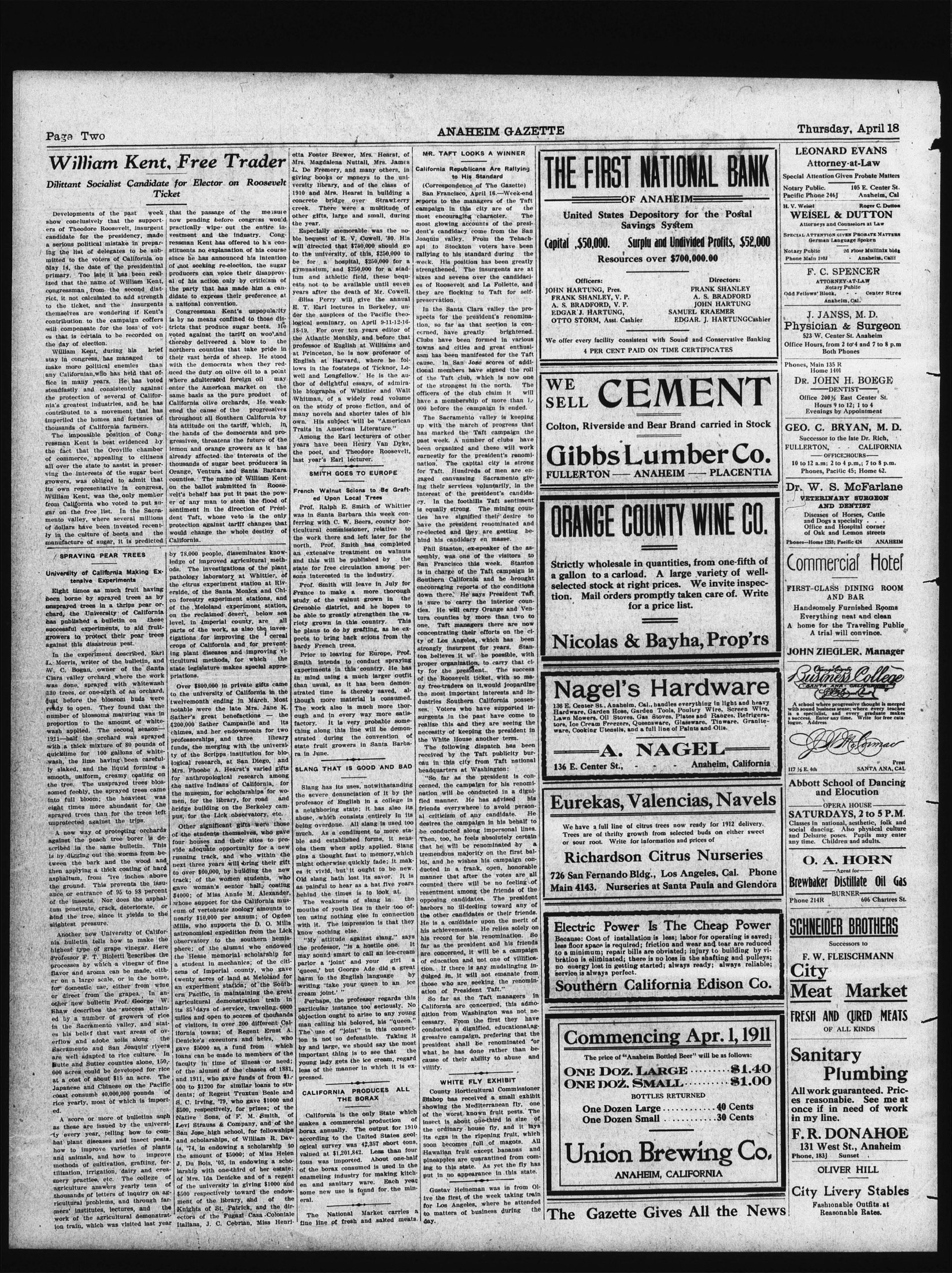
Searchable text
William Kent, Free Trader
Dilittant Socialist Candidate for Elector on Roosevelt Ticket
Developments of the past week show conclusively that the supporters of Theodore Roosevelt, insurgent candidate for the presidency, made a serious political mistake in preparing the list of delegates to be submitted to the voters of California on May 14, the date of the presidential primary. Too late it has been realized that the name of William Kent, congressman from the second district, it not calculated to add strength to the ticket, and the insurgents themselves are wondering if Kent's contribution to the campaign coffers will compensate for the loss of votes that is certain to be recorded on the day of election.
William Kent, during his brief stay in congress, has managed to make more political enemies than any Californian, who has held that office in many years. He has voted steadfastly and consistently against the protection of several of California's greatest industries, and he has contributed to a movement that has imperiled the homes and fortunes of thousands of California farmers.
The impossible position of Congressman Kent is best evidenced by the fact that the Oroville chamber of commerce, appealing to citizens all over the state to assist in preserving the interests of the sugar beet that the passage of the measure now pending before congress would practically wipe out the entire investment and the industry. Congressman Kent has offered to his constituents no explanation of his course since he has announced his intention of not seeking re-election, the sugar producers can voice their disapproval of his action only by criticism of the party that has made him a candidate to express their preference at a national convention.
Congressman Kent's unpopularity is by no means confined to those districts that produce sugar beets. He voted against the tariff on wool, and thereby delivered a blow to the northern counties that take pride in their vast herds of sheep. He stood with the democrats when they reduced the duty on olive oil to a point where adulterated foreign oil may enter the American market on the same basis as the pure product of California olive orchards. He weakened the cause of the progressives throughout all Southern California by his attitude on the tariff, which, in the hands of the democrats and progressives, threatens the future of the lemon and orange growers as it has already affected the interests of the thousands of sugar beet producers in Orange, Ventura and Santa Barbara etta Foster Brewer, Mrs. Magdalena Nuñez L. De Fremery, and giving books or more university library, and 1910 and Mrs. Heart concrete bridge o creek. There were other gifts, large and the year.
Especially memorable bequest of E. V. will directed that $7 to the university, of be for a hospital gymnasium, and $25arium and athletic fests not to be avail years after the death.
Bliss Perry will E. T. Earl lectures under the auspices of logical seminary, on 18-19. For over ten Atlantic Monthly professor of English at Princeton, he is English at Harvard lowes in the footsteps well and Longfellow thor of delightful e able biographs of W. Whitman, of a widow on the study of pro many novels and sh own. His subject w Traits in American.
Among the Earl N years have been H the poet, and The last year's Earl lec
SPRAYING PEAR TREES
University of California Making Extensive Experiments
Eight times as much fruit having been borne by sprayed trees as by unsprayed trees in a thrips pear orchard, the University of California has published a bulletin on these successful experiments, to aid fruit growers to protect their pear trees against this disastrous pest.
In the experiment described, Earl L. Morris, writer of the bulletin, and W. C. Bogan, owner of the Santa Clara valley orchard where the work was done, sprayed with whitewash 130 trees, or one-sixth of an orchard, just before the blossom buds were ready to open. They found that the number of blossoms maturing was in proportion to the amount of whitewash applied. The second season—1911—half the orchard was sprayed with a thick mixture of 80 pounds of quicklime for 100 gallons of whitewash, the lime having been carefully slaked, and the liquid forming a smooth, uniform, creamy coating on the tree. The unsprayed trees blossomed feebly, the sprayed trees came into full bloom; the heaviest was eight times more abundant for the sprayed trees than for the trees left unprotected against the trips.
A new way of protecting orchards against the peach tree borer is described in the same bulletin. This is by digging out the worms from between the bark and the wood and then applying a thick coating of hard asphaltum, from five inches above the ground. This prevents the issuance or entrance of 95 to 98 percent any California man who has held that office in many years. He has voted steadfastly and consistently against the protection of several of California's greatest industries, and he has contributed to a movement that has imperiled the homes and fortunes of thousands of California farmers.
The impossible position of Congressman Kent is best evidenced by the fact that the Oroville chamber of commerce, appealing to citizens all over the state to assist in preserving the interests of the sugar beet growers, was obliged to admit that its own representative in congress, William Kent, was the only member from California who voted to put sugar on the free list. In the Sacramento valley, where several millions of dollars have been invested recently in the culture of beets and the manufacture of sugar, it is predicted by 78,000 people, disseminates knowledge of improved agricultural methods. The investigations of the plant pathology laboratory at Whittier, of the citrus experiment station at Riverside, of the Santa Monica and Chico forestry experiment stations, and of the Meloland experiment station, on the reclaimed desert, below sea level, in Imperial county, are all parts of the work, as also the investigations for improving the cereal crops of California and for preventing plant diseases and improving viticultural methods, for which the state legislature makes special appropriations.
Over $800,000 in private gifts came to the university of California in the twelfemonth ending in March. Most notable were the late Mrs. Jane K. Sather's great benefactions — the $200,000 Sather Campanile and its chimes, and her endowments for two professorships and three library funds, the merging with the university of the Scripps institution for biological research, at San Diego, and Mrs. Phoebe A. Hearst's varied gifts for anthropological research among the native Indians of California, for the museum, for scholarships for women, for the library, for road and bridge building on the Berkeley campus, for the Lick observatory, etc.
Other significant gifts were those of the students themselves, who gave four houses and their sites to provide adequate opportunity for a new running track, and who within the next three years will bring their gift to over $60,000, by building the new track; of the women students, who gave woman's senior hall, costing $4000; of Miss Annie M. Alexander, well and Longfellow thror of delightful eable biographies of W. Whitman, of a widow on the study of pro- many novels and shown. His subject 'Traits in American Among the Earl years have been H he poet, and The last year's Earl lec
SMITH GOES
French Walnut Sci ed Upon Loc
Prof. Ralph E. S was in Santa Barbara ferring with C. W. ticultural commissioni nthe work there and north. Prof. Smith will an extensive treati n and this will be pu state for free circul sions interested in t
Prof. Smith will France to make a study of the walnu Grenoble district, a be able to greatly s arriety grown in this he plans to do by g pects to bring back hardy French trees.
Prior to leaving Smith intends to exper iments in this in mind using a m than usual, as it strated time is th though more materi The work also is oough and in every factory. It is very thing along this lin strated during th state fruit growers ra in June.
SLANG THAT IS
Slang has its use the severe denunci professor of English a neighboring state abuse, which consi being overdone. Al much. As a condi ble and establishe ns them when ap pins a thought fast might otherwise qu es it vivid, but it Old slang hath los as painful to hear behind the times
A new way of protecting orchards against the peach tree borer is described in the same bulletin. This is by digging out the worms from between the bark and the wood and then applying a thick coating of hard asphaltum, from five inches above the ground. This prevents the issuance or entrance of 95 to 98 percent of the insects. Nor does the asphaltum penetrate, crack, deteriorate, or bind the tree, since it yields to the slightest pressure.
Another new University of California bulletin tells how to make the highest type of grape vinegar. Here Professor F. T. Bioletti describes the processes by which a vinegar of fine flavor and aroma can be made, either on a large scale, or in the home, for domestic use, either from wine or direct from the grapes. In another new bulletin Prof. George W. Shaw describes the success attained by a number of growers of rice in the Sacramento valley, and states his belief that vast areas of overflow and adobe soils along the Sacramento and San Joaquin rivers are well adapted to rice culture. In Butte and Sutter counties alone, 150,000 acres could be developed for rice at a cost of about $15 an acre. The Japanese and Chinese on the Pacific coast consume 40,000,000 pounds of rice yearly, most of which is imported.
A score or more of bulletins such as these are issued by the university every year, telling how to combat plant diseases and insect pests, how to improve varieties of plants and animals, and how to improve methods of cultivation, grafting, fertilization, irrigation, dairy and creamery practice, etc. The college of agriculture answers yearly tens of thousands of letters of inquiry on agricultural problems, and through farmers' institutes, lectures, and the work of the agricultural demonstration train, which was visited last year
Other significant gifts were those of the students themselves, who gave four houses and their sites to provide adequate opportunity for a new running track, and who within the next three years will bring their gift to over $60,000, by building the new track; of the women students, who gave woman's senior hall, costing $4000; of Miss Annie M. Alexander, whose support for the California museum of vertebrate zoology amounts to nearly $10,000 per annum; of Ogden Mills, who supports the D. O. Mills astronomical expedition from the Lick observatory to the southern hemisphere; of the alumni who endowed the Hesse memorial scholarship for a student in mechanics; of the citizens of Imperial county, who gave twenty acres of land at Meloland for an experiment station; of the Southern Pacific, in maintaining the great agricultural demonstration train in its 85 days of service, traveling 6000 miles and open to scores of thousands of visitors, in over 200 different California towns; of Regent Ernst A. Denicke's executors and heirs, who gave $5000 as a fund from which loans can be made to members of the faculty in time of illness or need; of the alumni of the classes of 1881, and 1911, who gave funds of from $1,000 to $1200 for similar loans to students; of Regent Truxtun Beale and S. C. Irving, '79, who gave $1000 and $500, respectively, for prizes; of the Native Sons, of F. M. Smith, of Levi Strauss & Company, and of the San Jose high school, for fellowships and scholarships, of William R. Davis,'74, in endowing a scholarship to the amount of $5000; of Miss Helen J. Du Bols,'03, in endowing a scholarship with one-third of her estate; of Mrs. Ida Denicke and of a regent of the university in giving $1000 and $500 respectively toward the endowment of the library, and of the Knights of St. Patrick, and the directors of the Fugazi Casa Coloniale Italliana, J. C. Cebrian, Miss Henri-
ANAHEIM GAZETTE
etta Foster Brewer, Mrs. Hearst, of Mrs. Magdalena Nuttall, Mrs. James L. De Fremery, and many others, in giving books or moneys to the university library, and of the class of 1910 and Mrs. Hearst in building a concrete bridge over Strawberry creek. There were a multitude of other gifts, large and small, during the year.
Especially memorable was the noble bequest of E. V. Cowell, '80. His will directed that $750,000 should go to the university, of this, $250,000 to be for a hospital, $250,000 for a gymnasium, and $250,000 for a stadium and athletic field, these bequests not to be available until seven years after the death of Mr. Cowell.
Bliss Perry will give the annual E. T. Earl lectures in Berkeley, under the auspices of the Pacificological seminary, on April 9-11-12-16-18-19. For over ten years editor of the Atlantic Monthly, and before that professor of English at Williams and at Princeton, he is now professor of English at Harvard, where he follows in the footsteps of Ticknor, Lowell and Longfellow. He is the author of delightful essays, of admirable biographies of Whittier and Walt Whitman, of a widely read volume on the study of prose fiction, and of many novels and shorter tales of his own. His subject will be "American Traits in American Literature."
Among the Earl lecturers of other years have been Henry Van Dyke, the poet, and Theodore Roosevelt, last year's Earl lecturer.
MR. TAFT LOOKS A WINNER
California Republicans Are Rallying to His Standard
(Correspondence of The Gazette)
San Francisco, April 16.—Week-end reports to the managers of the Taft campaign in this city are of the most encouraging character. The most glowing accounts of the president's candidacy come from the San Joaquin valley. From the Tehachapi to Stockton voters have been rallying to his standard during the week. His position has been greatly strengthened. The insurgents are at sixes and sevens over the candidacies of Roosevelt and La Follette, and they are flocking to Taft for self-preservation.
In the Santa Clara valley the prospects for the president's renomination, so far as that section is concerned, have greatly brightened. Clubs have been formed in various towns and cities and great enthusiasm has been manifested for the Taft cause. In San Jose scores of additional members have signed the roll of the Taft club, which is now one of the strongest in the north. The officers of the club claim it will have a membership of more than 1,000 before the campaign is ended.
The Sacramento valley is keeping up with the march of progress that has marked the Taft campaign the past week. A number of clubs have been organized and these will work earnestly for the president's renomination. The capital city is strong for Taft. Hundreds of men are en-
SMITH GOES TO EUROPE
French Walnut Scions to Be Grafted Upon Local Trees
Prof. Ralph E. Smith of Whittier was in Santa Barbara this week conferring with C. W. Beers, county horticultural commissioner, relative to the work there and left later for the north. Prof. Smith has completed an extensive treatment on walnuts and this will be published by the state for free circulation among persons interested in the industry.
Prof. Smith will leave in July for France to make a more thorough study of the walnut grown in the Grenoble district, and he hopes to be able to greatly strengthen the variety grown in this country. This he plans to do by grafting, as he expects to bring back scions from the hardy French trees.
Prior to leaving for Europe, Prof. Smith intends to conduct spraying experiments in this country. He has in mind using a much larger outfit than usual, as it has been demonstrated time is thereby saved, although more material is consumed. The work also is much more thorough and in every way more satisfactory. It is very probable something along this line will be demonstrated during the convention of state fruit growers in Santa Barbara in June.
SLANG THAT IS GOOD AND BAD
Slang has its uses, notwithstanding the severe denunciation of it by the professor of English in a college in a neighboring state; it has also its abuse, which consists entirely in its being overdone. All slang is used too much. As a condiment to more stable and established forms, it seasons them when aptly applied. Slang pins a thought fast to memory, which might otherwise quickly fade; it makes it vivid, but it ought to be new. Old slang hath lost its savor. It is as painful to hear as a hat five years behind the times is to look at.
of the Taft club, which is now one of the strongest in the north. The officers of the club claim it will have a membership of more than 1,000 before the campaign is ended.
The Sacramento valley is keeping up with the march of progress that has marked the Taft campaign the past week. A number of clubs have been organized and these will work earnestly for the president's renomination. The capital city is strong for Taft. Hundreds of men are engaged canvassing Sacramento giving their services voluntarily, in the interest of the president's candidacy. In the foothills Taft sentiment is equally strong. The mining counties have signified their desire to have the president renominated and re-elected and they are getting behind his candidacy en masse.
Phil Stanton, ex-speaker of the assembly, was one of the visitors to San Francisco this week. Stanton is in charge of the Taft campaign in Southern California and he brought encouraging reports of the conditions down there. He says President Taft is sure to carry the interior counties. He will carry Orange and Ventura counties by more than two to one. Taft managers there are now concentrating their efforts on the city of Los Angeles, which has been strongly insurgent for years. Stanton believes it will be possible, with proper organization, to carry that city for the president.. The success of the Roosevelt ticket, with so many free-traders on it, would jeopardize the most important interests and industries Southern California possesses. Voters who have supported insurgents in the past have come to realize this and they are seeing the necessity of keeping the president in the White House another term.
The following dispatch has been received by the Taft publicity bureau in this city from Taft national headquarters at Washington:
"So far as the president is concerned, the campaign for his renomination will be conducted in a dignified manner. He has advised his friends everywhere to avoid personal criticism of any candidate. He desires the campaign in his behalf to be conducted along impersonal lines. Then, too, he feels absolutely certain that he will be renominated by a tremendous majority on the first ballot, and he wishes his campaign conducted in a frank, open, honorable manner that after the votes are all counted there will be no feeling of resentment among the friends of the opposing candidates. The president..."
professor of English in a college in a neighboring state; it has also its abuse, which consists entirely in its being overdone. All slang is used too much. As a condiment to more stable and established forms, it seasons them when aptly applied. Slang pins a thought fast to memory, which might otherwise quickly fade; it makes it vivid, but it ought to be new. Old slang hath lost its savor. It is as painful to hear as a hat five years behind the times is to look at.
The weakness of slang in the mouths of youth lies in their too often using nothing else in connection with it. The impression is that they know nothing else.
"My attitude against slang," says the professor, "is a hostile one. It may sound smart to call an ice-cream parlor a 'joint' and your girl a 'queen,' but George Ade did a great harm to the English language by writing 'take your queen to an ice cream joint.'"
Perhaps, the professor regards this particular instance too seriously. No objection ought to arise to any young man calling his beloved, his "queen." The use of "joint" in this connection is not so defensible. Taking it by and large, we should say the most important thing is to see that the young lady gets the ice cream, regard less of the manner in which it is expressed.
CALIFORNIA PRODUCES ALL THE BORAX
California is the only State which makes a commercial production of borax annually. The output for 1910 according to the United States geological survey was 42,357 short tons, valued at $1,201,842. Less than four tons was imported. About one-half of the borax consumed is used in the enameling industry for making kitchen and sanitary ware. Each year some new use is found for the mineral.
The National Market carries a fine line of fresh and salted meats.
WHITE FLY EXHIBIT
County Horticultural Commissioner Bishop has received a small exhibit showing the Mediterranean fly, one of the worst known fruit pests. The insect is about one-third in size of the ordinary house fly, and it lays its eggs in the ripening fruit, which soon becomes full of magots. All Hawaiian fruit except bananas and pineapples are quarantined from coming to this state. As yet the fly has put in no appearance in this state.
Gustav Heineman was in from Olive the first of the week taking train for Los Angeles, where he attended to matters of business during the day.
THURSDAY, April 18
FIRST NATIONAL BANK
OF ANAHEIM
States Depository for the Postal Savings System
2000. Surplus and Undivided Profits, $52,000
Resources over $700,000.00
Directors:
G, Pres.
FRANK SHANLEY
NLEY, V. P.
A. S. BRADFORD
ORD, V. P.
JOHN HARTUNG
ARTUNG,
SAMUEL KRAEMER
M, Asst. Cashier
EDGAR. J. HARTUNGCashier
Facility consistent with Sound and Conservative Banking
PER CENT PAID ON TIME CERTIFICATES
CEMENT
Riverside and Bear Brand carried in Stock
Lumber Co.
ANAHEIM — PLACENTIA
LEONARD EVANS
Attorney-at-Law
Special Attention Given Probate Matters
Notary Public. 105 E. Center St.
Pacific Phone 246J Anaheim, Cal
H. V. Weisel
Roger C. Dutton
WEISEL & DUTTON
Attorneys and Counselors at Law
SPECIAL ATTENTION GIVEN PROBATE MATTERS
German Language Spoken
Notary Public 2d Floor Mullinix bldg
Phone Main 110J Anaheim, Cal
F. C. SPENCER
ATTORNEY-AT-LAW
Notary Public
Odd Fellows' Block, Center Street
Anaheim, Cal.
J. JANSS, M. D.
Physician & Surgeon
523 W. Center St. Anaheim
Office Hours, from 2 to 4 and 7 to 8 p.m.
Both Phones
Phones, Main 135 R
Home 140l
DR. JOHN H. BOEGE
DENTIST
Office 200½ East Center St.
Hours 9 to 12; 1 to 4
Evenings by Appointment
GEO. C. BRYAN, M. D.
Successor to the late Dr. Rich,
FULLERTON, CALIFORNIA
OFFICE:HOURS—
10 to 12 a.m; 2 to 4 p.m.; 7 to 8 p.m.
Phones, Pacific 45; Home 62.
CEMENT
verside and Bear Brand carried in Stock
Lumber Co.
ANAHEIM — PLACENTIA
GE COUNTY WINE CO.
holesale in quantities, from one-fifth of to a carload. A large variety of well-stock at right prices. We invite inspections promptly taken care of. Write for a price list.
Las & Bayha, Prop's
gel's Hardware
St., Anaheim, Cal., handles everything in light and heavy garden hose, Garden Tools, Poultry Wire, Screen Wire, Oil Stoves, Gas Stoves, Plates and Ranges, Refrigeration Freezers, Queensware, Glassware, Granite-Untensils, and a full line of Palms and Oils.
A. NAGEL
Enter St., Anaheim, California
Texas, Valencias, Navels
full line of citrus trees now ready for 1912 delivery. Of thrifty growth from selected buds on either sweet potato. Write for information and prices of Gardson Citrus Nurseries
Nernando Bldg., Los Angeles, Cal. Phone Nurseries at Santa Paula and Glendora
DR. JOHN H. BOEGE
DENTIST
Office 200½ East Center St.
Hours 9 to 12; 1 to 4
Evenings by Appointment
GEO. C. BRYAN, M. D.
Successor to the late Dr. Rich,
FULLERTON, CALIFORNIA
OFFICE:HOURS
10 to 12 a.m; 2 to 4 p.m.; 7 to 8 p.m.
Phones, Pacific 45; Home 62.
Dr. W. S. McFarlane
VETERINARY SURGEON AND DENTIST
Diseases of Horses, Cattle and Dogs a specialty ...
Office and Hospital corner of Oak and Lemon streets
Phones—Home 1253; Pacific 424 ANAHEIM
Commercial Hotel
FIRST-CLASS DINING ROOM AND BAR
Handsomely Furnished Rooms Everything neat and clean A home for the Traveling Public A trial will convince.
JOHN ZIEGLER. Manager
Business College
A school where progressive thought is merged with sound business sense; where every teacher is a specialist, and every graduate makes a success. Enter any time. Write for free catalogue. Address
Prest
117 ½ E. 4th
SANTA ANA, CAL
Abbott School of Dancing and Elocution
OPERA HOUSE
SATURDAYS, 2 to 5 P.M.
Classes in national, aesthetic, folk and social dancing. Also physical culture and Delsarte poses. Pupils may enter any time. Children and adults.
O. A. HORN
Agent for
Brewbaker Distillate Oil Gas
BURNER
Texas, Valencias, Navels
full line of citrus trees now ready for 1912 delivery.
of thrifty growth from selected buds on either sweet pot.
Write for information and prices of
Hardson Citrus Nurseries
Nernando Bldg., Los Angeles, Cal. Phone Nurseries at Santa Paula and Glendora
Power Is The Cheap Power
cost of installation is less; labor for operating is saved;
price is required; friction and wear and tear are reduced;
repair bills are obviated; injury to building by vitiminated; there is no loss in the shafting and pulleys;
most in getting started; always ready; always reliable;
always perfect.
Eastern California Edison Co.
Immencing Apr. 1, 1911
price of "Anaheim Bottled Beer" will be as follows:
DOZ. LARGE $1.40
DOZ. SMALL $1.00
BOTTLES RETURNED
One Dozen Large 40 Cents
One Dozen Small 30 Cents
Union Brewing Co,
ANAHEIM, CALIFORNIA
Zazette Gives All the News
OPERA HOUSE
SATURDAYS, 2 to 5 P.M.
Classes in national, aesthetic, folk and social dancing. Also physical culture and Delsarte poses. Pupils may enter any time. Children and adults.
O. A. HORN
Agent for
Brewbaker Distillate Oil Gas
BURNER
Phone 214R 606 Chartres St.
SCHNEIDER BROTHERS
Successors to
F. W. FLEISCHMANN
City Meat Market
FRESH AND CURED MEATS OF ALL KINDS
Sanitary Plumbing
All work guaranteed. Prices reasonable. See me at once if in need of work in my line.
F. R. DONAHOE
131 West St., Anaheim
Phone, 183J Sunset
OLIVER HILL
City Livery Stables
Fashionable Outfits at Reasonable Rates.