anaheim-gazette 1912-04-11
Scanned page
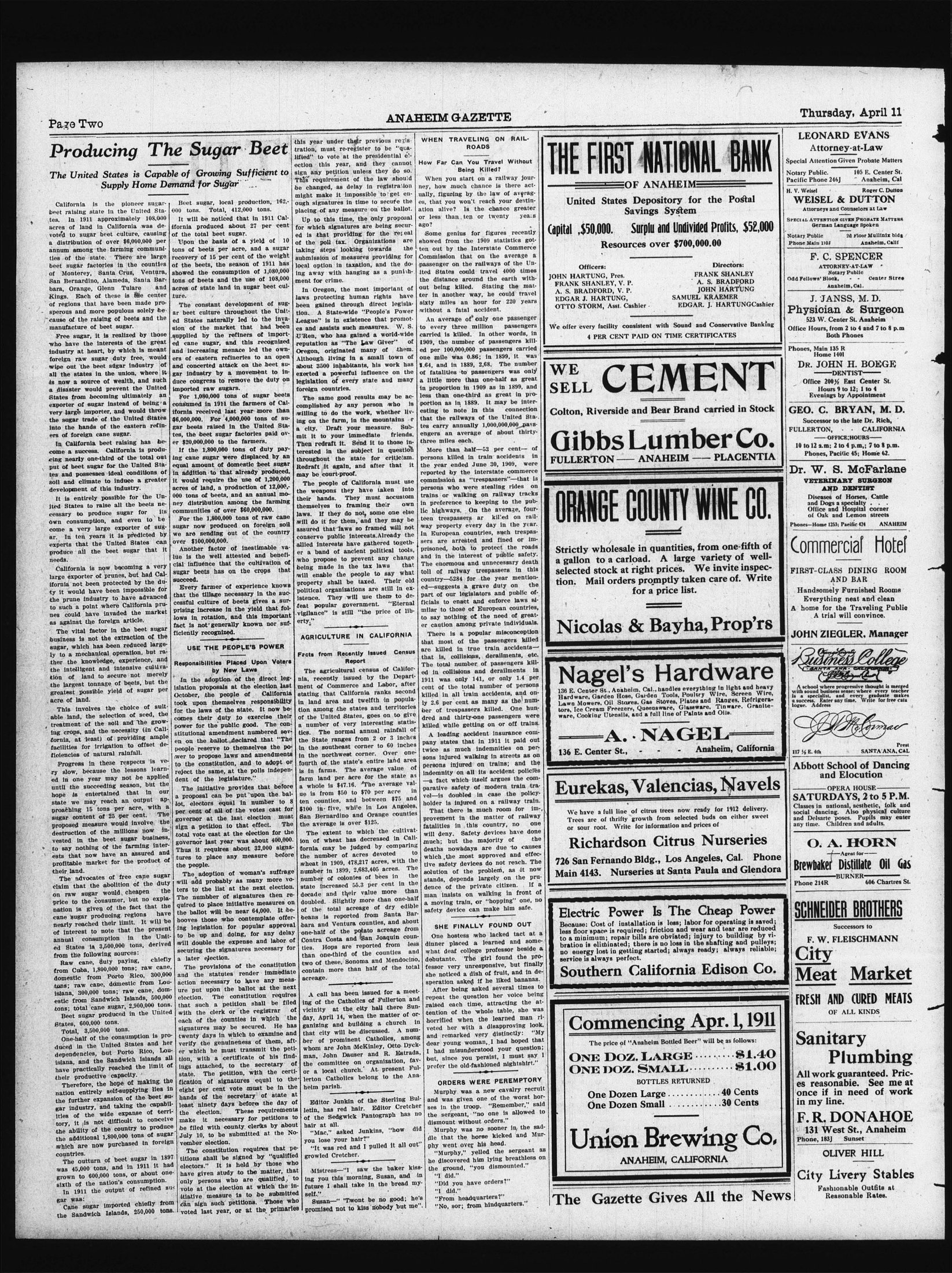
Searchable text
Producing The Sugar Beet
The United States is Capable of Growing Sufficient to Supply Home Demand for Sugar
California is the pioneer sugar beet raising state in the United States. In 1911 approximately 108,000 acres of land in California was devoted to sugar beet culture, causing a distribution of over $6,000,000 per annum among the farming communities of the state. There are large beet sugar factories in the counties of Monterey, Santa Cruz, Ventura, San Bernardino, Alameda, Santa Barbara, Orange, Glenn Tulare and Kings. Each of these is the center of regions that have been made prosperous and more populous solely because of the raising of beets and the manufacture of beet sugar.
Free sugar, it is realized by those who have the interests of the great industry at heart, by which is meant foreign raw sugar duty free, would wipe out the beet sugar industry of all the states in the union, where it is now a source of wealth, and such a disaster would prevent the United States from becoming ultimately an exporter of sugar instead of being a very large importer, and would throw the sugar trade of the United States into the hands of the eastern refiners of foreign cane sugar.
In California beet raising has become a success. California is producing nearly one-third of the total output of beet sugar for the United States and possesses ideal conditions of Beet sugar, local production, 162,000 tons. Total, 412,000 tons.
It will be noticed that in 1911 California produced about 27 per cent of the total beet sugar.
Upon the basis of a yield of 10 tons of beets per acre, and a sugar recovery of 15 per cent of the weight of the beets, the season of 1911 has showed the consumption of 1,080,000 tons of beets and the use of 108,000 acres of state land in sugar beet culture.
The constant development of sugar beet culture throughout the United States naturally led to the invasion of the market that had been supplied by the refiners of imported cane sugar, and this recognized and increasing menace led the owners of eastern refineries to an open and concerted attack on the beet sugar industry by a movement to induce congress to remove the duty on imported raw sugars.
For 1,080,000 tons of sugar beets consumed in 1911 the farmers of California received last year more than $6,000,000. For 4,000,000 tons of sugar beets raised in the United States, the beet sugar factories paid over $20,000,000 to the farmers.
If the 1,800,000 tons of duty paying cane sugar were displaced by an equal amount of domestic beet sugar in addition to that already produced,
this year under thetration, must re-reglified" to vote at the election this year, sign any petition uThis requirement could be changed, as del might make it important signatures in placing of any means.
Up to this time, for which signature is that providing of the poll tax. Taking steps looking submission of measure local option in taxing away with harmment for crime.
In Oregon, the laws protecting hu been gained through A State-wide League" is in existence and assists such U'Ren, who has given reputation as "The Oregon, originated Although living in about 3500 inhabita exerted a powerful legislation of every foreign countries.
The same good complished by any willing to do the ing on the farm, in a city. Draft you mit it to your im Then redraft it. S terested in the su throughout the st Reddraft it again, may be court-proof.
all the states in the union, where it is now a source of wealth, and such a disaster would prevent the United States from becoming ultimately an exporter of sugar instead of being a very large importer, and would throw the sugar trade of the United States into the hands of the eastern refiners of foreign cane sugar.
In California beet raising has become a success. California is producing nearly one-third of the total output of beet sugar for the United States and possesses ideal conditions of soil and climate to induce a greater development of this industry.
It is entirely possible for the United States to raise all the beets necessary to produce sugar for its own consumption, and even to become a very large exporter of sugar. In ten years it is predicted by experts that the United States can produce all the beet sugar that it needs.
California is now becoming a very large exporter of prunes, but had California not been protected by the duty it would have been impossible for the prune industry to have advanced to such a point where California prunes could have invaded the market as against the foreign article.
The vital factor in the beet sugar business is not the extraction of the sugar, which has been reduced largely to a mechanical operation, but rather the knowledge, experience, and the intelligent and intensive cultivation of land to secure not merely the largest tonnage of beets, but the greatest possible yield of sugar per acre of land.
This involves the choice of suitable land, the selection of seed, the treatment of the soil and the growing crops, and the necessity (in California, at least) of providing ample facilities for irrigation to offset deficiencies of natural rainfall.
Progress in these respects is very slow, because the lessons learned in one year may not be applied until the succeeding season, but the hope is entertained that in our state we may reach an output approaching 15 tons per acre, with a sugar content of 25 per cent. The proposed measure would involve the destruction of the millions now invested in the beet sugar business, to say nothing of the farming interests that now have an assured and profitable market for the product of their land.
The advocates of free cane sugar claim that the abolition of the duty on raw sugar would cheapen but no explainer industry by a movement to reduce congress to remove the duty on imported raw sugars.
For 1,080,000 tons of sugar beets consumed in 1911 the farmers of California received last year more than $6,000,000. For 4,000,000 tons of sugar beets raised in the United States, the beet sugar factories paid over $20,000,000 to the farmers.
If the 1,800,000 tons of duty paying cane sugar were displaced by an equal amount of domestic beet sugar in addition to that already produced, it would require the use of 1,200,000 acres of land, a production of 12,000,000 tons of beets, and an annual money distribution among the farming communities of over $60,000,000.
For the 1,800,000 tons of raw cane sugar now produced on foreign soil we are sending out of the country over $100,000,000.
Another factor of inestimable value is the well attested and beneficial influence that the cultivation of sugar beets has on the crops that succeed.
Every farmer of experience knows that the tillage necessary in the successful culture of beets gives a surprising increase in the yield that follows in rotation, and this important fact is not generally known nor sufficiently recognized.
USE THE PEOPLE'S POWER
Responsibilities Placed Upon Voters by New Laws
In the adoption of the direct legislation proposals at the election last October, the people of California took upon themselves responsibility for the laws of the state. It now becomes their duty to exercise their power for the public good. The constitutional amendment numbered seven on the ballot declared that "The people reserve to themselves the power to propose laws and amendments to the constitution, and to adopt or reject the same, at the polls independent of the legislature."
The initiative provides that before a proposal can be put upon the ballot, electors equal in number to 8 per cent of all of the votes cast for governor at the last election must sign a petition to that effect. The total vote cast at the election for the governor last year was about 400,000. Thus it requires about 32,000 signatures to place any measure before the people.
The adoption of woman's suffrage will add probably as many more voters to the list at the next election. The number of signatures then re-exerted a powerful legislative force on foreign countries.
The same goodwill complied by any willing to do this on farm in a city. Draft you mit it to your imminent redraft it. Sisterested in this superseded by Redraft it again, it may be court-proofed.
The people of California—the weapons they carry their hands. They themselves to fraternize laws. If they do so will do it for them assured that laws conserve public interest allied interests have er a band of anarchists who propose to pay being made in this will enable the property shall be political organization instance. They will feat popular government vigilance" is still pertinent."
state we may reach an output approaching 15 tons per acre, with a sugar content of 25 per cent. The proposed measure would involve the destruction of the millions now invested in the beet sugar business, to say nothing of the farming interests that now have an assured and profitable market for the product of their land.
The advocates of free cane sugar claim that the abolition of the duty on raw sugar would cheapen the price to the consumer, but no explanation is given of the fact that the cane sugar producing regions have nearly reached their limit. It will be of interest to note that the present annual consumption in the United States is 3,500,000 tons, derived from the following sources:
Raw cane, duty paying, chiefly from Cuba, 1,800,000 tons; raw cane, domestic from Porto Rico, 300,000 tons; raw cane, domestic from Louisiana, 300,000 tons; raw cane, domestic from Sandwich Islands, 500,000 tons; total cane sugar, 2,900,000 tons.
Beet sugar produced in the United States, 600,000 tons.
Total, 3,500,000 tons.
One-half of the consumption is produced in the United States and her dependencies, but Porto Rico, Louisiana, and the Sandwich Islands all have practically reached the limit of their productive capacity.
Therefore, the hope of making the nation entirely self-supplying lies in the further expansion of the beet sugar industry, and taking the capabilities of the wide expanse of territory, it is not difficult to conceive the ability of the country to produce the additional 1,800,000 tons of sugar which are now purchased in foreign countries.
The outturn of beet sugar in 1897 was 45,000 tons, and in 1911 it had grown to 600,000 tons, or about one-sixth of the nation's consumption.
In 1911 the output of refined sugar was:
Cane sugar imported chiefly from the Sandwich Islands, 250,000 tons.
The adoption of woman's suffrage will add probably as many more voters to the list at the next election. The number of signatures then required to place initiative measures on the ballot will be near 64,000. It behoves those who contemplate offering legislation for popular approval to be up and doing, for any delay will double the expense and labor of securing the signatures necessary for a later election.
The provisions of the constitution and the statutes render immediate action necessary to have any measure put upon the ballot at the next election. The constitution requires that such a petition shall be filed with the clerk or the registrar of each of the counties in which the signatures may be secured. He has twenty days in which to examine and verify the genuineness of them, after which he must transmit the petition, with a certificate of his findings attached, to the secretary of state. The petition, with the certification of signatures equal to eight per cent vote must be in the hands of the secretary of state at least ninety days before the day of the election. These requirements make it necessary for petitions to be filed with county clerks by about July 10, to be submitted at the November election.
The constitution requires that petitions shall be signed by "qualified electors." It is held by those who have given study to the matter, that only persons who are qualified to vote at the election at which the initiative measure is to be submitted can sign such petitions. Those who voted last year, or at the primaries lot, electors equal in number to 8 per cent of all of the votes cast for governor at the last election must sign a petition to that effect. The total vote cast at the election for the governor last year was about 400,000. Thus it requires about 32,000 signatures to place any measure before the people.
The extent to its application of wheat has fornia may be just the number of acres wheat in 1909, 478 number in 1899, 23 number of colonies state increased five decade and their doubled. Slightly of the total acres beans is reported bara and Ventura one-half of the population Contra Costa and ties. Hops are less than one-third or two of these. Some contain more than acreage.
A call has been made of the Catholic vicinity at the day April 14, whi ganizing and bu t that city will be ber of prominence whom are John M man, John Daus s,the committee o r a local church lerton Catholics heim parish.
Editor Junkin letin, has red ha w of the Sedgwick hair at all.
"Mac," asked you lose your ha w "It was red an growled Cretcher
Mistress—"I ing you this mo future I shall ta self."
Susan—"Two promised not to
ANAHEIM GAZETTE
this year under their previous registration, must re-register to be "qualified" to vote at the presidential election this year, and they cannot sign any petition unless they do so. This requirement of the law should be changed, as delay in registration might make it impossible to get enough signatures in time to secure the placing of any measure on the ballot.
Up to this time, the only proposal for which signatures are being secured is that providing for the repeal of the poll tax. Organizations are taking steps looking towards the submission of measures providing for local option in taxation, and the doing away with hanging as a punishment for crime.
In Oregon, the most important of laws protecting human rights have been gained through direct legislation. A State-wide "People's Power League" is in existence that promotes and assists such measures. W. S. U'Ren, who has gained a world-wide reputation as "The Law Giver" of Oregon, originated many of them. Although living in a small town of about 3500 inhabitants, his work has exerted a powerful influence on the legislation of every state and many foreign countries.
The same good results may be accomplished by any person who is willing to do the work, whether living on the farm, in the mountains or a city. Draft your measure. Submit it to your immediate friends. Then redraft it. Send it to those interested in the subject in question throughout the state for criticism. Redraft it again, and after that it may be court-proof.
WHEN TRAVELING ON RAILROADS
How Far Can You Travel Without Being Killed?
When you start on a railway journey, how much chance is there actually, figuring by the law of averages, that you won't reach your destination alive? Is the chance greater or less than ten or twenty years ago?
Some genius for figures recently showed from the 1909 statistics gotten out by the Interstate Commerce Commission that on the average a passenger on the railways of the United States could travel 4000 times the distance around the earth without being killed. Stating the matter in another way, he could travel sixty miles an hour for 220 years without a fatal accident.
An average of only one passenger to every three million passengers carried is killed. In other words, in 1909, the number of passengers killed per 100,000,000 passengers carried one mile was 0.86; in 1899, it was 1.64, and in 1889, 2.68. The number of fatalities to passengers was only a little more than one-half as great in proportion in 1909 as in 1899, and less than one-third as great in proportion as in 1889. It may be interesting to note in this connection that the railways of the United States carry annually 1,000,000,000 passengers an average of about thirty-three miles each.
More than half—53 per cent—of persons killed in train accidents in the year ended June 30, 1909, were reported by the interstate commerce
AGRICULTURE IN CALIFORNIA
Facts from Recently Issued Census Report
The agricultural census of California, recently issued by the Department of Commerce and Labor, after stating that California ranks second in land area and twelfth in population among the states and territories of the United States, goes on to give a number of very interesting statistics. The normal annual rainfall of the State ranges from 2 or 3 inches in the southeast corner to 60 inches in the northwest corner. Over one-fourth of the state's entire land area is in farms. The average value of farm land per acre for the state as a whole is $47.16. The average value is from $50 to $70 per acre in ten counties, and between $75 and $100 in five, while in Los Angeles, San Bernardino and Orange counties the average is over $125.
The extent to which the cultivation of wheat has decreased in California may be judged by comparing the number of acres devoted to wheat in 1909, 478,217 acres, with the number in 1899, 2,683,405 acres. The number of colonies of bees in the state increased 55.3 per cent in the decade and their value more than exerted a powerful influence on the legislation of every state and many foreign countries.
The same good results may be accomplished by any person who is willing to do the work, whether living on the farm, in the mountains or a city. Draft your measure. Submit it to your immediate friends. Then redraft it. Send it to those interested in the subject in question throughout the state for criticism. Redraft it again, and after that it may be court-proof.
The people of California must use the weapons they have taken into their hands. They must accustom themselves to framing their own laws. If they do not, some one else will do it for them, and they may be assured that laws so framed will not conserve public interests. Already the allied interests have gathered together a band of ancient political tools, who propose to prevent any change being made in the tax laws that will enable the people to say what property shall be taxed. Their old political organizations are still in existence. They will use them to defeat popular government. "Eternal vigilance" is still "the price of liberty."
More than half—53 per cent—of persons killed in train accidents in the year ended June 30, 1909, were reported by the interstate commerce commission as "trespassers"—that is persons who were stealing rides on trains or walking on railway tracks in preference to keeping to the public highways. On the average, fourteen trespassers ar killed on railway property every day in the year. In European countries, such trespassers are arrested and fined or imprisoned, both to protect the roads and in the interest of public safety. The enormous and unnecessary death toll of railway trespassers in this country—5284 for the year mentioned—suggests a grave duty on the part of our legislators and public officials to enact and enforce laws similar to those of European countries, to say nothing of the need of greater caution among private individuals.
There is a popular misconception that most of the passengers killed are killed in true train accidents—that is, collisions, derailments, etc. The total number of passengers killed in collisions and derailments in 1911 was only 141, or only 1.4 per cent of the total number of persons killed in all train accidents, and only 2.6 per cent as many as the number of trespassers killed. One hundred and thirty-one passengers were killed while getting on or off trains.
A leading accident insurance company states that in 1911 it paid out twice as much indemnities on persons injured walking in streets as on persons injured on trains; and the indemnity on all its accident policies—a fact which itself argues the comparative safety of modern train travel—is doubled in case the policyholder is injured on a railway train.
That there is much room for improvement in the matter of railway fatalities in this country, no one will deny. Safety devices have done much; but the majority of the deaths nowadays are due to causes which the most approved and effective safety devices do not reach. The solution of the problem, as it now stands, depends largely on the prudence of the private citizen. If a man insists on walking in front of
The extent to which the cultivation of wheat has decreased in California may be judged by comparing the number of acres devoted to wheat in 1909, 478,217 acres, with the number in 1899, 2,683,405 acres. The number of colonies of bees in the state increased 55.3 per cent in the decade and their value more than doubled. Slightly more than one-half of the total acreage of dry edible beans is reported from Santa Barbara and Ventura counties, and about one-half of the potato acreage from Contra Costa and San Joaquin counties. Hops are reported from less than one-third of the counties and two of these, Sonoma and Mendocino, contain more than half of the total acreage.
A call has been issued for a meeting of the Catholics of Fullerton and vicinity at the city hall there Sunday, April 14, when the matter of organizing and building a church in that city will be discussed. A number of prominent Catholics, among whom are John McKinley, Otto Dyckman, John Dauser and R. Estrada, the committee on organization, favor a local church. At present Fullerton Catholics belong to the Anaheim parish.
Editor Junkin of the Sterling Bulletin, has red hair. Editor Cretcher of the Sedgwick Pantograph has no hair at all.
"Mac," asked Junkins, "how did you lose your hair?"
"It was red and I pulled it all out" growled Cretcher.
Mistress—"I saw the baker kissing you this morning, Susan, and in future I shall take in the bread myself."
Susan—"Twont be no good; he's promised not to kiss nobody but me."
That there is much room for improvement in the matter of railway fatalities in this country, no one will deny. Safety devices have done much; but the majority of the deaths nowadays are due to causes which the most approved and effective safety devices do not reach. The solution of the problem, as it now stands, depends largely on the prudence of the private citizen. If a man insists on walking in front of a moving train, or "hopping" one, no safety device can make him safe.
SHE FINALLY FOUND OUT
One hostess who lacked tact at a dinner placed a learned and somewhat deaf college professor beside a debutante. The girl found the professor very unresponsive, but finally she noticed a dish of fruit, and in desperation asked if he liked bananas.
After being asked several times to repeat the question her voice being raised each time, attracting the attention of the whole table, she was horrified when the learned man rived her with a disapproving look, and remarked very distinctly: "My dear young woman, I had hoped that I had misunderstood your question; but, since you persist, I must say I prefer the old-fashioned nightshirt."
ORDERS WERE PEREMPTORY
Murphy was a new cavalry recruit and was given one of the worst horses in the troop. "Remember," said the sergeant, "no one is allowed to dismount without orders."
Murphy was no sooner in the saddle that the horse kicked and Murphy went over his head.
"Murphy," yelled the sergeant as he discovered him lying breathless on the ground, "you dismounted."
"I did."
"Did you have orders?"
"I did."
"From headquarters?"
"No, sor; from hindquarters."
THURSDAY, April 11
FIRST NATIONAL BANK
OF ANAHEIM
States Depository for the Postal Savings System
$000. Surplus and Undivided Profits, $52,000
Resources over $700,000.00
Directors:
ING, Pres.
NLEY, V. P.
ORD, V. P.
ARTUNG,
M, Asst. Cashier
FRANK SHANLEY
A. S. BRADFORD
JOHN HARTUNG
SAMUEL KRAEMER
EDGAR. J. HARTUNGCashier
facility consistent with Sound and Conservative Banking
PER CENT PAID ON TIME CERTIFICATES
CEMENT
Riverside and Bear Brand carried in Stock
Lumber Co.
ANAHEIM — PLACENTIA
LEONARD EVANS
Attorney-at-Law
Special Attention Given Probate Matters
Notary Public. 105 E. Center St.
Pacific Phone 246J Anaheim, Cal
H. V. Weisel Roger C. Dutton
WEISEL & DUTTON
Attorneys and Counselors at Law
SPECIAL ATTENTION GIVEN PROBATE MATTERS
German Language Spoken
Notary Public 2d Floor Mullinix bldg
Phone Main 110J Anaheim, Cal
F. C. SPENCER
ATTORNEY-AT-LAW
Notary Public
Odd Fellows' Block, Center Street
Anaheim, Cal.
J. JANSS, M. D.
Physician & Surgeon
523 W. Center St. Anaheim
Office Hours, from 2 to 4 and 7 to 8 p.m
Both Phones
Phones, Main 135 R
Home 140l
DR. JOHN H. BOEGE
DENTIST
Office 200½ East Center St.
Hours 9 to 12; 1 to 4
Evenings by Appointment
GEO. C. BRYAN, M. D.
Successor to the late Dr. Rich,
FULLERTON, CALIFORNIA
OFFICE;HOURS—
10 to 12 a.m; 2 to 4 p.m.; 7 to 8 p.m.
Phones, Pacific 45; Home 62.
Dr. W. S. McFarlane
CEMENT
Riverside and Bear Brand carried in Stock
Lbs Lumber Co.
TON — ANAHEIM — PLACENTIA
GE COUNTY WINE CO.
wholesale in quantities, from one-fifth of to a carload. A large variety of well-stock at right prices. We invite inspections promptly taken care of. Write for a price list.
olas & Bayha, Prop'rs
gel's Hardware
St., Anaheim, Cal., handles everything in light and heavy garden hose, Garden Tools, Poultry Wire, Screen Wire, Oil Stoves, Gas Stoves, Plates and Ranges, Refrigerators, Freezers, Queensware, Glassware, Tinware. Granite-Utensils, and a full line of Paints and Oils.
A. NAGEL
Center St., Anaheim, California
kas, Valencias, Navels
a full line of citrus trees now ready for 1912 delivery. Of thrifty growth from selected buds on either sweet root. Write for information and prices of
Hardson Citrus Nurseries
fernando Bldg., Los Angeles, Cal. Phone
B. Nurseries at Santa Paula and Glendora
DENTIST
Office 200½ East Center St.
Hours 9 to 12; 1 to 4
Evenings by Appointment
GEO. C. BRYAN, M. D.
Successor to the late Dr. Rich,
FULLERTON, CALIFORNIA
OFFICE; HOURS
10 to 12 a.m.; 2 to 4 p.m.; 7 to 8 p.m.
Phones, Pacific 45; Home 62.
Dr. W. S. McFarlane
VETERINARY SURGEON AND DENTIST
Diseases of Horses, Cattle and Dogs a specialty...
Office and Hospital corner of Oak and Lemon streets
Phones—Home 1253; Pacific 424 ANAHEIM
Commercial Hotel
FIRST-CLASS DINING ROOM AND BAR
Handsomely Furnished Rooms Everything neat and clean A home for the Traveling Public A trial will convince.
JOHN ZIEGLER, Manager
Business College
A school where progressive thought is merged with sound business sense; where every teacher is a specialist, and every graduate makes a success. Enter any time. Write for free cata logue. Address
Prest
117 ½ E. 4th
SANTA ANA, CAL
Abbott School of Dancing and Elocution
OPERA HOUSE
SATURDAYS, 2 to 5 P.M.
Classes in national, aesthetic, folk and social dancing. Also physical culture and Delsarte poses. Pupils may enter any time. Children and adults.
O. A. HORN
Agent for
Brewbaker Distillate Oil Gas
BURNER
Phone 214R 606 Chartres St.
a full line of citrus trees now ready for 1912 delivery.
of thrifty growth from selected buds on either sweet
root. Write for information and prices of
Hardson Citrus Nurseries
Fernando Bldg., Los Angeles, Cal. Phone
B. Nurseries at Santa Paula and Glendora
Power Is The Cheap Power
cost of installation is less; labor for operating is saved;
ace is required; friction and wear and tear are reduced
um; repair bills are obviated; injury to building by viliminated; there is no loss in the shafting and pulleys;
lost in getting started; always ready; always reliable;
always perfect.
Southern California Edison Co.
Immencing Apr. 1, 1911
The price of "Anaheim Bottled Beer" will be as follows:
E DOZ. LARGE $1.40
E DOZ. SMALL $1.00
BOTTLES RETURNED
One Dozen Large 40 Cents
One Dozen Small 30 Cents
Union Brewing Co.
ANAHEIM, CALIFORNIA
Gazette Gives All the News
SATURDAYS, 2:10 P.M.
Classes in national, aesthetic, folk and social dancing. Also physical culture and Delsarte poses. Pupils may enter any time. Children and adults.
O. A. HORN
Agent for
Brewbaker Distillate Oil Gas
BURNER
Phone 214R 606 Chartres St.
SCHNEIDER BROTHERS
Successors to
F. W. FLEISCHMANN
City Meat Market
FRESH AND CURED MEATS
OF ALL KINDS
Sanitary Plumbing
All work guaranteed. Prices reasonable. See me at once if in need of work in my line.
F. R. DONAHOE
131 West St., Anaheim
Phone, 183J Sunset
OLIVER HILL
City Livery Stables
Fashionable Outfits at Reasonable Rates.