anaheim-gazette 1912-03-28
Scanned page
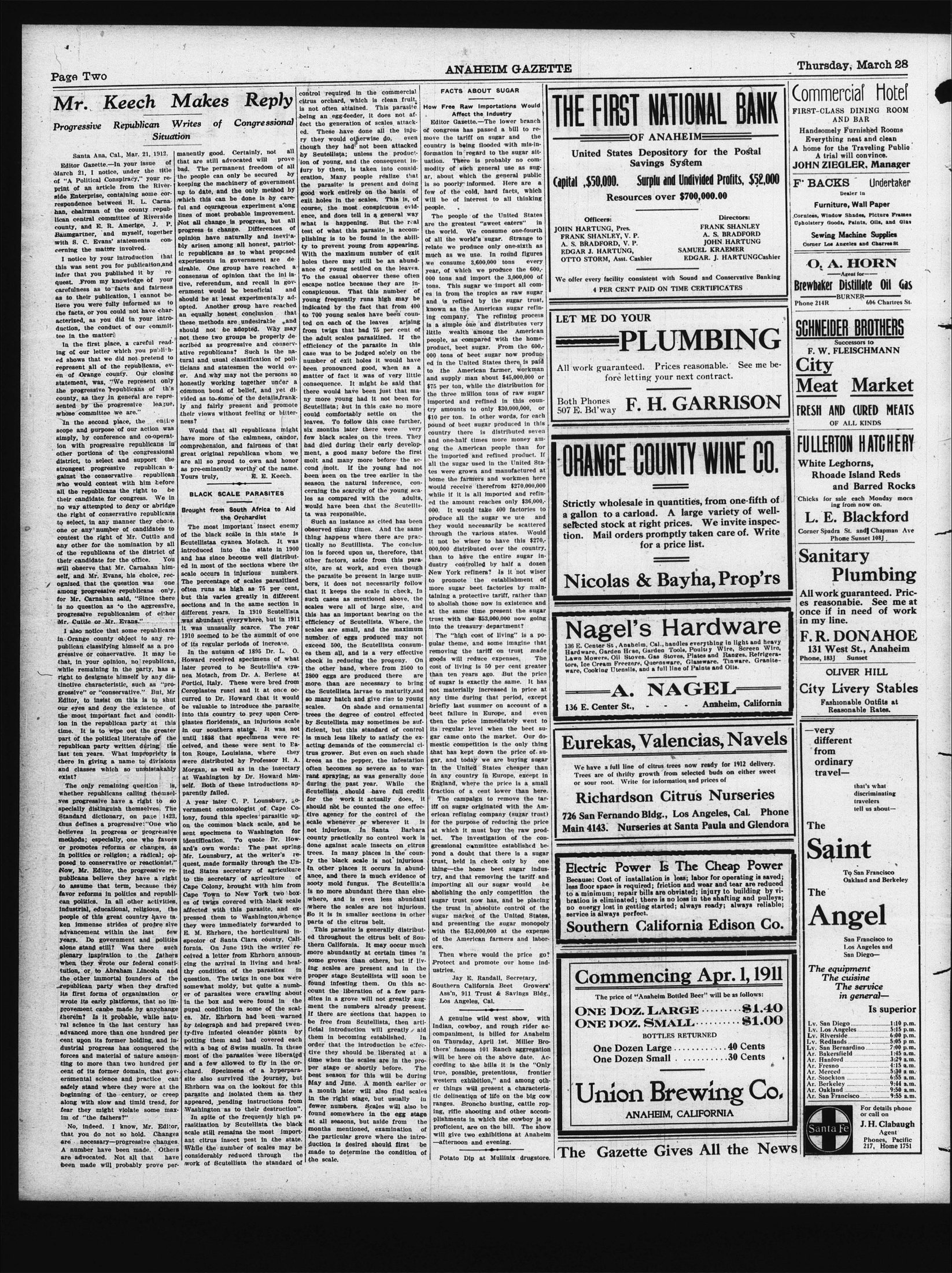
Searchable text
Mr. Keech Makes Reply
Progressive Republican Writes of Congressional Situation
Santa Ana, Cal., Mar. 21, 1912.
Editor Gazette.—In your issue of March 21, I notice, under the title of "A Political Conspiracy," your reprint of an article from the Riverside Enterprise, containing some correspondence between H. L. Carnahan, chairman of the county republican central committee of Riverside county, and E. R. Amerige, J. P. Baumgartner, and myself, together with S. C. Evans' statements concerning the matter involved.
I notice by your introduction that this was sent you for publication, and infer that you published it by request. From my knowledge of your carefulness as to facts and fairness as to their publication, I cannot believe you were fully informed as to the facts, or you could not have characterized, as you did in your introduction, the conduct of our committee in the matter.
In the first place, a careful reading of our letter which you published shows that we did not pretend to represent all of the republicans, even of Orange county. Our closing statement, was, "We represent only the progressive republicans of this county, as they in general are represented by the progressive league, whose committee we are."
In the second place, the entire scope and purpose of our action was simply, by conference and co-operation with progressive republicans in other portions of the congressional district, to select and support the strongest progressive republican advocate in the conservative republican control required citrus orchard, which is not often attained being an egg-feeded effect the generation ed. These have very they would otherwise though they had by Scutellista; union of young, and fury by them, is eration, Many the parasite is good work entire exit holes in the course, the mossence, and does to what is happen test of what this plishing is to be able to prevent you.
With the maximum holes there mayance of young se To the casual escape notice be conspicuous. The young frequently indicated by them to 700 young scaled on each of from twigs that the adult scales efficiency of the case was to be number of exit been pronounced matter of fact consequence. It there would have ny more young Scutellista; but could comfortable leaves. To follow six months later few black scales had died during ment, a good molt and many cond molt. If
In the second place, the entire scope and purpose of our action was simply, by conference and co-operation with progressive republicans in other portions of the congressional district, to select and support the strongest progressive republican against the conservative republican who would contest with him before all the republicans the right to be their candidate for congress. We in no way attempted to deny or abridge the right of conservative republicans to select, in any manner they chose, one or any number of candidates to contest the right of Mr. Cuttle and any other for the nomination by all of the republicans of the district of their candidate for the office. You will observe that Mr. Carnahan himself, and Mr. Evans, his choice, recognized that the question was one among progressive republicans only, for Mr. Carnahan said, "Since there is no question as to the aggressive, progressive republicanism of either Mr. Cuttle or Mr. Evans."
I also notice that some republicans in Orange county object to any republican classifying himself as a progressive or conservative. It may be that, in your opinion, no republican, while remaining in the party, has a right to designate himself by any distinctive characteristic, such as "progressive" or "conservative." But, Mr. Editor, to insist on this is to shut our eyes and deny the existence of the most important fact and condition in the republican party at this time. It is to wipe out the greater part of the political literature of the republican party written during the last ten years. What impropriety is there in giving a name to divisions and classes which so unmistakably exist?
The only remaining question is whether republicans calling themselves progressive have a right to so specially distinguish themselves. The Standard dictionary, on page 1423, thus defines a progressive: "One who believes in progress or progressive methods; especially, one who favors or promotes reforms or changes, as in politics or religion; a radical; opposed to conservative or reactionist." Now, Mr. Editor, the progressive republicans believe they have a right to assume that term, because they favor reforms in politics and republican statement, was, "We represent only the progressive republicans of this county, as they in general are represented by the progressive league, whose committee we are."
In the second place, the entire scope and purpose of our action was simply, by conference and co-operation with progressive republicans in other portions of the congressional district, to select and support the strongest progressive republican against the conservative republican who would contest with him before all the republicans the right to be their candidate for congress. We in no way attempted to deny or abridge the right of conservative republicans to select, in any manner they chose, one or any number of candidates to contest the right of Mr. Cuttle and any other for the nomination by all of the republicans of the district of their candidate for the office. You will observe that Mr. Carnahan himself, and Mr. Evans, his choice, recognized that the question was one among progressive republicans only, for Mr. Carnahan said, "Since there is no question as to the aggressive, progressive republicanism of either Mr. Cuttle or Mr. Evans."
I also notice that some republicans in Orange county object to any republican classifying himself as a progressive or conservative. It may be that, in your opinion, no republican, while remaining in the party, has a right to designate himself by any distinctive characteristic, such as "progressive" or "conservative." But, Mr. Editor, to insist on this is to shut our eyes and deny the existence of the most important fact and condition in the republican party at this time. It is to wipe out the greater part of the political literature of the republican party written during the last ten years. What impropriety is there in giving a name to divisions and classes which so unmistakably exist?
The only remaining question is whether republicans calling themselves progressive have a right to so specially distinguish themselves. The Standard dictionary, on page 1423, thus defines a progressive: "One who believes in progress or progressive methods; especially, one who favors or promotes reforms or changes, as in politics or religion; a radical; opposed to conservative or reactionist." Now, Mr. Editor, the progressive republicans believe they have a right to assume that term, because they favor reforms in politics and republican statement, was, "We represent only the progressive republicans of this county, as they in general are represented by the progressive league, whose committee we are."
In the second place, the entire scope and purpose of our action was simply, by conference and co-operation with progressive republicans in other portions of the congressional district, to select and support the strongest progressive republican against the conservative republican who would contest with him before all the republicans the right to be their candidate for congress. We in no way attempted to deny or abridge the right of conservative republicans to select, in any manner they chose, one or any number of candidates to contest the right of Mr. Cuttle and any other for the nomination by all of the republicans of the district of their candidate for the office. You will observe that Mr. Carnahan himself, and Mr. Evans, his choice, recognized that the question was one among progressive republicans only, for Mr. Carnahan said, "Since there is no question as to the aggressive, progressive republicanism of either Mr. Cuttle or Mr. Evans."
I also notice that some republicans in Orange county object to any republican classifying himself as a progressive or conservative. It may be that, in your opinion, no republican, while remaining in the party, has a right to designate himself by any distinctive characteristic, such as "progressive" or "conservative." But, Mr. Editor, to insist on this is to shut our eyes and deny the existence of the most important fact and condition in the republican party at this time. It is to wipe out the greater part of the political literature of the republican party written during the last ten years. What impropriety is there in giving a name to divisions and classes which so unmistakably exist?
The only remaining question is whether republicans calling themselves progressive have a right to so specially distinguish themselves. The Standard dictionary, on page 1423, thus defines a progressive: "One who believes in progress or progressive methods; especially, one who favors or promotes reforms or changes, as in politics or religion; a radical; opposed to conservative or reactionist." Now, Mr. Editor, the progressive republicans believe they have a right to assume that term, because they favor reforms in politics and republican statement, was, "We represent only the progressive repUBLICANS OF THIS COUNTY AS YOU INGREDIENT OF THE REPUBLICAN PARTY OBJECTED TO BE THEIR CANDIDATE FOR CONGRESS."
In the autumn of 1895 Dr. L. O. Howard received specimens of what later proved to be Scutellista cyanea Motsch, from Dr. A. Berlese at Portici, Italy. These were bred from Ceroplastes rusci and it at once occurred to Dr. Howard that it would be valuable to introduce the parasite into this country to prey upon Ceroplastes floridensis, an injurious scale in our southern states. It was not until 1898 that specimens were received, and these were sent to Eaton Rouge, Louisiana, where they were distributed by Professor H. A. Morgan, as well as in the insectary at Washington by Dr. Howard himself. Both of these introductions apparently failed.
A year later C. P. Lounsbury, government entomologist of Cape Colony, found this species parasitic upon the common black scale, and he sent specimens to Washington for identification. To quote Dr. Howard's own words: The past spring Mr. Lounsbury, at the writer's request made formally through the United States secretary of agriculture to the secretary of agriculture of Cape Colony, brought with him from Cape Town to New York two box-trees.
Such an instance observed many times happens without scarcity no Scutellion is forced up other factors; as site are at work the parasite be seen it does not that it keeps such cases as no scales were all this has an impaired efficiency of Scutelliais are small number of eggs exceed 500; these them all; and check in reducibility other hand; 2800 eggs are more than are Scutelliais so many hatch scales.
On these trees the degree by Scutelliais sufficient; but this is much less likely acting demands truus grower. But trees as the period spraying; during the passage Scutelliais show for the work should not be active agency for scale whenever not injurious.
County practical done against so trees. In many tythe black silt In other places ance; and there sooty mold fun is no more abu where and is
ves progressive have a right to so specially distinguish themselves. The Standard dictionary, on page 1423, thus defines a progressive: "One who believes in progress or progressive methods; especially, one who favors or promotes reforms or changes, as in politics or religion; a radical; opposed to conservative or reactionist." Now, Mr. Editor, the progressive republicans believe they have a right to assume that term, because they favor reforms in politics and republican politics. In all other activities, industrial, educational, religious, the people of this great country have taken immense strides of progressive advancement within the last few years. Do government and politics alone stand still? Was there such plenary inspiration to the fathers when they wrote our federal constitution, or to Abraham Lincoln and the other immortal founders of the republican party when they drafted its first forms of organization or wrote its early platforms, that no improvement can be made by any change therein? Is it probable, while natural science in the last century has advanced more than one hundred per cent upon its former holding, and industrial progress has conquered the forces and material of nature amounting to more than two hundred per cent of its former domain, that governmental science and practice can safely stand where they were at the beginning of the century, or creep along with slow and timid tread, for fear they might violate some maxim of "the fathers?" No, indeed. I know, Mr. Editor, that you do not so hold. Changes are necessary—progressive changes. A number have been made. Others are advocated. Not all that have been made will probably prove per-
A year later C. P. Lounsbury, government entomologist of Cape Colony, found this species parasitic upon the common black scale, and he sent specimens to Washington for identification. To quote Dr. Howard's own words: The past spring Mr. Lounsbury, at the writer's request, made formally through the United States secretary of agriculture to the secretary of agriculture of Cape Colony, brought with him from Cape Town to New York two boxes of twigs covered with black scale affected with this parasite, and expressed them to Washington, whence they were immediately forwarded to E. M. Ehrhorn, the horticultural inspector of Santa Clara county, California. On June 19th the writer received a letter from Ehrhorn announcing the arrival in living and healthy condition of the parasites in question. The twigs in one box were somewhat moldy, but quite a number of parasites were crawling about in the box and were found in the pupal condition in some of the scales. Mr. Ehrhorn had been warned by telegraph and had prepared twenty-five infested oleander plants by potting them and had covered each with a bag of Swiss muslin. In these most of the parasites were liberated and a few allowed to fly in the orchard. Specimens of a hyperparasite also survived the journey, but Ehrhorn was on the lookout for this parasite and isolated them as they appeared, pending instructions from Washington as to their destruction.
In spite of the frequently high parasitization by Scutellista the black scale still remains the most important citrus insect pest in the state. While the number of scales may be considerably reduced through the work of Scutellista the standard of
ANAHEIM GAZETTE
FACTS ABOUT SUGAR
How Free Raw Importations Would Affect the Industry
Editor Gazette.—The lower branch of congress has passed a bill to remove the tariff on sugar and the country is being flooded with mis-information in regard to the sugar situation. There is probably no commodity of such general use as sugar, about which the general public is so poorly informed. Here are a few of the cold, hard facts, which will be of interest to all thinking people.
The people of the United States are the greatest "sweet eaters" in the world. We consume one-fourth of all the world's sugar. Strange to relate we produce only one-sixth as much as we use. In round figures we consume 3,600,000 tons every year, of which we produce the 600,000 tons and import the 3,000,000 of tons. This sugar we import all comes in from the tropics as raw sugar and is refined by the sugar trust, known as the American sugar refining company. The refining process is a simple one and distributes very little wealth among the American people, as compared with the home-product, beet sugar. From the 600,000 tons of beet sugar now produced in the United States there is paid to the American farmer, workman and supply man about $45,000,000 or $75 per ton, while the distribution for the three million tons of raw sugar imported and refined in this country amounts to only $30,000,000, or $10 per ton. In other words, for each pound of beet sugar produced in this country there is distributed seven and one-half times more money among the American people than for the imported and refined product. If all the sugar used in the United States were grown and manufactured at
matter of fact it was of very little consequence. It might be said that there would have been just that many more young had it not been for Scutellista; but in this case no more could comfortably settle on the leaves. To follow this case further, six months later there were very few black scales on the trees. They had died during their early development, a good many before the first molt and many more before the second molt. If the young had not been seen on the tree earlier in the season the natural inference, concerning the scarcity of the young scales as compared with the adults, would have been that the Scutellista was responsible.
Such an instance as cited has been observed many times. And the same thing happens where there are practically no Scutellista. The conclusion is forced upon us, therefore, that other factors, aside from this parasite, are at work, and even though the parasite be present in large numbers, it does not necessarily follow that it keeps the scale in check. In such cases as mentioned above, the scales were all of large size, and this has an important bearing on the efficiency of Scutellista. Where the scales are small, and the maximum number of eggs produced may not exceed 500, the Scutellista consumes them all, and is a very effective check in reducing the progeny. On the other hand, where from 2500 to 2800 eggs are produced there are more than are necessary to bring the Scutellista larvae to maturity, and so many hatch and give rise to young scales. On shade and ornamental trees the degree of control effected by Scutellista may sometimes be sufficient, but this standard of control is much less likely to satisfy the exacting demands of the commercial citrus grower. But even on such shade trees as the pepper, the infestation often becomes so severe as to warrant spraying, as was generally done during the past year. While the Scutellista should have full credit for the work it actually does, it should not be counted the one effective agency for the control of the scale whenever or wherever it is not injurious. In Santa Barbara county practically no control work is done against scale insects on citrus trees. In many places in the county the black scale is not injurious. In other places it occurs in abundance, and there is much evidence of sooty mold fungus. The Scutellista is no more abundant there than elsewhere, and is even less abundant and supply man about $45,000,000 or $75 per ton, while the distribution for the three million tons of raw sugar imported and refined in this country amounts to only $30,000,000, or $10 per ton. In other words, for each pound of beet sugar produced in this country there is distributed seven and one-half times more money among the American people than for the imported and refined product. If all the sugar used in the United States were grown and manufactured at home the farmers and workmen here would receive therefrom $270,000,000 while if it is all imported and refined the amount reaches only $36,000,-000. It would take 400 factories to produce all the sugar we use and they would necessarily be scattered through the various states. Would it not be wiser to have this $270,-000,000 distributed over the country, than to have the entire sugar industry controlled by half a dozen New York refiners? Is it not wiser to promote the establishment of more sugar beet factories by maintaining a protective tariff, rather than to abolish those now in existence and at the same time present the sugar trust with the $53,000,000 now going into the treasury department?
The "high cost of living" is a popular theme, and some imagine that removing the tariff on trust made goods will reduce expenses. The cost of living is 50 per cent greater than ten years ago. But the price of sugar is exactly the same. It has not materially increased in price at any time during that period, except briefly last summer on account of a beet failure in Europe, and even then the price immediately went to its regular level when the beet sugar came onto the market. Our domestic competition is the only thing that has kept down the price of sugar, and today we are buying sugar in the United States cheaper than in any country in Europe, except in England, where the price is a small fraction of a cent lower than here.
The campaign to remove the tariff on sugar originated with the American refining company (sugar trust) for the purpose of reducing the price at which it must buy the raw product. The investigation of the congressional committee established beyond a doubt that there is a sugar trust, held in check only by one thing—the home beet sugar industry, and that removing the tariff and importing all our sugar would be abolishing the only competition the sugar trust now has and be placing...
for the work it actually does, it should not be counted the one effective agency for the control of the scale whenever or wherever it is not injurious. In Santa Barbara county practically no control work is done against scale insects on citrus trees. In many places in the county the black scale is not injurious. In other places it occurs in abundance, and there is much evidence of sooty mold fungus. The Scutellista is no more abundant there than elsewhere, and is even less abundant where the scales are not injurious. So it is in smaller sections in other parts of the citrus belt.
This parasite is generally distributed throughout the citrus belt of Southern California. It may occur much more abundantly at certain times in some groves than others, but if living scales are present and in the proper stage Scutellista will soon be found infesting them. On this account the liberation of a few parasites in a grove will not greatly augment the numbers already present. If there are sections that happen to be free from Scutellista, then artificial introduction will greatly aid them in becoming established. In order that the introduction be effective they should be liberated at a time when the scales are in the proper stage or shortly before. The best season for this will be during May and June. A month earlier or a month later will also find scales in the right stage, but usually in fewer numbers. Scales will also be found somewhere in the egg stage at all seasons, but aside from the months mentioned, examination of the particular grove where the introduction is desired should first be made to determine the condition of the scale.
The campaign to remove the tariff on sugar originated with the American refining company (sugar trust) for the purpose of reducing the price at which it must buy the raw product. The investigation of the congressional committee established beyond a doubt that there is a sugar trust, held in check only by one thing—the home beet sugar industry, and that removing the tariff and importing all our sugar would be abolishing the only competition the sugar trust now has, and be placing the trust in absolute control of the sugar market of the United States, and presenting the sugar monopoly with the $53,000,000 at the expense of the American farmers and laborers.
Then where would the price go? Protect and promote our home industries.
Jay E. Randall, Secretary,
Southern California Beet Growers'
Ass'n, 911 Trust & Savings Bldg., Los Angeles, Cal.
A genuine wild west show, with Indian, cowboy, and rough rider accompaniment, is billed for Anaheim on Thursday, April 1st. Miller Brothers' famous 101 Ranch aggregation will be here on the above date. According to the bills it is the "Only true, possible, pretentious, frontier western exhibition," and among other things will present a characteristic delineation of life on the big cow ranges. Broncho busting, cattle roping, rifle shooting and other accomplishments in which the cowboy is so proficient, are on the bill. The show will give two exhibitions at Anaheim—afternoon and evening.
Potato Dip at Mullinix drugstore.
FIRST NATIONAL BANK
OF ANAHEIM
United States Depository for the Postal Savings System
$10,000. Surplus and Undivided Profits, $52,000
Resources over $700,000.00
Directors:
UNG, Pres.
RANLEY, V. P.
DFORD, V. P.
HARTUNG,
ORM, Asst. Cashier
FRANK SHANLEY
A. S. BRADFORD
JOHN HARTUNG
SAMUEL KRAEMER
EDGAR. J. HARTUNGCashier
Facility consistent with Sound and Conservative Banking
PER CENT PAID ON TIME CERTIFICATES
DO YOUR PLUMBING
guaranteed. Prices reasonable. See me before letting your next contract.
F. H. GARRISON
Commercial Hotel
FIRST-CLASS DINING ROOM AND BAR
Handsomely Furnished Rooms
Everything neat and clean
A home for the Traveling Public
A trial will convince.
JOHN ZIEGLER, Manager
F' BACKS Undertaker
Dealer in
Furniture, Wall Paper
Cornices, Window Shades, Picture Frames
Upholstery Goods, Paints, Oils, and Glas
Sewing Machine Supplies
Corner Los Angeles and Charres St
O. A. HORN
Agent for
Brewbaker Distillate Oil Gas
BURNER
Phone 214R 606 Chartres St.
SCHNEIDER BROTHERS
Successors to
F. W. FLEISCHMANN
City
Meat Market
FRESH AND CURED MEATS OF ALL KINDS
FULLERTON HATCHERY
White Leghorns,
Rhoade Island Reds
F. H. GARRISON
ANGE COUNTY WINE CO.
wholesale in quantities, from one-fifth of to a carload. A large variety of well-stock at right prices. We invite inspec-Mail orders promptly taken care of. Write for a price list.
Colas & Bayha, Prop'rs
Angel's Hardware
Enter St., Anaheim, Cal., handles everything in light and heavy Garden Hose, Garden Tools, Poultry Wire, Screen Wire, Vwers, Oil Stoves, Gas Stoves, Plates and Ranges, Refrigeration Freezers, Queensware, Glassware, Tinware. Granite-ing Utensils, and a full line of Paints and Oils.
A. NAGEL
Center St., Anaheim, California
Ekas, Valencias, Navels
are a full line of citrus trees now ready for 1912 delivery. Care of thrifty growth from selected buds on either sweet root. Write for information and prices of Richardson Citrus Nurseries
Fernando Bldg., Los Angeles, Cal. Phone 43. Nurseries at Santa Paula and Glendora
Electric Power Is The Cheap Power
Cost of installation is less; labor for operating is saved; space is required; friction and wear and tear are reduced; repair bills are obviated; injury to building by vi-illiminated; there is no loss in the shafting and pulleys;
Meat Market
FRESH AND CURED MEATS
OF ALL KINDS
FULLERTON HATCHERY
White Leghorns,
Rhoade Island Reds
and Barred Rocks
Chicks for sale each Monday morning from now on.
L. E. Blackford
Corner Spadra St. and Chapman Ave
Phone Sunset 108J
Sanitary Plumbing
All work guaranteed. Prices reasonable. See me at once if in need of work in my line.
F. R. DONAHOE
131 West St., Anaheim
Phone, 183J Sunset
OLIVER HILL
City Livery Stables
Fashionable Outfits at Reasonable Rates.
very different from ordinary travel—
that's what discriminating travelers tell us about—
The Saint
To San Francisco
Oakland and Berkeley
The
Electric Power Is The Cheap Power
Cost of installation is less; labor for operating is saved;
space is required; friction and wear and tear are reduced
mum; repair bills are obviated; injury to building by vieliminated; there is no loss in the shafting and pulleys;
ly lost in getting started; always ready; always reliable;
always perfect.
Commencing Apr. 1, 1911
The price of "Anaheim Bottled Beer" will be as follows:
THE DOZ. LARGE $1.40
THE DOZ. SMALL $1.00
BOTTLES RETURNED
One Dozen Large 40 Cents
One Dozen Small 30 Cents
Union Brewing Co,
ANAHEIM, CALIFORNIA
Gazette Gives All the News
The Saint
To San Francisco
Oakland and Berkeley
The Angel
San Francisco to
Los Angeles and
San Diego—
The equipment
The cuisine
The service
in general—
Is superior
Lv. San Diego 1:10 p.m.
Lv. Los Angeles 5:15 p.m.
Lv. Riverside 6:00 p.m.
Lv. Redlands 5:05 p.m.
Lv. San Bernardino 7:00 p.m.
Ar. Bakerfield 1:45 a.m.
Ar. Hanford 3:29 a.m.
Ar. Fresno 4:15 a.m.
Ar. Merced 5:30 a.m.
Ar. Stockton 6:55 a.m.
Ar. Berkeley 9:44 a.m.
Ar. Oakland 9:50 a.m.
Ar. San Francisco 9:55 a.m.
For details phone or call on
J.H. Clabaugh
Agent
Phones, Pacific
217, Home 1751